REVIEW 4 major objections 4 minor 101 references
Nonisospectral Integrability and Exact Current Fluctuations in the Two-Dimensional SSEP
T0 review · 4 major / 4 minor · reviewed 2026-08-14 · deepseek-v4-flash
Pith's one-line read The paper claims an exact closed form for the annealed scaled cumulant generating function of the current through a circular boundary in the two-dimensional symmetric simple exclusion process, valid for any fixed disk radius, with the…
desk verdict If the supplement holds up, this is the first exact full counting statistics for a finite curved region in d>1, but the visible text does not demonstrate the central identity. read the letter →
The pith
A machine-rendered reading of the paper's core claim, the machinery that carries it, and where it could break.
The reading
What carries the argument
The central machinery is the nonisospectral Lax pair (16)-(17), whose time-dependent spectral parameter $k(t;z)=1/(z+4it)$ compensates the explicit factor of $x$ in the radial MFT equations, together with the area coordinate $x=r^2/2$ that flattens the radial measure and produces a linear-coefficient divergence form. After a diagonalizing gauge, the spatial problem takes Volterra form with off-diagonal potentials $u,v$; at the two temporal endpoints the annealed conditions make the half-line transfer matrix factor into triangular matrices, leading to the scalar factorization $\Phi_-(s)\Phi_+(s)=1+\omega K(s)$ on the real line, where $K(z)=\exp(-4r_0^2/(z(z+4i)))$. The first large-$z$ coefficient of $\log\Phi_+$ yields the trace identity $\partial_\omega F_2(\omega;r_0)=\frac{1}{2\omega}\mathrm{PV}\int_\mathbb{R}\log\frac{1+\omega}{1+\omega K(s)}ds$; expanding in $\omega$, evaluating radial moments, and resumming produces the closed integral (6). The radial convexity reduction guarantees that the radial minimum equals the full two-dimensional minimum.
What would settle it
Directly solve the radial MFT boundary-value problem (9)-(12) numerically for a fixed $r_0$ and several $\lambda$, evaluate the on-shell action, and compare with Eq. (6); a pointwise discrepancy beyond numerical precision at moderate $\lambda$, away from contour-crossing zeros, would falsify the closed form, as would a mismatch in the second or fourth current cumulant measured in a large-$T$ lattice SSEP simulation.
Extended reading notes
Core claim
On its own terms, the paper establishes that the annealed scaled cumulant generating function for the net outward particle current through a disk of radius $R=r_0\sqrt{T}$ in the two-dimensional SSEP is exactly $F_2(\omega(\lambda);r_0)=4r_0^2\int_0^1\sqrt{1-y^2}\log(1+\omega e^{-r_0^2y^2})dy$, with $\omega(\lambda)=\rho_1(1-\rho_2)(e^\lambda-1)+\rho_2(1-\rho_1)(e^{-\lambda}-1)$. From this closed form the paper obtains the rate function by Legendre transform, all current cumulants by differentiation, the fluctuation symmetry $\mu(\lambda)=\mu(A-\lambda)$ with $A=\log[\rho_1(1-\rho_2)/(\rho_2(1-\rho_1))]$, and a channel representation $F_2(\omega;r_0)=\int_0^1\log(1+\omega\theta)\,\nu_2(d\theta)$ in which the counting geometry is encoded in a measure $\nu_2$ of total weight $\pi r_0^2$. The paper further shows that optimal endpoint density profiles reconstructed from the spectral factors agree pointwise with a direct numerical solution of the macroscopic fluctuation theory equations.
Load-bearing premise
The load-bearing premise is that the half-line Jost solutions of the nonisospectral Lax pair satisfy the standard decay and analyticity assumptions and that the endpoint transfer matrices factor into the stated triangular forms with $\alpha\beta=\eta_0\omega$; if either fails, the scalar factorization, the trace identity, and hence the closed form are unsupported.
Editorial extensions
If this is right
- The annealed rate function $I(q)$ for the disk current is obtained by Legendre transform of Eq. (6) and is non-Gaussian for finite $r_0$. All current cumulants are derivatives of Eq. (6), and the mean matches an independent heat-content calculation based on ordinary diffusive evolution.
- The SCGF obeys the fluctuation relation $\mu^{\rm ann}_2(\lambda;r_0)=\mu^{\rm ann}_2(A-\lambda;r_0)$, so the rate function satisfies $I(q)-I(-q)=Aq$, with the minimum of the SCGF at $\lambda=A/2$ independent of $r_0$.
- The large-$|\lambda|$ slopes of Eq. (6) approach $\pm\pi r_0^2$, in agreement with the full annealed support of the disk occupation.
- The full counting statistics admit a spectral-channel form $F_2(\omega;r_0)=\int_0^1\log(1+\omega\theta)\,\nu_2(d\theta)$, encoding the radial geometry in a measure $\nu_2$ of total weight $\pi r_0^2$, which suggests a microscopic Poisson-binomial interpretation in the diffusive limit.
Reading between the lines
- Inference: The same nonisospectral closure may extend to other radially symmetric diffusive lattice gases whose MFT equations share the structure (14), provided the convexity reduction still holds; the exact form of the kernel $K(z)$ would change but the factorization strategy would not.
- Inference: The channel measure $\nu_2$ suggests a testable finite-system conjecture: the occupation generating polynomial for a disk on the lattice may admit a Poisson-binomial factorization whose spectral measure converges to $\nu_2$ in the diffusive limit, which could be checked numerically for moderate $T$.
- Inference: Because the simultaneous flattening of the radial measure and the linear divergence form occurs only in two dimensions, the exact one-integral formula is unlikely to have a direct analogue in higher dimensions; approximate variational or spectral approaches there would need a different closure.
- Inference: The triangular endpoint factorization suggests that annular or multi-interface counting regions could be treated by composing additional endpoint shears, though the scalar factorization would become matrix-valued and the closed form would likely be replaced by a system of coupled equations.
Editorial analysis
A structured set of objections, weighed in public.
Referee Report
Summary. The paper considers annealed current fluctuations in the two-dimensional symmetric simple exclusion process across a circular passive counting boundary. The initial state is a Bernoulli product measure with density rho1 inside a disk of radius R and rho2 outside, and the observable is the net particle loss from the disk over a finite time. The authors formulate the problem in macroscopic fluctuation theory, argue via convexity and rotational averaging that the optimal history can be taken radially symmetric, and then reduce the radial MFT equations to a nonisospectral Lax pair on the half line. Their main result is the closed-form scaled cumulant generating function mu_ann^2(lambda; r0) reproduced in Eq. (6), expressed as a one-dimensional integral over the combination omega(lambda). From this formula they derive the rate function, cumulants, fluctuation symmetry, a spectral channel representation, and a reconstruction of endpoint densities. The central technical route is a half-line scattering construction leading to a scalar factorization problem and a trace identity that relates the first spectral coefficient to the derivative of the SCGF. Several load-bearing steps are not shown in the main text and are deferred to Supplemental Material [83], including the radial optimality proof, the endpoint algebra, the normalization of the trace identity, and the final resummation.
Significance. If correct, Eq. (6) is a significant exact result: it provides the full annealed large-deviation statistics for a finite, curved counting region in a genuinely two-dimensional interacting diffusive system, going beyond the one-interface one-dimensional solutions. The formula is parameter-free in that all dependence on the initial densities and lambda enters through the single function omega(lambda), and it is checked against the mean current, the fluctuation symmetry, small- and large-radius asymptotics, and a pointwise endpoint-density comparison. The nonisospectral Lax pair and the reduction of the scattering problem to a scalar factorization are conceptually interesting and may be useful beyond this particular observable. However, the visible text does not contain the derivations of the key identities needed to establish Eq. (6); the essential steps are delegated to a Supplemental Material that is not provided in the manuscript. The result is therefore presently a plausible and well-tested conjecture rather than a demonstrated theorem, and the manuscript itself concedes the absence of rigorous control of the Jost solutions and analytic continuation.
major comments (4)
- [Half-Line Scattering and Scalar Factorization, Eq. (29)] Equation (29) is the hinge of the whole derivation: it reduces the matrix half-line scattering problem to a scalar factorization problem. Yet the text obtains it by "direct evaluation" of the endpoint frames and by "standard decay and analyticity assumptions," with all details confined to [83]. In particular, the relation alpha*beta = eta0*omega and the elimination of the origin-side transforms are not demonstrated. Without a derivation of (29) from (26)-(28), the scalar factorization (32), the Cauchy formula (33), and hence the spectral reconstruction of the SCGF are unsupported. This is a load-bearing gap that must be closed in the visible manuscript or in an actually available supplement.
- [Spectral Reconstruction of the SCGF, Eq. (35)] The trace identity (35) is normalized using the deterministic step rho1=1, rho2=0 and then asserted to hold for general densities because "the annealed endpoint algebra depends on (rho1, rho2, lambda) only through omega." This transfer is nontrivial: C1 in (34) is defined through the normalized scalar factor Phi+, which depends on the gauge frames and the Jost normalization, and it is not evident that the same constant of proportionality survives for arbitrary rho1, rho2. A derivation showing that the ratio C1/omega is independent of the endpoint densities, or an explicit computation for general rho1, rho2, is needed. As written, the extension from one representative case to the full statement of Eq. (6) is an assumption rather than a demonstrated identity.
- [Discussion and Outlook] The manuscript explicitly concedes that "a rigorous analysis of the present construction would also require control of the half-line Jost solutions, analytic continuation, and possible contour-crossing zeros." These are not peripheral technicalities: the scalar factorization (32)-(33) relies on analytic continuation into complementary spectral domains, and the principal-value regularization in (34)-(35) is justified only if the contour deformation and zero-crossing structure are controlled. The paper should either supply sufficient conditions under which these manipulations are valid or clearly state the precise regularity and zero-avoidance assumptions under which Eq. (6) is claimed to hold. Without this, the central formula remains conditional on unverified analytic behavior.
- [MFT and Radial Optimality, first paragraph] The reduction of the full two-dimensional variational problem to radially symmetric histories is a central premise, but the proof is deferred entirely to [83]. The convexity/Jensen argument sketched in the text is plausible for the dynamical cost, but the endpoint terms F0 and the constraint that QT is preserved under rotational averaging require explicit treatment. Since the radial reduction is what makes the rest of the construction possible, the proof should be included in the main text or in an available supplement rather than referenced as an unpublished document.
minor comments (4)
- [References, [83]] Reference [83] is listed as "(2026), see Supplemental Material" with no further information. If the supplement is not included with the posted arXiv version, a reader cannot check any of the deferred derivations. The authors should make the supplement available or state explicitly where it can be obtained.
- [Equation (34)] The factor 1/(2*pi*i) in front of a principal-value real integral is notationally unusual; the reader must infer that this is a contour integral representation with the contour taken along the real axis. A brief clarifying remark would avoid confusion.
- [Figure 3] The endpoint-density comparison is shown for a single parameter set and a single value of lambda. Given that this comparison is the main direct test of the scattering solution at the field level, one more parameter set or a short statement of how many cases were tested in [83] would strengthen confidence in the reconstruction formulas.
- [General notation] The symbol B(r) is used in Eqs. (11)-(12) as the indicator of the disk, but earlier in Eq. (2) the same letter denotes the particle number in the ball. This reuse of notation is slightly confusing and should be fixed by using, for example, chi(r) for the indicator.
Circularity Check
No reduction-by-construction found: Eq. (6) is not an input, and the trace-identity normalization is a single calibration that does not force the lambda-dependence; the main caveat is deferred proofs in [83], a completeness issue rather than circularity.
full rationale
The derivation chain was walked from the main result Eq. (6) backward through the spectral reconstruction, the scalar factorization (32), the endpoint connection algebra (26)-(29), and the radial reduction of the MFT variational problem. No step makes Eq. (6) equivalent to its own inputs by definition. The only externally fixed quantity is the normalization of the trace identity (35): in the deterministic step case rho1=1, rho2=0, the proportionality constant between dF2/domega and the spectral coefficient C1 is fixed from the independently known mass transported through the disk boundary. This fixes one scalar constant; it does not determine the full omega-dependence of the jump 1+omega K(s), the Wiener-Hopf factors Phi+/- in (31)-(33), or the higher cumulants obtained from Eq. (35). The closed form (6) is therefore not a renamed fit to the mean current. The genuinely load-bearing identities in the visible text are Eq. (29), obtained by 'direct evaluation' of the endpoint frames, and Eq. (35), whose 'trace-identity normalization' is deferred to the author's Supplemental Material [83]; the Discussion explicitly concedes that rigorous control of the half-line Jost solutions, analytic continuation, and possible contour-crossing zeros is missing. These are real completeness and verifiability gaps: if the supplement supplies the promised algebra, the derivation is a genuine scattering computation; if not, Eq. (6) is unsupported as written, but it is still not circular. Independent benchmarks give the central claim external content: the mean agrees with a heat-content calculation, the formula satisfies the fluctuation symmetry, the endpoint densities match direct iterative MFT solutions in Fig. 3, and the small- and large-r0 asymptotics are checked. Accordingly, no circular step is exhibited in the visible text; the repeated deferral to [83] is a minor self-referential gap that lowers confidence but does not make the derivation circular.
Assumptions & free parameters
assumptions (6)
- ad hoc to paper The optimal MFT history may be chosen radially symmetric; the proof via convexity and rotational averaging is delegated to Supplemental Material [83].
- domain assumption The half-line Jost construction satisfies the 'standard decay and analyticity assumptions' required for the scattering and factorization steps.
- ad hoc to paper At the temporal endpoints the gauge connection factorizes into triangular pieces with u(x,0) = alpha*delta(x-x0) and v(x,1) = beta*delta(x-x0), and the endpoint algebra yields alpha*beta = eta0*omega and Eq. (29).
- ad hoc to paper The trace-identity normalization determined from the deterministic step rho1=1, rho2=0 (mass transported) extends to general densities because the endpoint algebra depends only on omega.
- ad hoc to paper The physical branch is obtained by continuous continuation from omega = 0; zeros crossing the factorization contour are handled by including zero factors, and the Abel principal-value regularization is the correct one.
- domain assumption The MFT variational principle and the diffusive scaling T^{d/2} for the current of the 2D SSEP are valid for this observable.
Cite this review
Pith. "Pith review of Nonisospectral Integrability and Exact Current Fluctuations in the Two-Dimensional SSEP." pith.science (2026). https://pith.science/paper/WZQHB4D7
@misc{pith2026260808480,
  author       = {Pith},
  title        = {Pith review of: Nonisospectral Integrability and Exact Current Fluctuations in the Two-Dimensional SSEP},
  year         = {2026},
  howpublished = {\url{https://pith.science/paper/WZQHB4D7}},
  note         = {Machine review of arXiv:2608.08480}
}
abstract
We study annealed current fluctuations in the two-dimensional symmetric simple exclusion process across a circular passive counting boundary. The initial density is $\rho_1$ inside a disk of radius $R$ and $\rho_2$ outside, and the observable is the net decrease of the particle number in the disk over a finite time. Using convexity of the macroscopic fluctuation theory action and rotational averaging, we show that the minimizer of the full two-dimensional variational problem may be chosen radially symmetric. For the resulting radial problem, a suitable change of variables leads to a nonisospectral formulation on the half-line. Combining the associated scattering construction with a scalar factorization, we obtain a closed expression for the scaled cumulant generating function and hence the annealed large-deviation statistics of the current.
Figures


Reference graph
Works this paper leans on
-
[83]
G. Carinci, C. Franceschini, R. Frassek, C. Giardin` a, and F. Redig, Commun. Math. Phys.406, 103 (2025)
work page 2025
-
[1]
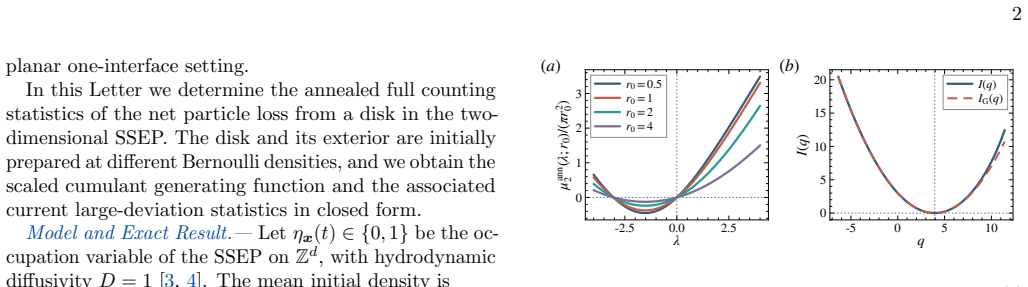
(b) Exact rate function I(q) at r0 = 2 compared with the Gaussian approximation IG(q) = (q−¯q)2/[2µ′′ 2 (0)], with ¯q= µ′ 2(0)
for r0 = 0.5, 1, 2, 4. (b) Exact rate function I(q) at r0 = 2 compared with the Gaussian approximation IG(q) = (q−¯q)2/[2µ′′ 2 (0)], with ¯q= µ′ 2(0). In current-density variables the dynamical MFT cost is Z 1 0 dt Z ddr |j+∇ρ| 2 4ρ(1−ρ) , ∂ tρ+∇·j= 0.(8) Its local integrand is jointly convex in ρ and j + ∇ρ, and F0 is convex. For 0 < ρ <1 the Hessian of ...
-
[2]
Spitzer, Adv
F. Spitzer, Adv. Math.5, 246 (1970)
1970
-
[3]
T. M. Liggett,Interacting Particle Systems(Springer, New York, 1985)
1985
-
[4]
Spohn,Large Scale Dynamics of Interacting Particles (Springer, Berlin, 1991)
H. Spohn,Large Scale Dynamics of Interacting Particles (Springer, Berlin, 1991)
1991
-
[5]
Kipnis and C
C. Kipnis and C. Landim,Scaling Limits of Interact- ing Particle Systems, Grundlehren der mathematischen Wissenschaften, Vol. 320 (Springer, Berlin, 1999)
1999
-
[6]
Dembo and O
A. Dembo and O. Zeitouni,Large Deviations Techniques and Applications, 2nd ed. (Springer, New York, 1998)
1998
-
[7]
M. I. Freidlin and A. D. Wentzell,Random Perturbations of Dynamical Systems, 3rd ed. (Springer, Berlin, 2012)
2012
Show all 101 references
-
[8]
Touchette, Phys
H. Touchette, Phys. Rep.478, 1 (2009)
2009
-
[9]
Gallavotti and E
G. Gallavotti and E. G. D. Cohen, Phys. Rev. Lett.74, 2694 (1995)
1995
-
[10]
J. L. Lebowitz and H. Spohn, J. Stat. Phys.95, 333 (1999)
1999
-
[11]
Bertini, A
L. Bertini, A. D. Sole, D. Gabrielli, G. Jona-Lasinio, and C. Landim, J. Stat. Phys.107, 635 (2002)
2002
-
[12]
Bertini, A
L. Bertini, A. D. Sole, D. Gabrielli, G. Jona-Lasinio, and C. Landim, Math. Phys. Anal. Geom.6, 231 (2003)
2003
-
[13]
Bertini, A
L. Bertini, A. D. Sole, D. Gabrielli, G. Jona-Lasinio, and C. Landim, Phys. Rev. Lett.94, 030601 (2005)
2005
-
[14]
Bertini, A
L. Bertini, A. D. Sole, D. Gabrielli, G. Jona-Lasinio, and C. Landim, J. Stat. Phys.123, 237 (2006)
2006
-
[15]
Bertini, D
L. Bertini, D. Gabrielli, and J. L. Lebowitz, J. Stat. Phys. 121, 843 (2005)
2005
-
[16]
Bertini, A
L. Bertini, A. D. Sole, D. Gabrielli, G. Jona-Lasinio, and C. Landim, Rev. Mod. Phys.87, 593 (2015)
2015
-
[17]
Derrida, J
B. Derrida, J. Stat. Mech. , P07023 (2007)
2007
-
[18]
Derrida, Lecture notes on large deviations in non- equilibrium diffusive systems (2025), arXiv:2505.15618 [math-ph]
B. Derrida, Lecture notes on large deviations in non- equilibrium diffusive systems (2025), arXiv:2505.15618 [math-ph]
2025
-
[19]
Bodineau and B
T. Bodineau and B. Derrida, J. Stat. Phys.192, 51 (2025)
2025
-
[20]
Bertini, D
L. Bertini, D. Gabrielli, and G. Jona-Lasinio, Macro- scopic fluctuation theory from a lagrangian viewpoint and the schr¨ odinger problem (2025), arXiv:2506.22085 [math.PR]
2025 arXiv
-
[21]
S. Saha, S. Jangid, T. A. de Pirey, J. U. Klamser, and T. Sadhu, A bottom-up approach to fluctuating hydrody- namics: Coarse-graining of stochastic lattice gases and the dean–kawasaki equation (2026), arXiv:2601.02319 [cond-mat.stat-mech]
2026
-
[22]
Onsager and S
L. Onsager and S. Machlup, Phys. Rev.91, 1505 (1953)
1953
-
[23]
Machlup and L
S. Machlup and L. Onsager, Phys. Rev.91, 1512 (1953)
1953
-
[24]
P. C. Martin, E. D. Siggia, and H. A. Rose, Phys. Rev. A8, 423 (1973)
1973
-
[25]
Kamenev,Field Theory of Non-Equilibrium Systems (Cambridge University Press, Cambridge, 2011)
A. Kamenev,Field Theory of Non-Equilibrium Systems (Cambridge University Press, Cambridge, 2011)
2011
-
[26]
Derrida, J
B. Derrida, J. L. Lebowitz, and E. R. Speer, J. Stat. Phys.107, 599 (2002)
2002
-
[27]
Derrida, J
B. Derrida, J. L. Lebowitz, and E. R. Speer, Phys. Rev. Lett.89, 030601 (2002)
2002
-
[28]
Derrida, J
B. Derrida, J. L. Lebowitz, and E. R. Speer, J. Stat. Phys.110, 775 (2003)
2003
-
[29]
Enaud and B
C. Enaud and B. Derrida, J. Stat. Phys.114, 537 (2004)
2004
-
[30]
Derrida, B
B. Derrida, B. Dou¸ cot, and P.-E. Roche, J. Stat. Phys. 115, 717 (2004)
2004
-
[31]
Bodineau and B
T. Bodineau and B. Derrida, Phys. Rev. Lett.92, 180601 6 (2004)
2004
-
[32]
Bodineau and B
T. Bodineau and B. Derrida, Phys. Rev. E72, 066110 (2005)
2005
-
[33]
Bodineau and B
T. Bodineau and B. Derrida, C. R. Physique8, 540 (2007)
2007
-
[34]
Lecomte, C
V. Lecomte, C. Appert-Rolland, and F. van Wijland, J. Stat. Phys.127, 51 (2007)
2007
-
[35]
Appert-Rolland, B
C. Appert-Rolland, B. Derrida, V. Lecomte, and F. van Wijland, Phys. Rev. E78, 021122 (2008)
2008
-
[36]
P. I. Hurtado and P. L. Garrido, Phys. Rev. Lett.102, 250601 (2009)
2009
-
[37]
P. I. Hurtado and P. L. Garrido, Phys. Rev. Lett.107, 180601 (2011)
2011
-
[38]
Tailleur, J
J. Tailleur, J. Kurchan, and V. Lecomte, J. Phys. A41, 505001 (2008)
2008
-
[39]
Gorissen and C
M. Gorissen and C. Vanderzande, Phys. Rev. E86, 051114 (2012)
2012
-
[40]
Akkermans, T
E. Akkermans, T. Bodineau, B. Derrida, and O. Shpiel- berg, EPL103, 20001 (2013)
2013
-
[41]
Derrida and A
B. Derrida and A. Gerschenfeld, J. Stat. Phys.136, 1 (2009)
2009
-
[42]
Derrida and A
B. Derrida and A. Gerschenfeld, J. Stat. Phys.137, 978 (2009)
2009
-
[43]
P. L. Krapivsky and B. Meerson, Phys. Rev. E86, 031106 (2012)
2012
-
[44]
Vilenkin, B
A. Vilenkin, B. Meerson, and P. V. Sasorov, J. Stat. Mech. , P06007 (2014)
2014
-
[45]
Meerson and P
B. Meerson and P. V. Sasorov, Phys. Rev. E89, 010101(R) (2014)
2014
-
[46]
Prolhac and K
S. Prolhac and K. Mallick, J. Phys. A: Math. Theor.41, 175002 (2008)
2008
-
[47]
C. A. Tracy and H. Widom, Commun. Math. Phys.279, 815 (2008)
2008
-
[48]
C. A. Tracy and H. Widom, Commun. Math. Phys.290, 129 (2009)
2009
-
[49]
Mallick, H
K. Mallick, H. Moriya, and T. Sasamoto, Phys. Rev. Lett.129, 040601 (2022)
2022
-
[50]
Mallick, H
K. Mallick, H. Moriya, and T. Sasamoto, J. Stat. Mech. 2024, 074001 (2024)
2024
-
[51]
Dandekar, P
R. Dandekar, P. L. Krapivsky, and K. Mallick, Phys. Rev. E110, 064153 (2024)
2024
-
[52]
Berlioz, O
T. Berlioz, O. B´ enichou, and A. Grabsch, Phys. Rev. Lett.134, 247101 (2025)
2025
-
[53]
Berlioz, O
T. Berlioz, O. B´ enichou, and A. Grabsch, J. Stat. Mech. 2026, 063205 (2026)
2026
-
[54]
Suzuki and T
D. Suzuki and T. Sasamoto, Non-stationary current fluctuations in 1d boundary-driven diffusive systems via macroscopic fluctuation theory (2026), arXiv:2605.27275 [cond-mat.stat-mech]
2026 arXiv
-
[55]
Jangid, S
S. Jangid, S. Saha, K. Sharma, J. Kethepalli, B. Guiselin, J. D. Nardis, and T. Sadhu, An exactly solvable macro- scopic fluctuation theory of single-file diffusion (2026), arXiv:2607.14073 [cond-mat.stat-mech]
2026 arXiv
-
[56]
Arratia, Ann
R. Arratia, Ann. Probab.11, 362 (1983)
1983
-
[57]
A. D. Masi and P. A. Ferrari, J. Stat. Phys.107, 677 (2002)
2002
-
[58]
Vandenberg-Rodes, Electron
A. Vandenberg-Rodes, Electron. Commun. Probab.15, 240 (2010)
2010
-
[59]
Sethuraman and S
S. Sethuraman and S. R. S. Varadhan, Ann. Probab.41, 1461 (2013)
2013
-
[60]
P. L. Krapivsky, K. Mallick, and T. Sadhu, Phys. Rev. Lett.113, 078101 (2014)
2014
-
[61]
P. L. Krapivsky, K. Mallick, and T. Sadhu, J. Stat. Phys. 160, 885 (2015)
2015
-
[62]
P. L. Krapivsky, K. Mallick, and T. Sadhu, J. Stat. Mech. , P09007 (2015)
2015
-
[63]
Sadhu and B
T. Sadhu and B. Derrida, J. Stat. Mech. , P09008 (2015)
2015
-
[64]
Imamura, K
T. Imamura, K. Mallick, and T. Sasamoto, Commun. Math. Phys.384, 1409 (2021)
2021
-
[65]
Grabsch, A
A. Grabsch, A. Poncet, P. Rizkallah, P. Illien, and O. B´ enichou, Sci. Adv.8, eabm5043 (2022)
2022
-
[66]
Xue and L
X. Xue and L. Zhao, Stochastic Process. Appl.167, 104218 (2024)
2024
-
[67]
Grabsch, D
A. Grabsch, D. Venturelli, and O. B´ enichou, Phys. Rev. Lett.135, 137102 (2025)
2025
-
[68]
Grabsch, D
A. Grabsch, D. Venturelli, and O. B´ enichou, Phys. Rev. E113, 054128 (2026)
2026
-
[69]
P. I. Hurtado, Optimal paths and dynamical symmetry breaking in the current fluctuations of driven diffusive media (2025), arXiv:2501.09629 [cond-mat.stat-mech]
2025 arXiv
-
[70]
Schorlepp and O
T. Schorlepp and O. Shpielberg, Phys. Rev. E111, 064113 (2025)
2025
-
[71]
Yoshimura and ˇZ
T. Yoshimura and ˇZ. Krajnik, Phys. Rev. E111, 024141 (2025)
2025
-
[72]
Yoshimura and ˇZ
T. Yoshimura and ˇZ. Krajnik, Phys. Rev. E113, 064120 (2026)
2026
-
[73]
Albert, D
M. Albert, D. Bernard, T. Jin, S. Scopa, and S. Wei, Universal classical and quantum fluctuations in the large deviations of current of noisy quantum systems: The case of QSSEP and QSSIP (2026), arXiv:2601.16883 [cond-mat.stat-mech]
2026
-
[74]
Berlioz, D
T. Berlioz, D. Venturelli, A. Grabsch, and O. B´ enichou, J. Stat. Mech.2024, 113208 (2024)
2024
-
[75]
Gabrielli and R
D. Gabrielli and R. J. Harris, Ann. Henri Poincar´ e 10.1007/s00023-025-01582-y (2025), arXiv:2409.01337
2025
-
[76]
Meerson, A
B. Meerson, A. Vilenkin, and P. L. Krapivsky, Phys. Rev. E90, 022120 (2014)
2014
-
[77]
Meerson, J
B. Meerson, J. Stat. Mech. , P04009 (2015)
2015
-
[78]
Agranov and B
T. Agranov and B. Meerson, Phys. Rev. E95, 062124 (2017)
2017
-
[79]
P. C. Bressloff, J. Phys. A: Math. Theor.58, 505001 (2025)
2025
-
[80]
Grabsch, H
A. Grabsch, H. Moriya, K. Mallick, T. Sasamoto, and O. B´ enichou, Phys. Rev. Lett.133, 117102 (2024)
2024
-
[81]
Sharma, S
K. Sharma, S. Saha, S. Jangid, and T. Sadhu, Phys. Rev. E113, L052101 (2026)
2026
-
[82]
Saha and T
S. Saha and T. Sadhu, Large deviations of density in the non-equilibrium steady state of boundary-driven dif- fusive systems (2025), arXiv:2501.03164 [cond-mat.stat- mech]
2025
-
[84]
(2026), see Supplemental Material
2026
-
[85]
Lakshmanan, Phys
M. Lakshmanan, Phys. Lett. A61, 53 (1977)
1977
-
[86]
L. A. Takhtajan, Phys. Lett. A64, 235 (1977)
1977
-
[87]
Lakshmanan and K
M. Lakshmanan and K. Porsezian, Phys. Lett. A146, 329 (1990)
1990
-
[88]
Porsezian and M
K. Porsezian and M. Lakshmanan, J. Math. Phys.32, 2923 (1991)
1991
-
[89]
Kipnis, C
C. Kipnis, C. Marchioro, and E. Presutti, J. Stat. Phys. 27, 65 (1982)
1982
-
[90]
Bettelheim, N
E. Bettelheim, N. R. Smith, and B. Meerson, Phys. Rev. Lett.128, 130602 (2022)
2022
-
[91]
Bettelheim, N
E. Bettelheim, N. R. Smith, and B. Meerson, J. Stat. Mech.2022, 093103 (2022)
2022
-
[92]
Bettelheim and B
E. Bettelheim and B. Meerson, Phys. Rev. E110, 014101 (2024)
2024
-
[93]
Krajenbrink and P
A. Krajenbrink and P. L. Doussal, Phys. Rev. Lett.127, 7 064101 (2021)
2021
-
[94]
Krajenbrink and P
A. Krajenbrink and P. L. Doussal, Phys. Rev. E105, 054142 (2022)
2022
-
[95]
Krajenbrink and P
A. Krajenbrink and P. L. Doussal, Phys. Rev. E107, 014137 (2023)
2023
-
[96]
Janas, A
M. Janas, A. Kamenev, and B. Meerson, Phys. Rev. E 94, 032133 (2016)
2016
-
[97]
Tsai, Trans
L.-C. Tsai, Trans. Am. Math. Soc.376, 6521 (2023)
2023
-
[98]
Schorlepp, P
T. Schorlepp, P. Sasorov, and B. Meerson, J. Stat. Mech. 2023, 123202 (2023)
2023
-
[99]
Bettelheim, J
E. Bettelheim, J. Phys. A57, 035201 (2024)
2024
-
[100]
Cantini, An integrable approach to macroscopic fluctuation theory for the multispecies SSEP (2026), arXiv:2606.27186 [cond-mat.stat-mech]
L. Cantini, An integrable approach to macroscopic fluctuation theory for the multispecies SSEP (2026), arXiv:2606.27186 [cond-mat.stat-mech]
2026 arXiv
-
[101]
Borcea, P
J. Borcea, P. Br¨ and´ en, and T. M. Liggett, J. Am. Math. Soc.22, 521 (2009)
2009
Reviewed August 14, 2026 · model on record in the stance chip above.
Discussion (0). Continue with ORCID to comment.