REVIEW 4 major objections 6 minor 12 references
Loss-Resilient Wireless Video Token Communication over Block Fading Channels
T0 review · 4 major / 6 minor · reviewed 2026-08-14 · deepseek-v4-flash
Pith's one-line read Token video survives fading without retransmission
desk verdict Serious video-TokenCom system paper with a genuinely new packetization/scheduler design, but its erasure-trained receiver is tested on correlated block-fading losses and the missing TokenCom baselines make the empirical claim unproven. read the letter →
The pith
A machine-rendered reading of the paper's core claim, the machinery that carries it, and where it could break.
The reading
What carries the argument
The central object is the token importance map plus the packetizer-scheduler-detokenizer pipeline built on it. I-tokens, which anchor structure, are given top importance; P-token importance is measured as temporal neighborhood novelty, a weighted cosine similarity between each token and a 3x3 neighborhood in the preceding token group. The packetizer mixes a cyclic-strided traversal of I-tokens with a pseudorandom round-robin of P-tokens so that structural anchors and correlated temporal regions are spread across packets using only a shared seed. The online scheduler greedily selects packets by importance density times a sigmoid-mapped decoding reliability, minus a penalty for concentrating important packets in the same fading block, using current-block CSI alone. At the receiver, a detokenizer fine-tuned on whole-packet erasures fills zeroed token positions from surrounding context, and a super-resolution network restores the final frames.
What would settle it
Measure LPIPS at the same average packet error rate under two loss patterns: i.i.d. random packet erasures and block-fading erasures where an entire fading block is lost at once. If WVTC's LPIPS under block-fading erasures is substantially worse than under i.i.d. erasures at the same PER, then the erasure-aware detokenizer has not generalized to correlated losses, and the reported graceful degradation is an artifact of the training-mask distribution.
Extended reading notes
Core claim
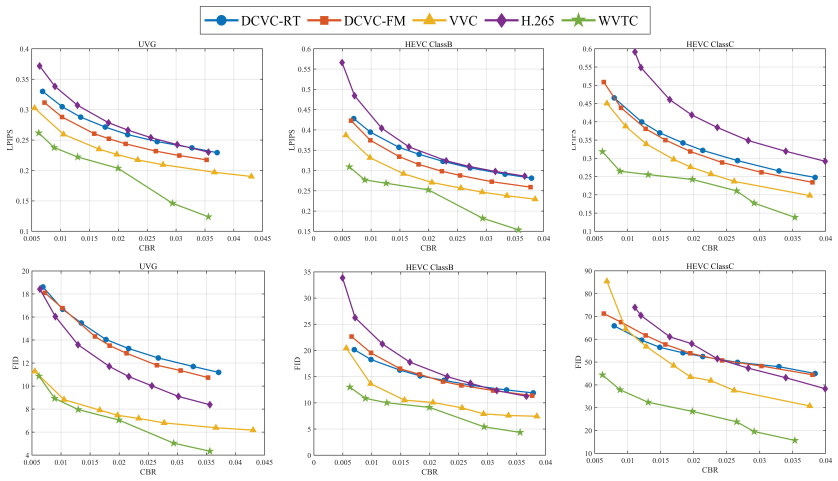
On its own terms, the paper's central claim is that importance-aware shuffled packetization plus online channel-aware packet scheduling plus an erasure-aware detokenizer jointly make token-based video transmission perceptually better and more loss-resilient than both learned and conventional video codecs at comparable channel bandwidth ratios. Numerically, WVTC reaches the lowest or near-lowest LPIPS and FID across most operating points and exhibits more graceful perceptual degradation as packet error rate increases, because important and temporally correlated tokens are dispersed rather than clustered, and important packets are steered away from unreliable fading blocks. The reconstruction is done from surviving tokens alone, with no retransmission.
Load-bearing premise
The receiver-side detokenizer is trained on independent, random whole-packet erasures with a fixed masking ratio, but in the tested channel a deep fade erases all packets scheduled in a fading block together; the claim relies on the detokenizer generalizing to those correlated, block-level loss patterns.
Editorial extensions
If this is right
- WVTC operates without retransmission, so end-to-end latency stays bounded while packet losses occur; this suits real-time wireless video.
- Because packetization and scheduling require no extra position signaling or textual prompts, the gains come without sending side information beyond the packet ID and CRC.
- The learned codec baselines suffer increasingly severe error propagation as reference information is lost, while WVTC's perceptual quality falls off more slowly with packet error rate.
- Increasing channel bandwidth ratio improves WVTC most in medium- to high-rate regions, where more informative packets can be delivered and dispersed.
Reading between the lines
- The same importance metric could be repurposed for content-aware bitrate selection or adaptive modulation choices per packet, not just packet scheduling.
- Fine-tuning the detokenizer on block-fading-correlated erasure masks, where an entire fading block is erased at once, would likely close the train-test mismatch and could make the reported gains hold at higher packet error rates.
- The shuffled mixed-token packetization idea transfers to other tokenized media where a few structural tokens anchor many detail tokens, such as images or point clouds.
- In multi-user or broadcast settings, the scheduler might prioritize packets carrying shared structural tokens across users, improving group reconstruction efficiency.
Editorial analysis
A structured set of objections, weighed in public.
Referee Report
Summary. The paper proposes a loss-resilient wireless video token communication (WVTC) framework for block fading channels. It combines content-intrinsic token importance scoring, a shuffled mixed I/P-token packetization scheme, and an online CSI-aware packet scheduler to disperse important and correlated tokens across packets and fading blocks. At the receiver, a fine-tuned erasure-aware detokenizer reconstructs the video from surviving tokens without retransmission. The authors report improvements in LPIPS and FID over DCVC-RT, DCVC-FM, VVC, and H.265 across channel bandwidth ratios, and claim more graceful perceptual degradation as the packet error rate increases.
Significance. If the results hold, WVTC offers a practical no-retransmission design for robust video transmission over block fading channels, leveraging the structure of learned discrete video tokens. The problem is well motivated and the proposed components—importance scoring via temporal novelty, packetization to disperse structural and temporal information, and CSI-aware scheduling with an importance-concentration penalty—are novel and technically coherent. The paper also makes a useful contribution by fine-tuning a pretrained VidTok detokenizer to reconstruct from erased token tensors. However, the central performance claims currently rest on thin evidence: single point estimates, a training/evaluation distribution mismatch, and an ambiguous zero-fill sentinel. Strengths of the manuscript include its clear system model and the plausible mechanism for graceful degradation; the main weaknesses are in the empirical validation and one reconstruction-ambiguity issue.
major comments (4)
- [Section IV and Section V-B, Fig. 4] The erasure-aware detokenizer is fine-tuned under i.i.d. whole-packet erasures with masking ratio rm ~ U(0, 0.2), but the test channel is block fading, which produces correlated erasures of all packets within a fading block, and the PER axis in Fig. 4 extends to 0.30, beyond the training range. The claim of more graceful degradation in Section V-B therefore depends on the unverified assumption that the detokenizer generalizes to block-correlated loss patterns. Please provide either block-correlated fine-tuning, an ablation with block-correlated erasures, or error bars over channel realizations to support this central claim.
- [Section II-C and Section IV] The receiver fills erased token positions with zeros and provides no explicit mask to the detokenizer. Since the FSQ codebook has cardinality |K| = 4096 and typically contains the index 0 as a valid token, the zero-fill sentinel may collide with a legitimate token value; the detokenizer would then be unable to distinguish an erased position from a genuine token 0. The paper does not specify the token index range or otherwise address this ambiguity. Please clarify that 0 is not in the codebook, or introduce a dedicated out-of-codebook mask token.
- [Section V-B, Figs. 3 and 4] The performance comparisons are single point estimates with no error bars, no repeated seeds, and no confidence intervals, despite the stochastic channel model and random masking during training. The statements that WVTC achieves the 'lowest or near-lowest' LPIPS/FID and exhibits 'more graceful perceptual degradation' are not supported with statistical evidence. Report means and variances over multiple independent runs and channel realizations, and release the code and evaluation protocol for reproducibility.
- [Section III-A and Section V-A] The importance score (Eq. 8) and the scheduler (Eq. 14) depend on hand-set constants alpha_1, alpha, M, kappa, beta, lambda_h, w_adv, and Q. No sensitivity analysis or ablation is provided to show that the reported gains are robust to these choices. At minimum, vary lambda_h and M and report the resulting changes in Fig. 3 and Fig. 4, so that the reader can assess the sensitivity of the claimed improvements to these hyperparameters.
minor comments (6)
- [Author list] Several author names contain stray spaces ('Y ongjeong Oh', 'Y ongpeng Wu'); please fix these typographical issues.
- [Fig. 1] Figure 1 appears to contain raw integer text ('31 9 14 45 ...') that looks like a rendering artifact; please check and replace with a properly rendered schematic.
- [Section V-A] The text states 'average gamma_b = 8 dB', but gamma_b is defined in Eq. (3) as the instantaneous SNR. Please clarify that the average is E[gamma_b] or phrase it as 'average SNR of 8 dB'.
- [Section V-A] The number of Monte Carlo channel realizations used in Figs. 3 and 4 is not specified; please add this to the experimental setup.
- [Fig. 4] Figure 4 reports only LPIPS under PER, while the abstract and conclusion claim improvements in perceptual quality more broadly. Consider also plotting FID under PER to match the stated claims.
- [References] The UVG and HEVC dataset sources are not cited; please add the appropriate references for reproducibility.
Circularity Check
No significant circularity: WVTC's performance claims are empirical comparisons against external baselines, with no fitted parameter renamed as prediction and no load-bearing self-citations.
full rationale
The paper's central claims—improved perceptual quality and more graceful degradation under increasing PER—are supported by direct comparison against external codecs (DCVC-RT, DCVC-FM, VVC, H.265) on unseen test datasets (UVG, HEVC ClassB/ClassC). The token-importance metric, shuffled packetization, and CSI-aware scheduler are presented as heuristic designs with explicitly stated hand-set constants, not as derived predictions, so no equation reduces to its own input. The receiver detokenizer is fine-tuned on Vimeo-90K under random packet erasures and then evaluated under block-fading losses; this is a standard train/eval separation, and any generalization gap between i.i.d. training erasures and correlated block-fading losses is a correctness or robustness risk, not circularity. No load-bearing step cites prior work by the same authors, no uniqueness theorem is imported, and no fitted parameter is relabeled as a prediction. The absence of self-citation or constructional equivalence warrants a score of 0.
Assumptions & free parameters
free parameters (9)
- alpha_1 =
0.9
- alpha =
0.75
- M =
5
- kappa =
32
- beta =
2
- lambda_h =
2
- w_adv =
0.02
- Q =
390
- rm =
U(0, 0.2)
assumptions (5)
- domain assumption Block fading with independent Rayleigh coefficients per block and perfect current CSI at the transmitter (Eqs. 2-3)
- domain assumption Offline 3GPP TS 38.214 MCS table and Rayleigh BLER lookup table are accurate for all packet lengths and MCS indices (Sec. V-A2)
- ad hoc to paper Pre-FSQ tokenizer embeddings E are available and cosine similarity over a 3x3 neighborhood measures temporal reconstruction importance (Eqs. 6-8)
- domain assumption The fine-tuned detokenizer can reconstruct missing content from zero-filled token tensors without an explicit mask (Sec. II-C)
- domain assumption Training under i.i.d. random packet erasure with masking ratio up to 0.2 is representative of block-fading-caused packet loss (Sec. IV)
Cite this review
Pith. "Pith review of Loss-Resilient Wireless Video Token Communication over Block Fading Channels." pith.science (2026). https://pith.science/paper/74IQD3QX
@misc{pith2026260808698,
  author       = {Pith},
  title        = {Pith review of: Loss-Resilient Wireless Video Token Communication over Block Fading Channels},
  year         = {2026},
  howpublished = {\url{https://pith.science/paper/74IQD3QX}},
  note         = {Machine review of arXiv:2608.08698}
}
read the original abstract
Video token communication represents video content as discrete tokens that differ in their importance to reconstruction and exhibit temporal dependencies. When these tokens are packetized for wireless transmission, block fading can cause multiple important or correlated tokens to be lost together, severely degrading video reconstruction. To address this issue, we propose a loss-resilient wireless video token communication (WVTC) framework. WVTC evaluates token importance from the intrinsic predictive structure of video tokens, assigning high priority to structural I-tokens and measuring P-token importance by temporal neighborhood novelty. A shuffled mixed I/P-token packetization scheme disperses structural anchors and correlated temporal regions across packets. Using only current block channel state information, an online scheduler jointly considers packet importance density, MCS-dependent decoding reliability, block capacity, and importance concentration when allocating packets to fading blocks. At the receiver, a fine-tuned detokenizer reconstructs missing content from surviving tokens without retransmission. Numerical results demonstrate improved perceptual quality and more graceful degradation under increasing packet error rates.
Figures


Figures from the paper (1 more)

Reference graph
Works this paper leans on
-
[1]
L. Qiao, et al., “Token communications: A large model-dr iven frame- work for cross-modal context-aware semantic communicatio ns,” IEEE Wireless Commun., vol. 32, no. 5, pp. 80-88, 2025
work page 2025
-
[2]
ToDMA: Large model-driven token-domai n multiple access for semantic communications,
L. Qiao, et al., “ToDMA: Large model-driven token-domai n multiple access for semantic communications,” Jul. 2026. [Online]. Available: https://arxiv.org/abs/2505.10946
arXiv 2026
-
[3]
Morphe: High-Fidelity Generative Vide o Streaming with Vision Foundation Model,
T. Gong, et al., “Morphe: High-Fidelity Generative Vide o Streaming with Vision Foundation Model,” Feb. 2026. [Online]. Availa ble: https: //arxiv.org/abs/2602.03529
-
[4]
J. Men, et al., “Video TokenCom: Textual intent-guided m ulti-rate video token communications with UEP-based adaptive source-chan nel cod- ing,” Mar. 2026. [Online]. Available: https://arxiv.org/ abs/2603.02470
arXiv 2026
-
[5]
VidTok: A versatile and open-source vid eo tokenizer,
A. Tang, et al., “VidTok: A versatile and open-source vid eo tokenizer,” Dec. 2024. [Online]. Available: https://arxiv.org/abs/2 412.13061
work page 2024
-
[6]
Swinir: Image restorati on using swin transformer,
J. Liang, J. Cao, G. Sun, et al., “Swinir: Image restorati on using swin transformer,” in Proc. IEEE/CVF Int. Conf. Comput. Vis. W orkshops (ICCVW). pp. 1833-1844, Oct. 2021
work page 2021
-
[7]
Video enh ance- ment with task-oriented flow,
T. Xue, B. Chen, J. Wu, D. Wei, and W. T. Freeman, “Video enh ance- ment with task-oriented flow,” Int. J. Comput. Vis. , vol. 127, no. 8, pp. 1106–1125, Feb. 2019
work page 2019
-
[8]
Deep joint source- channel coding for wireless image transmission,
E. Bourtsoulatze, D. Burth Kurka, and D. G¨ und¨ uz, “Deep joint source- channel coding for wireless image transmission,” IEEE Trans. Cogn. Commun. Netw., vol. 5, no. 3, pp. 567–579, Sep. 2019
2019
Show all 12 references
-
[9]
Towards practical real-time neural video compression,
Z. Jia, B. Li, J. Li, et al., “Towards practical real-time neural video compression,” in Proc. IEEE Conf. Comput. Vis. Pattern Recognit. (CVPR), Nashville, TN, USA, pp. 12543-12552, Jun. 2025
2025
-
[10]
Neural video compression with featu re modulation,
J. Li, B. Li, Y . Lu, “Neural video compression with featu re modulation,” in Proc. IEEE Conf. Comput. Vis. Pattern Recognit. (CVPR) , Seattle, W A, USA, pp. 26099-26108, Jun. 2024
2024
-
[11]
Overview of the versatile video codin g (VVC) standard and its applications,
B. Bross, et al., “Overview of the versatile video codin g (VVC) standard and its applications,” IEEE Trans. Circuits Syst. Video Technol., vol. 31, no. 10, pp. 3736-3764, Oct. 2021
2021
-
[12]
Sionna: An open-source library for n ext-generation physical layer research,
J. Hoydis, et al., “Sionna: An open-source library for n ext-generation physical layer research,” Mar. 2022. [Online]. Available: https://arxiv. org/abs/2203.11854
2022 arXiv
Reviewed August 14, 2026 · model on record in the stance chip above.
Discussion (0). Continue with ORCID to comment.