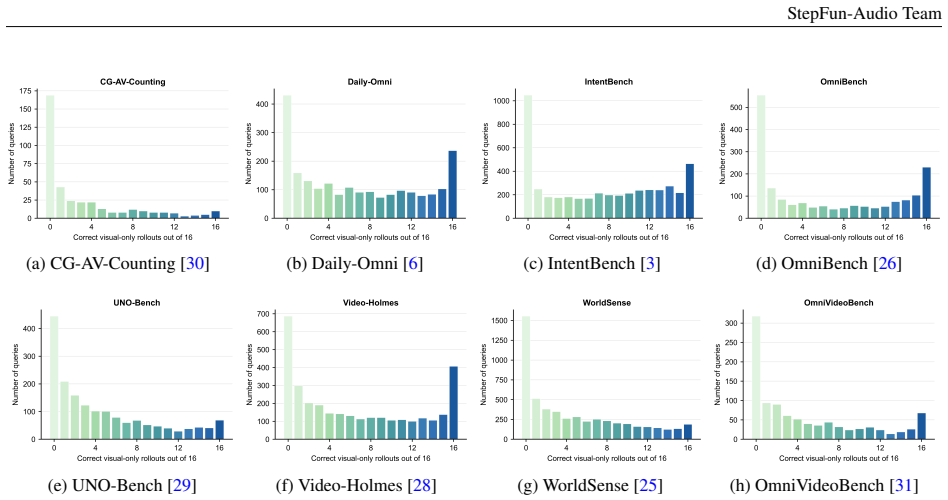
Omni-modal language models are intended to jointly understand audio, visual inputs, and language, but benchmark gains can be inflated when visual evidence alone is enough to answer a query. We study whether current omni-modal benchmarks separate visual shortcuts from genuine audio-visual-language evidence integration, and how post-training behaves under a visually debiased evaluation setting. We audit nine omni-modal benchmarks with visual-only probing, remove visually solvable queries, and retain full subsets when filtering is undefined or would make comparisons unstable. This yields OmniClean, a cleaned evaluation view with 8,551 retained queries from 16,968 audited queries. On OmniClean, we evaluate OmniBoost, a three-stage post-training recipe based on Qwen2.5-Omni-3B: mixed bi-modal SFT, mixed-modality RLVR, and SFT on self-distilled data. Balanced bi-modal SFT gives limited and uneven gains, RLVR provides the first broad improvement, and self-distillation reshapes the benchmark profile. After SFT on self-distilled data, the 3B model reaches performance comparable to, and in aggregate slightly above, Qwen3-Omni-30B-A3B-Instruct without using a stronger omni-modal teacher. These results show that omni-modal progress is easier to interpret when evaluation controls visual leakage, and that small omni-modal models can benefit from staged post-training with self-distilled omni-query supervision.
Unified multimodal models (UMMs) aim to integrate understanding and generation within a single architecture. However, it remains underexplored how to effectively coordinate these two capabilities for more effective and efficient reasoning. Existing coordination approaches either perform coupling during training, without explicit inference-time coordination, or impose a fixed coordination pattern for all inputs. In this work, we show that multimodal tasks exhibit substantial coordination-path diversity: different inputs favor different coordination paths. This suggests that exploiting such diversity is key to improving performance. We propose UniPath, a framework for adaptively modeling and exploiting coordination-path diversity. Instead of enforcing a single coordination pattern, we represent task solving as the selection and execution of a path, ranging from direct answering to textual inference, visual-thought construction, and hypothesis-based exploration. We construct role-aligned trajectories to train a path-conditioned executor and introduce a lightweight planner mechanism to enable input-dependent path selection. Experiments show that leveraging coordination-path diversity improves performance over fixed coordination strategies while providing interpretable intermediate behaviors. The code is available at:https://github.com/AIFrontierLab/TorchUMM/tree/main/src/umm/post_training/unipath.
Large Vision-Language Models (LVLMs) have achieved remarkable progress in multimodal tasks, yet their reliability is persistently undermined by hallucinations-generating text that contradicts visual input. Recent studies often attribute these errors to inadequate visual attention. In this work, we analyze the attention mechanisms via the logit lens, uncovering a distinct anomaly we term Vocabulary Hijacking. We discover that specific visual tokens, defined as Inert Tokens, disproportionately attract attention. Crucially, when their intermediate hidden states are projected into the vocabulary space, they consistently decode to a fixed set of unrelated words (termed Hijacking Anchors) across layers, revealing a rigid semantic collapse. Leveraging this semantic rigidity, we propose Hijacking Anchor-Based Identification (HABI), a robust strategy to accurately localize these Inert Tokens. To quantify the impact of this phenomenon, we introduce the Non-Hijacked Visual Attention Ratio (NHAR), a novel metric designed to identify attention heads that remain resilient to hijacking and are critical for factual accuracy. Building on these insights, we propose Hijacking-Aware Visual Attention Enhancement (HAVAE), a training-free intervention that selectively strengthens the focus of these identified heads on salient visual content. Extensive experiments across multiple benchmarks demonstrate that HAVAE significantly mitigates hallucinations with no additional computational overhead, while preserving the model's general capabilities. Our code is publicly available at https://github.com/lab-klc/HAVAE.
Multimodal misinformation increasingly leverages visual persuasion, where repurposed or manipulated images strengthen misleading text. We introduce \textbf{RW-Post}, a post-aligned \textbf{text--image benchmark} for real-world multimodal fact-checking with \emph{auditable} annotations: each instance links the original social-media post with reasoning traces and explicitly linked evidence items derived from human fact-check articles via an LLM-assisted extraction-and-auditing pipeline. RW-Post supports controlled evaluation across closed-book, evidence-bounded, and open-web regimes, enabling systematic diagnosis of visual grounding and evidence utilization. We provide \textbf{AgentFact} as a reference verification baseline and benchmark strong open-source LVLMs under unified protocols. Experiments show substantial headroom: current models struggle with faithful evidence grounding, while evidence-bounded evaluation improves both accuracy and faithfulness. Code and dataset will be released at https://github.com/xudanni0927/AgentFact.
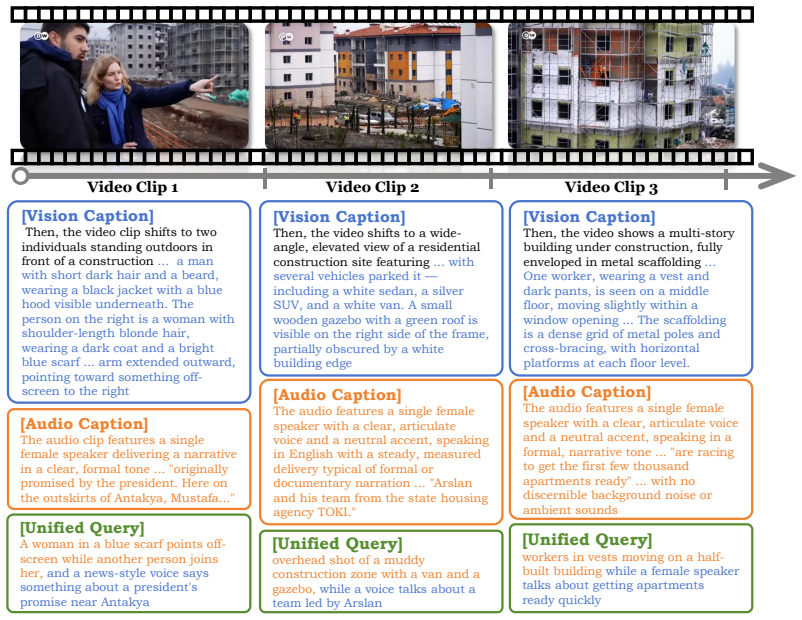
As video becomes increasingly central to information dissemination and multimodal large language models (MLLMs) continue to advance, evaluating video retrieval has become increasingly important. In realistic search scenarios, this requires matching short user queries to long-form content using both visual and auditory evidence. Yet existing retrieval benchmarks are still dominated by short clips, single modalities, and caption-based evaluation. We introduce FLARE, a full-modality long-video audiovisual retrieval benchmark with user-simulated queries. Built from 399 carefully screened Video-MME videos (10--60 min, 225.4 h) to ensure source quality and diversity, FLARE contains 87,697 clips annotated with vision, audio, and unified audiovisual captions, together with 274,933 user-style queries. Cross-modal queries are further filtered by a hard bimodal constraint, requiring retrieval to fail under either modality alone but succeed when both are combined. FLARE evaluates models under two regimes, caption-based and query-based retrieval, across vision, audio, and unified audiovisual settings. Experiments with 15 representative retrievers show that user-style queries substantially change model behavior, strong caption-based performance does not always transfer to query-based retrieval, and audio--language alignment remains a key bottleneck for unified audiovisual retrieval. Our code and data are released at https://flarebench.github.io/
Multimodal Intent Recognition (MIR) aims to understand complex user intentions by leveraging text, video, and audio signals. However, existing approaches face two key challenges: (1) overlooking intricate cross-modal interactions for distinguishing consistent and inconsistent cues, and (2) ineffectively modeling multimodal conflicts, leading to semantic cancellation. To address these, we propose a novel Cognitive Dual-Pathway Reasoning (CDPR) framework, which constructs a stable semantic foundation via the intuition pathway and mitigates high-level semantic conflicts through the reasoning pathway, cooperatively establishing deep semantic relations. Specifically, we first employ a representation disentanglement strategy to extract modality-invariant and specific features. Subsequently, the intuition pathway aggregates cross-modal consensus using shared features for solid global representations. The reasoning pathway introduces an inconsistency perception mechanism, combining semantic prototype matching with statistical probability calibration to precisely quantify conflict severity, and dynamically adjusting the weights between both pathways. Furthermore, a multi-view loss function is adopted to alleviate modality laziness and learn structured features at different stages. Extensive experiments on two benchmarks show that CDPR achieves SOTA performance and superior robustness in mitigating multimodal inconsistency. The code is available at https://github.com/Hebust-NLP/CDPR.
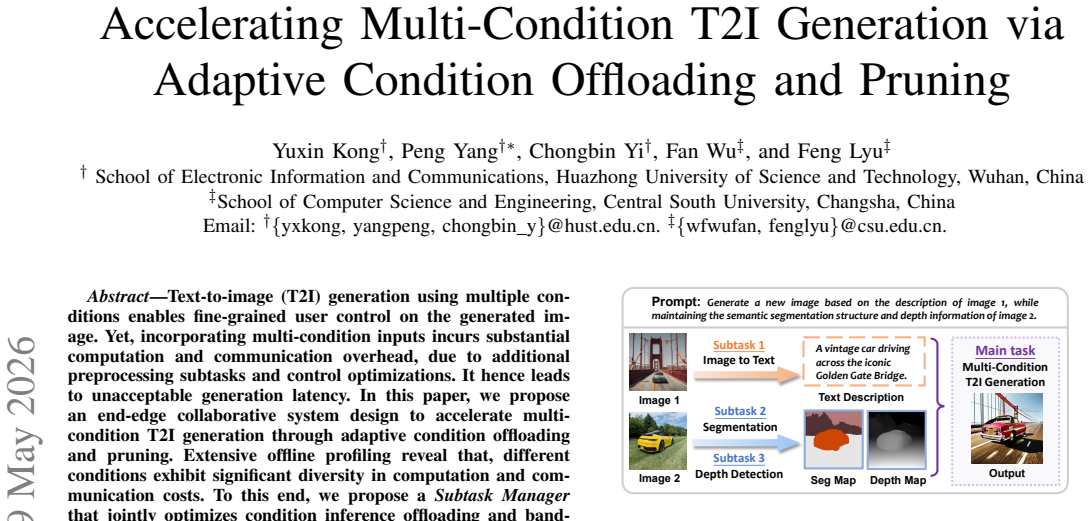
Text-to-image (T2I) generation using multiple conditions enables fine-grained user control on the generated image. Yet, incorporating multi-condition inputs incurs substantial computation and communication overhead, due to additional preprocessing subtasks and control optimizations. It hence leads to unacceptable generation latency. In this paper, we propose an end-edge collaborative system design to accelerate multi-condition T2I generation through adaptive condition offloading and pruning. Extensive offline profiling reveal that, different conditions exhibit significant diversity in computation and communication costs. To this end, we propose a \textit{Subtask Manager} that jointly optimizes condition inference offloading and bandwidth allocation using a heuristic algorithm, balancing local and edge execution delays to minimize overall preprocessing latency. Then, we design a lightweight feature-driven \textit{Conditioning Scale Estimator} that evaluates the contribution of each condition by analyzing its feature activation strength and overlap with other conditions. This allows adaptive conditioning scale selection and pruning of insignificant conditions, thereby accelerating the denoising process. Extensive experimental results show that our system reduces latency by nearly 25\% and improves 6\% average generation quality, outperforming other benchmarks.
Dominant semantic geometry is already shared across modalities; residuals in few directions can be bounded-corrected to the target.
abstractclick to expand
Training multimodal large language models has long been limited by the scarcity of high-quality paired multimodal data. Recent studies show that the shared representation space of pretrained multimodal contrastive models can serve as a bridge, enabling models to perform multimodal training with unimodal data. However, the key premise of this paradigm remains insufficiently understood: can representations from different modalities be reliably interchanged? The core obstacle lies in the persistent Modality Gap in the shared space. In this work, we revisit the geometric nature of the modality gap. We find that modality representations already share compatible dominant semantic geometry. What truly hinders modality interchangeability is not a simple global shift, but an anisotropic residual structure concentrated along a small number of dominant directions. Based on this finding, we further propose the principle of anisotropic modality gap alignment: effective modality alignment should align with the target-modality distribution while preserving the semantic structure of the source modality. Guided by this principle, we propose an anisotropic geometric correction framework, AnisoAlign, for unpaired modality alignment. This framework leverages the internal geometric prior of the target modality and performs bounded correction on source-modality representations, thereby constructing substitute representations in the target modality. Experiments confirm its benefits in both geometric diagnostics and text-only MLLM training. Overall, this work recasts the modality gap from an empirical observation into a correctable, structured geometric phenomenon and provides a new representation alignment perspective for training multimodal models with unimodal data.
Terminals provide a powerful interface for AI agents by exposing diverse tools for automating complex workflows, yet existing terminal-agent benchmarks largely focus on tasks grounded in text, code, and structured files. However, many real-world workflows require practitioners to work directly with audio and video files. Working with such multimedia files calls for terminal agents not only to understand multimedia content, but also to convert auditory and visual evidence across related files into appropriate actions. To evaluate terminal agents on multimedia-file tasks, we introduce MultiMedia-TerminalBench (MMTB), a benchmark of 105 tasks across 5 meta-categories where terminal agents directly operate with audio and video files. Alongside MMTB, we propose Terminus-MM, a multimedia harness that extends Terminus-KIRA with audio and video perception for terminal agents. Together, MMTB and Terminus-MM support a controlled study of multimedia terminal agents, revealing how different forms of multimedia access shape task outcomes and determine which evidence agents rely on to construct executable terminal workflows. MMTB media and metadata are released at https://huggingface.co/datasets/mm-tbench/mmtb-media
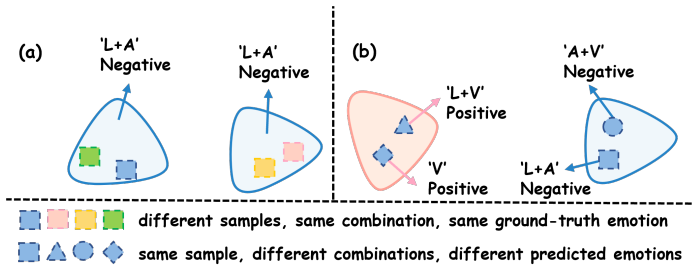
Multimodal Emotion Recognition (MER) has attracted growing attention with the rapid advancement of human-computer interaction. However, different modalities exhibit substantial discrepancies in semantics, quality, and availability, leading to highly heterogeneous modality combinations and posing significant challenges to achieving consistent and reliable emotion understanding. To address this challenge, we propose the Modality-Aware Contrastive and Uncertainty-Regularized (MCUR) framework, which approaches MER from the perspective of representation consistency, aiming to enable robust emotion prediction across heterogeneous modality combinations. MCUR incorporates two core components: (1) Modality Combination-Based and Category-Based Contrastive Learning mechanism (MCB-CL), which encourages samples with the same emotion category and the same available modalities to be close in the representation space; and (2) Sample-wise Uncertainty-Guided Regularization (SUGR), which adaptively assigns sample-wise uncertain weights to samples to optimize training. Extensive experiments demonstrate that MCUR consistently outperforms existing methods, achieving average F1 gains of 2.2% on MOSI, 2.67% on MOSEI, and 4.37% on IEMOCAP.
Multimodal emotion recognition (MER) benefits from combining text, audio, and vision, yet standard fusion often fails when modalities conflict. Crucially, conflicts differ in resolvability: benign conflicts stem from missing, weak, or ambiguous cues and can be mitigated by cross-modal calibration, while severe conflicts arise from intrinsically contradictory (e.g., sarcasm) or misleading signals, for which forced fusion may amplify errors. Recognizing this, we propose Dual-Path Conflict Resolution (DCR), a unified framework that learns when to fuse and when to drop modalities. Path I (Affective Fusion Distiller, AFD) performs reverse distillation from audio/visual teachers to a textual student using temporally weighted class evidence, thereby enhancing representation-level calibration and improving fusion when alignment is beneficial. Path II (Affective Discernment Agent, ADA) formulates MER as a contextual bandit that selects among fusion and unimodal predictions based on a dual-view state and a calibration-aware reward, enabling decision-level arbitration under irreconcilable conflicts without requiring per-modality reliability labels. By taking into account the full multimodal context and coupling soft calibration with hard arbitration, DCR reconciles conflicts that can be aligned while bypassing misleading modalities when fusion is harmful. Across five benchmarks covering both dialogue-level and clip-level MER, DCR consistently outperforms competitive baselines or achieves highly competitive results. Further ablations, conflict-specific subset evaluation, and modality-selection analysis verify that AFD and ADA are complementary and jointly improve robust conflict-aware emotion recognition.
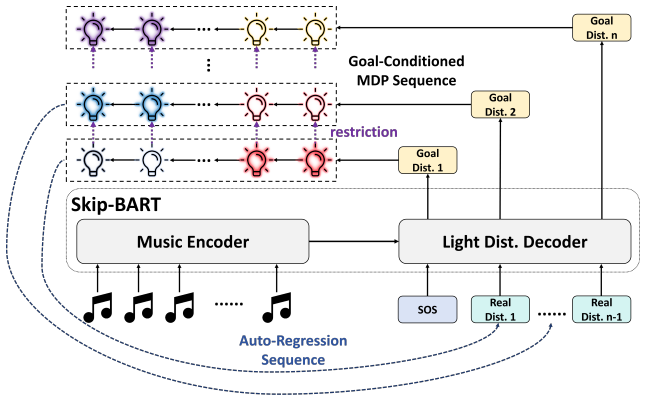
Music-inspired Automatic Stage Lighting Control (ASLC) has gained increasing attention in recent years due to the substantial time and financial costs associated with hiring and training professional lighting engineers. However, existing methods suffer from several notable limitations: the low interpretability of rule-based approaches, the restriction to single-primary-light control in music-to-color-space methods, and the limited transferability of music-to-controlling-parameter frameworks. To address these gaps, we propose SeqLight, a hierarchical deep learning framework that maps music to multi-light Hue-Saturation-Value (HSV) space. Our approach first customizes SkipBART, an end-to-end single primary light generation model, to predict the full light color distribution for each frame, followed by hybrid Imitation Learning (IL) techniques to derive an effective decomposition strategy that distributes the global color distribution among individual lights. Notably, the light decomposition module can be trained under varying venue-specific lighting configurations using only mixed light data and no professional demonstrations, thereby flexibly adapting across diverse venues. In this stage, we formulate the light decomposition task as a Goal-Conditioned Markov Decision Process (GCMDP), construct an expert demonstration set inspired by Hindsight Experience Replay (HER), and introduce a three-phase IL training pipeline, achieving strong generalization capability. To validate our IL solution for the proposed GCMDP, we conduct a series of quantitative analysis and human study. The code and trained models are provided at https://github.com/RS2002/SeqLight .
We present the Streaming Reservoir Convergence Theorem (SRCT), a novel mathematical framework for multi-provider adaptive bitrate streaming that addresses three fundamental structural weaknesses in current systems: linear provider probing, reactive failover, and cold standby transitions. SRCT models stream acquisition as a concurrent reservoir filling problem$-$probing all $N$ providers simultaneously rather than in batches$-$and maintains $k$ pre-verified, pre-fetched standby streams alongside the active stream to enable sub-second failover with zero user-visible disruption.
We prove four principal results: (1) a harmonic lower bound on reservoir safety showing that $k$ independent streams provide $H_k / \bar{\lambda}$ expected uptime where $H_k$ is the $k$-th harmonic number; (2) a concurrent acquisition speedup $S(N,b) = (N/b) \cdot (1-F^b)/(1-F^N)$ over batched probing, yielding $3$-$5\times$ practical improvement; (3) monotonic non-decreasing quality under lazy-refill with convergence to the Pareto-optimal frontier; and (4) a prospect-weighted switching rule$-$using Kahneman-Tversky value functions with $\alpha=\beta=0.88$, $\lambda=2.25$ $-$ that provably eliminates thrashing between similar-quality streams via a no-thrash bound on the expected switch count.
We implement SRCT across two production streaming pipelines: a primary movie/TV system serving 12+ HLS providers with $k=3$ reservoir slots, and a live sports system with multi-format DASH/HLS failover. Empirical verification via Monte Carlo simulation (5000 trials) confirms all four theorems across 22 independent checks. The reservoir of $k=3$ streams achieves $9.15\times$ mean time to depletion versus a single stream, and concurrent probing of 12 providers at 40% failure rate yields a $4.27\times$ speedup over the current batched-by-3 default.
Periodic patterns are fundamental cues in multimedia signals and systems, including repetitive motion in video (e.g., gait cycles), rhythmic and pitch-related structure in audio, and recurring textures in image sequences. When such user-generated streams are collected from edge devices, local differential privacy (LDP) is appealing because it perturbs data before upload; however, the injected noise can corrupt spectral peaks and induce phase drift, making period estimation unreliable and degrading reconstruction quality. We propose \textbf{CPR} (\textit{Cycle and Phase Recovery}), a period-aware reconstruction framework for periodic time series under LDP. CPR performs multi-scale period probing and multi-consensus selection to suppress noise-induced spectral interference, then aggregates perturbed samples at matched within-cycle phase positions to stabilize phase alignment across cycles. To recover the underlying per-phase values, CPR combines EM-based denoising with kernel density estimation, improving robustness under tight privacy budgets. Experiments on two real-world periodic datasets demonstrate that CPR better preserves periodic structure and consistently achieves lower reconstruction error than representative LDP baselines, especially in the low-$\epsilon$ regime.
This paper presents a comprehensive documentation of RenCon 2025, the revival of the expressive performance rendering competition which took place at ISMIR 2025 in Daejeon, Korea. The competition attracted 9 entries from international research groups, representing diverse approaches to expressive piano performance rendering. The two-phase assessment structure comprised a preliminary online evaluation and live real-time rendering at the conference. We analyze the competition format, participant demographics, system performance, and lessons learned for future iterations. The results demonstrate significant advances in expressive rendering capabilities while highlighting remaining challenges in achieving human-level musical expression.
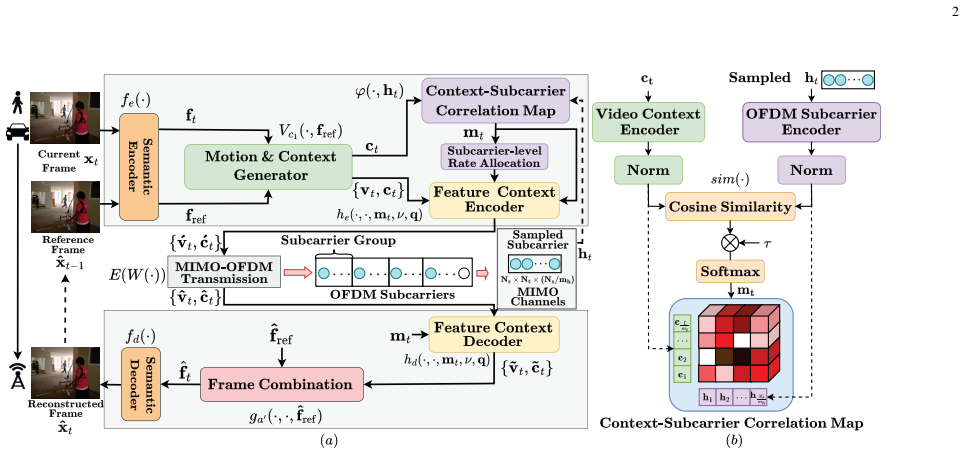
This paper proposes a MIMO-OFDM-based context video semantic transmission framework, namely M-CVST, for robust video communication over multi-path multiple-input multiple-output (MIMO) channels. It introduces a context-subcarrier correlation map that aligns video feature context with groups of MIMO subcarriers. To leverage the time-correlated nature of multi-path channels, a recursive subcarrier sampling method paired with time-correlated reference embedding is designed, enabling the use of previously sampled MIMO subcarrier CSI to enhance channel state awareness in the entropy coding model. Numerical results verify the superiority of proposed M-CVST over MIMO multi-path channels compared to other semantic schemes and traditional separated schemes.
Estimating reliability of audio and video separately allows gated fusion that raises correlation with human ratings when one stream is clean
abstractclick to expand
Audio-visual quality assessment (AVQA) is essential for streaming, teleconferencing, and immersive media. In realistic streaming scenarios, distortions are often asymmetric, where one modality may be severely degraded while the other remains clean. Still, most contemporary AVQA metrics treat audio and video as equally reliable, causing confidence-unaware fusion to emphasize unreliable signals. This paper proposes MCM-AVQA, a multimodal confidence-aware AVQA framework that explicitly estimates modality-specific confidence and injects it into a dedicated audio-visual mixer for cross-modal attention. The Audio-Visual Mixer utilizes frame-level, confidence-guided channel attention to gate fusion, modulating feature interaction between modalities so that high-confidence streams dominate while unreliable inputs are suppressed, preserving temporal degradation patterns. A multi-head visual confidence estimator turns frame-level artifact probabilities into temporally smoothed, clip-level visual confidence scores, while an audio confidence module derives confidence from speech-quality cues without requiring a clean reference. Experiments on multiple AVQA benchmarks show that MCM-AVQA, and specifically its confidence-guided Audio-Visual Mixer, improve correlation with human mean opinion scores and yield more interpretable behavior under real-world asymmetric audio-visual distortions.
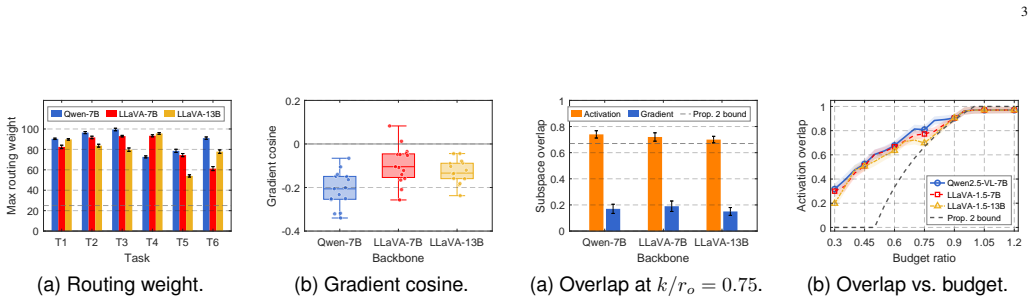
While current federated multimodal continual learning over mixture-of-experts low-rank adaptation (MoE-LoRA) is built on the unverified assumption that routing isolates task-specific knowledge into disjoint experts, we argue that routing operates per-sample, while forgetting accumulates across the task sequence, and gradient conflict persists within each expert even when routing is maximally polarized. Moreover, activation-subspace protection can also fail because, under parameter-efficient fine-tuning, it entangles tasks due to a dimension-counting bound, and federated averaging (FedAvg) disrupts client-side orthogonality. To address this, we propose PRISM (Per-expert Routing-projection Interference-informed Subspace Method), which maintains a per-expert gradient subspace basis whose orthogonality is preserved under FedAvg and reinterprets MoE routing as a capacity allocator. Our results show that, on LLaVA-1.5-7B, LLaVA-1.5-13B, and Qwen2.5-VL-7B across CoIN-6 and CoIN-Long-10, PRISM outperforms sixteen the state of the art baselines in average accuracy. Compared to the best federated multimodal baseline, the performance margin increases from +3.23 pp on CoIN-6 to +6.06 pp on CoIN-Long-10.
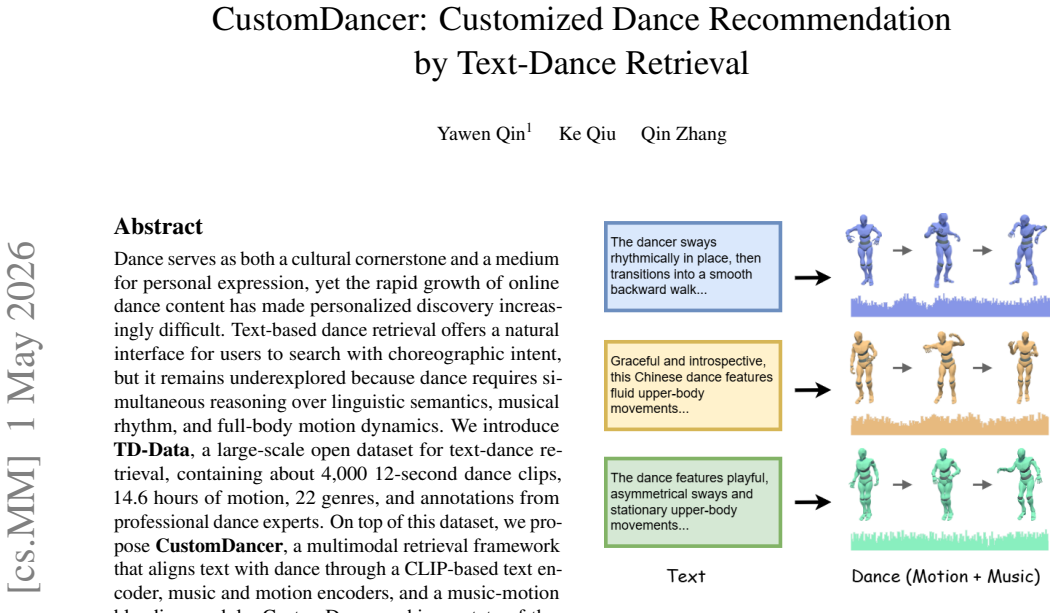
Dance serves as both a cultural cornerstone and a medium for personal expression, yet the rapid growth of online dance content has made personalized discovery increasingly difficult. Text-based dance retrieval offers a natural interface for users to search with choreographic intent, but it remains underexplored because dance requires simultaneous reasoning over linguistic semantics, musical rhythm, and full-body motion dynamics. We introduce TD-Data, a large-scale open dataset for text-dance retrieval, containing about 4,000 12-second dance clips, 14.6 hours of motion, 22 genres, and annotations from professional dance experts. On top of this dataset, we propose CustomDancer, a multimodal retrieval framework that aligns text with dance through a CLIP-based text encoder, music and motion encoders, and a music-motion blending module. CustomDancer achieves state-of-the-art performance on TD-Data, reaching 10.23% Recall@1 and improving retrieval quality in both quantitative benchmarks and user preference studies.
Wide exploration on robocall surveillance research is hindered due to limited access to public datasets, due to privacy concerns. In this work, we first curate Robo-SAr, a synthetic robocall dataset designed for robocall surveillance research. Robo-SAr comprises of ~200 unwanted and ~1200 legitimate synthetic robocall samples across three realistic adversarial axes: psycholinguistics-manipulated transcripts, emotion-eliciting speech, and cloned voices. We further propose RoboKA, a Kolmogorov-Arnold Network (KAN)-based multimodal fusion framework designed to model structured nonlinear interactions between acoustic and linguistic cues that characterize diverse adversarial robocall strategies. RoboKA first leverages cross-modal contrastive learning to align latent modality representations and feeds the resulting embeddings to a KAN-projection head for final classification. We benchmark RoboKA against strong unimodal and multimodal baselines in both in-domain and out-of-domain setups, finding RoboKA to surpass all baselines in terms of recall and F1-score.
Video temporal grounding (VTG) aims to localize the start and end timestamps of the event described by a given query within an untrimmed video. Despite the strong open-world video understanding and recognition ability of video language large models (Vid-LLMs), outputting precise temporal grounding information remains challenging, since explicit temporal cues are scarce in untrimmed videos, and query-relevant entities are hard to track consistently across the video timeline. In this paper, we present \MarkIt{}, a training-free framework that transforms an input video into a query-conditioned marked video, which empowers Vid-LLMs to generate more reliable temporal localization predictions. The core component of \MarkIt{} is an annotation-free query-to-mask grounding bridge (Q2M-Bridge). Given a natural-language query, it automatically derives a compact set of canonical subject tags through linguistic parsing and normalization, then maps these tags to query-conditioned instance masks using text-conditioned open-vocabulary segmentation. The bridge also embeds lightweight semantic instance markers and a persistent frame index into each frame, effectively transforming long-range temporal reasoning into explicit visual cues for Vid-LLMs. \MarkIt{} adopts an inference-time plug-and-play design, needs no modifications to Vid-LLM weights, and is fully compatible with supervised fine-tuning. Experiments conducted on multiple mainstream moment retrieval and highlight detection benchmarks demonstrate that \MarkIt {} achieves state-of-the-art results, delivering consistent temporal grounding improvements across a wide range of existing models.
Conversational multimodal understanding aims to infer the meaning or label of the current utterance from its preceding dialogue context together with textual, acoustic, and visual signals. Existing methods mainly strengthen contextual modeling through enhanced encoding, fusion, or propagation, but rarely abstract the context-utterance dependency into an explicit cue and incorporate it into later multimodal reasoning. To address this issue, we propose CUCI-Net for conversational multimodal understanding. CUCI-Net fully preserves the structural distinction between context and utterance during encoding, effectively abstracts their dependency into an interpretation cue by combining local modality evidence with global contextual evidence, and seamlessly integrates the resulting cue into the final multimodal interaction stage for context-conditioned prediction. Extensive experiments on mainstream benchmark datasets fully demonstrate the effectiveness of the proposed method.
Multimodal Sentiment Analysis (MSA) requires integrating language, acoustic, and visual signals without sacrificing modality-specific sentiment evidence. Existing methods mainly improve either shared-private decomposition or cross-modal interaction. Although effective, both ultimately depend on how shared and modality-specific evidence is organized before prediction. We observe that, under standard shared-private pipelines, modality heterogeneity often induces a branch-imbalance process: dominant shared patterns accumulate in the shared branch, yielding redundant and modality-biased evidence, while repeated interaction and rigid alignment gradually leak shared information into modality-specific channels and weaken discriminative private representations. As a result, the complementarity between shared and private representations is reduced, limiting robust sentiment reasoning. To address this issue, we propose the Dual-Branch Rebalancing Framework (DBR) on top of a standard multimodal decoupling stage. In the shared branch, a Temporal-Structural Factorization (TSF) module disentangles temporal evolution from structural dependencies and adaptively integrates them to reduce shared redundancy. In the private branch, an Anchor-Guided Private Routing (AGPR) module preserves discriminative modality-specific patterns while allowing controlled cross-modal borrowing. A Bidirectional Rebalancing Fusion (BRF) module then reunifies the two regularized branches in a context-aware manner for final prediction. Extensive experiments on CMU-MOSI, CMU-MOSEI, and MIntRec demonstrate that DBR consistently outperforms the compared baselines. Further analyses show that these improvements come from coordinated mitigation of branch imbalance.
Automated movie creation requires coordinating multiple characters, modalities, and narrative elements across extended sequences -- a challenge that existing end-to-end approaches struggle to address effectively. We present \textbf{CineAGI}, a hierarchical movie generation framework that decomposes this complex task through specialized multi-agent orchestration. Our framework employs three key innovations: (1) a multi-agent narrative synthesis module where specialized LLM agents collaboratively generate comprehensive cinematic blueprints with character profiles, scene descriptions, and cross-modal specifications; (2) a decoupled character-centric pipeline that maintains identity consistency through instance-level tracking and integration while enabling flexible multi-character composition; and (3) a hierarchical audio-visual synchronization mechanism ensuring frame-level alignment of dialogue, expressions, and music. Extensive experiments demonstrate that CineAGI achieves 40\% improvement in overall consistency, 4.4\% gain in subject consistency, 5.4\% enhancement in aesthetic quality, and 28.7\% higher character consistency compared to baselines. Our work establishes a principled foundation for automated multi-scene video generation that preserves narrative coherence and character authenticity.
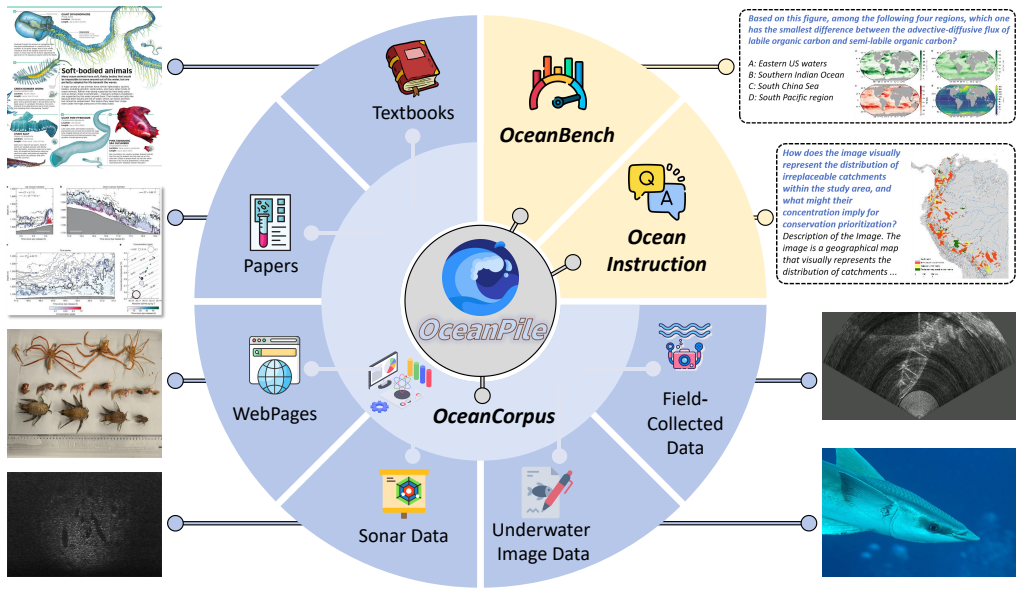
The vast and underexplored ocean plays a critical role in regulating global climate and supporting marine biodiversity, yet artificial intelligence has so far delivered limited impact in this domain due to a fundamental data bottleneck. Specifically, ocean data are highly fragmented across disparate sources and inherently exhibit multi-modal, high-noise, and weakly labeled characteristics, lacking unified schemas and semantic alignment. Although Multimodal Large Language Models (MLLMs) have achieved remarkable success in general domains, their application to ocean science remains severely constrained by the absence of large-scale, well-aligned multimodal datasets tailored to marine environments. To bridge this gap, we introduce OceanPile, a large-scale multimodal corpus designed for ocean foundation models. It comprises three key components: OceanCorpus, a unified collection integrating sonar data, underwater imagery, marine science visuals, and scientific text from diverse authoritative sources; OceanInstruction, a high-quality instruction dataset synthesized via a novel pipeline guided by a hierarchical Ocean Concept Knowledge Graph; and OceanBenchmark, a manually curated evaluation benchmark for rigorous assessment. We establish a multi-stage quality control process to ensure scientific validity and alignment across modalities. Experimental validation demonstrates significant performance improvements for models trained on our data. All datasets are publicly released to advance the field of marine artificial intelligence and empower domain-specific MLLMs.
The rapid advancement of photorealistic Text-to-Video (T2V) generation brings in an urgent need for up-to-date evaluation methods. Existing benchmarks largely overlooked implausible scenarios and do not measure audio-visual alignment. We introduce BRITE, the first framework that unifies (1) implausible prompting, (2) fine-grained assessment of audio-visual consistency, and (3) QA-based interpretable evaluation into a comprehensive T2V benchmark. Unlike fully automated Multimodal LLM-based pipelines, which are prone to hallucination and prompt ambiguity, BRITE guarantees reliability through a rigorous human-in-the-loop protocol for benchmark creation. Evaluating five state-of-the-art models (Sora 2, Veo 3.1, Runway Gen4.5, Pixverse V5.5, and Qwen3Max), we reveal a critical performance gap: while models excel at static object composition, they exhibit significant degradation in object-action binding and audio-visual synchronization. Our framework offers the community a reliable, interpretable benchmark and evaluation framework that can detect and locate limitations in the next generation of T2V models, especially for off-manifold prompts
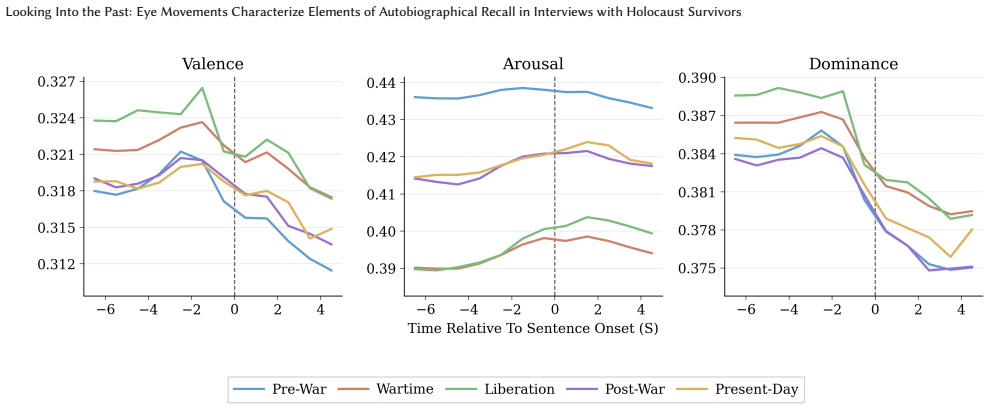
Eye movement and memory retrieval are deeply and bidirectionally intertwined, however existing literature is generally confined to controlled lab settings. We investigate the relationship between eye gaze and memory recall in free-form autobiographical recall, which comprises both autonoetic consciousness -- the ability to mentally place oneself in the past or future -- and various affective states. Using a large video corpus of semi-naturalistic interviews with Holocaust survivors (N = 806), we examine eye movements with respect to episodic, semantic, affective, and temporal dimensions of traumatic and highly emotional autobiographical recall. We observe gaze patterns vary significantly across certain temporal contexts, most prominently in vertical eye movements. We additionally train intra-subject sequence models to predict temporal context of sentences from segments of gaze features, and find that eye movements entirely preceding sentence onset are sufficient for prediction. Our results corroborate prior findings in literature linking eye movements to memory in controlled and semi-structured settings, reinforcing the role of eye gaze in retrieving and constructing memories, especially in highly emotional and remote memory recall.
Virtual flood experience systems, which enable users to vividly experience flooding, are attracting increasing attention as effective tools for communicating flood risks. However, existing systems typically rely on virtual cities that do not correspond to real locations and often lack sufficient photorealism, limiting users' ability to relate scenarios to their own surroundings. Although 360{\deg} video-based virtual environments offer a simple and scalable way to visually replicate real-world scenes, effective 3D flood visualization in these environments typically requires 3D building geometry of the target area, which is not readily available in many regions. To address this limitation, we propose a new virtual flood experience framework that integrates 360{\deg} videos with 3D models automatically constructed from widely available 2D building footprints. By extruding footprints to plausible heights and spatially aligning the constructed models with 360{\deg} videos, our framework enables 3D flood visualization in photorealistic environments without relying on pre-existing city models such as CityGML. We demonstrate the framework in Memuro, Hokkaido, Japan, an area vulnerable to river flooding. A user study with local residents showed that the proposed system enhances users' ability to envision location-specific flood evacuation situations, demonstrating its potential as an effective tool for disaster risk communication and education.
Real-time multimodal agents transport raw audio and screenshots using networking stacks designed for human receivers, which optimize for perceptual fidelity and smooth playout. Yet agent models act as event-driven processors with no inherent sense of physical time, consuming task-relevant semantics rather than reconstructing signals in real time. This fundamental difference shifts the transport goal from the technical problem of signal fidelity (Shannon-Weaver Level A) to the semantic problem of meaning preservation (Level B). This mismatch imposes significant overhead. In visual pipelines, screenshot upload accounts for over 60% of end-to-end action latency on constrained uplinks, and in voice pipelines, conventional transport carries massive redundancy, sending 43-64x more data than needed to maintain task accuracy. We present Sema, a semantic transport system that combines discrete audio tokenizers with a hybrid screen representation (lossless accessibility-tree or OCR text, plus compact visual tokens) and bursty token delivery that eliminates jitter buffers. In simulations under emulated WAN conditions, Sema reduces uplink bandwidth by 64x for audio and 130-210x for screenshots while preserving task accuracy within 0.7 percentage points of the raw baseline.
We present AttentionBender, a tool that manipulates cross-attention in Video Diffusion Transformers to help artists probe the internal mechanics of black-box video generation. While generative outputs are increasingly realistic, prompt-only control limits artists' ability to build intuition for the model's material process or to work beyond its default tendencies. Using an autobiographical research-through-design approach, we built on Network Bending to design AttentionBender, which applies 2D transforms (rotation, scaling, translation, etc.) to cross-attention maps to modulate generation. We assess AttentionBender by visualizing 4,500+ video generations across prompts, operations, and layer targets. Our results suggest that cross-attention is highly entangled: targeted manipulations often resist clean, localized control, producing distributed distortions and glitch aesthetics over linear edits. AttentionBender contributes a tool that functions both as an Explainable AI style probe of transformer attention mechanisms, and as a creative technique for producing novel aesthetics beyond the model's learned representational space.
Micro-video popularity prediction (MVPP) aims to forecast the future popularity of videos on online media, which is essential for applications such as content recommendation and traffic allocation. In real-world scenarios, it is critical for MVPP approaches to understand both the temporal dynamics of a given video (temporal) and its historical relevance to other videos (spatial). However, existing approaches sufer from limitations in both dimensions: temporally, they rely on sparse short-range sampling that restricts content perception; spatially, they depend on flat retrieval memory with limited capacity and low efficiency, hindering scalable knowledge utilization. To overcome these limitations, we propose a unified framework that achieves joint spatio-temporal enlargement, enabling precise perception of extremely long video sequences while supporting a scalable memory bank that can infinitely expand to incorporate all relevant historical videos. Technically, we employ a Temporal Enlargement driven by a frame scoring module that extracts highlight cues from video frames through two complementary pathways: sparse sampling and dense perception. Their outputs are adaptively fused to enable robust long-sequence content understanding. For Spatial Enlargement, we construct a Topology-Aware Memory Bank that hierarchically clusters historically relevant content based on topological relationships. Instead of directly expanding memory capacity, we update the encoder features of the corresponding clusters when incorporating new videos, enabling unbounded historical association without unbounded storage growth. Extensive experiments on three widely used MVPP benchmarks demonstrate that our method consistently outperforms 11 strong baselines across mainstream metrics, achieving robust improvements in both prediction accuracy and ranking consistency.
End-to-end learned video compression has achieved strong rate-distortion performance, but rate control remains underexplored, especially in target-bitrate-driven and budget-constrained scenarios. Existing methods mainly rely on explicit R-D-lambda modeling or feed-forward prediction, which may lack stable online adjustment when video content varies dynamically.
We propose a feedback-driven rate control framework for learned video compression. First, we build a single-model multi-rate coding interface on top of a DCVC-style framework, enabling continuous bitrate control through the rate-distortion parameter lambda. Then, a log-domain PI/PID closed-loop controller updates lambda online according to the error between the target bitrate and the entropy-estimated bitrate, achieving stable target bitrate tracking. To further improve frame-level bit allocation under budget constraints, we introduce a dual-branch GRU-based adjustment controller that refines the base control signal using budget-state features and causal coding statistics.
Experiments on UVG and HEVC show that the proposed PI/PID controller achieves average bitrate errors of 2.88% and 2.95% on DCVC and DCVC-TCM, respectively. With the proposed adjustment controller, the method further achieves average BD-rate reductions of 5.69% and 4.49%, while reducing the average bitrate errors to 2.13% and 2.24%. These results show that the proposed method provides a practical solution for learned video compression with both controllable bitrate and improved rate-distortion performance.
We study when, where, and why 978 Holocaust survivors smile in video testimonies. We create an automatic smile detection model from facial features with an F1 of 85% and annotate detected smiles under two established taxonomies of smiling. We produce narrative features on 1,083,417 transcript sentences as well as emotional valence from three different modalities: audio, eye gaze, and text transcript. Smiling rates are significantly correlated with specific semantic topics, narrative structures, and temporal syntaxes across the entire corpus. Smiles often occur during periods of intense negative affect; these negative-affect smiles improve the valence trajectory of surrounding sentences significantly across all three modalities. Smiling reduces eye dynamics and blink rates, and the strength of both of these effects is also modulated by narrative valence. Taken together, we conclude that smiling plays a critical role in regulating emotion and social interaction during traumatic recollection.
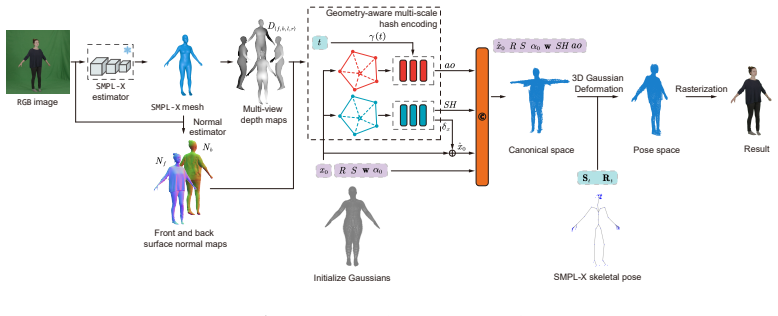
Real-time, high-fidelity 3D human reconstruction from RGB images is essential for interactive applications such as virtual reality and gaming, yet remains challenging due to the complex non-rigid deformations of dynamic human bodies. Although 3D Gaussian Splatting enables efficient rendering, existing methods struggle to capture fine geometric details and often produce artifacts such as fused fingers and over-smoothed faces. Moreover, conventional spatial-field-based dynamic modeling faces a trade-off between reconstruction fidelity and GPU memory consumption. To address these issues, we propose a novel 3D Gaussian human reconstruction framework that combines region-aware initialization with rich geometric priors. Specifically, we leverage the expressive SMPL-X model to initialize both 3D Gaussians and skinning weights, providing a robust geometric foundation for precise reconstruction. We further introduce a region-aware density initialization strategy and a geometry-aware multi-scale hash encoding module to improve local detail recovery while maintaining computational efficiency.Experiments on PeopleSnapshot and GalaBasketball show that our method achieves superior reconstruction quality and finer detail preservation under complex motions, while maintaining real-time rendering speed.
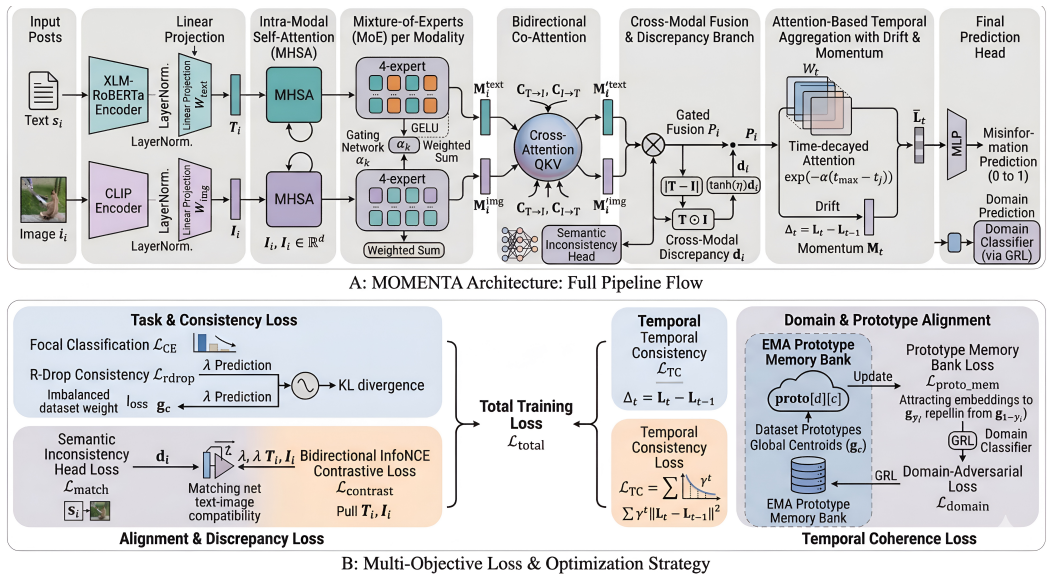
The widespread dissemination of multimodal content on social media has made misinformation detection increasingly challenging, as misleading narratives often arise not only from textual or visual content alone, but also from semantic inconsistencies between modalities and their evolution over time. Existing multimodal misinformation detection methods typically model cross-modal interactions statically and often show limited robustness across heterogeneous datasets, domains, and narrative settings. To address these challenges, we propose MOMENTA, a unified framework for multimodal misinformation detection that captures modality heterogeneity, cross-modal inconsistency, temporal dynamics, and cross-domain generalization within a single architecture. MOMENTA employs modality-specific mixture-of-experts modules to model diverse misinformation patterns, bidirectional co-attention to align textual and visual representations in a shared semantic space, and a discrepancy-aware branch to explicitly capture semantic disagreement between modalities. To model narrative evolution, we introduce an attention-based temporal aggregation mechanism with drift and momentum encoding over overlapping time windows, enabling the framework to capture both short-term fluctuations and longer-term trends in misinformation propagation. In addition, domain-adversarial learning and a prototype memory bank improve domain invariance and stabilize representation learning across datasets. The model is trained using a multi-objective optimization strategy that jointly enforces classification performance, cross-modal alignment, contrastive learning, temporal consistency, and domain robustness. Experiments on Fakeddit, MMCoVaR, Weibo, and XFacta show that MOMENTA achieves strong, consistent results across accuracy, F1-score, AUC, and MCC, highlighting its effectiveness for multimodal misinformation detection.
Real-world video creation often involves a complex reasoning workflow of selecting relevant shots from noisy materials, planning missing shots for narrative completeness, and organizing them into coherent storylines. However, existing benchmarks focus on isolated sub-tasks and lack support for evaluating this full process. To address this gap, we propose Multimodal Context-to-Script Creation (MCSC), a new task that transforms noisy multimodal inputs and user instructions into structured, executable video scripts. We further introduce MCSC-Bench, the first large-scale MCSC dataset, comprising 11K+ well-annotated videos. Each sample includes: (1) redundant multimodal materials and user instructions; (2) a coherent, production-ready script containing material-based shots, newly planned shots (with shooting instructions), and shot-aligned voiceovers. MCSC-Bench supports comprehensive evaluation across material selection, narrative planning, and conditioned script generation, and includes both in-domain and out-of-domain test sets. Experiments show that current multimodal LLMs struggle with structure-aware reasoning under long contexts, highlighting the challenges posed by our benchmark. Models trained on MCSC-Bench achieve SOTA performance, with an 8B model surpassing Gemini-2.5-Pro, and generalize to out-of-domain scenarios. Downstream video generation guided by the generated scripts further validates the practical value of MCSC. Datasets will be public soon.
Recent advances in video-to-audio (V2A) generation enable high-quality audio synthesis from visual content, yet achieving robust and fine-grained controllability remains challenging. Existing methods suffer from weak textual controllability under visual-text conflict and imprecise stylistic control due to entangled temporal and timbre information in reference audio. Moreover, the lack of standardized benchmarks limits systematic evaluation.
We propose ControlFoley, a unified multimodal V2A framework that enables precise control over video, text, and reference audio. We introduce a joint visual encoding paradigm that integrates CLIP with a spatio-temporal audio-visual encoder to improve alignment and textual controllability. We further propose temporal-timbre decoupling to suppress redundant temporal cues while preserving discriminative timbre features. In addition, we design a modality-robust training scheme with unified multimodal representation alignment (REPA) and random modality dropout. We also present VGGSound-TVC, a benchmark for evaluating textual controllability under varying degrees of visual-text conflict.
Extensive experiments demonstrate state-of-the-art performance across multiple V2A tasks, including text-guided, text-controlled, and audio-controlled generation. ControlFoley achieves superior controllability under cross-modal conflict while maintaining strong synchronization and audio quality, and shows competitive or better performance compared to an industrial V2A system.
Code, models, datasets, and demos are available at: https://yjx-research.github.io/ControlFoley/.
Recent image-to-audio models have shown impressive performance on object-centric visual scenes. However, their application to satellite imagery remains limited by the complex, wide-area semantic ambiguity of top-down views. While satellite imagery provides a uniquely scalable source for global soundscape generation, matching these views to real acoustic environments with unique spatial structures is inherently difficult. To address this challenge, we introduce Geo2Sound, a novel task and framework for generating geographically realistic soundscapes from satellite imagery. Specifically, Geo2Sound combines structural geospatial attributes modeling, semantic hypothesis expansion, and geo-acoustic alignment in a unified framework. A lightweight classifier summarizes overhead scenes into compact geographic attributes, multiple sound-oriented semantic hypotheses are used to generate diverse acoustically plausible candidates, and a geo-acoustic alignment module projects geographic attributes into the acoustic embedding space and identifies the candidate most consistent with the candidate sets. Moreover, we establish SatSound-Bench, the first benchmark comprising over 20k high-quality paired satellite images, text descriptions, and real-world audio recordings, collected from the field across more than 10 countries and complemented by three public datasets. Experiments show that Geo2Sound achieves a SOTA FAD of 1.765, outperforming the strongest baseline by 50.0%. Human evaluations further confirm substantial gains in both realism (26.5%) and semantic alignment, validating our high-fidelity synthesis on scale. Project page and source code: https://github.com/Blanketzzz/Geo2Sound
We present AVID, the first large-scale benchmark for audio-visual inconsistency understanding in videos. While omni-modal large language models excel at temporally aligned tasks such as captioning and question answering, they struggle to perceive cross-modal conflicts, a fundamental human capability that is critical for trustworthy AI. Existing benchmarks predominantly focus on aligned events or deepfake detection, leaving a significant gap in evaluating inconsistency perception in long-form video contexts. AVID addresses this with: (1) a scalable construction pipeline comprising temporal segmentation that classifies video content into Active Speaker, Voiceover, and Scenic categories; an agent-driven strategy planner that selects semantically appropriate inconsistency categories; and five specialized injectors for diverse audio-visual conflict injection; (2) 11.2K long videos (avg. 235.5s) with 39.4K annotated inconsistency events and 78.7K segment clips, supporting evaluation across detection, temporal grounding, classification, and reasoning with 8 fine-grained inconsistency categories. Comprehensive evaluations of state-of-the-art omni-models reveal significant limitations in temporal grounding and reasoning. Our fine-tuned baseline, AVID-Qwen, achieves substantial improvements over the base model (2.8$\times$ higher BLEU-4 in segment reasoning) and surpasses all compared models in temporal grounding (mIoU: 36.1\% vs 26.2\%) and holistic understanding (SODA-m: 7.47 vs 6.15), validating AVID as an effective testbed for advancing trustworthy omni-modal AI systems.
Predicting post-surgical seizure outcomes in pharmacoresistant epilepsy is a clinical challenge. Conventional deep-learning approaches operate on static, single-timepoint pre-operative scans, omitting longitudinal morphological changes. We propose \emph{Neuro-Oracle}, a three-stage framework that: (i) distils pre-to-post-operative MRI changes into a compact 512-dimensional trajectory vector using a 3D Siamese contrastive encoder; (ii) retrieves historically similar surgical trajectories from a population archive via nearest-neighbour search; and (iii) synthesises a natural-language prognosis grounded in the retrieved evidence using a quantized Llama-3-8B reasoning agent. Evaluations are conducted on the public EPISURG dataset ($N{=}268$ longitudinally paired cases) using five-fold stratified cross-validation. Since ground-truth seizure-freedom scores are unavailable, we utilize a clinical proxy label based on the resection type. We acknowledge that the network representations may potentially learn the anatomical features of the resection cavities (i.e., temporal versus non-temporal locations) rather than true prognostic morphometry. Our current evaluation thus serves mainly as a proof-of-concept for the trajectory-aware retrieval architecture. Trajectory-based classifiers achieve AUC values between 0.834 and 0.905, compared with 0.793 for a single-timepoint ResNet-50 baseline. The Neuro-Oracle agent (M5) matches the AUC of purely discriminative trajectory classifiers (0.867) while producing structured justifications with zero observed hallucinations under our audit protocol. A Siamese Diversity Ensemble (M6) of trajectory-space classifiers attains an AUC of 0.905 without language-model overhead.
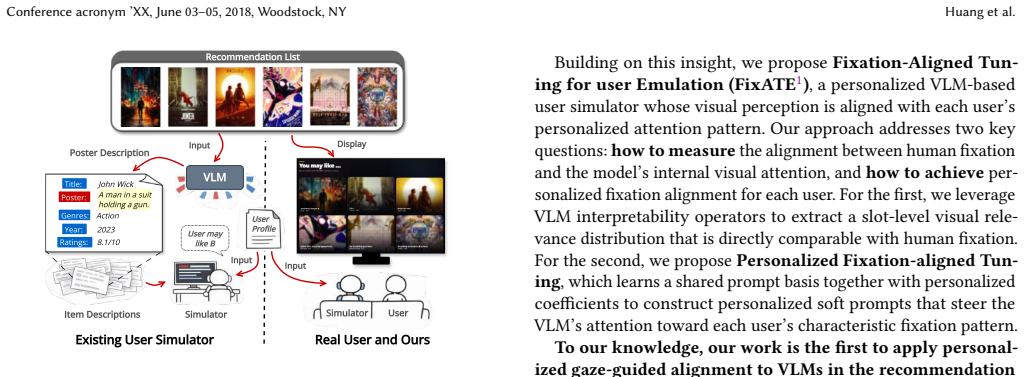
Large language model (LLM) agents are increasingly deployed as scalable user simulators for recommender system evaluation. Yet existing simulators perceive recommendations through text or structured metadata rather than the visual interfaces real users browse-a critical gap, since attention over recommendation layouts is both visually driven and highly personalized. We investigate whether aligning a vision-language model's (VLM's) visual attention with user-specific gaze patterns can improve simulation fidelity. Analysis of a real-world eye-tracking dataset collected in a carousel-based recommendation setting reveals that users exhibit stable individual gaze patterns strongly predictive of click behavior. Building on this finding, we propose Fixation-Aligned Tuning for user Emulation (FixATE). Our approach first probes the VLM's internal visual attention via interpretability operators to obtain a slot-level relevance distribution comparable with human fixation, and then learns personalized soft prompts to steer the model's attention toward each user's characteristic fixation pattern. Experiments across three interpretability-based probing operators and two architecturally distinct VLM backbones demonstrate consistent improvements in both attention alignment and click prediction accuracy. These results suggest that making the model "see like the user" is a viable path toward simulators that more faithfully reproduce how users perceive and act in recommendation interfaces.
The method drops less important 2D or 3D tokens at the right processing stage, adding only 5.8 percent overhead.
abstractclick to expand
Vision-Language-Action (VLA) models have emerged as the mainstream of embodied intelligence. Recent VLA models have expanded their input modalities from 2D-only to 2D+3D paradigms, forming multi-visual-modal VLA (MVLA) models. Despite achieving improved spatial perception, MVLA faces a greater acceleration demand due to the increased number of input tokens caused by modal expansion. Token pruning is an effective optimization methods tailored to MVLA models. However, existing token pruning schemes are designed for 2D-only VLA models, ignoring 2D/3D modality salience differences. In this paper, we follow the application process of multi-modal data in MVLA models and develop a tri-stage analysis to capture the discrepancy and dynamics of 2D/3D modality salience. Based on these, we propose a corresponding tri-stage token pruning framework for MVLA models to achieve optimal 2D/3D token selection and efficient pruning. Experiments show that our framework achieves up to a 2.55x inference speedup with minimal accuracy loss, while only costing 5.8% overhead. Our Code is coming soon.
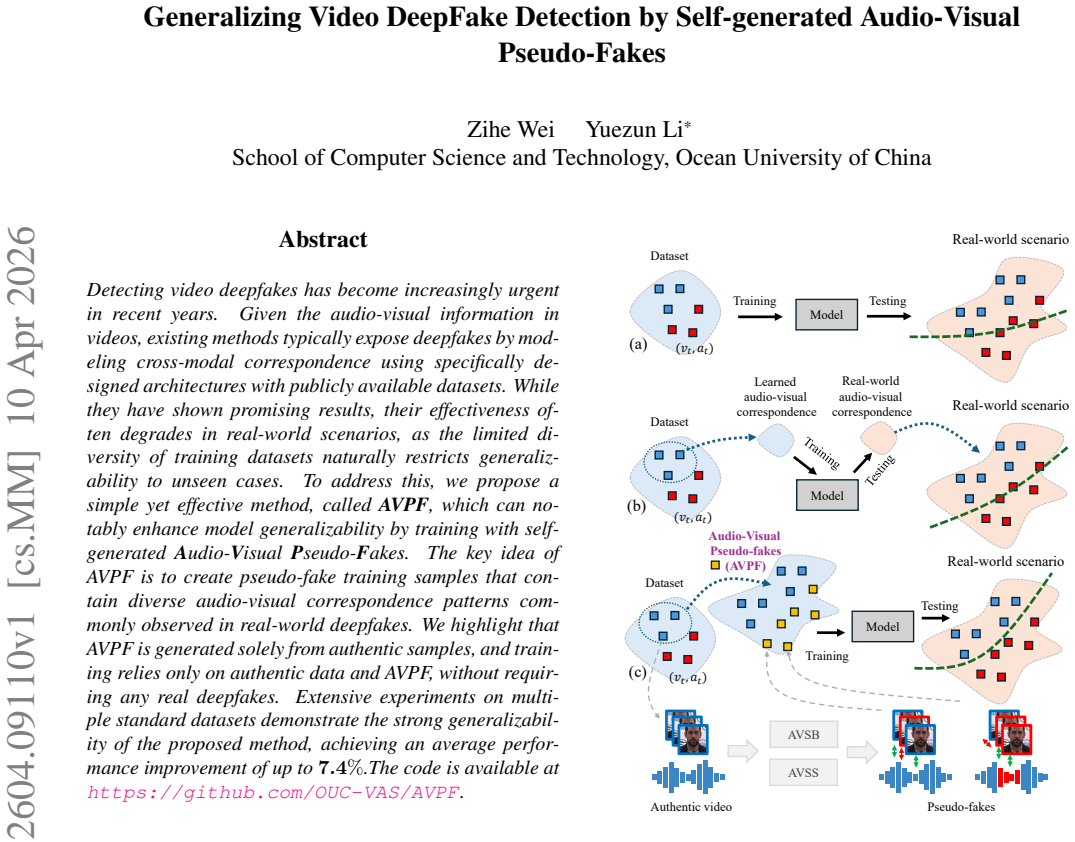
Detecting video deepfakes has become increasingly urgent in recent years. Given the audio-visual information in videos, existing methods typically expose deepfakes by modeling cross-modal correspondence using specifically designed architectures with publicly available datasets. While they have shown promising results, their effectiveness often degrades in real-world scenarios, as the limited diversity of training datasets naturally restricts generalizability to unseen cases. To address this, we propose a simple yet effective method, called AVPF, which can notably enhance model generalizability by training with self-generated Audio-Visual Pseudo-Fakes.The key idea of AVPF is to create pseudo-fake training samples that contain diverse audio-visual correspondence patterns commonly observed in real-world deepfakes. We highlight that AVPF is generated solely from authentic samples, and training relies only on authentic data and AVPF, without requiring any real deepfakes.Extensive experiments on multiple standard datasets demonstrate the strong generalizability of the proposed method, achieving an average performance improvement of up to 7.4%.
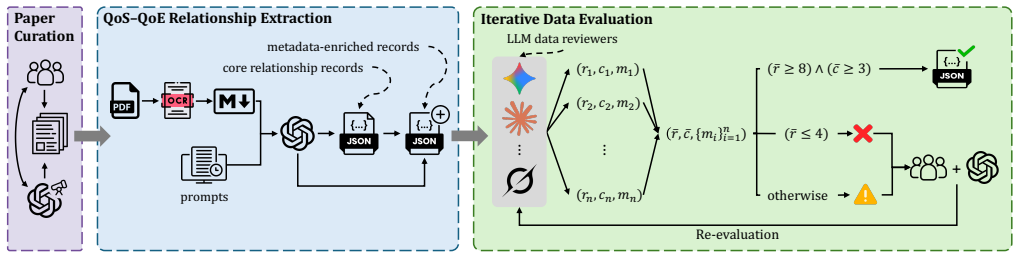
QoS-QoE translation is a fundamental problem in multimedia systems because it characterizes how measurable system and network conditions affect user-perceived experience. Although many prior studies have examined this relationship, their findings are often developed for specific setups and remain scattered across papers, experimental settings, and reporting formats, limiting systematic reuse, cross-scenario generalization, and large-scale analysis. To address this gap, we first introduce QoS-QoE Translation dataset, a source-grounded dataset of structured QoS-QoE relationships from the multimedia literature, with a focus on video streaming related tasks. We construct the dataset through an automated pipeline that combines paper curation, QoS-QoE relationship extraction, and iterative data evaluation. Each record preserves the extracted relationship together with parameter definitions, supporting evidence, and contextual metadata. We further evaluate the capability of large language models (LLMs) on QoS-QoE translation, both before and after supervised fine-tuning on our dataset, and show strong performance on both continuous-value and discrete-label prediction in bidirectional translation, from QoS-QoE and QoE-QoS. Our dataset provides a foundation for benchmarking LLMs in QoS-QoE translation and for supporting future LLM-based reasoning for multimedia quality prediction and optimization. The complete dataset and code are publicly available at https://yyu6969.github.io/qos-qoe-translation-page/, for full reproducibility and open access.
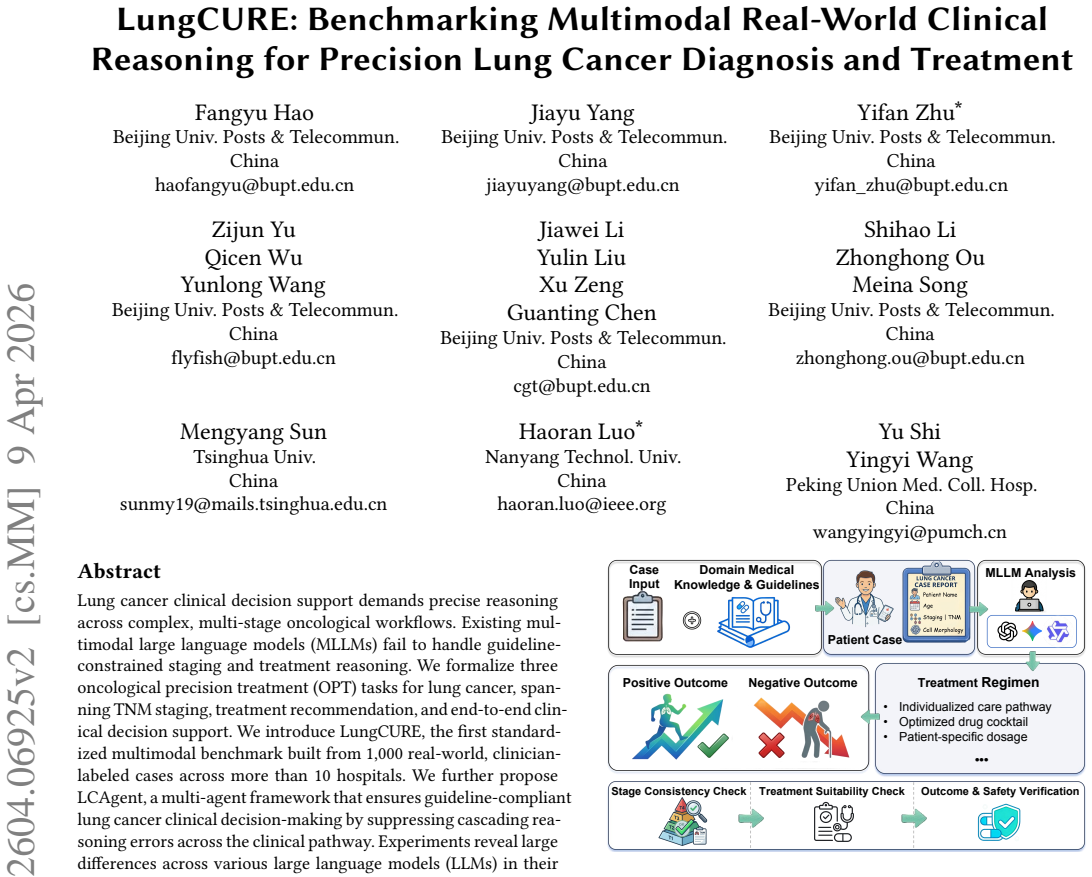
Lung cancer clinical decision support demands precise reasoning across complex, multi-stage oncological workflows. Existing multimodal large language models (MLLMs) fail to handle guideline-constrained staging and treatment reasoning. We formalize three oncological precision treatment (OPT) tasks for lung cancer, spanning TNM staging, treatment recommendation, and end-to-end clinical decision support. We introduce LungCURE, the first standardized multimodal benchmark built from 1,000 real-world, clinician-labeled cases across more than 10 hospitals. We further propose LCAgent, a multi-agent framework that ensures guideline-compliant lung cancer clinical decision-making by suppressing cascading reasoning errors across the clinical pathway. Experiments reveal large differences across various large language models (LLMs) in their capabilities for complex medical reasoning, when given precise treatment requirements. We further verify that LCAgent, as a simple yet effective plugin, enhances the reasoning performance of LLMs in real-world medical scenarios.
Multimodal sentiment analysis (MSA) aims to predict human sentiment from textual, acoustic, and visual information in videos. Recent studies improve multimodal fusion by modeling modality interaction and assigning different modality weights. However, they usually compress diverse sentiment cues into a single compact representation before sentiment reasoning. This early aggregation makes it difficult to preserve the internal structure of sentiment evidence, where different cues may complement, conflict with, or differ in reliability from each other. In addition, modality importance is often determined only once during fusion, so later reasoning cannot further adjust modality contributions. To address these issues, we propose PRISM, a framework that unifies structured affective extraction and adaptive modality evaluation. PRISM organizes multimodal evidence in a shared prototype space, which supports structured cross-modal comparison and adaptive fusion. It further applies dynamic modality reweighting during reasoning, allowing modality contributions to be continuously refined as semantic interactions become deeper. Experiments on three benchmark datasets show that PRISM outperforms representative baselines.
Multimodal large language models (MLLMs) have shown strong capability in semantic understanding and visual reasoning, yet their use on continuous video streams in bandwidth-constrained edge-cloud systems incurs prohibitive computation and communication overhead and hinders low-latency alerting and effective visual evidence delivery. To address this challenge, we propose DAT to achieve high-quality semantic generation, low-latency event alerting, and effective visual evidence supplementation. To reduce unnecessary deep reasoning costs, we propose a collaborative small-large model cascade. A lightweight edge-side small model acts as a gating module to filter non-target-event frames and perform object detection, triggering MLLM inference only for suspicious frames. Building on this, we introduce an efficient fine-tuning strategy with visual guidance and semantic prompting, which improves structured event understanding, object detection, and output consistency. To ensure low-latency semantic alerting and effective visual evidence supplementation under bandwidth constraints, we further devise a semantics and bandwidth-aware multi-stream adaptive transmission optimization method. Experimental results show that DAT achieves 98.83% recognition accuracy and 100% output consistency. Under severe congestion, it reduces weighted semantic alert delay by up to 77.5% and delivers 98.33% of visual evidence within 0.5 s, demonstrating the effectiveness of jointly optimizing cascade inference and elastic transmission.
High-quality STEM animations can be useful for learning, but they are still not common in daily teaching, mostly because they take time and special skills to make. In this paper, we present a semi-automated, human-in-the-loop (HITL) pipeline that uses a large language model (LLM) to help convert math and physics concepts into narrated animations with the Python library Manim. The pipeline also tries to follow multimedia learning ideas like segmentation, signaling, and dual coding, so the narration and the visuals are more aligned.
To keep the outputs stable, we use constrained prompt templates, a symbol ledger to keep symbols consistent, and we regenerate only the parts that have errors. We also include expert review before the final rendering, because sometimes the generated code or explanation is not fully correct.
We tested the approach with 100 undergraduate students in a within-subject A-B study. Each student learned two similar STEM topics, one with the LLM-generated animations and one with PowerPoint slides. In general, the animation-based instruction gives slightly better post-test scores (83% vs.78%, p < .001), and students show higher learning gains (d=0.67). They also report higher engagement (d=0.94) and lower cognitive load (d=0.41). Students finished the tasks faster, and many of them said they prefer the animated format. Overall, these results suggest LLM-assisted animation can make STEM content creation easier, and it may be a practical option for more classrooms.
Differential diagnosis of mental disorders remains a fundamental challenge in real-world clinical practice, where multiple conditions often exhibit overlapping symptoms. However, most existing public datasets are developed under single-disorder settings and rely on limited data elicitation paradigms, restricting their ability to capture disorder-specific patterns. In this work, we investigate differential mental disorder detection through psychology-inspired multimodal stimuli, designed to elicit diverse emotional, cognitive, and behavioral responses grounded in findings from experimental psychology. Based on this paradigm, we collect a large-scale multimodal mental health dataset (MMH) covering depression, anxiety, and schizophrenia, with all diagnostic labels clinically verified by licensed psychiatrists. To effectively model the heterogeneous signals induced by diverse elicitation tasks, we further propose a paradigm-aware multimodal framework that leverages inter-disorder differences prior knowledge as prompt-guided semantic descriptions to capture task-specific affective and interaction contexts for multimodal representation learning in the new differential mental disorder detection task. Extensive experiments show that our framework consistently outperforms existing baselines, underscoring the value of psychology-inspired stimulus design for differential mental disorder detection.
Annotated film data boosts style control in generated speech and visuals, but tests reveal models miss human-level nuance in cross-modal表达.
abstractclick to expand
The recent advancement of Artificial Intelligence Generated Content (AIGC) has led to significant strides in modeling human interaction, particularly in the context of multimodal dialogue. While current methods impressively generate realistic dialogue in isolated modalities like speech or vision, challenges remain in controllable Multimodal Dialogue Generation (MDG). This paper focuses on the natural alignment between speech, vision, and text in human interaction, aiming for expressive dialogue generation through multimodal conditional control. To address the insufficient richness and diversity of dialogue expressiveness in existing datasets, we introduce a novel multimodal dialogue annotation pipeline to curate dialogues from movies and TV series with fine-grained annotations in interactional characteristics. The resulting MM-Dia dataset (360+ hours, 54,700 dialogues) facilitates explicitly controlled MDG, specifically through style-controllable dialogue speech synthesis. In parallel, MM-Dia-Bench (309 highly expressive dialogues with visible single-/dual-speaker scenes) serves as a rigorous testbed for implicit cross-modal MDG control, evaluating audio-visual style consistency across modalities. Extensive experiments demonstrate that training on MM-Dia significantly enhances fine-grained controllability, while evaluations on MM-Dia-Bench reveal limitations in current frameworks to replicate the nuanced expressiveness of human interaction. These findings provides new insights and challenges for multimodal conditional dialogue generation.