REVIEW 4 major objections 5 minor
OpenCodeReview: Determinism over Non-Determinism for Cost-Effective Agent-Based Code Review
T0 review · 4 major / 5 minor · reviewed 2026-08-11 · deepseek-v4-flash
Pith's one-line read OpenCodeReview replaces agent freedom with deterministic engineering and outperforms mainstream coding agents at lower cost.
desk verdict A genuinely interesting systems paper whose headline quality claim is conditional on an untested benchmark judge from the same group; the cost story and the design are credible, the 2.17x SEM-F1 is not yet established. read the letter →
The pith
A machine-rendered reading of the paper's core claim, the machinery that carries it, and where it could break.
The reading
What carries the argument
The load-bearing mechanism is "deterministic engineering for uncertain agents": constraining the LLM's action space along axes validated against how expert reviewers actually read diffs, rather than maximizing its freedom. It is carried by three modules—Rule-Guided Dispatch (a four-tier rule chain for file and criterion assignment), Grounded File Review (a curated six-tool set with bounded outputs, file-level parallel SubAgents, and context compression), and Independent Reflection (a filter-only reflector that sees strictly less than the reviewer, namely the diff alone, and removes comments directly contradicted by diff evidence). The machinery's work is to turn the agent's variability into reproducibility, bound the context footprint of exploration, and cut hallucinated comments without suppressing true ones.
What would settle it
Run the same six-backend comparison on a fresh set of 200 pull requests whose ground-truth comments are curated by engineers with no connection to OpenCodeReview and judged by a different semantic judge; if the 25.10% versus 11.57% SEM-F1 advantage does not substantially persist, the central claim is refuted.
Extended reading notes
Core claim
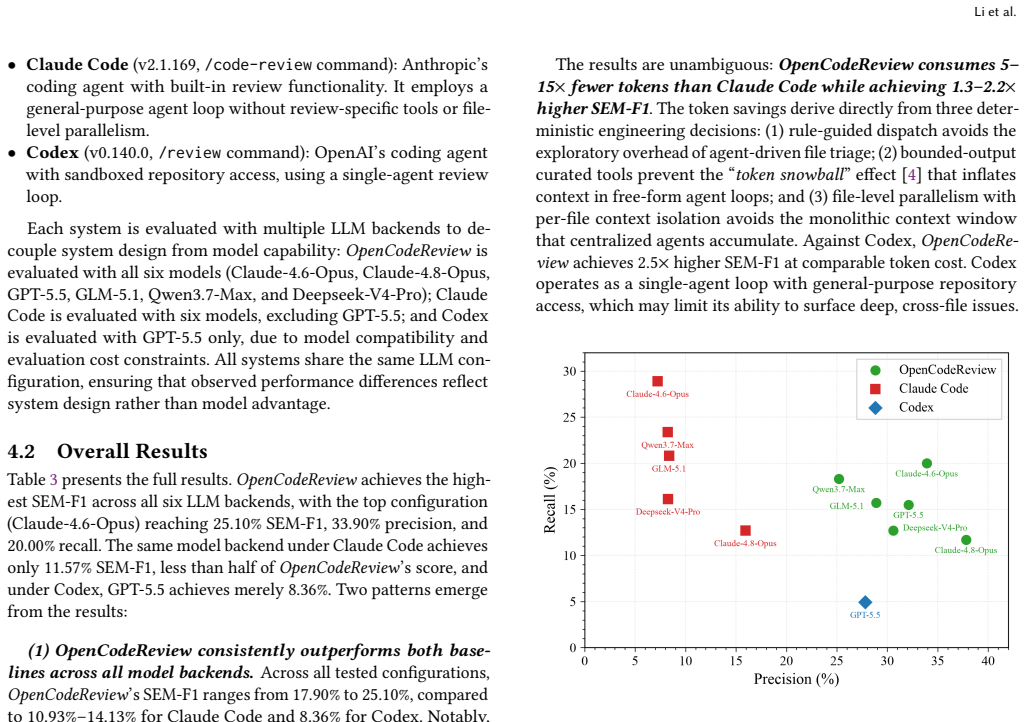
The paper's central claim is that injecting determinism at three pipeline points turns an unreliable, expensive agent into a reliable and cheap one without capping the depth of issues found. Rule-Guided Dispatch replaces agent-driven file triage with a four-tier rule chain that maps every changed file to the same review criteria on every run. Grounded File Review replaces a general shell with six bounded, review-specific tools in a ReAct loop, so each SubAgent can trace callers, definitions, and related diffs without inflating the context window. Independent Reflection then runs a separate pass in which the reflector sees only the diff and applies a falsification-first filter, deleting comments the diff directly contradicts while failing open to preserve recall. Together these yield the reported result: the best configuration reaches 25.10% SEM-F1 with 33.90% precision and 20.00% recall, and every OpenCodeReview configuration beats every baseline configuration tested.
Load-bearing premise
The central claim rests on AACR-Bench being an impartial yardstick: its expert-verified comments and its Qwen3-235B semantic judge must not be biased toward OpenCodeReview's comment style, even though several AACR-Bench authors also wrote this paper.
Editorial extensions
If this is right
- If the reported gains hold, deployment cost of agent-based review can drop by an order of magnitude while quality rises, making always-on review practical for repositories that cannot afford today's token budgets.
- System design becomes a first-order variable: the same model under OpenCodeReview outperforms the same model under Claude Code, so teams should compare pipelines, not just model cards.
- The asymmetric information boundary—reflector sees less, not more—offers a cheap way to filter agent output in any task where a subset of evidence can adjudicate a claim.
- Deterministic dispatch and bounded tools imply that review outcomes become reproducible across runs, which is a prerequisite for using automated review in regulated or safety-critical engineering processes.
Reading between the lines
- Editorial inference: the same determinism recipe could transfer to other bounded software-engineering tasks—issue triage, changelog generation, or dependency audit—where a fixed rule layer and bounded tools can replace open-ended exploration.
- Editorial inference: the information-asymmetry principle implies that any agent output that can be checked against a cheaper or narrower evidence subset could be filtered the same way, without needing a second, larger model.
- Editorial inference: the cost-quality gap suggests that the main obstacle to production code-review agents is not model capability but uncontrolled exploration; a testable prediction is that adding OpenCodeReview's constraints to an existing agent will improve its precision more than upgrading its model.
Editorial analysis
A structured set of objections, weighed in public.
Referee Report
Summary. The paper introduces OpenCodeReview, an LLM-based code review agent whose design philosophy is 'deterministic engineering for uncertain agents.' It injects determinism at three pipeline points: Rule-Guided Dispatch (deterministic file and criterion selection), Grounded File Review (a curated tool set with bounded outputs in a ReAct loop plus file-level parallel SubAgents), and Independent Reflection (a falsification-first filter that sees only the diff). The system is evaluated on AACR-Bench against Claude Code and Codex across six LLM backends, with the headline result that OpenCodeReview reaches up to 2.17x higher SEM-F1 (25.10% vs. 11.57%) while consuming 5-15x fewer tokens. The paper also claims that system design matters more than model choice.
Significance. If the results hold, the paper makes a useful contribution by challenging the assumption that more agent autonomy is always better, and by showing a concrete cost-quality frontier improvement for code review. The open-source release is valuable for reproducibility, and the evaluation spans multiple LLM backends, which is more than many agent papers do. The idea of achieving reflection via an asymmetric information boundary rather than a different model is thought-provoking. However, the current evidence is weakened by the reliance on a benchmark and LLM judge with substantial author overlap, the lack of variance reporting around five-run means, the partial baseline coverage, and the absence of ablations for the three key modules. These issues make the central claim plausible but not yet convincingly established.
major comments (4)
- [Section 4.1.1, Table 3, reference [30]]
- [Section 6, Internal validity]
- [Section 4.1.2, Table 3]
- [Section 3, Section 4.4]
minor comments (5)
- [Section 3.1]
- [Section 4.1.2]
- [Table 3]
- [Section 4.3]
- [Section 2.1]
Circularity Check
Headline SEM-F1 claim is measured on a same-team benchmark and judge, making the central comparison self-referential rather than externally falsified.
-
self citation load bearing
[Section 4.1.1 (Evaluation Setup), Table 3, and Reference [30]]
"We evaluate on AACR-Bench [30], a recently introduced multilingual, repository-level benchmark... Ground truth consists of 1,505 review comments validated through an "AI-assisted, expert-verified" pipeline... Semantic equivalence is determined by an LLM judge (Qwen3-235B-A22B-Instruct in this work)."
The sole measurement instrument for the central claim is AACR-Bench [30]. The cited benchmark paper lists at least five authors who are also authors of the present paper (Lei Zhang, Zhengqi Zhuang, Guoping Rong, Zhengfeng Li, and Boge Wang), and the semantic judge is an Alibaba Qwen model produced by the same ecosystem as several authors. The paper neither discloses this overlap nor calibrates the judge against human agreement. Consequently, the headline 'up to 2.17x higher SEM-F1' is a score generated by a same-team benchmark and same-ecosystem judge: the system being evaluated and the instrument performing the evaluation are not independent, so the comparison is self-referential rather than an external falsification.
full rationale
The paper's engineering claims—Rule-Guided Dispatch, Grounded File Review, and Independent Reflection—are described procedurally and are not derived from the evaluation metric, so there is no equation-level circularity of the form 'input equals output by construction.' The token-savings and SEM-F1 numbers are empirical measurements within the stated protocol. However, the evaluation is not fully independent: AACR-Bench [30] is cited as the benchmark, but its author list overlaps substantially with this paper, and the semantic judge is a Qwen model from the same industrial ecosystem. The paper does not report judge calibration, human-agreement rates, or any external benchmark, and it does not disclose the author overlap. This makes the central comparison a same-team measurement rather than a neutral external test. I score this as 4 rather than higher because the benchmark does contain expert-verified ground-truth comments, the systems are compared across six LLM backends, and the system is open-sourced, so the central claim still has some independent content; the self-citation is load-bearing but not a pure logical derivation.
Assumptions & free parameters
free parameters (4)
- max ReAct iterations =
30
- context compression thresholds =
60% and 80% utilization
- tool output bounds =
500 lines, 100 search results, 100 matches, 10s timeout
- file size exclusion threshold =
80% of model context window
assumptions (6)
- domain assumption AACR-Bench ground truth is complete and correctly represents review issues.
- domain assumption The Qwen3-235B judge reliably detects semantic equivalence of review comments.
- domain assumption The same LLM configuration across systems isolates system design as the cause of differences.
- domain assumption The reflector can reliably detect comments directly contradicted by diff evidence.
- domain assumption The built-in rule system adequately encodes review criteria for the benchmark languages.
- domain assumption A ReAct loop with 30 iterations is sufficient to trace cross-file dependencies.
Cite this review
Pith. "Pith review of OpenCodeReview: Determinism over Non-Determinism for Cost-Effective Agent-Based Code Review." pith.science (2026). https://pith.science/paper/OVHPONIR
@misc{pith2026260809290,
  author       = {Pith},
  title        = {Pith review of: OpenCodeReview: Determinism over Non-Determinism for Cost-Effective Agent-Based Code Review},
  year         = {2026},
  howpublished = {\url{https://pith.science/paper/OVHPONIR}},
  note         = {Machine review of arXiv:2608.09290}
}
read the original abstract
LLM-based code review agents promise scalable, always-on review, yet current systems suffer from two intertwined weaknesses: (1) non-determinism--unbounded tool use makes review outcomes unstable, and (2) context locality--the reviewer's access remains bounded to the diff, capping discoverable issue depth. Both give rise to three challenges: misaligned context retrieval, a coherence-efficiency trade-off in multi-file pull requests, and hallucinated comments that erode trust. To address these, we introduce OpenCodeReview, built on deterministic engineering for uncertain agents: rather than granting maximal freedom, we inject determinism at three deliberate pipeline points. Rule-Guided Dispatch uses a multi-layer rule system to deterministically select files and review criteria, eliminating variability of agent-driven triage. Grounded File Review replaces free-form exploration with a curated tool set exposed through a ReAct loop, while file-level parallel SubAgents balance context coherence against efficiency and recover cross-file dependencies on demand. Independent Reflection introduces a falsification-first filter under an asymmetric information boundary--the reflector sees only the diff, not the agent's tool-augmented exploration--removing hallucinated comments without self-reinforcing bias, improving precision while preserving recall. On AACR-Bench (200 real-world PRs, 10 languages, 1,505 expert-verified comments), OpenCodeReview outperforms mainstream coding agents (e.g., Claude Code and Codex) across six LLM backends, achieving up to 2.17x higher SEM-F1 (25.10% vs. 11.57%) while consuming 5-15x fewer tokens. We open-source OpenCodeReview at https://github.com/alibaba/open-code-review.
Figures


Reviewed August 11, 2026 · model on record in the stance chip above.
Discussion (0). Continue with ORCID to comment.