REVIEW 2 major objections 5 minor 57 references
Search-Based Generation of Undetected Quantum Circuit Mutants
T0 review · 2 major / 5 minor · reviewed 2026-08-11 · deepseek-v4-flash
Pith's one-line read The paper introduces QUMUG, a search-based generator of quantum circuit mutants tuned to pass a given test suite while remaining non-equivalent, and reports that these mutants are three times harder to detect than those from existing tools.
desk verdict Novel approach, broken validation: the non-equivalence test suffers from massive multiple testing, inflating the headline results. read the letter →
The pith
A machine-rendered reading of the paper's core claim, the machinery that carries it, and where it could break.
The reading
What carries the argument
The load-bearing mechanism is the parameterised-gate mutation operator combined with a two-part fitness function. Each candidate mutant encodes a circuit position, one of five operators (add $R_x$, add $R_y$, add $R_z$, add $U$, replace with $U$), and three floating-point angles restricted in practice to the range $[-0.5,0.5]$. The fitness function minimises the number of test cases that detect the mutant, rewarding closeness to the undetected region; once no test case detects it, the function maximises total Hellinger distance between the original and mutated output distributions, so the search does not simply converge on equivalent mutants. Detection in the evaluation is decided by a chi-square test, and a five-times-larger comprehensive suite is used only after generation to classify mutants as non-equivalent.
What would settle it
Apply an exact state-vector equivalence check to the mutants that QUMUG classifies as non-equivalent; if a substantial fraction of those mutants are exactly equivalent under full-state comparison, then the reported non-equivalence ratio and test-suite-improvement numbers overstate the method's value.
Extended reading notes
Core claim
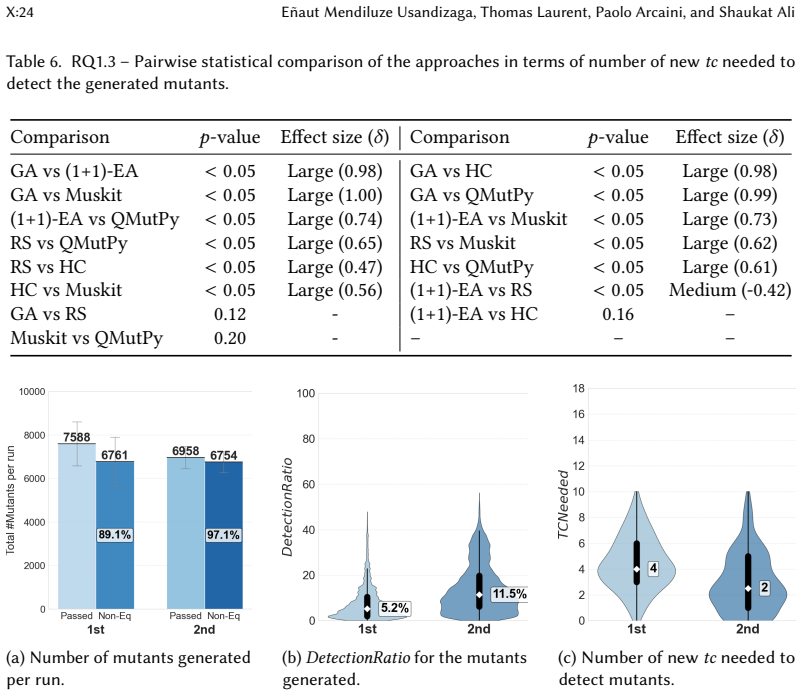
The central claim is that mutant difficulty is controllable by making the mutation itself parameterised. Instead of inserting a fixed gate, QUMUG adds or replaces gates drawn from $R_x(\theta)$, $R_y(\theta)$, $R_z(\phi)$, and the universal $U(\theta,\phi,\lambda)$ gate, and the search tunes the angles so the mutant passes every test in the input suite while still producing a measurable difference in output distributions. The paper's evaluation concludes that this approach produces mutants that are markedly more challenging than fixed-gate mutants: the best search algorithm, a genetic algorithm, required a median of five additional test cases to reveal all of its mutants, whereas mutants from the baseline tools were all detected after adding a single test case. The higher-order analysis further shows that second-order mutants, meaning two mutations in the same circuit and most often placed on different qubits or circuit positions, are detected by a set of test cases different from the union of the detection sets of their constituent first-order mutants in 71.25% of cases, evidence that interactions between faults create behaviours not present in either mutation alone.
Load-bearing premise
The result rests on the assumption that a mutant classified as non-equivalent because the expanded test suite detects it really does differ from the original circuit, since that expanded suite is still a finite sample of initialisations and measurement bases.
Editorial extensions
If this is right
- Quantum mutation scores computed with fixed-gate tools likely overestimate test-suite quality, because the easy-to-detect mutants inflate kill rates; QUMUG's surviving mutants give a stricter benchmark.
- Surviving mutants can be used directly as test-generation targets: each new mutant that passes the suite pinpoints a missing test case, so suites can be strengthened iteratively until the search stalls.
- Higher-order quantum mutants should be treated as interaction faults rather than paired first-order faults, since their detection sets usually differ from the union of their components.
- The parameterised-gate operators can be reused outside mutation analysis, for instance in fault localisation and circuit repair, where controlling the size of a change is useful.
- Diversity, not just difficulty, matters for test-suite improvement: the paper attributes the genetic algorithm's advantage partly to its maintaining a more diverse mutant population.
Reading between the lines
- The reported difficulty gap depends on the chosen oracle: a different statistical test, distance metric, or a state-vector comparator could plausibly shrink or widen the three-fold gap between QUMUG and the fixed-gate baselines.
- Because the search already treats each mutant as an array of positions and angles, QUMUG could be embedded in a continuous-integration loop that adds every generated survivor to the test suite and reruns the search until no new non-equivalent mutants appear.
- The dominance of second-order mutants placed on different qubits or positions suggests a testable interaction hypothesis: separation between the two mutations may control whether effects cancel or compound, and sweeping that separation directly would reveal the mechanism.
- The restriction of gate angles to $[-0.5,0.5]$, chosen after preliminary runs, may itself be responsible for the subtlety of the mutants; repeating the experiment with different angle bounds would show how sensitively the difficulty results depend on this search-space cutoff.
Signed reviews
Editorial analysis
A structured set of objections, weighed in public.
Referee Report
Summary. The paper proposes QUMUG, a search-based approach for generating quantum circuit mutants that pass a given test suite TS while remaining non-equivalent. Mutations are introduced via parameterisable gates (Rx, Ry, Rz, U), with parameters tuned by four search algorithms (GA, HC, (1+1)-EA, random search). The approach is evaluated on 30 quantum circuits (3–7 qubits) drawn from MQT Bench and compared against two existing quantum mutation tools, Muskit and QMutPy. The paper reports that QUMUG mutants are markedly harder to detect, with GA producing on average 494 non-equivalent undetected mutants per program, a 94.3% non-equivalence ratio, and a median of five additional test cases needed to detect them versus one for the baselines. It also presents the first study of higher-order (second-order) quantum mutants, analysing their characteristics and test-case interactions.
Significance. If the empirical claims were fully supported, this would be a valuable contribution: it introduces a new family of parametric mutation operators, provides the first implementation and analysis of higher-order quantum mutants, uses a reasonable experimental design with external baselines, ten repeated runs, statistical testing with effect sizes, and a public repository. The central comparative claim, however, rests on the non-equivalence validation, and that validation currently has a load-bearing multiple-comparisons problem. The approach and benchmarks are promising, but the headline numbers and the comparative conclusion need to be re-established with a sound equivalence criterion before the paper's central claim can be accepted.
major comments (2)
- [Section 5.4 / Definition 5] The non-equivalence validation has a severe multiple-comparisons problem that undermines the central claim. A mutant is labelled non-equivalent if at least one test case from CTS yields p<0.05 on the chi-square test. For a truly equivalent mutant, each test case is a Bernoulli trial with a 5% false-positive rate, so the probability of being misclassified as non-equivalent is 1−(0.95)^{|CTS|}. Even under the smallest consistent reading of the CTS size, this is about 71% for 3-qubit circuits and above 99% for 5-qubit circuits, and it is effectively 100% for 7-qubit circuits. The reported 94.3% non-equivalence ratio, the non-equivalent mutant counts in Fig. 4, and the RQ1.2/RQ1.3 analyses that filter on 'non-equivalent' are therefore dominated by Type I errors. Section 7.4.1 discusses only CTS incompleteness (false negatives) and does not address this false-positive problem. The authors should apply a multiple-testing correction (e.g., Benjamini-Hochberg) or use an alternative equivalence criterion (e.g., a minimum Hellinger distance or a joint test across CTS) and re-run the affected analyses.
- [Section 5.6] The mutation angle search range was reduced from [-180,180] to [-0.5,0.5] after the authors observed that the vast majority of selected angles in their own preliminary search fell in that range. Because this range is derived from the same search process being evaluated and is used by all QUMUG variants but not by the fixed-gate baselines, the comparative claim that parameterisable-gate mutants are intrinsically more challenging is confounded by this post hoc design choice. A sensitivity analysis with at least one broader range (e.g., [-5,5] or the full [-180,180]) is needed to show that the reported advantage of QUMUG is not an artefact of restricting the search to small perturbations.
minor comments (5)
- [Section 5.3] The formulas for test-suite size yield non-integer values for some circuits: for q=3, 2^q×0.4×3 = 9.6 test cases. Please clarify how rounding is performed and whether the reported sizes are exact or approximate.
- [Section 5.4] The statement that CTS is five times larger than TS is inconsistent with the preceding description. With TS using 20% classical plus 20% quantum initialisations, and CTS using the remaining 80% classical initialisations plus 'the same number of quantum initialisations', the implied ratio is either 2.5 or 4, depending on interpretation, not 5. Please correct the text and recompute any quantities that depend on this ratio.
- [Table 4] P-values are reported inconsistently: some appear as '0.31' or '0.06' while others appear as '<0.05'. Use a uniform convention, e.g., exact p-values or a single threshold notation, to avoid ambiguity.
- [Figure 10 / Section 6.2.3] The labels for cases (5) and (6) are confusing because the text and the caption describe the inclusion relationships in opposite directions. Consider renaming these categories with explicit set equations, such as 'tcd_hom ⊂ tcd_fom' and 'tcd_fom ⊂ tcd_hom'.
- [Abstract / Section 6.1.2] The abstract says 'three times more challenging' while Section 6.1.2 says 'detected by three times fewer test cases'. Please state the precise metric (detection ratio) in both places so the claim is unambiguous.
Circularity Check
No circular derivation: QUMUG's reported mutant difficulty is an empirical comparison against external baselines; self-citations are motivational, and the CTS-based non-equivalence label is an acknowledged operational definition applied uniformly.
full rationale
The paper's central derivation is an empirical search-and-evaluate loop: QUMUG tunes parametric mutation angles to pass TS while maximizing Hellinger distance (Eq. 2), and the reported difficulty metrics are then measured on the larger, independently constructed CTS. No reported headline quantity is a fitted parameter renamed as a prediction. The non-equivalence label is operational: 'A generated mutant is considered non-equivalent if it is detected by at least one test case from CTS' (Section 5.4), so the 94.3% non-equivalent ratio is a CTS-detection ratio by definition. This is a construct-validity choice, not a circular derivation, because the same definition is applied symmetrically to QUMUG, Muskit, and QMutPy, and the paper explicitly acknowledges in Section 7.4.1 that semantic equivalence is not proved. Citations to the authors' earlier work [29, 30, 45] motivate the problem statement and the choice of chi-square testing, but the paper re-establishes the baseline behavior empirically (Fig. 5, Table 5), so those self-citations are not load-bearing. The multiple-testing concern about per-test alpha = 0.05 across the CTS suite is a statistical-validity criticism rather than a circularity of derivation, and it does not change the fact that the generation results are not constructed from the evaluation metric: the search never optimizes against CTS. Accordingly, no step in the claimed derivation chain reduces to its own input.
Assumptions & free parameters
free parameters (3)
- Mutation angle search range =
[-0.5, 0.5] degrees
- GA hyperparameters =
population size 100, mutation probability 0.5, crossover probability 0.5, 100 generations
- Test suite sampling fraction =
20% of classical inputs plus an equal number of quantum inputs
assumptions (4)
- domain assumption CTS detection is a sufficient proxy for behavioral non-equivalence
- domain assumption Ideal circuit simulation output distributions faithfully represent quantum program behavior
- domain assumption The chi-square test with the chosen shot count reliably distinguishes output distributions
- domain assumption Mutants are a valid proxy for real quantum software faults
Cite this review
Pith. "Pith review of Search-Based Generation of Undetected Quantum Circuit Mutants." pith.science (2026). https://pith.science/paper/55LUW5CR
@misc{pith2026260809318,
  author       = {Pith},
  title        = {Pith review of: Search-Based Generation of Undetected Quantum Circuit Mutants},
  year         = {2026},
  howpublished = {\url{https://pith.science/paper/55LUW5CR}},
  note         = {Machine review of arXiv:2608.09318}
}
read the original abstract
Quantum mutation analysis is emerging as an essential technique for evaluating test suites due to the limited availability of real faulty quantum programs. However, existing quantum mutation analysis tools use fixed gate-based mutations, resulting in easy-to-detect mutants, which reduces their effectiveness in assessing the quality of test suites. We propose QUMUG, a search-based approach for generating challenging mutants by utilising parameterisable quantum gates. QUMUG employs search algorithms to optimise mutation parameters and find non-equivalent mutants passing a given test suite. In our evaluation over 30 quantum programs, QUMUG produced mutants that are three times more challenging than the mutants generated by existing tools. Among the four evaluated search algorithms, the genetic algorithm was the most effective, generating an average of 494 undetected mutants per program with a 99.67% success rate and 94.3% non-equivalent ratio. The generated mutants demonstrated their effectiveness by requiring the addition of five times more test cases to the test suite than the mutants generated by existing tools. We also analysed the behaviour of higher order mutants in quantum circuits, and showed that while first order mutations are more effective for enhancing the test suite, higher order mutants highlight the need for new unique test cases.
Figures


Figures from the paper (7 more)




Reference graph
Works this paper leans on
-
[1]
Rui Abreu, Shaukat Ali, Paolo Arcaini, José Campos, Michael Felderer, Claude Gravel, Fuyuki Ishikawa, Stefan Klikovits, Andriy Miranskyy, Anila Mjeda, Mohammad Reza Mousavi, Masaomi Yamaguchi, Lei Zhang, and Jianjun Zhao. 2026. Software Testing in the Quantum World.Computer59, 4 (2026), 135–138. doi:10.1109/MC.2026.3655854
arXiv 2026
-
[2]
Rui Abreu, João Paulo Fernandes, Luis Llana, and Guilherme Tavares. 2022. Metamorphic Testing of Oracle Quantum Programs. In2022 IEEE/ACM 3rd International Workshop on Quantum Software Engineering (Q-SE). 16–23. doi:10.1145/ 3528230.3529189
arXiv 2022
-
[4]
Paul Ammann, Marcio Eduardo Delamaro, and Jeff Offutt. 2014. Establishing Theoretical Minimal Sets of Mutants. In 2014 IEEE Seventh International Conference on Software Testing, Verification and Validation. 21–30. doi:10.1109/ICST. 2014.13
doi:10.1109/icst 2014
-
[5]
Thomas Back. 1996.Evolutionary algorithms in theory and practice: evolution strategies, evolutionary programming, genetic algorithms. Oxford university press
work page 1996
-
[6]
José Campos and André Souto. 2021. QBugs: A Collection of Reproducible Bugs in Quantum Algorithms and a Supporting Infrastructure to Enable Controlled Quantum Software Testing and Debugging Experiments. In2021 IEEE/ACM 2nd International Workshop on Quantum Software Engineering (Q-SE). IEEE Computer Society, Los Alamitos, CA, USA, 28–32. doi:10.1109/Q-SE52...
arXiv 2021
-
[7]
Norman Cliff. 1993. Dominance statistics: Ordinal analyses to answer ordinal questions.Psychological bulletin114, 3 (1993), 494. doi:10.1037/0033-2909.114.3.494
-
[8]
Antonio García de la Barrera, Ignacio García-Rodríguez de Guzmán, Macario Polo, and José A. Cruz-Lemus. 2022. Quantum Software Testing: Current Trends and Emerging Proposals. Springer International Publishing, Cham, 167–191. doi:10.1007/978-3-031-05324-5_9
-
[9]
Antonio García de la Barrera, Ignacio García-Rodríguez de Guzmán, Macario Polo, and Mario Piattini. 2023. Quantum software testing: State of the art.Journal of Software: Evolution and Process35, 4 (2023), e2419. doi:10.1002/smr.2419
Show all 57 references
-
[10]
Janez Demšar. 2006. Statistical Comparisons of Classifiers over Multiple Data Sets.J. Mach. Learn. Res.7 (Dec. 2006), 1–30
2006
-
[11]
Daniel Fortunato, José Campos, and Rui Abreu. 2022. Mutation Testing of Quantum Programs: A Case Study With Qiskit.IEEE Transactions on Quantum Engineering3 (2022), 1–17. doi:10.1109/TQE.2022.3195061
2022
-
[12]
Daniel Fortunato, José Campos, and Rui Abreu. 2022. Mutation Testing of Quantum Programs Written in QISKit. In Proceedings of the ACM/IEEE 44th International Conference on Software Engineering: Companion Proceedings(Pittsburgh, Pennsylvania)(ICSE ’22). Association for Computin...
2022 doi
-
[13]
Daniel Fortunato, José Campos, and Rui Abreu. 2022. QMutPy: A Mutation Testing Tool for Quantum Algorithms and Applications in Qiskit. InProceedings of the 31st ACM SIGSOFT International Symposium on Software Testing and Analysis(Virtual, South Korea)(ISSTA 2022). Association ...
2022
-
[14]
Sophie Fortz, Eñaut Mendiluze Usandizaga, Shaukat Ali, Paolo Arcaini, and Mohammad Reza Mousavi. 2026. Robust Mutation Analysis of Quantum Programs Under Noise. arXiv:2605.13279 [cs.SE] https://arxiv.org/abs/2605.13279
2026 arXiv
-
[15]
Stanton A. Glantz. 2012.Primer of Biostatistics(7th edition ed.). McGraw Hill, New York. https://www.accessscience. com/content/book/9780071781503
2012
-
[16]
Greenberger, Michael A
Daniel M. Greenberger, Michael A. Horne, and Anton Zeilinger. 1989. Going Beyond Bell’s Theorem. InBell’s Theorem, Quantum Theory and Conceptions of the Universe, Menas Kafatos (Ed.). Springer Netherlands, Dordrecht, 69–72. doi:10.1007/978-94-017-0849-4_10
1989 doi
-
[17]
Shahin Honarvar, Mohammad Reza Mousavi, and Rajagopal Nagarajan. 2020. Property-Based Testing of Quantum Programs in Q#. InProceedings of the IEEE/ACM 42nd International Conference on Software Engineering Workshops (Seoul, Republic of Korea)(ICSEW’20). Association for Computin...
2020
-
[18]
Yuta Ishimoto, Masanari Kondo, Naoyasu Ubayashi, Yasutaka Kamei, Ryota Katsube, Naoto Sato, and Hideto Ogawa
-
[19]
Yue Jia and Mark Harman. 2011. An Analysis and Survey of the Development of Mutation Testing.IEEE Transactions on Software Engineering37, 5 (2011), 649–678. doi:10.1109/TSE.2010.62
2011 doi
-
[20]
Ryoichi Kawai. 2022. A First Step to Quantum Computation with Qiskit. https://kawaihome.link/jbooks/qcomp- short/cover.html
2022
-
[21]
Marinos Kintis, Mike Papadakis, Andreas Papadopoulos, Evangelos Valvis, and Nicos Malevris. 2016. Analysing and Comparing the Effectiveness of Mutation Testing Tools: A Manual Study. In2016 IEEE 16th International Working Conference on Source Code Analysis and Manipulation (SC...
2016 doi
-
[22]
Jonas Klamroth, Max Scheerer, and Oliver Denninger. 2025. Detecting and Tolerating Faults in Hybrid Quantum Software Systems Using Architectural Redundancy. InIEEE International Conference on Quantum Software, QSW 2025, Helsinki, Finland, July 7-12, 2025, Rong N. Chang, Carl K...
2025
-
[23]
Michael Kölle, Tom Bintener, Maximilian Zorn, Gerhard Stenzel, Leo Sünkel, Thomas Gabor, and Claudia Linnhoff- Popien. 2025. Evaluating Mutation Techniques in Genetic-Algorithm-Based Quantum Circuit Synthesis. InProceedings of the Genetic and Evolutionary Computation Conferenc...
2025
-
[24]
Thomas Laurent, Mike Papadakis, Marinos Kintis, Christopher Henard, Yves Le Traon, and Anthony Ventresque. 2017. Assessing and Improving the Mutation Testing Practice of PIT. In2017 IEEE International Conference on Software Testing, Verification and Validation (ICST). 430–435....
2017 doi
-
[25]
Neilson Carlos Leite Ramalho, Higor Amario de Souza, and Marcos Lordello Chaim. 2025. Testing and Debugging Quantum Programs: The Road to 2030.ACM Trans. Softw. Eng. Methodol.34, 5, Article 155 (May 2025), 46 pages. doi:10.1145/3715106
2025 doi
-
[26]
Gushu Li, Li Zhou, Nengkun Yu, Yufei Ding, Mingsheng Ying, and Yuan Xie. 2020. Projection-based runtime assertions for testing and debugging Quantum programs.Proc. ACM Program. Lang.4, OOPSLA, Article 150 (nov 2020), 29 pages. doi:10.1145/3428218
2020 doi
-
[27]
Peixun Long and Jianjun Zhao. 2024. Testing Multi-Subroutine Quantum Programs: From Unit Testing to Integration Testing.ACM Trans. Softw. Eng. Methodol.33, 6, Article 147 (June 2024), 61 pages. doi:10.1145/3656339
2024 doi
-
[28]
Kane Meissel and Esther S Yao. 2024. Using Cliff’s delta as a non-parametric effect size measure: an accessible web app and R tutorial.Practical Assessment, Research, and Evaluation29, 1 (2024). doi:10.7275/pare.1977
2024 doi
-
[30]
Eñaut Mendiluze Usandizaga, Shaukat Ali, Tao Yue, and Paolo Arcaini. 2025. Quantum circuit mutants: Empirical analysis and recommendations.Empirical Software Engineering30, 4 (16 Apr 2025), 100. doi:10.1007/s10664-025-10643-z
2025 doi
-
[31]
Search-Based Generation of Undetected Quantum Circuit Mutants
Eñaut Mendiluze Usandizaga, Thomas Laurent, Paolo Arcaini, and Shaukat Ali. 2026. Supplementary material for the paper “Search-Based Generation of Undetected Quantum Circuit Mutants”. https://doi.org/10.5281/zenodo.21718539
2026 doi
-
[32]
Asmar Muqeet, Shaukat Ali, and Paolo Arcaini. 2024. Quantum Program Testing Through Commuting Pauli Strings on IBM’s Quantum Computers. InProceedings of the 39th IEEE/ACM International Conference on Automated Software Engineering(Sacramento, CA, USA)(ASE ’24). Association for ...
2024
-
[33]
Asmar Muqeet, Tao Yue, Shaukat Ali, and Paolo Arcaini. 2024. Mitigating Noise in Quantum Software Testing Using Machine Learning.IEEE Transactions on Software Engineering50, 11 (2024), 2947–2961. doi:10.1109/TSE.2024.3462974
2024
-
[34]
Juan Manuel Murillo, Jose Garcia-Alonso, Enrique Moguel, Johanna Barzen, Frank Leymann, Shaukat Ali, Tao Yue, Paolo Arcaini, Ricardo Pérez-Castillo, Ignacio García-Rodríguez de Guzmán, Mario Piattini, Antonio Ruiz-Cortés, Antonio Brogi, Jianjun Zhao, Andriy Miranskyy, and Manu...
2025 doi
-
[35]
Nielsen and Isaac L
Michael A. Nielsen and Isaac L. Chuang. 2016.Quantum Computation and Quantum Information (10th Anniversary edition). Cambridge University Press, Cambridge, UK
2016
-
[36]
Mike Papadakis, Marinos Kintis, Jie Zhang, Yue Jia, Yves Le Traon, and Mark Harman. 2019. Chapter Six - Mutation Testing Advances: An Analysis and Survey. Advances in Computers, Vol. 112. Elsevier, 275–378. doi:10.1016/bs.adcom. 2018.03.015
2019 doi
-
[37]
Mike Papadakis and Nicos Malevris. 2010. An Empirical Evaluation of the First and Second Order Mutation Testing Strategies. In2010 Third International Conference on Software Testing, Verification, and Validation Workshops. 90–99. doi:10.1109/ICSTW.2010.50
2010 doi
-
[38]
Gabriel Pontolillo, Asmar Muqeet, Shaukat Ali, and Mohammad Reza Mousavi. 2025. From Ideal to Noisy: Adapting Property-Based Testing for Real-World Noisy Quantum Computers. In2025 IEEE International Conference on Quantum Computing and Engineering (QCE), Vol. 01. 405–416. doi:1...
2025
-
[39]
Nils Quetschlich, Lukas Burgholzer, and Robert Wille. 2023. MQT Bench: Benchmarking Software and Design Automation Tools for Quantum Computing.Quantum7 (2023), 1062. arXiv:2204.13719 doi:10.22331/q-2023-07-20-1062 MQT Bench is available at https://mqt-bench.app/
2023 arXiv
-
[40]
Troels F Rønnow, Zhihui Wang, Joshua Job, Sergio Boixo, Sergei V Isakov, David Wecker, John M Martinis, Daniel A Lidar, and Matthias Troyer. 2014. Defining and detecting quantum speedup.Science345, 6195 (2014), 420–424. doi:10.1126/science.1252319
2014 doi
-
[41]
David Schuler and Andreas Zeller. 2013. Covering and uncovering equivalent mutants.Software Testing, Verification and Reliability23, 5 (2013), 353–374
2013
-
[42]
Birgit Schwarz, David Schuler, and Andreas Zeller. 2011. Breeding High-Impact Mutations. In2011 IEEE Fourth International Conference on Software Testing, Verification and Validation Workshops. 382–387. doi:10.1109/ICSTW.2011.56
2011 doi
-
[43]
Rodolfo Adamshuk Silva, Simone do Rocio Senger de Souza, and Paulo Sérgio Lopes de Souza. 2017. A systematic review on search based mutation testing.Information and Software Technology81 (2017), 19–35. doi:10.1016/j.infsof.2016.01.017
2017 doi
-
[44]
Sánchez, José A
Ana B. Sánchez, José A. Parejo, Sergio Segura, Amador Durán, and Mike Papadakis. 2024. Mutation Testing in Practice: Insights From Open-Source Software Developers.IEEE Transactions on Software Engineering50, 5 (2024), 1130–1143. doi:10.1109/TSE.2024.3377378
2024
-
[45]
Eñaut Mendiluze Usandizaga, Thomas Laurent, Paolo Arcaini, and Shaukat Ali. 2026. Quantum Circuit Repair by Gate Prioritisation. In2026 IEEE International Conference on Software Testing, Verification and Validation (ICST). 744–748. doi:10.1109/ICST69053.2026.00095
2026
-
[46]
Willem Visser. 2016. What makes killing a mutant hard. InProceedings of the 31st IEEE/ACM International Conference on Automated Software Engineering(Singapore, Singapore)(ASE ’16). Association for Computing Machinery, New York, NY, USA, 39–44. doi:10.1145/2970276.2970345
2016
-
[47]
Jiyuan Wang, Fucheng Ma, and Yu Jiang. 2021. Poster: Fuzz Testing of Quantum Program. In2021 14th IEEE Conference on Software Testing, Verification and Validation (ICST). 466–469. doi:10.1109/ICST49551.2021.00061
2021
-
[48]
Xinyi Wang, Shaukat Ali, and Davide Taibi. 2025. The Landscape of Quantum Software Testing Tools.IEEE Software 42, 5 (2025), 136–140. doi:10.1109/MS.2025.3578154
2025
-
[49]
Xinyi Wang, Paolo Arcaini, Tao Yue, and Shaukat Ali. 2021. Application of Combinatorial Testing to Quantum Programs. In2021 IEEE 21st International Conference on Software Quality, Reliability and Security (QRS). 179–188. doi:10.1109/QRS54544.2021.00029
2021
-
[50]
Xinyi Wang, Paolo Arcaini, Tao Yue, and Shaukat Ali. 2021. Generating Failing Test Suites for Quantum Programs With Search. InSearch-Based Software Engineering, Una-May O’Reilly and Xavier Devroey (Eds.). Springer International Publishing, Cham, 9–25. doi:10.1007/978-3-030-88106-1_2
2021 doi
-
[53]
Xinyi Wang, Tongxuan Yu, Paolo Arcaini, Tao Yue, and Shaukat Ali. 2022. Mutation-Based Test Generation for Quantum Programs with Multi-Objective Search. InProceedings of the Genetic and Evolutionary Computation Conference(Boston, Massachusetts)(GECCO ’22). Association for Comp...
2022
-
[54]
Frank Wilcoxon. 1945. Individual Comparisons by Ranking Methods.Biometrics Bulletin1, 6 (1945), 80–83. http: //www.jstor.org/stable/3001968
1945
-
[55]
Woodward
M.R. Woodward. 1993. Mutation testing—its origin and evolution.Information and Software Technology35, 3 (1993), 163–169. doi:10.1016/0950-5849(93)90053-6
1993 doi
-
[56]
2008.Quantum computing for computer scientists
Noson S Yanofsky and Mirco A Mannucci. 2008.Quantum computing for computer scientists. Cambridge University Press
2008
-
[57]
Jiaming Ye, Shangzhou Xia, Fuyuan Zhang, Paolo Arcaini, Lei Ma, Jianjun Zhao, and Fuyuki Ishikawa. 2024. QuraTest: Integrating Quantum Specific Features in Quantum Program Testing. InProceedings of the 38th IEEE/ACM International Conference on Automated Software Engineering(Ec...
2024
-
[58]
Jianjun Zhao. 2020. Quantum Software Engineering: Landscapes and Horizons.CoRRabs/2007.07047 (2020). arXiv:2007.07047 https://arxiv.org/abs/2007.07047
2020 arXiv
-
[59]
Pengzhan Zhao, Jianjun Zhao, Zhongtao Miao, and Shuhan Lan. 2021. Bugs4Q: A Benchmark of Real Bugs for Quantum Programs. In2021 36th IEEE/ACM International Conference on Automated Software Engineering (ASE). 1373–
2021
-
[1376]
doi:10.1109/ASE51524.2021.9678908 ACM Trans. Softw. Eng. Methodol., Vol. X, No. X, Article X. Publication date: August 2026
2021
-
[2025]
InProceedings of the 29th International Conference on Evaluation and Assessment in Software Engineering (EASE ’25)
Evaluating Mutation-based Fault Localization for Quantum Programs. InProceedings of the 29th International Conference on Evaluation and Assessment in Software Engineering (EASE ’25). Association for Computing Machinery, New York, NY, USA, 666–671. doi:10.1145/3756681.3757022
Reviewed August 11, 2026 · model on record in the stance chip above.
Discussion (0). Continue with ORCID to comment.