REVIEW 5 major objections 7 minor 294 references
Exploring the multi-wavelength properties of the high energetic event ZTF20abbiixp/GRB 200524A: from prompt emission to afterglow
T0 review · 5 major / 7 minor · reviewed 2026-08-11 · deepseek-v4-flash
Pith's one-line read The afterglow of GRB 200524A is best explained by a forward plus reverse shock in a dense constant-density medium, which places the burst beyond the 3-sigma energy–magnetization correlation for high-energy long GRBs.
desk verdict Careful multi-wavelength study of GRB 200524A with a solid prompt analysis; the dense-ISM, high-eps_B afterglow claims are plausible but sit too close to prior boundaries to be taken at face value. read the letter →
The pith
A machine-rendered reading of the paper's core claim, the machinery that carries it, and where it could break.
The reading
What carries the argument
The load-bearing object is the authors' custom forward-shock/reverse-shock afterglow model. It computes synchrotron emission from a decelerating top-hat jet using the standard characteristic frequencies, cooling frequency, and peak flux density of the forward and reverse shocks, together with the reverse-shock crossing time, the spectral cut-off frequency, the jet break, and the transition into the deep Newtonian phase; the circumburst density follows $n(R)\propto R^{-k}$ with the uniform-ISM case $k=0$ and the wind case $k=2$. Ten physical parameters — jet opening angle, isotropic-equivalent kinetic energy, ambient density, electron power-law index, and the electron and magnetic energy fractions of both shocks, plus the reverse-shock crossing time — are constrained by Bayesian nested-sampling fits to the multi-wavelength light curves. The same model produces the forest-plot fit and the posterior distributions from which the burst's outlier position in the $E_{\rm k,iso}$–$\epsilon_B$ diagram follows.
What would settle it
The most direct test is a redshift check: a flux-calibrated spectrum of the afterglow or of the faint object $3''$ south would confirm or replace $z=1.256$, and since $E_{\rm k,iso}$, $n_0$, and the outlier position in the $E_{\rm k,iso}$–$\epsilon_B$ plane all scale with luminosity distance, a different redshift would move the burst's headline numbers and could place it back inside the correlation. A complementary test is a 10 GHz radio observation at 40–60 days after the trigger, where the best-fit ISM forward-plus-reverse-shock model predicts continued fading below the existing upper limits, while wind or inverse-Compton alternatives predict a detectable flux.
Extended reading notes
Core claim
The paper's central claim is that the panchromatic afterglow of ZTF20abbiixp / GRB 200524A, observed from X-ray to 10 GHz radio between 0.075 and 8.75 days after the Fermi trigger, is best described by a forward shock plus a reverse shock propagating into a constant-density interstellar medium. The best-fit parameters are $\log_{10} E_{\rm k,iso} = 54.25$ (about $1.8\times10^{54}$ erg), $\log_{10} n_0 = 2.82$ (about $660\ \mathrm{cm}^{-3}$), $\log_{10} \epsilon_B = -0.53$ (about 0.3) for the forward shock, an electron index $p \approx 2.04$, and a jet half-opening angle near 0.27 rad. A wind-like density profile cannot reproduce the data, and a forward shock alone fails at early optical times; only the addition of the reverse shock, with a crossing time near 4900 s and a magnetic fraction orders of magnitude smaller ($\log_{10}\epsilon_{B,\rm RS}\approx -5.5$), brings the model into agreement. From these results the authors conclude that the magnetic field is amplified at the external shock rather than carried in the ejecta, and that the burst sits beyond the 3-$\sigma$ band of the $E_{\rm k,iso}$–$\epsilon_B$ anti-correlation for high-energy long GRBs, a position they describe as unique in that plane.
Load-bearing premise
Every headline number in this paper — the density near $660\ \mathrm{cm}^{-3}$, the kinetic energy near $10^{54.25}$ erg, and the claimed 3-$\sigma$ outlier position — assumes the afterglow is synchrotron radiation from a standard top-hat jet with forward and reverse shocks, and assumes the redshift $z=1.256$ that rests on one secure Mg II absorption-line pair, tentative Cr II identifications, and a spectrum taken with no flux calibration.
Editorial extensions
If this is right
- A forward shock alone cannot explain the early optical excess; the reverse-shock component is physically required, which ties the ejecta's magnetic structure to the fitted reverse-shock parameters.
- The dense environment ($\log_{10} n_0 \approx 2.82$) points to the burst exploding inside or near a compact, dense gas cloud of the kind found in star-forming regions.
- The contrast between a strongly magnetized forward shock ($\epsilon_B \approx 0.3$) and a weakly magnetized reverse shock ($\log_{10}\epsilon_{B,\rm RS}\approx -5.5$) implies the magnetic field is generated at the external shock rather than transported from the central engine.
- The burst's position beyond the 3-sigma $E_{\rm k,iso}$–$\epsilon_B$ anti-correlation indicates that high-energy long GRBs are not a single family in shock microphysics; events like this one occupy a rare corner of the parameter space.
- Wind-like circumburst profiles fail to describe the data even when the density is high, reinforcing the conclusion that this burst's surroundings are genuinely ISM-like.
Reading between the lines
- The near-zero spectral lag paired with a flux-tracking $E_p$ is explained by the superposition of many overlapping pulses; if this mechanism is general, any lag-based luminosity estimator applied to other multi-peaked bursts carries a similar systematic uncertainty, a claim that could be tested by simulating pulse superpositions from existing lag–luminosity samples.
- The paper follows the literature in placing only forward-shock values on the $E_{\rm k,iso}$–$\epsilon_B$ diagram; including the reverse-shock parameters, whose magnetic fraction here is orders of magnitude smaller, would be a direct robustness check of the claimed 3-sigma outlier position.
- The highest-energy Fermi-LAT photon exceeds the synchrotron limit and no very-high-energy emission was detected, so the model excludes inverse-Compton emission by assumption rather than by measurement; a very-high-energy detection of a future burst in a dense environment would test whether that omission is safe.
Editorial analysis
A structured set of objections, weighed in public.
Referee Report
Summary. This paper presents a multi-wavelength study of the long GRB 200524A (ZTF20abbiixp), combining Fermi-GBM, INTEGRAL/SPI-ACS, Konus-Wind, and AstroSat prompt data with Swift-XRT/UVOT, ground-based optical photometry/spectroscopy, and VLA/RT-22 radio observations. The prompt analysis finds an intensity-tracking E_p evolution, a near-zero spectral lag, and a high-energy LAT photon. The optical light curve is fitted by a broken power law with a break near 1 d, and the broadband afterglow is modeled with a forward-plus-reverse shock in a constant-density medium, yielding log10 n0 ~ 2.8, log10 E_k,iso ~ 54.25, p ~ 2.04, and log10 eps_B,FS ~ -0.53. From these parameters the authors place the burst beyond the 3-sigma E_k,iso-eps_B correlation of high-energy long GRBs (Section 4.2.3, Fig. 12).
Significance. The observational dataset is valuable: the paper compiles a dense optical light curve from many facilities, adds X-ray and radio constraints, and provides a careful prompt spectral analysis with several cross-checks (Amati, lag-luminosity, T90-EH diagrams). If the afterglow parameters are robust, the burst would be an interesting outlier: a very energetic GRB in a dense medium with strong FS magnetic-field amplification and weak RS magnetization. The paper also makes falsifiable quantitative claims, namely the 10-parameter FS+RS fit and the placement of the burst in the E_k,iso-eps_B plane. However, the central afterglow conclusions are not yet fully supported: the numerical model is not self-contained, some key parameters sit at or near the adopted prior boundaries, and the redshift is not secured against systematic uncertainty. The paper is a strong observational contribution whose main modeling claims require additional verification.
major comments (5)
- [Section 4.2.2, Table 5] Several best-fit parameters lie at the edge of their adopted prior ranges: log10 eps_B_FS = -0.528 against an upper limit of -0.5, log10 n0 = 2.822 against an upper limit of 3, log10 eps_e_RS = -0.705 against an upper limit of -0.6, and t_X = 4893 s against an upper limit of 6000 s. A posterior peaking at a hard boundary is a standard warning that the prior truncates the distribution, so the quoted 1-sigma ranges are not the full uncertainty. This matters directly for the headline claims: eps_B ~ 0.3 drives the 'beyond 3-sigma' statement in Section 4.2.3, and n0 ~ 660 cm^-3 drives the dense-ISM claim. In addition, the quoted +0.177 uncertainty on log10 eps_B is formally inconsistent with a hard upper prior boundary at -0.5: the 84th percentile of a truncated posterior cannot exceed -0.5. Please rerun with wider priors (for example eps_B up to 0 and n0 up to 4), report the posterior mass near the boundaries, and reconcile the quoted credible intervals with the prior bounds.
- [Section 4.2.2] The model equations are not given in this paper; the characteristic frequencies and peak fluxes are deferred to a companion paper (Ghosh et al. 2026), and no code or data products are released. This makes it impossible to check the degeneracies among the ten parameters or the claimed FS+RS decomposition, especially since the closure relations in Section 4.2.1 are said not to distinguish ISM from wind. For a central quantitative claim, the model prescription (or a public implementation) and the exact likelihood and prior definitions should be included in the manuscript or a clearly linked supplement.
- [Section 3.4] The adopted redshift z = 1.256 is based on a strong Mg II doublet, with the Cr II features only tentatively identified and no flux calibration; Mg II absorption can also arise in intervening systems. All derived energetics (E_iso, E_k,iso), densities, and the Fig. 12 position scale with redshift. The paper should quantify how the inferred parameters and the outlier claim shift for a plausible redshift range, or at minimum discuss the intervening-absorber possibility and its impact on the conclusions.
- [Section 4.2.3, Fig. 12] The 'beyond 3-sigma' claim depends on the value of eps_B from the prior-sensitive fit and on a correlation computed only from the Aksulu et al. (2022) sample; the paper itself notes that the significance decreases when VHE-detected GRBs are included (Barnard et al. 2025). As long as eps_B is not robust to prior choice, the unique-position claim is not established. Please present the correlation with the extended-prior eps_B values (or with eps_B treated as an upper/lower limit) and with the full sample, and state the resulting significance.
- [Section 4.2.1 vs Table 5] Closure relations give p in the range 1.6-3.0 and cannot distinguish ISM from wind, yet the model adopts a narrow prior p in (2.01, 2.40) and reports p = 2.041 +/- 0.007. The apparent precision is model-dependent and no cross-check is given against the closure-relation estimate. Please justify the prior width and show that the dense-ISM and reverse-shock conclusions are stable when p is allowed the full range permitted by the data.
minor comments (7)
- [Abstract and Section 4.2.1] The abstract states a break at 10^5 s, while Section 4.2.1 reports t_flat = 0.81 d, which is approximately 7.0 x 10^4 s; please reconcile these values.
- [Section 2.3 and Fig. 5] The text quotes 9.8 GeV for the highest-energy photon, while the Figure 5 caption says 9.213 GeV; Section 5 also says 9.8 GeV. Please correct the inconsistency.
- [Table 2] The time-resolved interval (-2, 4) s is listed after (-1, 2) s; if this is not a typo for (2, 4) s, the bins overlap and the spectral-evolution correlations in Section 2.2.1 need to be re-examined.
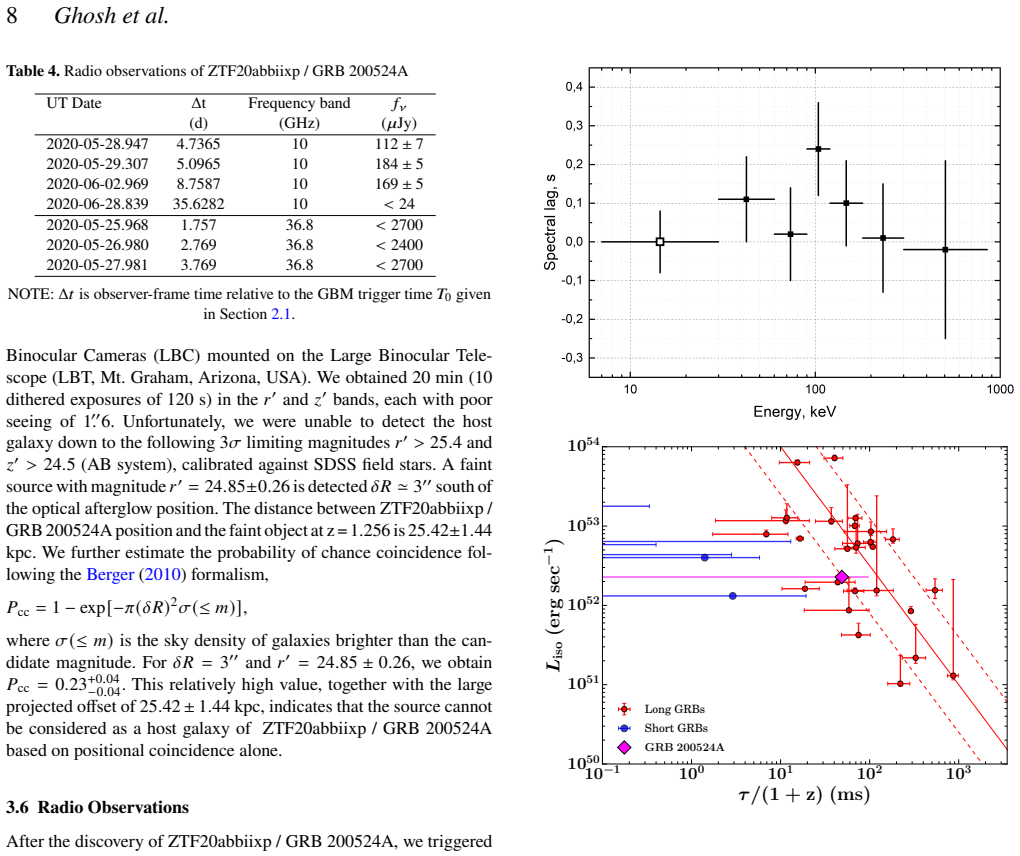
- [Section 4.1.1] The text says there is no significant spectral lag across the (7, 850) keV range, but later reports a 250 +/- 100 ms lag between the 10-30 keV and 50-100 keV bands; please clarify whether these statements refer to different band pairs or different significance criteria.
- [Table 4] The first three 10 GHz entries are formatted as '10112 +/- 7', etc., which likely means 112 +/- 7 microJy; the column would be clearer if written as 112 +/- 7.
- [Appendix A] The table header reads 'Photomeric observations'; the intended word is 'Photometric'.
- [Throughout] The source name is written both as ZTF20abbiix and as ZTF20abbiixp; please use one consistent designation after the discovery section.
Circularity Check
No significant circularity: afterglow parameters are fitted to the data, external correlations are benchmark comparisons, and the self-cited model equations rest on standard external-shock formalism.
full rationale
The paper's central afterglow claim is a goodness-of-fit statement: a Bayesian fit of an FS+RS model to the panchromatic data returns parameters such as log10 n0 = 2.82 and log10 epsB = -0.53. Fitting a model to data and then reporting that the model describes the data is not circular, because the paper does not present these fitted values as independent predictions of a separate dataset. The position of ZTF20abbiixp / GRB 200524A in the log(Ek,iso)-log(epsB) plane is compared against the external Aksulu et al. (2022) sample; the burst was not used in constructing that correlation, so the 'beyond 3-sigma' placement is a model-dependent comparison, not a self-defined result. The closure-relation analysis in Section 4.2.1 explicitly finds that the indices do not distinguish ISM from wind, and the subsequent FS+RS modeling is presented as an interpretation of the full dataset rather than as a derivation forced by the closure relations. The expressions for the model are cited to Ghosh et al. (2026), a self-citation, but the same sentence also cites the standard external-shock framework of Panaitescu & Kumar (2000), Granot & Sari (2002), Gao et al. (2013), and Kumar & Zhang (2015), so the self-citation is not load-bearing in the sense of replacing an external physical basis. No uniqueness theorem is imported from the authors' prior work, and no fitted parameter is renamed as a prediction. Concerns that some posterior maxima sit near prior boundaries (log10 n0 = 2.822 vs. an upper limit of 3; log10 epsB = -0.528 vs. -0.5; tX = 4893 s vs. 6000 s) are robustness and prior-sensitivity issues, not circularity. The derivation chain is therefore self-contained against external benchmarks, and no circular step is exhibited.
Assumptions & free parameters
free parameters (10)
- theta_j (jet opening angle) =
0.273 rad (posterior best fit)
- log10 E0 (isotropic kinetic energy) =
54.255 (1.8e54 erg)
- log10 n0 (ambient density) =
2.822 cm^-3
- p (electron powerlaw index) =
2.041
- log10 eps_e =
-2.96
- log10 eps_B =
-0.528 (0.3)
- p_RS =
2.083
- log10 eps_e,RS =
-0.705
- log10 eps_B,RS =
-5.456
- t_X (reverse shock crossing time) =
4893 s
assumptions (6)
- domain assumption The fireball/external shock model: the afterglow is synchrotron emission from forward and reverse shocks in a relativistic blast wave.
- domain assumption Top-hat jet with initially quasi-spherical deceleration.
- domain assumption Density profile n(R) = (A/mp) R^-k with only k=0 or k=2 considered.
- domain assumption Synchrotron self-Compton does not contribute without VHE detection.
- domain assumption Redshift z = 1.256 from Mg II absorption lines, with Cr II and Ca II tentative.
- standard math Standard Lambda-CDM cosmology with H0=70, Omega_m=0.27, Omega_Lambda=0.73.
Cite this review
Pith. "Pith review of Exploring the multi-wavelength properties of the high energetic event ZTF20abbiixp/GRB 200524A: from prompt emission to afterglow." pith.science (2026). https://pith.science/paper/B4LJ4SGO
@misc{pith2026260809704,
  author       = {Pith},
  title        = {Pith review of: Exploring the multi-wavelength properties of the high energetic event ZTF20abbiixp/GRB 200524A: from prompt emission to afterglow},
  year         = {2026},
  howpublished = {\url{https://pith.science/paper/B4LJ4SGO}},
  note         = {Machine review of arXiv:2608.09704}
}
abstract
We conducted a comprehensive multi-wavelength analysis of a high energetic long-duration ZTF20abbiixp / GRB~200524A detected by \textit{Fermi} Gamma Ray Burst Monitor (GBM). Our study combines extended high-energy observations from multiple space-based observatories including \textit{Fermi} with broadband afterglow data spanning X-ray to radio wavelengths, complemented by extensive photometric and spectroscopic follow-up from several ground-based optical facilities worldwide like 3.6-m Devasthal Optical Telescope (DOT). ZTF20abbiixp / GRB~200524A exhibits almost negligible spectral lag, likely arising from the presence of multiple overlapping emission episodes, a property uncommon among long-duration bursts. The burst additionally shows a clear intensity-tracking evolution of the prompt-emission spectral parameters. The broadband afterglow light curve best fits with a broken powerlaw with a break at $10^{5}$ s since the GBM trigger. The electron powerlaw index (p) calculated from the temporal and spectral slopes fail to distinguish between a interstellar medium and a wind environment. Our custom-developed afterglow model fits the panchromatic data well, combining forward shock (FS) and reverse shock (RS) emission. The RS contribution required to fit the early time optical data. The inferred afterglow model parameters suggest that ZTF20abbiixp / GRB~200524A is a high energetic burst expanding into a dense ISM environment, with a relatively large value of the fraction of energy going to accelerating electron and magnetic field ($\epsilon_B$).
Figures


Figures from the paper (8 more)




Reference graph
Works this paper leans on
-
[1]
Erratum: The E _ p,i -E _ iso correlation: type I gamma-ray bursts and the new classification method. , keywords =. doi:10.1093/mnras/stab1031ERRATUM: 10.1093/mnras/stz3611 , adsurl =
-
[2]
A Short Gamma-ray Burst ``No-host'' Problem? Investigating Large Progenitor Offsets for Short GRBs with Optical Afterglows. , keywords =. doi:10.1088/0004-637X/722/2/1946 , archivePrefix =. 1007.0003 , primaryClass =
arXiv 1946
-
[3]
Constraining Gamma-ray Burst Initial Lorentz Factor with the Afterglow Onset Feature and Discovery of a Tight _ 0 -E _ ,iso Correlation. , keywords =. doi:10.1088/0004-637X/725/2/2209 , archivePrefix =. 0912.4800 , primaryClass =
-
[4]
Gamma-Ray Bursts from Stellar Mass Accretion Disks around Black Holes. , keywords =. doi:10.1086/172359 , adsurl =
-
[5]
Cosmological Fast Optical Transients with the Zwicky Transient Facility: A Search for Dirty Fireballs. , keywords =. doi:10.3847/1538-4357/ac8bd0 , archivePrefix =. 2201.12366 , primaryClass =
-
[6]
Bulletin de la Societe Royale des Sciences de Liege , keywords =
3.6-m Devasthal Optical Telescope Project: Completion and first results. Bulletin de la Societe Royale des Sciences de Liege , keywords =
-
[7]
Astronomical Society of India Conference Series , year = 2012, series =
New optical telescopes at Devasthal observatory : 1.3-m installed and 3.6-m upcoming. Astronomical Society of India Conference Series , year = 2012, series =
2012
-
[8]
Nucleosynthesis, neutrino bursts and -rays from coalescing neutron stars. , keywords =. doi:10.1038/340126a0 , adsurl =
Show all 294 references
-
[9]
, keywords =
The Supernova Gamma-Ray Burst Connection. , keywords =. doi:10.1146/annurev.astro.43.072103.150558 , archivePrefix =. astro-ph/0609142 , primaryClass =
-
[10]
Explosion mechanisms
Magnetorotational core collapse of possible GRB progenitors - I. Explosion mechanisms. , keywords =. doi:10.1093/mnras/staa096 , archivePrefix =. 1909.01105 , primaryClass =
1909 arXiv
-
[11]
, keywords =
A Study of Compact Object Mergers as Short Gamma-Ray Burst Progenitors. , keywords =. doi:10.1086/505169 , archivePrefix =. astro-ph/0601458 , primaryClass =
-
[12]
, keywords =
ALMA and GMRT Constraints on the Off-axis Gamma-Ray Burst 170817A from the Binary Neutron Star Merger GW170817. , keywords =. doi:10.3847/2041-8213/aa970b , archivePrefix =. 1710.05847 , primaryClass =
-
[13]
, keywords =
Gravitational Waves and Gamma-Rays from a Binary Neutron Star Merger: GW170817 and GRB 170817A. , keywords =. doi:10.3847/2041-8213/aa920c , archivePrefix =. 1710.05834 , primaryClass =
-
[14]
A Comprehensive Analysis of Fermi Gamma-Ray Burst Data. III. Energy-dependent T _ 90 Distributions of GBM GRBs and Instrumental Selection Effect on Duration Classification. , keywords =. doi:10.1088/0004-637X/763/1/15 , archivePrefix =. 1205.1188 , primaryClass =
-
[15]
, keywords =
Instrumental Tip-of-the-iceberg Effects on the Prompt Emission of Swift/BAT Gamma-ray Bursts. , keywords =. doi:10.3847/1538-4357/ac4d94 , archivePrefix =. 2111.13392 , primaryClass =
-
[16]
Nature Astronomy , keywords =
Discovery and confirmation of the shortest gamma-ray burst from a collapsar. Nature Astronomy , keywords =. doi:10.1038/s41550-021-01428-7 , archivePrefix =. 2105.05067 , primaryClass =
-
[17]
, keywords =
A kilonova following a long-duration gamma-ray burst at 350 Mpc. , keywords =. doi:10.1038/s41586-022-05390-w , archivePrefix =. 2204.10864 , primaryClass =
-
[18]
, keywords =
A nearby long gamma-ray burst from a merger of compact objects. , keywords =. doi:10.1038/s41586-022-05327-3 , archivePrefix =. 2209.03363 , primaryClass =
-
[19]
, keywords =
The First Fermi-LAT Gamma-Ray Burst Catalog. , keywords =. doi:10.1088/0067-0049/209/1/11 , archivePrefix =. 1303.2908 , primaryClass =
-
[20]
, keywords =
The physics of gamma-ray bursts & relativistic jets. , keywords =. doi:10.1016/j.physrep.2014.09.008 , archivePrefix =. 1410.0679 , primaryClass =
2014 arXiv
-
[21]
Advances in Astronomy , keywords =
Physics of Gamma-Ray Bursts Prompt Emission. Advances in Astronomy , keywords =. doi:10.1155/2015/907321 , archivePrefix =. 1504.02626 , primaryClass =
2015 arXiv
-
[22]
, keywords =
Identification and Properties of the Photospheric Emission in GRB090902B. , keywords =. doi:10.1088/2041-8205/709/2/L172 , archivePrefix =. 0911.2025 , primaryClass =
2025 arXiv
-
[23]
A Comprehensive Analysis of Fermi Gamma-ray Burst Data. I. Spectral Components and the Possible Physical Origins of LAT/GBM GRBs. , keywords =. doi:10.1088/0004-637X/730/2/141 , archivePrefix =. 1009.3338 , primaryClass =
-
[24]
GRB Coordinates Network , year = 2020, month = may, volume =
GRB 200524A: Fermi-LAT detection. GRB Coordinates Network , year = 2020, month = may, volume =
2020
-
[25]
GRB Coordinates Network , year = 2020, month = may, volume =
GRB 200524A: Liverpool Telescope observations. GRB Coordinates Network , year = 2020, month = may, volume =
2020
-
[26]
GRB Coordinates Network , year = 2020, month = may, volume =
GRB 200524A: Assy continued optical observations. GRB Coordinates Network , year = 2020, month = may, volume =
2020
-
[27]
GRB Coordinates Network , year = 2020, month = may, volume =
GRB 200524A: Assy optical observations. GRB Coordinates Network , year = 2020, month = may, volume =
2020
-
[28]
GRB Coordinates Network , year = 2020, month = may, volume =
GRB 200524A: OAJ multicolor afterglow detection. GRB Coordinates Network , year = 2020, month = may, volume =
2020
-
[29]
, keywords =
Lower Limits on Lorentz Factors in Gamma-Ray Bursts. , keywords =. doi:10.1086/321455 , archivePrefix =. astro-ph/0011508 , primaryClass =
-
[30]
GRB Coordinates Network , year = 2020, month = may, volume =
GRB 200524A: Correction to the GCN 27800. GRB Coordinates Network , year = 2020, month = may, volume =
2020
-
[31]
GRB Coordinates Network , year = 2020, month = may, volume =
GRB 200524A: GROWTH-India confirmation of optical afterglow. GRB Coordinates Network , year = 2020, month = may, volume =
2020
-
[32]
, keywords =
Afterglow Observations of Fermi Large Area Telescope Gamma-ray Bursts and the Emerging Class of Hyper-energetic Events. , keywords =. doi:10.1088/0004-637X/732/1/29 , archivePrefix =. 1004.2900 , primaryClass =
-
[33]
, keywords =
A High Signal-to-noise Ratio Composite Spectrum of Gamma-ray Burst Afterglows. , keywords =. doi:10.1088/0004-637X/727/2/73 , archivePrefix =. 1011.0734 , primaryClass =
-
[34]
, keywords =
The Prompt Energy Release of Gamma-Ray Bursts using a Cosmological k-Correction. , keywords =. doi:10.1086/321093 , archivePrefix =. astro-ph/0102371 , primaryClass =
-
[35]
, keywords =
A Comparison of the Afterglows of Short- and Long-duration Gamma-ray Bursts. , keywords =. doi:10.1088/0004-637X/701/1/824 , archivePrefix =. 0806.3607 , primaryClass =
-
[36]
GRB Coordinates Network , year = 2019, month = sep, volume =
Swift XRT Detection of X-ray Emission from ZTF19abvizsw. GRB Coordinates Network , year = 2019, month = sep, volume =
2019
-
[37]
GRB Coordinates Network , year = 2019, month = sep, volume =
LIGO/Virgo S190901ap: Keck I LRIS spectroscopy of ZTF19abvizsw. GRB Coordinates Network , year = 2019, month = sep, volume =
2019
-
[38]
, keywords =
Discovery of a Cosmological, Relativistic Outburst via its Rapidly Fading Optical Emission. , keywords =. doi:10.1088/0004-637X/769/2/130 , archivePrefix =. 1304.4236 , primaryClass =
-
[39]
Reviews of Modern Physics , keywords =
The physics of gamma-ray bursts. Reviews of Modern Physics , keywords =. doi:10.1103/RevModPhys.76.1143 , archivePrefix =. astro-ph/0405503 , primaryClass =
-
[40]
, keywords =
Observations of the GRB Afterglow ATLAS17aeu and Its Possible Association with GW 170104. , keywords =. doi:10.3847/1538-4357/aa95c1 , archivePrefix =. 1706.00175 , primaryClass =
-
[41]
, keywords =
A Tale of Two Transients: GW 170104 and GRB 170105A. , keywords =. doi:10.3847/1538-4357/aa81d2 , archivePrefix =. 1706.00024 , primaryClass =
-
[42]
, keywords =
iPTF14yb: The First Discovery of a Gamma-Ray Burst Afterglow Independent of a High-energy Trigger. , keywords =. doi:10.1088/2041-8205/803/2/L24 , archivePrefix =. 1504.00673 , primaryClass =
-
[43]
, keywords =
How to Tell a Jet from a Balloon: A Proposed Test for Beaming in Gamma-Ray Bursts. , keywords =. doi:10.1086/310876 , archivePrefix =. astro-ph/9705163 , primaryClass =
-
[44]
, keywords =
Beaming, Baryon Loading, and the Synchrotron Self-Compton Component in Gamma-Ray Bursts. , keywords =. doi:10.1086/309061 , archivePrefix =. astro-ph/9910240 , primaryClass =
- [45]
-
[46]
, keywords =
Simulation of optical interstellar scintillation. , keywords =. doi:10.1051/0004-6361/201220172 , archivePrefix =. 1301.0514 , primaryClass =
-
[47]
GRB Coordinates Network , year = 2020, month = may, volume =
Konus-Wind observation of GRB 200524A. GRB Coordinates Network , year = 2020, month = may, volume =
2020
-
[48]
, year = 1995, month = feb, volume =
Konus-W Gamma-Ray Burst Experiment for the GGS Wind Spacecraft. , year = 1995, month = feb, volume =. doi:10.1007/BF00751332 , adsurl =
1995 doi
-
[49]
, year = 2014, series =
ASTROSAT mission. , year = 2014, series =. doi:10.1117/12.2062667 , adsurl =
2014 doi
-
[50]
GRB Coordinates Network , year = 2020, month = may, volume =
GRB 200524A: AstroSat CZTI detection. GRB Coordinates Network , year = 2020, month = may, volume =
2020
-
[51]
American Institute of Physics Conference Series , year = 2011, editor =
An Updated Ultraviolet Calibration for the Swift/UVOT. American Institute of Physics Conference Series , year = 2011, editor =. doi:10.1063/1.3621807 , archivePrefix =. 1102.4717 , primaryClass =
2011 arXiv
-
[52]
GRB Coordinates Network , year = 2020, month = may, volume =
GRB200524A: UVOT detection. GRB Coordinates Network , year = 2020, month = may, volume =
2020
-
[53]
GRB Coordinates Network , year = 2020, month = may, volume =
GRB 200524: Swift/UVOT observations missed the ZTF20abbiixp position. GRB Coordinates Network , year = 2020, month = may, volume =
2020
-
[54]
Astronomical Data Analysis Software and Systems V , year = 1996, series =
XSPEC: The First Ten Years. Astronomical Data Analysis Software and Systems V , year = 1996, series =
1996
-
[55]
, archivePrefix = "arXiv", eprint =
Calibration of X-ray absorption in our Galaxy. , archivePrefix = "arXiv", eprint =. doi:10.1093/mnras/stt175 , adsurl =
-
[56]
Nature Astronomy , keywords =
Dense gas linked to star-forming regions photoionized by embedded gamma-ray bursts. Nature Astronomy , keywords =. doi:10.1038/s41550-026-02786-w , archivePrefix =. 2601.07919 , primaryClass =
-
[57]
, keywords =
A Decade of Gamma-Ray Bursts Observed by Fermi-LAT: The Second GRB Catalog. , keywords =. doi:10.3847/1538-4357/ab1d4e , archivePrefix =. 1906.11403 , primaryClass =
1906 arXiv
-
[58]
, keywords =
The Expanded Very Large Array: A New Telescope for New Science. , keywords =. doi:10.1088/2041-8205/739/1/L1 , archivePrefix =. 1106.0532 , primaryClass =
-
[59]
arXiv e-prints , keywords =
ZTF20aajnksq (AT2020blt): A Fast Optical Transient at z 2.9 With No Detected Gamma-Ray Burst Counterpart. arXiv e-prints , keywords =
-
[60]
GRB Coordinates Network , year = 2020, month = may, volume =
GRB 200524A: Swift-XRT afterglow detection. GRB Coordinates Network , year = 2020, month = may, volume =
2020
-
[61]
GRB Coordinates Network , year = 2020, month = may, volume =
GRB 200524A: Swift ToO observations. GRB Coordinates Network , year = 2020, month = may, volume =
2020
-
[62]
BATSE Observations of Gamma-Ray Burst Spectra. I. Spectral Diversity. , keywords =. doi:10.1086/172995 , adsurl =
-
[63]
GRB Coordinates Network , year = 2020, month = may, volume =
GRB 200524A: Fermi GBM detection. GRB Coordinates Network , year = 2020, month = may, volume =
2020
-
[64]
, keywords =
The Fermi Gamma-ray Burst Monitor. , keywords =. doi:10.1088/0004-637X/702/1/791 , archivePrefix =. 0908.0450 , primaryClass =
-
[65]
GRB Coordinates Network , year = 2020, month = may, volume =
ZTF Discovery of ZTF20abbiixp: The Likely Optical Afterglow to GRB 200524A. GRB Coordinates Network , year = 2020, month = may, volume =
2020
-
[66]
, keywords =
The Automated Palomar 60 Inch Telescope. , keywords =. 2006. doi:10.1086/508366 , archivePrefix =. astro-ph/0608323 , primaryClass =
2006 arXiv
-
[67]
arXiv e-prints , keywords =
A Fully Automated Integral Field Spectrograph Pipeline for the SEDMachine: pysedm. arXiv e-prints , keywords =. 2019
2019
-
[68]
Richard Dekany and Roger M. Smith and Reed Riddle and Michael Feeney and Michael Porter and David Hale and Jeffry Zolkower and Justin Belicki and Stephen Kaye and John Henning and Richard Walters and John Cromer and Alex Delacroix and Hector Rodriguez and Daniel J. Reiley and ...
-
[69]
, keywords =
Host Galaxies of Type Ic and Broad-lined Type Ic Supernovae from the Palomar Transient Factory: Implications for Jet Production. , keywords =. doi:10.3847/1538-4357/ab4185 , archivePrefix =. 1901.00872 , primaryClass =
1901 arXiv
-
[70]
, keywords =
On the variation of the initial mass function. , keywords =. doi:10.1046/j.1365-8711.2001.04022.x , archivePrefix =. astro-ph/0009005 , primaryClass =
2001
-
[71]
, keywords =
Transparent Helium in Stripped Envelope Supernovae. , keywords =. doi:10.1088/2041-8205/792/1/L11 , archivePrefix =. 1407.5992 , primaryClass =
-
[72]
, keywords =
X-Ray Emission from Supernovae in Dense Circumstellar Matter Environments: A Search for Collisionless Shocks. , keywords =. doi:10.1088/0004-637X/763/1/42 , archivePrefix =. 1206.0748 , primaryClass =
-
[73]
, keywords =
The Large Area Telescope on the Fermi Gamma-Ray Space Telescope Mission. , keywords =. doi:10.1088/0004-637X/697/2/1071 , archivePrefix =. 0902.1089 , primaryClass =
-
[74]
, keywords =
Wave-driven mass loss in the last year of stellar evolution: setting the stage for the most luminous core-collapse supernovae. , keywords =. doi:10.1111/j.1745-3933.2012.01264.x , archivePrefix =. 1202.5036 , primaryClass =
2012
-
[76]
, keywords =
An online repository of Swift/XRT light curves of -ray bursts. , keywords =. doi:10.1051/0004-6361:20077530 , archivePrefix =. 0704.0128 , primaryClass =
-
[77]
, archivePrefix = "arXiv", eprint =
Multi-messenger Observations of a Binary Neutron Star Merger. , archivePrefix = "arXiv", eprint =. doi:10.3847/2041-8213/aa91c9 , adsurl =
-
[78]
, keywords =
An Ordinary Short Gamma-Ray Burst with Extraordinary Implications: Fermi-GBM Detection of GRB 170817A. , keywords =. doi:10.3847/2041-8213/aa8f41 , archivePrefix =. 1710.05446 , primaryClass =
-
[79]
Science , archivePrefix = "arXiv", eprint =
Swope Supernova Survey 2017a (SSS17a), the optical counterpart to a gravitational wave source. Science , archivePrefix = "arXiv", eprint =. doi:10.1126/science.aap9811 , adsurl =
-
[80]
Science , archivePrefix = "arXiv", eprint =
A radio counterpart to a neutron star merger. Science , archivePrefix = "arXiv", eprint =. doi:10.1126/science.aap9855 , adsurl =
-
[81]
, keywords =
GW190425: Observation of a Compact Binary Coalescence with Total Mass 3.4 M _ ☉. , keywords =. doi:10.3847/2041-8213/ab75f5 , archivePrefix =. 2001.01761 , primaryClass =
2001 arXiv
-
[82]
, archivePrefix = "arXiv", eprint =
Galaxy And Mass Assembly: accurate panchromatic photometry from optical priors using LAMBDAR. , archivePrefix = "arXiv", eprint =. doi:10.1093/mnras/stw832 , adsurl =
-
[83]
Census of the Local Universe (CLU) Narrowband Survey. I. Galaxy Catalogs from Preliminary Fields. , keywords =. doi:10.3847/1538-4357/ab2131 , archivePrefix =. 1710.05016 , primaryClass =
-
[84]
, keywords =
A Simple Model for the Absorption of Starlight by Dust in Galaxies. , keywords =. doi:10.1086/309250 , archivePrefix =. astro-ph/0003128 , primaryClass =
-
[85]
, archivePrefix = "arXiv", eprint =
The Ninth Data Release of the Sloan Digital Sky Survey: First Spectroscopic Data from the SDSS-III Baryon Oscillation Spectroscopic Survey. , archivePrefix = "arXiv", eprint =. doi:10.1088/0067-0049/203/2/21 , adsurl =
-
[86]
, keywords =
unWISE: Unblurred Coadds of the WISE Imaging. , keywords =. 2014. doi:10.1088/0004-6256/147/5/108 , archivePrefix =. 1405.0308 , primaryClass =
2014 arXiv
-
[87]
, keywords =
Full-depth Coadds of the WISE and First-year NEOWISE-reactivation Images. , keywords =. 2017. doi:10.3847/1538-3881/153/1/38 , archivePrefix =. 1603.05664 , primaryClass =
2017 arXiv
-
[88]
, Title =
HEASARC , Date-Added =. , Title =
-
[89]
astro-ph.IM
The Pan-STARRS1 Database and Data Products. arXiv:1612.05243 , primaryClass = "astro-ph.IM", keywords =
-
[90]
arXiv e-prints , keywords =
The Koala: A Fast Blue Optical Transient with Luminous Radio Emission from a Starburst Dwarf Galaxy at z=0.27. arXiv e-prints , keywords =
-
[91]
, keywords =
The Swift X-Ray Telescope. , keywords =. doi:10.1007/s11214-005-5097-2 , archivePrefix =. astro-ph/0508071 , primaryClass =
- [92]
-
[93]
, keywords =
An Embedded X-Ray Source Shines through the Aspherical AT 2018cow: Revealing the Inner Workings of the Most Luminous Fast-evolving Optical Transients. , keywords =. doi:10.3847/1538-4357/aafa01 , archivePrefix =. 1810.10720 , primaryClass =
-
[94]
Nearby supernova host galaxies from the CALIFA Survey. I. Sample, data analysis, and correlation to star-forming regions. , keywords =. doi:10.1051/0004-6361/201424717 , archivePrefix =. 1409.1623 , primaryClass =
-
[95]
, keywords =
UBVRI Photometry of SN 1993J in M81: Days 3 to 365. , keywords =. doi:10.1086/118048 , adsurl =
-
[96]
Serbian Astronomical Journal , keywords =
Large Synoptic Survey Telescope: From Science Drivers To Reference Design. Serbian Astronomical Journal , keywords =. doi:10.2298/SAJ0876001I , adsurl =
-
[97]
Summer School on Machine Learning , pages=
Gaussian processes in machine learning , author=. Summer School on Machine Learning , pages=. 2003 , organization=
2003
-
[98]
SNCosmo: Python library for supernova cosmology. 2016
2016
-
[99]
, keywords =
simsurvey: estimating transient discovery rates for the Zwicky transient facility. , keywords =. doi:10.1088/1475-7516/2019/10/005 , archivePrefix =. 1902.03923 , primaryClass =
2019 arXiv
-
[100]
, keywords =
Dynamical Capture Binary Neutron Star Mergers. , keywords =. doi:10.1088/2041-8205/760/1/L4 , archivePrefix =. 1208.5279 , primaryClass =
-
[101]
Astronomical Data Analysis Software and Systems IV , year = 1995, editor =
FTOOLS: A FITS Data Processing and Analysis Software Package. Astronomical Data Analysis Software and Systems IV , year = 1995, editor =
1995
-
[102]
arXiv e-prints , keywords =
ZTF Early Observations of Type Ia Supernovae II: First Light, the Initial Rise, and Time to Reach Maximum Brightness. arXiv e-prints , keywords =
-
[103]
Proceedings of the Royal Society of London
An invariant form for the prior probability in estimation problems , author=. Proceedings of the Royal Society of London. Series A. Mathematical and Physical Sciences , volume=. 1946 , publisher=
1946
-
[104]
, keywords =
Oxygen and helium in stripped-envelope supernovae. , keywords =. doi:10.1051/0004-6361/201731701 , archivePrefix =. 1807.00100 , primaryClass =
-
[105]
, keywords =
Electron scattering wings on lines in interacting supernovae. , keywords =. doi:10.1093/mnras/stx3163 , archivePrefix =. 1712.01237 , primaryClass =
-
[106]
, keywords =
Electron-capture supernovae exploding within their progenitor wind. , keywords =. doi:10.1051/0004-6361/201424264 , archivePrefix =. 1407.4563 , primaryClass =
-
[107]
, keywords =
The [O i] lambda lambda 6300,6364 Doublet of SN 1987A. , keywords =. doi:10.1086/171082 , adsurl =
-
[108]
, keywords =
The Palomar Transient Factory: System Overview, Performance, and First Results. , keywords =. doi:10.1086/648598 , archivePrefix =. 0906.5350 , primaryClass =
-
[109]
, keywords =
Exploring the Optical Transient Sky with the Palomar Transient Factory. , keywords =. doi:10.1086/605911 , archivePrefix =. 0906.5355 , primaryClass =
-
[111]
, keywords =
Double Neutron Star Populations and Formation Channels. , keywords =. doi:10.3847/2041-8213/ab2ed1 , archivePrefix =. 1904.12745 , primaryClass =
1904 arXiv
-
[112]
, keywords =
The cosmic merger rate of neutron stars and black holes. , keywords =. doi:10.1093/mnras/sty1613 , archivePrefix =. 1806.04866 , primaryClass =
-
[113]
Double Compact Objects. II. Cosmological Merger Rates. , keywords =. doi:10.1088/0004-637X/779/1/72 , archivePrefix =. 1308.1546 , primaryClass =
-
[114]
IAU Symposium , year = 2019, editor =
Local merger rates of double neutron stars. IAU Symposium , year = 2019, editor =. doi:10.1017/S1743921318007639 , archivePrefix =. 1811.09296 , primaryClass =
2019 arXiv
-
[115]
, keywords =
The influence of the distribution of cosmic star formation at different metallicities on the properties of merging double compact objects. , keywords =. doi:10.1093/mnras/sty3087 , archivePrefix =. 1811.03565 , primaryClass =
-
[116]
, keywords =
Double neutron stars: merger rates revisited. , keywords =. doi:10.1093/mnras/stx2923 , archivePrefix =. 1708.07885 , primaryClass =
-
[117]
, keywords =
Constraints on the Formation of Double Neutron Stars from the Observed Eccentricities and Current Limits on Merger Rates. , keywords =. doi:10.32023/0001-5237/67.1.2 , archivePrefix =. 1611.05366 , primaryClass =
-
[118]
, keywords =
Multidimensional simulations of ultrastripped supernovae to shock breakout. , keywords =. doi:10.1093/mnras/sty1683 , archivePrefix =. 1803.03388 , primaryClass =
-
[119]
, keywords =
Neutron star kicks and their relationship to supernovae ejecta mass. , keywords =. doi:10.1093/mnras/stw1275 , archivePrefix =. 1605.09529 , primaryClass =
-
[120]
, keywords =
The Effects of Binary Evolution on the Dynamics of Core Collapse and Neutron Star Kicks. , keywords =. doi:10.1086/421713 , archivePrefix =. astro-ph/0309588 , primaryClass =
-
[121]
, keywords =
A Global Three-dimensional Radiation Magneto-hydrodynamic Simulation of Super-Eddington Accretion Disks. , keywords =. doi:10.1088/0004-637X/796/2/106 , archivePrefix =. 1410.0678 , primaryClass =
-
[122]
, keywords =
A Wind-disk Self-irradiation Model for Supercritical Accretion. , keywords =. doi:10.3847/2041-8213/ab44c7 , archivePrefix =. 1909.07565 , primaryClass =
1909 arXiv
-
[123]
, keywords =
Progenitors of gravitational wave mergers: binary evolution with the stellar grid-based code COMBINE. , keywords =. doi:10.1093/mnras/sty2190 , archivePrefix =. 1801.05433 , primaryClass =
-
[125]
, keywords =
Timing of a young mildly recycled pulsar with a massive white dwarf companion. , keywords =. doi:10.1093/mnras/stt1996 , archivePrefix =. 1310.5857 , primaryClass =
-
[127]
, keywords =
The Rotation Rates of Massive Stars: The Role of Binary Interaction through Tides, Mass Transfer, and Mergers. , keywords =. doi:10.1088/0004-637X/764/2/166 , archivePrefix =. 1211.3742 , primaryClass =
-
[128]
, keywords =
Evolution of binary stars and the effect of tides on binary populations. , keywords =. doi:10.1046/j.1365-8711.2002.05038.x , archivePrefix =. astro-ph/0201220 , primaryClass =
2002
-
[129]
Hydrogen-poor stars
Pre-supernova outbursts via wave heating in massive stars - II. Hydrogen-poor stars. , keywords =. doi:10.1093/mnras/sty369 , archivePrefix =. 1710.04251 , primaryClass =
-
[130]
Observational constraints on the progenitors of Type Ibc supernovae
The death of massive stars - II. Observational constraints on the progenitors of Type Ibc supernovae. , keywords =. doi:10.1093/mnras/stt1612 , archivePrefix =. 1301.1975 , primaryClass =
1975 arXiv
-
[131]
arXiv e-prints , keywords =
Radiation Hydrodynamical Simulations of Eruptive Mass Loss from Progenitors of Type Ibn/IIn Supernovae. arXiv e-prints , keywords =
-
[132]
, keywords =
Super-Eddington stellar winds driven by near-surface energy deposition. , keywords =. doi:10.1093/mnras/stw365 , archivePrefix =. 1509.06370 , primaryClass =
-
[133]
, keywords =
Large-scale Mixing in a Violent Oxygen─Neon Shell Merger Prior to a Core-collapse Supernova. , keywords =. doi:10.3847/1538-4357/ab66bb , archivePrefix =. 1905.04378 , primaryClass =
1905 arXiv
-
[134]
, keywords =
Mass loss of massive stars near the Eddington luminosity by core neutrino emission shortly before their explosion. , keywords =. doi:10.1051/0004-6361/201322992 , archivePrefix =. 1403.2731 , primaryClass =
-
[135]
, keywords =
Turbulent mixing and nuclear burning in stellar interiors. , keywords =. doi:10.1093/mnras/sty2392 , archivePrefix =. 1808.06737 , primaryClass =
-
[136]
, keywords =
Origins of Type Ibn SNe 2006jc/2015G in interacting binaries and implications for pre-SN eruptions. , keywords =. doi:10.1093/mnras/stz3431 , archivePrefix =. 1909.07999 , primaryClass =
1909 arXiv
-
[137]
, keywords =
Detailed models of the binary pulsars J1141-6545 and B2303+46. , keywords =. doi:10.1111/j.1365-2966.2006.10897.x , adsurl =
2006
-
[138]
Science , keywords =
Lense─Thirring frame dragging induced by a fast-rotating white dwarf in a binary pulsar system. Science , keywords =. doi:10.1126/science.aax7007 , archivePrefix =. 2001.11405 , primaryClass =
2001 arXiv
-
[139]
Low-mass objects
How much H and He is 'hidden' in SNe Ib/c? - I. Low-mass objects. , keywords =. doi:10.1111/j.1365-2966.2012.20464.x , archivePrefix =. 1201.1506 , primaryClass =
2012
-
[140]
, keywords =
Dawes Review 6: The Impact of Companions on Stellar Evolution. , keywords =. doi:10.1017/pasa.2016.52 , archivePrefix =. 1611.03542 , primaryClass =
2016 arXiv
-
[141]
, keywords =
Predicting the Presence of Companions for Stripped-envelope Supernovae: The Case of the Broad-lined Type Ic SN 2002ap. , keywords =. doi:10.3847/1538-4357/aa7467 , archivePrefix =. 1705.07898 , primaryClass =
-
[142]
, keywords =
Mass Loss: Its Effect on the Evolution and Fate of High-Mass Stars. , keywords =. doi:10.1146/annurev-astro-081913-040025 , archivePrefix =. 1402.1237 , primaryClass =
-
[145]
, keywords =
The Rate of iPTF 14gqr like Ultra-stripped Supernovae and Binary Evolution Leading to Double Neutron Star Formation. , keywords =. doi:10.3847/1538-4357/ab321c , archivePrefix =. 1903.07575 , primaryClass =
1903 arXiv
-
[146]
, keywords =
Nebular Spectroscopy: A Guide on Hii Regions and Planetary Nebulae. , keywords =. doi:10.1088/1538-3873/aa72c3 , archivePrefix =. 1705.06323 , primaryClass =
-
[147]
, keywords =
The Chemical Composition of the Small Magellanic Cloud H II Region NGC 346 and the Primordial Helium Abundance. , keywords =. doi:10.1086/309485 , archivePrefix =. astro-ph/0003154 , primaryClass =
-
[148]
, keywords =
Grains in Ionized Nebulae: Spectral Line Diagnostics. , keywords =. doi:10.1086/175217 , adsurl =
-
[149]
, keywords =
Physical conditions in the UV line emitting region of supernova 1979cin NGC 4321. , keywords =
-
[150]
, keywords =
Coordinated optical, ultraviolet, radio and X-ray observations of SN 1979c in M 100. , keywords =. doi:10.1093/mnras/192.4.861 , adsurl =
-
[151]
A New Approach to Following Transients with HST: Rolling Snapshots
-
[152]
, keywords =
Radio Observations Reveal Unusual Circumstellar Environments for Some Type Ibc Supernova Progenitors. , keywords =. doi:10.1088/0004-637X/752/1/17 , archivePrefix =. 1201.5120 , primaryClass =
-
[153]
, keywords =
A Spectroscopic Study of Type Ibc Supernova Host Galaxies from Untargeted Surveys. , keywords =. doi:10.1088/0004-637X/758/2/132 , archivePrefix =. 1206.2643 , primaryClass =
-
[154]
, keywords =
The Chemical Composition of the Sun. , keywords =. doi:10.1146/annurev.astro.46.060407.145222 , archivePrefix =. 0909.0948 , primaryClass =
-
[155]
arXiv e-prints , keywords =
The Zwicky Transient Facility Bright Transient Survey I: Spectroscopic Classification and the Redshift Completeness of Local Galaxy Catalogs. arXiv e-prints , keywords =
-
[156]
arXiv e-prints , keywords =
The expansion of stripped-envelope stars: consequences for supernovae and gravitational-wave progenitors. arXiv e-prints , keywords =
-
[157]
Handbook of Supernovae , year = 2017, editor =
Interacting Supernovae: Types IIn and Ibn. Handbook of Supernovae , year = 2017, editor =. doi:10.1007/978-3-319-21846-5_38 , adsurl =
2017 doi
-
[158]
, year = 1994, month = may, volume =
SN 1988Z: low-mass ejecta colliding with the clumpy wind?. , year = 1994, month = may, volume =. doi:10.1093/mnras/268.1.173 , adsurl =
1994 doi
-
[159]
, keywords =
Synchrotron Self-Absorption in Radio Supernovae. , keywords =. doi:10.1086/305676 , adsurl =
-
[160]
, keywords =
A Deep Search for Prompt Radio Emission from Thermonuclear Supernovae with the Very Large Array. , keywords =. doi:10.3847/0004-637X/821/2/119 , archivePrefix =. 1510.07662 , primaryClass =
-
[161]
, keywords =
Self-similar solutions for the interaction of stellar ejecta with an external medium. , keywords =. doi:10.1086/160126 , adsurl =
-
[162]
, keywords =
The radio and X-ray emission from type II supernovae. , keywords =. doi:10.1086/160167 , adsurl =
-
[163]
I - Analytic solutions for the early part of the light curve
Type I supernovae. I - Analytic solutions for the early part of the light curve. , keywords =. 1982. doi:10.1086/159681 , adsurl =
1982 doi
-
[164]
arXiv , Author =:1307.6212 , Journal =
doi:10.1051/0004-6361/201322068 , Eid =. arXiv , Author =:1307.6212 , Journal =
-
[165]
, keywords =
Stellar population synthesis at the resolution of 2003. , keywords =. 2003. doi:10.1046/j.1365-8711.2003.06897.x , archivePrefix =. astro-ph/0309134 , primaryClass =
2003
-
[166]
pyraf-dbsp: Reduction pipeline for the Palomar Double Beam Spectrograph. 2016
2016
-
[167]
, keywords =
The Zwicky Transient Facility: Surveys and Scheduler. , keywords =. 2019. doi:10.1088/1538-3873/ab0c2a , archivePrefix =. 1905.02209 , primaryClass =
2019 arXiv
-
[168]
, keywords =
The Zwicky Transient Facility: System Overview, Performance, and First Results. , keywords =. 2019. doi:10.1088/1538-3873/aaecbe , archivePrefix =. 1902.01932 , primaryClass =
2019 arXiv
-
[169]
Ground-based and Airborne Instrumentation for Astronomy V , year = "2014", series =
First-generation instrumentation for the Discovery Channel Telescope. Ground-based and Airborne Instrumentation for Astronomy V , year = "2014", series =. doi:10.1117/12.2056872 , adsurl =
2014 doi
-
[170]
, keywords =
Faint Thermonuclear Supernovae from AM Canum Venaticorum Binaries. , keywords =. 2007. doi:10.1086/519489 , archivePrefix =. astro-ph/0703578 , primaryClass =
2007 arXiv
-
[171]
, keywords =
The SED Machine: A Robotic Spectrograph for Fast Transient Classification. , keywords =. 2018. doi:10.1088/1538-3873/aaa53f , archivePrefix =. 1710.02917 , primaryClass =
2018 arXiv
-
[172]
, archivePrefix = "arXiv", eprint =
Determining the Type, Redshift, and Age of a Supernova Spectrum. , archivePrefix = "arXiv", eprint =. doi:10.1086/520494 , adsurl =
-
[173]
, keywords =
Ultraviolet Spectroscopy of Supernovae: The First Two Years of Swift Observations. , keywords =. 2009. doi:10.1088/0004-637X/700/2/1456 , archivePrefix =. 0906.0367 , primaryClass =
2009 arXiv
-
[174]
, keywords =
CIGALE: a python Code Investigating GALaxy Emission. , keywords =. 2019. doi:10.1051/0004-6361/201834156 , archivePrefix =. 1811.03094 , primaryClass =
2019 arXiv
-
[175]
, keywords =
The Dust Content and Opacity of Actively Star-forming Galaxies. , keywords =. 2000. doi:10.1086/308692 , archivePrefix =. astro-ph/9911459 , primaryClass =
2000 arXiv
-
[176]
, keywords =
The Relationship between Infrared, Optical, and Ultraviolet Extinction. , keywords =. 1989. doi:10.1086/167900 , adsurl =
1989 doi
-
[177]
, keywords =
Galactic Stellar and Substellar Initial Mass Function. , keywords =. 2003. doi:10.1086/376392 , archivePrefix =. astro-ph/0304382 , primaryClass =
2003 arXiv
-
[178]
, keywords =
Shock Breakout in Dense Mass Loss: Luminous Supernovae. , keywords =. doi:10.1088/2041-8205/729/1/L6 , archivePrefix =. 1101.1111 , primaryClass =
-
[179]
, keywords =
The Transitional Stripped-envelope SN 2008ax: Spectral Evolution and Evidence for Large Asphericity. , keywords =. 2011. doi:10.1088/0004-637X/739/1/41 , archivePrefix =. 1001.2775 , primaryClass =
2011 arXiv
-
[180]
VizieR Online Data Catalog , keywords =
VizieR Online Data Catalog: AllWISE Data Release (Cutri+ 2013). VizieR Online Data Catalog , keywords =. 2013
2013
-
[181]
Infrared Emission from Interstellar Dust. IV. The Silicate-Graphite-PAH Model in the Post-Spitzer Era. , keywords =. 2007. doi:10.1086/511055 , archivePrefix =. astro-ph/0608003 , primaryClass =
2007 arXiv
-
[182]
Science , keywords =
A hot and fast ultra-stripped supernova that likely formed a compact neutron star binary. Science , keywords =. 2018. doi:10.1126/science.aas8693 , archivePrefix =. 1810.05181 , primaryClass =
2018 arXiv
-
[183]
, keywords =
Palomar Gattini-IR: Survey Overview, Data Processing System, On-sky Performance and First Results. , keywords =. doi:10.1088/1538-3873/ab6069 , archivePrefix =. 1910.13319 , primaryClass =
1910 arXiv
-
[184]
arXiv e-prints , keywords =
The Zwicky Transient Facility Census of the Local Universe I: Systematic search for Calcium rich gap transients reveal three related spectroscopic sub-classes. arXiv e-prints , keywords =
-
[185]
, archivePrefix = "arXiv", eprint =
ZTF 18aaqeasu (SN2018byg): A Massive Helium-shell Double Detonation on a Sub-Chandrasekhar-mass White Dwarf. , archivePrefix = "arXiv", eprint =. doi:10.3847/2041-8213/ab0aec , adsurl =
-
[186]
, keywords =
iPTF 16hgs: A Double-peaked Ca-rich Gap Transient in a Metal-poor, Star-forming Dwarf Galaxy. , keywords =. doi:10.3847/1538-4357/aadf8e , archivePrefix =. 1806.10623 , primaryClass =
-
[187]
Ground-based and Airborne Instrumentation for Astronomy VI , year = 2016, series =
The Zwicky Transient Facility Camera. Ground-based and Airborne Instrumentation for Astronomy VI , year = 2016, series =. doi:10.1117/12.2234558 , adsurl =
2016 doi
-
[188]
, keywords =
Multidimensional Simulations of the Accretion-induced Collapse of White Dwarfs to Neutron Stars. , keywords =. 2006. doi:10.1086/503626 , archivePrefix =. astro-ph/0601603 , primaryClass =
2006 arXiv
-
[189]
, keywords =
Magnetically Driven Explosions of Rapidly Rotating White Dwarfs Following Accretion-Induced Collapse. , keywords =. 2007. doi:10.1086/521701 , archivePrefix =. 0705.3678 , primaryClass =
2007 arXiv
-
[190]
, keywords =
Overview of the DESI Legacy Imaging Surveys. , keywords =. 2019. doi:10.3847/1538-3881/ab089d , archivePrefix =. 1804.08657 , primaryClass =
2019 arXiv
-
[191]
Science , keywords =
PTF 11kx: A Type Ia Supernova with a Symbiotic Nova Progenitor. Science , keywords =. 2012. doi:10.1126/science.1219164 , archivePrefix =. 1207.1306 , primaryClass =
2012 arXiv
-
[192]
, keywords =
The First Systematic Study of Type Ibc Supernova Multi-band Light Curves. , keywords =. 2011. doi:10.1088/0004-637X/741/2/97 , archivePrefix =. 1011.4959 , primaryClass =
2011 arXiv
-
[193]
, keywords =
The Fast and Furious Decay of the Peculiar Type Ic Supernova 2005ek. , keywords =. 2013. doi:10.1088/0004-637X/774/1/58 , archivePrefix =. 1306.2337 , primaryClass =
2013 arXiv
-
[194]
, keywords =
Rapidly Evolving and Luminous Transients from Pan-STARRS1. , keywords =. 2014. doi:10.1088/0004-637X/794/1/23 , archivePrefix =. 1405.3668 , primaryClass =
2014 arXiv
-
[195]
, keywords =
The Subluminous, Spectroscopically Peculiar Type 1a Supernova 1991bg in the Elliptical Galaxy NGC 4374. , keywords =. 1992. doi:10.1086/116339 , adsurl =
1992 doi
-
[196]
, keywords =
The Peculiar Type IA SN 1991T: Detonation of a White Dwarf?. , keywords =. 1992. doi:10.1086/186252 , adsurl =
1992 doi
-
[197]
, year = 1997, month = jan, volume =
Optical Spectra of Supernovae. , year = 1997, month = jan, volume =. doi:10.1146/annurev.astro.35.1.309 , adsurl =
1997 doi
-
[198]
, keywords =
SN 2005bf: A Possible Transition Event between Type Ib/c Supernovae and Gamma-Ray Bursts. , keywords =. 2006. doi:10.1086/500531 , archivePrefix =. astro-ph/0509731 , primaryClass =
2006 arXiv
-
[199]
, keywords =
SN 2006jc: A Wolf-Rayet Star Exploding in a Dense He-rich Circumstellar Medium. , keywords =. 2007. doi:10.1086/513145 , archivePrefix =. astro-ph/0612711 , primaryClass =
2007 arXiv
-
[200]
, keywords =
Type Iax Supernovae: A New Class of Stellar Explosion. , keywords =. 2013. doi:10.1088/0004-637X/767/1/57 , archivePrefix =. 1212.2209 , primaryClass =
2013 arXiv
-
[201]
corner.py: Scatterplot matrices in Python , Url =
Daniel Foreman-Mackey , Date-Added =. corner.py: Scatterplot matrices in Python , Url =. doi:10.21105/joss.00024 , Journal =
-
[202]
The Journal of Open Source Software , Title =
Mickael Rigault , Doi =. The Journal of Open Source Software , Title =
-
[203]
, keywords =
emcee: The MCMC Hammer. , keywords =. doi:10.1086/670067 , archivePrefix =. 1202.3665 , primaryClass =
-
[204]
Two stripped-envelope supernovae from low-mass progenitors in NGC 5806
PTF12os and iPTF13bvn. Two stripped-envelope supernovae from low-mass progenitors in NGC 5806. , keywords =. 2016. doi:10.1051/0004-6361/201628275 , archivePrefix =. 1606.03074 , primaryClass =
2016 arXiv
-
[205]
, keywords =
ZTF18aalrxas: A Type IIb Supernova from a Very Extended Low-mass Progenitor. , keywords =. 2019. doi:10.3847/2041-8213/ab218f , archivePrefix =. 1903.09262 , primaryClass =
2019 arXiv
-
[206]
, keywords =
GALEX Spectroscopy of SN 2005ay Suggests Ultraviolet Spectral Uniformity among Type II-P Supernovae. , keywords =. 2008. doi:10.1086/592744 , archivePrefix =. 0806.3276 , primaryClass =
2008 arXiv
-
[207]
, keywords =
A Wolf-Rayet-like progenitor of SN 2013cu from spectral observations of a stellar wind. , keywords =. doi:10.1038/nature13304 , archivePrefix =. 1406.7640 , primaryClass =
-
[208]
Handbook of Supernovae , year = 2017, editor =
Observational and Physical Classification of Supernovae. Handbook of Supernovae , year = 2017, editor =. doi:10.1007/978-3-319-21846-5_35 , adsurl =
2017 doi
-
[209]
arXiv e-prints , keywords =
On the Ca-strong 1991bg-like type Ia supernova 2016hnk: evidence for a Chandrasekhar-mass explosion. arXiv e-prints , keywords =. 2019
2019
-
[210]
, archivePrefix = "arXiv", eprint =
The Low-velocity, Rapidly Fading Type Ia Supernova 2002es. , archivePrefix = "arXiv", eprint =. doi:10.1088/0004-637X/751/2/142 , adsurl =
-
[211]
, keywords =
The Swift Gamma-Ray Burst Mission. , keywords =. 2004. doi:10.1086/422091 , archivePrefix =. astro-ph/0405233 , primaryClass =
2004 arXiv
-
[212]
, keywords =
The Zwicky Transient Facility: Science Objectives. , keywords =. doi:10.1088/1538-3873/ab006c , archivePrefix =. 1902.01945 , primaryClass =
1902 arXiv
-
[213]
, keywords =
An Open Catalog for Supernova Data. , keywords =. 2017. doi:10.3847/1538-4357/835/1/64 , archivePrefix =. 1605.01054 , primaryClass =
2017 arXiv
-
[214]
, keywords =
Optical and Infrared Spectroscopy of SN 1999ee and SN 1999ex. , keywords =. doi:10.1086/340968 , archivePrefix =. astro-ph/0203491 , primaryClass =
-
[215]
, keywords =
The Submillimeter Array. , keywords =. 2004. doi:10.1086/423245 , archivePrefix =. astro-ph/0406352 , primaryClass =
2004 arXiv
-
[216]
, keywords =
AT2018cow: A Luminous Millimeter Transient. , keywords =. doi:10.3847/1538-4357/aaf473 , archivePrefix =. 1810.10880 , primaryClass =
-
[217]
, keywords =
Type Ibn Supernovae Show Photometric Homogeneity and Spectral Diversity at Maximum Light. , keywords =. doi:10.3847/1538-4357/836/2/158 , archivePrefix =. 1608.01998 , primaryClass =
-
[218]
, keywords =
Rapidly Rising Optical Transients from the Birth of Binary Neutron Stars. , keywords =. 2017. doi:10.3847/1538-4357/aa8c7d , archivePrefix =. 1704.06276 , primaryClass =
2017 arXiv
-
[219]
Hunter, J. D. , Date-Added =. Matplotlib: A 2D graphics environment , Volume =. doi:10.1109/MCSE.2007.55 , Journal =
2007 doi
-
[220]
, keywords =
Super-luminous Type Ic Supernovae: Catching a Magnetar by the Tail. , keywords =. 2013. doi:10.1088/0004-637X/770/2/128 , archivePrefix =. 1304.3320 , primaryClass =
2013 arXiv
-
[221]
, keywords =
OGLE-2013-SN-079: A Lonely Supernova Consistent with a Helium Shell Detonation. , keywords =. 2015. doi:10.1088/2041-8205/799/1/L2 , archivePrefix =. 1410.6473 , primaryClass =
2013 arXiv
-
[222]
arXiv e-prints , keywords =
Ca hnk: Calcium-rich Transient SN 2016hnk from the Helium Shell Detonation of a Sub-Chandrasekhar White Dwarf. arXiv e-prints , keywords =. 2019
2019
-
[223]
, keywords =
The Spitzer-WISE Survey of the Ecliptic Poles. , keywords =. 2011. doi:10.1088/0004-637X/735/2/112 , adsurl =
2011 doi
-
[224]
, keywords =
A Hubble Space Telescope Ultraviolet Spectrum of SN 1993J. , keywords =. 1994. doi:10.1086/187179 , adsurl =
1994 doi
-
[225]
2001-- , Bdsk-Url-1 =
Eric Jones and Travis Oliphant and Pearu Peterson and others , Date-Added =. 2001-- , Bdsk-Url-1 =
2001
-
[226]
, keywords =
Supernova Light Curves Powered by Young Magnetars. , keywords =. 2010. doi:10.1088/0004-637X/717/1/245 , archivePrefix =. 0911.0680 , primaryClass =
2010 arXiv
-
[227]
Handbook of Supernovae , year = "2017", editor =
Unusual Supernovae and Alternative Power Sources. Handbook of Supernovae , year = "2017", editor =. doi:10.1007/978-3-319-21846-5_32 , adsurl =
2017 doi
-
[228]
, keywords =
Rapidly Decaying Supernova 2010X: A Candidate ``.Ia'' Explosion. , keywords =. 2010. doi:10.1088/2041-8205/723/1/L98 , archivePrefix =. 1009.0960 , primaryClass =
2010 arXiv
-
[229]
, keywords =
Calcium-rich Gap Transients in the Remote Outskirts of Galaxies. , keywords =. 2012. doi:10.1088/0004-637X/755/2/161 , archivePrefix =. 1111.6109 , primaryClass =
2012 arXiv
-
[230]
, archivePrefix = "arXiv", eprint =
The GROWTH Marshal: A Dynamic Science Portal for Time-domain Astronomy. , archivePrefix = "arXiv", eprint =. doi:10.1088/1538-3873/aafbc2 , adsurl =
-
[231]
, keywords =
The Global Schmidt Law in Star-forming Galaxies. , keywords =. 1998. doi:10.1086/305588 , archivePrefix =. astro-ph/9712213 , primaryClass =
1998 arXiv
-
[232]
, keywords =
Physics of Luminous Transient Light Curves: A New Relation between Peak Time and Luminosity. , keywords =. 2019. doi:10.3847/1538-4357/ab1f09 , archivePrefix =. 1812.06522 , primaryClass =
2019 arXiv
-
[233]
, keywords =
Flash Spectroscopy: Emission Lines from the Ionized Circumstellar Material around <10-day-old Type II Supernovae. , keywords =. 2016. doi:10.3847/0004-637X/818/1/3 , archivePrefix =. 1512.00846 , primaryClass =
2016 arXiv
-
[234]
, keywords =
Rapidly fading supernovae from massive star explosions. , keywords =. 2014. doi:10.1093/mnras/stt2191 , archivePrefix =. 1309.4088 , primaryClass =
2014 arXiv
-
[235]
, keywords =
Helium giant stars as progenitors of rapidly fading Type Ibc supernovae. , keywords =. 2018. doi:10.1093/mnrasl/sly180 , archivePrefix =. 1809.09103 , primaryClass =
2018 arXiv
-
[236]
, archivePrefix = "arXiv", eprint =
Seven-year Wilkinson Microwave Anisotropy Probe (WMAP) Observations: Cosmological Interpretation. , archivePrefix = "arXiv", eprint =. doi:10.1088/0067-0049/192/2/18 , adsurl =
-
[237]
, archivePrefix = "arXiv", eprint =
Double-detonation Sub-Chandrasekhar Supernovae: Synthetic Observables for Minimum Helium Shell Mass Models. , archivePrefix = "arXiv", eprint =. doi:10.1088/0004-637X/719/2/1067 , adsurl =
-
[238]
, archivePrefix = "arXiv", eprint =
The peculiar Type Ia supernova iPTF14atg: Chandrasekhar-mass explosion or violent merger?. , archivePrefix = "arXiv", eprint =. doi:10.1093/mnras/stw962 , adsurl =
-
[239]
, keywords =
Evidence for Asphericity in the Type IIN Supernova SN 1998S. , keywords =. 2000. doi:10.1086/308910 , archivePrefix =. astro-ph/9908040 , primaryClass =
2000 arXiv
-
[240]
, keywords =
Analyzing the Largest Spectroscopic Data Set of Stripped Supernovae to Improve Their Identifications and Constrain Their Progenitors. , keywords =. doi:10.3847/0004-637X/827/2/90 , archivePrefix =. 1510.08049 , primaryClass =
-
[241]
, keywords =
Preparing Red-Green-Blue Images from CCD Data. , keywords =. 2004. doi:10.1086/382245 , archivePrefix =. astro-ph/0312483 , primaryClass =
2004 arXiv
-
[242]
PyNeb: Analysis of emission lines. 2013
2013
-
[243]
, keywords =
Bolometric light curves and explosion parameters of 38 stripped-envelope core-collapse supernovae. , keywords =. 2016. doi:10.1093/mnras/stv2983 , archivePrefix =. 1406.3667 , primaryClass =
2016 arXiv
-
[244]
, keywords =
Cosmic Star-Formation History. , keywords =. 2014. doi:10.1146/annurev-astro-081811-125615 , archivePrefix =. 1403.0007 , primaryClass =
2014 arXiv
-
[245]
Science , keywords =
Asphericity in Supernova Explosions from Late-Time Spectroscopy. Science , keywords =. 2008. doi:10.1126/science.1149437 , archivePrefix =. 0801.1100 , primaryClass =
2008 arXiv
-
[246]
, keywords =
Machine Learning for the Zwicky Transient Facility. , keywords =. 2019. doi:10.1088/1538-3873/aaf3fa , archivePrefix =. 1902.01936 , primaryClass =
2019 arXiv
-
[247]
, keywords =
Time-dependent models of accretion discs with nuclear burning following the tidal disruption of a white dwarf by a neutron star. , keywords =. doi:10.1093/mnras/stw1410 , archivePrefix =. 1603.07334 , primaryClass =
-
[248]
, keywords =
The O3N2 and N2 abundance indicators revisited: improved calibrations based on CALIFA and T _ e -based literature data. , keywords =. 2013. doi:10.1051/0004-6361/201321956 , archivePrefix =. 1307.5316 , primaryClass =
2013 arXiv
-
[249]
, year = 2019, month = jan, volume = 131, number = 1, pages =
The Zwicky Transient Facility: Data Processing, Products, and Archive. , year = 2019, month = jan, volume = 131, number = 1, pages =. doi:10.1088/1538-3873/aae8ac , adsurl =
2019 doi
-
[250]
, keywords =
Hubble Space Telescope spectra of the Type Ia supernova SN 2011fe: a tail of low-density, high-velocity material with Z < Z _ ☉. , keywords =. 2014. doi:10.1093/mnras/stu077 , archivePrefix =. 1305.2356 , primaryClass =
2014 arXiv
-
[251]
, keywords =
SN2018kzr: A Rapidly Declining Transient from the Destruction of a White Dwarf. , keywords =. 2019. doi:10.3847/2041-8213/ab4dae , archivePrefix =. 1909.04545 , primaryClass =
2019 arXiv
-
[252]
Data Structures for Statistical Computing in Python , Year =
Wes McKinney , Booktitle =. Data Structures for Statistical Computing in Python , Year =
-
[253]
, keywords =
Nickel-rich outflows from accretion discs formed by the accretion-induced collapse of white dwarfs. , keywords =. 2009. doi:10.1111/j.1365-2966.2009.14909.x , archivePrefix =. 0812.3656 , primaryClass =
2009
-
[254]
Nature Astronomy , keywords =
New regimes in the observation of core-collapse supernovae. Nature Astronomy , keywords =. doi:10.1038/s41550-019-0856-2 , archivePrefix =. 1908.02476 , primaryClass =
1908 arXiv
-
[255]
, keywords =
Fallback Supernovae: A Possible Origin of Peculiar Supernovae with Extremely Low Explosion Energies. , keywords =. doi:10.1088/0004-637X/719/2/1445 , archivePrefix =. 1006.5336 , primaryClass =
-
[256]
, keywords =
Light-curve and spectral properties of ultrastripped core-collapse supernovae leading to binary neutron stars. , keywords =. 2017. doi:10.1093/mnras/stw3225 , archivePrefix =. 1612.02882 , primaryClass =
2017 arXiv
-
[257]
, keywords =
The Properties of NI CO Fe Decay. , keywords =. 1994. doi:10.1086/192008 , adsurl =
1994 doi
-
[258]
, keywords =
A semianalytical light curve model and its application to type IIP supernovae. , keywords =. 2014. doi:10.1051/0004-6361/201424237 , archivePrefix =. 1409.6256 , primaryClass =
2014 arXiv
-
[259]
, keywords =
A two-component model for fitting light curves of core-collapse supernovae. , keywords =. 2016. doi:10.1051/0004-6361/201527931 , archivePrefix =. 1602.04001 , primaryClass =
2016 arXiv
-
[260]
, keywords =
Supernovae with Two Peaks in the Optical Light Curve and the Signature of Progenitors with Low-mass Extended Envelopes. , keywords =. 2014. doi:10.1088/0004-637X/788/2/193 , archivePrefix =. 1401.7013 , primaryClass =
2014 arXiv
-
[261]
, keywords =
SN 2009ip: Constraints on the Progenitor Mass-loss Rate. , keywords =. 2013. doi:10.1088/0004-637X/768/1/47 , archivePrefix =. 1303.3894 , primaryClass =
2013 arXiv
-
[262]
1982", month =
An Efficient Low Resolution and Moderate Resolution Spectrograph for the Hale Telescope. , year = "1982", month = "Jun", volume =. doi:10.1086/131027 , adsurl =
1982 doi
-
[263]
, keywords =
The Keck Low-Resolution Imaging Spectrometer. , keywords =. 1995. doi:10.1086/133562 , adsurl =
1995 doi
-
[264]
Type Ibn (SN 2006jc-like) events
Massive stars exploding in a He-rich circumstellar medium - I. Type Ibn (SN 2006jc-like) events. , keywords =. doi:10.1111/j.1365-2966.2008.13602.x , archivePrefix =. 0801.2277 , primaryClass =
2008
-
[265]
, archivePrefix = "arXiv", eprint =
The Zwicky Transient Facility Alert Distribution System. , archivePrefix = "arXiv", eprint =. doi:10.1088/1538-3873/aae904 , adsurl =
-
[266]
, keywords =
The Cow: Discovery of a Luminous, Hot, and Rapidly Evolving Transient. , keywords =. doi:10.3847/2041-8213/aadd90 , archivePrefix =. 1807.05965 , primaryClass =
-
[267]
, keywords =
The fast, luminous ultraviolet transient AT2018cow: extreme supernova, or disruption of a star by an intermediate-mass black hole?. , keywords =. doi:10.1093/mnras/sty3420 , archivePrefix =. 1808.00969 , primaryClass =
-
[268]
, keywords =
Fully Automated Reduction of Longslit Spectroscopy with the Low Resolution Imaging Spectrometer at the Keck Observatory. , keywords =. 2019. doi:10.1088/1538-3873/ab215d , archivePrefix =. 1903.07629 , primaryClass =
2019 arXiv
-
[269]
, keywords =
[OIII]/[NII] as an abundance indicator at high redshift. , keywords =. 2004. doi:10.1111/j.1365-2966.2004.07591.x , archivePrefix =. astro-ph/0401128 , primaryClass =
2004
-
[270]
, year = "2014", volume =
SPRAT: Spectrograph for the Rapid Acquisition of Transients. , year = "2014", volume =. doi:10.1117/12.2055117 , adsurl =
2014 doi
-
[271]
, keywords =
Using Double-peaked Supernova Light Curves to Study Extended Material. , keywords =. 2015. doi:10.1088/2041-8205/808/2/L51 , archivePrefix =. 1505.07103 , primaryClass =
2015 arXiv
-
[272]
, archivePrefix = "arXiv", eprint =
Observational Predictions for Sub-Chandrasekhar Mass Explosions: Further Evidence for Multiple Progenitor Systems for Type Ia Supernovae. , archivePrefix = "arXiv", eprint =. doi:10.3847/1538-4357/aafb6a , adsurl =
-
[273]
Science , keywords =
An Unusually Fast-Evolving Supernova. Science , keywords =. 2010. doi:10.1126/science.1181709 , archivePrefix =. 0911.2699 , primaryClass =
2010 arXiv
-
[274]
, keywords =
The bolometric light curves and physical parameters of stripped-envelope supernovae. , keywords =. doi:10.1093/mnras/stw299 , archivePrefix =. 1602.01736 , primaryClass =
-
[275]
, keywords =
Investigating the properties of stripped-envelope supernovae; what are the implications for their progenitors?. , keywords =. doi:10.1093/mnras/sty3399 , archivePrefix =. 1812.03716 , primaryClass =
-
[276]
Numerical recipes in C++ : the art of scientific computing by William H
Numerical recipes in C++ : the art of scientific computing. Numerical recipes in C++ : the art of scientific computing by William H. Press. xxviii, 1,002 p. : ill. ; 26 cm. Includes bibliographical references and index. ISBN : 0521750334 , year = 2002, adsurl =
2002
-
[277]
, keywords =
Rapidly evolving transients in the Dark Energy Survey. , keywords =. 2018. doi:10.1093/mnras/sty2309 , archivePrefix =. 1803.04869 , primaryClass =
2018 arXiv
-
[278]
Nature Astronomy , keywords =
A fast-evolving luminous transient discovered by K2/Kepler. Nature Astronomy , keywords =. doi:10.1038/s41550-018-0423-2 , archivePrefix =. 1804.04641 , primaryClass =
-
[279]
, keywords =
The Swift Ultra-Violet/Optical Telescope. , keywords =. 2005. doi:10.1007/s11214-005-5095-4 , archivePrefix =. astro-ph/0507413 , primaryClass =
2005 arXiv
-
[280]
, archivePrefix = "arXiv", eprint =
Measuring Reddening with Sloan Digital Sky Survey Stellar Spectra and Recalibrating SFD. , archivePrefix = "arXiv", eprint =. doi:10.1088/0004-637X/737/2/103 , adsurl =
-
[281]
, keywords =
Maps of Dust Infrared Emission for Use in Estimation of Reddening and Cosmic Microwave Background Radiation Foregrounds. , keywords =. 1998. doi:10.1086/305772 , archivePrefix =. astro-ph/9710327 , primaryClass =
1998 arXiv
-
[282]
1978", month =
Mathematical-statistical Description of the Iterative Beam Removing Technique (Method CLEAN). , year = "1978", month = "Apr", volume =
1978
-
[283]
, keywords =
Unstable Helium Shell Burning on Accreting White Dwarfs. , keywords =. 2009. doi:10.1088/0004-637X/699/2/1365 , archivePrefix =. 0903.0654 , primaryClass =
2009 arXiv
-
[284]
, keywords =
Thermonuclear .Ia Supernovae from Helium Shell Detonations: Explosion Models and Observables. , keywords =. 2010. doi:10.1088/0004-637X/715/2/767 , archivePrefix =. 1002.2258 , primaryClass =
2010 arXiv
-
[285]
, archivePrefix = "arXiv", eprint =
Every Interacting Double White Dwarf Binary May Merge. , archivePrefix = "arXiv", eprint =. doi:10.1088/2041-8205/805/1/L6 , adsurl =
-
[286]
Setting the Stage for Circumstellar Interaction in Core-Collapse Supernovae. II. Wave-driven Mass Loss in Supernova Progenitors. , keywords =. 2014. doi:10.1088/0004-637X/780/1/96 , archivePrefix =. 1308.5978 , primaryClass =
2014 arXiv
-
[287]
, keywords =
2D simulations of the double-detonation model for thermonuclear transients from low-mass carbon-oxygen white dwarfs. , keywords =. 2012. doi:10.1111/j.1365-2966.2011.20162.x , archivePrefix =. 1111.2117 , primaryClass =
2012
-
[288]
, keywords =
PTF11iqb: cool supergiant mass-loss that bridges the gap between Type IIn and normal supernovae. , keywords =. doi:10.1093/mnras/stv354 , archivePrefix =. 1501.02820 , primaryClass =
-
[289]
Ground-based Telescopes , year = "2004", editor =
The Liverpool Telescope: performance and first results. Ground-based Telescopes , year = "2004", editor =. doi:10.1117/12.551456 , adsurl =
2004 doi
-
[290]
Total recombination coefficients and machine-readable tables for Z=1 to 8
Recombination line intensities for hydrogenic ions-IV. Total recombination coefficients and machine-readable tables for Z=1 to 8. , keywords =. 1995. doi:10.1093/mnras/272.1.41 , adsurl =
1995 doi
-
[291]
, keywords =
The Subluminous and Peculiar Type Ia Supernova PTF 09dav. , keywords =. 2011. doi:10.1088/0004-637X/732/2/118 , archivePrefix =. 1103.1797 , primaryClass =
2011 arXiv
-
[292]
, keywords =
Rapidly Rising Transients from the Subaru Hyper Suprime-Cam Transient Survey. , keywords =. 2016. doi:10.3847/0004-637X/819/1/5 , archivePrefix =. 1601.03261 , primaryClass =
2016 arXiv
-
[293]
, keywords =
Ultra-stripped Type Ic Supernovae from Close Binary Evolution. , keywords =. 2013. doi:10.1088/2041-8205/778/2/L23 , archivePrefix =. 1310.6356 , primaryClass =
2013 arXiv
-
[294]
, keywords =
Evolution towards and beyond accretion-induced collapse of massive white dwarfs and formation of millisecond pulsars. , keywords =. 2013. doi:10.1051/0004-6361/201321662 , archivePrefix =. 1308.4887 , primaryClass =
2013 arXiv
-
[295]
, keywords =
Ultra-stripped supernovae: progenitors and fate. , keywords =. 2015. doi:10.1093/mnras/stv990 , archivePrefix =. 1505.00270 , primaryClass =
2015 arXiv
-
[296]
, keywords =
The broad-lined Type Ic supernova 2003jd. , keywords =. 2008. doi:10.1111/j.1365-2966.2007.12647.x , archivePrefix =. 0710.5173 , primaryClass =
2008
-
[297]
, keywords =
Analysis of late-time light curves of Type IIb, Ib and Ic supernovae. , keywords =. 2015. doi:10.1093/mnras/stv650 , archivePrefix =. 1411.5975 , primaryClass =
2015 arXiv
-
[298]
, year = 1973, month = dec, volume = 186, pages =
Binaries and Supernovae of Type I. , year = 1973, month = dec, volume = 186, pages =. doi:10.1086/152565 , adsurl =
1973 doi
-
[299]
, keywords =
iPTF 16asu: A Luminous, Rapidly Evolving, and High-velocity Supernova. , keywords =. doi:10.3847/1538-4357/aa99de , archivePrefix =. 1706.05018 , primaryClass =
-
[300]
, keywords =
The Collapse of White Dwarfs to Neutron Stars. , keywords =. 1992. doi:10.1086/171338 , adsurl =
1992 doi
Reviewed August 11, 2026 · model on record in the stance chip above.
Discussion (0). Continue with ORCID to comment.