REVIEW 1 major objections 5 minor 76 references
Fairness in Link Prediction Beyond Demographic Parity: A Reproducibility Study
T0 review · 1 major / 5 minor · reviewed 2026-08-15 · deepseek-v4-flash
Pith's one-line read Dyadic demographic parity can mask within-group exposure disparities in ranked link prediction, and the MORAL re-ranker removes them with negligible utility loss.
desk verdict Careful reproduction with worthwhile new stress-tests; the 'reduces biases' headline outruns the distribution-preserving evidence. read the letter →
The pith
A machine-rendered reading of the paper's core claim, the machinery that carries it, and where it could break.
The reading
What carries the argument
The machinery is the pair of rank-aware exposure objects. NDKL (Normalized Discounted KL-divergence) is the normalized sum, over ranking prefixes, of the position-discounted KL divergence between the empirical subgroup-pair distribution $\hat{\pi}_k$ and the target distribution $\pi$; it is the detector that $\Delta_\mathrm{DP}$ cannot be. MORAL is a greedy aggregation procedure: it trains one GCN-based predictor per subgroup-pair type, and at each rank chooses the top remaining candidate whose insertion would keep the running distribution closest to $\pi$ in KL divergence. Because both the metric and the optimiser use the same $\pi$, they are aligned; the paper adds AWRF (a single $\ell^1$ distance on the position-weighted exposure distribution) as a check that the fairness gains are not merely an artifact of optimizing the same divergence that the metric evaluates.
What would settle it
Take a graph whose true edge mix is known to be biased against one subgroup pair, run MORAL on it, and check whether the output still matches that biased mix; if it does, the method is preserving the status quo rather than achieving fairness.
Extended reading notes
Core claim
The central discovery is that exposure, not predicted-link parity, is the right currency for fairness in ranked link prediction. The authors show that $\Delta_\mathrm{DP}$ is permutation-invariant over the ranking and aggregates intra-group links together, so it cannot detect that one subgroup-pair type is systematically ranked lower than another; their reproduced experiments display exactly this pattern, with $\Delta_\mathrm{DP}$ flat while NDKL varies substantially. NDKL, defined as the normalized rank-discounted KL divergence between the subgroup-pair distribution of each prefix and the observed distribution $\pi$ of the original graph, does detect the shift. MORAL then fixes it: using one decoupled predictor per subgroup-pair type, it greedily builds a ranking whose running type distribution stays close to $\pi$, and the reproduction finds near-zero NDKL and AWRF across all six datasets with Precision@1000 at or near the best baseline. The paper further argues that the framework generalizes beyond binary attributes and that its behavior responds predictably to graph homophily, with exposure disparity peaking at intermediate absolute homophily.
Load-bearing premise
The fairness argument rests on treating the graph's current subgroup-pair link proportions as the target distribution; the paper itself calls this a design choice, so if those proportions encode historical bias, matching them preserves the bias rather than removing it.
Editorial extensions
If this is right
- Auditors of ranked link prediction should report exposure per subgroup-pair type (NDKL or AWRF) alongside or instead of $\Delta_\mathrm{DP}$, because aggregated parity can report a clean bill of health while one pair type is buried at the bottom of the ranking.
- MORAL is a practical post-processing fix: across six datasets it drives NDKL to 0.00–0.01 and AWRF to 0.001–0.003 while keeping Precision@1000 at or near the best baseline.
- The fairness gains come from the re-ranking step itself: the ablation shows a 66.9% NDKL reduction and a 92.6% AWRF reduction relative to the raw decoupled predictions.
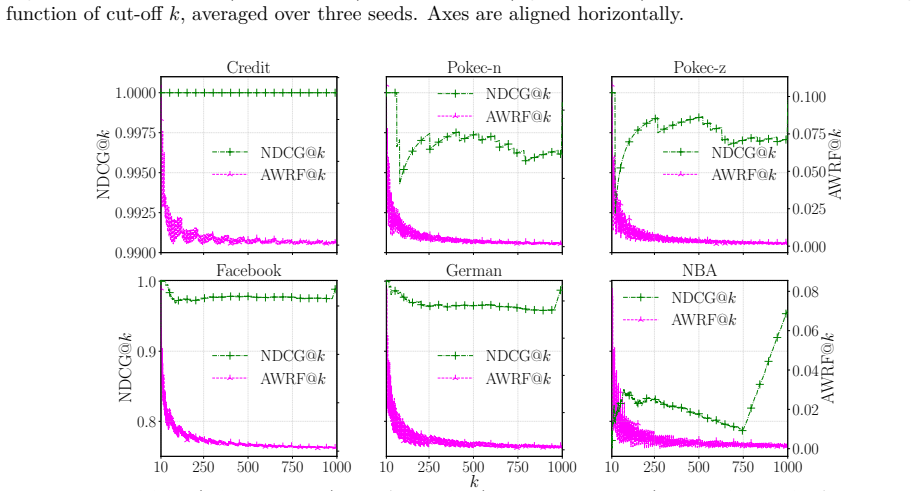
- At higher attribute cardinality, exposure alignment becomes harder: NDKL and AWRF increase monotonically with the number of subgroup-pair types $T = m(m+1)/2$, even though utility stays high, revealing a fairness-scalability trade-off.
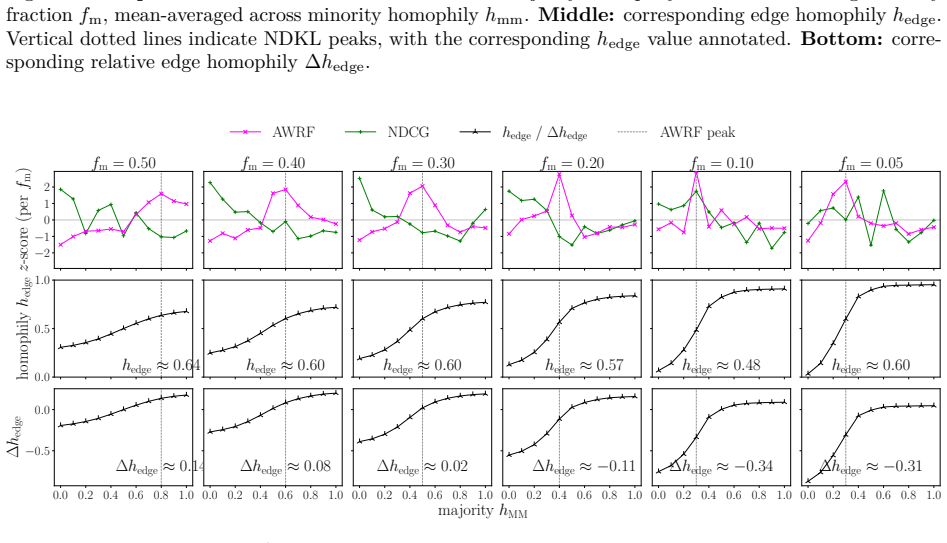
- Exposure-based audits are most informative at intermediate absolute homophily (edge homophily around 0.6), because that is where NDKL and AWRF peaks occur; very high homophily constrains the candidate pools and reduces divergence.
Reading between the lines
- Beyond the paper, the same two metric definitions could audit any ranked recommender system, since NDKL and AWRF need only a ranking and subgroup labels; the results therefore generalize to candidate-generation rankings in search and recommendation.
- A testable extension is to replace the distribution-preserving target $\pi$ with a corrective target, such as equalized exposure across subgroup-pair types, and measure how the greedy re-ranker trades utility against that alternative objective.
- Because MORAL trains one predictor per subgroup-pair type, its cost grows as $O(m^2)$ with attribute cardinality; parameter sharing across types is a natural next step that the paper's own future-work section gestures at.
- The peak of exposure disparity at intermediate homophily suggests that audits looking only at highly homophilic networks could miss the worst case; sampling medium-homophily settings is the more informative check.
Signed reviews
Editorial analysis
A structured set of objections, weighed in public.
Referee Report
Summary. This paper is a reproducibility study of Mattos et al. (2025), which argues that dyadic demographic parity (ΔDP) can hide within-group exposure bias in ranked link prediction and proposes the rank-aware NDKL metric and the MORAL post-processing re-ranker. The authors formalize the original claims as C1–C3, reimplement the framework on six real-world datasets after identifying and correcting inconsistencies in the released code, and extend the original work with an asymmetric homophily stress-test on synthetic DPAH graphs, a metric robustness analysis using AWRF and NDCG, and categorical sensitive attributes up to 55 subgroup-pair types. The reproduced results show that ΔDP is largely invariant to within-group exposure shifts while NDKL changes substantially, and that MORAL achieves near-zero NDKL/AWRF with Precision/NDCG comparable to baselines. The paper is transparent about its limitations, explicitly stating in Section 3.3 and Section 5 that the fairness target π is the observed subgroup-pair distribution and that this is a design choice rather than a universally correct definition of fairness.
Significance. The paper's main strengths are its concrete reproducibility artifacts and the breadth of its robustness checks. It documents the discrepancies in the original codebase (Section 3.5), releases a corrected implementation, and reports hyperparameters, seeds, compute time, and CO2 estimates. The central empirical demonstrations—ΔDP invariance under intra-group exposure reallocation (Figure 2), and MORAL consistently attaining near-zero NDKL/AWRF with small standard deviations (Tables 2 and 4)—are clean and support the reproduced claims C1–C3 for the distribution-preserving fairness target. The homophily stress-test is a valuable addition, showing that exposure-based metrics are most sensitive at intermediate absolute homophily, and the categorical-attribute extension identifies a genuine fairness-scalability trade-off. The main limitation is acknowledged in the paper itself: every fairness quantity is measured against the same observed π, so the results establish that MORAL reproduces the observed graph composition rather than achieving a normatively independent notion of fairness.
major comments (1)
- [Abstract and Section 5 (practical recommendations)] The abstract states that MORAL 'reduces these biases' and Section 5 recommends 'use MORAL when outputs are consumed as rankings and top-K exposure is a fairness concern.' These statements are in tension with the paper's own caveats in Section 3.3 and the final paragraph of Section 5, which state that π is a design choice and that low NDKL/AWRF values 'should be interpreted as evidence of strong performance under distribution-preserving fairness, rather than for support of a more general claim about fairness.' Since Algorithm 1, Eq. (3), and Eq. (7) all reference the same observed π, no experiment distinguishes 'reducing bias' from 'reproducing the observed graph composition.' I recommend qualifying the abstract and the practical recommendations, or adding an experiment with an alternative reference distribution (e.g., uniform exposure) to substantiate the stronger phrasing.
minor comments (5)
- [Table 2, MORAL row] The ΔNDKL values for MORAL on Credit and Facebook are inconsistent with the original values in Table 14: the original NDKL for Credit is 0.01 and for Facebook 0.04, while the reproduced values are 0.00 and 0.01, so Δ should be −0.01 and −0.03, respectively, not −0.04 and 0.00. Please correct these entries.
- [Section 4.1, Tables 2 and 3] Because the reproduction changes the data split, negative sampling, the direction of the KL divergence, and the normalization (Section 3.5 and Appendix A.2), the Δ columns compare different evaluation pipelines. The text should explicitly state that 'reproduced or improved' is relative to a corrected implementation rather than a like-for-like replication of the original results.
- [Section 3.3] The text refers to 'Appendix A for the full algorithm' and later to 'Appendix A.1'; please unify the cross-reference to a single location.
- [Section 3.5] The preprocessing statement 'all graphs are treated as undirected by removing self-loops, merging duplicate edges, and treating (u,v) as equivalent to (v,u)' appears before the definition of the candidate set C; please clarify whether this preprocessing also applies to the DPAH synthetic graphs and to the categorical-attribute Credit graph.
- [Figure 2 caption] The right panel's y-axis is NDKL with values around 0.000–0.010; please state in the caption that the plots are computed at K=1000 and on the same data splits as the main experiments.
Circularity Check
MORAL's NDKL improvement is partly by construction: Algorithm 1 greedily minimizes D_KL(q'||pi), and NDKL evaluates exactly that divergence; the paper acknowledges this coupling and relies on AWRF, which still uses the same pi.
-
fitted input called prediction
[Section 3.3 and Algorithm 1, compared with Section 3.2 Eq. (3) and Section 3.6.2]
"At each rank position, MORAL selects the current top remaining edge from each C and chooses the one that minimises D_KL(q'||pi)... Because MORAL's ranking procedure directly optimizes the same divergence that NDKL evaluates post hoc (see Algorithm 1), MORAL's performance under NDKL may be particularly favourable."
Algorithm 1 builds the ranking by picking, at every position, the candidate that minimizes D_KL(q'||pi) against the observed pi. NDKL@K (Eq. 3) is the same prefix-by-prefix KL divergence accumulated against the same pi: NDKL@K = (1/Z) sum_k delta_k D_KL(pi_hat_k, pi). Therefore MORAL's near-zero NDKL is not an independent measurement of bias reduction; it is the objective being optimized. Claim C3, 'MORAL consistently mitigates previously undetected exposure biases, as measured by NDKL', is thus forced by the algorithm's own definition for the NDKL part of the evaluation.
-
other
[Section 5 (Limitations and future work) and Section 3.6.2 (AWRF adaptation, Eq. 7)]
"preserving pi is a design choice rather than a universally correct fairness target (Mitchell et al., 2021). Thus, the low NDKL and AWRF values achieved by MORAL should be interpreted as evidence of strong performance under distribution-preserving fairness, rather than for support of a more general claim about fairness, as the reference distribution pi might contain biases in itself."
The headline conclusion 'MORAL reduces these biases' is established only relative to the observed pi. MORAL's objective, NDKL (Eq. 3), and the adapted AWRF (Eq. 7) all compare against the same observed pi, so the AWRF robustness check changes only the aggregation mechanism (prefix-KL versus a single l1 exposure distance at K), not the reference distribution. If pi itself encodes historical bias, matching pi reproduces that bias while reporting near-zero NDKL/AWRF. The paper's own caveat is in tension with the abstract's unqualified 'reduces these biases', and no experiment tests an alternative fairness target that would support the broader claim.
full rationale
This is a transparency-positive reproducibility study with substantial independent content: the authors re-implement the pipeline, add synthetic homophily stress-tests, categorical sensitive attributes, and report AWRF and NDCG, which are not directly optimized by MORAL. The AWRF results and utility metrics provide some external evidence that the reranking does not merely destroy precision. However, the central NDKL-based evaluation of MORAL is partially circular because the same pi and the same KL prefix divergence appear in both the optimization objective (Algorithm 1) and the evaluation metric (Eq. 3); the paper itself explicitly flags this coupling. The AWRF check does not fully break the circularity because it still uses the same reference distribution pi, and the authors concede that low values only support distribution-preserving fairness, not a general fairness claim. Since the main fairness claim ('MORAL reduces these biases') rests on NDKL, which MORAL minimizes by construction, and only partially on independent metrics, the appropriate circularity score is 6, reflecting partial circularity in the central claim rather than a fully independent derivation.
Assumptions & free parameters
free parameters (1)
- Target exposure distribution π =
Observed subgroup-pair edge proportions per dataset (e.g., Credit: E_0-0 ≈ 1%, E_1-1 ≈ 87%, E_0-1 ≈ 12%; Table 9)
assumptions (2)
- domain assumption Observed subgroup-pair proportions π are a valid reference for distribution-preserving fairness.
- domain assumption Exposure, modeled as logarithmically discounted attention δ_k = 1/log2(k+1), is the relevant fairness currency for ranked link prediction.
Cite this review
Pith. "Pith review of Fairness in Link Prediction Beyond Demographic Parity: A Reproducibility Study." pith.science (2026). https://pith.science/paper/Z5HMAH6D
@misc{pith2026260809899,
  author       = {Pith},
  title        = {Pith review of: Fairness in Link Prediction Beyond Demographic Parity: A Reproducibility Study},
  year         = {2026},
  howpublished = {\url{https://pith.science/paper/Z5HMAH6D}},
  note         = {Machine review of arXiv:2608.09899}
}
abstract
In fair ranked link prediction, demographic parity ($\Delta_\mathrm{DP}$) is a common fairness metric. Yet, Mattos et al. (2025) argue that it fails to detect exposure bias because it ignores where links appear in the ranking. In this study, we reproduce this claim by showing that $\Delta_\mathrm{DP}$ can indicate aggregate parity even when some subgroup-pair links are systematically ranked lower than others. The proposed rank-aware Normalized Discounted KL-divergence (NDKL), however, does detect such disparities. We also reproduce the effectiveness of MORAL, a post-processing method that improves exposure-based fairness while maintaining competitive utility. Beyond reproduction, we assess robustness using synthetic homophily settings, categorical sensitive attributes, and additional fairness and utility metrics, including subgroup-pair-adapted Attention-Weighted Rank Fairness (AWRF). Overall, our results show that exposure-based metrics uncover biases hidden by $\Delta_\mathrm{DP}$ and that MORAL reduces these biases with minimal utility loss across diverse settings and datasets. We release a corrected, reproducible implementation at https://github.com/Floris93100/reproducing-MORAL.
Figures


Figures from the paper (7 more)





Reference graph
Works this paper leans on
-
[1]
Scaling Learning Algorithms Towards
Bengio, Yoshua and LeCun, Yann , booktitle =. Scaling Learning Algorithms Towards
-
[2]
and Osindero, Simon and Teh, Yee Whye , journal =
Hinton, Geoffrey E. and Osindero, Simon and Teh, Yee Whye , journal =. A Fast Learning Algorithm for Deep Belief Nets , volume =
-
[3]
2016 , publisher=
Deep learning , author=. 2016 , publisher=
2016
-
[4]
Journal of Network and Computer Applications , volume=
Applications of link prediction in social networks: A review , author=. Journal of Network and Computer Applications , volume=. 2020 , publisher=
work page 2020
-
[5]
Application of network link prediction in drug discovery , author=. BMC Bioinformatics , volume=. 2021 , publisher=
work page 2021
-
[6]
Machine Intelligence Research , volume=
A comprehensive survey on trustworthy graph neural networks: Privacy, robustness, fairness, and explainability , author=. Machine Intelligence Research , volume=. 2024 , publisher=
2024
-
[7]
Ethics of data and analytics , pages=
Machine bias , author=. Ethics of data and analytics , pages=. 2022 , publisher=
2022
-
[8]
Proceedings of the 2018 World Wide Web Conference , pages=
Algorithmic glass ceiling in social networks: The effects of social recommendations on network diversity , author=. Proceedings of the 2018 World Wide Web Conference , pages=
work page 2018
Show all 76 references
-
[9]
International conference on learning representations , year=
On dyadic fairness: Exploring and mitigating bias in graph connections , author=. International conference on learning representations , year=
-
[10]
Proceedings of the IEEE , volume=
Trustworthy graph neural networks: Aspects, methods, and trends , author=. Proceedings of the IEEE , volume=. 2024 , publisher=
2024
-
[11]
ACM Transactions on Knowledge Discovery from Data , volume=
Fairness-aware graph neural networks: A survey , author=. ACM Transactions on Knowledge Discovery from Data , volume=. 2024 , publisher=
2024
-
[12]
Proceedings of the 2nd ACM Conference on Equity and Access in Algorithms, Mechanisms, and Optimization , pages=
Fairegm: fair link prediction and recommendation via emulated graph modification , author=. Proceedings of the 2nd ACM Conference on Equity and Access in Algorithms, Mechanisms, and Optimization , pages=
-
[13]
Advances in neural information processing systems , volume=
Cross-links matter for link prediction: rethinking the debiased GNN from a data perspective , author=. Advances in neural information processing systems , volume=
-
[14]
Proceedings of the international AAAI conference on web and social media , volume=
Fairlp: Towards fair link prediction on social network graphs , author=. Proceedings of the international AAAI conference on web and social media , volume=
-
[15]
arXiv preprint arXiv:2511.06568 , year=
Breaking the Dyadic Barrier: Rethinking Fairness in Link Prediction Beyond Demographic Parity , author=. arXiv preprint arXiv:2511.06568 , year=
-
[16]
arXiv preprint arXiv:1710.03184 , year=
On formalizing fairness in prediction with machine learning , author=. arXiv preprint arXiv:1710.03184 , year=
-
[17]
arXiv preprint arXiv:2309.17417 , year=
Networked inequality: Preferential attachment bias in graph neural network link prediction , author=. arXiv preprint arXiv:2309.17417 , year=
-
[18]
International Conference on Machine Learning , pages=
Correcting exposure bias for link recommendation , author=. International Conference on Machine Learning , pages=. 2021 , organization=
2021
-
[19]
International conference on machine learning , pages=
Preventing fairness gerrymandering: Auditing and learning for subgroup fairness , author=. International conference on machine learning , pages=. 2018 , organization=
2018
-
[20]
AI Magazine , volume=
Fairness amidst non-IID graph data: A literature review , author=. AI Magazine , volume=. 2025 , publisher=
2025
-
[21]
IEEE transactions on neural networks and learning systems , volume=
A comprehensive survey on graph neural networks , author=. IEEE transactions on neural networks and learning systems , volume=. 2020 , publisher=
2020
-
[22]
Proceedings of the 14th ACM international conference on web search and data mining , pages=
Say no to the discrimination: Learning fair graph neural networks with limited sensitive attribute information , author=. Proceedings of the 14th ACM international conference on web search and data mining , pages=
-
[23]
Seoul Journal of Business , volume=
Scale-free networks in the presence of constraints: An empirical investigation of the airline route network , author=. Seoul Journal of Business , volume=. 2007 , publisher=
2007
-
[24]
Social networks , volume=
Models of core/periphery structures , author=. Social networks , volume=. 2000 , publisher=
2000
-
[25]
Complexity , volume=
Exploring the regional structure of the worldwide air traffic and route networks , author=. Complexity , volume=. 2023 , publisher=
2023
-
[26]
Peixoto, Tiago de Paula , title =
-
[27]
Netzschleuder: the network catalogue, repository and centrifuge , author=
Netzschleuder , url=. Netzschleuder: the network catalogue, repository and centrifuge , author=
-
[28]
Science advances , volume=
A clarified typology of core-periphery structure in networks , author=. Science advances , volume=. 2021 , publisher=
2021
-
[29]
Proceedings of the 30th annual ACM SIGACT-SIGOPS symposium on principles of distributed computing , pages=
Distributed k-core decomposition , author=. Proceedings of the 30th annual ACM SIGACT-SIGOPS symposium on principles of distributed computing , pages=
-
[30]
Physical review E , volume=
Mixing patterns in networks , author=. Physical review E , volume=. 2003 , publisher=
2003
-
[31]
arXiv preprint arXiv:2002.05287 , year=
Geom-gcn: Geometric graph convolutional networks , author=. arXiv preprint arXiv:2002.05287 , year=
2002 arXiv
-
[32]
arXiv preprint arXiv:2302.11640 , year=
A critical look at the evaluation of GNNs under heterophily: Are we really making progress? , author=. arXiv preprint arXiv:2302.11640 , year=
-
[33]
Advances in Neural Information Processing Systems , volume=
Classic gnns are strong baselines: Reassessing gnns for node classification , author=. Advances in Neural Information Processing Systems , volume=
-
[34]
Companion proceedings of the 2019 world wide web conference , pages=
Quantifying the impact of user attention on fair group representation in ranked lists , author=. Companion proceedings of the 2019 world wide web conference , pages=
2019
-
[35]
arXiv preprint arXiv:2006.05205 , year=
On the bottleneck of graph neural networks and its practical implications , author=. arXiv preprint arXiv:2006.05205 , year=
2006 arXiv
-
[36]
Proceedings of the AAAI conference on artificial intelligence , volume=
Deeper insights into graph convolutional networks for semi-supervised learning , author=. Proceedings of the AAAI conference on artificial intelligence , volume=
-
[37]
Proceedings of the 24th ACM SIGKDD international conference on knowledge discovery & data mining , pages=
Fairness of exposure in rankings , author=. Proceedings of the 24th ACM SIGKDD international conference on knowledge discovery & data mining , pages=
-
[38]
Proceedings of the 2019 AAAI/ACM Conference on AI, Ethics, and Society , pages=
Popularity bias in ranking and recommendation , author=. Proceedings of the 2019 AAAI/ACM Conference on AI, Ethics, and Society , pages=
2019
-
[39]
Proceedings of the 25th acm sigkdd international conference on knowledge discovery & data mining , pages=
Fairness-aware ranking in search & recommendation systems with application to linkedin talent search , author=. Proceedings of the 25th acm sigkdd international conference on knowledge discovery & data mining , pages=
-
[40]
Scientific reports , volume=
Inequality and inequity in network-based ranking and recommendation algorithms , author=. Scientific reports , volume=. 2022 , publisher=
2022
-
[41]
Annual review of statistics and its application , volume=
Algorithmic fairness: Choices, assumptions, and definitions , author=. Annual review of statistics and its application , volume=. 2021 , publisher=
2021
-
[42]
International scientific conference and international workshop present day trends of innovations , volume=
Data analysis in public social networks , author=. International scientific conference and international workshop present day trends of innovations , volume=
-
[43]
2023 , publisher=
Fairness and machine learning: Limitations and opportunities , author=. 2023 , publisher=
2023
-
[44]
Proceedings of the 45th International ACM SIGIR Conference on Research and Development in Information Retrieval , pages=
Measuring fairness in ranked results: An analytical and empirical comparison , author=. Proceedings of the 45th International ACM SIGIR Conference on Research and Development in Information Retrieval , pages=
-
[45]
ACM Transactions on Information Systems (TOIS) , volume=
Cumulated gain-based evaluation of IR techniques , author=. ACM Transactions on Information Systems (TOIS) , volume=. 2002 , publisher=
2002
-
[46]
2008 , publisher=
Introduction to information retrieval , author=. 2008 , publisher=
2008
-
[47]
Proceedings
A new model for learning in graph domains , author=. Proceedings. 2005 IEEE international joint conference on neural networks. , volume=. 2005 , organization=
2005
-
[48]
International Conference on Learning Representations (ICLR) , year=
Semi-supervised classification with graph convolutional networks , author=. International Conference on Learning Representations (ICLR) , year=
-
[49]
Social forces , volume=
The glass ceiling effect , author=. Social forces , volume=. 2001 , publisher=
2001
-
[50]
Proceedings of the 2015 conference on innovations in theoretical computer science , pages=
Homophily and the glass ceiling effect in social networks , author=. Proceedings of the 2015 conference on innovations in theoretical computer science , pages=
2015
-
[51]
American journal of Orthopsychiatry , volume=
Invisibility syndrome: A clinical model of the effects of racism on African-American males , author=. American journal of Orthopsychiatry , volume=. 2000 , publisher=
2000
-
[52]
Proceedings of the International AAAI Conference on Web and Social Media , volume=
The effect of homophily on disparate visibility of minorities in people recommender systems , author=. Proceedings of the International AAAI Conference on Web and Social Media , volume=
-
[53]
Lacoste, Alexandre and Luccioni, Alexandra and Schmidt, Victor and Dandres, Thomas , title =
-
[54]
Nowtricity , title =
-
[55]
Australasian Conference on Data Science and Machine Learning , pages=
Towards fairness and privacy: A novel data pre-processing optimization framework for non-binary protected attributes , author=. Australasian Conference on Data Science and Machine Learning , pages=. 2023 , organization=
2023
-
[56]
Science , volume=
Reducing food’s environmental impacts through producers and consumers , author=. Science , volume=. 2018 , publisher=
2018
-
[57]
Scientific reports , volume=
Homophily influences ranking of minorities in social networks , author=. Scientific reports , volume=. 2018 , publisher=
2018
-
[58]
2025 , journal=
Reassessing Fairness: A Reproducibility Study of NIFA's Impact on GNN Models , author=. 2025 , journal=
2025
-
[59]
The European Physical Journal B , volume=
Modeling the world-wide airport network , author=. The European Physical Journal B , volume=. 2004 , publisher=
2004
-
[60]
2019 , publisher=
Fairwalk: Towards fair graph embedding , author=. 2019 , publisher=
2019
-
[61]
Proceedings of the 14th ACM Web Science Conference 2022 , pages=
Link recommendations: Their impact on network structure and minorities , author=. Proceedings of the 14th ACM Web Science Conference 2022 , pages=
2022
-
[62]
Proceedings of the 44th International ACM SIGIR Conference on Research and Development in Information Retrieval , pages =
When Fair Ranking Meets Uncertain Inference , author =. Proceedings of the 44th International ACM SIGIR Conference on Research and Development in Information Retrieval , pages =. 2021 , publisher =
2021
-
[63]
Annual review of sociology , volume=
Birds of a feather: Homophily in social networks , author=. Annual review of sociology , volume=. 2001 , publisher=
2001
-
[64]
Assortative Mixing in Networks , author =. Phys. Rev. Lett. , volume =. 2002 , month =. doi:10.1103/PhysRevLett.89.208701 , url =
2002 doi
-
[65]
Proceedings of the National Academy of Sciences , volume=
Identifying the roles of race-based choice and chance in high school friendship network formation , author=. Proceedings of the National Academy of Sciences , volume=. 2010 , publisher=
2010
-
[66]
Advances in Neural Information Processing Systems , volume=
Characterizing graph datasets for node classification: Homophily-heterophily dichotomy and beyond , author=. Advances in Neural Information Processing Systems , volume=
-
[67]
IEEE Transactions on Knowledge and Data Engineering , year=
Fairness in graph mining: A survey , author=. IEEE Transactions on Knowledge and Data Engineering , year=
-
[68]
arXiv preprint arXiv:1810.00826 , year=
How powerful are graph neural networks? , author=. arXiv preprint arXiv:1810.00826 , year=
-
[69]
, title =
Lichman, M. , title =. 2013 , howpublished =
2013
-
[70]
Advances in neural information processing systems , volume=
Distributed representations of words and phrases and their compositionality , author=. Advances in neural information processing systems , volume=
-
[71]
2006 , publisher=
Elements of information theory , author=. 2006 , publisher=
2006
-
[72]
Contribution aux applications statistiques de la th
Sch. Contribution aux applications statistiques de la th. Annales de l'ISUP , volume=
-
[73]
Proceedings of the AAAI Conference on Artificial Intelligence , volume=
Breaking the dyadic barrier: Rethinking fairness in link prediction beyond demographic parity , author=. Proceedings of the AAAI Conference on Artificial Intelligence , volume=
-
[74]
Data & Policy , volume=
A recommendation and risk classification system for connecting rough sleepers to essential outreach services , author=. Data & Policy , volume=. 2021 , publisher=
2021
-
[75]
Prevention Science , pages=
AI-augmented prevention science needs community-engaged prevention science: A framework for greater accountability , author=. Prevention Science , pages=. 2025 , publisher=
2025
-
[76]
Proceedings of the 2025 CHI Conference on Human Factors in Computing Systems , pages=
The datafication of care in public homelessness services , author=. Proceedings of the 2025 CHI Conference on Human Factors in Computing Systems , pages=
2025
Reviewed August 15, 2026 · model on record in the stance chip above.
Discussion (0). Continue with ORCID to comment.