REVIEW 4 major objections 4 minor 46 references
The iSTORM Instrument for Airborne Measurements of Gamma-Ray Emissions from Thunderstorms
T0 review · 4 major / 4 minor · reviewed 2026-08-12 · deepseek-v4-flash
Pith's one-line read This paper presents iSTORM, a 32-crystal CeBr3 gamma-ray spectrometer for ER-2 flights, and reports its 250 keV-to-5 MeV range, 157 cm2 area, and detection of glows, TGFs, and new flickering gamma-ray flashes during ALOFT.
desk verdict A credible instrument paper whose main soft spot is the unquantified packet-loss recovery used in the FGF timing analysis; the instrument claims themselves hold up. read the letter →
The pith
A machine-rendered reading of the paper's core claim, the machinery that carries it, and where it could break.
The reading
What carries the argument
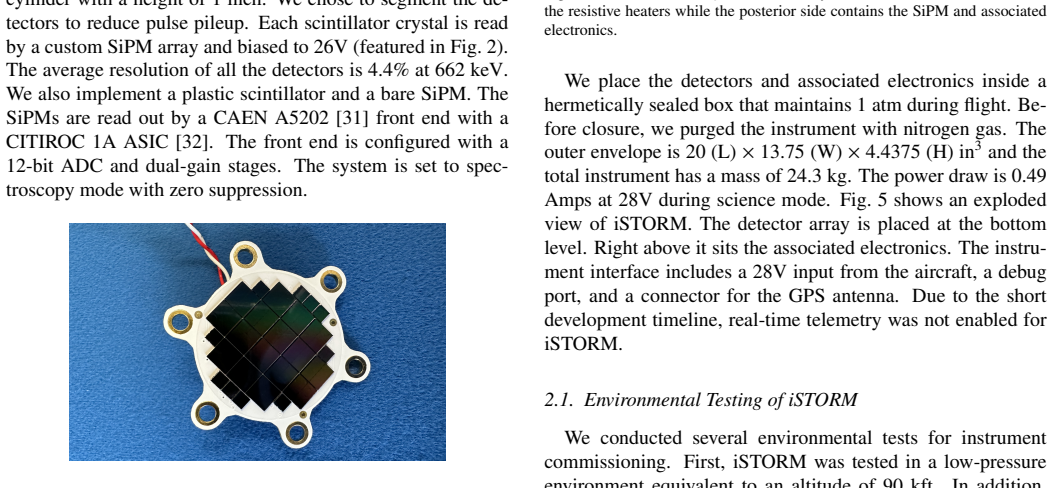
The load-bearing design is an array of 32 one-inch-diameter CeBr3 scintillator crystals, each read out by a custom silicon photomultiplier (SiPM) array biased at 26 V, with signals digitized by a CAEN A5202 front end using a CITIROC 1A ASIC in dual-gain, 12-bit spectroscopy mode. Segmentation reduces pulse pileup, the dual gains and zero suppression enable the 250 keV to 5 MeV range, and an event counter in the data stream recovers the number of lost events during high-count-rate intervals, with those lost events redistributed uniformly between recorded events. A hermetically sealed one-atmosphere box and a GPS-disciplined clock allow the instrument to operate at 65-68 kft cruise altitude.
What would settle it
Take a bright, packet-loss-affected FGF seen by both iSTORM and the BGO instrument and compare the recovered iSTORM pulse spacings with the independently timed BGO pulses in the same window; systematic disagreement concentrated in loss intervals would show that assigning lost events uniformly between recorded events distorts the FGF timing results. Alternatively, replay known high-rate pulse trains with controlled bursty losses through the A5202 data stream and check whether the recovery algorithm reproduces the injected spacings.
Extended reading notes
Core claim
The paper's central claim is that a compact, segmented CeBr3/SiPM spectrometer can do science-quality gamma-ray transient measurements from an ER-2 aircraft. The instrument achieves an energy range of approximately 250 keV to 5 MeV with 157 cm2 total geometrical area, and during ALOFT it detected glows, TGFs, and FGFs. In the 10-minute case study from July 24, 2023, iSTORM saw 7 TGFs embedded in glow episodes plus 3 FGFs, and the paper reports a linear relation between FGF total duration and average pulse spacing, $\mathrm{Duration\,[ms]} \approx 5.4 \times \mathrm{average\,spacing\,[ms]} + 14.2$. The companion BGO instrument saw the same events, which the paper takes as cross-validation that FGFs are a distinct, real phenomenon rather than an instrumental artifact.
Load-bearing premise
The load-bearing premise is that, when data packets are lost in the brightest flashes, the missing events were spread evenly in time between the two recorded events around each loss; if losses arrived in bursts instead, the reported pulse timings and count rates would be biased.
Editorial extensions
If this is right
- A 157 cm2 airborne detector can measure thunderstorm gamma rays from about 250 keV to 5 MeV while cruising at 20 km, so near-storm aircraft surveys are a viable complement to space-based TGF observations.
- The July 24, 2023 flight's nearly 100 TGFs indicate that very active storms produce far more flashes than satellite-based rarity estimates implied.
- The measured FGF relation, $\mathrm{Duration\,[ms]} \approx 5.4 \times \mathrm{average\,pulse\,spacing\,[ms]} + 14.2$, gives models a quantitative target for the electric-field conditions that generate flickering flashes.
- The absence of optical or radio counterparts to FGFs implies that gamma-ray observations may be the only remote way to detect those events.
- With a faster readout and near-real-time count-rate telemetry, the upgraded iSTORM can extend the same measurements to pyrocumulonimbus storms during the INSPYRE campaign.
Reading between the lines
- A next test beyond the paper is to replay recorded ALOFT high-rate intervals through a bench setup with known injected event times and check whether the uniform-loss recovery reproduces the injected pulse spacings; this would directly test the FGF timing results.
- If the FGF duration-spacing relation holds in more events, it would suggest a common regulator such as a persistent avalanche region modulating pulse rate, rather than a sequence of independent TGF-like bursts.
- Because FGFs lack optical and radio counterparts, archival airborne and balloon gamma-ray datasets may contain unrecognized multi-pulse structures in the 20-250 ms range; a blind search could test that possibility.
- An imaging instrument such as the planned coded-aperture telescope could map FGF pulse origins in the cloud, connecting the measured timing correlation to the spatial structure of the electric field.
Editorial analysis
A structured set of objections, weighed in public.
Referee Report
Summary. The manuscript describes the design, environmental testing, and first in-flight results of iSTORM, a 32-element CeBr3 scintillator array with SiPM readout flown on the NASA ER-2 during the ALOFT campaign. The authors report that the instrument achieves a useful energy range of about 250 keV to 5 MeV under flight conditions with a total geometrical area of 157 cm^2, and they show examples of gamma-ray glows, TGFs, and the newly reported flickering gamma-ray flashes (FGFs). The paper also presents a linear relation between FGF duration and average pulse spacing in its Fig. 16.
Significance. If the performance claims hold, iSTORM provides a useful airborne capability for thunderstorm gamma-ray observations, and the reported detections of glows, TGFs, and FGFs are scientifically important. The paper is honest about key limitations: spectra are stated not to be deconvolved, and the calibration is based on standard Cs-137 ground measurements. The direct comparison with the co-flying BGO instrument is promised but not shown. The central concern is that the temporal structure of FGFs, which underpins the only quantitative relation in the paper, depends on a packet-loss correction that is not validated. This is a load-bearing issue, not a cosmetic one.
major comments (4)
- [Section 2, paragraph on the A5202 event counter; Section 3.3] The description of the event-counter correction is not sufficient to support the FGF timing results. The paper states that when the BeagleBone Black drops packets during high-count-rate events, the lost events are 'distribute[d] uniformly between two recorded events.' The FGF pulse durations, spacings, and the correlation in Fig. 16 are derived from these corrected event times. If packet loss is concentrated at the high-rate phases of a burst, uniform insertion will systematically stretch pulse durations and fill inter-pulse gaps, directly biasing the reported 15 ms spacing and the duration-versus-spacing relation. The paper gives no estimate of the lost fraction for the FGF events, no test of the uniformity assumption, and no comparison with the independent BGO readout that observed the same phenomena. Please quantify the loss rate for the events shown and validate the reconstruction against the BGO data, or explicitly state how the main timing results are robust to non-uniform loss.
- [Section 3.3, Fig. 16] The linear fit in Fig. 16 is the only quantitative relation in the paper, but it is reported without uncertainties: the fit parameters Duration[ms] = 5.4 × Average FGF Pulse Time Difference [ms] + 14.2383 have no error bars, no coefficient of determination, and no statement of how many points were used or whether the correlation is statistically significant. The error bars shown are the standard deviation of pulse times within each FGF, which does not include the uncertainty introduced by the packet-loss correction discussed above. Please provide fit uncertainties, a goodness-of-fit measure, and a clear description of the sample size and selection criteria for the 24 FGFs.
- [Section 3.3] The manuscript states that 'The BGO’s observation is consistent with that of iSTORM' but shows no comparison. Because the BGO instrument uses a different readout and would be affected differently by dead time or packet loss, a direct overlay or time-tagged comparison of the FGF pulse structure is a natural and powerful validation of the iSTORM timing. Adding this comparison would also address the concern that the observed FGF morphology is an artifact of the uniform event-redistribution procedure.
- [Section 2.1 and Section 3.1.1] The energy-range claim needs more support in the flight environment. Figure 7 shows that the Cs-137 photopeak is cropped into the overflow bin at -5 °C, and the paper states that -5 °C is the lower limit for science operations. The pod is described as having blowers to maintain non-freezing temperatures, but no in-flight gain calibration or temperature record is reported to show that the 250 keV to 5 MeV range is actually maintained during typical cruise altitudes. In addition, the in-flight count-rate time series (Figs. 11 and 14) and the glow/background spectra in Fig. 13 are presented without statistical uncertainties, which is problematic for a paper that asserts the detection of specific transients. Please add error bars to the count-rate and spectral quantities and describe how the in-flight energy scale was monitored.
minor comments (4)
- [References] Reference [3] is a duplicate of Reference [1]; the same paper is listed twice with identical bibliographic information.
- [Fig. 13 caption] The caption contains a typo: 'measurmed' should be 'measured'.
- [Fig. 16 caption] The caption writes 'Time Different' where 'Time Difference' is meant.
- [Acknowledgments] The acknowledgment contains a typo: 'Earh Science Division' should be 'Earth Science Division'.
Circularity Check
Instrument paper with direct calibrated measurements; no circular derivation, minor self-citations only.
full rationale
The paper's central claims are instrument performance (energy range, geometrical area, calibrations) and direct detection of glows, TGFs, and FGFs from flight data. The energy range is established by Cs-137 spectra and temperature tests (Sec. 2.1, Fig. 7), and the geometrical area follows from the 32-detector layout; neither is fitted to the phenomena being reported. Glow, TGF, and FGF identifications are count-rate and energy-time observations, and the paper states the independent BGO instrument's observation is consistent with iSTORM (Sec. 3), providing an external cross-check rather than a self-citation chain. The only correction step is the uniform redistribution of packets lost by the BBB (Sec. 2); this is an acknowledged data-reconstruction assumption and a potential bias for FGF timing, but it is not derived from, nor does it define, the FGF claims, so it is a robustness limitation rather than a circular reduction. References [11], [39], [45], and [46] are ALOFT companion papers with overlapping authors, but the present manuscript's load-bearing content is its own calibrated measurements; the self-citations are contextual and not used to forbid alternatives or import a uniqueness theorem. No fitted parameter is renamed as a prediction. Although the duration-versus-average-spacing relationship in Fig. 16 is partly definitional, the paper presents it as a descriptive fit and does not use it to establish the instrument's performance or the existence of FGFs. Overall circularity is minimal and confined to non-load-bearing contextual self-citation.
Assumptions & free parameters
free parameters (2)
- FGF duration-spacing linear fit slope =
5.4 ms per ms
- FGF duration-spacing linear fit intercept =
14.2383 ms
assumptions (3)
- domain assumption The observed count-rate enhancements are genuine atmospheric gamma-ray phenomena, not detector or aircraft artifacts.
- domain assumption The GPS-disciplined clock and the event counter provide timing accurate enough to resolve pulse structures down to milliseconds.
- ad hoc to paper Uniform redistribution of lost events preserves the temporal structure of the transients.
Cite this review
Pith. "Pith review of The iSTORM Instrument for Airborne Measurements of Gamma-Ray Emissions from Thunderstorms." pith.science (2026). https://pith.science/paper/O3J32GR4
@misc{pith2026260809990,
  author       = {Pith},
  title        = {Pith review of: The iSTORM Instrument for Airborne Measurements of Gamma-Ray Emissions from Thunderstorms},
  year         = {2026},
  howpublished = {\url{https://pith.science/paper/O3J32GR4}},
  note         = {Machine review of arXiv:2608.09990}
}
abstract
The in-Situ Thunderstorm Observer for Radiation Mechanisms (iSTORM) is a gamma-ray spectrometer to study gamma-ray transients originating from thunderstorms, such as glows and terrestrial gamma-ray flashes (TGFs). It is designed and built by the U.S. Naval Research Laboratory for deployment aboard a NASA ER-2 aircraft. Using an array of 32 one-inch-diameter $\mathrm{CeBr}_3$ scintillators read out with silicon photomultipliers (SiPMs), the instrument achieves an energy range of $\sim 250 \ \mathrm{keV}$ to $5 \ \mathrm{MeV}$ under flight conditions, with a total geometrical area of $157 \ \mathrm{cm^2}$. One of two gamma-ray instruments in the ALOFT campaign, iSTORM recorded glows, terrestrial gamma-ray flashes (TGFs), and the newly discovered flickering gamma-ray flashes (FGFs).
Figures


Figures from the paper (9 more)


Reference graph
Works this paper leans on
-
[2]
G. K. Parks, B. H. Mauk, R. Spiger, J. Chin, X-ray en- hancements detected during thunderstorm and lightning activ- ities, Geophysical Research Letters 8 (11) (1981) 1176–1179. arXiv:https://agupubs.onlinelibrary.wiley.com/doi/pdf/10.1029/GL008i011p01176, doi:https://doi.org/10.1029/GL008i011p01176. URLhttps://agupubs.onlinelibrary.wiley.com/doi/abs/ 10.1...
-
[4]
J. E. Grove, A. Chekhtman, Fermi LAT Collaboration, G. Fishman, M. Briggs, V . Connaughton, Fermi GBM Collaboration, Observation of Terrestrial Gamma-ray Flashes with Fermi LAT, in: American Astronom- ical Society Meeting Abstracts #219, V ol. 219 of American Astronomical Society Meeting Abstracts, 2012, p. 149.13
work page 2012
-
[5]
M. Marisaldi, F. Fuschino, C. Labanti, M. Galli, F. Longo, E. Del Monte, G. Barbiellini, M. Tavani, A. Giuliani, E. Moretti, S. Vercellone, E. Costa, S. Cutini, I. Donnarumma, Y . Evangelista, M. Feroci, I. Lapshov, F. Lazzarotto, P. Lipari, S. Mereghetti, L. Pacciani, M. Rapis- arda, P. Soffitta, M. Trifoglio, A. Argan, F. Boffelli, A. Bulgarelli, P. Car...
-
[6]
D. M. Smith, L. I. Lopez, R. Lin, C. P. Barrington-Leigh, , Science 307 (5712) (2005) 1085 1088, cited by: 430. doi:10.1126/science.1107466. URLhttps://www.scopus.com/inward/record.uri?eid=2-s2. 0-13844319483&doi=10.1126%2fscience.1107466&partnerID= 40&md5=eddd8f5c6953b415f17354c634b2cb7c
-
[7]
N. stgaard, T. Neubert, V . Reglero, K. Ullaland, S. Yang, G. Genov, M. Marisaldi, A. Mezentsev, P. Kochkin, N. Lehtinen, D. Sarria, B. H. Qureshi, A. Solberg, C. Maiorana, K. Albrechtsen, C. Budtz- Jrgensen, I. Kuvvetli, F. Christiansen, O. Chanrion, M. Heumesser, J. Navarro-Gonzalez, P. Connell, C. Eyles, H. Christian, S. Al- nussirat, First 10 months o...
work page 2019
-
[8]
L. E. McTague, S. A. Cummer, M. S. Briggs, V . Connaughton, M. Stanbro, G. Fitzpatrick, A lightning-based search for nearby observationally dim terrestrial gamma ray flashes, Journal of Geo- physical Research: Atmospheres 120 (23) (2015) 12,003–12,017. arXiv:https://agupubs.onlinelibrary.wiley.com/doi/pdf/10.1002/2015JD023475, doi:https://doi.org/10.1002/...
-
[10]
J. R. Dwyer, D. M. Smith, A comparison between monte carlo simulations of runaway breakdown and terrestrial gamma- ray flash observations, Geophysical Research Letters 32 (22). arXiv:https://agupubs.onlinelibrary.wiley.com/doi/pdf/10.1029/2005GL023848, doi:https://doi.org/10.1029/2005GL023848. URLhttps://agupubs.onlinelibrary.wiley.com/doi/abs/ 10.1029/20...
-
[11]
I. Bjrge-Engeland, N. stgaard, D. Sarria, M. Marisaldi, A. Mezentsev, A. Fuglestad, N. Lehtinen, J. E. Grove, D. Shy, T. Lang, M. Quick, H. Christian, C. Schultz, R. Blakeslee, I. Adams, R. Kroodsma, G. Heymsfield, K. Ullaland, S. Yang, B. H. Qureshi, J. Snder- gaard, B. Husa, D. Walker, M. Bateman, D. Mach, P. Bitzer, M. Fullekrug, M. Cohen, M. Stanley, ...
work page 2024
Show all 46 references
-
[12]
J. M. Chaffin, D. M. Smith, J. Lapierre, S. Cummer, J. Or- tberg, A. Sunjerga, A. Mostajabi, M. Rubinstein, F. Rachidi, Mountaintop gamma ray observations of three terrestrial gamma- ray flashes at the sntis tower, switzerland with coincident ra- dio waveforms, Journal of Geop...
2024 doi
-
[13]
J. W. Belz, P. R. Krehbiel, J. Remington, M. A. Stanley, R. U. Ab- basi, R. LeV on, W. Rison, D. Rodeheffer, T. Abu-Zayyad, M. Allen, E. Barcikowski, D. R. Bergman, S. A. Blake, M. Byrne, R. Cady, B. G. Cheon, M. Chikawa, A. di Matteo, T. Fujii, K. Fujita, R. Fuji- wara, M. Fu...
2020
-
[14]
D. M. Smith, J. R. Dwyer, B. J. Hazelton, B. W. Grefenstette, G. F. M. Martinez-McKinney, Z. Y . Zhang, A. W. Lowell, N. A. Kelley, M. E. Splitt, S. M. Lazarus, W. Ulrich, M. Schaal, Z. H. Saleh, E. Cramer, H. Rassoul, S. A. Cummer, G. Lu, X.-M. Shao, C. Ho, T. Hamlin, R. J. B...
-
[15]
G. S. Bowers, D. M. Smith, N. A. Kelley, G. F. Martinez-McKinney, S. A. Cummer, J. R. Dwyer, S. Heckman, R. H. Holzworth, F. Marks, P. Reasor, J. Gamache, J. Dunion, T. Richards, H. K. Rassoul, A terres- trial gamma-ray flash inside the eyewall of hurricane patricia, Journal o...
2018 doi
-
[16]
Kochkin, A
P. Kochkin, A. P. J. van Deursen, M. Marisaldi, A. Ursi, A. I. de Boer, M. Bardet, C. Allasia, J.-F. Boissin, F. Flourens, N. stgaard, In-flight observation of gamma ray glows by ildas, Journal of Geo- physical Research: Atmospheres 122 (23) (2017) 12,801–12,811. arXiv:https:/...
2017 doi
-
[17]
Kochkin, D
P. Kochkin, D. Sarria, N. Lehtinen, A. Mezentsev, S. Yang, G. Genov, K. Ullaland, M. Marisaldi, N. stgaard, H. J. Chris- tian, J. E. Grove, M. Quick, S. Al-Nussirat, E. Wulf, A rapid gamma-ray glow flux reduction observed from 20 km alti- tude, Journal of Geophysical Research:...
2021 doi
-
[18]
Helmerich, T
C. Helmerich, T. McKinney, E. Cavanaugh, S. Dangelo, Tgfs, gamma-ray glows, and direct lightning strike radiation observed during a single flight of a balloon-borne gamma-ray spectrometer, Earth and Space Sci- ence 11 (2) (2024) e2023EA003317, e2023EA003317 2023EA003317. arXiv...
2024 doi
-
[19]
Pallu, S
M. Pallu, S. Celestin, Y . Hazem, F. Trompier, G. Patton, Xstorm: A new gamma ray spectrometer for detection of close proximity gamma ray glows and tgfs, Journal of Geophysical Research: Atmospheres 128 (24) (2023) e2023JD039180, e2023JD039180 2023JD039180. arXiv:https://agupu...
2023 doi
-
[20]
J. T. Sanchez, D. M. Smith, T. Wu, Q. Yang, D. Wang, M. Kamogawa, T. Suzuki, Downward terrestrial gamma-ray flash associated with a positive cloud-to-ground lightning flash, Geophysical Research Let- ters 52 (20) (2025) e2025GL117634, e2025GL117634 2025GL117634. arXiv:https://...
2025 doi
-
[21]
J. M. Chaffin, J. J. Manfredi, G. S. Bowers, W. J. Erwin, J. C. Petrosky, High elevation radiation array (hera) detectors for airborne thunderstorm investigations, Nuclear Instruments and Methods in Physics Research Section A: Accelerators, Spectrom- eters, Detectors and Assoc...
2024
-
[22]
T. J. Lang, N. Østgaard, M. Marisaldi, M. G. Quick, C. J. Schultz, I. Adams, C. G. Amiot, P. Bitzer, R. J. Blakeslee, R. G. Brown, et alli, Hunting for gamma rays above thunderstorms: The aloft campaign, Bul- letin of the American Meteorological Society 106 (8) (2025) E1649– E1669
2025
-
[23]
Quick, R
M. Quick, R. J. Blakeslee, J. Christian, H. J., M. F. Stewart, S. Podgorny, D. Corredor, Airborne GLM Simulator (FEGS), in: AGU Fall Meeting Abstracts, V ol. 2015, 2015, pp. GC33D–1316
2015
-
[24]
Galliano, R
J. Galliano, R. Platt, Advanced microwave precipitation radiome- ter, in: [Conference Digest] International Conference on Millimeter Wave and Far-Infrared Technology: ICMWFT ’90, 1989, pp. 22–25. doi:10.1109/ICMWFT.1989.763744
1989
-
[25]
M. L. Walker McLinden, L. Li, G. M. Heymsfield, M. Coon, A. Emory, The NASA GSFC 94-GHz Airborne Solid-State Cloud Radar System (CRS), Journal of Atmospheric and Oceanic Technology 38 (5) (2021) 1001–1017
2021
-
[26]
G. M. Heymsfield, J. B. Halverson, J. Simpson, L. Tian, T. P. Bui, ER-2 Doppler radar investigations of the eyewall of Hurricane Bonnie during the Convection and Moisture Experiment-3, Journal of Applied Meteo- rology and Climatology 40 (8) (2001) 1310–1330
2001
-
[27]
I. S. Adams, R. Kroodsma, S. J. Munchak, M. Fritts, L. Milani, The Con- figurable Scanning Submillimeter-wave Instrument/Radiometer (CoS- SIR): Modernizing Submillimeter Radiometry for Future Cloud Investi- gations, in: AGU Fall Meeting Abstracts, V ol. 2020, 2020, pp. A197–10
2020
-
[28]
Ostgaard, H
N. Ostgaard, H. J. Christian, J. E. Grove, D. Sarria, A. Mezent- sev, P. Kochkin, N. Lehtinen, M. Quick, S. Al-Nussirat, E. Wulf, G. Genov, K. Ullaland, M. Marisaldi, S. Yang, R. J. Blakeslee, Gamma ray glow observations at 20-km altitude, Journal of Geo- physical Research: At...
2019 doi
-
[29]
Bateman, M
M. Bateman, M. Stewart, S. Podgorny, H. Christian, D. Mach, R. Blakeslee, J. Bailey, D. Daskar, A low-noise, microprocessor- controlled, internally digitizing rotating-vane electric field mill for air- borne platforms, Journal of Atmospheric and Oceanic Technology 24 (7) (2007...
2007
-
[30]
Navarro, The NASA Earth Research-2 (ER-2) aircraft: A flying labo- ratory for Earth science studies, in: International Symposium on Remote Sensing of Environment, no
R. Navarro, The NASA Earth Research-2 (ER-2) aircraft: A flying labo- ratory for Earth science studies, in: International Symposium on Remote Sensing of Environment, no. H-2691, 2007. URLhttps://ntrs.nasa.gov/citations/20070014865
2007
-
[31]
Venaruzzo, A
M. Venaruzzo, A. Abba, C. Tintori, Y . Venturini, Fers-5200: a distributed front-end readout system for multidetector arrays (2020). arXiv:2010.15688
2020 arXiv
-
[32]
Perri, P
M. Perri, P. Garosi, C. Mattone, C. Tintori, M. Corbo, D. Ninci, M. Ve- naruzzo, Y . Venturini, A. Saltarelli, Amplitude measurements with sipm and asic (citiroc 1a) front-end electronics, IEEE Transactions on Nuclear Science 70 (6) (2023) 1023–1029. doi:10.1109/TNS.2023.3262409
2023
-
[33]
Drozdowski, P
W. Drozdowski, P. Dorenbos, A. J. J. Bos, G. Bizarri, A. Owens, F. G. A. Quarati, Cebr 3 scintillator development for possible use in space mis- sions, IEEE Transactions on Nuclear Science 55 (3) (2008) 1391–1396. doi:10.1109/TNS.2007.908579
2008
-
[34]
T. J. Schmit, J. Li, W. P. Menzel, Advanced baseline imager (ABI) for future geostationary operational environmental satellites (GOES-R and beyond), in: W. P. Menzel, W.-J. Zhang, J. L. Marshall, M. Tokuno (Eds.), Applications with Weather Satellites, V ol. 4895, International...
2003 doi
-
[35]
GOES-R-Algorithm-Working-Group-&-GOES-R-Program-Office, NOAA GOES-R Series Advanced Baseline Imager (ABI) Level 2 Reflected Shortwave Radiation Top-of-Atmosphere, NOAA National Centers for Environmental Information
-
[36]
Hilburn, Inferring airmass properties from goes-r abi observations
K. Hilburn, Inferring airmass properties from goes-r abi observations
-
[37]
K. B. Eack, W. H. Beasley, W. D. Rust, T. C. Marshall, M. Stolzen- burg, X-ray pulses observed above a mesoscale convective sys- tem, Geophysical Research Letters 23 (21) (1996) 2915–2918. doi:https://doi.org/10.1029/96GL02570. URLhttps://agupubs.onlinelibrary.wiley.com/doi/ab...
1996 doi
-
[38]
Tsuchiya, T
H. Tsuchiya, T. Enoto, S. Yamada, T. Yuasa, K. Nakazawa, T. Kitaguchi, M. Kawaharada, M. Kokubun, H. Kato, M. Okano, K. Makishima, Long-duration gamma ray emissions from 2007 and 2008 winter thun- derstorms, Journal of Geophysical Research: Atmospheres 116 (D9). arXiv:https://...
2007 doi
-
[39]
Marisaldi, N
M. Marisaldi, N. Østgaard, A. Mezentsev, T. Lang, J. E. Grove, D. Shy, G. M. Heymsfield, P. Krehbiel, R. J. Thomas, M. Stanley, D. Sar- ria, C. Schultz, R. Blakeslee, M. G. Quick, H. Christian, I. Adams, R. Kroodsma, N. Lehtinen, K. Ullaland, S. Yang, B. H. Qureshi, J. Sønderg...
2024
-
[40]
Sarria, N
D. Sarria, N. stgaard, I. Bjrge-Engeland, A. Mezentsev, M. Marisaldi, N. Lehtinen, M. Stanley, T. Lang, C. Schultz, A. Fuglestad, Spectral analysis of flickering gamma-ray flashes observed during the aloft 2023 campaign, Journal of Geophysical Research: Atmospheres 130 (23) (2...
2025 doi
-
[41]
G. J. Fishman, P. N. Bhat, R. Mallozzi, J. M. Horack, T. Koshut, C. Kouveliotou, G. N. Pendleton, C. A. Meegan, R. B. Wilson, W. S. Paciesas, S. J. Goodman, H. J. Christian, Discovery of intense gamma-ray flashes of atmospheric origin, Science 264 (5163) (1994) 1313–1316. arXi...
1994
-
[42]
D. M. Smith, J. R. Dwyer, B. J. Hazelton, B. W. Grefenstette, G. F. M. Martinez-McKinney, Z. Y . Zhang, A. W. Lowell, N. A. Kelley, M. E. Splitt, S. M. Lazarus, W. Ulrich, M. Schaal, Z. H. Saleh, E. Cramer, H. K. Rassoul, S. A. Cummer, G. Lu, R. J. Blakeslee, The rarity of ter...
-
[43]
B. M. Hare, M. A. Uman, J. R. Dwyer, D. M. Jordan, M. I. Big- gerstaff, J. A. Caicedo, F. L. Carvalho, R. A. Wilkes, D. A. Ko- tovsky, W. R. Gamerota, J. T. Pilkey, T. K. Ngin, R. C. Moore, H. K. Rassoul, S. A. Cummer, J. E. Grove, A. Nag, D. P. Bet- ten, A. Bozarth, Ground-le...
2016 doi
-
[44]
Y . Wada, T. Enoto, Y . Nakamura, Y . Furuta, T. Yuasa, K. Nakazawa, T. Morimoto, M. Sato, T. Matsumoto, D. Yonetoku, T. Sawano, H. Sakai, M. Kamogawa, T. Ushio, K. Makishima, H. Tsuchiya, Gamma-ray glow preceding downward terrestrial gamma-ray flash, Communications Physics 2 ...
2019 doi
-
[45]
A. N. Fuglestad, M. Marisaldi, D. Sarria, A. Mezentsev, N. stgaard, I. B. Engeland, N. Lehtinen, . H. Faerder, T. Lang, M. G. Quick, R. Blakeslee, C. Schultz, H. Christian, J. E. Grove, D. Shy, M. Fullekrug, The source brightness distribution of terrestrial gamma-ray flashes f...
2026 doi
-
[46]
Østgaard, A
N. Østgaard, A. Mezentsev, M. Marisaldi, J. E. Grove, M. Quick, H. Christian, S. Cummer, M. Pazos, Y . Pu, M. Stanley, D. Sarria, T. Lang, C. Schultz, R. Blakeslee, I. Adams, R. Kroodsma, G. Heyms- field, N. Lehtinen, K. Ullaland, S. Yang, B. H. Qureshi, J. Søndergaard, B. Hus...
2024
-
[47]
D. A. Peterson, N. Lareau, O. V . Kalashnikova, Introducing the INjected Smoke and PYRocumulonimbus Experiment (INSPYRE), in: AGU Fall Meeting Abstracts, V ol. 2024 of AGU Fall Meeting Abstracts, 2024, pp. A43X–09
2024
-
[48]
Remington, D
J. Remington, D. Shy, J. E. Grove, B. F. Phlips, Investigations of pyrocu- mulonimbus convection, lightning, and energetic radiation, AGU25
-
[49]
Marisaldi, D
M. Marisaldi, D. Sarria, E. Grove, D. Shy, A. Mezentsev, N. Lehtinen, N. Østgaard, T. Lang, Imaging gamma-ray glows, Tech. rep., Copernicus Meetings (2026). 9
2026
Reviewed August 12, 2026 · model on record in the stance chip above.
Discussion (0). Continue with ORCID to comment.