REVIEW 3 major objections 4 minor 20 references
Commensurate Structure of Quark and Lepton Mixing: Eighteenth Powers of One Parameter and a Digital-Clock Quantization of the Unitarity Triangles
T0 review · 3 major / 4 minor · reviewed 2026-08-14 · deepseek-v4-flash
Pith's one-line read The measured quark and lepton mixing matrices are claimed to be organized by a single small parameter, $\varepsilon=|V_{ub}|^{3/10}=0.1869$, through a lattice of integer eighteenth powers and a 7.5-degree angular clock.
desk verdict A self-aware flavor numerology paper with a clean, testable leptonic prediction; the quark-side lattice is post-hoc and hostage to the exclusive |Vub|, but it deserves serious referee time. read the letter →
The pith
A machine-rendered reading of the paper's core claim, the machinery that carries it, and where it could break.
The reading
What carries the argument
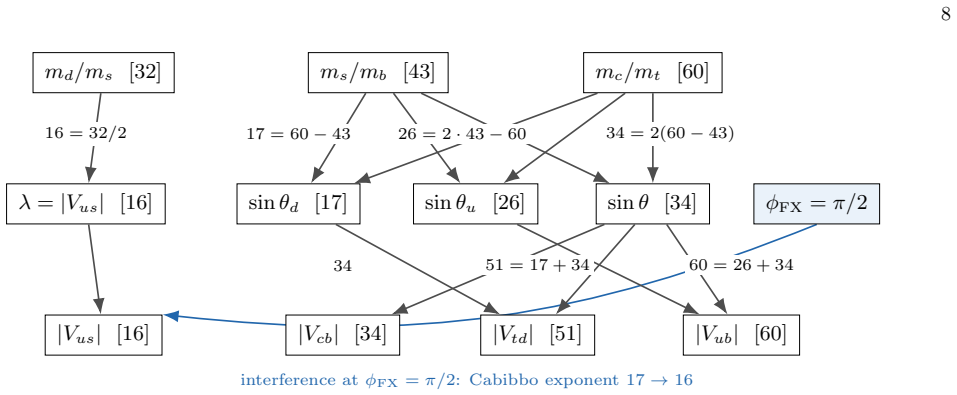
The load-bearing machinery is the FX parameterization of the CKM matrix, a three-angle-plus-phase decomposition in which every angle is separately measurable from exact inversion of moduli ratios, making lattice hypotheses directly testable. On that representation the paper builds two lattices: the multiplicative lattice of integer eighteenth powers of the internal parameter $\varepsilon$, and the angular $\pi/24$ lattice for unitarity-triangle angles. The bridge between them is the theorem $\tan\beta\simeq\sqrt{\varepsilon}$, which follows from the exponent difference $26/18-17/18=1/2$ and turns the triangular quantization into the angular approximation of the multiplicative lattice at maximal phase. The same $\varepsilon$ then carries the neutrino mass ratio $m_2/m_3=\varepsilon^{19/18}$, exporting the lattice from the quark to the lepton sector, and the quark mass ratios at $M_Z$ close the structure through relations such as $m_d/m_s=\lambda^2$, $m_s/m_b=\sin\theta_d\sin\theta_u$, and $m_c/m_t=|V_{ub}|$.
What would settle it
Measure $|V_{ub}|$ through inclusive decays at sub-percent precision: if it lands near $4.1\times10^{-3}$ rather than $3.7\times10^{-3}$, $\varepsilon$ shifts outside the estimator band and the exponent lattice fails. Independently, a degree-level measurement of the CKM angle $\gamma$ that stays near $65.4^\circ$ rather than moving toward $67.5^\circ$-$68^\circ$ would exclude the $\pi/24$ triangle; a resolution of the atmospheric octant to $\theta_{23}<45^\circ$ would falsify the quark–lepton transfer relation $\delta_{\rm CP}\simeq296^\circ$; and a DUNE or Hyper-Kamiokande measurement of $\delta_{\rm CP}$ far from both $296^\circ$ and $244^\circ$ would exclude the leptonic lattice.
Extended reading notes
Core claim
The central claim is that flavor data, read through the FX parameterization for quarks and the $(1,3)$-column unitarity triangle for leptons, are commensurate with two exact-looking structures whose relation is the identity $\tan\beta\simeq\sqrt{\varepsilon}$. With $\varepsilon=|V_{ub}|^{3/10}=0.1869$, the three measured quark angles satisfy $\sin\theta_u=\varepsilon^{26/18}$, $\sin\theta_d=\varepsilon^{17/18}$, and $\sin\theta=\varepsilon^{34/18}$ with coefficients within 2.5% of unity, and the FX phase is maximal, $\phi_{\rm FX}=92.3^\circ\pm2.7^\circ$ against $\pi/2$. Unit coefficients and maximal phase reproduce the remaining CKM moduli at the percent level and fix the Jarlskog invariant as $J=\varepsilon^{111/18}\sin\phi_{\rm FX}$. The rephasing-invariant image is a unitarity triangle quantized on the $\pi/24$ lattice, $(\alpha,\beta,\gamma)=(12,3,9)\times7.5^\circ=(90^\circ,22.5^\circ,67.5^\circ)$; for leptons, where mixing is large and only the angular structure can act, the same lattice requires $\delta_{\rm CP}\simeq296^\circ$ in the upper octant or $244^\circ$ in the lower octant. The same $\varepsilon$ also gives the neutrino mass ratio $m_2/m_3=\varepsilon^{19/18}$ and the PMNS first row as powers of that ratio, $(|U_{e1}|,|U_{e2}|,|U_{e3}|)\simeq(r^{1/9},r^{1/3},\tfrac{\sqrt{3}}{2}r)$. The paper is explicit that the analysis is at the parameterization level and assumes no dynamics.
Load-bearing premise
The lattice is anchored to the adopted exclusive-leaning value $|V_{ub}|=0.00373\pm0.00012$; if the inclusive determination near $4.1\times10^{-3}$ is correct, $\varepsilon$ rises to about 0.193, outside the estimator band, and the $\sin\theta_d$ exponent moves from 17.05 to about 17.4, breaking the eighteenths pattern.
Editorial extensions
If this is right
- If the unit-coefficient lattice is exact, the remaining CKM moduli are reproduced at the percent level and the Jarlskog invariant is fixed at $J=\varepsilon^{111/18}\sin\phi_{\rm FX}$, matching the measured value.
- The quark unitarity triangle is predicted to have angles $(90^\circ,22.5^\circ,67.5^\circ)$, so $\gamma$ should land near $67.5^\circ$-$68^\circ$, one to two degrees above the current central values, testable at LHCb and Belle II.
- The leptonic $(1,3)$-column PMNS triangle on the same grid predicts $\delta_{\rm CP}\simeq296^\circ$ in the upper octant (or $244^\circ$ in the lower octant), with the upper branch also fixing $\sin^2\theta_{23}\simeq0.549$; DUNE and Hyper-Kamiokande can test both predictions.
- The neutrino mass ratio is predicted to satisfy $m_2/m_3=\varepsilon^{19/18}$, equivalently $|V_{ub}|=(m_2/m_3)^{60/19}$, and the PMNS first row is given by powers of $r=m_2/m_3$; JUNO can test these at the per-mille level.
- The mass-ratio relations $m_d/m_s=\lambda^2$, $m_s/m_b=\sin\theta_d\sin\theta_u$, and $m_c/m_t=|V_{ub}|$ are parameter-free and already agree with data at 0.7%, 0.02$\sigma$, and 1.2% respectively.
Reading between the lines
- If the pattern survives the coming measurements, the integer exponents point toward a charge-counting mechanism with integer charges, and the maximal phase points toward a discrete folding symmetry that quantizes phases to $\pm\pi/2$; the paper states this as an open requirement rather than a claim.
- The framework's commitment to the exclusive-leaning $|V_{ub}|$ means the inclusive/exclusive tension is itself a decisive test: an inclusive value near $4.1\times10^{-3}$ would move $\varepsilon$ to about 0.193 and shift the $\sin\theta_d$ placement from 17.05 to about 17.4, breaking the lattice before oscillation experiments weigh in.
- A testable extension of the same logic is to scan the other five PMNS unitarity triangles for $\pi/24$ placements; the paper deliberately restricts to the $(1,3)$-column triangle and claims no selection credit, so checking the remaining triangles would quantify the look-elsewhere effect.
- The same $\varepsilon$-based mass relation predicts normal ordering and the geometric completion $m_1=m_2^2/m_3\simeq1.5$ meV, giving a summed neutrino mass near 60 meV and an effective Majorana mass below the reach of ton-scale neutrinoless double-beta decay; this is a concrete target for cosmological mass-sum measurements.
Editorial analysis
A structured set of objections, weighed in public.
Referee Report
Summary. The paper proposes two commensurate empirical structures in the measured CKM and PMNS data. Multiplicatively, it claims that the three Fritzsch–Xing angles satisfy sinθ_u = ε^{26/18}, sinθ_d = ε^{17/18}, and sinθ = ε^{34/18} with the single hierarchy parameter ε = |V_ub|^{3/10} = 0.1869, and that the FX phase is maximal, φ_FX ≈ 92.3° ≈ π/2. Additively, it claims that the unitarity-triangle angles are quantized on the π/24 lattice, (α, β, γ) = (90°, 22.5°, 67.5°), with a leptonic analog predicting δ_CP ≈ 296° in the upper atmospheric octant or 244° in the lower octant. Additional relations tie the neutrino mass ratio m_2/m_3 to ε^{19/18}, express the PMNS first row in powers of r = m_2/m_3, and give a geometric completion m_1 = m_2^2/m_3. The analysis is explicitly confined to the parameterization level, with no dynamical input.
Significance. If the patterns survive, they would provide a strikingly compact encoding of flavor parameters and would focus model building on specific exponent and angle assignments; the leptonic δ_CP prediction and the mass-ratio relations are concrete and testable at DUNE, Hyper-Kamiokande, and JUNO. The paper has notable strengths: the FX inversion is exact and clearly presented; the Monte Carlo error propagation and the complete reporting of fitted exponents, distances, and order-one coefficients make the analysis reproducible; the chance-probability accounting is explicit; and the text is unusually candid about its own limitations, including the anchor dependence on |V_ub|. The main reservation is that the central pattern is a post-hoc fit: the denominator 18, the anchor exponent 3/10, the π/24 unit, and the choice of PMNS triangle were all selected after inspecting the same data, and the reported p-values do not correct for these choices. The paper itself concedes that the retrodictive agreement is only suggestive and that the case rests on prospective measurements, which tempers but does not remove the concern.
major comments (3)
- [Sec. III, Eq. (5) and Tables I, III, V] The integer eighteenths pattern is anchored to the exclusive-leaning value |V_ub| = 0.00373 ± 0.00012 through ε = |V_ub|^{3/10}, while sinθ_d is fixed by |V_td/V_ts| and is essentially independent of |V_ub|. The paper itself notes that an inclusive |V_ub| near 4.1×10^{-3} would give ε ≈ 0.193 and move the sinθ_d exponent from 17.05 to about 17.4. This is not a peripheral uncertainty: the assignment sinθ_d = ε^{17/18} is the cleanest placement in Table V, it is the only odd numerator that forces the denominator 18, it underpins the 5σ rejection of the ninths lattice in Sec. III, and it produces the exponent difference 26/18 − 17/18 = 1/2 underlying tanβ = √ε in Sec. VIII. With inclusive input, that placement fails and the derived β theorem shifts. Because the abstract and Sec. XI present the eighteenths pattern as a property of the measured data, the claims need to be explicitly conditional on the |V_ub| determination, with a dedicated sensitivity analysis across the inclusive–exclusive range and revised versions of Tables IV and V and the Sec. V p-values under both choices.
- [Sec. V] The reported chance probabilities, p ≈ 0.10 for the three angle exponents and p ≈ 0.04 for the two triangle angles, condition on the lattice structure already being chosen: the denominator 18, the anchor exponent 3/10, the FX parameterization, the π/24 unit, and the (1,3) PMNS triangle were all selected after inspecting the same data. The paper acknowledges the denominator look-elsewhere effect only in passing, noting that a skeptic granting trials over denominators would dilute the probabilities toward tens of percent; that admission already shows that p = 0.10 is not the probability that the pattern arises by chance. The abstract's promise to quantify the chance probability should be revised to state clearly that these numbers are conditional on the model-selection choices, or explicit trials factors should be given.
- [Sec. VIII and Sec. XI] The '23° theorem' tanβ ≃ √ε is not an independent confirmation of the framework. It follows algebraically from the fitted exponents sinθ_u = ε^{26/18} and sinθ_d = ε^{17/18} (difference 1/2) together with the approximation tanβ ≃ s_u/s_d at maximal phase, so the resulting β = 23.0° inherits the fitted inputs. The paper is transparent about this logic in Sec. VIII, but the abstract and Sec. XI list tanβ ≃ √ε and β = 23.0° among the results without noting that they are restatements of the lattice hypothesis rather than independent outputs. I recommend placing all such derived consequences in an explicitly labeled 'consequences of the lattice hypothesis' category, distinct from the genuinely predictive statements such as δ_CP ≈ 296° and the mass-ratio relations.
minor comments (4)
- [Sec. II, Eq. (4)] The determination of φ_FX from |V_us| uses an inverse cosine; the paper does not state how the correct branch is selected or how the ± sign ambiguity of cos φ_FX is resolved in the Monte Carlo propagation. A sentence on the branch choice would improve reproducibility.
- [Table I] The source column lists '[7]' for all CKM inputs, but the adopted |V_ub| is explicitly exclusive-leaning and |V_td/V_ts| is not the PDG central value. Please state the inclusive values alongside the adopted ones and clarify that these are choices meant to be tested, not PDG averages.
- [Sec. VI, Eq. (18)] The text says the π/24 assignment is consistent with data at 1σ, but Sec. II cites the BESIII–LHCb value γ = (71.3 ± 5.0)°, which sits about 0.8σ above 67.5°; a brief comment on this newer determination would prevent readers from infering a stronger current constraint than the global fits provide.
- [Abstract and Sec. XI] The phrase 'consistent with data at 1σ through α ≃ φ_FX and the theorem tanβ ≃ √ε' is difficult to parse. It should state explicitly which angles are within 1σ and which are decisive tests, especially since γ is the quantity that will discriminate between the lattice value 67.5° and the current central values.
Circularity Check
No circularity: the lattice is a parameterization-level fit with an explicitly excluded anchor; derived J and beta are independent checks, and the leptonic delta_CP prediction is genuinely prospective.
full rationale
The paper is self-aware about its fitting structure. It defines epsilon = |Vub|^(3/10) by construction and explicitly labels the |Vub| placement an anchor with zero distance and no chance-probability credit, so the anchor is not dressed as evidence. The three lattice assignments sin(theta_u)=epsilon^(26/18), sin(theta_d)=epsilon^(17/18), sin(theta)=epsilon^(34/18) are fitted exponents; the near-integer values are data-dependent, not forced by the definition of epsilon. The identity |Vub| = s_u s does force n_u + n_s = 60, but the individual integers 26 and 34 and the independent 17 are not imposed by that sum. The derived Jarlskog invariant J = epsilon^(111/18) sin(phi_FX) and the theorem tan(beta) ~ sqrt(epsilon) are algebraic consequences of the fitted exponents and maximal phase, but they are checked against independently measured J, beta, and gamma rather than used to define the exponents; this is standard model testing rather than circularity. The leptonic delta_CP prediction from the pi/24 angular lattice uses independent PMNS inputs and does not feed back into the quark fits, so it is genuinely prospective. The only self-citation, the companion pi/12 paper [14], is cited for a symmetry aside and is not load-bearing. No step in the derivation reduces to its own input by construction.
Assumptions & free parameters
free parameters (3)
- epsilon exponent 3/10 in anchor definition =
|Vub|^{3/10} = 0.1869±0.0018
- lattice denominator 18 and angular unit 7.5 degrees =
18; π/24
- integer exponents for FX angles and m2/m3 =
26, 17, 34, 19
assumptions (4)
- domain assumption CKM and PMNS unitarity
- domain assumption Normal ordering of neutrino masses with hierarchical lightest mass
- domain assumption Scale stability of the mass ratios used in the lattice
- domain assumption Adopted experimental central values, especially exclusive-leaning |Vub|=0.00373
Cite this review
Pith. "Pith review of Commensurate Structure of Quark and Lepton Mixing: Eighteenth Powers of One Parameter and a Digital-Clock Quantization of the Unitarity Triangles." pith.science (2026). https://pith.science/paper/D7YSEYV6
@misc{pith2026260810312,
  author       = {Pith},
  title        = {Pith review of: Commensurate Structure of Quark and Lepton Mixing: Eighteenth Powers of One Parameter and a Digital-Clock Quantization of the Unitarity Triangles},
  year         = {2026},
  howpublished = {\url{https://pith.science/paper/D7YSEYV6}},
  note         = {Machine review of arXiv:2608.10312}
}
abstract
We identify two commensurate structures in the measured quark and lepton mixing data, one multiplicative and one angular, and their exact relation. With the hierarchy parameter $\varepsilon\equiv|V_{ub}|^{3/10}=0.1869\pm0.0018$, the measured Fritzsch--Xing (FX) angles satisfy $\sin\theta_u=\varepsilon^{26/18}$, $\sin\theta_d=\varepsilon^{17/18}$, and $\sin\theta=\varepsilon^{34/18}$ with coefficients within $2.5\%$ of unity, and the phase is maximal, $\phi_{\rm FX}=92.3^\circ\pm2.7^\circ$ against $\pi/2$. Unit coefficients reproduce the remaining moduli at the percent level and fix the derived Jarlskog invariant, $J=\varepsilon^{111/18}\sin\phi_{\rm FX}$, matching the measured $3.08(14)\times10^{-5}$. The rephasing-invariant image of this structure is a unitarity triangle quantized on the $\pi/24$ lattice, a digital clock, $(\alpha,\beta,\gamma)=(12,3,9)\times7.5^\circ$, consistent with data at $1\sigma$ through $\alpha\simeq\phi_{\rm FX}$ and the theorem $\tan\beta\simeq\sqrt{\varepsilon}$; degree-level $\gamma$ confronts $67.5^\circ$--$68^\circ$. For the leptons, where only the angular structure can act, its PMNS analog, formed from columns $1$ and $3$, free of Majorana phases, on the same lattice requires $\delta_{\rm CP}\simeq296^\circ$ in the upper octant or $244^\circ$ in the lower, testable at DUNE and Hyper-Kamiokande. The quark and lepton triangles share $\beta=22.5^\circ$, measured for quarks, predicted for leptons, and differ by a transfer of two lattice units, with corollary $\delta_{\rm CP}\simeq-\delta\simeq295^\circ$. The same $\varepsilon$ sets the neutrino mass ratio, $r\equiv m_2/m_3=\varepsilon^{19/18}$, and the PMNS first row follows in powers of $r$, $(r^{1/9},\,r^{1/3},\,\tfrac{\sqrt{3}}{2}r)$, both relations at $0.2\sigma$ and testable at JUNO. The analysis is confined to the parameterization level; no dynamics is assumed.
Figures


Figures from the paper (3 more)


Reference graph
Works this paper leans on
-
[1]
Parametrization of the Kobayashi- Maskawa Matrix,
L. Wolfenstein, “Parametrization of the Kobayashi- Maskawa Matrix,” Phys. Rev. Lett.51, 1945 (1983)
work page 1983
-
[2]
Weak self-masses, Cabibbo angle, and brokenSU(2)×SU(2),
R. Gatto, G. Sartori, and M. Tonin, “Weak self-masses, Cabibbo angle, and brokenSU(2)×SU(2),” Phys. Lett. B28, 128 (1968)
work page 1968
-
[3]
and quark-lepton complementarity [4, 5] played the same role for the leptons. None of these proposals sup- plied dynamics, and none was diminished by that; their function was descriptive and predictive, and the model- building literature they generated is the measure of their success. This paper is written deliberately in that tradition, and its scope sho...
work page Pith review arXiv 2026
-
[4]
Neutrino mixing and quark-lepton complementarity,
H. Minakata and A. Y. Smirnov, “Neutrino mixing and quark-lepton complementarity,” Phys. Rev. D70, 073009 (2004)
work page 2004
-
[5]
Tri- bimaximal mixing and the neutrino oscillation data,
P. F. Harrison, D. H. Perkins, and W. G. Scott, “Tri- bimaximal mixing and the neutrino oscillation data,” Phys. Lett. B530, 167 (2002)
work page 2002
-
[6]
Flavor symmetries and the description of flavor mixing,
H. Fritzsch and Z.-Z. Xing, “Flavor symmetries and the description of flavor mixing,” Phys. Lett. B413, 396 (1997); “On the parametrization of flavor mixing in the standard model,” Phys. Rev. D57, 594 (1998)
work page 1997
-
[7]
on-lattice with an order-one coefficient
would giveε= 0.193, outside the estimator band of Table IV altogether and moving the sinθ d placement from 17.05 to approximately 17.4. The ten non-anchor estimators thus adjudicate the tension from within; led by|V us|9/8, they require|V ub|=ε 10/3 ≃3.72×10 −3, so the lattice takes the exclusive side of the|V ub|dispute and, like the 2-3 pair above, is f...
-
[8]
Relation between the neutrino and quark mixing angles and grand unification,
M. Raidal, “Relation between the neutrino and quark mixing angles and grand unification,” Phys. Rev. Lett. 93, 161801 (2004)
work page 2004
Show all 20 references
-
[9]
Navaset al.(Particle Data Group), Phys
S. Navaset al.(Particle Data Group), Phys. Rev. D110, 030001 (2024)
2024
-
[10]
Simultaneous de- termination of CKM angleγand charm mixing parame- ters,
R. Aaijet al.(LHCb Collaboration), “Simultaneous de- termination of CKM angleγand charm mixing parame- ters,” JHEP12, 141 (2021)
2021
-
[11]
Precise measurement of the CKM angleγwith a novel approach,
M. Ablikimet al.(BESIII and LHCb Collaborations), “Precise measurement of the CKM angleγwith a novel approach,” arXiv:2604.05712, submitted to Phys. Rev. Lett. (2026)
2026 arXiv
-
[12]
Three loop calculations and inclusiveV cb,
M. Bordone, B. Capdevila, and P. Gambino, “Three loop calculations and inclusiveV cb,” Phys. Lett. B822, 136679 (2021)
2021
-
[13]
FLAG Review 2024,
Y. Aokiet al.(Flavour Lattice Averaging Group), “FLAG Review 2024,” Phys. Rev. D113, 014508 (2026), arXiv:2411.04268 [hep-lat]
2026 arXiv
-
[14]
NuFit-6.0: updated global analy- sis of three-flavor neutrino oscillations,
I. Esteban, M. C. Gonzalez-Garcia, M. Mal- toni, I. Martinez-Soler, J. P. Pinheiro, and T. Schwetz, “NuFit-6.0: updated global analy- sis of three-flavor neutrino oscillations,” JHEP 12, 216 (2024), arXiv:2410.05380 [hep-ph]; see also https://www.nu-fit.org
2024 arXiv
-
[15]
Updated values of running quark and lepton masses,
Z.-z. Xing, H. Zhang, and S. Zhou, “Updated values of running quark and lepton masses,” Phys. Rev. D77, 113016 (2008); G.-y. Huang and S. Zhou, “Precise val- ues of running quark and lepton masses in the standard model,” Phys. Rev. D103, 016010 (2021)
2008
-
[16]
Theπ/12 model: trimaximal first-column lepton mixing with charged-leptonµ–τbreaking,
V. Barger, “Theπ/12 model: trimaximal first-column lepton mixing with charged-leptonµ–τbreaking,” sub- mitted to Phys. Rev. D (2026)
2026
-
[17]
Realizing the relaxion from mul- tiple axions and its UV completion with high scale su- persymmetry,
K. Choi and S. H. Im, “Realizing the relaxion from mul- tiple axions and its UV completion with high scale su- persymmetry,” JHEP01, 149 (2016); D. E. Kaplan and R. Rattazzi, “Large field excursions and approximate dis- crete symmetries from a clockwork axion,” Phys. Rev. D 93...
2016
-
[18]
A clockwork solution to the flavor puzzle,
R. Alonso, A. Carmona, B. M. Dillon, J. F. Kamenik, J. Martin Camalich, and J. Zupan, “A clockwork solution to the flavor puzzle,” JHEP10, 099 (2018)
2018
-
[19]
The Conformal Origin of the Lepton Flavor Mixing Matrix,
C. Aigle and A. Jourjine, “The Conformal Origin of the Lepton Flavor Mixing Matrix,” arXiv:2607.19454 [hep- ph] (2026)
2026 arXiv
-
[20]
Hierarchy of quark masses, Cabibbo angles and CP violation,
C. D. Froggatt and H. B. Nielsen, “Hierarchy of quark masses, Cabibbo angles and CP violation,” Nucl. Phys. B147, 277 (1979)
1979
Reviewed August 14, 2026 · model on record in the stance chip above.
Discussion (0). Continue with ORCID to comment.