REVIEW 4 major objections 5 minor 42 references
MEGA: Self-Evolving Agent Optimization Infrastructure via Wisdom Graph
T0 review · 4 major / 5 minor · reviewed 2026-08-15 · deepseek-v4-flash
Pith's one-line read MEGA proposes a single infrastructure where optimizing an agent and evolving the knowledge that guides optimization are the same process, and reports a 7.03-point aggregate gain over GEPA on four benchmarks.
desk verdict A genuinely thoughtful architecture paper whose core self-evolution claim is not actually tested by its own experiments; the headline gains come from a setup that seeds the Wisdom Graph with golden skills and never closes the loop. read the letter →
The pith
A machine-rendered reading of the paper's core claim, the machinery that carries it, and where it could break.
The reading
What carries the argument
The central object is the typed Wisdom Graph (WG-DB), a directed multi-graph whose nodes are atomic PCR triplets and whose edges carry sufficiency/necessity scores; a role-fluid node pool lets one concept act as the action in one triplet and as the condition in another. Layer 2 reasons over the graph with deduction, abduction, and induction to add unrecorded relations, then solves a Prize-Collecting Steiner Tree formulation to retrieve a connected subgraph that includes low-similarity bridging knowledge. The Seed-Epoch fixed-seed evaluation procedure in Layer 3 is the attribution mechanism that turns optimization outcomes into trustworthy evidence. Together these pieces make the graph self-correcting: verified plans raise evidence confidence, failed combinations are demoted, and contradictions are resolved through graph maintenance.
What would settle it
Run MEGA's Layer 1 and Layer 2 on SkillsBench with a skill pool generated only from ordinary agent sessions, withholding the benchmark's golden skills: if pass rate does not exceed the No Skills baseline or stays far below the pre-seeded-pool result, the claim that operational evidence alone grows the graph is unsupported. Alternatively, optimize a project, then start a second project with a cold graph versus the warmed graph; equal performance would refute the compounding claim.
Extended reading notes
Core claim
The central claim is that one infrastructure can unify three capabilities that current systems keep separate: optimizing agent workflows, accumulating transferable knowledge, and evolving that knowledge from operational evidence. The mechanism is a typed Wisdom Graph in which every wisdom asset is decomposed into atomic PCR (Primary-Context-Resultant) units with typed dependencies and sufficiency/necessity scores; logical inference expands implicit relations among these units, and Prize-Collecting Steiner Tree retrieval assembles role-differentiated execution plans. In Layer 3, a Seed-Epoch regime fixes the evaluation set within each epoch so performance deltas are attributable to strategy changes, and each verdict updates evidence confidence and transfer rates in the graph. On the paper's measurements, the integrated system reaches 46.5 percent pass rate on SkillsBench with the best token efficiency, and an aggregate score of 76.55 on GPT-4.1 Mini across four benchmarks, 7.03 points above GEPA.
Load-bearing premise
The load-bearing premise is that a pre-seeded skill pool containing the benchmark's own golden skills can stand in for a Wisdom Graph that MEGA's distillation and feedback loop builds and refines itself, so the promised self-evolution is assumed rather than demonstrated.
Editorial extensions
If this is right
- New agent projects could begin with previously validated skills, strategies, curation patterns, and optimization trajectories instead of restarting strategy search from scratch.
- Optimization would target the entire heterogeneous workflow, including code nodes, LLM calls, and tool-using agents, rather than prompts alone, because Layer 3 jointly optimizes all node types.
- Retrieval quality should improve with use: every attributed verdict updates evidence confidence and historical transfer rates, and maintenance merges duplicates, resolves contradictions, and updates stale content.
- The reported results imply that even with smaller validation sets than baseline optimizers use, the closed loop can converge to higher scores by composing wisdom rather than only rewriting prompts.
Reading between the lines
- A testable extension the paper leaves implicit: if the loop truly compounds, warmed graphs should require fewer optimization epochs or less validation data per new project; a longitudinal study tracking convergence time against cumulative verdict count would test this directly.
- Because Layer 1 distills wisdom from sessions before any model-specific optimization, the same Wisdom Graph might transfer strategic guidance across different base LLMs; the paper does not test cross-model transfer.
- Explicit accumulation of negative evidence, encoded as 'when not to invoke,' suggests a stronger claim than ordinary skill libraries: the graph could steer future retrieval away from known failure combinations, which would show up as reduced error rates on repeated task families.
- Layer 3's ability to synthesize evaluation data when none exists implies that the infrastructure also shifts the human role from dataset builder to objective-setter and data-strategy approver; the paper keeps this at the level of pipeline design and marks text-only generation as the current limit.
Signed reviews
Editorial analysis
A structured set of objections, weighed in public.
Referee Report
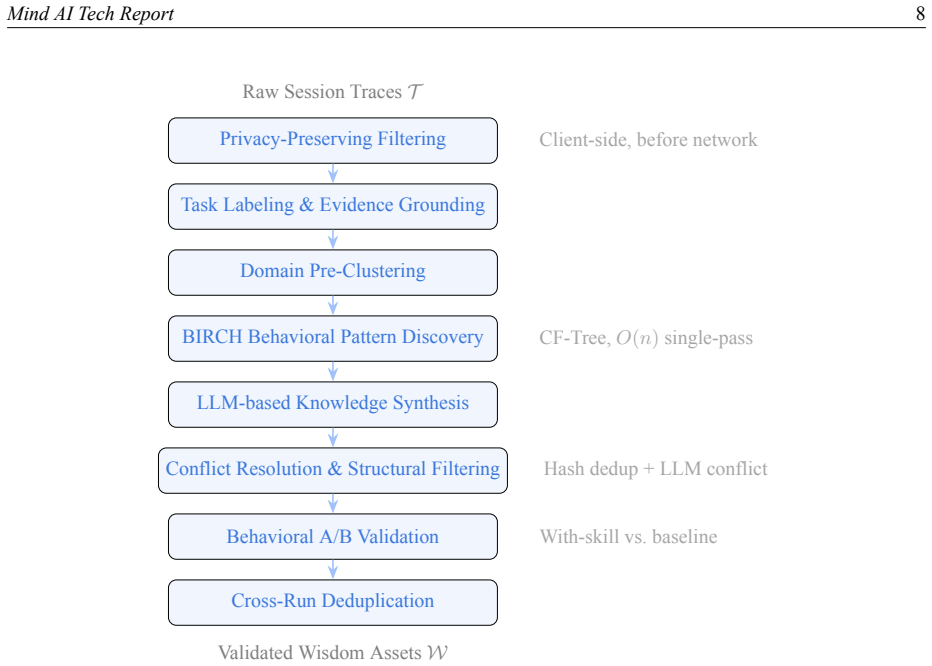
Summary. The paper proposes MEGA, a three-layer infrastructure for agent-system optimization. Layer 1 distills agent sessions into validated 'wisdom assets' via clustering and behavioral A/B testing; Layer 2 decomposes these assets into atomic PCR (Primary-Context-Resultant) units stored in a typed Wisdom Graph, performs deductive, abductive, and inductive inference to expand the graph, and retrieves execution plans via a Prize-Collecting Steiner Tree formulation; Layer 3 runs a multi-agent optimization loop over heterogeneous workflows, attributes performance deltas to specific changes via a fixed-seed 'Seed-Epoch' regime, and feeds verdicts back into the graph. The central claim is that this closed loop lets optimization knowledge compound across projects, so new projects start from previously validated wisdom. The empirical sections report a SkillsBench curation study (Table 4) and a four-benchmark optimization study against prior optimizers (Table 5), with an aggregate score of 76.55 versus GEPA's 69.52 on GPT-4.1 Mini.
Significance. If the self-evolving loop were actually demonstrated, the paper would address a real gap in the agent-optimization literature: current optimizers do not accumulate transferable knowledge, and current skill libraries do not reason compositionally over that knowledge. The architecture is specified in unusual detail, including the PCR formalism (Definition 1), the Seed-Epoch attribution scheme (Definition 2), verdict feedback (Definition 3), and the PCST retrieval objective (Eq. 5). The paper also ships a repository link for benchmark configuration and results, which is a genuine strength, and it compares against published baselines rather than only internal ablations. However, the empirical sections do not test the mechanism that defines the paper's contribution: the cross-project, evidence-driven self-evolution of the Wisdom Graph. The evaluation is set up so that the graph already contains the golden skills for the test tasks, and the optimization study measures a single pass over one static pool, so the reported gains cannot be attributed to the claimed loop.
major comments (4)
- [Section 7.1, Table 4] The skill pool for the curation evaluation 'comprises 4,207 assets including SkillsBench's golden skills for all curation systems.' This means MEGA's WG-DB retrieval is evaluated under an oracle condition in which the target task's reference skills are present in the pool, and the same is true for the comparison systems. As a result, the 46.5% pass rate measures retrieval and plan assembly from a pool that already contains the correct solutions; it does not measure Layer 1's distillation of reusable wisdom from raw sessions, nor does it test the cross-project accumulation that the paper's central claim requires. An ablation with the golden skills withheld, or with a pool built only from MEGA's own Layer 1 output, would be needed to attribute the result to the Wisdom Graph rather than to the oracle pool.
- [Section 7.2 and Eq. (1)] The optimization experiment does not exercise the self-evolving loop that Eq. (1) formalizes. MEGA's Layer 3 is run on the same static 4,207-asset graph evaluated in Section 7.1, and the verdicts produced during a single benchmark are fed back into that same pool; there is no measurement over multiple projects, no sequence of graph updates, and no evidence that cross-project optimization trajectories change the starting point of a later optimization. The abstract's claim that 'optimizing an agent system and evolving the knowledge that guides optimization are one and the same process' is therefore assumed rather than demonstrated. A minimal test would run MEGA on a first project, then a second project with the updated graph, and compare against a graph that received no feedback; the paper reports no such comparison.
- [Table 5, Section 7.2] The headline +7.03 aggregate improvement over GEPA is reported as a single set of point values with no error bars, no multiple-seed variance, and no significance tests. Baseline scores for MIPROv2, TextGrad, GEPA, and Feedback Descent are cited from the respective prior papers rather than reproduced under identical conditions, while MEGA is run with smaller validation sets (100 vs. 300 for HotpotQA, as stated in the setup). These differences make the comparison unmatched: the reported gain could result from evaluation-protocol differences, validation-set size, or random seed rather than from MEGA's mechanisms. The claim that 'MEGA's optimization loop requires less validation data to converge' is not supported by any controlled comparison that varies validation size.
- [Sections 1.2 and 5.6] The Scope of Disclosure states that 'algorithmic details are selectively disclosed at the level of design objectives and formal properties,' and Section 5.6 explicitly says that 'detailed parameter settings and statistical assumptions are omitted.' The architecture relies on a large set of free parameters and unspecified functions: the BIRCH radius threshold T (Eq. 3), the cold/warm gating thresholds θ_cold and θ_warm (Eq. 7), the blending threshold k (Eq. 8), the promotion thresholds n_min and r_min (Eq. 9), the evolution threshold θ_evo (Eq. 10), and the prize/cost functions of the PCST objective (Eq. 5). Because none of these are given concrete values or estimation procedures, the central derivation cannot be independently checked, and the reported experimental results cannot be reproduced from the manuscript alone.
minor comments (5)
- [General] The manuscript contains repeated OCR-like artifacts, including 'with-out' in the abstract, 'relations;' in the abstract, and missing spaces in Section 1; these should be corrected throughout.
- [Table 4 and Section 7.1] The efficiency metric is defined in the text as 'pass-rate improvement per additional megatoken consumed relative to the NoSkills baseline' but the table reports 'Efficiency (score/Mtok)' and the caption defines it as 'pass rate per megatoken consumed'; these definitions are inconsistent and should be unified.
- [Figure 10 and Table 4] Pass rates are computed from 5 attempts per task across 84 tasks with a stochastic agent, yet no error bars or confidence intervals are reported; at minimum, a binomial confidence interval would clarify whether the differences among the three curation methods are meaningful.
- [Section 7.2] The statement that HotpotQA and PUPA 'approach the ceiling reachable through workflow and prompt optimization' is presented without evidence; the paper does not provide an oracle or ceiling analysis to justify this interpretation.
- [References] Several references list only partial author lists or use placeholder years (e.g., some 2026 arXiv preprints), which is acceptable for a preprint but should be checked for consistency with the journal's citation requirements.
Circularity Check
No derivation-level circularity: Eq. (1) is an architectural definition, Tables 4-5 are direct measurements, and the untested cross-project self-evolution claim is a validity gap rather than a circular reduction.
full rationale
The paper's formal backbone is an architecture specification, not a theorem whose conclusions are preloaded into its premises. Equation (1) defines W(t), Pi(t), E(t), and T3(t) as the outputs of the three layers and then asserts that T3(t-1) and E(t-1) feed back into Layer 1 and Layer 2; the abstract's statement that "optimizing an agent system and evolving the knowledge that guides optimization are one and the same process" restates this design definition rather than deriving a non-trivial consequence from independent premises. The quantitative claims are direct measurements: Section 7.1 compares curation methods on a shared 4,207-asset pool, and Section 7.2 compares optimizers on common ground-truth datasets with baseline scores cited from GEPA and Feedback Descent. Including SkillsBench's golden skills in the common pool is a deliberate control for curation quality, and since all curation conditions share the same pool and MEGA still fails more than half of the tasks, the 46.5% pass rate is not forced by construction. Similarly, Section 7.2's use of the same Wisdom Graph is an intended within-run optimization condition, not a fitted parameter renamed as a prediction. The genuine problems are external-validity and disclosure gaps: Section 7 never exercises cross-project evidence accumulation, and the "Scope of Disclosure" states that algorithmic details are selectively disclosed, so the operationalized self-evolution loop cannot be independently checked from the report. These are substantive scientific limitations, but they are not circularity of the kind where a prediction is equivalent to a fitted input, a cited uniqueness theorem forces the choice, or a result is identical to its assumptions by definition.
Assumptions & free parameters
free parameters (6)
- BIRCH radius threshold T =
not disclosed
- Gate thresholds theta_cold and theta_warm =
not disclosed
- Blending threshold k in transfer rate =
not disclosed
- Promotion thresholds n_min and r_min =
not disclosed
- Evolution threshold theta_evo =
not disclosed
- PCST prize and cost functions =
not disclosed
assumptions (5)
- domain assumption Inference rules for deduction, abduction, and induction over PCR triplets produce valid new relations.
- domain assumption Fixed-seed evaluation within an epoch eliminates data variance and attributes deltas to strategy changes.
- domain assumption Behavioral A/B validation with an LLM teacher-student protocol provides a reliable performance-lift estimate.
- ad hoc to paper The 4,207-asset pool containing SkillsBench's golden skills is an appropriate evaluation substrate for wisdom curation.
- domain assumption PCST over the undirected projection of the Wisdom Graph yields plans that improve task performance.
invented entities (3)
-
Wisdom Graph (WG-DB)
-
PCR triplet (Primary-Context-Resultant)
-
Curation patterns and optimization trajectories
Cite this review
Pith. "Pith review of MEGA: Self-Evolving Agent Optimization Infrastructure via Wisdom Graph." pith.science (2026). https://pith.science/paper/LI6LH7Y6
@misc{pith2026260810504,
  author       = {Pith},
  title        = {Pith review of: MEGA: Self-Evolving Agent Optimization Infrastructure via Wisdom Graph},
  year         = {2026},
  howpublished = {\url{https://pith.science/paper/LI6LH7Y6}},
  note         = {Machine review of arXiv:2608.10504}
}
read the original abstract
As coding agents increasingly handle implementation, the central challenge shifts from building individual agents to building an infrastructure that systematically improves them. Current approaches optimize agent systems without accumulating transferable knowledge, accumulate knowledge without compositional reasoning over it, and lack a mechanism for that knowledge to self-evolve through operational evidence. MEGA (Meta Evaluation-Grounded Adaptation) addresses these gaps as a self-evolving infrastructure: each optimization cycle produces durable assets, compositional reasoning over those assets guides subsequent optimization, and operational evidence refines both the accumulated wisdom and the reasoning that governs it. Layer 1 distills reusable wisdom from agent sessions through behavioral-pattern clustering and empirical A/B validation, transforming each process into a durable asset. Layer 2 decomposes these assets into atomic PCR (Primary-Context-Resultant) units within a typed Wisdom Graph and performs deductive, abductive, and inductive reasoning to expand implicit relations; it then assembles context-specific execution plans through compositional retrieval that surfaces bridging knowledge unreachable by embedding similarity alone. Layer 3 performs multi-agent collaborative optimization over heterogeneous agent workflows (code nodes, LLM calls, and tool-using agents), attributing improvement effects to specific strategy changes through controlled evaluation that eliminates data variance. Evidence fed back from Layer 3 drives the self-evolution of both the curation strategies that govern wisdom composition and the optimization trajectories accumulated across runs. The result is an infrastructure in which optimizing an agent system and evolving the knowledge that guides optimization are one and the same process.
Figures


Figures from the paper (8 more)


Reference graph
Works this paper leans on
-
[1]
RussellL.Ackoff. Fromdatatowisdom. Journal of Applied Systems Analysis,16:3–9,1989
work page 1989
-
[2]
GEPA:Reflectivepromptevolutioncanoutperformreinforcementlearning
Lakshya A Agrawal, Shangyin Tan, Dilara Soylu, Noah Ziems, Rishi Khare, Krista Opsahl-Ong, ArnavSinghvi,etal. GEPA:Reflectivepromptevolutioncanoutperformreinforcementlearning. In International Conference on Learning Representations (ICLR),2026. OralPresentation
work page 2026
-
[3]
Agent KB: Leveraging cross-domain experience for agentic problem solving,
Zhuoqun Chen et al. Agent KB: Leveraging cross-domain experience for agentic problem solving,
-
[4]
arXiv preprint arXiv:2404.16130,2024
Darren Edge, Ha Trinh, Newman Cheng, Joshua Bradley, Alex Chao, Apurva Mody, Steven Truitt, andJonathanLarson.Fromlocaltoglobal: AgraphRAGapproachtoquery-focusedsummarization. arXiv preprint arXiv:2404.16130,2024
arXiv 2024
-
[5]
A general approximation technique for constrained forestproblems
Michel X Goemans and David P Williamson. A general approximation technique for constrained forestproblems. SIAM Journal on Computing,24(2):296–317,1995
work page 1995
-
[6]
Flow: Modularized agentic workflow automation
Boye Gu et al. Flow: Modularized agentic workflow automation. InInternational Conference on Learning Representations (ICLR),2025
work page 2025
-
[7]
DS-Agent: Automated data science by empowering large language models with case-basedreasoning
Siyuan Guo et al. DS-Agent: Automated data science by empowering large language models with case-basedreasoning. In International Conference on Machine Learning (ICML),2024
work page 2024
-
[8]
LightRAG: Simple and fast retrieval-augmented generation, 2024
Zirui Guo et al. LightRAG: Simple and fast retrieval-augmented generation, 2024. arXiv:2410.05779
arXiv 2024
Show all 42 references
-
[9]
FromRAGtomemory: Non-parametriccontinuallearningforlarge languagemodels
BernalJiménezGutierrezetal. FromRAGtomemory: Non-parametriccontinuallearningforlarge languagemodels. In International Conference on Machine Learning (ICML),2025
2025
-
[10]
Upskill: Agent skill generation and evaluation
Hugging Face. Upskill: Agent skill generation and evaluation. https://github.com/ huggingface/upskill,2025
2025
-
[11]
https://ghuntley.com/loop/,2025.Autonomous agentlooppatternforiterativetaskcompletion
GeoffreyHuntley.Everythingisaralphloop. https://ghuntley.com/loop/,2025.Autonomous agentlooppatternforiterativetaskcompletion
2025
-
[12]
arXiv:2507.00014
ThomasJoshi,ShayanChowdhury,andFarukUysal.SWE-Bench-CL:Continuallearningforcoding agents,2025. arXiv:2507.00014
2025 arXiv
-
[13]
Joshi, Hanna Mober, et al
Omar Khattab, Arnav Singhvi, Paridhi Maheshwari, Zhiyuan Zhang, Keshav Santhanam, Sri Vard- hamanan, Saiful Haq, Ashutosh Sharma, Thomas T. Joshi, Hanna Mober, et al. DSPy: Compil- ing declarative language model calls into state-of-the-art pipelines. InInternational Conference...
2024
-
[14]
Feedback descent: Open-ended text optimization via pairwisecomparison
Yoonho Lee, Joseph Boen, and Chelsea Finn. Feedback descent: Open-ended text optimization via pairwisecomparison. arXiv preprint arXiv:2511.07919,2025
2025
-
[15]
Organizing, orchestrating, and benchmarking agent skills at ecosystem scale.arXiv preprint arXiv:2603.02176,2026
Hao Li, Chunjiang Mu, Jianhao Chen, Siyue Ren, Zhiyao Cui, Yiqun Zhang, Lei Bai, and Shuyue Hu. Organizing, orchestrating, and benchmarking agent skills at ecosystem scale.arXiv preprint arXiv:2603.02176,2026
2026
-
[16]
SkillNet: Create, evaluate, and connect AI skills.arXiv preprint arXiv:2603.04448, 2026
Hao Li et al. SkillNet: Create, evaluate, and connect AI skills.arXiv preprint arXiv:2603.04448, 2026. Mind AI Tech Report 28
2026
-
[17]
SkillsBench: Benchmarkinghowwellagentskillswork acrossdiversetasks,2026
XiangyiLi,WenboChen,YiminLiu,etal. SkillsBench: Benchmarkinghowwellagentskillswork acrossdiversetasks,2026. arXiv:2602.12670
2026 arXiv
-
[18]
SWE- Next: Scalable real-world software engineering tasks for agents.arXiv preprint arXiv:2603.20691, 2026
JiarongLiang,ZhihengLyu,ZijieLiu,XiangchaoChen,PingNie,KaiZou,andWenhuChen. SWE- Next: Scalable real-world software engineering tasks for agents.arXiv preprint arXiv:2603.20691, 2026
2026
-
[19]
Self-refine: Iterativerefinementwith self-feedback
Aman Madaan, Niket Tandon, Prakhar Gupta, Skyler Hallinan, Luyu Gao, Sarah Wiegreffe, Uri Alon,NouhaDziri,ShrimaiPrabhumoye,YimingYang,etal. Self-refine: Iterativerefinementwith self-feedback. InAdvances in Neural Information Processing Systems (NeurIPS),2023
2023
-
[20]
ProcMEM: Learning reusable procedural memory from experience via non- parametricPPOforLLMagents,2026
Haoran Mi et al. ProcMEM: Learning reusable procedural memory from experience via non- parametricPPOforLLMagents,2026. arXiv:2602.01869
2026 arXiv
-
[21]
Optimizinginstructionsanddemonstrationsformulti-stagelanguagemodelprograms
KristaOpsahl-Ong,MichaelJ.Ryan,JoshHardy,ShwethaPatel,MichaelS.Bernstein,andChristo- pherPotts. Optimizinginstructionsanddemonstrationsformulti-stagelanguagemodelprograms. In Empirical Methods in Natural Language Processing (EMNLP),2024
2024
-
[22]
Le, etal
Siru Ouyang, Jun Yan, I-Hung Hsu, Yanfei Chen, Ke Jiang, Zifeng Wang, Rujun Han, Long T. Le, etal. ReasoningBank: Scalingagentself-evolvingwithreasoningmemory. In International Confer- ence on Learning Representations (ICLR),2026. arXiv:2509.25140
2026 arXiv
-
[23]
Gonzalez
CharlesPacker,SarahWooders,KevinLin,VivianFang,ShishirG.Patil,IonStoica,andJosephE. Gonzalez. MemGPT:TowardsLLMsasoperatingsystems,2023. arXiv:2310.08560
2023 arXiv
-
[24]
Synthesizingagenticdataforwebagentswithprogressivedifficultyenhancementmechanisms
Shrey Pandit, Xuan-Phi Nguyen, Yifei Ming, Austin Xu, Jiayu Wang, Caiming Xiong, and Shafiq Joty. Synthesizingagenticdataforwebagentswithprogressivedifficultyenhancementmechanisms. arXiv preprint arXiv:2510.13913,2025
2025
-
[25]
Causality: Models, Reasoning, and Inference.CambridgeUniversityPress,2ndedition, 2009
JudeaPearl. Causality: Models, Reasoning, and Inference.CambridgeUniversityPress,2ndedition, 2009
2009
-
[26]
Measuring and narrowing the compositionality gap in language models
OfirPress,MuruZhang,SewonMin,LudwigSchmidt,NoahASmith,andMikeLewis. Measuring and narrowing the compositionality gap in language models. InFindings of the Association for Computational Linguistics (EMNLP),2023
2023
-
[27]
ATOMIC: An atlas of machine common- senseforif-thenreasoning
Maarten Sap, Ronan Le Bras, Emily Allaway, Chandra Bhagavatula, Nicholas Lourie, Hannah Rashkin, Brendan Roof, Noah A Smith, and Yejin Choi. ATOMIC: An atlas of machine common- senseforif-thenreasoning. In AAAI Conference on Artificial Intelligence,2019
2019
-
[28]
Reflexion: Languageagentswithverbalreinforcementlearning
NoahShinn,FedericoCassano,AshwinGopinath,KarthikNarasimhan,andShunyuYao. Reflexion: Languageagentswithverbalreinforcementlearning. In Advances in Neural Information Processing Systems (NeurIPS),2023
2023
-
[29]
ConceptNet 5.5: An open multilingual graph of generalknowledge
Robyn Speer, Joshua Chin, and Catherine Havasi. ConceptNet 5.5: An open multilingual graph of generalknowledge. In AAAI Conference on Artificial Intelligence,2017
2017
-
[30]
Dynamic cheatsheet: Adaptive memory for test-time learning.arXiv preprint, 2025
Mirac Suzgun et al. Dynamic cheatsheet: Adaptive memory for test-time learning.arXiv preprint, 2025
2025
-
[31]
Voyager: An open-ended embodied agent with large language models.arXiv preprint arXiv:2305.16291,2023
GuanzhiWang,YuqiXie,YunfanJiang,AjayMandlekar,ChaoweiXiao,YukeZhu,LinxiFan,and Anima Anandkumar. Voyager: An open-ended embodied agent with large language models.arXiv preprint arXiv:2305.16291,2023
2023 arXiv
-
[32]
Stateful reflective developer platforms (SRDP): Ai-native platforms for compounding agentproductivity
Jun Wang. Stateful reflective developer platforms (SRDP): Ai-native platforms for compounding agentproductivity. arXiv preprint arXiv:2512.22716,2025. DefinestheSRDPframeworkonwhich Memento-Skills[41]isbuilt. Mind AI Tech Report 29
2025
-
[33]
arXiv preprint arXiv:2409.07429,2024
ZoraZhiruoWang,JiayuanMao,DanielFried,andGrahamNeubig.Agentworkflowmemory. arXiv preprint arXiv:2409.07429,2024
2024 arXiv
-
[34]
Optimas: Optimizing compound AI systems with globally aligned local rewards
Yuxin Wu et al. Optimas: Optimizing compound AI systems with globally aligned local rewards. arXiv preprint,2025
2025
-
[35]
SWE-Exp: Experience-driven software issue resolution, 2025
Xingyao Xiang et al. SWE-Exp: Experience-driven software issue resolution, 2025. arXiv:2507.23361
2025
-
[36]
UTBoost: Rigorousevaluationofcodingagents onSWE-Bench
BoxiYu,YuxuanZhu,PinjiaHe,andDanielKang. UTBoost: Rigorousevaluationofcodingagents onSWE-Bench. In Association for Computational Linguistics (ACL),2025. arXiv:2506.09289
2025 arXiv
-
[37]
TextGrad: Automaticdifferentiationviatext
Mert Yuksekgonul, Federico Bianchi, Joseph Boen, Sheng Liu, Zhi Huang, Carlos Guestrin, and JamesZou. TextGrad: Automaticdifferentiationviatext. Nature,2025
2025
-
[38]
AFlow: Automatingagenticworkflowgeneration
JiayiZhangetal. AFlow: Automatingagenticworkflowgeneration. In International Conference on Learning Representations (ICLR),2025. OralPresentation
2025
-
[39]
Agentic context engineering: Evolving contexts for self- improvinglanguagemodels.In International Conference on Learning Representations (ICLR),2026
Qizheng Zhang, Changran Hu, et al. Agentic context engineering: Evolving contexts for self- improvinglanguagemodels.In International Conference on Learning Representations (ICLR),2026. arXiv:2510.04618
2026 arXiv
-
[40]
BIRCH: An efficient data clustering method forverylargedatabases
Tian Zhang, Raghu Ramakrishnan, and Miron Livny. BIRCH: An efficient data clustering method forverylargedatabases. In ACM SIGMOD International Conference on Management of Data,1996
1996
-
[41]
arXiv preprint arXiv:2603.18743,2026
HuichiZhou,SiyuanGuo,AnjieLiu,ZhongweiYu,ZiqinGong,BowenZhao,etal.Memento-skills: Letagentsdesignagents. arXiv preprint arXiv:2603.18743,2026
2026
-
[42]
Syn- thetic sandbox for training machine learning engineering agents.arXiv preprint arXiv:2604.04872, 2026
YuhangZhou,LizhuZhang,YifanWu,JiayiLiu,XiangjunFan,ZhuokaiZhao,andHongYan. Syn- thetic sandbox for training machine learning engineering agents.arXiv preprint arXiv:2604.04872, 2026
2026 arXiv
Reviewed August 15, 2026 · model on record in the stance chip above.
Discussion (0). Continue with ORCID to comment.