REVIEW 4 major objections 5 minor 68 references
Towards Color-Faithful Low-Light Image Enhancement via Adaptive Color Debiasing and Saturation Rectification
T0 review · 4 major / 5 minor · reviewed 2026-08-15 · deepseek-v4-flash
Pith's one-line read A small adaptive color transform wrapped around any enhancement backbone removes the embedded color casts behind low-light color error.
desk verdict A well-scoped color correction module with a promising mechanism and solid ablations, but the headline numbers are undercut by uncontrolled baselines and dataset-specific post-processing. read the letter →
The pith
A machine-rendered reading of the paper's core claim, the machinery that carries it, and where it could break.
The reading
What carries the argument
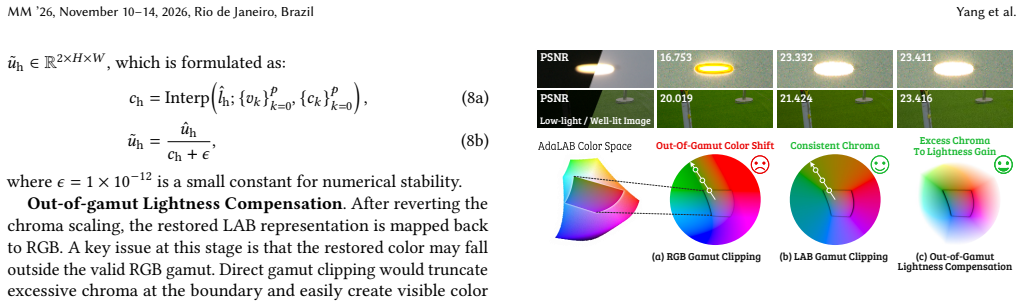
The load-bearing mechanism is the pair AdaLAB and AdaCCT. AdaLAB is a cylindrical, image-adaptive form of CIELab that keeps the L axis and the two opponent a*b* axes but reorganizes the chromatic plane per image. AdaCCT is the transform that performs the reorganization, driven by three groups of image-adaptive parameters predicted from a 128×128 downsampled input: lightness sensitivity vertices (adaptive, monotonically increasing partitions of the lightness axis), chroma-scaling intensities (a learnable 1D map along lightness with exponentially decaying global interaction across all vertices), and a single two-dimensional hue-shift direction whose per-vertex magnitudes make the shift lightness-aware through linear interpolation. The forward transform computes $\tilde u_l = u_l - s_l d_l$ with a similarity weight $s_l \in [\delta_1, \delta_2]$ and then $\hat u_l = c_l \tilde u_l$; the inverse transform divides by the scaling ($\tilde u_h = \hat u_h / (c_h + \epsilon)$) and replaces gamut clipping with out-of-gamut lightness compensation, $l_h = \hat l_h + \gamma \| u_c - \tilde u_h \|_2$, converting unrepresentable chroma into a lightness gain. The transform is deliberately asymmetric: the inverse does not undo the debiasing, and the training target in AdaLAB space applies the same chroma scaling but omits the hue offset, so the backbone learns to enhance a debiased, well-scaled representation instead of inheriting the embedded cast.
What would settle it
Run CAGE on a mixed-illumination test set, for example a room lit by warm tungsten on one side and cool daylight on the other, and compare each output pixel with ground truth in a*b* coordinates: if spatially separated regions of nearly equal lightness show hue residuals with opposite signs or significantly different mean directions, the shared-direction debiasing is wrong exactly where the paper concedes it could fail.
Extended reading notes
Core claim
The central claim is that lightness–chrominance decoupling alone cannot remove the chromatic disturbance embedded in a low-light image: the disturbance propagates through any enhancement pipeline and reappears as global color bias together with local under- and over-saturation. CIELab offers a coherent basis for organizing this disturbance, but a reversible transform merely re-parameterizes it. CAGE therefore builds an explicitly asymmetric transform, AdaCCT, with a forward pass that suppresses the disturbance and an inverse pass that repairs its aftermath. The forward pass predicts, from a downsampled input, a shared two-dimensional hue-shift direction whose magnitude varies with lightness, shifts each pixel's chroma along that direction by a similarity-weighted amount, then rescales chroma by a lightness-dependent intensity learned with global interaction across lightness intervals. The inverse pass reverts only the scaling, not the debiasing, and handles out-of-gamut colors by turning the unrepresentable chroma surplus into a lightness gain rather than clipping it. The reported experiments on six benchmarks, three backbone families, no-reference datasets, and a human rating study support that this wrapper improves color fidelity and overall quality at negligible computational cost.
Load-bearing premise
The load-bearing premise is that within any one image the low-light color cast points in a single shared hue direction, with only its strength varying as brightness varies, so a single shift direction plus lightness-dependent magnitude can model and remove the bias; if a scene mixes different light sources and regions of similar brightness are cast in different directions, the debiasing can be wrong and residual local color bias persists.
Editorial extensions
If this is right
- Color-faithful enhancement becomes a wrapper problem: any existing low-light backbone can be retrofitted with the forward and inverse transforms, and the reported gains come from color modeling rather than added capacity (0.07M parameters, under 0.01 GFLOPs).
- The consistent gains across a Retinex-based transformer, an RGB-space network, and an HSV-inspired color-space network imply the embedded-bias mechanism is general to low-light imaging and not an artifact of one architecture.
- Because the inverse transform turns out-of-gamut chroma into lightness gain instead of clipping, strong enhancement no longer has to trade saturated colors against washed-out ones; the reported reduction in over- and under-saturation is the direct consequence.
- The reported no-reference improvements (BRISQUE and NIQE reductions in most of the 15 backbone-dataset combinations) imply the color correction carries over to real unpaired photos, which is the setting where such a module would actually be deployed.
Reading between the lines
- Boundary prediction: the shared-direction premise implies the method will struggle exactly where the authors place its stated boundary — scenes with mixed light sources, where regions of similar brightness are cast in different directions; a spatially-varying hue-shift predictor is the natural next step, though it would trade the global-coherence prior that keeps the module at 0.07M parameters.
- Out-of-gamut lightness compensation is a transferable principle: any operation that pushes colors outside a display gamut, such as tone mapping, color grading, or gamut mapping, could convert chroma surplus into lightness instead of clipping, and that claim could be tested independently on a gamut-mapping benchmark.
- The paper's ablation splits color failure into two mechanisms — global bias removed by hue shifting and saturation abnormality fixed by chroma scaling — and reports that removing hue-shift hurts PSNR most while removing chroma-scaling hurts LPIPS most; that split could be reused as a diagnostic for attributing color problems in any given enhancement dataset.
- A testable extension is to push the debiasing upstream into the RAW domain, where the color cast originates in the sensor pipeline; doing so would show whether the learned shift direction can correct bias before demosaicing and how OOGLC interacts with RAW-level denoising.
Signed reviews
Editorial analysis
A structured set of objections, weighed in public.
Referee Report
Summary. The paper proposes CAGE, a plug-and-play color-correction wrapper for low-light image enhancement. It introduces AdaLAB, an image-adaptive variant of the CIELab space in which low-light color bias is modeled as a lightness-dependent hue-directional shift plus chroma scaling, and AdaCCT, a forward/inverse transform pair. The forward transform debiases and rescales chroma before the enhancement backbone operates; the inverse transform reverts chroma scaling and maps out-of-gamut chroma surplus to lightness compensation. The authors integrate CAGE into Retinexformer, DarkIR, and HVI-CIDNet and report consistent PSNR/SSIM/LPIPS gains on LOLv1, LOLv2, SDSD, and SID, plus no-reference gains on DICM/LIME/MEF/NPE/VV, ablation studies, and a human perceptual study.
Significance. If the evaluation is properly controlled, the paper's contribution is a low-cost, backbone-agnostic color-correction module with a clearly described mechanism. Strengths include the small overhead (about 0.07M additional parameters and less than 0.01 GFLOPs), the breadth of benchmarks (six paired and five no-reference datasets), ablations that isolate hue shift, chroma scaling, lightness sensitivity, color-space choice, and gamut handling, and the release of code. The central empirical claim currently rests on a comparison protocol that does not fully isolate CAGE from retraining and post-hoc adjustment effects, so the significance is conditional on the control experiments requested below.
major comments (4)
- [Sec. 4.1, Tables 1–2] The comparison protocol does not isolate CAGE. The text states that backbone networks are retrained for fair comparison, but no retrained baseline without CAGE is reported; the '+Ours' rows are compared against numbers whose provenance (published versus retrained) is unspecified. Because retraining recipes and seeds can shift PSNR/SSIM by the same order as some of the claimed gains, the reported deltas may partly reflect training configuration rather than AdaLAB/AdaCCT. Please report, for each backbone and dataset, a same-protocol retrained baseline without CAGE and the '+Ours' result initialized or trained under identical conditions.
- [Appendix B.1, Eq. (20)] Dataset-specific post-hoc adjustments and GT-mean rescaling are applied to CAGE outputs, but it is not stated whether they are applied identically to the baseline outputs. On LOLv1, CAGE uses alpha_l=1.3 and GT-mean rescaling (Eq. 20); on LOLv2-real, it uses alpha_l=1.1 and alpha_c=0.8. If the baselines are not adjusted in the same way, some of the reported gains (e.g., +2.21 dB on LOLv2-real for Retinexformer) could arise from these evaluation-side operations rather than from the transform. Please either apply the same adjustments to all compared methods or ablate the adjustments to show that CAGE's gains persist without them.
- [Sec. 3.4, Eq. (11)] The AdaLAB supervision target is constructed by applying the input-predicted chroma-scaling intensity to the ground truth. This makes part of the supervision self-referential: the model can reduce the AdaLAB loss by predicting a scaling that aligns the target to its own representation, rather than learning a genuinely corrective scaling. The authors should justify this design or ablate it against a fixed target (e.g., GT-derived scaling or no scaling in the AdaLAB loss), and should report whether the RGB-space loss alone preserves the observed gains.
- [Sec. 3.2, Appendix D] The method assumes a single image-level hue-shift direction whose magnitude varies with lightness, and Appendix D concedes that mixed illumination can violate this assumption, leaving residual local color bias. This limitation is acknowledged, but its impact is not quantified. To bound the central claim, please report results on mixed-illumination subsets or on the most challenging SDSD/SID scenes, and clarify whether the gains are concentrated in scenes with coherent global color bias.
minor comments (5)
- [Tables 1–2, LPIPS notation] The notation '+0.065' under LPIPS is confusing because lower LPIPS is better; the caption says '+(-) denotes improvement (reduction)', but a reader cannot tell whether '+0.065' means a 0.065 reduction (good) or an increase. Please use a direction-consistent delta convention for each metric.
- [Abstract, Fig. 8] The phrase 'cylindrical adaptive LAB color space' is slightly misleading because AdaLAB is displayed in Cartesian coordinates in Fig. 8; the cylindrical aspect lives in the parameterization of the transform rather than in the color-space coordinates. Consider rewording for clarity.
- [Fig. 3 caption] The term 'GT-mean Brighten Image' is not defined in the caption; please define it or point the reader to Appendix B.1 where the GT-mean operation is explained.
- [Sec. 4.4, Gamut Harmonization paragraph] The text says 'As shown in Table 8' when referring to the gamut-harmonization ablation, but the table displayed in the main text is Table 5, and the appendix also contains a Table 8. Please renumber to avoid ambiguity.
- [Appendix C, Human Subjective Evaluation] The human study is a useful addition, but no statistical significance test is reported for the mean-score differences. Please state whether the observed improvements over the three baselines are statistically significant.
Circularity Check
No significant circularity: CAGE is an empirical, end-to-end trained color transform; the auxiliary AdaLAB target is anchored by the RGB reconstruction loss, and self-citations are not load-bearing.
full rationale
CAGE does not claim a first-principles derivation. Its forward and inverse transforms are learned components trained end-to-end with a reconstruction loss in both AdaLAB and RGB space (Eq. 11). The only self-referential element is the AdaLAB target y_AdaLAB, which applies the input-predicted chroma scaling to the ground truth (Sec. 3.4). This is not circular because the same predicted scaling is divided out in the inverse transform (Eq. 8), so the RGB loss against the true ground truth anchors the final output; the AdaLAB loss is a consistency constraint rather than a substitute for ground-truth supervision. Self-citations [31, 44, 45] appear in related work and baseline comparisons and carry no load-bearing argument. The dataset-specific alpha_l/alpha_c settings and GT-mean rescaling (Appendix B.1) are evaluation-protocol choices, not derivation steps; they could affect comparison fairness but do not make the method's output equivalent to its input. Appendix D's acknowledged limitation on mixed illumination is an assumption about the target domain, not a circularity.
Assumptions & free parameters
free parameters (6)
- lightness interval count p =
32
- similarity-weight bounds delta1, delta2 =
0.2, 1.0
- lightness compensation ratio gamma =
1.0
- loss balance lambda =
1.0
- output saturation and brightness gains alpha_c, alpha_l =
LOLv1: alpha_l=1.3, alpha_c=1.0; LOLv2-Real: alpha_l=1.1, alpha_c=0.8; default 1.0/1.0
- global-interaction temperature tau =
learned
assumptions (5)
- domain assumption Low-light color bias is globally coherent in direction and varies mainly with lightness.
- domain assumption CIELab provides a perceptually coherent basis for reorganizing low-light chromatic distributions.
- domain assumption The feasible chroma range in LAB is non-monotonic along the lightness axis, so chroma scaling should be non-monotonic.
- domain assumption Paired ground-truth images are valid color-faithful targets.
- domain assumption Existing enhancement backbones can be wrapped with forward and inverse color transforms without architectural changes.
invented entities (2)
-
AdaLAB color space
-
AdaCCT transform
Cite this review
Pith. "Pith review of Towards Color-Faithful Low-Light Image Enhancement via Adaptive Color Debiasing and Saturation Rectification." pith.science (2026). https://pith.science/paper/ZYCMANIG
@misc{pith2026260810512,
  author       = {Pith},
  title        = {Pith review of: Towards Color-Faithful Low-Light Image Enhancement via Adaptive Color Debiasing and Saturation Rectification},
  year         = {2026},
  howpublished = {\url{https://pith.science/paper/ZYCMANIG}},
  note         = {Machine review of arXiv:2608.10512}
}
read the original abstract
Low-light imaging often introduces color bias caused by the low signal-to-noise ratio and the image formation process. Although recent low-light image enhancement methods have achieved strong brightness recovery, faithful color restoration remains challenging, manifesting as overall color bias together with local under- and over-saturation. To address this issue, we propose CAGE, a cylindrical color correction framework with adaptive color debiasing and gamut-harmonized saturation rectification for color-faithful low-light image enhancement. We first introduce AdaLAB, a cylindrical adaptive LAB color space that provides a decoupled and image-specific basis for uniform color correction. Building on this color space, we further develop AdaCCT, an adaptive cylindrical color transform with forward and inverse transforms for the conversion between RGB and AdaLAB color space, as well as necessary color debiasing and saturation rectification. The forward transform suppresses embedded color bias before backbone enhancement by reorganizing the chromatic distribution through chromatic-plane shifting and scaling, while the inverse transform achieves faithful saturation rectification through out-of-gamut lightness compensation. Extensive experiments on multiple benchmarks show that CAGE achieves more faithful color restoration, specifically reduces color bias and saturation abnormality, and delivers better overall visual quality across different low-light enhancement backbones. The code is available at https://yangzhichen763.github.io/CAGE/.
Figures


Figures from the paper (16 more)



Reference graph
Works this paper leans on
-
[1]
Mahmoud Afifi, Luxi Zhao, Abhijith Punnappurath, Mohamed A Abdelsalam, Ran Zhang, and Michael S Brown. 2025. Time-aware auto white balance in mobile photography. InProceedings of the IEEE/CVF International Conference on Computer Vision. 5038–5047
work page 2025
-
[2]
Yousef Atoum, Mao Ye, Liu Ren, Ying Tai, and Xiaoming Liu. 2020. Color- wise attention network for low-light image enhancement. InProceedings of the IEEE/CVF Conference on Computer Vision and Pattern Recognition Workshops. 506–507
work page 2020
-
[3]
Jiesong Bai, Yuhao Yin, Qiyuan He, Yuanxian Li, and Xiaofeng Zhang. 2024. RetinexMamba: Retinex-based Mamba for low-light image enhancement. In Proceedings of the International Conference on Neural Information Processing. Springer, 427–442
work page 2024
-
[4]
Alexandru Brateanu, Raul Balmez, Adrian Avram, Ciprian Orhei, and Cosmin Ancuti. 2025. LYT-NET: Lightweight YUV transformer-based network for low- light image enhancement.IEEE Signal Processing Letters32 (2025), 2065–2069
work page 2025
-
[5]
Yuanhao Cai, Hao Bian, Jing Lin, Haoqian Wang, Radu Timofte, and Yulun Zhang. 2023. Retinexformer: One-stage Retinex-based transformer for low-light image enhancement. InProceedings of the IEEE/CVF International Conference on Computer Vision. 12504–12513
work page 2023
-
[6]
Luyang Cao, Han Xu, Jian Zhang, Lei Qi, Jiayi Ma, Yinghuan Shi, and Yang Gao. 2025. Towards perfection: Building inter-component mutual correction for Retinex-based low-light image enhancement. InProceedings of the ACM International Conference on Multimedia. 9549–9558
work page 2025
-
[7]
Chen Chen, Qifeng Chen, Jia Xu, and Vladlen Koltun. 2018. Learning to see in the dark. InProceedings of the IEEE/CVF Conference on Computer Vision and Pattern Recognition. 3291–3300
work page 2018
-
[8]
Ziteng Cui, Kunchang Li, Lin Gu, Shenghan Su, Peng Gao, Zhengkai Jiang, Yu Qiao, and Tatsuya Harada. 2022. You only need 90k parameters to adapt light: A light weight transformer for image enhancement and exposure correc- tion, In Proceedings of the British Machine Vision Conference.arXiv preprint arXiv:2205.14871
arXiv 2022
Show all 68 references
-
[9]
Dan Ding, Feng Shi, and Ye Li. 2025. Low-illumination color imaging: Progress and challenges.Optics and Laser Technology184 (2025), 112553
2025
-
[10]
Daniel Feijoo, Juan C Benito, Alvaro Garcia, and Marcos V Conde. 2025. DarkIR: Robust low-light image restoration. InProceedings of the IEEE/CVF Conference on Computer Vision and Pattern Recognition. 10879–10889
2025
-
[11]
Theo Gevers, Arjan Gijsenij, Joost Van de Weijer, and Jan-Mark Geusebroek. 2012. Color in computer vision: Fundamentals and applications. John Wiley & Sons
2012
-
[12]
Chunle Guo, Chongyi Li, Jichang Guo, Chen Change Loy, Junhui Hou, Sam Kwong, and Runmin Cong. 2020. Zero-reference deep curve estimation for low- light image enhancement. InProceedings of the IEEE/CVF Conference on Computer Vision and Pattern Recognition. 1780–1789
2020
-
[13]
Hang Guo, Jinmin Li, Tao Dai, Zhihao Ouyang, Xudong Ren, and Shu-Tao Xia
-
[14]
Xiaojie Guo and Qiming Hu. 2023. Low-light image enhancement via breaking down the darkness.International Journal of Computer Vision131 (2023), 48–66
2023
-
[15]
Xiaojie Guo, Yu Li, and Haibin Ling. 2016. LIME: Low-light image enhancement via illumination map estimation.IEEE Transactions on Image Processing26 (2016), 982–993
2016
-
[16]
Quan Huynh-Thu and Mohammed Ghanbari. 2008. Scope of validity of PSNR in image/video quality assessment.Electronics Letters44 (2008), 800–801
2008
-
[17]
2019.Colorimetry — Part 4: CIE 1976 L*a*b* Colour Space
International Commission on Illumination and International Organization for Standardization. 2019.Colorimetry — Part 4: CIE 1976 L*a*b* Colour Space. ISO and CIE
2019
-
[18]
Hai Jiang, Ao Luo, Xiaohong Liu, Songchen Han, and Shuaicheng Liu. 2024. Ligh- tenDiffusion: Unsupervised low-light image enhancement with latent-Retinex diffusion models. InProceedings of the European Conference on Computer Vision. 161–179
2024
-
[19]
Yifan Jiang, Xinyu Gong, Ding Liu, Yu Cheng, Chen Fang, Xiaohui Shen, Jian- chao Yang, Pan Zhou, and Zhangyang Wang. 2021. EnlightenGAN: Deep light enhancement without paired supervision.IEEE Transactions on Image Processing 30 (2021), 2340–2349
2021
-
[20]
Hanul Kim, Su-Min Choi, Chang-Su Kim, and Yeong Jun Koh. 2021. Represen- tative color transform for image enhancement. InProceedings of the IEEE/CVF International Conference on Computer Vision. 4459–4468
2021
-
[21]
Wontae Kim, Keuntek Lee, and Nam Ik Cho. 2025. Lightweight and fast real-time image enhancement via decomposition of the spatial-aware lookup tables. In Proceedings of the IEEE/CVF International Conference on Computer Vision. 11895– 11905
2025
-
[22]
Chulwoo Lee, Chul Lee, and Chang-Su Kim. 2013. Contrast enhancement based on layered difference representation of 2D histograms.IEEE Transactions on Image Processing22 (2013), 5372–5384
2013
-
[23]
Chongyi Li, Chunle Guo, Linghao Han, Jun Jiang, Ming-Ming Cheng, Jinwei Gu, and Chen Change Loy. 2021. Low-light image and video enhancement using deep learning: A survey.IEEE transactions on pattern analysis and machine intelligence 44, 12 (2021), 9396–9416
2021
-
[24]
Chongyi Li, Chunle Guo, and Chen Change Loy. 2021. Learning to enhance low-light image via zero-reference deep curve estimation.IEEE Transactions on Pattern Analysis and Machine Intelligence44 (2021), 4225–4238
2021
-
[25]
Chongyi Li, Chun-Le Guo, Man Zhou, Zhexin Liang, Shangchen Zhou, Ruicheng Feng, and Chen Change Loy. 2023. Embedding fourier for ultra-high-definition low-light image enhancement. InProceedings of the International Conference on Learning Representations
2023
-
[26]
Risheng Liu, Long Ma, Jiaao Zhang, Xin Fan, and Zhongxuan Luo. 2021. Retinex- inspired unrolling with cooperative prior architecture search for low-light image enhancement. InProceedings of the IEEE/CVF Conference on Computer Vision and Pattern Recognition. 10561–10570
2021
-
[27]
Junyu Lou, Xiaorui Zhao, Kexuan Shi, and Shuhang Gu. 2025. Learning pixel- adaptive multi-layer perceptrons for real-time image enhancement. InProceedings of the IEEE/CVF International Conference on Computer Vision. 14095–14105
2025
-
[28]
Kede Ma, Kai Zeng, and Zhou Wang. 2015. Perceptual quality assessment for multi-exposure image fusion.IEEE Transactions on Image Processing24 (2015), 3345–3356
2015
-
[29]
Anish Mittal, Anush Krishna Moorthy, and Alan Conrad Bovik. 2012. No- reference image quality assessment in the spatial domain.IEEE Transactions on Image Processing21 (2012), 4695–4708
2012
-
[30]
completely blind
Anish Mittal, Rajiv Soundararajan, and Alan C Bovik. 2012. Making a “completely blind” image quality analyzer.IEEE Signal Processing Letters20 (2012), 209–212
2012
-
[31]
Yuzhen Niu, Fusheng Li, Yuezhou Li, Siling Chen, and Yuzhong Chen. 2025. Adaptive luminance enhancement and high-fidelity color correction for low-light image enhancement.IEEE Transactions on Computational Imaging11 (2025), 732–747
2025
-
[32]
David Serrano-Lozano, Luis Herranz, Michael S Brown, and Javier Vazquez- Corral. 2024. NamedCurves: Learned image enhancement via color naming. In Proceedings of the European Conference on Computer Vision. 92–108
2024
-
[33]
Vassilios Vonikakis, Rigas Kouskouridas, and Antonios Gasteratos. 2018. On the evaluation of illumination compensation algorithms.Multimedia Tools and Applications77 (2018), 9211–9231
2018
-
[34]
Chenxi Wang and Zhi Jin. 2023. Brighten-and-colorize: A decoupled network for customized low-light image enhancement. InProceedings of the ACM International Conference on Multimedia. 8356–8366
2023
-
[35]
Chenxi Wang, Hongjun Wu, and Zhi Jin. 2023. FourLLIE: Boosting low-light image enhancement by fourier frequency information. InProceedings of the ACM International Conference on Multimedia. 7459–7469
2023
-
[36]
Ruixing Wang, Xiaogang Xu, Chi-Wing Fu, Jiangbo Lu, Bei Yu, and Jiaya Jia. 2021. Seeing dynamic scene in the dark: A high-quality video dataset with mechatronic alignment. InProceedings of the IEEE/CVF International Conference on Computer Vision. 9700–9709
2021
-
[37]
Shuhang Wang, Jin Zheng, Hai-Miao Hu, and Bo Li. 2013. Naturalness preserved enhancement algorithm for non-uniform illumination images.IEEE Transactions on Image Processing22 (2013), 3538–3548
2013
-
[38]
Tao Wang, Kaihao Zhang, Tianrun Shen, Wenhan Luo, Bjorn Stenger, and Tong Lu. 2023. Ultra-high-definition low-light image enhancement: A benchmark and transformer-based method. InProceedings of the AAAI Conference on Artificial Intelligence. 2654–2662
2023
-
[39]
Wenjing Wang, Huan Yang, Jianlong Fu, and Jiaying Liu. 2024. Zero-reference low- light enhancement via physical quadruple priors. InProceedings of the IEEE/CVF Conference on Computer Vision and Pattern Recognition. 26057–26066
2024
-
[40]
Yufei Wang, Renjie Wan, Wenhan Yang, Haoliang Li, Lap-Pui Chau, and Alex Kot. 2022. Low-light image enhancement with normalizing flow. InProceedings of the AAAI Conference on Artificial Intelligence, Vol. 36. 2604–2612
2022
-
[41]
Zhou Wang, Alan C Bovik, Hamid R Sheikh, and Eero P Simoncelli. 2004. Image quality assessment: From error visibility to structural similarity.IEEE Transactions on Image Processing13 (2004), 600–612
2004
-
[42]
Chen Wei, Wenjing Wang, Wenhan Yang, and Jiaying Liu. 2018. Deep Retinex decomposition for low-light enhancement. InProceedings of the British Machine Vision Conference
2018
-
[43]
Wenhui Wu, Jian Weng, Pingping Zhang, Xu Wang, Wenhan Yang, and Jianmin Jiang. 2022. URetinex-Net: Retinex-based deep unfolding network for low-light image enhancement. InProceedings of the IEEE/CVF Conference on Computer Vision and Pattern Recognition. 5901–5910. MM ’26, Nove...
2022
-
[44]
Rui Xu, Yuezhou Li, Yuzhen Niu, Huangbiao Xu, Yuzhong Chen, and Tiesong Zhao. 2024. Bilateral interaction for local-global collaborative perception in low-light image enhancement.IEEE Transactions on Multimedia26 (2024), 10792– 10804
2024
-
[45]
Rui Xu, Yuzhen Niu, Yuezhou Li, Huangbiao Xu, Wenxi Liu, and Yuzhong Chen
-
[46]
Xiaogang Xu, Ruixing Wang, Chi-Wing Fu, and Jiaya Jia. 2022. SNR-aware low- light image enhancement. InProceedings of the IEEE/CVF Conference on Computer Vision and Pattern Recognition. 17714–17724
2022
-
[47]
Qingsen Yan, Yixu Feng, Cheng Zhang, Guansong Pang, Kangbiao Shi, Peng Wu, Wei Dong, Jinqiu Sun, and Yanning Zhang. 2025. HVI: A new color space for low-light image enhancement. InProceedings of the IEEE/CVF Conference on Computer Vision and Pattern Recognition. 5678–5687
2025
-
[48]
Qingsen Yan, Kangbiao Shi, Yixu Feng, Tao Hu, Peng Wu, Guansong Pang, and Yanning Zhang. 2025. HVI-CIDNet+: Beyond extreme darkness for low-light image enhancement.arXiv preprint arXiv:2507.06814(2025)
2025 arXiv
-
[49]
Canqian Yang, Meiguang Jin, Xu Jia, Yi Xu, and Ying Chen. 2022. AdaInt: Learning adaptive intervals for 3D lookup tables on real-time image enhancement. In Proceedings of the IEEE/CVF Conference on Computer Vision and Pattern Recognition. 17522–17531
2022
-
[50]
Canqian Yang, Meiguang Jin, Yi Xu, Rui Zhang, Ying Chen, and Huaida Liu
-
[51]
Wenhan Yang, Shiqi Wang, Yuming Fang, Yue Wang, and Jiaying Liu. 2020. From fidelity to perceptual quality: A semi-supervised approach for low-light image enhancement. InProceedings of the IEEE/CVF Conference on Computer Vision and Pattern Recognition. 3063–3072
2020
-
[52]
Wenhan Yang, Wenjing Wang, Haofeng Huang, Shiqi Wang, and Jiaying Liu
-
[53]
Xunpeng Yi, Han Xu, Hao Zhang, Linfeng Tang, and Jiayi Ma. 2025. Diff- Retinex++: Retinex-driven reinforced diffusion model for low-light image en- hancement.IEEE Transactions on Pattern Analysis and Machine Intelligence(2025), 6823–6841
2025
-
[54]
Syed Waqas Zamir, Aditya Arora, Salman Khan, Munawar Hayat, Fahad Shah- baz Khan, and Ming-Hsuan Yang. 2022. Restormer: Efficient transformer for high-resolution image restoration. InProceedings of the IEEE/CVF Conference on Computer Vision and Pattern Recognition. 5728–5739
2022
-
[55]
Syed Waqas Zamir, Aditya Arora, Salman Khan, Munawar Hayat, Fahad Shahbaz Khan, Ming-Hsuan Yang, and Ling Shao. 2020. Learning enriched features for real image restoration and enhancement. InProceedings of the European Conference on Computer Vision. 492–511
2020
-
[56]
Hui Zeng, Jianrui Cai, Lida Li, Zisheng Cao, and Lei Zhang. 2020. Learning image-adaptive 3d lookup tables for high performance photo enhancement in real-time.IEEE Transactions on Pattern Analysis and Machine Intelligence44 (2020), 2058–2073
2020
-
[57]
Richard Zhang, Phillip Isola, Alexei A Efros, Eli Shechtman, and Oliver Wang
-
[58]
Tongshun Zhang, Pingping Liu, Yubing Lu, Mengen Cai, Zijian Zhang, Zhe Zhang, and Qiuzhan Zhou. 2025. CWNet: Causal wavelet network for low-light image enhancement. InProceedings of the IEEE/CVF International Conference on Computer Vision. 8789–8799
2025
-
[59]
Yu Zhang, Xiaoguang Di, Bin Zhang, Ruihang Ji, and Chunhui Wang. 2021. Better than reference in low-light image enhancement: Conditional re-enhancement network.IEEE Transactions on Image Processing31 (2021), 759–772
2021
-
[60]
Yonghua Zhang, Xiaojie Guo, Jiayi Ma, Wei Liu, and Jiawan Zhang. 2021. Beyond brightening low-light images.International Journal of Computer Vision129 (2021), 1013–1037
2021
-
[61]
Yonghua Zhang, Jiawan Zhang, and Xiaojie Guo. 2019. Kindling the darkness: A practical low-light image enhancer. InProceedings of the ACM International Conference on Multimedia. 1632–1640
2019
-
[62]
Han Zhou, Wei Dong, Xiaohong Liu, Shuaicheng Liu, Xiongkuo Min, Guangtao Zhai, and Jun Chen. 2024. GLARE: Low light image enhancement via generative latent feature based codebook retrieval. InProceedings of the European Conference on Computer Vision. 36–54
2024
-
[63]
Shangchen Zhou, Chongyi Li, and Chen Change Loy. 2022. LEDNet: Joint low- light enhancement and deblurring in the dark. InProceedings of the European Conference on Computer Vision. 573–589. Towards Color-Faithful Low-Light Image Enhancement via Adaptive Color Debiasing and Sat...
2022
-
[2018]
In Proceedings of the IEEE/CVF Conference on Computer Vision and Pattern Recognition
The unreasonable effectiveness of deep features as a perceptual metric. In Proceedings of the IEEE/CVF Conference on Computer Vision and Pattern Recognition. 586–595
-
[2021]
Sparse gradient regularized deep Retinex network for robust low-light image enhancement.IEEE Transactions on Image Processing30 (2021), 2072–2086
2021
-
[2022]
InProceedings of the European Conference on Computer Vision
SepLUT: Separable image-adaptive lookup tables for real-time image enhancement. InProceedings of the European Conference on Computer Vision. 201–217
-
[2024]
InProceedings of the European Conference on Computer Vision
MambaIR: A simple baseline for image restoration with state-space model. InProceedings of the European Conference on Computer Vision. 222–241
-
[2025]
InProceedings of the IEEE/CVF Conference on Computer Vision and Pattern Recognition
URWKV: Unified RWKV model with multi-state perspective for low-light image restoration. InProceedings of the IEEE/CVF Conference on Computer Vision and Pattern Recognition. 21267–21276
Reviewed August 15, 2026 · model on record in the stance chip above.
Discussion (0). Continue with ORCID to comment.