REVIEW 3 major objections 5 minor 73 references
All You Need is not $\Omega_\mathrm{gw}$: Beyond the Mean of the Cross-Correlation Estimator when Searching for an Astrophysical Gravitational-Wave Background
T0 review · 3 major / 5 minor · reviewed 2026-08-12 · deepseek-v4-flash
Pith's one-line read The paper claims that for Cosmic Explorer the cross-correlation estimator from binary black holes becomes non-Gaussian, breaking the Gaussian likelihood assumption used in stochastic background searches.
desk verdict A solid, useful forecast: the cross-correlation estimator stays Gaussian at O5 but becomes non-Gaussian for BBH at Cosmic Explorer, with the main caveat being an arbitrary low-redshift cutoff that deserves a sensitivity scan. read the letter →
The pith
A machine-rendered reading of the paper's core claim, the machinery that carries it, and where it could break.
The reading
What carries the argument
The engine is the compound-Poisson cumulant relation $\kappa_n(\bar C_f)=\langle N_{\rm tot}\rangle N_{\rm seg}^{-n}\langle (X_f^{(i)})^n\rangle_\theta + \kappa_n(\bar n_f)$, which reduces the difficult many-event statistics to single-event averages. The single-event response is decomposed via Stokes parameters into three physically distinct terms: the sky-averaged mean intensity (which reproduces the standard $\Omega_{\rm gw}$ spectrum), the geometrical shot noise from the deviation of each event's detector response from its sky average, and the polarization leakage from finite catalog size. Adaptive Monte Carlo integration over the population models evaluates the moments, and a lower-redshift cutoff at $z_{\min}=0.2$ makes the fourth moment converge.
What would settle it
Recompute the BBH cumulants at Cosmic Explorer with $z_{\min}$ varied from 0.05 to 0.5 under the same population model: if the excess kurtosis at 20 Hz moves from the quoted 1.3 to below 0.3 or above 3, or if a direct histogram of simulated $\bar C_f$ values at 20 Hz shows the Edgeworth density becoming negative in the bulk, the central claim about non-Gaussianity needs revision.
Extended reading notes
Core claim
The central claim is that the statistical distribution of $\bar C_f$ is not fully captured by its mean $\Omega_{\rm gw}$, and for the next generation of ground-based detectors the higher-order cumulants of the binary-black-hole background become too large to ignore. The key identity is $\kappa_n(\bar C_f)\simeq \langle N_{\rm tot}\rangle / N_{\rm seg}^n \langle (X_f^{(i)})^n\rangle_\theta + \kappa_n(\bar n_f)$, which ties each cumulant to the Poisson rate of mergers and the moments of a single event's detector response. Using this, the paper computes 90% credible intervals for the cumulants for the three CBC populations and finds effectively Gaussian behavior at O5 for all, but at CE a BBH-driven skewness of order 0.3 and excess kurtosis of order 1.3 in the most sensitive band, with the signal variance itself overtaking detector noise there.
Load-bearing premise
The quoted non-Gaussianity numbers rest on the $z_{\min}=0.2$ lower-redshift cutoff imposed to make the moment integrals converge; the loudest nearby mergers dominate the fourth-order cumulant, and the paper does not include a dedicated scan over this cutoff.
Editorial extensions
If this is right
- For the LIGO O5 network, current Gaussian-likelihood stochastic searches remain valid for all three compact-binary populations.
- For a two-detector Cosmic Explorer network, analyses of the BBH background that keep all data must go beyond a Gaussian likelihood; neglecting the signal variance would understate uncertainties.
- The Edgeworth expansion can serve as a leading-order description for the moderate non-Gaussianity, but its truncated series has limited validity in the tails.
- If one notches out individually resolvable BBH signals, the remaining background can be treated as effectively Gaussian again.
- BNS and NSBH backgrounds stay effectively Gaussian even at CE, so no new formalism is needed for them.
Reading between the lines
- The paper's compound-Poisson machinery also implies that $\bar C_f$ values at different frequencies are positively correlated through the chirp evolution, so a full likelihood should include off-diagonal frequency covariances; the paper flags this as future work.
- Because the non-Gaussianity is driven by the loudest nearby mergers, the measured skewness and kurtosis could in principle be used as an independent handle on the local merger rate or on how imperfectly resolvable events are removed.
- The z_min cutoff models a residual background left after notching; a realistic notching pipeline will produce a population-dependent residual, so the CE numbers should be interpreted as a full-background upper bound on non-Gaussianity rather than a prediction for a specific analysis.
Editorial analysis
A structured set of objections, weighed in public.
Referee Report
Summary. The paper computes the cumulants up to fourth order of the frequency-domain cross-correlation estimator \bar{C}_f for a stochastic gravitational-wave background produced by compact binary coalescences. The estimator is decomposed into mean intensity, geometrical shot noise, and polarization leakage, and the cumulants are obtained from a compound-Poisson master equation, Eq. (15), with population inputs taken from external LVK fits. Numerical results are presented for BBH, BNS, and NSBH populations under LIGO A+ (O5) and two-detector Cosmic Explorer configurations. The central claim is that \bar{C}_f remains effectively Gaussian for all three populations at O5 and for BNS/NSBH even at CE, while for the BBH background at CE the estimator becomes non-Gaussian, with skewness \gamma_1=0.31^{+0.04}_{-0.03} and excess kurtosis \gamma_2=1.3^{+0.4}_{-0.3} at f=20 Hz. The paper argues that an Edgeworth expansion is adequate as a leading-order description and that notching resolved BBH events is a viable alternative in the next-generation era.
Significance. If the quantitative claims hold, this is a timely and useful result for the stochastic-background community: it validates Gaussian likelihood frameworks for the upcoming O5 runs, quantifies when those frameworks break down for next-generation detectors, and identifies the physical origin of the non-Gaussianity in terms of shot noise and polarization leakage. The central derivation is parameter-free in the sense that the cumulant relation, Eq. (15), is an exact property of the compound-Poisson model and is not fitted to the target non-Gaussianity; the inputs are external LVK population fits. The paper also performs useful checks of the neglected off-diagonal and self-interaction terms through the R\tau criterion in Sec. III B and uses adaptive Vegas integration to handle heavy-tailed moments. The main weakness is the treatment of the lower-redshift cutoff z_min=0.2, which is not subjected to a dedicated sensitivity scan in this work and directly affects the headline BBH kurtosis value.
major comments (3)
- [Sec. III C, Eqs. (15), (27)-(28); Fig. 5] The headline result \gamma_2=1.3^{+0.4}_{-0.3} for the BBH background at CE depends directly on the imposed lower-redshift cutoff z_min=0.2. As the paper itself notes, the moments \langle (X_f^{(i)})^n\rangle diverge as z\to 0, and the fourth moment is dominated by the nearest and loudest events. The manuscript asserts robustness for z_min below O(0.5) and cites Ref. [34], but it does not present a z_min sensitivity scan, nor does it quantify how the 90% credible intervals on \gamma_1 and \gamma_2 would shift for, say, z_min=0.1 or z_min=0.35. Because z_min is also only a proxy for the actual SNR- and mass-dependent resolvability/notching threshold, the quoted non-Gaussianity is a modeling choice rather than a prediction for a uniquely defined residual background. I request a dedicated scan over z_min (including the value z_min=0.35 studied in Ref. [34]) and a discussion of how the headline values and their credible intervals change.
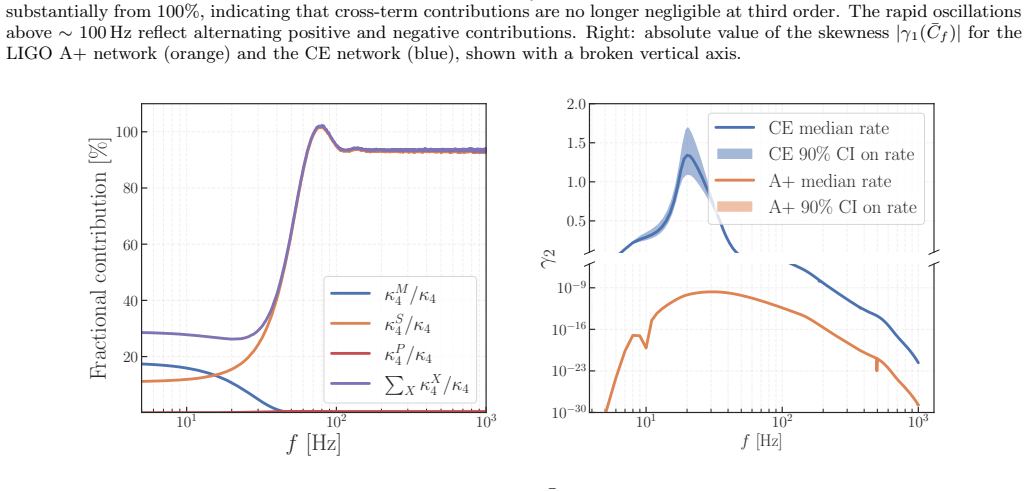
- [Sec. III E, Figs. 4-5] The fractional-contribution plots for \kappa_3 and \kappa_4 show that the diagonal terms (mean intensity, shot noise, polarization leakage) do not account for the full cumulant: below 25 Hz the sum of the three diagonal contributions is only about 45% of \kappa_3, with the remaining 55% attributed to cross-terms. The text describes this briefly, but it would strengthen the paper to state explicitly how the cross-terms are computed and to verify that the numerical evaluation of the full \kappa_n via Eq. (15) is stable in the frequency region where the cross-terms dominate. Without this detail, the reader cannot assess whether the reported \gamma_1(f) and \gamma_2(f) values, especially their oscillatory high-frequency behavior, are robust.
- [Sec. III F and Sec. IV] For the BNS background, the paper acknowledges that the neglect of off-diagonal (overlap) and self-interaction terms may break down below about 8-12 Hz, where R\tau reaches the marginal and dangerous zones. The conclusions for BNS non-Gaussianity are nevertheless stated as robust, relying on the argument that the induced error would need to reach O(10^4) to affect the quoted \gamma_2 bound. This is a reasonable order-of-magnitude argument, but it is not a calculation; since the BNS background is the one most affected by the approximation, the caveat should be stated in the abstract or conclusions with the same prominence as the BBH result, rather than only in the body.
minor comments (5)
- [Acknowledgments] The acknowledgment text contains a typo: the Minnesota Supercomputing Institute URL is followed by 'eduledgments' instead of 'Acknowledgments'.
- [References [43]-[44]] References [43] and [44] appear to cite the same arXiv preprint (2209.01310 and 2209.01221) with different identifiers; please verify and consolidate to the published version if available.
- [Sec. III A] The text says 'Planck18 parameters' but the word appears as 'planet18' in the PDF; please fix the capitalization.
- [Fig. 4 and Fig. 5 captions] The right panels use a broken vertical axis, but the captions do not explain the break or the scale change; adding a note would improve readability.
- [Sec. II A, Eq. (8)] The notation P_{a;f}\equiv P_{gw;f}+P_{na;f} is introduced but P_{gw;f} is not defined in Eq. (8) until later; please define it at first use for clarity.
Circularity Check
No circularity: the headline non-Gaussianity is a forward-model output from a standard compound-Poisson identity and external LVK population inputs; self-citations are supporting, not definitional.
full rationale
The derivation chain is self-contained rather than circular. Equation (15) is the standard compound-Poisson cumulant identity, with the Poisson rate and population moments taken from external inputs (PixelPop rates, LVK mass/spin models, IMRPhenomXAS waveforms, A+ and CE PSDs). The headline skewness and excess kurtosis, Eqs. (27)-(28), are outputs of this chain, not quantities fitted into it. The three-component decomposition in Eq. (19) is an algebraic identity, so it cannot smuggle in conclusions. The self-citations that do appear are not load-bearing in a circular sense: Ref. [38] supplies the standard estimator variance formula, Ref. [41] is a side remark on Stokes decomposition, and Ref. [34] is cited for robustness of the z_min=0.2 cutoff. The paper acknowledges that this cutoff is 'somewhat arbitrary' and that its robustness is discussed in Ref. [34]; while the absence of an in-paper z_min sensitivity scan is a legitimate limitation for the numerical values, the quoted cumulants are conditional on a stated modeling prior rather than being defined by the target result. There is no exhibited reduction of any prediction to its own input, so the circularity score is 0.
Assumptions & free parameters
free parameters (5)
- z_min lower redshift cutoff =
0.2
- Local BBH merger rate R0 =
18.0 (+4.9/-4.4) Gpc^-3 yr^-1
- Local BNS merger rate R0 =
23.4 (+54.7/-18.2) Gpc^-3 yr^-1
- Local NSBH merger rate R0 =
15.9 (+16.9/-8.9) Gpc^-3 yr^-1
- BBH Madau-Dickinson parameters (alpha_z, beta_z, z_p) =
2.85, 4.14, 2.27
assumptions (5)
- domain assumption CBC mergers are independent events forming a Poisson process in time; N_tot is Poisson and each event's X_f is drawn independently from the population model.
- domain assumption Each CBC chirp contributes to at most one time-frequency pixel; mutual interference between events and self-interaction across segments are negligible.
- domain assumption Detector noise is Gaussian, stationary, uncorrelated between detectors, so kappa_3(nbar_f)=kappa_4(nbar_f)=0 and kappa_2(nbar_f) follows Eq. (9).
- domain assumption The adopted CBC population models (mass spectra, Madau-Dickinson redshift evolution, zero spins, IMRPhenomXAS waveforms) represent the true populations.
- domain assumption The local merger rates and their 90% credible intervals from PixelPop/GWTC-5 are correct.
Cite this review
Pith. "Pith review of All You Need is not $\Omega_\mathrm{gw}$: Beyond the Mean of the Cross-Correlation Estimator when Searching for an Astrophysical Gravitational-Wave Background." pith.science (2026). https://pith.science/paper/YUDXVXNL
@misc{pith2026260811119,
  author       = {Pith},
  title        = {Pith review of: All You Need is not $\Omega_\mathrmgw$: Beyond the Mean of the Cross-Correlation Estimator when Searching for an Astrophysical Gravitational-Wave Background},
  year         = {2026},
  howpublished = {\url{https://pith.science/paper/YUDXVXNL}},
  note         = {Machine review of arXiv:2608.11119}
}
abstract
Searches for the stochastic gravitational-wave background (SGWB) using ground-based detectors rely heavily on the cross-correlation estimator $\bar C_f$, whose statistical properties determine the theoretical foundation for inference frameworks built on it. Past analyses usually assume Gaussianity of $\bar C_f$, but this assumption has not been systematically tested for a background of astrophysical origin like the one produced by compact binary coalescences. In this work, we decompose $\bar C_f$ into three physically motivated components: (1) the mean intensity, (2) the geometrical shot noise, and (3) the polarization leakage, and we compute 90\% credible intervals for its cumulants up to fourth order for the binary black hole, binary neutron star, and neutron star-black hole populations by propagating local merger rate uncertainties. We find that for the upcoming LIGO O5 sensitivity, $\bar C_f$ remains effectively Gaussian for all three populations, validating current Gaussian likelihood frameworks. For Cosmic Explorer (CE), however, the $\bar C_f$ produced by binary black holes becomes non-Gaussian, with skewness and excess kurtosis of $0.31^{+0.04}_{-0.03}$ and $1.3^{+0.4}_{-0.3}$, respectively, in the most sensitive band over a one-year observation period. For binary neutron star and neutron star - black hole mergers, $\bar C_f$ remains largely Gaussian even at CE. These results indicate that the Edgeworth expansion provides an adequate leading-order description of the non-Gaussianity expected in the next-generation era, while also motivating the development of more sophisticated statistical methods for a more accurate treatment.
Figures


Figures from the paper (6 more)



Reference graph
Works this paper leans on
-
[34]
H. Zhong and V. Mandic, Phys. Rev. D113, 044048 (2026), arXiv:2509.15014 [gr-qc]
arXiv 2026
-
[1]
B. P. Abbottet al.(LIGO Scientific, Virgo), Phys. Rev. Lett.116, 061102 (2016), arXiv:1602.03837 [gr-qc]
arXiv 2016
-
[2]
B. P. Abbottet al.(LIGO Scientific, Virgo), Phys. Rev. 13 10−5 10−4 10−3 CE median CE 90% CI A+ median A+ 90% CI 101 102 103 f [Hz] 10−22 10−17 10−12 10−7 10−10 10−8 10−6 10−4 101 102 103 f [Hz] 10−30 10−26 10−22 10−18 |γ1| γ2 FIG. 9. Same as Fig. 8, for the NSBH case. X9, 031040 (2019), arXiv:1811.12907 [astro-ph.HE]
arXiv 2019
-
[3]
Abbottet al.(LIGO Scientific, Virgo), Phys
R. Abbottet al.(LIGO Scientific, Virgo), Phys. Rev. X 11, 021053 (2021), arXiv:2010.14527 [gr-qc]
arXiv 2021
-
[4]
Abbottet al.(KAGRA, Virgo, LIGO Scientific), Phys
R. Abbottet al.(KAGRA, Virgo, LIGO Scientific), Phys. Rev. X13, 041039 (2023), arXiv:2111.03606 [gr-qc]
arXiv 2023
-
[5]
A. G. Abacet al.(LIGO Scientific, Virgo, KAGRA), (2025), arXiv:2508.18082 [gr-qc]
arXiv 2025
-
[6]
(LIGO Scientific, Virgo, KAGRA), (2026), arXiv:2605.27225 [gr-qc]
arXiv 2026
-
[7]
N. Christensen, Rep. Prog. Phys.82, 016903 (2019), arXiv:1811.08797 [gr-qc]
arXiv 2019
Show all 73 references
-
[8]
A. I. Renzini, B. Goncharov, A. C. Jenkins, and P. M. Meyers, Galaxies10, 34 (2022), arXiv:2202.00178 [gr-qc]
2022 arXiv
-
[9]
J. D. Romano and N. J. Cornish, Living Rev. Relativ. 20, 2 (2017), arXiv:1608.06889 [gr-qc]
2017 arXiv
-
[10]
A. G. Abacet al.(LIGO Scientific, Virgo, KAGRA), (2025), arXiv:2508.20721 [gr-qc]
2025 arXiv
-
[11]
Abbottet al.(KAGRA, Virgo, LIGO Scientific), Phys
R. Abbottet al.(KAGRA, Virgo, LIGO Scientific), Phys. Rev. D104, 022004 (2021), arXiv:2101.12130 [gr-qc]
2021
-
[12]
Allen and J
B. Allen and J. D. Romano, Phys. Rev. D59, 102001 (1999), arXiv:gr-qc/9710117
1999 arXiv
-
[13]
Mandic, E
V. Mandic, E. Thrane, S. Giampanis, and T. Regimbau, Phys. Rev. Lett.109, 171102 (2012), arXiv:1209.3847 [astro-ph.CO]
2012 arXiv
-
[14]
Matas and J
A. Matas and J. D. Romano, Phys. Rev. D103, 062003 (2021), arXiv:2012.00907 [gr-qc]
2021 arXiv
-
[15]
Drasco and E
S. Drasco and E. E. Flanagan, Phys. Rev. D67, 082003 (2003), arXiv:gr-qc/0210032
2003 arXiv
-
[16]
Smith and E
R. Smith and E. Thrane, Phys. Rev. X8, 021019 (2018), arXiv:1712.00688 [gr-qc]
2018 arXiv
-
[17]
Biscoveanu, C
S. Biscoveanu, C. Talbot, E. Thrane, and R. Smith, Phys. Rev. Lett.125, 241101 (2020), arXiv:2009.04418 [astro-ph.HE]
2020 arXiv
-
[18]
Lawrence, K
J. Lawrence, K. Turbang, A. Matas, A. I. Renzini, N. van Remortel, and J. D. Romano, Phys. Rev. D107, 103026 (2023), arXiv:2301.07675 [gr-qc]
2023 arXiv
-
[19]
X.-X. Kou, M. Saleem, V. Mandic, C. Talbot, and E. Thrane, Phys. Rev. D112, 084064 (2025), arXiv:2506.14179 [gr-qc]
2025 arXiv
-
[20]
Mukherjee and J
S. Mukherjee and J. Silk, Mon. Not. Roy. Astron. Soc. 491, 4690 (2020), arXiv:1912.07657 [gr-qc]
2020 arXiv
-
[21]
M. R. Sah and S. Mukherjee, Mon. Not. Roy. Astron. Soc.527, 4100 (2023), arXiv:2307.06405 [gr-qc]
2023 arXiv
-
[22]
M. R. Sah and S. Mukherjee, Phys. Rev. D113, 123058 (2026), arXiv:2511.03262 [astro-ph.HE]
2026 arXiv
-
[23]
Martellini and T
L. Martellini and T. Regimbau, Phys. Rev. D89, 124009 (2014), arXiv:1405.5775 [astro-ph.CO]
2014 arXiv
-
[24]
Martellini and T
L. Martellini and T. Regimbau, Phys. Rev. D92, 104025 (2015), [Erratum: Phys.Rev.D 97, 049903 (2018)], arXiv:1509.04802 [astro-ph.CO]
2015 arXiv
-
[25]
Liu and S
X. Liu and S. Kuroyanagi, (2026), arXiv:2601.10428 [gr- qc]
2026
-
[26]
Punturoet al., Class
M. Punturoet al., Class. Quantum Grav.27, 194002 (2010)
2010
-
[27]
Branchesiet al., J
M. Branchesiet al., J. Cosmology Astropart. Phys.2023, 068 (2023), arXiv:2303.15923 [gr-qc]
2023 arXiv
-
[28]
Abacet al.(ET), J
A. Abacet al.(ET), J. Cosmology Astropart. Phys. 2026, 081 (2026), arXiv:2503.12263 [gr-qc]
2026 arXiv
-
[29]
Reitzeet al., Bull
D. Reitzeet al., Bull. Am. Astron. Soc.51, 035 (2019), arXiv:1907.04833 [astro-ph.IM]
2019 arXiv
-
[30]
Evanset al., (2021), arXiv:2109.09882 [astro-ph.IM]
M. Evanset al., (2021), arXiv:2109.09882 [astro-ph.IM]
2021 arXiv
-
[31]
Evanset al., (2023), arXiv:2306.13745 [astro-ph.IM]
M. Evanset al., (2023), arXiv:2306.13745 [astro-ph.IM]
2023 arXiv
-
[32]
Zhong, R
H. Zhong, R. Ormiston, and V. Mandic, Phys. Rev. D 107, 064048 (2023), [Erratum: Phys.Rev.D 108, 089902 (2023)], arXiv:2209.11877 [gr-qc]
2023 arXiv
-
[33]
Zhong, B
H. Zhong, B. Zhou, L. Reali, E. Berti, and V. Mandic, Phys. Rev. D110, 064047 (2024), arXiv:2406.10757 [gr- qc]
2024 arXiv
-
[35]
Caprini and D
C. Caprini and D. G. Figueroa, Class. Quantum Grav. 35, 163001 (2018), arXiv:1801.04268 [astro-ph.CO]
2018 arXiv
-
[36]
Aghanimet al.(Planck), Astron
N. Aghanimet al.(Planck), Astron. Astrophys.641, A6 (2020), [Erratum: Astron.Astrophys. 652, C4 (2021)], arXiv:1807.06209 [astro-ph.CO]
2020 arXiv
-
[37]
C. M. F. Mingarelli, S. R. Taylor, B. S. Sathyaprakash, and W. M. Farr, arXiv preprint (2019), arXiv:1911.09745 [gr-qc]
2019 arXiv
-
[38]
Zhong, J
H. Zhong, J. D. Romano, V. Mandic, S. Kandhasamy, and A. I. Renzini, (2026), arXiv:2606.23816 [gr-qc]
2026 arXiv
-
[39]
A. I. Renziniet al., Astrophys. J.952, 25 (2023), arXiv:2303.15696 [gr-qc]
2023 arXiv
-
[40]
GWTC-5.0: Popula- tion Properties of Merging Compact Binaries,
LIGO Scientific Collaboration and Virgo Collabora- tion and KAGRA Collaboration, “GWTC-5.0: Popula- tion Properties of Merging Compact Binaries,” (2026), arXiv:2605.27226 [astro-ph.HE]. 14
2026 arXiv
- [41]
-
[42]
Belgacem, F
E. Belgacem, F. Iacovelli, M. Maggiore, M. Mancarella, and N. Muttoni, J. Cosmology Astropart. Phys.04, 032 (2025), arXiv:2411.04028 [gr-qc]
2025 arXiv
-
[43]
B. Zhou, L. Reali, E. Berti, M. C ¸ alı¸ skan, C. Creque- Sarbinowski, M. Kamionkowski, and B. S. Sathyaprakash, Phys. Rev. D108, 064040 (2023), arXiv:2209.01310 [gr-qc]
2023 arXiv
-
[44]
B. Zhou, L. Reali, E. Berti, M. C ¸ alı¸ skan, C. Creque- Sarbinowski, M. Kamionkowski, and B. S. Sathyaprakash, arXiv (2022), arXiv:2209.01221 [gr-qc]
2022 arXiv
-
[45]
H. Song, D. Liang, Z. Wang, and L. Shao, Phys. Rev. D 109, 123014 (2024), arXiv:2401.00984 [gr-qc]
2024 arXiv
-
[46]
A. I. Renzini and J. Golomb, Astron. Astrophys.691, A238 (2024), arXiv:2407.03742 [astro-ph.CO]
2024 arXiv
-
[47]
Ebersold and T
M. Ebersold and T. Regimbau, Phys. Rev. D113, 044026 (2026), arXiv:2510.02163 [gr-qc]
2026
-
[48]
W. G. Lamb and S. R. Taylor, Astrophys. J. Lett.971, L10 (2024), arXiv:2407.06270 [gr-qc]
2024 arXiv
-
[49]
W. G. Lamb, J. M. Wachter, A. Mitridate, S. C. Sardesai, B. B´ ecsy, E. L. Hagen, S. R. Taylor, and L. Z. Kelley, Phys. Rev. D113, 123065 (2026), arXiv:2511.09659 [gr- qc]
2026 arXiv
-
[50]
Meacher, E
D. Meacher, E. Thrane, and T. Regimbau, Phys. Rev. D89, 084063 (2014), arXiv:1402.6231 [astro-ph.CO]
2014 arXiv
-
[51]
A. C. Jenkins, J. D. Romano, and M. Sakellariadou, Phys. Rev. D100, 083501 (2019), arXiv:1907.06642 [astro-ph.CO]
2019 arXiv
-
[52]
A. C. Jenkins and M. Sakellariadou, Phys. Rev. D100, 063508 (2019), arXiv:1902.07719 [astro-ph.CO]
2019 arXiv
-
[53]
Kouvatsos, A
N. Kouvatsos, A. C. Jenkins, A. I. Renzini, J. D. Ro- mano, and M. Sakellariadou, Phys. Rev. D109, 103535 (2024), arXiv:2312.09110 [astro-ph.CO]
2024 arXiv
-
[54]
Heinzel, M
J. Heinzel, M. Mould, S. ´Alvarez-L´ opez, and S. Vi- tale, Phys. Rev. D111, 063043 (2025), arXiv:2406.16813 [astro-ph.HE]
2025 arXiv
-
[55]
Madau and M
P. Madau and M. Dickinson, Annu. Rev. Astron. Astro- phys.52, 415 (2014), arXiv:1403.0007 [astro-ph.CO]
2014 arXiv
-
[56]
Abbottet al.(KAGRA, Virgo, LIGO Scientific), Phys
R. Abbottet al.(KAGRA, Virgo, LIGO Scientific), Phys. Rev. X13, 011048 (2023), arXiv:2111.03634 [astro- ph.HE]
2023 arXiv
-
[57]
Landry and J
P. Landry and J. S. Read, Astrophys. J. Lett.921, L25 (2021), arXiv:2107.04559 [astro-ph.HE]
2021 arXiv
-
[58]
Zhong, L
H. Zhong, L. Reali, B. Zhou, E. Berti, and V. Mandic, arXiv (2025), arXiv:2501.17717 [gr-qc]
2025 arXiv
-
[59]
Madau and T
P. Madau and T. Fragos, Astrophys. J.840, 39 (2017), arXiv:1606.07887 [astro-ph.GA]
2017 arXiv
-
[60]
Regimbauet al., Phys
T. Regimbauet al., Phys. Rev. D86, 122001 (2012), arXiv:1201.3563 [gr-qc]
2012 arXiv
-
[61]
Biscoveanu, P
S. Biscoveanu, P. Landry, and S. Vitale, Mon. Not. R. Astron. Soc.518, 5298 (2022), arXiv:2207.01568 [astro- ph.HE]
2022 arXiv
-
[62]
A. G. Abacet al.(LIGO Scientific, KAGRA, Virgo), Astrophys. J. Lett.970, L34 (2024), arXiv:2404.04248 [astro-ph.HE]
2024 arXiv
-
[63]
Pratten, S
G. Pratten, S. Husa, C. Garcia-Quiros, M. Colleoni, A. Ramos-Buades, H. Estelles, and R. Jaume, Phys. Rev. D102, 064001 (2020), arXiv:2001.11412 [gr-qc]
2020 arXiv
-
[64]
Buonanno, B
A. Buonanno, B. Iyer, E. Ochsner, Y. Pan, and B. S. Sathyaprakash, Phys. Rev. D80, 084043 (2009), arXiv:0907.0700 [gr-qc]
2009 arXiv
-
[65]
vegas: Adaptive multidimensional monte carlo integration,
G. P. Lepage, “vegas: Adaptive multidimensional monte carlo integration,”https://github.com/gplepage/ vegas(2024), python package
2024
-
[66]
G. P. Lepage, J. Comput. Phys.27, 192 (1978)
1978
-
[67]
G. P. Lepage, J. Comput. Phys.439, 110386 (2021), arXiv:2009.05112 [physics.comp-ph]
2021 arXiv
-
[68]
Aasiet al.(LIGO Scientific), Class
J. Aasiet al.(LIGO Scientific), Class. Quantum Grav. 32, 074001 (2015), arXiv:1411.4547 [gr-qc]
2015 arXiv
-
[69]
The A+ design curve,
L. Barsotti, L. McCuller, M. Evans,et al., “The A+ design curve,”https://dcc.ligo.org/LIGO-T1800042/ public(2018), LIGO Document T1800042-v5
2018
-
[70]
Chandra,https://github.com/koustavchandra/ gwforge/tree/main/GWForge/ifo/noise_curves (2025)
K. Chandra,https://github.com/koustavchandra/ gwforge/tree/main/GWForge/ifo/noise_curves (2025)
2025
-
[71]
Chandra, Class
K. Chandra, Class. Quantum Grav.42, 025003 (2025), arXiv:2407.21109 [gr-qc]
2025 arXiv
-
[72]
Thrane and J
E. Thrane and J. D. Romano, Phys. Rev. D88, 124032 (2013), arXiv:1310.5300 [astro-ph.IM]
2013 arXiv
-
[73]
Blinnikov and R
S. Blinnikov and R. Moessner, Astron. Astrophys. Sup. 130, 193 (1998), arXiv:astro-ph/9711239
1998 arXiv
Reviewed August 12, 2026 · model on record in the stance chip above.
Discussion (0). Continue with ORCID to comment.