REVIEW 2 major objections 6 minor 60 references
Robustness of AI-Art Detectors under Generator Shift
T0 review · 2 major / 6 minor · reviewed 2026-08-16 · deepseek-v4-flash
Pith's one-line read This paper claims that frozen-backbone AI-art detectors trained on earlier U-Net diffusion generators lose 21 to 26 points of balanced accuracy on Stable Diffusion 3.5 Medium, with most errors being missed AI images rather than false…
desk verdict A clean, honest empirical study of cross-generator detector failure, but the generator-shift attribution is underdetermined because the OOD set also switches the prompt pipeline. read the letter →
The pith
A machine-rendered reading of the paper's core claim, the machinery that carries it, and where it could break.
The reading
What carries the argument
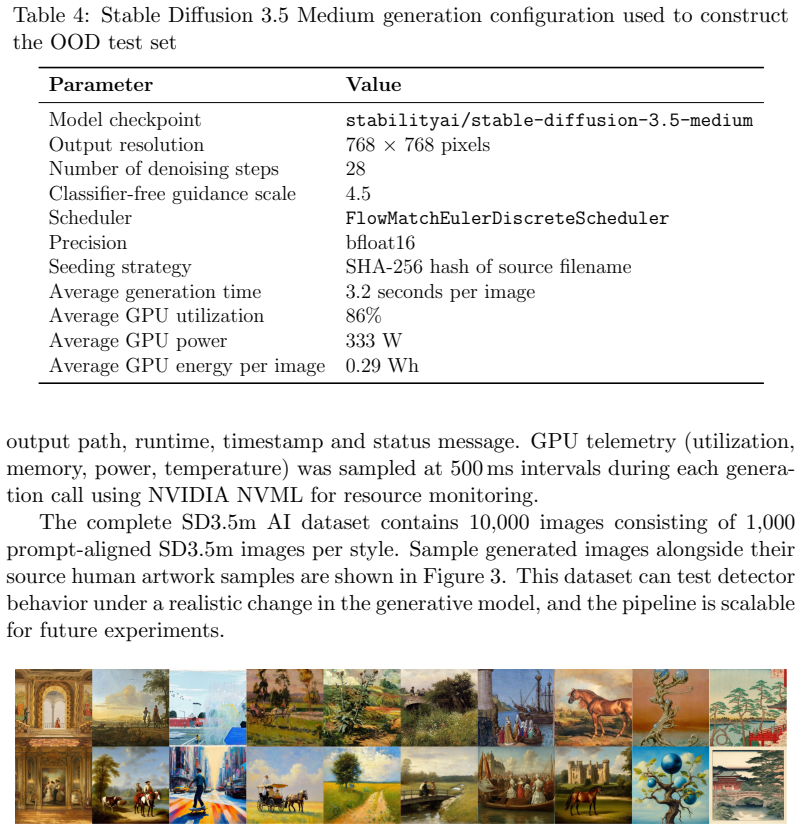
The central object is the prompt-aligned SD3.5m dataset, built to make generator shift measurable: 10,000 Stable Diffusion 3.5 Medium images, 1,000 per art style, generated from reverse-prompted, title-augmented captions (CLIP Interrogator with BLIP-Large) of held-out human artworks, so the OOD images match the style and approximate content of the human references while the generative architecture changes from U-Net-based latent diffusion to a Diffusion Transformer. The detectors are frozen pretrained backbones (ResNet-18/50, EfficientNet-B0, ConvNeXt-Base, CLIP ViT-L/14) with a single linear classification head, trained with weighted binary cross-entropy and evaluated at a validation-selected threshold never adjusted on OOD data. This combination is what turns a new generator into a controlled experimental variable and puts the asymmetric false-negative failure at the center of the results.
What would settle it
Generate a control out-of-distribution set from Stable Diffusion 2.1 or Latent Diffusion using the same CLIP Interrogator, BLIP, and title-augmented prompt pipeline used for the SD3.5m dataset, and evaluate the five detectors at their locked thresholds. If these control images show the same large drop in balanced accuracy and recall as SD3.5m, the degradation is caused by the prompt pipeline rather than by the generator architecture; if they stay near in-distribution levels, the generator itself is the cause.
Extended reading notes
Core claim
On its own terms, the paper's central discovery is a generalization gap: detectors trained and tuned on one generator family do not transfer to a newer architecture. All five models are nearly flawless in-distribution, with balanced accuracy between 0.926 and 0.997; under generator shift to SD3.5m, balanced accuracy drops by 20.8 to 25.7 percentage points. The error pattern is asymmetric: false-negative rates climb steeply while false-positive rates remain low, so a deployed detector would let roughly 4,300 to 5,800 of 10,000 SD3.5m images pass as human-created. CLIP ViT-L/14 performs best overall, and Ukiyo-e remains comparatively detectable while Realism is hardest, with no model exceeding 0.694 balanced accuracy on Realism. Grad-CAM analysis shows that false negatives have weaker and more diffuse activations than successful in-distribution detections, supporting the view that the visual cues learned from LDM and SD2.1 do not cleanly transfer to SD3.5m.
Load-bearing premise
The load-bearing premise is that the out-of-distribution performance drop is caused by the change in generator architecture, not by the change in the prompt-construction pipeline used to create the SD3.5m images; the paper itself acknowledges this prompt distribution shift as a competing explanation.
Editorial extensions
If this is right
- A non-adversarial producer who merely adopts a newer public generator can evade a deployed detector; no gradient access, adversarial perturbation, or knowledge of the detector is required.
- In a screening workflow, the practical failure is one-sided: synthetic images from newer generators mostly pass as human, while human artwork is rarely flagged, so high precision on known generators gives false confidence.
- Strong in-distribution accuracy should not be used as evidence of deployment readiness; periodic evaluation against newly released generators is the corresponding requirement.
- Style-aware evaluation is necessary, since OOD difficulty varies from Ukiyo-e, the easiest style, to Realism, the hardest, across all backbones.
- Backbone choice reduces but does not close the gap: CLIP ViT-L/14 and ConvNeXt-Base degrade least, yet still lose more than 20 points of balanced accuracy.
Reading between the lines
- Beyond the paper: because the SD3.5m images were generated with a different prompt pipeline (CLIP Interrogator, BLIP captioning, and title augmentation) than the AI-ArtBench in-distribution images, part of the measured drop may reflect prompt or content shift; a control OOD set from SD2.1 or LDM generated with the same reverse-prompting pipeline would separate the two explanations.
- Beyond the paper: if generator architecture is the dominant cause, then detectors trained on low-level artifacts will keep failing as new architectures and samplers appear; a more durable detector would likely need to model the generative process itself, for instance through diffusion reconstruction error or frequency-aware features, rather than relying on frozen image features alone.
- Beyond the paper: a testable extension is to train detectors on a prompt-diverse and generator-diverse mixture and measure the SD3.5m gap; if the gap shrinks, both prompt diversity and generator diversity are needed for robustness.
- Beyond the paper: the asymmetric false-negative pattern suggests that in evasion-prone deployments the operating threshold should be tuned for recall, and that validation-selected thresholds may need recalibration whenever a new generator family appears.
Signed reviews
Editorial analysis
A structured set of objections, weighed in public.
Referee Report
Summary. The paper investigates how AI-art detectors trained on earlier U-Net-based generators behave when evaluated on images from a newer Diffusion Transformer-based generator, Stable Diffusion 3.5 Medium. The authors construct a prompt-aligned SD3.5m dataset of 10,000 images across ten art styles using a reverse-prompting pipeline (CLIP Interrogator with BLIP captions, followed by title and style augmentation), train five frozen-backbone linear-probe detectors on a balanced subset of AI-ArtBench (LDM and SD2.1) data, and evaluate them on this OOD set with fixed validation-selected thresholds. The paper reports strong in-distribution performance, substantial OOD drops in balanced accuracy and AI recall, low OOD false-positive rates, and a per-style analysis showing that Realism is hardest and Ukiyo-e easiest. Grad-CAM visualizations on ConvNeXt-Base are used to argue that OOD false negatives arise from weak and peripheral attribution. The central claim is that current frozen-backbone detectors generalize poorly under generator shift, with the primary failure mode being missed AI images.
Significance. If the result holds, the paper provides a valuable empirical warning: detectors that look near-perfect on known generators can miss a large fraction of images from a newer architecture, and the false-negative asymmetry has direct operational consequences. The study has notable strengths: a balanced, source-equalized training corpus; deterministic preprocessing; frozen backbones with linear probes; fixed thresholds; per-style and source-wise analyses; and a clearly stated emerging-generator threat model. The authors also candidly acknowledge in Section 5 that prompt distribution shift may remain. However, the headline attribution of the performance drop to generator architecture is not uniquely established, because the OOD construction changes both the generator and the prompt pipeline simultaneously. The paper is therefore a useful empirical contribution, but its central claim needs either an additional control experiment or a more carefully qualified interpretation.
major comments (2)
- [Sections 3.4.2-3.4.4, 4.3, and 5] The central claim that generator shift causes the OOD performance drop is confounded with prompt-pipeline shift. The SD3.5m images are generated from reverse-prompted, title-augmented prompts built with CLIP Interrogator and BLIP, whereas the in-distribution AI-ArtBench images from LDM and SD2.1 were generated with a different, unspecified prompt pipeline. Because the experimental design changes both the generator and the prompt distribution at once, the large drops in recall (e.g., CLIP ViT-L/14 from about 0.997 to 0.568 in Table 16) cannot be uniquely attributed to the change in generator architecture. The acknowledgment in Section 5 that 'there may still be some prompt distribution shift' does not resolve the issue, and the dataset quality metrics in Table 5 measure prompt-image alignment and distributional distance rather than the effect of prompt pipeline on detector features. A control OOD set generated from LDM and/or SD2.1 under the same reverse-prompted, title-augmented pipeline is needed; without it, the conclusions should be reframed as applying to a combined generator-plus-prompt shift.
- [Sections 3.4.2 and 3.6.1] The same CLIP ViT-L/14 model is used both as the vision encoder in the prompt-generation pipeline (CLIP Interrogator) and as the detector backbone for the best-performing model. This shared component is a potential confound for the cross-architecture comparison: the OOD images may be systematically closer to or farther from the CLIP ViT-L/14 feature distribution used by the detector, making the finding that 'CLIP ViT-L/14 performs best overall' in Section 4.3 difficult to interpret as a pure statement about detector robustness. The authors should either use a different encoder in the Interrogator (for example, a ViT-B/32 or an OpenCLIP variant) or provide a control analysis showing that the ranking of backbones is insensitive to this shared-component choice.
minor comments (6)
- [Section 3.4.1] Please clarify how the 10,000 held-out human samples were selected across the ten styles and whether the sampling was stratified with a fixed seed; the current text states only that the images were 'sampled across the 10 art styles.'
- [Section 4.1] The early-stopping behavior is described ambiguously: the text says the procedure uses patience of three epochs but that training proceeded to the full ten-epoch budget in runs that continued to improve. Please report which models, if any, were stopped early.
- [Table 5] The overall row is computed on pooled data rather than as an average of the per-style rows; this is stated in the text, but a table footnote would prevent reader confusion.
- [Section 4.4 and Figure 15] The style name is spelled 'Ukiyoe' in Figure 15 and 'Ukiyo-e' elsewhere; please unify the spelling throughout.
- [Section 3.4.4] For reproducibility, please provide the exact diffusers library version and the checkpoint revision or hash for stabilityai/stable-diffusion-3.5-medium, in addition to the generation parameters already listed in Table 4.
- [General] The paper makes strong reproducibility claims but does not state whether the OOD dataset, extracted feature bundles, training scripts, or audit logs will be released; please add an availability statement or repository link.
Circularity Check
No significant circularity: the OOD results are an empirical measurement on an unseen generator, not a quantity defined by construction from the inputs.
full rationale
The paper's central claim is empirical rather than derived: five frozen-backbone linear-probe detectors are trained on LDM/SD2.1 artwork features, thresholds are selected on a validation split, and the locked models are then evaluated on SD3.5m images that were never used in training or threshold selection. There is no equation in which the reported OOD balanced accuracy or recall is defined as a fitted parameter, no target quantity is reconstructed from its own definition, and no load-bearing uniqueness theorem is imported from the authors' prior work. The only notable entanglement is that the OOD SD3.5m images were reverse-prompted with CLIP Interrogator using the same CLIP ViT-L/14 backbone that is later evaluated, but this does not force the measured performance drop; if anything it could affect CLIP's OOD scores in either direction, and all five detectors degrade. The acknowledged prompt-pipeline difference between the ID and OOD sets (Section 5) is an experimental-control confound for attributing the drop specifically to the generator architecture, but it is a validity threat, not circularity: the OOD metrics themselves are measured on genuinely unseen data. The paper is therefore self-contained as an empirical benchmark, with no circular derivation step to exhibit.
Assumptions & free parameters
assumptions (3)
- domain assumption Frozen-backbone linear probes provide a representative and realistic detector design for AI-art screening.
- domain assumption Reverse prompting with CLIP Interrogator and title augmentation produces SD3.5m images semantically comparable to the human reference set.
- domain assumption The held-out human reference set, extracted from the training pool, does not leak into detector training.
Cite this review
Pith. "Pith review of Robustness of AI-Art Detectors under Generator Shift." pith.science (2026). https://pith.science/paper/VN57L2CY
@misc{pith2026260811643,
  author       = {Pith},
  title        = {Pith review of: Robustness of AI-Art Detectors under Generator Shift},
  year         = {2026},
  howpublished = {\url{https://pith.science/paper/VN57L2CY}},
  note         = {Machine review of arXiv:2608.11643}
}
read the original abstract
Text-to-image generative models have advanced rapidly, with modern Diffusion Transformer architectures producing images that are increasingly difficult to distinguish from human-created artwork. This development has raised significant concerns regarding copyright protection, misinformation, fraud, impersonation, and the authenticity of digital content. Most AI-art detectors are trained and evaluated on the same generator family, leaving robustness to newer architectures underexplored. In this chapter, we analyze generator shift based on a Stable Diffusion 3.5 Medium (SD3.5m) artwork dataset spanning ten art styles through reverse prompting of held-out human artwork samples. Five detectors are trained on U-Net-based latent diffusion artwork and evaluated in a zero-shot cross-generator setting on the SD3.5m dataset. Deep learning models perform strongly in-distribution but degrade under generator shift, misclassifying many SD3.5m images as human while human false positives remain low. The CLIP ViT-L/14 model performs best overall, while Grad-CAM analysis reveals weaker and more diffuse activation on false negatives. These findings highlight a generalization gap in current AI-art detectors and motivate the development of detectors as one component of a layered defense that remains reliable across rapidly evolving generative architectures.
Figures


Figures from the paper (18 more)


Reference graph
Works this paper leans on
-
[1]
Roberto Amoroso, Davide Morelli, Marcella Cornia, et al. Parents and chil- dren: Distinguishing multimodal deepfakes from natural images.ACM Trans- actions on Multimedia Computing, Communications and Applications, 21(1):1– 23, 2024
work page 2024
-
[2]
Pierre Baldi, Søren Brunak, Yves Chauvin, et al. Assessing the accuracy of pre- diction algorithms for classification: an overview.Bioinformatics, 16(5):412– 424, 2000
work page 2000
-
[3]
Demystifying MMD GANs.https://arxiv.org/abs/1801.01401, 2018
M Bi´ nkowski, Danica J Sutherland, Michael Arbel, et al. Demystifying MMD GANs.https://arxiv.org/abs/1801.01401, 2018
arXiv 2018
-
[4]
Jordan J. Bird and Ahmad Lotfi. CIFAKE: Image classification and explainable identification of AI-generated synthetic images.IEEE Access, 12:15642–15650, 2024
work page 2024
-
[5]
Aras Bozkurt. GenAI et al. cocreation, authorship, ownership, academic ethics and integrity in a time of generative ai.Open Praxis, 16(1):1–10, 2024
work page 2024
-
[6]
Large scale GAN train- ing for high fidelity natural image synthesis.https://arxiv.org/abs/1809
Andrew Brock, Jeff Donahue, and Karen Simonyan. Large scale GAN train- ing for high fidelity natural image synthesis.https://arxiv.org/abs/1809. 11096, 2018
work page 2018
-
[7]
Robust AI-synthesized image detec- tion via multi-feature frequency-aware learning
Hongfei Cai, Chi Liu, Sheng Shen, et al. Robust AI-synthesized image detec- tion via multi-feature frequency-aware learning. InInternational Conference on Knowledge Science, Engineering and Management, KSEM, pages 157–171, 2025
work page 2025
-
[8]
Eva Cetinic and James She. Understanding and creating art with AI: Review and outlook.ACM Transactions on Multimedia Computing, Communications, and Applications, 18(2):1–22, 2022
work page 2022
Show all 60 references
-
[9]
Christie’s. Obvious and the interface between art and artifi- cial intelligence.https://www.christies.com/en/stories/a- collaboration-between-two-artists-one-human-one-a-machine- 0cd01f4e232f4279a525a446d60d4cd1
-
[10]
Discrete Fourier transform in unmasking deepfake images: A comparative study of StyleGAN creations.Information, 15(11):711, 2024
Vito Nicola Convertini, Donato Impedovo, Ugo Lopez, et al. Discrete Fourier transform in unmasking deepfake images: A comparative study of StyleGAN creations.Information, 15(11):711, 2024
2024
-
[11]
An image is worth 16×16 words: Transformers for image recognition at scale
Alexey Dosovitskiy, Lucas Beyer, Alexander Kolesnikov, et al. An image is worth 16×16 words: Transformers for image recognition at scale. InInterna- tional Conference on Learning Representations, ICLR, 2021
2021
-
[12]
RAID: A dataset for testing the adversarial robustness of AI-generated image detectors.https: //arxiv.org/abs/2506.03988, 2025
Hicham Eddoubi, Jonas Ricker, Federico Cocchi, et al. RAID: A dataset for testing the adversarial robustness of AI-generated image detectors.https: //arxiv.org/abs/2506.03988, 2025. 41
2025
-
[13]
Scaling rectified flow transformers for high-resolution image synthesis
Patrick Esser, Sumith Kulal, Andreas Blattmann, et al. Scaling rectified flow transformers for high-resolution image synthesis. InForty-First International Conference on Machine Learning, ICML, 2024
2024
-
[14]
Gatys, Alexander S
Leon A. Gatys, Alexander S. Ecker, and Matthias Bethge. Image style transfer using convolutional neural networks. In2016 IEEE Conference on Computer Vision and Pattern Recognition, CVPR, pages 2414–2423, 2016
2016
-
[15]
Generative adver- sarial nets.Advances in Neural Information Processing Systems, pages 2672– 2680, 2014
Ian J Goodfellow, Jean Pouget-Abadie, Mehdi Mirza, et al. Generative adver- sarial nets.Advances in Neural Information Processing Systems, pages 2672– 2680, 2014
2014
-
[16]
Anna Yoo Jeong Ha, Josephine Passananti, Ronik Bhaskar, et al. Organic or diffused: Can we distinguish human art from AI-generated images? InProceed- ings of the 2024 ACM SIGSAC Conference on Computer and Communications Security, pages 4822–4836, 2024
2024
-
[17]
Deep residual learning for image recognition
Kaiming He, Xiangyu Zhang, Shaoqing Ren, et al. Deep residual learning for image recognition. InProceedings of the IEEE/CVF Conference on Computer Vision and Pattern Recognition, CVPR, pages 770–778, 2016
2016
-
[18]
Gaussian error linear units (GELUs)
Dan Hendrycks and Kevin Gimpel. Gaussian error linear units (GELUs). https://arxiv.org/abs/1606.08415, 2016
2016 arXiv
-
[19]
CLIPscore: A reference-free evaluation metric for image captioning
Jack Hessel, Ari Holtzman, Maxwell Forbes, et al. CLIPscore: A reference-free evaluation metric for image captioning. InProceedings of the 2021 Conference on Empirical Methods in Natural Language Processing, EMNLP, pages 7514– 7528, 2021
2021
-
[20]
GANs trained by a two time-scale update rule converge to a local Nash equilibrium
Martin Heusel, Hubert Ramsauer, Thomas Unterthiner, et al. GANs trained by a two time-scale update rule converge to a local Nash equilibrium. InAdvances in Neural Information Processing Systems, NeurIPS, pages 6627–6638, 2017
2017
-
[21]
Multimodal LLMs can reason about aes- thetics in zero-shot
Ruixiang Jiang and Chang Wen Chen. Multimodal LLMs can reason about aes- thetics in zero-shot. InProceedings of the 33rd ACM International Conference on Multimedia, MM ’25, pages 6634–6643, 2025
2025
-
[22]
Human-art: A versatile human- centric dataset bridging natural and artificial scenes
Xuan Ju, Ailing Zeng, Jianan Wang, et al. Human-art: A versatile human- centric dataset bridging natural and artificial scenes. InProceedings of the IEEE/CVF Conference on Computer Vision and Pattern Recognition, CPVR, pages 618–629, 2023
2023
-
[23]
Characterizing pho- torealism and artifacts in diffusion model-generated images
Negar Kamali, Karyn Nakamura, Aakriti Kumar, et al. Characterizing pho- torealism and artifacts in diffusion model-generated images. InProceedings of the 2025 CHI Conference on Human Factors in Computing Systems, CHI ’25, pages 1–26, 2025
2025
-
[24]
A style-based generator architecture for generative adversarial networks
Tero Karras, Samuli Laine, and Timo Aila. A style-based generator architecture for generative adversarial networks. InProceedings of the IEEE/CVF Confer- ence on Computer Vision and Pattern Recognition, CVPR, pages 4401–4410, 2019
2019
-
[25]
BLIP: Bootstrapping language- image pre-training for unified vision-language understanding and generation
Junnan Li, Dongxu Li, Caiming Xiong, et al. BLIP: Bootstrapping language- image pre-training for unified vision-language understanding and generation. 42 InInternational Conference on Machine Learning, ICML, pages 12888–12900, 2022
2022
-
[26]
Detecting AI-generated artwork
Meien Li and Mark Stamp. Detecting AI-generated artwork. InProceedings of the Fifth Annual Computer Science Conference for CSU Undergraduates, CSCSU, 2025.https://arxiv.org/abs/2504.07078
2025 arXiv
-
[27]
The artbench dataset: Benchmarking generative models with artworks.https://arxiv.org/abs/2206.11404, 2022
Peiyuan Liao, Xiuyu Li, Xihui Liu, et al. The artbench dataset: Benchmarking generative models with artworks.https://arxiv.org/abs/2206.11404, 2022
2022 arXiv
-
[28]
Visual instruction tuning
Haotian Liu, Chunyuan Li, Qingyang Wu, et al. Visual instruction tuning. Advances in Neural Information Processing Systems, 36:34892–34916, 2023
2023
-
[29]
A ConvNet for the 2020s
Zhuang Liu, Hanzi Mao, Chao-Yuan Wu, et al. A ConvNet for the 2020s. In Proceedings of the IEEE/CVF Conference on Computer Vision and Pattern Recognition, CVPR, pages 11976–11986, 2022
2022
-
[30]
Decoupled weight decay regularization
Ilya Loshchilov and Frank Hutter. Decoupled weight decay regularization. In 7th International Conference on Learning Representations, ICLR, 2019.https: //arxiv.org/abs/1711.05101
2019 arXiv
-
[31]
Matthews
Brian W. Matthews. Comparison of the predicted and observed secondary structure of T4 phage lysozyme.Biochimica et Biophysica Acta (BBA)-Protein Structure, 405(2):442–451, 1975
1975
-
[32]
Inception- ism: Going deeper into neural networks.https://research.google/blog/ inceptionism-going-deeper-into-neural-networks/
Alexander Mordvintsev, Christopher Olah, and Mike Tyka. Inception- ism: Going deeper into neural networks.https://research.google/blog/ inceptionism-going-deeper-into-neural-networks/
-
[33]
WikiArt.https://www.kaggle.com/datasets/steubk/ wikiart
Stefano Morelli. WikiArt.https://www.kaggle.com/datasets/steubk/ wikiart
-
[34]
Artificial intelligence risk management framework (AI RMF 1.0).https: //nvlpubs.nist.gov/nistpubs/ai/nist.ai.100-1.pdf, 2023
NIST. Artificial intelligence risk management framework (AI RMF 1.0).https: //nvlpubs.nist.gov/nistpubs/ai/nist.ai.100-1.pdf, 2023
2023
-
[35]
Seyeon Park and Xiaoli Nan. Generative ai and misinformation: a scoping review of the role of generative AI in the generation, detection, mitigation, and impact of misinformation.AI & SOCIETY, 41(2):1501–1515, 2026
2026
-
[36]
PyTorch: An imperative style, high-performance deep learning library
Adam Paszke, Sam Gross, Francisco Massa, et al. PyTorch: An imperative style, high-performance deep learning library. InAdvances in Neural Informa- tion Processing Systems, NeurIPS, 2019
2019
-
[37]
Scalable diffusion models with transform- ers
William Peebles and Saining Xie. Scalable diffusion models with transform- ers. InProceedings of the IEEE/CVF International Conference on Computer Vision, ICCV, pages 4195–4205, 2023
2023
-
[38]
pharmapsychotic/clip-interrogator.https://github
pharmapsychotic et al. pharmapsychotic/clip-interrogator.https://github. com/pharmapsychotic/clip-interrogator, 2023
2023
-
[39]
Learning transferable visual models from natural language supervision
Alec Radford, Jong Wook Kim, Chris Hallacy, et al. Learning transferable visual models from natural language supervision. InProceedings of the 38th International Conference on Machine Learning, ICML, pages 8748–8763, 2021. 43
2021
-
[40]
Exploring the limits of transfer learning with a unified text-to-text transformer.Journal of Machine Learning Research, 21(140):1–67, 2020
Colin Raffel, Noam Shazeer, Adam Roberts, et al. Exploring the limits of transfer learning with a unified text-to-text transformer.Journal of Machine Learning Research, 21(140):1–67, 2020
2020
-
[41]
Artifact: A large-scale dataset with artificial and factual images for generalizable and robust synthetic image detection
Md Awsafur Rahman, Bishmoy Paul, Najibul Haque Sarker, et al. Artifact: A large-scale dataset with artificial and factual images for generalizable and robust synthetic image detection. In2023 IEEE International Conference on Image Processing, ICIP, pages 2200–2204, 2023
2023
-
[42]
Zero-shot text-to-image generation
Aditya Ramesh, Mikhail Pavlov, Gabriel Goh, et al. Zero-shot text-to-image generation. InInternational Conference on Machine Learning, ICML, pages 8821–8831, 2021
2021
-
[43]
Reverse prompt: Cracking the recipe inside text-to-image generation.https://arxiv.org/abs/2503.19937, 2025
Zhiyao Ren, Yibing Zhan, Baosheng Yu, et al. Reverse prompt: Cracking the recipe inside text-to-image generation.https://arxiv.org/abs/2503.19937, 2025
2025 arXiv
-
[44]
High-resolution image synthesis with latent diffusion models
Robin Rombach, Andreas Blattmann, Dominik Lorenz, et al. High-resolution image synthesis with latent diffusion models. InProceedings of the IEEE/CVF Conference on Computer Vision and Pattern Recognition, CVPR, pages 10684– 10695, 2022
2022
-
[45]
Ethical considerations and implications of generative AI in computer graphics.IEEE Computer Graphics and Applications, 45:78–89, 2025
Sudhir K Routray. Ethical considerations and implications of generative AI in computer graphics.IEEE Computer Graphics and Applications, 45:78–89, 2025
2025
-
[46]
Imagenet large scale visual recog- nition challenge.International Journal of Computer Vision, 115(3):211–252, 2015
Olga Russakovsky, Jia Deng, Hao Su, et al. Imagenet large scale visual recog- nition challenge.International Journal of Computer Vision, 115(3):211–252, 2015
2015
-
[47]
Grad-CAM: Visual explanations from deep networks via gradient-based localization
Ramprasaath R Selvaraju, Michael Cogswell, Abhishek Das, et al. Grad-CAM: Visual explanations from deep networks via gradient-based localization. In Proceedings of the IEEE International Conference on Computer Vision, ICCV, pages 618–626, 2017
2017
-
[48]
Glaze: Protecting artists from style mimicry by{Text-to-Image}models
Shawn Shan, Jenna Cryan, Emily Wenger, et al. Glaze: Protecting artists from style mimicry by{Text-to-Image}models. In32nd USENIX Security Symposium, USENIX Security, pages 2187–2204, 2023
2023
-
[49]
ArtBrain: An explainable end-to-end toolkit for classification and attribution of AI-generated art and style.https://arxiv.org/abs/2412.01512, 2024
Ravidu Suien Rammuni Silva, Ahmad Lotfi, Isibor Kennedy Ihianle, et al. ArtBrain: An explainable end-to-end toolkit for classification and attribution of AI-generated art and style.https://arxiv.org/abs/2412.01512, 2024
2024 arXiv
-
[50]
Semantic visual anomaly detection and reasoning in AI-generated images
Chuangchuang Tan, Xiang Ming, Jinglu Wang, et al. Semantic visual anomaly detection and reasoning in AI-generated images. InInternational Conference on Learning Representations, ICLR, 2026.https://openreview.net/forum? id=0iN4UKZwgn
2026
-
[51]
EfficientNet: Rethinking model scaling for convo- lutional neural networks
Mingxing Tan and Quoc Le. EfficientNet: Rethinking model scaling for convo- lutional neural networks. InProceedings of the 36th International Conference on Machine Learning, ICML, pages 6105–6114, 2019
2019
-
[52]
CNN-generated images are surprisingly easy to spot...for now
Sheng-Yu Wang, Oliver Wang, Richard Zhang, et al. CNN-generated images are surprisingly easy to spot...for now. InProceedings of the IEEE/CVF 44 Conference on Computer Vision and Pattern Recognition, CVPR, pages 8695– 8704, 2020
2020
-
[53]
DIRE for diffusion- generated image detection
Zhendong Wang, Jianmin Bao, Wengang Zhou, et al. DIRE for diffusion- generated image detection. InProceedings of the IEEE/CVF International Conference on Computer Vision, ICCV, pages 22445–22455, 2023
2023
-
[54]
Hard prompts made easy: Gradient-based discrete optimization for prompt tuning and discovery
Yuxin Wen, Neel Jain, John Kirchenbauer, et al. Hard prompts made easy: Gradient-based discrete optimization for prompt tuning and discovery. In Advances in Neural Information Processing Systems, NeurIPS, pages 51008– 51025, 2023
2023
-
[55]
Transformers: State-of- the-art natural language processing
Thomas Wolf, Lysandre Debut, Victor Sanh, et al. Transformers: State-of- the-art natural language processing. InProceedings of the 2020 Conference on Empirical Methods in Natural Language Processing: System Demonstrations, EMNLP, pages 38–45, 2020
2020
-
[56]
Diffusion models: A comprehen- sive survey of methods and applications.ACM Computing Surveys, 56(4):1–39, 2023
Ling Yang, Zhilong Zhang, Yang Song, et al. Diffusion models: A comprehen- sive survey of methods and applications.ACM Computing Surveys, 56(4):1–39, 2023
2023
-
[57]
The unreasonable effec- tiveness of deep features as a perceptual metric
Richard Zhang, Phillip Isola, Alexei A Efros, et al. The unreasonable effec- tiveness of deep features as a perceptual metric. InProceedings of the IEEE Conference on Computer Vision and Pattern Recognition, CVPR, pages 586– 595, 2018
2018
-
[58]
Detecting and Simulating Artifacts in GAN Fake Images
Xu Zhang, Svebor Karaman, and Shih-Fu Chang. Detecting and Simulating Artifacts in GAN Fake Images. In2019 IEEE International Workshop on Information Forensics and Security, WIFS, pages 1–6, 2019
2019
-
[59]
Generative artificial intelligence, human creativity, and art.PNAS Nexus, 3(3):pgae052, 2024
Eric Zhou and Dokyun Lee. Generative artificial intelligence, human creativity, and art.PNAS Nexus, 3(3):pgae052, 2024
2024
-
[60]
Genimage: A million-scale benchmark for detecting AI-generated image.Advances in Neural Information Processing Systems, pages 77771–77782, 2023
Mingjian Zhu, Hanting Chen, Qiangyu Yan, et al. Genimage: A million-scale benchmark for detecting AI-generated image.Advances in Neural Information Processing Systems, pages 77771–77782, 2023. 45
2023
Reviewed August 16, 2026 · model on record in the stance chip above.
Discussion (0). Continue with ORCID to comment.