REVIEW 4 major objections 5 minor 32 references
Structuring the Space of Perspectives
T0 review · 4 major / 5 minor · reviewed 2026-08-16 · deepseek-v4-flash
Pith's one-line read The space of perspective concepts in NLP is a single linear scale from abstract values and ideology to concrete argumentation and semantic frames.
desk verdict A useful conceptual map and decision tree, but the single 'latent' axis is overclaimed: one rated property is not intrinsic to the concepts and inter-rater reliability is low on two others. read the letter →
The pith
A machine-rendered reading of the paper's core claim, the machinery that carries it, and where it could break.
The reading
What carries the argument
The load-bearing instrument is a four-property annotation scheme applied by the three authors to fifteen concepts. The properties are strength of linguistic cues, granularity (scope in text), entity-specificity, and number of discrete classes. Hierarchical clustering on the averaged scores yields four compact groups (values and ideology, sentiment and stances, topics and media frames, argumentation), and principal component analysis shows that one component, PC1, carries the ordering: it is positively loaded on all four properties and explains 61.9% of the variance. PC1 is what the paper calls the specificity axis; it is the mechanism that turns a set of independent concept definitions into a single linear hierarchy.
What would settle it
Re-annotate the fifteen concepts with an independent panel of ten to twenty NLP researchers using the paper's codebook; if inter-rater reliability stays near $\rho \approx 0.3$ for those two properties and a principal component analysis with added properties shows a second substantial component, the linear specificity axis would be an artifact of the annotation design.
Extended reading notes
Core claim
On the paper's own terms, the central discovery is a latent linear ordering of perspective-related concepts. The first principal component of the authors' expert annotations loads positively on all four properties and explains 61.9% of the variance, and projecting the fifteen concepts onto this single dimension recovers the four clusters almost perfectly, with only a swap between topics and stances. The axis is interpreted as generic specificity: at one end, values, morals, and ideology are stable, document-level, entity-generic constructs with few labels and weak direct linguistic cues; at the other, claims, arguments, opinions, and semantic frames are localized, entity-bound, linguistically signalled, and open-ended. The paper therefore posits that the space of perspective concepts is structured as a single orderly scale, and it packages this as a concentric-circle model with extra-textual factors such as author, annotator, and media source placed outside the textual axis.
Load-bearing premise
The single-axis result depends on the four chosen properties being the right universal gradients and on the three authors' expert ratings being reliable despite low agreement on two of them ($\rho = 0.31$ for linguistic cues and $\rho = 0.26$ for entity-specificity).
Editorial extensions
If this is right
- Researchers can use the specificity axis to locate where a candidate perspective concept sits and to predict how it will behave in annotation: broad and ideological at one end, localized and linguistically concrete at the other.
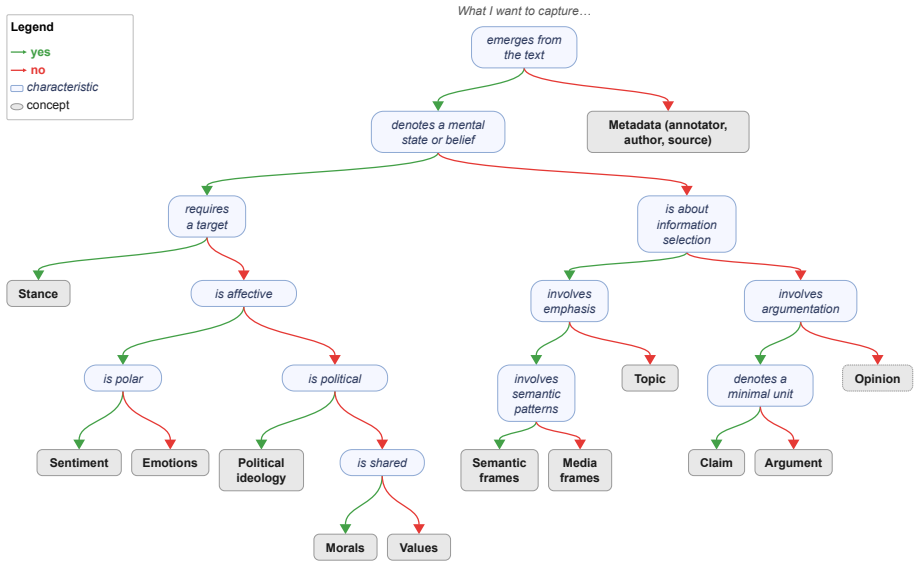
- A decision tree built from the same properties lets a researcher choose an operationalization—political ideology for a topic-agnostic corpus, frames for cross-outlet comparison, stances when a target is explicit—without mixing incompatible concepts.
- Concepts that look similar, such as sentiment and stance, are separated by properties like target-specificity, so a single axis explains why they are distinct but adjacent.
- The model separates text-internal perspective content from extra-textual context; metadata about authors, annotators, and media sources are treated as additional factors, not part of the textual specificity axis.
Reading between the lines
- If the single-axis structure survives a larger and more diverse annotator panel, it could serve as a shared coordinate system for comparing perspective-annotated corpora and for auditing language-model outputs level by level.
- The low inter-rater agreement on two of the four properties suggests a testable revision: sharpening or replacing those properties might change the ordering, and additional properties could reveal a second dimension.
- The hierarchy implies a prediction about texts: concepts at the argumentation end should be annotatable at phrase level with high reliability, while ideology requires document-level inference; existing annotated corpora could test this directly.
Signed reviews
Editorial analysis
A structured set of objections, weighed in public.
Referee Report
Summary. The paper reviews 15 perspective-related concepts used in NLP (e.g., values, ideology, stances, sentiment, frames, arguments, topics), proposes four gradient properties for comparing them (strength of linguistic cues, granularity, entity-specificity, number of discrete classes), and reports an expert annotation of the concepts along these properties by the three authors. Hierarchical clustering yields four groups, and PCA on the averaged ratings shows that PC1 explains 62% of the variance with positive loadings on all four properties. The authors interpret this as evidence of a latent linear ordering along a single 'specificity' axis, from abstract ideological concepts to concrete argumentation and semantic frames. They then present a decision tree (Figure 5) to help researchers choose concepts for perspective-oriented tasks and discuss implications for evaluating and auditing LLMs.
Significance. If the single-axis model were firmly established, it would provide a useful shared vocabulary and a practical guide for researchers working on perspectives, helping position tasks such as stance detection, sentiment analysis, and argument mining relative to each other. The paper's strengths are its broad and transparent literature review, an explicit codebook for the property annotation (Appendix B.2), a concrete and falsifiable claim about the ordering of concepts, and a decision tree that could be directly actionable. The claim, however, currently rests on a small, self-generated dataset: 15 concepts, 4 properties, and 3 annotators who are also the authors, with low inter-rater reliability on two properties and one property that is defined in terms of the researcher's choice of label-set size. The empirical validation is therefore suggestive rather than conclusive, and the evidence does not yet support the strong 'latent linear ordering' formulation.
major comments (4)
- [§4.1, Appendix B.2, §4.3] The fourth property, 'number of discrete classes', is defined in the codebook (Appendix B.2) as 'in a typical classification task, how many classes the concept comprises'. This makes it a property of the chosen operationalization rather than an invariant attribute of the concept: political ideology can be binary, three-way, or multi-party, and sentiment can be ternary or fine-grained. The paper's own §4.3 reports that PC2 is dominated by class number and that the only cluster-recovery failure (the swap between topics and stances) is attributed to this property. Since PC1 is positively loaded on all four properties, the recovered specificity axis is partly determined by an operationalization-dependent choice. To support the 'latent' interpretation, the authors should re-run the PCA without property (iv) and show that the single-axis structure and the ordering of concepts are preserved, or provide a principled argument for why class count is an intrinsic conceptual attribute rather than a feature of the annotation scheme.
- [Table 3, §4.1] Inter-rater reliability is low for two of the four properties: Spearman ρ = 0.31 for strength of linguistic cues and ρ = 0.26 for entity-specificity. The clustering and PCA in §4.2 and §4.3 are computed on averaged ratings over the three authors; if these two dimensions are dominated by noise, the resulting structure may largely reflect the two more reliable properties (granularity and class number). The authors state that the result is 'sufficiently robust', but no per-annotator analysis or bootstrap stability check is provided. To support the claim that the ordering is not an artifact of averaging unreliable judgments, the paper should report, for example, per-annotator clusterings or a bootstrap over annotators showing that the PC1 ordering is stable.
- [§4.3, Appendix B.3] The PCA is performed on 15 observations (concepts) and 4 averaged variables. With n = 15 and p = 4, a first component that explains 62% of the variance is not surprising even under fairly weak structure, and no significance testing is reported. The paper would be substantially stronger if it provided a permutation test or a comparison against a null model (e.g., random ratings with the same marginal distributions) to show that the PC1 dominance and the cluster recovery are unlikely by chance. Without such a test, the PCA is more a descriptive summary of the ratings than a validation of the 'latent linear ordering'.
- [§4.1, §4.3] The same three authors who selected the four properties also performed the ratings and then interpreted the resulting axis as a latent dimension of specificity. This circularity does not invalidate the proposed hierarchy, which indeed aligns with earlier proposals by Klebanov et al. (2010) and Van Der Meer (2024) cited in §4.3, but it weakens the claim that the axis is an empirical discovery about the concepts rather than a reflection of the annotators' prior theoretical commitments. The manuscript should explicitly discuss this risk and state what independent evidence (beyond the earlier hierarchies) would confirm or refute the single-axis model, for example a rating study by external annotators or a prediction about a held-out set of concepts.
minor comments (5)
- [§1] There is a typo in 'Principal Component Analyis' in the Contributions paragraph; it should be 'Analysis'.
- [References] The reference to Klebanov et al. (2010) contains a stray space in 'V ocabulary choice'; fix the formatting.
- [Figure 5] The legend for the decision tree uses a marker labeled '[is shared]' and the caption says 'characteristic concept', but the meaning of the bracketed text is not explained; clarify the legend.
- [§3, intro] The paper states it is 'not a full survey' yet claims to identify 15 concepts; the criteria for including a concept (as opposed to including a paper) are not explicitly listed in the main text. A brief statement of concept-selection criteria would help readers assess coverage.
- [Figures 3 and 4] The dendrogram and spider chart are informative but appear at a small size; increasing font sizes and the resolution would improve readability.
Circularity Check
No significant circularity: the claimed hierarchy is a transparent re-description of the authors' own property ratings, not a prediction disguised as an independent discovery.
full rationale
The paper's derivation chain is self-contained and transparent. The four properties in Section 4.1 are explicitly described as 'inductively derive[d] from the literature,' and the three authors annotate the 15 concepts on those properties. Section 4.3 then runs PCA on the same annotator-aggregated scores, so PC1 is by construction a linear combination of the four rated properties. The resulting 'latent linear ordering' is therefore an internal re-description of the chosen property scores rather than an externally tested prediction. However, the paper does not disguise this as an external prediction: it reports the procedure, loadings, variance explained, and the cluster-recovery check, and it acknowledges the prior hierarchies of Klebanov et al. (2010) and Van Der Meer (2024) as related work rather than importing a uniqueness claim from the authors' own publications. The low inter-rater reliability for two properties (rho = 0.31 and 0.26 in Table 3) and the operationalization-dependence of 'number of discrete classes' are validity concerns; they weaken the strong interpretation that the axis is 'underlying the concepts,' but they do not make any step of the derivation equivalent to its input by construction. No specific equation is reduced to a fitted parameter, and no load-bearing claim rests on a self-citation. Thus the paper exhibits at most a mild tendency to present an internal consistency check as support for a latent structure, which is a modeling-interpretation issue rather than circularity.
Assumptions & free parameters
free parameters (2)
- Number of clusters (k=4) =
4
- Interpretation of PC1 as 'specificity'
assumptions (3)
- ad hoc to paper The four property dimensions selected in Section 4.1 are universal and sufficient for comparing all perspective-related concepts.
- domain assumption Three expert annotators' scores are reliable enough for clustering despite low IRR (rho = 0.31 for linguistic cues, rho = 0.26 for entity-specificity).
- domain assumption The collected set of 227 papers and 15 concepts is representative of the perspective space in NLP.
Cite this review
Pith. "Pith review of Structuring the Space of Perspectives." pith.science (2026). https://pith.science/paper/ESIDVQ3F
@misc{pith2026260812113,
  author       = {Pith},
  title        = {Pith review of: Structuring the Space of Perspectives},
  year         = {2026},
  howpublished = {\url{https://pith.science/paper/ESIDVQ3F}},
  note         = {Machine review of arXiv:2608.12113}
}
read the original abstract
The same event can be reported from different perspectives depending on the experiences, background, and beliefs of the writer or speaker. A variety of NLP areas engage with perspectives, spanning from text analysis to algorithm optimization. A wide range of operative concepts (such as stances, sentiment, frames, and arguments) has been used to capture perspectives in texts, however the precise relationships among those concepts remain unclear. Arguably, a deeper theoretical understanding of these concepts would empower more effective research on perspectives. In this paper, we address this gap by reviewing the space of perspectives in NLP and defining a set of properties that help distinguishing perspective-related concepts. Our analysis leads us to posit a hierarchy which organizes these concepts linearly along a single axis. Finally, we show how this principled conceptual hierarchy can help researchers navigate the field and select operationalizations of perspective that align with their specific research objectives.
Figures


Figures from the paper (4 more)



Reference graph
Works this paper leans on
-
[1]
Strength of linguistic cues: how strongly the concept is associated with specific linguistic elements [1 = weakly associated; 5 = strongly associated]. This dimension captures to what extent a concept is signalled by identifiable surface features: some concepts leave strong lexical and syntactic traces, while others re- quire holistic document-level infer...
-
[2]
Granularity (scope): the typical scope or localization of the concept within a text [1 = very broad/document-level; 5 = very narrow/phrase- or clause-level]. This dimen- sion determines the annotation unit: some con- cepts are inherently local, while others are distributed across an entire document
-
[3]
Entity-specificity: how strongly the concept is tied to a specific entity (e.g., politician, pol- icy, event) [1 = not tied to a specific entity; 5 = directly tied to a specific entity]. This dimension distinguishes target-generic from target-specific concepts, determining whether entity recognition is a prerequisite for annota- tion and detection
-
[4]
Number of discrete classes: in a typical clas- sification task, how many classes the con- cept comprises [1 = few classes, e.g., binary; 5 = many classes]. This dimension reflects the complexity of the label space: binary or ternary concepts organize reality in a coarse- grained fashion, while open-ended concepts require finer distinctions. Decision Rules...
work page 1993
-
[6]
InFindings of the Association for Computational Linguistics: EMNLP 2020, pages 4208–4220, Online
Multichannel Generative Language Model: Learning All Possible Factorizations Within and Across Channels. InFindings of the Association for Computational Linguistics: EMNLP 2020, pages 4208–4220, Online. Asso- ciation for Computational Linguistics. Yi-Ting Chang, Yun-Zhu Song, Yi-Syuan Chen, and Hong-Han Shuai. 2023. Beyond detection: A defend-and-summariz...
work page 2020
-
[14]
all i know about politics is what i read in twitter
The Pragmatics behind Politics: Mod- elling Metaphor, Framing and Emotion in Polit- ical Discourse. InFindings of the Association for Computational Linguistics: EMNLP 2020, pages 4479–4488, Online. Association for Com- putational Linguistics. Susan Hunston and Geoffrey Thompson. 2000. Evaluation in text: Authorial stance and the con- struction of discours...
work page 2020
-
[15]
A systematic media frame analysis of 1.5 million new york times articles from 2000 to
work page 2000
-
[16]
Anne Lauscher, Henning Wachsmuth, Iryna Gurevych, and Goran Glavaš
InProceedings of the 12th ACM Confer- ence on Web Science, pages 305–314. Anne Lauscher, Henning Wachsmuth, Iryna Gurevych, and Goran Glavaš. 2022. Scientia potentia est—on the role of knowledge in compu- tational argumentation.Transactions of the Asso- ciation for Computational Linguistics, 10:1392– 1422. Michael Laver, Kenneth Benoit, and John Garry
work page 2022
Show all 32 references
-
[19]
InProceedings of the 54th Annual Meeting of the Association for Computational Linguistics (Volume 1: Long Papers), pages 311– 321
Connotation frames: A data-driven in- vestigation. InProceedings of the 54th Annual Meeting of the Association for Computational Linguistics (Volume 1: Long Papers), pages 311– 321. Marta Recasens, Cristian Danescu-Niculescu- Mizil, and Dan Jurafsky. 2013. Linguistic mod- els ...
2013
-
[20]
Corpus considerations for annotator mod- eling and scaling. InProceedings of the 2024 Conference of the North American Chapter of the Association for Computational Linguistics: Human Language Technologies (Volume 1: Long Papers), pages 1029–1040, Mexico City, Mex- ico. Associa...
2024
-
[21]
In Findings of the Association for Computational Linguistics: EMNLP 2023, pages 11807–11816, Singapore
Multiview clickbait detection via jointly modeling subjective and objective preference. In Findings of the Association for Computational Linguistics: EMNLP 2023, pages 11807–11816, Singapore. Association for Computational Lin- guistics. Mohammad Shokri, Vivek Sharma, Elena Fil...
2023
-
[23]
InFindings of the Association for Computational Linguistics: EMNLP 2023, pages 5534–5554, Singapore
Values, ethics, morals? on the use of moral concepts in NLP research. InFindings of the Association for Computational Linguistics: EMNLP 2023, pages 5534–5554, Singapore. As- sociation for Computational Linguistics. David Vilares and Yulan He. 2017. Detecting per- spectives in...
2023
-
[24]
undocumented workers
Recommenders with a mission: assessing diversity in news recommendations. InProceed- ings of the 2021 conference on human informa- tion interaction and retrieval, pages 173–183. Herun Wan, Shangbin Feng, Zhaoxuan Tan, Heng Wang, Yulia Tsvetkov, and Minnan Luo. 2024. DELL: Gene...
2021
-
[26]
InProceedings of the 17th Conference of the European Chapter of the Association for Computational Linguistics, pages 554–561, Dubrovnik, Croatia
LoFT: Enhancing faithfulness and diversity for table-to-text generation via logic form control. InProceedings of the 17th Conference of the European Chapter of the Association for Computational Linguistics, pages 554–561, Dubrovnik, Croatia. Association for Computational Lingu...
-
[27]
InProceedings of the 31st International Conference on Computational Linguistics, pages 7862–7869, Abu Dhabi, UAE
Unveiling fake news with adversarial argu- ments generated by multimodal large language models. InProceedings of the 31st International Conference on Computational Linguistics, pages 7862–7869, Abu Dhabi, UAE. Association for Computational Linguistics. Caleb Ziems and Diyi Yan...
2021
-
[32]
right” and “wrong
PC1 and PC2 explain 83.4% of the variance. As shown in Figure 6, the distribution of concepts along these two latent dimensions corresponds to the four clusters recognized in §4.2. Notably, PC1 alone explains 61.9% of the variance and is posi- tively correlated with each of th...
2005
-
[1184]
Chantal van Son, Marieke van Erp, Antske Fokkens, and Piek V ossen
European Language Resources Associa- tion (ELRA). Chantal van Son, Marieke van Erp, Antske Fokkens, and Piek V ossen. 2014. Hope and fear: How opinions influence factuality. InProceed- ings of the Ninth International Conference on Language Resources and Evaluation (LREC’14), p...
2014
-
[2003]
Sophie Lecheler, Mario Keer, Andreas RT Schuck, and Regula Hänggli
Extracting policy positions from political texts using words as data.American political science review, 97(2):311–331. Sophie Lecheler, Mario Keer, Andreas RT Schuck, and Regula Hänggli. 2015. The effects of repeti- tive news framing on political opinions over time. Communicat...
2010
-
[2005]
T Wilson
Annotating expressions of opinions and emotions in language.Language resources and evaluation, 39:165–210. T Wilson. 2005. Recognizing contextual polarity in phrase-level sentiment analysis. InProceedings of HLT/EMNLP. Theresa Wilson. 2008. Annotating subjective con- tent in m...
2005
-
[2008]
InPerspective and perspectivation in discourse, pages 1–11
Perspective and perspectivation in dis- course: An introduction. InPerspective and perspectivation in discourse, pages 1–11. John Benjamins Publishing Company. Stephan Greene and Philip Resnik. 2009. More than words: Syntactic packaging and implicit sentiment. InProceedings of...
2009
-
[2009]
Carl Friedrich Graumann and Werner Kallmeyer
Liberals and conservatives rely on differ- ent sets of moral foundations.Journal of person- ality and social psychology, 96(5):1029. Carl Friedrich Graumann and Werner Kallmeyer
-
[2012]
InPro- ceedings of the 50th Annual Meeting of the Asso- ciation for Computational Linguistics (Volume 2: Short Papers), pages 65–69
Genre independent subgroup detection in online discussion threads: A study of implicit attitude using textual latent semantics. InPro- ceedings of the 50th Annual Meeting of the Asso- ciation for Computational Linguistics (Volume 2: Short Papers), pages 65–69. Claes H De Vrees...
2005
-
[2013]
Proceedings of NeurIPS, 26
Lexical and hierarchical topic regression. Proceedings of NeurIPS, 26. Frank Nielsen. 2016. Hierarchical clustering. In Introduction to HPC with MPI for Data Science, pages 195–211. Springer. Olubusayo Olabisi, Aaron Hudson, Antonie Jetter, and Ameeta Agrawal. 2022. Analyzing ...
2016
-
[2016]
Public Opinion Quarterly, 80(S1):250–271
Fair and balanced? quantifying me- dia bias through crowdsourced content analysis. Public Opinion Quarterly, 80(S1):250–271. Elena Cabrio and Serena Villata. 2018. Five years of argument mining: A data-driven analysis. In IJCAI, volume 18, pages 5427–5433. Jaime Guillermo Carb...
2018
-
[2017]
InProceedings of the 15th Conference of the European Chapter of the Association for Computational Linguistics: Volume 1, Long Pa- pers, pages 251–261
Stance classification of context-dependent claims. InProceedings of the 15th Conference of the European Chapter of the Association for Computational Linguistics: Volume 1, Long Pa- pers, pages 251–261. Emma Barker, Monica Paramita, Adam Funk, Em- ina Kurtic, Ahmet Aker, Jonath...
2016
-
[2018]
InProceedings of the 2018 Conference on Empirical Methods in Natural Language Processing, pages 3570–3580
Framing and agenda-setting in russian news: a computational analysis of intricate po- litical strategies. InProceedings of the 2018 Conference on Empirical Methods in Natural Language Processing, pages 3570–3580. Charles J Fillmore. 1976. Frame semantics and the nature of lang...
2018
-
[2020]
InProceedings of the 7th Workshop on Argument Mining, pages 59–66
News aggregation with diverse viewpoint identification using neural embeddings and se- mantic understanding models. InProceedings of the 7th Workshop on Argument Mining, pages 59–66. Tanise Ceron, Nico Blokker, and Sebastian Padó
-
[2021]
Esra Dönmez and Agnieszka Fale ´nska
Assessing viewpoint diversity in search results using ranking fairness metrics.ACM SIGKDD Explorations Newsletter, 23(1):50–58. Esra Dönmez and Agnieszka Fale ´nska. 2026. Structuring the space of sociotechnical align- ment: A specification framework and systematic literature ...
2026 arXiv
-
[2022]
In Proceedings of the 26th Conference on Compu- tational Natural Language Learning (CoNLL), pages 325–338, Abu Dhabi, United Arab Emi- rates (Hybrid)
Optimizing text representations to cap- ture (dis)similarity between political parties. In Proceedings of the 26th Conference on Compu- tational Natural Language Learning (CoNLL), pages 325–338, Abu Dhabi, United Arab Emi- rates (Hybrid). Association for Computational Linguist...
2024 arXiv
-
[2023]
InProceedings of the NeurIPS workshop ’AI meets Moral Philosophy and Moral Psychol- ogy’
Assessing LLMs for moral value plural- ism. InProceedings of the NeurIPS workshop ’AI meets Moral Philosophy and Moral Psychol- ogy’. Rodney Benson. 2009. What makes news more multiperspectival? A field analysis.Poetics, 37(5-6):402–418. Sumit Bhatia and P Deepak. 2018. Topic-...
2009
-
[2024]
InProceedings of the 2024 Joint International Conference on Computa- tional Linguistics, Language Resources and Evaluation (LREC-COLING 2024), pages 1588– 1601, Torino, Italia
ASEM: Enhancing empathy in chat- bot through attention-based sentiment and emo- tion modeling. InProceedings of the 2024 Joint International Conference on Computa- tional Linguistics, Language Resources and Evaluation (LREC-COLING 2024), pages 1588– 1601, Torino, Italia. ELRA ...
2024
-
[2025]
InProceedings of the 31st International Conference on Computational Linguistics, pages 4689–4703, Abu Dhabi, UAE
Debate-to-write: A persona-driven multi- agent framework for diverse argument genera- tion. InProceedings of the 31st International Conference on Computational Linguistics, pages 4689–4703, Abu Dhabi, UAE. Association for Computational Linguistics. Nannan Huang, Lin Tian, Hayt...
2023
Reviewed August 16, 2026 · model on record in the stance chip above.
Discussion (0). Continue with ORCID to comment.