REVIEW 3 major objections 4 minor 84 references
SAG: SQL-Retrieval Augmented Generation with Query-Time Dynamic Hyperedges
T0 review · 3 major / 4 minor · reviewed 2026-08-16 · deepseek-v4-flash
Pith's one-line read SQL joins replace knowledge graphs for multi-hop retrieval
desk verdict SAG is a genuinely new retrieval architecture with big reported gains, but the headline recall number leans heavily on an answer-aware LLM selector that the baselines don't get; the SQL-join core still shows a real but smaller edge. read the letter →
The pith
A machine-rendered reading of the paper's core claim, the machinery that carries it, and where it could break.
The reading
What carries the argument
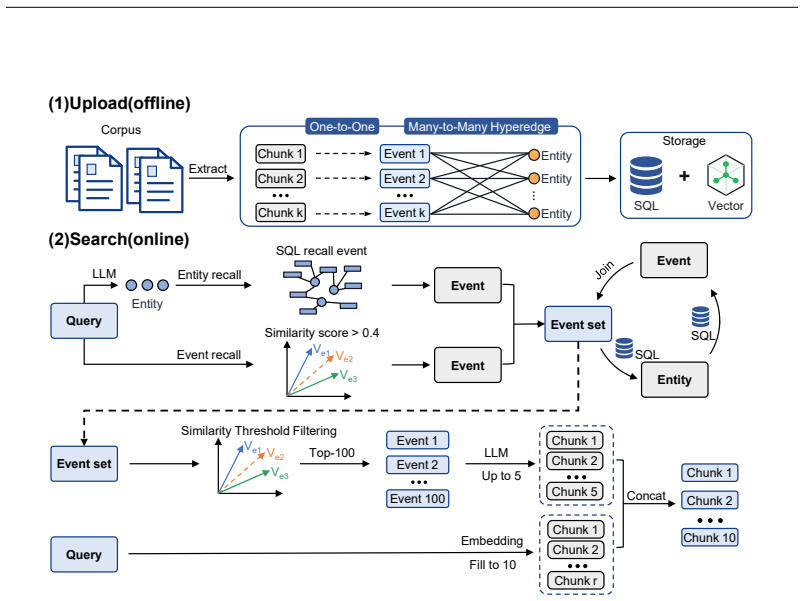
The central object is the latent hyperedge carried by the event–entity index. Each event h is stored as incidence rows (h,v) for every entity v in V(h); grouping rows by event reconstructs the full entity set, so the representation is lossless with respect to incidence. This makes a SQL join the mechanism that walks from query entities to events and back, performing event-to-entity-to-event expansion through the bipartite incidence graph. The key machinery does two jobs: it preserves each chunk's n-ary relation as one retrieval unit, and it makes the connective structure query-time and append-only rather than a materialized corpus-level graph.
What would settle it
Construct a two-hop QA set whose bridge entity appears in the gold passages under two different surface forms (e.g., 'Apple Inc.' in one passage and 'Apple' in the other). If SAG's Recall@5 on those questions is not meaningfully above a dense-only retriever, then the shared-entity join mechanism does not generalize beyond normalized surface forms.
Extended reading notes
Core claim
On its own terms, the paper's discovery is that a corpus of chunks can be reorganized as an event–entity index in which each chunk is represented by one semantically complete event and a set of indexing entities; because an event keeps all its entities together, it behaves as a hyperedge and preserves n-ary relations without triple decomposition. Retrieval then proceeds by activating only the hyperedges relevant to the query: an LLM identifies query entities, a SQL join retrieves all events sharing those entities, and a reverse join expands through intermediate entities for a bounded number of rounds. The result is a query-scoped neighborhood of events whose evidence is always the original chunk. The paper reports that this design achieves the best Recall@5 and QA F1 on MuSiQue, 2WikiMultiHopQA, and HotpotQA, with the margin over baselines widening as chain complexity increases.
Load-bearing premise
The load-bearing premise is that the same entity is always spelled the same way after normalization, so exact string equality can serve as the join key; if real corpora use aliases like 'Apple Inc.' versus 'Apple', the SQL joins will silently miss the bridge evidence and the reported recall gain should shrink.
Editorial extensions
If this is right
- Because evidence never leaves the original chunk, the reader sees exactly the document text, keeping provenance and context intact.
- The reported gains grow with chain depth: two-hop HotpotQA shows the smallest margin and four-hop MuSiQue the largest, suggesting shared-entity joins matter most when evidence is far apart.
- Append-only indexing means new documents can be added without rebuilding any global structure, which is the property needed for continuously growing corpora.
- Bounded activation budgets (a corpus pool, a frontier budget, and a candidate cap) keep the expensive LLM stages confined to a query-specific working set, so per-query cost need not grow with corpus size.
- The advantage persists across four different embedding models, indicating the improvement comes from the structured expansion rather than from encoder quality.
Reading between the lines
- The explicit no-disambiguation design suggests the reported numbers are a lower bound for what the architecture could achieve: adding a lightweight alias table (as the paper itself suggests) could recover bridge evidence that string matching currently misses.
- Because the index is relational rows rather than a graph, the same structure could be maintained with any SQL store and versioned with temporal tables, which would let stale events be retired without losing history.
- The mechanism is not limited to fact-chaining: the narrative-QA result hints that event-entity grouping helps whenever evidence must be assembled across a long text, so similar gains might appear in book-level or dialogue retrieval tasks.
- A testable extension is to replace exact SQL joins with fuzzy entity matching only at the join frontier, which would trade a little precision for alias robustness while keeping the append-only property.
Signed reviews
Editorial analysis
A structured set of objections, weighed in public.
Referee Report
Summary. The paper proposes SAG, a retrieval architecture for multi-hop QA that combines an append-only SQL event-entity index with dense retrieval and LLM-based final selection. Each corpus chunk is mapped to a single 'event' and a set of typed entity strings, stored as incidence rows; at query time, candidate events are obtained by dense seed retrieval and by SQL joins over shared entities, expanded for one round, coarsely ranked, and finally selected by an LLM that reads up to 100 candidate events and returns up to five. The selected events map back to original chunks, which are returned as evidence. Experiments on MuSiQue, 2WikiMultiHopQA, and HotpotQA report the best Recall@5 and QA F1 among the compared baselines, with ablations on expansion depth, candidate budget, dual-path output, and the final selector, as well as robustness checks across embedding models and corpus growth. The appendix formalizes the latent-hyperedge incidence representation and reports connectivity statistics, runtime, prompts, and additional QA results on NarrativeQA.
Significance. If the reported gains are attributable to the proposed architecture, SAG would be a practical contribution: it avoids a materialized global knowledge graph, supports append-only ingestion, and provides traceable retrieval stages. The paper deserves credit for a clearly described pipeline, systematic ablations that separate indexing, expansion, and selection, a reproducible benchmark code release, and an unusually candid limitations section. The formal propositions in Appendix A are simple definitional statements, but they are not used to derive the empirical results, so circularity is low. The main risk is experimental identification: the headline retrieval comparison does not cleanly isolate the effect of the SQL event-entity index from the effect of the answer-aware LLM selector, and the 2WikiMultiHopQA result was chosen after tuning on the same dev set on which it is reported. These issues are fixable with additional experiments, and the paper's core ideas are defensible, so I recommend major revision.
major comments (3)
- [§5.1 and Table 6; §3.4, Eq. (5)] The claim that 'architecture is the only free variable' (Section 5.1) is not supported by the comparison as presented. SAG's retrieval stage includes an answer-aware LLM selector that reads the question and up to K_cand=100 candidate events and returns at most five (Section 3.4, Eq. 5), whereas HippoRAG 2 and the other baselines rank candidates by embedding or PageRank scores without this selector. Table 6 shows the selector is worth 13.25 Recall@5 points on MuSiQue (80.36 with Qwen3.6-Flash versus 67.11 with Qwen3-Reranker-8B), which is larger than the 11.52-point or 15.23-point headline margins. The manuscript never reports SAG's Recall@5 from the embedding-ranked expanded candidate set before LLM selection, nor does it give HippoRAG 2 the same selection stage. To attribute the measured gains to the event-entity SQL-join index, the authors should report the pre-selection Recall@5 of SAG and apply the same context-aware selection to baselines' top candidates.
- [§5.1 (2WikiMultiHopQA note), §4.1] The 2WikiMultiHopQA headline result is obtained by a design decision made after observing the same 1,000-question dev sample that is then reported. Section 5.1 states that the initial design achieved 88.00% Recall@5, that this failure was revealed by traceable intermediate states, and that pruning during expansion raised the score to 93.34%, which is the number in Table 1. Because the 2Wiki result and the pruning modification were selected on the same dev questions, the main-table figure is not an unbiased estimate of expected performance. The authors should validate the final configuration on a separate split, or report the before/after comparison with error bars or an explicit model-selection caveat, before claiming best retrieval on every benchmark.
- [§3.1 and §5.3] The architecture's join mechanism depends on exact string equality after normalization, as acknowledged in Section 5.3, where 'Apple Inc.' and 'Apple' are not matched. This is not a peripheral implementation detail: shared entities are the only join keys, so every recall gain from SQL expansion is conditional on surface-form consistency across documents and queries. The limitation statement is honest, but the magnitude of the effect on the reported gains is unknown. I would like to see a quantitative analysis, such as the change in Recall@5 when common aliases are normalized or when a small alias table is added, so readers can judge how the result transfers to corpora without canonical surface forms.
minor comments (4)
- [Abstract and §5.1] The abstract says SAG outperforms the strongest baseline by 11.52 points, while Section 5.1 reports a 15.23-point lead over HippoRAG 2 on MuSiQue; the abstract's number is consistent with comparing against NV-Embed-v2 (80.36 - 68.84 = 11.52), but the paper should state explicitly which baseline the abstract refers to and use consistent terminology.
- [Table 6] The first row of Table 6 ('Default SAG (Ours) 4') appears to contain a stray '4' from the footnote; this formatting error should be corrected.
- [Table 1] Several structure-augmented baselines are marked with a dash in Recall@5 columns, yet the Avg row appears to include values from methods without reported Recall@5; the averaging rule should be stated explicitly in the table caption.
- [Appendix L, Table 12] The QA context formats differ across methods (raw passages versus CSV entity-relationship summaries). Section 5.1 and Table 9 should mention this difference whenever LLM-judge context-relevancy scores are discussed, since the text already notes it in Appendix L but not in the main results.
Circularity Check
No significant circularity: SAG's empirical claims are benchmark-measured, and the Appendix A propositions are explicitly scoped formalizations rather than evidence-generating derivations.
full rationale
The paper's central claims are empirical: Recall@5 and QA F1 are measured on external benchmarks (MuSiQue, 2WikiMultiHopQA, HotpotQA, NarrativeQA) under a stated unified configuration, with no parameter fitted to the reported headline numbers. Hyperparameters such as tau_evt=0.4 and K_cand=100 are dev-tuned operating points, not the target results. Appendix A's propositions are definitional in the sense that they restate the indexing and expansion design: Proposition 1 asserts that the incidence SQL table stores the incidence relation losslessly, which holds by construction, and the paper explicitly disclaims that mapping a chunk to an event preserves all source information. Proposition 2 restates one expansion round as two SQL joins and concludes that unpruned candidates are event vertices within bipartite distance 2L of the seed set; this follows immediately from the definitions of the joins and is not used to derive any Recall@5 number. No load-bearing self-citation chain appears; the authors' own GitHub links are reproducibility artifacts rather than evidence for the architecture, and no uniqueness theorem is imported from prior author work. The methodological caution raised by the ablation results—that SAG's retrieval stage includes an answer-aware LLM selector, and replacing it lowers Recall@5 from 80.36% to 67.11%—is an attribution/experimental-design concern, not a circularity: the reported 80.36% does not follow from the selector by construction, and the paper does not claim the selector is absent from SAG. The abstract's '11.52 points' margin also differs from Table 1's 15.23-point lead over HippoRAG 2, but that is a reporting inconsistency rather than an input-output equivalence. The alias-resolution limitation in Section 5.3 is a genuine performance caveat, but it does not make any derivation reduce to its own inputs. Overall, the derivation chain is self-contained with respect to circularity.
Assumptions & free parameters
free parameters (8)
- entity similarity threshold tau_ent =
0.9
- event similarity threshold tau_evt =
0.4
- seed budget K_seed =
50
- frontier budget =
50
- candidate budget K_cand =
100
- expansion depth L =
1
- structural selection cap K_event =
5
- output size K_out =
10
assumptions (5)
- domain assumption An LLM can faithfully compress each chunk into exactly one event plus a set of entities, preserving the chunk's relational meaning.
- domain assumption Surface-form string equality after normalization is sufficient for entity identity across chunks and queries.
- domain assumption Relevant multi-hop evidence is connected through shared entity surface forms within L=1 expansion steps.
- standard math The SQL incidence table (h, v) is exact and lossless for the extracted event-entity incidence.
- domain assumption Qwen3.6-Flash is an adequate reader and judge for the QA and LLM-judge metrics.
invented entities (1)
-
latent hyperedge
independent evidence
Cite this review
Pith. "Pith review of SAG: SQL-Retrieval Augmented Generation with Query-Time Dynamic Hyperedges." pith.science (2026). https://pith.science/paper/T3SNNN6A
@misc{pith2026260812129,
  author       = {Pith},
  title        = {Pith review of: SAG: SQL-Retrieval Augmented Generation with Query-Time Dynamic Hyperedges},
  year         = {2026},
  howpublished = {\url{https://pith.science/paper/T3SNNN6A}},
  note         = {Machine review of arXiv:2608.12129}
}
read the original abstract
While retrieval-augmented generation (RAG) has proven effective at giving LLMs access to external knowledge, mainstream dense-retrieval implementations remain inherently limited in handling structured constraints and multi-hop reasoning. Graph-based methods address this by constructing knowledge graphs offline, but they often fragment semantics, incur high maintenance, and complicate incremental updates. We propose SAG (SQL-Retrieval Augmented Generation), a structured retrieval architecture that organizes documents into an event-entity index without building a global knowledge graph. SAG represents each chunk as a semantically complete event paired with its entities, forming a latent hyperedge that preserves n-ary relations without decomposing them into triples. At query time, SAG treats shared entities as join keys to connect related chunks. This dynamically yields a query-scoped neighborhood of events, and yet every piece of evidence remains the original chunk throughout. Experiments on HotpotQA, 2WikiMultiHopQA, and MuSiQue show that SAG achieves the best retrieval and end-to-end QA performance on every benchmark, with gains that widen as reasoning-chain complexity increases. On MuSiQue, where multi-hop evidence chaining is most demanding, SAG reaches 80.36% Recall@5, outperforming the strongest baseline by 11.52 points. This work paves the way for knowledge infrastructure that enables LLM agents to retrieve and reason over continually growing organizational knowledge.
Figures


Figures from the paper (4 more)


Reference graph
Works this paper leans on
-
[1]
Self- RAG : Learning to retrieve, generate, and critique through self-reflection
Akari Asai, Zeqiu Wu, Yizhong Wang, Avirup Sil, and Hannaneh Hajishirzi. Self- RAG : Learning to retrieve, generate, and critique through self-reflection. In International Conference on Learning Representations (ICLR), 2024. URL https://openreview.net/forum?id=hSyW5go0v8
2024
-
[3]
Knowledge hypergraphs: Prediction beyond binary relations
Bahare Fatemi, Perouz Taslakian, David Vazquez, and David Poole. Knowledge hypergraphs: Prediction beyond binary relations. In Proceedings of the Twenty-Ninth International Joint Conference on Artificial Intelligence (IJCAI), 2020. URL https://arxiv.org/abs/1906.00137
arXiv 2020
-
[4]
Yifan Feng, Haoxuan You, Zizhao Zhang, Rongrong Ji, and Yue Gao. Hypergraph neural networks. In Proceedings of the AAAI Conference on Artificial Intelligence, 2019. URL https://arxiv.org/abs/1809.09401
arXiv 2019
-
[6]
Message passing for hyper-relational knowledge graphs
Mikhail Galkin, Priyansh Trivedi, Gaurav Maheshwari, Ricardo Usbeck, and Jens Lehmann. Message passing for hyper-relational knowledge graphs. In Proceedings of the 2020 Conference on Empirical Methods in Natural Language Processing (EMNLP), 2020. URL https://arxiv.org/abs/2009.10847
arXiv 2020
-
[7]
LightRAG : Simple and fast retrieval-augmented generation
Zirui Guo, Lianghao Xia, Yanhua Yu, Tu Ao, and Chao Huang. LightRAG : Simple and fast retrieval-augmented generation. In Proceedings of the 2025 Conference on Empirical Methods in Natural Language Processing (EMNLP), 2025. URL https://arxiv.org/abs/2410.05779
arXiv 2025
-
[8]
HippoRAG : Neurobiologically inspired long-term memory for large language models
Bernal Jim \'e nez Guti \'e rrez, Yiheng Shu, Yu Gu, Michihiro Yasunaga, and Yu Su. HippoRAG : Neurobiologically inspired long-term memory for large language models. In Advances in Neural Information Processing Systems (NeurIPS), 2024. URL https://arxiv.org/abs/2405.14831
arXiv 2024
-
[9]
From RAG to memory: Non-parametric continual learning for large language models
Bernal Jim \'e nez Guti \'e rrez, Yiheng Shu, Weijian Qi, Sizhe Zhou, and Yu Su. From RAG to memory: Non-parametric continual learning for large language models. In International Conference on Machine Learning (ICML), 2025. URL https://arxiv.org/abs/2502.14802
arXiv 2025
-
[10]
Constructing a multi-hop QA dataset for comprehensive evaluation of reasoning steps
Xanh Ho, Anh-Khoa Duong Nguyen, Saku Sugawara, and Akiko Aizawa. Constructing a multi-hop QA dataset for comprehensive evaluation of reasoning steps. In Proceedings of the 28th International Conference on Computational Linguistics (COLING), 2020. URL https://aclanthology.org/2020.coling-main.580/
2020
Show all 84 references
-
[12]
Unsupervised dense information retrieval with contrastive learning
Gautier Izacard, Mathilde Caron, Lucas Hosseini, Sebastian Riedel, Piotr Bojanowski, Armand Joulin, and Edouard Grave. Unsupervised dense information retrieval with contrastive learning. Transactions on Machine Learning Research (TMLR), 2022. URL https://arxiv.org/abs/2112.09118
2022 arXiv
-
[13]
Adaptive- RAG : Learning to adapt retrieval-augmented large language models through question complexity
Soyeong Jeong, Jinheon Baek, Sukmin Cho, Sung Ju Hwang, and Jong Park. Adaptive- RAG : Learning to adapt retrieval-augmented large language models through question complexity. In Proceedings of the 2024 Conference of the North American Chapter of the Association for Computatio...
2024
-
[14]
StructGPT : A general framework for large language model to reason on structured data
Jinhao Jiang, Kun Zhou, Zican Dong, Keming Ye, Wayne Xin Zhao, and Ji-Rong Wen. StructGPT : A general framework for large language model to reason on structured data. In Proceedings of the 2023 Conference on Empirical Methods in Natural Language Processing (EMNLP), 2023 a . UR...
2023 arXiv
-
[15]
Xu, Luyu Gao, Zhiqing Sun, Qian Liu, Jane Dwivedi-Yu, Yiming Yang, Jamie Callan, and Graham Neubig
Zhengbao Jiang, Frank F. Xu, Luyu Gao, Zhiqing Sun, Qian Liu, Jane Dwivedi-Yu, Yiming Yang, Jamie Callan, and Graham Neubig. Active retrieval augmented generation. In Proceedings of the 2023 Conference on Empirical Methods in Natural Language Processing (EMNLP), 2023 b . URL h...
2023
-
[16]
Dense passage retrieval for open-domain question answering
Vladimir Karpukhin, Barlas O g uz, Sewon Min, Patrick Lewis, Ledell Wu, Sergey Edunov, Danqi Chen, and Wen tau Yih. Dense passage retrieval for open-domain question answering. In Proceedings of the 2020 Conference on Empirical Methods in Natural Language Processing (EMNLP), 20...
2020
-
[17]
The NarrativeQA reading comprehension challenge
Tom\'a s Ko c isk\'y, Jonathan Schwarz, Phil Blunsom, Chris Dyer, Karl Moritz Hermann, G\'abor Melis, and Edward Grefenstette. The NarrativeQA reading comprehension challenge. Transactions of the Association for Computational Linguistics (TACL), 6: 0 317--328, 2018. URL https:...
2018
-
[18]
ATOM : AdapTive and OptiMized dynamic temporal knowledge graph construction using LLMs
Yassir Lairgi, Ludovic Moncla, Khalid Benabdeslem, R \'e my Cazabet, and Pierre Cl \'e au. ATOM : AdapTive and OptiMized dynamic temporal knowledge graph construction using LLMs . In Findings of the Association for Computational Linguistics: EACL 2026, 2026. URL https://arxiv....
2026
-
[20]
u ttler, Mike Lewis, Wen tau Yih, Tim Rockt \
Patrick Lewis, Ethan Perez, Aleksandra Piktus, Fabio Petroni, Vladimir Karpukhin, Naman Goyal, Heinrich K \"u ttler, Mike Lewis, Wen tau Yih, Tim Rockt \"a schel, Sebastian Riedel, and Douwe Kiela. Retrieval-augmented generation for knowledge-intensive NLP tasks. In Advances i...
2020 arXiv
-
[22]
StructRAG : Boosting knowledge intensive reasoning of LLMs via inference-time hybrid information structurization
Zhuoshi Li, Xin-Cheng Chen, Huiqian Yu, Haiming Lin, Jingbo Shang, Qiang Tang, Furu Wei, Xuancheng Ren, Longtao Huang, and Chao Li. StructRAG : Boosting knowledge intensive reasoning of LLMs via inference-time hybrid information structurization. In International Conference on ...
2025 arXiv
-
[23]
Generalizing tensor decomposition for N -ary relational knowledge bases
Yu Liu, Quanming Yao, and Yong Li. Generalizing tensor decomposition for N -ary relational knowledge bases. In Proceedings of The Web Conference (WWW), 2020. URL https://arxiv.org/abs/2007.03988
2020 arXiv
-
[24]
Role-aware modeling for N -ary relational knowledge bases
Yu Liu, Quanming Yao, and Yong Li. Role-aware modeling for N -ary relational knowledge bases. In Proceedings of The Web Conference (WWW), 2021. URL https://arxiv.org/abs/2104.09780
2021 arXiv
-
[25]
HyperGraphRAG : Retrieval-augmented generation via hypergraph-structured knowledge representation
Haoran Luo, Haihong E, Guanting Chen, Yandan Zheng, Xiaobao Wu, Yikai Guo, Qika Lin, Yu Feng, Zemin Kuang, Meina Song, Yifan Zhu, and Anh Tuan Luu. HyperGraphRAG : Retrieval-augmented generation via hypergraph-structured knowledge representation. In Advances in Neural Informat...
2025
-
[26]
Graph- R1 : Towards agentic GraphRAG framework via end-to-end reinforcement learning
Haoran Luo, Haihong E, Guanting Chen, Qika Lin, Yikai Guo, Fangzhi Xu, Zemin Kuang, et al. Graph- R1 : Towards agentic GraphRAG framework via end-to-end reinforcement learning. In International Conference on Machine Learning (ICML), 2026. URL https://arxiv.org/abs/2507.21892
2026 arXiv
-
[27]
Multi-hop question answering
Vaibhav Mavi, Anubhav Jangra, and Adam Jatowt. Multi-hop question answering. Foundations and Trends in Information Retrieval, 17 0 (5): 0 457--586, 2024. URL https://arxiv.org/abs/2204.09140
2024 arXiv
-
[28]
Generative representational instruction tuning
Niklas Muennighoff, Hongjin Su, Liang Wang, Nan Yang, Furu Wei, Tao Yu, Amanpreet Singh, and Douwe Kiela. Generative representational instruction tuning. In International Conference on Learning Representations (ICLR), 2025. URL https://arxiv.org/abs/2402.09906
2025 arXiv
-
[29]
Qwen3 technical report
Qwen Team . Qwen3 technical report. Technical report, Alibaba Group, 2025. URL https://arxiv.org/abs/2505.09388
2025 arXiv
-
[31]
Robertson and Steve Walker
Stephen E. Robertson and Steve Walker. Some simple effective approximations to the 2- P oisson model for probabilistic weighted retrieval. In Proceedings of the 17th Annual International ACM SIGIR Conference on Research and Development in Information Retrieval (SIGIR), 1994
1994
-
[32]
Musique: Multihop questions via single-hop question composition
Harsh Trivedi, Niranjan Balasubramanian, Tushar Khot, and Ashish Sabharwal. Musique: Multihop questions via single-hop question composition. Transactions of the Association for Computational Linguistics (TACL), 10, 2022. URL https://aclanthology.org/2022.tacl-1.31/
2022
-
[33]
Interleaving retrieval with chain-of-thought reasoning for knowledge-intensive multi-step questions
Harsh Trivedi, Niranjan Balasubramanian, Tushar Khot, and Ashish Sabharwal. Interleaving retrieval with chain-of-thought reasoning for knowledge-intensive multi-step questions. In Proceedings of the 61st Annual Meeting of the Association for Computational Linguistics (ACL), 20...
2023
-
[34]
Cross-granularity hypergraph retrieval-augmented generation for multi-hop question answering
Changjian Wang, Weihong Deng, Weili Guan, Quan Lu, and Ning Jiang. Cross-granularity hypergraph retrieval-augmented generation for multi-hop question answering. In Proceedings of the AAAI Conference on Artificial Intelligence, 2026. URL https://arxiv.org/abs/2508.11247
2026 arXiv
-
[35]
Y. Wang, R. Ren, J. Li, X. Zhao, J. Liu, and J. Wen. REAR : A relevance-aware retrieval-augmented framework for open-domain question answering. In Proceedings of the 2024 Conference on Empirical Methods in Natural Language Processing, pp.\ 5613--5626. Association for Computati...
2024
-
[36]
When to use graphs in RAG : A comprehensive analysis for graph retrieval-augmented generation
Zhishang Xiang, Chuanjie Wu, Qinggang Zhang, Shengyuan Chen, Zijin Hong, Xiao Huang, and Jinsong Su. When to use graphs in RAG : A comprehensive analysis for graph retrieval-augmented generation. arXiv preprint arXiv:2506.05690, 2025
2025
-
[38]
Cohen, Ruslan Salakhutdinov, and Christopher D
Zhilin Yang, Peng Qi, Saizheng Zhang, Yoshua Bengio, William W. Cohen, Ruslan Salakhutdinov, and Christopher D. Manning. HotpotQA : A dataset for diverse, explainable multi-hop question answering. In Proceedings of the 2018 Conference on Empirical Methods in Natural Language P...
2018
-
[39]
SiReRAG : Indexing similar and related information for multihop reasoning
Nan Zhang, Prafulla Kumar Choubey, Alexander Fabbri, Gabriel Bernadett-Shapiro, Rui Zhang, Prasenjit Mitra, Caiming Xiong, and Chien-Sheng Wu. SiReRAG : Indexing similar and related information for multihop reasoning. In International Conference on Learning Representations (IC...
2025
-
[40]
Learning with hypergraphs: Clustering, classification, and embedding
Dengyong Zhou, Jiayuan Huang, and Bernhard Sch \"o lkopf. Learning with hypergraphs: Clustering, classification, and embedding. In Advances in Neural Information Processing Systems (NIPS), 2006
2006
-
[41]
Retrieval-Augmented Generation for Knowledge-Intensive
Patrick Lewis and Ethan Perez and Aleksandra Piktus and Fabio Petroni and Vladimir Karpukhin and Naman Goyal and Heinrich K. Retrieval-Augmented Generation for Knowledge-Intensive. Advances in Neural Information Processing Systems (NeurIPS) , year =
-
[42]
International Conference on Learning Representations (ICLR) , year =
Akari Asai and Zeqiu Wu and Yizhong Wang and Avirup Sil and Hannaneh Hajishirzi , title =. International Conference on Learning Representations (ICLR) , year =
-
[43]
Proceedings of the 61st Annual Meeting of the Association for Computational Linguistics (ACL) , year =
Harsh Trivedi and Niranjan Balasubramanian and Tushar Khot and Ashish Sabharwal , title =. Proceedings of the 61st Annual Meeting of the Association for Computational Linguistics (ACL) , year =
-
[44]
Xu and Luyu Gao and Zhiqing Sun and Qian Liu and Jane Dwivedi-Yu and Yiming Yang and Jamie Callan and Graham Neubig , title =
Zhengbao Jiang and Frank F. Xu and Luyu Gao and Zhiqing Sun and Qian Liu and Jane Dwivedi-Yu and Yiming Yang and Jamie Callan and Graham Neubig , title =. Proceedings of the 2023 Conference on Empirical Methods in Natural Language Processing (EMNLP) , year =
2023
-
[45]
Manning , title =
Parth Sarthi and Salman Abdullah and Aditi Tuli and Shubh Khanna and Anna Goldie and Christopher D. Manning , title =. International Conference on Learning Representations (ICLR) , year =
-
[46]
Proceedings of the 2024 Conference of the North American Chapter of the Association for Computational Linguistics (
Soyeong Jeong and Jinheon Baek and Sukmin Cho and Sung Ju Hwang and Jong Park , title =. Proceedings of the 2024 Conference of the North American Chapter of the Association for Computational Linguistics (. 2024 , url =
2024
-
[47]
Advances in Neural Information Processing Systems (NeurIPS) , year =
Bernal Jim. Advances in Neural Information Processing Systems (NeurIPS) , year =
-
[48]
Findings of the Association for Computational Linguistics: EMNLP 2025 , year =
Haoyu Huang and Yongfeng Huang and Junjie Yang and Zhenyu Pan and Yongqiang Chen and Kaili Ma and Hongzhi Chen and James Cheng , title =. Findings of the Association for Computational Linguistics: EMNLP 2025 , year =
2025
-
[49]
International Conference on Learning Representations (ICLR) , year =
Nan Zhang and Prafulla Kumar Choubey and Alexander Fabbri and Gabriel Bernadett-Shapiro and Rui Zhang and Prasenjit Mitra and Caiming Xiong and Chien-Sheng Wu , title =. International Conference on Learning Representations (ICLR) , year =
-
[50]
International Conference on Learning Representations (ICLR) , year =
Mufei Li and Siqi Miao and Pan Li , title =. International Conference on Learning Representations (ICLR) , year =
-
[51]
International Conference on Learning Representations (ICLR) , year =
Zhuoshi Li and Xin-Cheng Chen and Huiqian Yu and Haiming Lin and Jingbo Shang and Qiang Tang and Furu Wei and Xuancheng Ren and Longtao Huang and Chao Li , title =. International Conference on Learning Representations (ICLR) , year =
-
[52]
arXiv preprint arXiv:2404.16130 , year =
Darren Edge and Ha Trinh and Newman Cheng and Joshua Bradley and Alex Chao and Apurva Mody and Steven Truitt and Jonathan Larson , title =. arXiv preprint arXiv:2404.16130 , year =
-
[53]
Bernal Jim. From. International Conference on Machine Learning (ICML) , year =
-
[54]
Rossi and Alexa Siu and Ruiyi Zhang and Tyler Derr , title =
Yu Wang and Nedim Lipka and Ryan A. Rossi and Alexa Siu and Ruiyi Zhang and Tyler Derr , title =. Proceedings of the AAAI Conference on Artificial Intelligence , year =
-
[55]
and Ren, R
Wang, Y. and Ren, R. and Li, J. and Zhao, X. and Liu, J. and Wen, J. , title =. Proceedings of the 2024 Conference on Empirical Methods in Natural Language Processing , pages =. 2024 , url =
2024
-
[56]
Chawla and Thomas Laurent and Yann LeCun and Xavier Bresson and Bryan Hooi , title =
Xiaoxin He and Yijun Tian and Yifei Sun and Nitesh V. Chawla and Thomas Laurent and Yann LeCun and Xavier Bresson and Bryan Hooi , title =. Advances in Neural Information Processing Systems (NeurIPS) , year =
-
[57]
Proceedings of the 2025 Conference on Empirical Methods in Natural Language Processing (EMNLP) , year =
Zirui Guo and Lianghao Xia and Yanhua Yu and Tu Ao and Chao Huang , title =. Proceedings of the 2025 Conference on Empirical Methods in Natural Language Processing (EMNLP) , year =
2025
-
[58]
Ni and Heung-Yeung Shum and Jian Guo , title =
Jiashuo Sun and Chengjin Xu and Lumingyuan Tang and Saizhuo Wang and Chen Lin and Yeyun Gong and Lionel M. Ni and Heung-Yeung Shum and Jian Guo , title =. International Conference on Learning Representations (ICLR) , year =
-
[59]
Findings of the Association for Computational Linguistics: ACL 2025 , year =
Hao Liu and Zhengren Wang and Xi Chen and Zhiyu Li and Feiyu Xiong and Qinhan Yu and Wentao Zhang , title =. Findings of the Association for Computational Linguistics: ACL 2025 , year =
2025
-
[60]
Ioannidis and Zhen Han and Qi Zhu and Ian Robinson and Bryan Thompson and Huzefa Rangwala and George Karypis , title =
Costas Mavromatis and Soji Adeshina and Vassilis N. Ioannidis and Zhen Han and Qi Zhu and Ian Robinson and Bryan Thompson and Huzefa Rangwala and George Karypis , title =. Proceedings of the 2025 Conference on Empirical Methods in Natural Language Processing (EMNLP) , year =
2025
-
[61]
Proceedings of the 2023 Conference on Empirical Methods in Natural Language Processing (EMNLP) , year =
Jinhao Jiang and Kun Zhou and Zican Dong and Keming Ye and Wayne Xin Zhao and Ji-Rong Wen , title =. Proceedings of the 2023 Conference on Empirical Methods in Natural Language Processing (EMNLP) , year =
2023
-
[62]
arXiv preprint arXiv:2306.03901 , year =
Chenxu Hu and Jie Fu and Chenzhuang Du and Simian Luo and Junbo Zhao and Hang Zhao , title =. arXiv preprint arXiv:2306.03901 , year =
-
[63]
Cohen and Ruslan Salakhutdinov and Christopher D
Zhilin Yang and Peng Qi and Saizheng Zhang and Yoshua Bengio and William W. Cohen and Ruslan Salakhutdinov and Christopher D. Manning , title =. Proceedings of the 2018 Conference on Empirical Methods in Natural Language Processing (EMNLP) , year =
2018
-
[64]
Proceedings of the 28th International Conference on Computational Linguistics (COLING) , year =
Xanh Ho and Anh-Khoa Duong Nguyen and Saku Sugawara and Akiko Aizawa , title =. Proceedings of the 28th International Conference on Computational Linguistics (COLING) , year =
-
[65]
Transactions of the Association for Computational Linguistics (TACL) , volume =
Harsh Trivedi and Niranjan Balasubramanian and Tushar Khot and Ashish Sabharwal , title =. Transactions of the Association for Computational Linguistics (TACL) , volume =. 2022 , url =
2022
-
[66]
Tom\'a. The. Transactions of the Association for Computational Linguistics (TACL) , volume =. 2018 , pages =
2018
-
[67]
Foundations and Trends in Information Retrieval , volume =
Vaibhav Mavi and Anubhav Jangra and Adam Jatowt , title =. Foundations and Trends in Information Retrieval , volume =. 2024 , url =
2024
-
[68]
Dense Passage Retrieval for Open-Domain Question Answering , booktitle =
Vladimir Karpukhin and Barlas O. Dense Passage Retrieval for Open-Domain Question Answering , booktitle =. 2020 , url =
2020
-
[69]
arXiv preprint arXiv:2309.07597 , year =
Shitao Xiao and Zheng Liu and Peitian Zhang and Niklas Muennighoff and Defu Lian and Jian-Yun Nie , title =. arXiv preprint arXiv:2309.07597 , year =
-
[70]
arXiv preprint arXiv:2405.17428 , year =
Chankyu Lee and Rajarshi Roy and Mengyao Xu and Jonathan Raiman and Mohammad Shoeybi and Bryan Catanzaro and Wei Ping , title =. arXiv preprint arXiv:2405.17428 , year =
-
[71]
Learning with Hypergraphs: Clustering, Classification, and Embedding , booktitle =
Dengyong Zhou and Jiayuan Huang and Bernhard Sch. Learning with Hypergraphs: Clustering, Classification, and Embedding , booktitle =
-
[72]
Proceedings of the AAAI Conference on Artificial Intelligence , year =
Yifan Feng and Haoxuan You and Zizhao Zhang and Rongrong Ji and Yue Gao , title =. Proceedings of the AAAI Conference on Artificial Intelligence , year =
-
[73]
Proceedings of the 2020 Conference on Empirical Methods in Natural Language Processing (EMNLP) , year =
Mikhail Galkin and Priyansh Trivedi and Gaurav Maheshwari and Ricardo Usbeck and Jens Lehmann , title =. Proceedings of the 2020 Conference on Empirical Methods in Natural Language Processing (EMNLP) , year =
2020
-
[74]
Proceedings of the Twenty-Ninth International Joint Conference on Artificial Intelligence (IJCAI) , year =
Bahare Fatemi and Perouz Taslakian and David Vazquez and David Poole , title =. Proceedings of the Twenty-Ninth International Joint Conference on Artificial Intelligence (IJCAI) , year =
-
[75]
Proceedings of The Web Conference (WWW) , year =
Yu Liu and Quanming Yao and Yong Li , title =. Proceedings of The Web Conference (WWW) , year =
-
[76]
Proceedings of the 2024 Conference on Empirical Methods in Natural Language Processing (EMNLP) , pages =
Ziyuan Zhuang and Zhiyang Zhang and Sitao Cheng and Fangkai Yang and Jia Liu and Shujian Huang and Qingwei Lin and Saravan Rajmohan and Dongmei Zhang and Qi Zhang , title =. Proceedings of the 2024 Conference on Empirical Methods in Natural Language Processing (EMNLP) , pages ...
2024
-
[77]
2025 , url =
Qwen3 Technical Report , institution =. 2025 , url =
2025
-
[78]
Advances in Neural Information Processing Systems (NeurIPS) , year =
Wujiang Xu and Zujie Liang and Kai Mei and Hang Gao and Juntao Tan and Yongfeng Zhang , title =. Advances in Neural Information Processing Systems (NeurIPS) , year =
-
[79]
Proceedings of the 2025 Conference of the North American Chapter of the Association for Computational Linguistics: Human Language Technologies (NAACL) , pages =
Xiangrong Zhu and Yuexiang Xie and Yi Liu and Yaliang Li and Wei Hu , title =. Proceedings of the 2025 Conference of the North American Chapter of the Association for Computational Linguistics: Human Language Technologies (NAACL) , pages =. 2025 , url =
2025
-
[80]
International Conference on Machine Learning (ICML) , year =
Haoran Luo and Haihong E and Guanting Chen and Qika Lin and Yikai Guo and Fangzhi Xu and Zemin Kuang and others , title =. International Conference on Machine Learning (ICML) , year =
-
[81]
Proceedings of the AAAI Conference on Artificial Intelligence , year =
Changjian Wang and Weihong Deng and Weili Guan and Quan Lu and Ning Jiang , title =. Proceedings of the AAAI Conference on Artificial Intelligence , year =
-
[82]
Advances in Neural Information Processing Systems (NeurIPS) , year =
Haoran Luo and Haihong E and Guanting Chen and Yandan Zheng and Xiaobao Wu and Yikai Guo and Qika Lin and Yu Feng and Zemin Kuang and Meina Song and Yifan Zhu and Anh Tuan Luu , title =. Advances in Neural Information Processing Systems (NeurIPS) , year =
-
[83]
Nature Communications , year =
Yifan Feng and Hao Hu and Shihui Ying and Xingliang Hou and Shiquan Liu and Mingyuan Yang and Junchang Li and Shaoyi Du and Nanning Zheng and Han Hu and Yue Gao , title =. Nature Communications , year =. doi:10.1038/s41467-026-71411-1 , url =
-
[84]
arXiv preprint arXiv:2501.13956 , year =
Preston Rasmussen and Pavlo Paliychuk and Travis Beauvais and Jack Ryan and Daniel Chalef , title =. arXiv preprint arXiv:2501.13956 , year =
-
[85]
Findings of the Association for Computational Linguistics: EACL 2026 , year =
Yassir Lairgi and Ludovic Moncla and Khalid Benabdeslem and R. Findings of the Association for Computational Linguistics: EACL 2026 , year =
2026
-
[86]
When to use graphs in
Xiang, Zhishang and Wu, Chuanjie and Zhang, Qinggang and Chen, Shengyuan and Hong, Zijin and Huang, Xiao and Su, Jinsong , journal =. When to use graphs in
-
[87]
Transactions on Machine Learning Research (TMLR) , year =
Gautier Izacard and Mathilde Caron and Lucas Hosseini and Sebastian Riedel and Piotr Bojanowski and Armand Joulin and Edouard Grave , title =. Transactions on Machine Learning Research (TMLR) , year =
-
[88]
Robertson and Steve Walker , title =
Stephen E. Robertson and Steve Walker , title =. Proceedings of the 17th Annual International ACM SIGIR Conference on Research and Development in Information Retrieval (SIGIR) , year =
-
[89]
arXiv preprint arXiv:2308.03281 , year =
Zehan Li and Xin Zhang and Yanzhao Zhang and Dingkun Long and Pengjun Xie and Meishan Zhang , title =. arXiv preprint arXiv:2308.03281 , year =
-
[90]
International Conference on Learning Representations (ICLR) , year =
Niklas Muennighoff and Hongjin Su and Liang Wang and Nan Yang and Furu Wei and Tao Yu and Amanpreet Singh and Douwe Kiela , title =. International Conference on Learning Representations (ICLR) , year =
-
[91]
, journal =
Bei, Yuanchen and Zhang, Weizhi and Wang, Siwen and Chen, Weizhi and Zhou, Sheng and Chen, Hao and Li, Yong and Bu, Jiajun and Pan, Shirui and Yu, Yizhou and King, Irwin and Karray, Fakhri and Yu, Philip S. , journal =. Graphs Meet
Reviewed August 16, 2026 · model on record in the stance chip above.
Discussion (0). Continue with ORCID to comment.