REVIEW 4 major objections 4 minor 53 references
Map-Det3D: Metric Feed-Forward 3D Reconstruction Prior for Multi-view 3D Object Detection from Streaming Inputs
T0 review · 4 major / 4 minor · reviewed 2026-08-16 · deepseek-v4-flash
Pith's one-line read Map-Det3D claims that a feed-forward metric reconstruction model can be the geometric backbone of an online detection transformer, decoding metric 3D boxes without depth sensors or 2D-to-3D lifting.
desk verdict A competent systems paper with real gains from repurposing an FF3R backbone into a DETR-style detector, but the zero-shot ScanNet claim needs a pretraining-overlap disclosure before I would call it robust transfer. read the letter →
The pith
A machine-rendered reading of the paper's core claim, the machinery that carries it, and where it could break.
The reading
What carries the argument
The mechanism that carries the argument is the per-window metric scale factor $\rho_t$ produced by the MapAnything backbone together with an up-to-scale 3D bounding-box head. The head predicts all geometric attributes in a scale-free representation, such as up-to-scale center offsets, log-depth, and log-dimensions, and then converts them to metric units using $\rho_t$, so that the network never regresses absolute meters directly. A second load-bearing component is the 16-layer multi-view transformer that fuses features across the temporal window, with the scale token updated jointly; ablations show this is the part whose fine-tuning produces the largest gains, and adding camera intrinsics and poses further stabilizes geometry.
What would settle it
Multiply every camera's focal length in the input metadata by a constant factor (e.g., 1.2) while keeping the images and scene geometry unchanged, and check whether predicted box depths and sizes scale accordingly; if the metric outputs shift with the camera parameters, the scale factor is not a true metric prior.
Extended reading notes
Core claim
The central discovery is that a metric feed-forward reconstruction model, designed for camera pose and dense geometry, can be repurposed as the encoder of a DETR-style detector and supply the absolute scale that monocular 3D object detection lacks. Map-Det3D feeds a sliding window of frames through MapAnything's multi-view transformer, obtains fused multi-scale features and a scale token, and decodes boxes in an up-to-scale parameterization: center offsets $\tilde{x}, \tilde{y}$, log-depth $\tilde{d}$, and log-dimensions $\tilde{s}_w, \tilde{s}_l, \tilde{s}_h$, then rescales via $x = \rho\tilde{x}$, $y = \rho\tilde{y}$, $z = \rho\exp(\tilde{d})$, $w = \rho\exp(\tilde{s}_w)$, and so on. This factorization keeps geometric reasoning in the well-posed up-to-scale space while the reconstruction prior owns metric scale. The paper's experiments attribute the gains to unfreezing the multi-view transformer, adding temporal context, and camera conditioning, and show the top image-only results on held-out CA-1M and zero-shot ScanNet200 while remaining competitive with online depth-free per-scene methods.
Load-bearing premise
The load-bearing premise is that the per-window scale factor predicted by the reconstruction backbone is metrically correct on scenes the model has never seen, and that fine-tuning the detector does not destroy that calibration.
Editorial extensions
If this is right
- Depth sensors and 2D-to-3D lifting are not necessary for competitive indoor metric 3D detection: with only RGB video and camera metadata, Map-Det3D reports 16.9 AP25 on held-out CA-1M and outperforms monocular baselines.
- The same geometric backbone can serve both reconstruction and detection; adapting it with object-aware losses preserves its transfer ability, as shown by zero-shot ScanNet200 results of 15.2 AP15.
- Temporal windows function as additional views: increasing the window from T=1 to T=5 raises CA-1M AP15 from 14.0 to 21.2, so causal multi-view aggregation is a direct source of geometric evidence.
- Camera metadata matters: adding intrinsics improves AP15 by 0.8 points and poses by a further 4.7 points in the ablation, so the design can consume whatever geometry information is available.
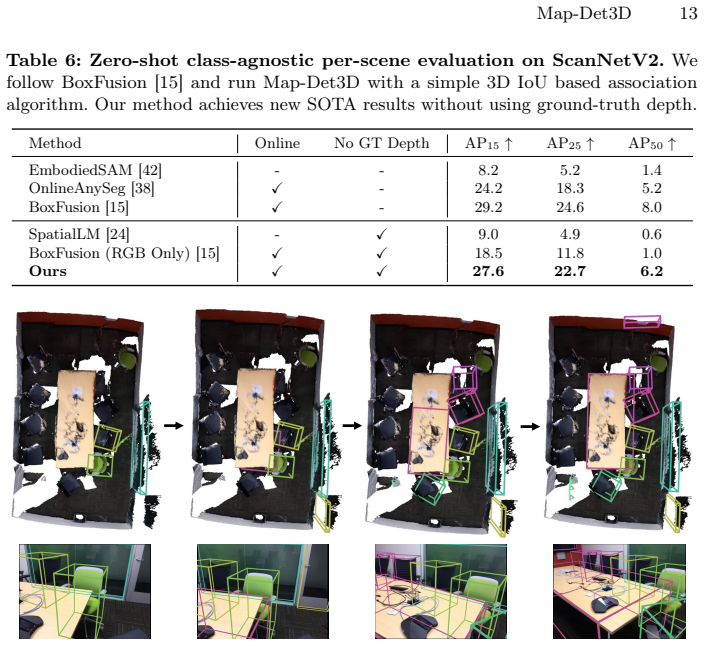
- The class-agnostic detector can be combined with simple tracking-by-detection to produce per-scene results on ScanNetV2, reaching 27.6 AP15 without ground-truth depth.
Reading between the lines
- If the scale factor stays calibrated under camera and scene shift, the same recipe should extend to outdoor settings by retraining or swapping the reconstruction backbone; a clean test would be evaluating on a driving dataset with known metric boxes.
- Compare Map-Det3D against a variant that predicts metric depth with a monocular depth foundation model instead of the reconstruction backbone; this would isolate whether the reconstruction's multi-view fusion or just its scale token is doing the work.
- Because the boxes are class-agnostic and metric, the output could serve as generic 3D proposals for open-vocabulary detection or segmentation by matching them to text queries through 2D grounding models, an extension the paper names as future work but does not demonstrate.
- The up-to-scale head could be detached from detection and used as a calibration probe: the distribution of predicted scale factors over windows might flag when the reconstruction prior is operating out of domain, giving a self-diagnostic for deployment.
Signed reviews
Editorial analysis
A structured set of objections, weighed in public.
Referee Report
Summary. The paper proposes Map-Det3D, an online multi-view 3D object detection framework that repurposes a feed-forward metric 3D reconstruction model (MapAnything) as the encoder of a DETR-style detection transformer. A short temporal window of RGB frames is treated as multi-view input, and an up-to-scale 3D bounding box head recovers metric coordinates and dimensions by multiplying the backbone's predicted per-window scale factor. The method is trained class-agnostically on CA-1M and evaluated on held-out CA-1M scenes, zero-shot on ScanNet200, and per-scene on ScanNetV2 with a simple tracking-by-detection module. The reported results show improvements over monocular baselines such as CuTR and Cube R-CNN, and competitive zero-shot performance on ScanNet.
Significance. If the results hold, this is a valuable architectural insight: rather than regressing depth or scale from 2D detections, a feed-forward reconstruction model's learned scale prior can be directly converted into metric 3D boxes. The ablations in Tab. 1 provide controlled evidence for the main design decisions (unfreezing the multi-view transformer, camera conditioning, and the direct 3D head), and the release of code and models supports reproducibility. The significance is somewhat tempered by the fact that the method is evaluated only on indoor class-agnostic detection, and by unresolved questions about the zero-shot comparison's control for backbone pretraining data and about the statistical reliability of the single-run results.
major comments (4)
- [Sec. 4.4, Tab. 5] The zero-shot ScanNet200 comparison does not disclose the pretraining corpus of the MapAnything backbone, despite the central claim of 'robust transfer without adaptation' (abstract, Sec. 4.4). MapAnything is a same-group model, and common FF3R training mixtures include ScanNet. If ScanNet validation imagery or geometry was part of the reconstruction pretraining, the large gap over CuTR (15.2 vs 4.3 AP15) could reflect encoder-data overlap rather than the proposed online multi-view architecture or scale handling. Please provide the complete list of datasets used in MapAnything's reconstruction pretraining and, if ScanNet is included, assess the impact of overlap (e.g., by reporting results with a backbone variant that was not trained on ScanNet, or by stratifying performance across scenes with different overlap levels).
- [Sec. 3.4, Eqs. (3)–(4) and Tab. 5] The metric outputs of the model depend entirely on the predicted scale factor rho (x = rho * x_tilde, z = rho * exp(d_tilde), w = rho * exp(s_w_tilde), etc.). The paper does not directly validate whether rho remains metrically calibrated on the zero-shot benchmark, even though a biased rho would corrupt every metric box regardless of the up-to-scale geometry. Please report the scale factor's accuracy (e.g., median absolute relative error of rho with respect to scene scale) on both CA-1M and ScanNet validation, and, ideally, ablate the downstream detection AP when rho is replaced by an oracle or ground-truth scale factor.
- [Sec. 4.3–4.5, Tabs. 1–6] All experimental tables report single-run results without error bars or significance tests. Several decisive comparisons involve modest margins (e.g., 17.2 vs 17.3 in Tab. 1 rows 5 and 7, and 21.1 vs 21.2 in Tab. 3), so the reader cannot judge whether the reported improvements are stable or within run-to-run noise. Please provide at least three independent runs for the main results and report mean and standard deviation, especially for the SOTA comparisons in Tabs. 4 and 5.
- [Sec. 4.2, Tabs. 4–5] The evaluation section states that, unlike prior benchmarks, all ground-truth boxes are evaluated regardless of visibility and truncation. If this protocol is applied to Map-Det3D but the baseline numbers in Tabs. 4 and 5 are taken from prior publications that used a different protocol (e.g., only visible boxes), the comparison is not apples-to-apples. Please state explicitly whether all baselines were re-evaluated under the same protocol, and, if so, provide the re-evaluated numbers; otherwise, the SOTA claims in Secs. 4.4 and 4.5 are not properly supported.
minor comments (4)
- [Fig. 1 caption] The phrase 'and adapts it for 3D object detection' should read 'and adapts it for 3D object detection' or 'and adapts it for 3D object detection'; the verb form is inconsistent with the rest of the caption.
- [Sec. 4.5 vs Sec. 3.1] The symbol T is reused for the temporal window size (Sec. 3.1) and for the track memory in the per-scene evaluation (Sec. 4.5). Please rename one of these to avoid confusion.
- [Sec. 4.3, Tab. 1] The row configuration in Tab. 1 is not fully self-explanatory; for example, row 4 has checkmarks for 'Unfreeze Scale Head' and 'Unfreeze MV Transformer' but no 'Multi-View' checkbox, which may make the incremental contribution hard to parse. Consider adding a short textual description of each configuration or explicitly labeling the row conditions.
- [References] The method relies heavily on reference [11] (MapAnything), which appears to be a same-group publication. Please confirm that this work is publicly available or accepted, since the paper's reproducibility depends on the released checkpoints.
Circularity Check
No circular derivation: the scale factor is a learned backbone output, the up-to-scale head is a parameterization, and in-domain/zero-shot results are externally benchmarked; only a same-group self-citation/data-disclosure burden remains.
full rationale
Map-Det3D's claims do not reduce to their inputs. The metric scale factor ρ_t is produced by the MapAnything backbone (Eq. 1) and, after fine-tuning with detection losses on CA-1M, is used to convert up-to-scale head outputs via x := ρ x̃, y := ρ ỹ, z := ρ exp(d̃), w := ρ exp(s_w̃) (Sec. 3.4). Nothing in these equations fits ρ to the reported AP numbers: ρ is a learned output, not a constant calibrated on CA-1M validation or ScanNet. In-domain numbers are on held-out CA-1M scenes (Tab. 4) and transfer numbers are on ScanNet200/ScanNetV2 (Tabs. 5-6), so the main claims are externally falsifiable rather than definitional. The only burden is self-citational: the geometric backbone MapAnything [11] shares authors with the present paper, and Sec. 3.2 does not disclose MapAnything's reconstruction-pretraining corpus. Therefore the ScanNet zero-shot comparison against CuTR (Sec. 4.4, Tab. 5) does not fully rule out that part of the transfer gain comes from encoder pretraining overlap rather than the proposed architecture or scale handling. That is a missing-control/missing-disclosure concern, not an equation-level circularity: no fitted parameter is renamed a prediction, and no uniqueness or ansatz result is imported from a same-author citation to force the design. Consistently with the default expectation for benchmark-backed papers, the circularity score is low.
Assumptions & free parameters
free parameters (2)
- per-window metric scale factor rho_t =
predicted by MapAnything, fine-tuned on CA-1M at 1/10 learning rate
- temporal window size T =
5 at inference
assumptions (4)
- domain assumption MapAnything's feed-forward reconstruction provides reliable multi-view geometry and a disentangled metric scale factor across indoor scenes.
- domain assumption Camera intrinsics and, when available, extrinsics are encoded and are sufficiently accurate to stabilize geometry; when absent, the backbone's estimated poses are accurate enough.
- domain assumption CA-1M provides exhaustive and accurate class-agnostic 9-DOF 3D annotations for objects in indoor scenes.
- domain assumption Hungarian matching on auxiliary 2D boxes, with disentangled 3D corner losses, is a sufficient training objective for direct 3D box prediction.
Cite this review
Pith. "Pith review of Map-Det3D: Metric Feed-Forward 3D Reconstruction Prior for Multi-view 3D Object Detection from Streaming Inputs." pith.science (2026). https://pith.science/paper/7DKD5ADD
@misc{pith2026260812179,
  author       = {Pith},
  title        = {Pith review of: Map-Det3D: Metric Feed-Forward 3D Reconstruction Prior for Multi-view 3D Object Detection from Streaming Inputs},
  year         = {2026},
  howpublished = {\url{https://pith.science/paper/7DKD5ADD}},
  note         = {Machine review of arXiv:2608.12179}
}
read the original abstract
Metric 3D object detection is a core capability for embodied agents, yet most reliable systems lean on depth sensors, trading away cost, power, and integration simplicity. This motivates monocular 3D detection, which avoids additional constraints, yet it faces a major obstacle: from a single image, depth, and especially absolute scale, are underconstrained. As a result, the prevailing pattern of detecting in 2D and then predicting 3D attributes is often brittle, since modest range errors can dominate 3D localization, and the learned scale prior can fail when cameras, motion, or environments undergo domain shifts. To address this, we propose Map-Det3D, an online multi-view 3D object detection model that brings detection directly into a 3D space reconstructed from RGB. We map a short temporal window into multiple views and repurpose a feed-forward metric 3D reconstruction model as our geometric backbone while tuning its object-aware capabilities. Building on this representation, Map-Det3D directly predicts boxes in metric 3D space, without the widely used 2D-to-3D lifting. Experiments across different benchmarks show that this design supports strong online performance and robust transfer without adaptation, suggesting that training reconstruction priors for detection is a practical route to stable metric 3D detection from monocular video. Code and models are available at https://royyang0714.github.io/Map-Det3D.
Figures


Figures from the paper (3 more)


Reference graph
Works this paper leans on
-
[1]
Bochkovskii, A., Delaunoy, A., Germain, H., Santos, M., Zhou, Y., Richter, S.R., Koltun, V.: Depth pro: Sharp monocular metric depth in less than a second. ICLR (2025)
work page 2025
-
[2]
In: CVPR
Brazil, G., Kumar, A., Straub, J., Ravi, N., Johnson, J., Gkioxari, G.: Omni3D: A large benchmark and model for 3D object detection in the wild. In: CVPR. IEEE, Vancouver, Canada (June 2023)
2023
- [3]
-
[4]
CVPR (2025)
Chen, S., Guo, H., Zhu, S., Zhang, F., Huang, Z., Feng, J., Kang, B.: Video depth anything: Consistent depth estimation for super-long videos. CVPR (2025)
2025
-
[5]
In: CVPR (2017)
Dai, A., Chang, A.X., Savva, M., Halber, M., Funkhouser, T., Nießner, M.: Scannet: Richly-annotated 3d reconstructions of indoor scenes. In: CVPR (2017)
2017
-
[6]
Duisterhof, B.P., Zust, L., Weinzaepfel, P., Leroy, V., Cabon, Y., Revaud, J.: Mast3r- sfm: a fully-integrated solution for unconstrained structure-from-motion. In: 3DV. pp. 1–10 (2025)
work page 2025
-
[7]
Fischer, T., Yang, Y.H., Kumar, S., Sun, M., Yu, F.: Cc-3dt: Panoramic 3d object tracking via cross-camera fusion. In: CORL (2022)
work page 2022
-
[8]
IEEE TPAMI45(2), 1992–2008 (2022)
Hu, H.N., Yang, Y.H., Fischer, T., Darrell, T., Yu, F., Sun, M.: Monocular quasi- dense 3d object tracking. IEEE TPAMI45(2), 1992–2008 (2022)
work page 2022
Show all 53 references
-
[9]
IEEE TPAMI (2024)
Hu, M., Yin, W., Zhang, C., Cai, Z., Long, X., Chen, H., Wang, K., Yu, G., Shen, C., Shen, S.: Metric3d v2: A versatile monocular geometric foundation model for zero-shot metric depth and surface normal estimation. IEEE TPAMI (2024)
2024
-
[10]
In: NeurIPS (2024)
Huang, R., Zheng, H., Wang, Y., Xia, Z., Pavone, M., Huang, G.: Training an open-vocabulary monocular 3d detection model without 3d data. In: NeurIPS (2024)
2024
-
[11]
Keetha, N., Müller, N., Schönberger, J., Porzi, L., Zhang, Y., Fischer, T., Knapitsch, A., Zauss, D., Weber, E., Antunes, N., Luiten, J., Lopez-Antequera, M., Bulò, S.R., Richardt, C., Ramanan, D., Scherer, S., Kontschieder, P.: MapAnything: Universal feed-forward metric 3D re...
2026
-
[12]
In: 2026 International Conference on 3D Vision (3DV) (2026)
Knaebel, K., Yilmaz, K., de Geus, D., Hermans, A., Adrian, D., Linder, T., Leibe, B.: DINO in the room: Leveraging 2D foundation models for 3D segmentation. In: 2026 International Conference on 3D Vision (3DV) (2026)
2026
-
[13]
Naval research logistics quarterly2(1-2), 83–97 (1955)
Kuhn, H.W.: The hungarian method for the assignment problem. Naval research logistics quarterly2(1-2), 83–97 (1955)
1955
-
[14]
In: Proceedings of the IEEE conference on computer vision and pattern recognition
Kundu, A., Li, Y., Rehg, J.M.: 3d-rcnn: Instance-level 3d object reconstruction via render-and-compare. In: Proceedings of the IEEE conference on computer vision and pattern recognition. pp. 3559–3568 (2018)
2018
-
[15]
In: Computer Graphics Forum
Lan, Y., Zhu, C., Gao, Z., Zhang, J., Cao, Y., Yi, R., Wang, Y., Xu, K.: Boxfusion: Reconstruction-free open-vocabulary 3d object detection via real-time multi-view box fusion. In: Computer Graphics Forum. vol. 44, p. e70254. Wiley Online Library (2025)
2025
-
[16]
In: Proceedings of the Computer Vision and Pattern Recognition Conference
Lazarow, J., Griffiths, D., Kohavi, G., Crespo, F., Dehghan, A.: Cubify anything: Scaling indoor 3d object detection. In: Proceedings of the Computer Vision and Pattern Recognition Conference. pp. 22225–22233 (2025)
2025
-
[17]
arXiv preprint arXiv:2203.17270 (2022) Map-Det3D 17
Li, Z., Wang, W., Li, H., Xie, E., Sima, C., Lu, T., Qiao, Y., Dai, J.: Bevformer: Learning bird’s-eye-view representation from multi-camera images via spatiotempo- ral transformers. arXiv preprint arXiv:2203.17270 (2022) Map-Det3D 17
2022 arXiv
-
[18]
In: CVPR
Li, Z., Xu, X., Lim, S., Zhao, H.: Unimode: Unified monocular 3d object detection. In: CVPR. pp. 16561–16570 (June 2024)
2024
-
[19]
arXiv preprint arXiv:2511.10647 (2025)
Lin, H., Chen, S., Liew, J.H., Chen, D.Y., Li, Z., Shi, G., Feng, J., Kang, B.: Depth anything 3: Recovering the visual space from any views. arXiv preprint arXiv:2511.10647 (2025)
2025 arXiv
-
[20]
In: ICCV
Lin, T.Y., Goyal, P., Girshick, R., He, K., Dollár, P.: Focal loss for dense object detection. In: ICCV. pp. 2980–2988 (2017)
2017
-
[21]
arXiv preprint arXiv:2211.10581 (2022)
Lin, X., Lin, T., Pei, Z., Huang, L., Su, Z.: Sparse4d: Multi-view 3d object detection with sparse spatial-temporal fusion. arXiv preprint arXiv:2211.10581 (2022)
2022 arXiv
-
[22]
ECCV (2024)
Liu, S., Zeng, Z., Ren, T., Li, F., Zhang, H., Yang, J., Li, C., Yang, J., Su, H., Zhu, J., et al.: Grounding dino: Marrying dino with grounded pre-training for open-set object detection. ECCV (2024)
2024
-
[23]
arXiv preprint arXiv:2203.05625 (2022)
Liu, Y., Wang, T., Zhang, X., Sun, J.: Petr: Position embedding transformation for multi-view 3d object detection. arXiv preprint arXiv:2203.05625 (2022)
2022 arXiv
-
[24]
In: NeurIPS (2025)
Mao, Y., Zhong, J., Fang, C., Zheng, J., Tang, R., Zhu, H., Tan, P., Zhou, Z.: Spatiallm: Training large language models for structured indoor modeling. In: NeurIPS (2025)
2025
-
[25]
In: ICIP
Naiden, A., Paunescu, V., Kim, G., Jeon, B., Leordeanu, M.: Shift r-cnn: Deep monocular 3d object detection with closed-form geometric constraints. In: ICIP. pp. 61–65. IEEE (2019)
2019
-
[26]
Nickolls, J., Buck, I., Garland, M., Skadron, K.: Scalable parallel programming with cuda: Is cuda the parallel programming model that application developers have been waiting for? Queue6(2), 40–53 (2008)
2008
-
[27]
Park, D., Ambrus, R., Guizilini, V., Li, J., Gaidon, A.: Is pseudo-lidar needed for monocular 3d object detection? In: ICCV (2021)
2021
-
[28]
In: NeurIPS, pp
Paszke, A., Gross, S., Massa, F., Lerer, A., Bradbury, J., Chanan, G., Killeen, T., Lin, Z., Gimelshein, N., Antiga, L., Desmaison, A., Kopf, A., Yang, E., DeVito, Z., Raison, M., Tejani, A., Chilamkurthy, S., Steiner, B., Fang, L., Bai, J., Chintala, S.: Pytorch: An imperativ...
2019
-
[29]
In: CVPR (2025)
Piccinelli, L., Sakaridis, C., Segu, M., Yang, Y.H., Li, S., Abbeloos, W., Van Gool, L.: UniK3D: Universal camera monocular 3d estimation. In: CVPR (2025)
2025
-
[30]
IEEE TPAMI (2026)
Piccinelli, L., Sakaridis, C., Yang, Y.H., Segu, M., Li, S., Abbeloos, W., Gool, L.V.: UniDepthV2: Universal monocular metric depth estimation made simpler. IEEE TPAMI (2026)
2026
-
[31]
In: 3DV (2026)
Piccinelli, L., Wandel, T., Sakaridis, C., Abbeloos, W., Gool, L.V.: Video depth propagation. In: 3DV (2026)
2026
-
[32]
In: CVPR (2024)
Piccinelli, L., Yang, Y.H., Sakaridis, C., Segu, M., Li, S., Van Gool, L., Yu, F.: UniDepth: Universal monocular metric depth estimation. In: CVPR (2024)
2024
-
[33]
In: CVPR
Rezatofighi, H., Tsoi, N., Gwak, J., Sadeghian, A., Reid, I., Savarese, S.: Generalized intersection over union: A metric and a loss for bounding box regression. In: CVPR. pp. 658–666 (2019)
2019
-
[34]
In: ECCV
Rukhovich, D.,Vorontsova, A., Konushin, A.:Fcaf3d: Fully convolutionalanchor-free 3d object detection. In: ECCV. pp. 477–493. Springer (2022)
2022
-
[35]
In: WACV
Rukhovich, D., Vorontsova, A., Konushin, A.: Imvoxelnet: Image to voxels projection for monocular and multi-view general-purpose 3d object detection. In: WACV. pp. 2397–2406 (2022)
2022
-
[36]
In: ICIP
Rukhovich, D., Vorontsova, A., Konushin, A.: Tr3d: Towards real-time indoor 3d object detection. In: ICIP. pp. 281–285. IEEE (2023) 18 Y-H. Yang et al
2023
-
[37]
arXiv preprint arXiv:2406.10224 (2024)
Straub, J., DeTone, D., Shen, T., Yang, N., Sweeney, C., Newcombe, R.: Efm3d: A benchmark for measuring progress towards 3d egocentric foundation models. arXiv preprint arXiv:2406.10224 (2024)
2024 arXiv
-
[38]
arXiv preprint arXiv:2503.01309 (2025)
Tang, Y., Zhang, J., Lan, Y., Guo, Y., Dong, D., Zhu, C., Xu, K.: Onlineanyseg: Online zero-shot 3d segmentation by visual foundation model guided 2d mask merging. arXiv preprint arXiv:2503.01309 (2025)
2025 arXiv
-
[39]
In: ICCV
Tu, T., Chuang, S.P., Liu, Y.L., Sun, C., Zhang, K., Roy, D., Kuo, C.H., Sun, M.: Imgeonet: Image-induced geometry-aware voxel representation for multi-view 3d object detection. In: ICCV. pp. 6996–7007 (2023)
2023
-
[40]
In: CVPR
Wang, J., Chen, M., Karaev, N., Vedaldi, A., Rupprecht, C., Novotny, D.: Vggt: Visual geometry grounded transformer. In: CVPR. pp. 5294–5306 (2025)
2025
-
[41]
In: ICLR (2026)
Wang, Y., Zhou, J., Zhu, H., Chang, W., Zhou, Y., Li, Z., Chen, J., Pang, J., Shen, C., He, T.: Pi3: Permutation-equivariant visual geometry learning. In: ICLR (2026)
2026
-
[42]
arXiv preprint arXiv:2408.11811 (2024)
Xu, X., Chen, H., Zhao, L., Wang, Z., Zhou, J., Lu, J.: Embodiedsam: Online segment any 3d thing in real time. arXiv preprint arXiv:2408.11811 (2024)
2024 arXiv
-
[43]
In: CVPR
Yang, C., Chen, Y., Tian, H., Tao, C., Zhu, X., Zhang, Z., Huang, G., Li, H., Qiao, Y., Lu, L., et al.: Bevformer v2: Adapting modern image backbones to bird’s-eye-view recognition via perspective supervision. In: CVPR. pp. 17830–17839 (2023)
2023
-
[44]
arXiv preprint arXiv:2310.11441 (2023)
Yang, J., Zhang, H., Li, F., Zou, X., Li, C., Gao, J.: Set-of-mark prompting unleashes extraordinary visual grounding in gpt-4v. arXiv preprint arXiv:2310.11441 (2023)
2023 arXiv
-
[45]
arXiv:2406.09414 (2024)
Yang, L., Kang, B., Huang, Z., Zhao, Z., Xu, X., Feng, J., Zhao, H.: Depth anything v2. arXiv:2406.09414 (2024)
2024 arXiv
-
[46]
In: ICCV
Yang, Y.H., Piccinelli, L., Segu, M., Li, S., Huang, R., Fu, Y., Pollefeys, M., Blum, H., Bauer, Z.: 3d-mood: Lifting 2d to 3d for monocular open-set object detection. In: ICCV. pp. 7429–7439 (October 2025)
2025
-
[47]
arXiv preprint arXiv:2411.16833 (2024)
Yao, J., Gu, H., Chen, X., Wang, J., Cheng, Z.: Open vocabulary monocular 3d object detection. arXiv preprint arXiv:2411.16833 (2024)
2024
-
[48]
arXiv preprint arXiv:2601.01676 (2026)
Yao, J., Redoy, R.M., Elbaum, S., Dwyer, M.B., Cheng, Z.: Labelany3d: Label any object 3d in the wild. arXiv preprint arXiv:2601.01676 (2026)
2026
-
[49]
arXiv preprint arXiv:2504.07958 (2025)
Zhang, H., Jiang, H., Yao, Q., Sun, Y., Zhang, R., Zhao, H., Li, H., Zhu, H., Yang, Z.: Detect anything 3d in the wild. arXiv preprint arXiv:2504.07958 (2025)
2025
-
[50]
arXiv preprint arXiv:2203.03605 (2022)
Zhang, H., Li, F., Liu, S., Zhang, L., Su, H., Zhu, J., Ni, L.M., Shum, H.Y.: Dino: Detr with improved denoising anchor boxes for end-to-end object detection. arXiv preprint arXiv:2203.03605 (2022)
2022 arXiv
-
[51]
arXiv preprint arXiv:2510.23607 (2025)
Zhang, Y., Wu, X., Lao, Y., Wang, C., Tian, Z., Wang, N., Zhao, H.: Concerto: Joint 2d-3d self-supervised learning emerges spatial representations. arXiv preprint arXiv:2510.23607 (2025)
2025
-
[52]
In: Proceedings of the IEEE/CVF conference on computer vision and pattern recognition
Zhou, Y., Barnes, C., Lu, J., Yang, J., Li, H.: On the continuity of rotation representations in neural networks. In: Proceedings of the IEEE/CVF conference on computer vision and pattern recognition. pp. 5745–5753 (2019)
2019
-
[53]
ICLR (2026)
Zhuo, D., Zheng, W., Guo, J., Wu, Y., Zhou, J., Lu, J.: Streaming 4d visual geometry transformer. ICLR (2026)
2026
Reviewed August 16, 2026 · model on record in the stance chip above.
Discussion (0). Continue with ORCID to comment.