REVIEW 3 major objections 4 minor 294 references
Why is GN-z11 Bright, Compact, and Nitrogen Enhanced? Insights from UV Absorption and Emission Diagnostics
T0 review · 3 major / 4 minor · reviewed 2026-08-16 · deepseek-v4-flash
Pith's one-line read New JWST spectral fitting indicates that the luminous, compact ultraviolet continuum of GN-z11 at z=10.60 is dominated by massive stars rather than a type 1 AGN, with the extreme nitrogen enrichment confined to dense gas around those stars.
desk verdict A careful, well-executed UV study of GN-z11 that makes a credible case for massive stars, but the stellar-vs-AGN model comparison is asymmetric and the density stratification result is the most durable piece. read the letter →
The pith
A machine-rendered reading of the paper's core claim, the machinery that carries it, and where it could break.
The reading
What carries the argument
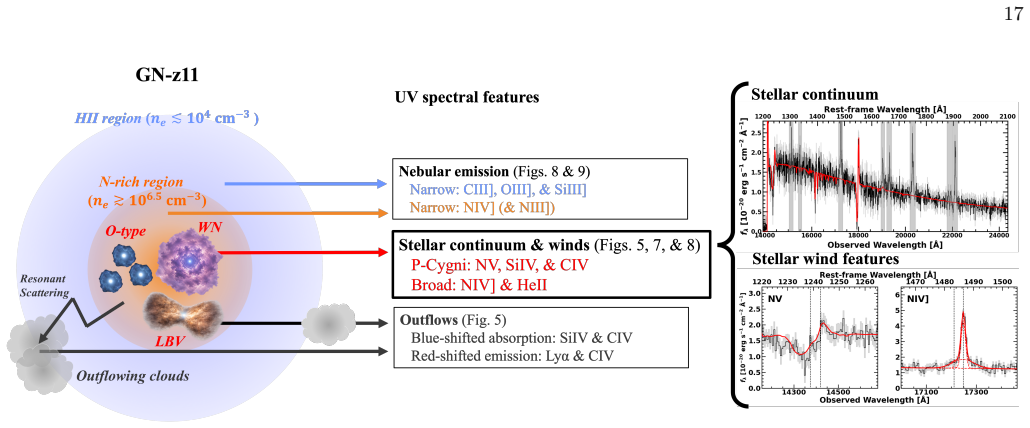
The load-bearing object is the P-Cygni profile, an emission peak with a blue-shifted absorption trough produced when a stellar wind absorbs and scatters line photons, taken as a wind diagnostic; N V $\lambda\lambda1238,1243$ is treated as the cleanest case because its ionization potential (77.5 eV) makes it difficult to produce in ordinary ISM/CGM gas. Around this, the paper builds a simultaneous fit of continuum, nebular emission, and ISM/CGM absorption using binary stellar population synthesis models plus photoionization calculations for the stellar hypothesis, versus a power-law AGN continuum with narrow emission and absorption for the AGN hypothesis, compared with the Widely Applicable Information Criterion for Bayesian model selection. The same decomposition is then used to extract electron densities from the C III] $\lambda\lambda1907,1909$, N III] $\lambda\lambda1747{-}1754$, and N IV] $\lambda\lambda1483,1486$ doublets, whose flux ratios respond differently to density, providing the stratification evidence.
What would settle it
Deeper rest-optical or X-ray data that reveal a broad Hα component with FWHM ≳ 2000 km/s, or an X-ray source above the current 3σ upper limit, would overturn the paper's claim that no type 1 AGN dominates GN-z11's UV continuum.
Extended reading notes
Core claim
The central claim is that the ultraviolet continuum of GN-z11, the property that makes it one of the brightest z>10 galaxies, is emitted mainly by a population of young (~3 Myr) massive stars, with no need for a dominant type 1 AGN. The evidence is a model comparison: a stellar model built from population synthesis, nebular emission, and partial-covering ISM/CGM absorption reproduces the N V $\lambda\lambda1238,1243$ P-Cygni profile naturally through stellar winds, whereas the AGN model (power-law continuum plus narrow nebular lines and absorption) can match it only by invoking an unusually broad absorption component with $\mathrm{FWHM}\sim4200$ km s$^{-1}$; the stellar model wins with $\Delta\mathrm{WAIC}=-25.2$. A second claim is that the gas is strongly density-stratified: C III] gives $n_e\lesssim10^{4.1}$ cm$^{-3}$, N III] is intermediate, and N IV] gives $n_e\gtrsim10^{6.5}$ cm$^{-3}$, so carbon- and nitrogen-emitting gas are physically separate. From this the paper concludes that the apparent nitrogen enhancement in GN-z11 reflects nitrogen-rich Wolf-Rayet winds enriching a dense, compact region photoionized by neighboring massive stars, rather than a galaxy-wide abundance pattern.
Load-bearing premise
The comparison AGN model is a bare power-law continuum with narrow emission lines and foreground absorption, with no broad-line region and no AGN-driven wind, so the statistical preference for stars depends on the AGN being represented only by that simple model; a more realistic AGN with broad absorption or broad lines might fit the same spectrum.
Editorial extensions
If this is right
- If the stellar interpretation is right, GN-z11's brightness does not require an AGN or exotic luminosity source at z≈10.6; a ~3 Myr old massive starburst can account for the compact UV continuum.
- The extreme N/O ratio derived from N IV] and N III] would not measure the galaxy's bulk composition; nitrogen abundance ratios from UV lines in compact high-redshift galaxies should be treated as potentially local enrichment unless density stratification is modeled.
- The density contrast between C III]- and N IV]-emitting gas means single-zone photoionization or abundance models for GN-z11 are inadequate; multi-component models with dense nitrogen-rich clumps are needed.
- The blue-shifted Si IV/C IV absorption and red-shifted Lyα/C IV emission at about 400–500 km/s imply a massive-star-driven outflow, linking stellar feedback to gas escape in reionization-era galaxies.
- If the stellar model is preferred, previous AGN interpretations of GN-z11's N V or broad N IV] features need reinterpretation as stellar-wind signatures rather than black-hole activity.
Reading between the lines
- Editorial inference: the AGN comparison used here is minimal, containing no broad-line region and no AGN-driven wind, so a more complete AGN model with broad absorption lines might reproduce the N V trough and shrink the ΔWAIC gap; this is an untested alternative, not a paper claim.
- Editorial inference: if local nitrogen enrichment by Wolf-Rayet or luminous-blue-variable winds is common in compact high-redshift starbursts, other 'nitrogen-enhanced' galaxies at z>7 with compact morphology should show the same C III]/N IV] density dichotomy, and stacking their spectra would be a direct test.
- Editorial inference: the density-stratification argument implies that UV nitrogen abundance indicators in the JWST era may be systematically biased high in nitrogen-loud galaxies, potentially affecting inferences about stellar initial mass functions, supermassive stars, or globular-cluster formation at high redshift.
- Editorial inference: the broad N IV] emission attributed to Wolf-Rayet winds could instead be produced by an LBV eruption or a Wolf-Rayet binary system, so calibrating the line widths and ratios with time-resolved spectra of local analogs would sharpen the stellar interpretation.
Signed reviews
Editorial analysis
A structured set of objections, weighed in public.
Referee Report
Summary. This paper presents new reductions of JWST/NIRSpec MSA and IFU spectroscopy of GN-z11 at z=10.60. The authors identify P-Cygni profiles in NV, SiIV, and CIV together with a broad NIV] component, compare the spectrum with local O, WN, and LBV stars, and fit BPASS stellar and power-law AGN spectral models. The stellar model is preferred by ΔWAIC = −25.2, which the authors use to conclude that the compact UV continuum is dominated by massive stars. They further derive electron densities from CIII], NIII], and NIV] and propose that the apparent nitrogen enhancement arises from dense gas locally enriched by WN/LBV winds within the same star-forming region.
Significance. If the stellar-dominance conclusion holds, it provides a concrete resolution to the debated power source of one of the brightest z>10 galaxies and strengthens the massive-star interpretation of UV-luminous compact galaxies during reionization. The paper contains a careful and transparent treatment of IFU systematic uncertainties (Section 2.3), a useful empirical comparison with ULLYSES and IUE spectra (Section 3.2), and a quantitative model-comparison framework. The density-stratification result, if confirmed, offers a plausible explanation for the apparent extreme N/O ratio in GN-z11 without invoking galaxy-wide enrichment. However, the central statistical test in Section 3.3 is asymmetric in its treatment of the competing hypotheses, so the conclusion as stated currently outruns the model comparison.
major comments (3)
- [3.3 (Eq. 6; Table 2)] The AGN model used for the decisive model comparison contains only a power-law continuum, narrow Gaussian nebular lines (Lyα, NV, CIV), and a partial-covering ISM/CGM absorption component. It contains no broad-line region emission and no AGN-driven wind absorption. The best-fit AGN model must therefore reproduce the observed NV profile with an ISM/CGM absorber at FWHM ~4200 km/s, log N_NV ~ 15.6, and Δv ~ −1000 km/s (Table 2). Those parameters are not physically surprising for an AGN outflow or BLR-associated gas, but the model does not allow such a component to be self-consistently associated with the AGN. As a result, ΔWAIC = −25.2 compares a physical stellar-wind model against a deliberately restricted AGN model, and the reported preference supports "narrow-line AGN model is strongly disfavored" rather than the abstract's "AGN models" generally. Please add a minimal AGN model with a broad emission component and/or a broad resonant absorption doublet tied to the AGN, and report the resulting ΔWAIC.
- [3.3–3.4] The paper concludes that the UV continuum is "dominated by massive stars," but only pure stellar and pure AGN models are fitted. A composite model with a stellar continuum plus a sub-dominant AGN component is not tested, so the data do not directly constrain the allowed AGN fraction. If a small (e.g., 10–20%) AGN contribution can be added without worsening the fit, the central claim would need to be weakened to "the UV continuum is primarily stellar, with a possible minor AGN contribution." Please fit a composite stellar+AGN model or otherwise report an upper limit on the AGN fraction, and adjust the abstract and Section 3.4 conclusions accordingly.
- [4.2.2 (Fig. 10)] The paper states that the Niv] and Niii] diagnostics in this object "do not provide unique density measurements but instead constrain n_e to lower or upper limits," yet the abstract and Section 4.3 present the difference between Ciii] and Niv] as evidence for "physically distinct nebular components." Given the nonlinearity of the diagnostic curves, please report the full marginal posterior distributions (for example, the 68% and 95% credible intervals for log n_e from each ion) and demonstrate that the Ciii] and Niv] densities are separated at a statistically meaningful level. If the constraints are genuinely one-sided, the wording "reaching densities of >10^6.5 cm^-3" is acceptable, but the claim of distinct components should be explicitly presented as contingent on the adopted electron temperature and on the assumed decomposition of the broad Niv] component.
minor comments (4)
- [References] The entries for Kobayashi & Ferrara 2024a and 2024b are identical (same journal, volume, page, and DOI), which is presumably a typographical error; one entry should be corrected to the intended paper.
- [References] The DOI for Nakane et al. 2024a appears malformed ("10.1088/0004-637X/.../10.1134/S1063773708080045") and should be checked.
- [Section 3.1] The identification of P-Cygni profiles in NV, SiIV, and CIV is presented before the quantitative fitting that actually distinguishes stellar from non-stellar origins; adding a sentence that these identifications are validated by the fits in Section 3.3 would improve the logical flow.
- [Section 2.3] The four IFU reduction variants are described in the text but the figure legend in Figure 2 does not explicitly label which panel corresponds to which variant; labeling the panels directly would aid the reader.
Circularity Check
No significant circularity: the stellar-vs-AGN conclusion is an empirical model comparison against external data, not a consequence of self-citation or of fitting the target claim into the model.
full rationale
The central claim that massive stars dominate the UV continuum of GN-z11 rests on (i) empirical comparison with local ULLYSES/IUE massive-star spectra and (ii) a quantitative MCMC/WAIC comparison of BPASS+Cloudy stellar models versus power-law AGN models against the observed MSA and IFU spectra (Section 3.3). The stellar model is not constructed from the observed NV P-Cygni profile; the profile is an independent prediction of the stellar-wind treatment in BPASS, and the AGN model is not derived from the stellar model. The fitted parameters (age, E(B-V), covering fraction, column densities) are inputs, but the model-selection outcome (Delta-WAIC = -25.2 favoring stellar models) is determined by the data, not by construction. Self-citations appear (Nakane et al. 2024a, 2025 for model implementation; Nakane & Ouchi 2026 for a Sersic profile used in IFU extraction), but none embeds the stellar-dominance conclusion; the IFU/MSA cross-checks and external MIRI/X-ray constraints provide independent support. The noted incompleteness of the AGN model (no BLR or AGN wind component) is a modeling/correctness risk that could weaken the stellar preference, but it is not a circularity, because the paper explicitly recognizes that P-Cygni-like profiles can be reproduced by nebular emission plus blue-shifted absorption and still uses the data to evaluate the two model families. No step reduces by definition to its own output.
Assumptions & free parameters
free parameters (13)
- Stellar age log(t_age/yr) =
6.46
- Stellar metallicity log(Z*/Zsun) =
-1.40
- E(B-V) color excess =
0.05
- AGN power-law slope beta =
-2.19
- ISM/CGM covering fraction C_f =
0.81 (stellar), 0.86 (AGN)
- log(N_SiIV) column density =
14.3
- log(N_CIV) column density =
14.2
- log(N_NV) column density =
15.6
- Emission line fluxes, widths, velocity offsets (Ly-alpha, CIV, NV) =
Fluxes ~1-11 x 10^-19 erg/s/cm2, FWHM ~300-750 km/s, offsets ~250-450 km/s
- Broad NIV] component FWHM =
1638 km/s
- log(n_e(CIII])) =
<4.1
- log(n_e(NIII])) =
2-7
- log(n_e(NIV])) =
>6.6
assumptions (6)
- domain assumption BPASS v2.2.1 stellar population synthesis models with Salpeter IMF, binary stars, and a high-mass cutoff of 100 solar masses
- domain assumption Cloudy v23.01 photoionization models for nebular continuum and emission lines
- domain assumption PyNeb atomic data and fixed electron temperature Te = 14,000 K from [OIII]
- domain assumption Inoue et al. (2014) IGM transmission model
- domain assumption NIRSpec line-spread function scaled by 0.5 following de Graaff et al. (2024)
- domain assumption NV P-Cygni profile is dominated by stellar wind because NV has a high ionization potential (77.5 eV) making ISM/CGM contamination negligible
Cite this review
Pith. "Pith review of Why is GN-z11 Bright, Compact, and Nitrogen Enhanced? Insights from UV Absorption and Emission Diagnostics." pith.science (2026). https://pith.science/paper/C2O52RO2
@misc{pith2026260812466,
  author       = {Pith},
  title        = {Pith review of: Why is GN-z11 Bright, Compact, and Nitrogen Enhanced? Insights from UV Absorption and Emission Diagnostics},
  year         = {2026},
  howpublished = {\url{https://pith.science/paper/C2O52RO2}},
  note         = {Machine review of arXiv:2608.12466}
}
abstract
We investigate the UV spectrum of GN-z11, a luminous, compact galaxy with strong nitrogen lines, at $z=10.60$, using deep JWST/NIRSpec high-resolution IFU and medium-resolution MSA spectra assembled from the JADES, SPURS, and GO programs. After optimized reduction and extraction of the IFU data including an evaluation of statistical and systematic uncertainties, we obtain mutually consistent spectra from the high- and medium-resolution observations. After carefully accounting for the data quality limitations, we identify prominent P-Cygni profiles in NV$\lambda\lambda1238,1243$, SiIV$\lambda\lambda1394,1403$, and CIV$\lambda\lambda1548,1550$, together with broad NIV]$\lambda\lambda1483,1486$ emission (FWHM $\sim1600$ km s$^{-1}$). The P-Cygni profiles resemble those of massive stars such as O-type stars and luminous blue variables (LBVs), while the broad NIV] emission resembles that of nitrogen-sequence Wolf-Rayet (WN) stars. We fit stellar and active galactic nuclei (AGN) UV spectral models and find that the stellar models are strongly preferred over the AGN models ($\Delta$WAIC $=-25$), with the preference driven primarily by the NV P-Cygni profile. These results indicate that the luminous, compact UV continuum of GN-z11 is dominated by massive stars. We derive electron densities from CIII]$\lambda\lambda1907,1909$, NIII]$\lambda\lambda1747-1754$, and NIV], with the nitrogen diagnostics extending well beyond the CIII]-based limit and reaching densities of $\gtrsim10^{6.5}$ cm$^{-3}$ for NIV], indicating physically distinct carbon- and nitrogen-emitting nebular components. These findings suggest that the apparent nitrogen enhancement inferred for GN-z11 as a whole may arise when strong narrow nitrogen emission originates from dense gas locally enriched in nitrogen by WN stellar winds and photoionized by nearby massive stars within the same star-forming region.
Figures


Figures from the paper (7 more)


Reference graph
Works this paper leans on
-
[1]
2010, , 725, 1620, 10.1088/0004-637X/725/2/1620
Adamo , A., Zackrisson , E., \"O stlin , G., & Hayes , M. 2010, , 725, 1620, 10.1088/0004-637X/725/2/1620
-
[2]
2025, , 695, A250, 10.1051/0004-6361/202451731
\'A lvarez-M \'a rquez , J., Crespo G \'o mez , A., Colina , L., et al. 2025, , 695, A250, 10.1051/0004-6361/202451731
-
[3]
Arellano-C \'o rdova , K. Z., Berg , D. A., Mingozzi , M., et al. 2025, , 544, 1588, 10.1093/mnras/staf1723
-
[4]
Arrabal Haro , P., Dickinson , M., Finkelstein , S. L., et al. 2023, , 951, L22, 10.3847/2041-8213/acdd54
-
[5]
Astropy Collaboration , Robitaille , T. P., Tollerud , E. J., et al. 2013, , 558, A33, 10.1051/0004-6361/201322068
-
[6]
Astropy Collaboration , Price-Whelan , A. M., Sip o cz , B. M., et al. 2018, , 156, 123, 10.3847/1538-3881/aabc4f
-
[7]
Astropy Collaboration , Price-Whelan , A. M., Lim , P. L., et al. 2022, , 935, 167, 10.3847/1538-4357/ac7c74
-
[8]
Berg , D. A., Chisholm , J., Erb , D. K., et al. 2021, , 922, 170, 10.3847/1538-4357/ac141b
Show all 294 references
-
[9]
A., James , B
Berg , D. A., James , B. L., King , T., et al. 2022, , 261, 31, 10.3847/1538-4365/ac6c03
2022 doi
-
[10]
A., Naidu , R
Berg , D. A., Naidu , R. P., Chisholm , J., et al. 2026, , 1003, 112, 10.3847/1538-4357/ae5e4c
2026 doi
-
[11]
2025, , 983, L30, 10.3847/2041-8213/adc735
Bhattacharya , S., Arnaboldi , M., Gerhard , O., Kobayashi , C., & Saha , K. 2025, , 983, L30, 10.3847/2041-8213/adc735
2025 doi
-
[12]
2025, astropy/photutils: 2.3.0 , 2.3.0, Zenodo, 10.5281/zenodo.17129028
Bradley , L., Sip o cz , B., Robitaille , T., et al. 2025, astropy/photutils: 2.3.0 , 2.3.0, Zenodo, 10.5281/zenodo.17129028
2025 doi
-
[13]
2023, msaexp: NIRSpec analyis tools , 0.6.17, Zenodo, 10.5281/zenodo.7299500
Brammer , G. 2023, msaexp: NIRSpec analyis tools , 0.6.17, Zenodo, 10.5281/zenodo.7299500
2023 doi
-
[14]
J., Saxena , A., Cameron , A
Bunker , A. J., Saxena , A., Cameron , A. J., et al. 2023, , 677, A88, 10.1051/0004-6361/202346159
2023 doi
-
[15]
2026, JWST Calibration Pipeline , 2.0.1, Zenodo, 10.5281/zenodo.20058613
Bushouse , H., Eisenhamer , J., Dencheva , N., et al. 2026, JWST Calibration Pipeline , 2.0.1, Zenodo, 10.5281/zenodo.20058613
2026 doi
-
[16]
C., et al
Calzetti , D., Armus , L., Bohlin , R. C., et al. 2000, , 533, 682, 10.1086/308692
2000 doi
-
[17]
J., Katz , H., Rey , M
Cameron , A. J., Katz , H., Rey , M. P., & Saxena , A. 2023, , 523, 3516, 10.1093/mnras/stad1579
2023 doi
-
[18]
G., Lucatello , S., Bragaglia , A., & Bonifacio , P
Carretta , E., Gratton , R. G., Lucatello , S., Bragaglia , A., & Bonifacio , P. 2005, , 433, 597, 10.1051/0004-6361:20041892
2005 doi
-
[19]
H., Kulkarni , V
Cashman , F. H., Kulkarni , V. P., Kisielius , R., Ferland , G. J., & Bogdanovich , P. 2017, , 230, 8, 10.3847/1538-4365/aa6d84
2017 doi
-
[20]
2024, , 972, 143, 10.3847/1538-4357/ad5f88
Castellano , M., Napolitano , L., Fontana , A., et al. 2024, , 972, 143, 10.3847/1538-4357/ad5f88
2024 doi
-
[21]
I., Abbott , D
Castor , J. I., Abbott , D. C., & Klein , R. I. 1975, , 195, 157, 10.1086/153315
1975 doi
-
[22]
2023, , 673, L7, 10.1051/0004-6361/202346410
Charbonnel , C., Schaerer , D., Prantzos , N., et al. 2023, , 673, L7, 10.1051/0004-6361/202346410
2023 doi
- [23]
-
[24]
R., Bayliss , M., et al
Chisholm , J., Rigby , J. R., Bayliss , M., et al. 2019, , 882, 182, 10.3847/1538-4357/ab3104
2019 doi
-
[25]
2021, , 508, 4175, 10.1093/mnras/stab2497
Chon , S., Omukai , K., & Schneider , R. 2021, , 508, 4175, 10.1093/mnras/stab2497
2021 doi
-
[26]
G., et al
Crespo G \'o mez , A., Colina , L., P \'e rez-Gonz \'a lez , P. G., et al. 2026, , 706, A46, 10.1051/0004-6361/202556814
2026 doi
-
[27]
2026, , 710, A18, 10.1051/0004-6361/202558145
Curti , M., Cataldi , E., Belfiore , F., et al. 2026, , 710, A18, 10.1051/0004-6361/202558145
2026 doi
-
[28]
2023, Nature Astronomy, 7, 622, 10.1038/s41550-023-01918-w
Curtis-Lake , E., Carniani , S., Cameron , A., et al. 2023, Nature Astronomy, 7, 622, 10.1038/s41550-023-01918-w
2023 doi
-
[29]
2024, , 684, A87, 10.1051/0004-6361/202347755
de Graaff , A., Rix , H.-W., Carniani , S., et al. 2024, , 684, A87, 10.1051/0004-6361/202347755
2024 doi
-
[30]
C., Birnboim , Y., Mandelker , N., & Li , Z
Dekel , A., Sarkar , K. C., Birnboim , Y., Mandelker , N., & Li , Z. 2023, , 523, 3201, 10.1093/mnras/stad1557
2023 doi
-
[31]
2026, , 547, stag401, 10.1093/mnras/stag401
D'Eugenio , F., Maiolino , R., Perna , M., et al. 2026, , 547, stag401, 10.1093/mnras/stag401
2026 doi
-
[32]
T., McLeod , D
Donnan , C. T., McLeod , D. J., McLure , R. J., et al. 2026, , 1002, 134, 10.3847/1538-4357/ae5c05
2026 doi
-
[33]
2026, , 710, A239, 10.1051/0004-6361/202558704
Ebihara , S., Fujii , M., Saitoh , T., et al. 2026, , 710, A239, 10.1051/0004-6361/202558704
2026 doi
- [35]
-
[36]
J., Stanway , E
Eldridge , J. J., Stanway , E. R., Xiao , L., et al. 2017, , 34, e058, 10.1017/pasa.2017.51
2017 doi
-
[38]
2024, , 684, A207, 10.1051/0004-6361/202348321
Ferrara , A. 2024, , 684, A207, 10.1051/0004-6361/202348321
2024 doi
-
[39]
2023, , 522, 3986, 10.1093/mnras/stad1095
Ferrara , A., Pallottini , A., & Dayal , P. 2023, , 522, 3986, 10.1093/mnras/stad1095
2023 doi
-
[40]
L., Bagley , M
Finkelstein , S. L., Bagley , M. B., Ferguson , H. C., et al. 2023, , 946, L13, 10.3847/2041-8213/acade4
2023 doi
-
[41]
W., Lang , D., & Goodman , J
Foreman-Mackey , D., Hogg , D. W., Lang , D., & Goodman , J. 2013, , 125, 306, 10.1086/670067
2013 doi
-
[42]
R., et al
Fujimoto , S., Wang , B., Weaver , J. R., et al. 2024, , 977, 250, 10.3847/1538-4357/ad9027
2024 doi
-
[43]
2021, , 506, 5512, 10.1093/mnras/stab2099
Fukushima , H., & Yajima , H. 2021, , 506, 5512, 10.1093/mnras/stab2099
2021 doi
- [44]
-
[45]
2007, , 670, 457, 10.1086/521871
Garc \' a-Rojas , J., & Esteban , C. 2007, , 670, 457, 10.1086/521871
2007 doi
-
[46]
J., et al
Georgiev , L., Koenigsberger , G., Hillier , D. J., et al. 2011, , 142, 191, 10.1088/0004-6256/142/6/191
2011 doi
- [47]
-
[48]
M., van Hoof , P
Gunasekera , C. M., van Hoof , P. A. M., Chatzikos , M., & Ferland , G. J. 2023, Research Notes of the American Astronomical Society, 7, 246, 10.3847/2515-5172/ad0e75
2023 doi
-
[49]
Gunawardhana , M. L. P., Brinchmann , J., Croom , S., et al. 2025, , 543, 3172, 10.1093/mnras/staf1620
2025 doi
-
[50]
J., & Crowther , P
Hadfield , L. J., & Crowther , P. A. 2006, , 368, 1822, 10.1111/j.1365-2966.2006.10245.x
2006
-
[51]
2006, , 457, 1015, 10.1051/0004-6361:20065052
Hamann , W.-R., Gr \"a fener , G., & Liermann , A. 2006, , 457, 1015, 10.1051/0004-6361:20065052
2006 doi
-
[52]
2024, , 960, 56, 10.3847/1538-4357/ad0b7e
Harikane , Y., Nakajima , K., Ouchi , M., et al. 2024, , 960, 56, 10.3847/1538-4357/ad0b7e
2024 doi
-
[53]
2023, , 959, 39, 10.3847/1538-4357/ad029e
Harikane , Y., Zhang , Y., Nakajima , K., et al. 2023, , 959, 39, 10.3847/1538-4357/ad029e
2023 doi
-
[54]
K., Ellis , R
Harikane , Y., Inoue , A. K., Ellis , R. S., et al. 2025, , 980, 138, 10.3847/1538-4357/ad9b2c
2025 doi
-
[55]
G., Alvarez-Marquez , J., et al
Harikane , Y., Perez-Gonzalez , P. G., Alvarez-Marquez , J., et al. 2026, arXiv e-prints, arXiv:2601.21833, 10.48550/arXiv.2601.21833
2026 doi
-
[57]
2024, , 688, A105, 10.1051/0004-6361/202245588
Hawcroft , C., Sana , H., Mahy , L., et al. 2024, , 688, A105, 10.1051/0004-6361/202245588
2024 doi
-
[58]
M., & Furlanetto , S
Hegde , S., Wyatt , M. M., & Furlanetto , S. R. 2024, , 2024, 025, 10.1088/1475-7516/2024/08/025
2024 doi
-
[59]
E., Brammer , G
Heintz , K. E., Brammer , G. B., Watson , D., et al. 2025, , 693, A60, 10.1051/0004-6361/202450243
2025 doi
-
[60]
J., Koenigsberger , G., Naz \'e , Y., et al
Hillier , D. J., Koenigsberger , G., Naz \'e , Y., et al. 2019, , 486, 725, 10.1093/mnras/stz808
2019 doi
-
[61]
C., Feigelson , E
Ho , L. C., Feigelson , E. D., Townsley , L. K., et al. 2001, , 549, L51, 10.1086/319138
2001 doi
- [62]
-
[63]
Hunter, J. D. 2007, Computing in Science & Engineering, 9, 90, 10.1109/MCSE.2007.55
2007 doi
-
[64]
K., Shimizu , I., Iwata , I., & Tanaka , M
Inoue , A. K., Shimizu , I., Iwata , I., & Tanaka , M. 2014, , 442, 1805, 10.1093/mnras/stu936
2014 doi
-
[65]
2023 a , , 956, 139, 10.3847/1538-4357/acf376
Isobe , Y., Ouchi , M., Nakajima , K., et al. 2023 a , , 956, 139, 10.3847/1538-4357/acf376
2023 doi
-
[66]
2023 b , , 959, 100, 10.3847/1538-4357/ad09be
Isobe , Y., Ouchi , M., Tominaga , N., et al. 2023 b , , 959, 100, 10.3847/1538-4357/ad09be
2023 doi
-
[67]
2026, , 547, stag123, 10.1093/mnras/stag123
Isobe , Y., Maiolino , R., Ji , X., et al. 2026, , 547, stag123, 10.1093/mnras/stag123
2026 doi
-
[68]
I., Stasi \'n ska , G., Meynet , G., Guseva , N
Izotov , Y. I., Stasi \'n ska , G., Meynet , G., Guseva , N. G., & Thuan , T. X. 2006, , 448, 955, 10.1051/0004-6361:20053763
2006 doi
-
[69]
L., Tsamis , Y
James , B. L., Tsamis , Y. G., Barlow , M. J., et al. 2009, , 398, 2, 10.1111/j.1365-2966.2009.15172.x
2009
-
[70]
L., Abril-Melgarejo , V., Arellano-C \'o rdova , K
James , B. L., Abril-Melgarejo , V., Arellano-C \'o rdova , K. Z., et al. 2026, , 1002, 82, 10.3847/1538-4357/ae5056
2026 doi
-
[71]
2026, , 545, staf2110, 10.1093/mnras/staf2110
Ji , X., Belokurov , V., Maiolino , R., et al. 2026, , 545, staf2110, 10.1093/mnras/staf2110
2026 doi
-
[72]
2024, , 10.1093/mnras/stae2375
Ji , X., \"U bler , H., Maiolino , R., et al. 2024, , 10.1093/mnras/stae2375
2024 doi
-
[73]
2008, , 679, 962, 10.1086/587868
Jiang , L., Fan , X., & Vestergaard , M. 2008, , 679, 962, 10.1086/587868
2008 doi
-
[74]
2012, , 422, 3268, 10.1111/j.1365-2966.2012.20847.x
Jin , C., Ward , M., & Done , C. 2012, , 422, 3268, 10.1111/j.1365-2966.2012.20847.x
2012
-
[75]
A., Ellis , R
Jones , T. A., Ellis , R. S., Schenker , M. A., & Stark , D. P. 2013, , 779, 52, 10.1088/0004-637X/779/1/52
2013 doi
-
[76]
2025, , 278, 33, 10.3847/1538-4365/adc690
Kageura , Y., Ouchi , M., Nakane , M., et al. 2025, , 278, 33, 10.3847/1538-4365/adc690
2025 doi
-
[77]
2025, , 995, 150, 10.3847/1538-4357/ae1cc3
Kiyota , T., Ouchi , M., Xu , Y., et al. 2025, , 995, 150, 10.3847/1538-4357/ae1cc3
2025 doi
-
[79]
2024 b , , 962, L6, 10.3847/2041-8213/ad1de1
---. 2024 b , , 962, L6, 10.3847/2041-8213/ad1de1
2024 doi
-
[80]
C., Kim , J.-G., & Kim , C.-G
Lancaster , L., Ostriker , E. C., Kim , J.-G., & Kim , C.-G. 2021, , 922, L3, 10.3847/2041-8213/ac3333
2021 doi
-
[81]
L., Finkelstein , S
Larson , R. L., Finkelstein , S. L., Kocevski , D. D., et al. 2023, , 953, L29, 10.3847/2041-8213/ace619
2023 doi
-
[82]
1992, , 401, 596, 10.1086/172089
Leitherer , C., Robert , C., & Drissen , L. 1992, , 401, 596, 10.1086/172089
1992 doi
-
[83]
A., Heckman , T
Leitherer , C., Tremonti , C. A., Heckman , T. M., & Calzetti , D. 2011, , 141, 37, 10.1088/0004-6256/141/2/37
2011 doi
-
[84]
Luridiana , V., Morisset , C., & Shaw , R. A. 2015, , 573, A42, 10.1051/0004-6361/201323152
2015 doi
-
[85]
2024, , 627, 59, 10.1038/s41586-024-07052-5
Maiolino , R., Scholtz , J., Witstok , J., et al. 2024, , 627, 59, 10.1038/s41586-024-07052-5
2024 doi
- [86]
- [87]
-
[88]
1995, , 298, 767
Meynet , G. 1995, , 298, 767
1995
-
[89]
L., Arellano-C \'o rdova , K
Mingozzi , M., James , B. L., Arellano-C \'o rdova , K. Z., et al. 2022, , 939, 110, 10.3847/1538-4357/ac952c
2022 doi
-
[90]
B., Mirocha , J., Furlanetto , S., & Sabti , N
Mu \ n oz , J. B., Mirocha , J., Furlanetto , S., & Sabti , N. 2023, , 526, L47, 10.1093/mnrasl/slad115
2023 doi
-
[91]
2023, , 949, L16, 10.3847/2041-8213/acd550
Nagele , C., & Umeda , H. 2023, , 949, L16, 10.3847/2041-8213/acd550
2023 doi
-
[92]
P., Oesch , P
Naidu , R. P., Oesch , P. A., Brammer , G., et al. 2025, arXiv e-prints, arXiv:2505.11263, 10.48550/arXiv.2505.11263
2025 doi
- [93]
-
[94]
2024 a , , 976, 122, 10.3847/1538-4357/ad84e810.1134/S1063773708080045
Nakane , M., Ouchi , M., Nakajima , K., et al. 2024 a , , 976, 122, 10.3847/1538-4357/ad84e810.1134/S1063773708080045
2024 doi
-
[95]
2024 b , , 967, 28, 10.3847/1538-4357/ad38c2
---. 2024 b , , 967, 28, 10.3847/1538-4357/ad38c2
2024 doi
- [96]
-
[97]
J., Latif , M
Nandal , D., Whalen , D. J., Latif , M. A., & Heger , A. 2025, , 994, L11, 10.3847/2041-8213/ae1a63
2025 doi
-
[98]
2025, , 693, A50, 10.1051/0004-6361/202452090
Napolitano , L., Castellano , M., Pentericci , L., et al. 2025, , 693, A50, 10.1051/0004-6361/202452090
2025 doi
-
[99]
I., Iani , E., et al
Navarro-Carrera , R., Caputi , K. I., Iani , E., et al. 2025, , 993, 194, 10.3847/1538-4357/adca35
2025 doi
-
[100]
A., Brammer , G., van Dokkum , P
Oesch , P. A., Brammer , G., van Dokkum , P. G., et al. 2016, , 819, 129, 10.3847/0004-637X/819/2/129
2016 doi
-
[102]
2005, , 626, 627, 10.1086/429955
Omukai , K., Tsuribe , T., Schneider , R., & Ferrara , A. 2005, , 626, 627, 10.1086/429955
2005 doi
-
[103]
2020, , 58, 617, 10.1146/annurev-astro-032620-021859
Ouchi , M., Ono , Y., & Shibuya , T. 2020, , 58, 617, 10.1146/annurev-astro-032620-021859
2020 doi
-
[104]
2023, , 679, A89, 10.1051/0004-6361/202346649
Perna , M., Arribas , S., Marshall , M., et al. 2023, , 679, A89, 10.1051/0004-6361/202346649
2023 doi
-
[105]
2025, STPSF , 2.1.0, Zenodo, 10.5281/zenodo.15747364
Perrin , M., Long , J., Osborne , S., et al. 2025, STPSF , 2.1.0, Zenodo, 10.5281/zenodo.15747364
2025 doi
-
[106]
A., Steidel , C
Pettini , M., Rix , S. A., Steidel , C. C., et al. 2002, , 569, 742, 10.1086/339355
2002 doi
-
[107]
K., Barlow , M
Prinja , R. K., Barlow , M. J., & Howarth , I. D. 1990, , 361, 607, 10.1086/169224
1990 doi
-
[108]
Rauscher , B. J. 2024, , 136, 015001, 10.1088/1538-3873/ad1b36
2024 doi
-
[109]
E., Johnson , K
Reines , A. E., Johnson , K. E., & Hunt , L. K. 2008, , 136, 1415, 10.1088/0004-6256/136/4/1415
2008 doi
-
[110]
A., Rivera-Thorsen , T
Rigby , J., Hutchison , T. A., Rivera-Thorsen , T. E., et al. 2024, JWST-Templates/Notebooks: minor update, added DOI tracker , v1.0.2, Zenodo, 10.5281/zenodo.10933642
2024 doi
-
[111]
R., Vieira , J
Rigby , J. R., Vieira , J. D., Phadke , K. A., et al. 2025, , 978, 108, 10.3847/1538-4357/ad7501
2025 doi
-
[112]
E., Chisholm , J., Welch , B., et al
Rivera-Thorsen , T. E., Chisholm , J., Welch , B., et al. 2024, , 690, A269, 10.1051/0004-6361/202450359
2024 doi
-
[113]
2025, , 697, A96, 10.1051/0004-6361/202453275
Rizzuti , F., Matteucci , F., Molaro , P., Cescutti , G., & Maiolino , R. 2025, , 697, A96, 10.1051/0004-6361/202453275
2025 doi
-
[114]
E., Johnson , B
Robertson , B. E., Johnson , B. D., Tacchella , S., et al. 2026, arXiv e-prints, arXiv:2601.15956, 10.48550/arXiv.2601.15956
2026 doi
-
[115]
2024, astropy/reproject: v0.13.1 , v0.13.1, Zenodo, 10.5281/zenodo.10931886
Robitaille , T., Ginsburg , A., Mumford , S., et al. 2024, astropy/reproject: v0.13.1 , v0.13.1, Zenodo, 10.5281/zenodo.10931886
2024 doi
-
[116]
J., Fullerton , A
Roman-Duval , J., Fischer , W. J., Fullerton , A. W., et al. 2025, , 985, 109, 10.3847/1538-4357/adc45b
2025 doi
-
[118]
L., Shapley , A
Sanders , R. L., Shapley , A. E., Topping , M. W., et al. 2026, , 1003, 228, 10.3847/1538-4357/ae66e2
2026 doi
-
[119]
J., Jones , G
Saxena , A., Bunker , A. J., Jones , G. C., et al. 2024, , 684, A84, 10.1051/0004-6361/202347132
2024 doi
-
[120]
2024, , 687, L11, 10.1051/0004-6361/202450721
Schaerer , D., Marques-Chaves , R., Xiao , M., & Korber , D. 2024, , 687, L11, 10.1051/0004-6361/202450721
2024 doi
-
[121]
P., et al
Senchyna , P., Plat , A., Stark , D. P., et al. 2024, , 966, 92, 10.3847/1538-4357/ad235e
2024 doi
-
[122]
P., Charlot , S., et al
Senchyna , P., Stark , D. P., Charlot , S., et al. 2022, , 930, 105, 10.3847/1538-4357/ac5d38
2022 doi
-
[123]
E., Steidel , C
Shapley , A. E., Steidel , C. C., Pettini , M., & Adelberger , K. L. 2003, , 588, 65, 10.1086/373922
2003 doi
-
[124]
R., & Eldridge , J
Stanway , E. R., & Eldridge , J. J. 2018, , 479, 75, 10.1093/mnras/sty1353
2018 doi
-
[125]
C., Erb , D
Steidel , C. C., Erb , D. K., Shapley , A. E., et al. 2010, , 717, 289, 10.1088/0004-637X/717/1/289
2010 doi
-
[126]
C., Strom , A
Steidel , C. C., Strom , A. L., Pettini , M., et al. 2016, , 826, 159, 10.3847/0004-637X/826/2/159
2016 doi
-
[127]
C., et al
Sun , G., Faucher-Gigu \`e re , C.-A., Hayward , C. C., et al. 2023, , 955, L35, 10.3847/2041-8213/acf85a
2023 doi
-
[128]
J., Hainline , K., et al
Tacchella , S., Eisenstein , D. J., Hainline , K., et al. 2023, , 952, 74, 10.3847/1538-4357/acdbc6
2023 doi
- [129]
-
[130]
P., Topping , M
Tang , M., Stark , D. P., Topping , M. W., Mason , C., & Ellis , R. S. 2024, , 975, 208, 10.3847/1538-4357/ad7eb7
2024 doi
-
[131]
W., Stark , D
Topping , M. W., Stark , D. P., Senchyna , P., et al. 2024, , 529, 3301, 10.1093/mnras/stae682
2024 doi
-
[132]
2025 a , , 980, 225, 10.3847/1538-4357/ada95c
---. 2025 a , , 980, 225, 10.3847/1538-4357/ada95c
2025 doi
- [133]
-
[134]
2023, , 677, A145, 10.1051/0004-6361/202346137
\"U bler , H., Maiolino , R., Curtis-Lake , E., et al. 2023, , 677, A145, 10.1051/0004-6361/202346137
2023 doi
- [135]
-
[136]
2025, , 991, L38, 10.3847/2041-8213/ae0574
Usui , M., Mawatari , K., \'A lvarez-M \'a rquez , J., et al. 2025, , 991, L38, 10.3847/2041-8213/ae0574
2025 doi
-
[137]
E., Brammer , G., et al
Valentino , F., Heintz , K. E., Brammer , G., et al. 2025, , 699, A358, 10.1051/0004-6361/202553908
2025 doi
-
[138]
2016, , 821, L27, 10.3847/2041-8205/821/2/L27
Vanzella , E., De Barros , S., Cupani , G., et al. 2016, , 821, L27, 10.3847/2041-8205/821/2/L27
2016 doi
- [139]
-
[140]
E., et al
Virtanen, P., Gommers, R., Oliphant, T. E., et al. 2020, Nature Methods, 17, 261, 10.1038/s41592-019-0686-2
2020 doi
-
[141]
2024, , 962, 50, 10.3847/1538-4357/ad13ff
Watanabe , K., Ouchi , M., Nakajima , K., et al. 2024, , 962, 50, 10.3847/1538-4357/ad13ff
2024 doi
- [142]
-
[143]
2010, Journal of Machine Learning Research, 11, 3571
Watanabe, S. 2010, Journal of Machine Learning Research, 11, 3571. http://jmlr.org/papers/v11/watanabe10a.html
2010
- [144]
-
[145]
Yung , L. Y. A., Somerville , R. S., Finkelstein , S. L., Wilkins , S. M., & Gardner , J. P. 2024, , 527, 5929, 10.1093/mnras/stad3484
2024 doi
-
[146]
2026, , 998, 141, 10.3847/1538-4357/ae3825
Zhang , Y., Morishita , T., & Stiavelli , M. 2026, , 998, 141, 10.3847/1538-4357/ae3825
2026 doi
-
[147]
Harris and K
Charles R. Harris and K. Jarrod Millman and St. Array programming with. 2020 , month = sep, journal =. doi:10.1038/s41586-020-2649-2 , publisher =
2020 doi
-
[148]
Hunter, J. D. , Title =. Computing in Science & Engineering , Volume =
-
[149]
and Haberland, Matt and Reddy, Tyler and Cournapeau, David and Burovski, Evgeni and Peterson, Pearu and Weckesser, Warren and Bright, Jonathan and
Virtanen, Pauli and Gommers, Ralf and Oliphant, Travis E. and Haberland, Matt and Reddy, Tyler and Cournapeau, David and Burovski, Evgeni and Peterson, Pearu and Weckesser, Warren and Bright, Jonathan and. Nature Methods , year =
-
[150]
, keywords =
Astropy: A community Python package for astronomy. , keywords =. doi:10.1051/0004-6361/201322068 , archivePrefix =. 1307.6212 , primaryClass =
-
[151]
, keywords =
The Astropy Project: Building an Open-science Project and Status of the v2.0 Core Package. , keywords =. doi:10.3847/1538-3881/aabc4f , archivePrefix =. 1801.02634 , primaryClass =
-
[152]
, keywords =
The Astropy Project: Sustaining and Growing a Community-oriented Open-source Project and the Latest Major Release (v5.0) of the Core Package. , keywords =. doi:10.3847/1538-4357/ac7c74 , archivePrefix =. 2206.14220 , primaryClass =
-
[153]
, keywords =
emcee: The MCMC Hammer. , keywords =. doi:10.1086/670067 , archivePrefix =. 1202.3665 , primaryClass =
-
[154]
, keywords =
Secondary standard stars for absolute spectrophotometry. , keywords =. doi:10.1086/160817 , adsurl =
-
[155]
, keywords =
The James Webb Space Telescope Mission. , keywords =. doi:10.1088/1538-3873/acd1b5 , archivePrefix =. 2304.04869 , primaryClass =
-
[156]
, keywords =
The Science Performance of JWST as Characterized in Commissioning. , keywords =. doi:10.1088/1538-3873/acb293 , archivePrefix =. 2207.05632 , primaryClass =
-
[157]
, keywords =
Performance of NIRCam on JWST in Flight. , keywords =. doi:10.1088/1538-3873/acac53 , archivePrefix =. 2212.12069 , primaryClass =
-
[158]
The Near-Infrared Spectrograph (NIRSpec) on the James Webb Space Telescope. I. Overview of the instrument and its capabilities. , keywords =. doi:10.1051/0004-6361/202142663 , archivePrefix =. 2202.03305 , primaryClass =
-
[159]
The Near-Infrared Spectrograph (NIRSpec) on the James Webb Space Telescope. II. Multi-object spectroscopy (MOS). , keywords =. doi:10.1051/0004-6361/202142673 , archivePrefix =. 2202.03306 , primaryClass =
-
[160]
, keywords =
In-orbit Performance of the Near-infrared Spectrograph NIRSpec on the James Webb Space Telescope. , keywords =. doi:10.1088/1538-3873/acb846 , archivePrefix =. 2301.13766 , primaryClass =
-
[161]
, keywords =
JADES NIRSpec Spectroscopy of GN-z11: Lyman- emission and possible enhanced nitrogen abundance in a z = 10.60 luminous galaxy. , keywords =. doi:10.1051/0004-6361/202346159 , archivePrefix =. 2302.07256 , primaryClass =
-
[162]
, keywords =
JADES NIRSpec initial data release for the Hubble Ultra Deep Field: Redshifts and line fluxes of distant galaxies from the deepest JWST Cycle 1 NIRSpec multi-object spectroscopy. , keywords =. doi:10.1051/0004-6361/202347094 , archivePrefix =. 2306.02467 , primaryClass =
- [163]
-
[164]
, keywords =
The Mean Absorption-line Spectra of a Selection of Luminous z 6 Lyman Break Galaxies. , keywords =. doi:10.3847/1538-4357/abb597 , archivePrefix =. 2005.11078 , primaryClass =
2005 arXiv
-
[165]
, keywords =
An updated analytic model for attenuation by the intergalactic medium. , keywords =. doi:10.1093/mnras/stu936 , archivePrefix =. 1402.0677 , primaryClass =
-
[166]
, keywords =
The Stellar Mass versus Stellar Metallicity Relation of Star-forming Galaxies at 1.6 z 3.0 and Implications for the Evolution of the -enhancement. , keywords =. doi:10.3847/1538-4357/ac399e , archivePrefix =. 2109.06044 , primaryClass =
-
[167]
, keywords =
JWST Identification of Extremely Low C/N Galaxies with [N/O] 0.5 at z 6-10 Evidencing the Early CNO-cycle Enrichment and a Connection with Globular Cluster Formation. , keywords =. doi:10.3847/1538-4357/ad09be , archivePrefix =. 2307.00710 , primaryClass =
-
[168]
, year = 1955, month = jan, volume =
The Luminosity Function and Stellar Evolution. , year = 1955, month = jan, volume =. doi:10.1086/145971 , adsurl =
1955 doi
-
[169]
, keywords =
The Dust Content and Opacity of Actively Star-forming Galaxies. , keywords =. doi:10.1086/308692 , archivePrefix =. astro-ph/9911459 , primaryClass =
-
[170]
, keywords =
The VANDELS survey: the stellar metallicities of star-forming galaxies at 2.5 < z < 5.0. , keywords =. doi:10.1093/mnras/stz1402 , archivePrefix =. 1903.11081 , primaryClass =
1903 arXiv
-
[171]
, keywords =
BPASS predictions for binary black hole mergers. , keywords =. doi:10.1093/mnras/stw1772 , archivePrefix =. 1602.03790 , primaryClass =
-
[172]
, year = 1998, month = jul, volume =
CLOUDY 90: Numerical Simulation of Plasmas and Their Spectra. , year = 1998, month = jul, volume =. doi:10.1086/316190 , adsurl =
1998 doi
-
[173]
, keywords =
Ultraviolet Line Spectra of Metal-poor Star-forming Galaxies. , keywords =. doi:10.1086/319814 , archivePrefix =. astro-ph/0012358 , primaryClass =
-
[174]
, keywords =
Spectral Modeling of Star-forming Regions in the Ultraviolet: Stellar Metallicity Diagnostics for High-Redshift Galaxies. , keywords =. doi:10.1086/424031 , archivePrefix =. astro-ph/0407296 , primaryClass =
-
[175]
, keywords =
Stellar population effects on the inferred photon density at reionization. , keywords =. doi:10.1093/mnras/stv2661 , archivePrefix =. 1511.03268 , primaryClass =
-
[176]
, keywords =
Reconciling the Stellar and Nebular Spectra of High-redshift Galaxies. , keywords =. doi:10.3847/0004-637X/826/2/159 , archivePrefix =. 1605.07186 , primaryClass =
-
[177]
, keywords =
An ultraviolet line list for O star spectra. , keywords =. doi:10.1086/190998 , adsurl =
-
[178]
, keywords =
An Ultraviolet Spectral Atlas of 10 Lacertae Obtained with the Goddard High Resolution Spectrograph on the Hubble Space Telescope. , keywords =. doi:10.1086/300446 , adsurl =
-
[179]
, keywords =
The chemical make-up of the Sun: A 2020 vision. , keywords =. doi:10.1051/0004-6361/202140445 , archivePrefix =. 2105.01661 , primaryClass =
2020 arXiv
-
[180]
, keywords =
Nitrogen enhancements 440 Myr after the big bang: supersolar N/O, a tidal disruption event, or a dense stellar cluster in GN-z11?. , keywords =. doi:10.1093/mnras/stad1579 , archivePrefix =. 2302.10142 , primaryClass =
-
[181]
, keywords =
Abundances of C, N, O in slightly evolved stars in the globular clusters NGC 6397, NGC 6752 and 47 Tuc. , keywords =. doi:10.1051/0004-6361:20041892 , archivePrefix =. astro-ph/0411241 , primaryClass =
-
[182]
EMPRESS. IV. Extremely Metal-poor Galaxies Including Very Low-mass Primordial Systems with M _ * = 10 ^ 4 - 10 ^ 5 M _ and 2\. , keywords =. doi:10.3847/1538-4357/ac3509 , archivePrefix =. 2108.03850 , primaryClass =
-
[183]
, keywords =
The chemical composition of metal-poor emission-line galaxies in the Data Release 3 of the Sloan Digital Sky Survey. , keywords =. doi:10.1051/0004-6361:20053763 , archivePrefix =. astro-ph/0511644 , primaryClass =
-
[184]
, keywords =
Extreme N-emitters at high redshift: Possible signatures of supermassive stars and globular cluster or black hole formation in action. , keywords =. doi:10.1051/0004-6361/202347411 , archivePrefix =. 2307.04234 , primaryClass =
-
[185]
, keywords =
A small and vigorous black hole in the early Universe. , keywords =. doi:10.1038/s41586-024-07052-5 , archivePrefix =. 2305.12492 , primaryClass =
-
[186]
, year = 2013, month = aug, volume =
Nucleosynthesis in Stars and the Chemical Enrichment of Galaxies. , year = 2013, month = aug, volume =. doi:10.1146/annurev-astro-082812-140956 , adsurl =
2013 doi
-
[187]
, keywords =
GN-z11 in Context: Possible Signatures of Globular Cluster Precursors at Redshift 10. , keywords =. doi:10.3847/1538-4357/ad235e , archivePrefix =. 2303.04179 , primaryClass =
-
[188]
EMPRESS. XIII. Chemical Enrichment of Young Galaxies Near and Far at z 0 and 4 10: Fe/O, Ar/O, S/O, and N/O Measurements with a Comparison of Chemical Evolution Models. , keywords =. doi:10.3847/1538-4357/ad13ff , archivePrefix =. 2305.02078 , primaryClass =
-
[189]
Stellar Yields of Rotating First Stars. II. Pair-instability Supernovae and Comparison with Observations. , keywords =. doi:10.3847/1538-4357/aab95f , archivePrefix =. 1803.06630 , primaryClass =
-
[190]
, keywords =
How Much ^ 56 Ni Can Be Produced in Core-Collapse Supernovae? Evolution and Explosions of 30-100 M _ Stars. , keywords =. doi:10.1086/524767 , archivePrefix =. 0707.2598 , primaryClass =
-
[191]
, keywords =
An Ultraviolet Spectroscopic Atlas of Local Starbursts and Star-forming Galaxies: The Legacy of FOS and GHRS. , keywords =. doi:10.1088/0004-6256/141/2/37 , archivePrefix =. 1011.0385 , primaryClass =
-
[192]
, keywords =
Nitrogen abundance in turn-off stars of NGC 6397 and NGC 6752. , keywords =. doi:10.1051/0004-6361:200809963 , adsurl =
-
[193]
, keywords =
Nitrogen Abundances in Giant Stars of the Globular Cluster NGC 6752. , keywords =. doi:10.1086/590658 , archivePrefix =. 0806.0187 , primaryClass =
-
[194]
, keywords =
Abundances in giant stars of the globular cluster NGC 6752. , keywords =. doi:10.1051/0004-6361:20052916 , archivePrefix =. astro-ph/0504283 , primaryClass =
-
[195]
, keywords =
The NIRVANDELS Survey: a robust detection of -enhancement in star-forming galaxies at z ≃ 3.4. , keywords =. doi:10.1093/mnras/stab1340 , archivePrefix =. 2103.06300 , primaryClass =
-
[196]
, keywords =
Oxygen, sodium, magnesium, and aluminium as tracers of the galactic bulge formation. , keywords =. doi:10.1051/0004-6361:20066036 , archivePrefix =. astro-ph/0610346 , primaryClass =
-
[197]
Chemical evolution of the Galactic bulge as traced by microlensed dwarf and subgiant stars. V. Evidence for a wide age distribution and a complex MDF. , keywords =. doi:10.1051/0004-6361/201220678 , archivePrefix =. 1211.6848 , primaryClass =
-
[198]
Systematic Non-LTE Study of the -.6 [Fe/H] 0.2 F and G Dwarfs in the Solar Neighborhood. II. Abundance Patterns from Li to Eu. , keywords =. doi:10.3847/1538-4357/833/2/225 , archivePrefix =. 1610.00193 , primaryClass =
-
[199]
Implications of 3D non-LTE spectral line formation
Carbon, oxygen, and iron abundances in disk and halo stars. Implications of 3D non-LTE spectral line formation. , keywords =. doi:10.1051/0004-6361/201936265 , archivePrefix =. 1908.10319 , primaryClass =
1908 arXiv
-
[200]
, keywords =
Properties of stellar generations in globular clusters and relations with global parameters. , keywords =. doi:10.1051/0004-6361/200913451 , archivePrefix =. 1003.1723 , primaryClass =
-
[201]
Research Notes of the American Astronomical Society , keywords =
The 23.01 Release of Cloudy. Research Notes of the American Astronomical Society , keywords =. doi:10.3847/2515-5172/ad0e75 , archivePrefix =. 2311.10163 , primaryClass =
-
[202]
A detailed elemental abundance study of 714 F and G dwarf stars in the solar neighbourhood
Exploring the Milky Way stellar disk. A detailed elemental abundance study of 714 F and G dwarf stars in the solar neighbourhood. , keywords =. doi:10.1051/0004-6361/201322631 , archivePrefix =. 1309.2631 , primaryClass =
-
[203]
, keywords =
The Nucleosynthetic Signature of Population III. , keywords =. doi:10.1086/338487 , archivePrefix =. astro-ph/0107037 , primaryClass =
-
[204]
, keywords =
Nucleosynthesis of Zinc and Iron Peak Elements in Population III Type II Supernovae: Comparison with Abundances of Very Metal Poor Halo Stars. , keywords =. doi:10.1086/323946 , archivePrefix =. astro-ph/0103241 , primaryClass =
-
[205]
, keywords =
Exact and approximate expressions of energy generation rates and their impact on the explosion properties of pair instability supernovae. , keywords =. doi:10.1093/mnras/stv2649 , archivePrefix =. 1511.03040 , primaryClass =
-
[206]
Astrophysics and Space Science Library , year = 2004, editor =
Hypernovae and Other Black-Hole-Forming Supernovae. Astrophysics and Space Science Library , year = 2004, editor =. doi:10.1007/978-0-306-48599-2_10 , archivePrefix =. astro-ph/0308136 , primaryClass =
2004 arXiv
-
[207]
, keywords =
Nucleosynthesis yields of core-collapse supernovae and hypernovae, and galactic chemical evolution. , keywords =. doi:10.1016/j.nuclphysa.2006.05.008 , archivePrefix =. astro-ph/0605725 , primaryClass =
2006 arXiv
-
[208]
EMPRESS. II. Highly Fe-enriched Metal-poor Galaxies with 1.0 (Fe/O) _ and 0.02 (O/H) _ : Possible Traces of Supermassive (>300 M _ ) Stars in Early Galaxies. , keywords =. doi:10.3847/1538-4357/abec3d , archivePrefix =. 2006.03831 , primaryClass =
2006
-
[209]
, keywords =
JADES Imaging of GN-z11: Revealing the Morphology and Environment of a Luminous Galaxy 430 Myr after the Big Bang. , keywords =. doi:10.3847/1538-4357/acdbc6 , archivePrefix =. 2302.07234 , primaryClass =
-
[210]
, keywords =
Nucleosynthesis in Chandrasekhar Mass Models for Type IA Supernovae and Constraints on Progenitor Systems and Burning-Front Propagation. , keywords =. doi:10.1086/313278 , archivePrefix =. astro-ph/0002337 , primaryClass =
-
[211]
Characterizing Extreme Emission-line Galaxies. I. A Four-zone Ionization Model for Very High-ionization Emission. , keywords =. doi:10.3847/1538-4357/ac141b , archivePrefix =. 2105.12765 , primaryClass =
-
[212]
, keywords =
Low-redshift Lyman continuum leaking galaxies with high [O III]/[O II] ratios. , keywords =. doi:10.1093/mnras/sty1378 , archivePrefix =. 1805.09865 , primaryClass =
-
[213]
, keywords =
Heavy-Element Abundances in Blue Compact Galaxies. , keywords =. doi:10.1086/306708 , archivePrefix =. astro-ph/9811387 , primaryClass =
-
[214]
, keywords =
The Mg II 2797, 2803 emission in low-metallicity star-forming galaxies from the SDSS. , keywords =. doi:10.1051/0004-6361/201221010 , archivePrefix =. 1306.1848 , primaryClass =
-
[215]
, keywords =
GA-NIFS: An extremely nitrogen-loud and chemically stratified galaxy at z 5.55. , keywords =. doi:10.1093/mnras/stae2375 , archivePrefix =. 2404.04148 , primaryClass =
-
[216]
, keywords =
JADES ─ the small blue bump in GN-z11: insights into the nuclear region of a galaxy at z = 10.6. , keywords =. doi:10.1093/mnras/staf1083 , archivePrefix =. 2405.05772 , primaryClass =
-
[217]
, keywords =
GA-NIFS: A massive black hole in a low-metallicity AGN at z 5.55 revealed by JWST/NIRSpec IFS. , keywords =. doi:10.1051/0004-6361/202346137 , archivePrefix =. 2302.06647 , primaryClass =
-
[218]
, keywords =
Constraining Type Ia Supernova Delay Time with Spatially Resolved Star Formation Histories. , keywords =. doi:10.3847/1538-4357/ac178d , archivePrefix =. 2101.06242 , primaryClass =
-
[219]
, keywords =
De re metallica: the cosmic chemical evolution of galaxies. , keywords =. doi:10.1007/s00159-018-0112-2 , archivePrefix =. 1811.09642 , primaryClass =
-
[220]
, keywords =
Mg II and Fe II Fluxes of Luminous Quasars at z 2.7 and the Evaluation of the Baldwin Effect in the Flux-to-abundance Conversion Method for Quasars. , keywords =. doi:10.3847/1538-4357/abc33b , archivePrefix =. 2010.10548 , primaryClass =
2010 arXiv
-
[221]
, keywords =
Potential Signature of Population III Pair-instability Supernova Ejecta in the BLR Gas of the Most Distant Quasar at z = 7.54. , keywords =. doi:10.3847/1538-4357/ac8163 , archivePrefix =. 2207.11909 , primaryClass =
-
[222]
, keywords =
Chemical Evolution of the Universe at 0.7 < z < 1.6 Derived from Abundance Diagnostics of the Broad-line Region of Quasars. , keywords =. doi:10.3847/1538-4357/834/2/203 , archivePrefix =. 1611.06027 , primaryClass =
-
[223]
, keywords =
Nebular dominated galaxies: insights into the stellar initial mass function at high redshift. , keywords =. doi:10.1093/mnras/stae1547 , archivePrefix =. 2311.02051 , primaryClass =
-
[224]
, keywords =
How Small Were the First Cosmological Objects?. , keywords =. doi:10.1086/303434 , archivePrefix =. astro-ph/9603007 , primaryClass =
-
[225]
, keywords =
On the variation of the initial mass function. , keywords =. doi:10.1046/j.1365-8711.2001.04022.x , archivePrefix =. astro-ph/0009005 , primaryClass =
2001
-
[226]
, keywords =
One Hundred First Stars: Protostellar Evolution and the Final Masses. , keywords =. doi:10.1088/0004-637X/781/2/60 , archivePrefix =. 1308.4456 , primaryClass =
-
[227]
, keywords =
Primordial star formation under the influence of far ultraviolet radiation: 1540 cosmological haloes and the stellar mass distribution. , keywords =. doi:10.1093/mnras/stv044 , archivePrefix =. 1501.01630 , primaryClass =
-
[228]
, keywords =
Uncovering the physical origin of the prominent Lyman- emission and absorption in GS9422 at z = 5.943. , keywords =. doi:10.1051/0004-6361/202450375 , archivePrefix =. 2404.06543 , primaryClass =
-
[229]
Extremely Metal-poor Representatives Explored by the Subaru Survey (EMPRESS). I. A Successful Machine-learning Selection of Metal-poor Galaxies and the Discovery of a Galaxy with M* < 10 ^ 6 M _ and 0.016 Z _. , keywords =. doi:10.3847/1538-4357/aba047 , archivePrefix =. 1910....
-
[230]
Accreting white dwarf models for type I supernovae. III. Carbon deflagration supernovae. , keywords =. doi:10.1086/162639 , adsurl =
-
[231]
, keywords =
Gemini-Phoenix infrared high-resolution abundance analysis of five giants in the bulge globular cluster NGC 6553. , keywords =. doi:10.1051/0004-6361:20031357 , archivePrefix =. astro-ph/0309552 , primaryClass =
-
[232]
, keywords =
High-resolution near-infrared spectra of NGC 6624 and 6569. , keywords =. doi:10.1111/j.1365-2966.2011.18580.x , archivePrefix =. 1103.0233 , primaryClass =
2011
-
[233]
, keywords =
Redshift Evolution of Electron Density in the Interstellar Medium at z 0-9 Uncovered with JWST/NIRSpec Spectra and Line-spread Function Determinations. , keywords =. doi:10.3847/1538-4357/acf376 , archivePrefix =. 2301.06811 , primaryClass =
-
[234]
, keywords =
GA-NIFS: the interplay between merger, star formation, and chemical enrichment in MACS1149-JD1 at z = 9.11 with JWST/NIRSpec. , keywords =. doi:10.1093/mnras/stae1971 , archivePrefix =. 2407.08616 , primaryClass =
-
[235]
, keywords =
JWST NIRSpec High-resolution Spectroscopy of MACS0647 JD at z = 10.167: Resolved [O II] Doublet and Electron Density in an Early Galaxy. , keywords =. doi:10.3847/1538-4357/ad6001 , archivePrefix =. 2404.16201 , primaryClass =
-
[236]
, keywords =
Single Degenerate Models for Type Ia Supernovae: Progenitor's Evolution and Nucleosynthesis Yields. , keywords =. doi:10.1007/s11214-018-0499-0 , archivePrefix =. 1805.10811 , primaryClass =
-
[237]
, keywords =
Constraining the Final Fates of Massive Stars by Oxygen and Iron Enrichment History in the Galaxy. , keywords =. doi:10.3847/1538-4357/aaa024 , archivePrefix =. 1712.02013 , primaryClass =
-
[238]
Observatory Operations: Strategies, Processes, and Systems VII , year = 2018, series =
Preparing the NIRSpec/JWST science data calibration: from ground testing to sky. Observatory Operations: Strategies, Processes, and Systems VII , year = 2018, series =. doi:10.1117/12.2313839 , archivePrefix =. 1805.06922 , primaryClass =
2018 arXiv
-
[239]
, keywords =
UNCOVER: The Growth of the First Massive Black Holes from JWST/NIRSpec-Spectroscopic Redshift Confirmation of an X-Ray Luminous AGN at z = 10.1. , keywords =. doi:10.3847/2041-8213/acf7c5 , archivePrefix =. 2308.02750 , primaryClass =
-
[240]
Nature Astronomy , keywords =
Evidence for heavy-seed origin of early supermassive black holes from a z 10 X-ray quasar. Nature Astronomy , keywords =. doi:10.1038/s41550-023-02111-9 , archivePrefix =. 2305.15458 , primaryClass =
-
[241]
The GLASS-JWST Early Release Science Program. I. Survey Design and Release Plans. , keywords =. doi:10.3847/1538-4357/ac8158 , archivePrefix =. 2206.07978 , primaryClass =
-
[242]
CEERS Key Paper. I. An Early Look into the First 500 Myr of Galaxy Formation with JWST. , keywords =. doi:10.3847/2041-8213/acade4 , archivePrefix =. 2211.05792 , primaryClass =
-
[243]
, keywords =
Spectroscopic Confirmation of CEERS NIRCam-selected Galaxies at z ≃ 8-10. , keywords =. doi:10.3847/2041-8213/acdd54 , archivePrefix =. 2304.05378 , primaryClass =
-
[244]
, keywords =
Confirmation and refutation of very luminous galaxies in the early Universe. , keywords =. doi:10.1038/s41586-023-06521-7 , archivePrefix =. 2303.15431 , primaryClass =
-
[245]
, keywords =
JWST NIRSpec Spectroscopy of the Triply Lensed z = 10.17 Galaxy MACS0647 JD. , keywords =. doi:10.3847/1538-4357/ad5da8 , archivePrefix =. 2305.03042 , primaryClass =
-
[246]
, keywords =
The JWST UNCOVER Treasury Survey: Ultradeep NIRSpec and NIRCam Observations before the Epoch of Reionization. , keywords =. doi:10.3847/1538-4357/ad66cf , archivePrefix =. 2212.04026 , primaryClass =
- [247]
-
[248]
EMPRESS. V. Metallicity Diagnostics of Galaxies over 12 + log(O/H) ≃ 6.9-8.9 Established by a Local Galaxy Census: Preparing for JWST Spectroscopy. , keywords =. doi:10.3847/1538-4365/ac7710 , archivePrefix =. 2206.02824 , primaryClass =
-
[249]
, keywords =
Direct T _ e -based Metallicities of z = 2 9 Galaxies with JWST/NIRSpec: Empirical Metallicity Calibrations Applicable from Reionization to Cosmic Noon. , keywords =. doi:10.3847/1538-4357/ad15fc , archivePrefix =. 2303.08149 , primaryClass =
-
[250]
, keywords =
The chemical enrichment in the early Universe as probed by JWST via direct metallicity measurements at z 8. , keywords =. doi:10.1093/mnras/stac2737 , archivePrefix =. 2207.12375 , primaryClass =
-
[251]
, keywords =
The mass-metallicity and the fundamental metallicity relation revisited on a fully T _ e -based abundance scale for galaxies. , keywords =. doi:10.1093/mnras/stz2910 , archivePrefix =. 1910.00597 , primaryClass =
1910 arXiv
-
[252]
, keywords =
New fully empirical calibrations of strong-line metallicity indicators in star-forming galaxies. , keywords =. doi:10.1093/mnras/stw2766 , archivePrefix =. 1610.06939 , primaryClass =
- [253]
-
[254]
, keywords =
No Redshift Evolution in the Broad-line-region Metallicity up to z = 7.54: Deep Near-infrared Spectroscopy of ULAS J1342+0928. , keywords =. doi:10.3847/1538-4357/aba193 , archivePrefix =. 2006.16268 , primaryClass =
2006 arXiv
- [255]
-
[256]
Fe II Emission in 14 Low-Redshift Quasars. I. Observations. , keywords =. doi:10.1086/506376 , archivePrefix =. astro-ph/0606040 , primaryClass =
-
[257]
, keywords =
Evidence for Non-evolving Fe II/Mg II Ratios in Rapidly Accreting z -0.5ex 6 QSOs. , keywords =. doi:10.1088/0004-637X/739/2/56 , archivePrefix =. 1106.5501 , primaryClass =
-
[258]
, keywords =
Fe II/Mg II Emission-Line Ratio in High-Redshift Quasars. , keywords =. doi:10.1086/378045 , archivePrefix =. astro-ph/0306584 , primaryClass =
-
[259]
, keywords =
Black Hole Masses and Enrichment of z -0.5ex 6 SDSS Quasars. , keywords =. doi:10.1086/521596 , archivePrefix =. 0707.1662 , primaryClass =
-
[260]
, keywords =
Physical Properties of 15 Quasars at z 6.5. , keywords =. doi:10.3847/1538-4357/aa9185 , archivePrefix =. 1710.01251 , primaryClass =
-
[261]
, keywords =
The Fe II/Mg II Flux Ratio of Low-luminosity Quasars at z 3. , keywords =. doi:10.3847/1538-4357/ab05da , archivePrefix =. 1902.04579 , primaryClass =
1902 arXiv
-
[262]
, keywords =
Stellar Mass Loss in Elliptical Galaxies and the Fueling of Active Galactic Nuclei. , keywords =. doi:10.1086/173212 , adsurl =
-
[263]
, keywords =
The Distribution of Low-Mass Stars in the Galactic Disc. , keywords =. doi:10.1093/mnras/262.3.545 , adsurl =
-
[264]
, keywords =
Star Formation, Supernovae, Iron, and : Consistent Cosmic and Galactic Histories. , keywords =. doi:10.3847/1538-4357/aa8b6e , archivePrefix =. 1703.04540 , primaryClass =
-
[265]
, keywords =
Type Ia Supernova Rate Measurements to Redshift 2.5 from CANDELS: Searching for Prompt Explosions in the Early Universe. , keywords =. doi:10.1088/0004-6256/148/1/13 , archivePrefix =. 1401.7978 , primaryClass =
-
[266]
, keywords =
Delay Time Distribution Measurement of Type Ia Supernovae by the Subaru/XMM-Newton Deep Survey and Implications for the Progenitor. , keywords =. doi:10.1093/pasj/60.6.1327 , archivePrefix =. 0804.0909 , primaryClass =
-
[267]
, keywords =
Observational Clues to the Progenitors of Type Ia Supernovae. , keywords =. doi:10.1146/annurev-astro-082812-141031 , archivePrefix =. 1312.0628 , primaryClass =
-
[268]
, keywords =
Mass Functions of the Active Black Holes in Distant Quasars from the Large Bright Quasar Survey, the Bright Quasar Survey, and the Color-selected Sample of the SDSS Fall Equatorial Stripe. , keywords =. doi:10.1088/0004-637X/699/1/800 , archivePrefix =. 0904.3348 , primaryClass =
-
[269]
, keywords =
A Catalog of Quasar Properties from Sloan Digital Sky Survey Data Release 7. , keywords =. doi:10.1088/0067-0049/194/2/45 , archivePrefix =. 1006.5178 , primaryClass =
-
[270]
An Introduction to Active Galactic Nuclei
-
[271]
arXiv e-prints , keywords =
The JADES Origins Field: A New JWST Deep Field in the JADES Second NIRCam Data Release. arXiv e-prints , keywords =. doi:10.48550/arXiv.2310.12340 , archivePrefix =. 2310.12340 , primaryClass =
-
[272]
, keywords =
JWST Census for the Mass-Metallicity Star Formation Relations at z = 4-10 with Self-consistent Flux Calibration and Proper Metallicity Calibrators. , keywords =. doi:10.3847/1538-4365/acd556 , archivePrefix =. 2301.12825 , primaryClass =
-
[273]
, keywords =
Pure Spectroscopic Constraints on UV Luminosity Functions and Cosmic Star Formation History from 25 Galaxies at z _ spec = 8.61-13.20 Confirmed with JWST/NIRSpec. , keywords =. doi:10.3847/1538-4357/ad0b7e , archivePrefix =. 2304.06658 , primaryClass =
-
[274]
, keywords =
JWST NIRSpec Spectroscopy of the Remarkable Bright Galaxy GHZ2/GLASS-z12 at Redshift 12.34. , keywords =. doi:10.3847/1538-4357/ad5f88 , archivePrefix =. 2403.10238 , primaryClass =
-
[275]
Nature Astronomy , keywords =
A luminous and young galaxy at z = 12.33 revealed by a JWST/MIRI detection of H and [O III]. Nature Astronomy , keywords =. doi:10.1038/s41550-024-02397-3 , archivePrefix =. 2403.10491 , primaryClass =
- [276]
-
[277]
, keywords =
Seven wonders of Cosmic Dawn: JWST confirms a high abundance of galaxies and AGN at z ≃ 9 11 in the GLASS field. , keywords =. doi:10.1051/0004-6361/202452090 , archivePrefix =. 2410.10967 , primaryClass =
-
[278]
, keywords =
JWST MIRI Detections of H and [O III] and a Direct Metallicity Measurement of the z = 10.17 Lensed Galaxy MACS0647‑JD. , keywords =. doi:10.3847/1538-4357/ad6562 , archivePrefix =. 2404.16200 , primaryClass =
-
[279]
PyNeb: a new tool for analyzing emission lines. I. Code description and validation of results. , keywords =. doi:10.1051/0004-6361/201323152 , archivePrefix =. 1410.6662 , primaryClass =
-
[280]
Planetary Nebulae: An Eye to the Future , year = 2012, series =
PyNeb: a new software for the analysis of emission lines. Planetary Nebulae: An Eye to the Future , year = 2012, series =. doi:10.1017/S1743921312011738 , adsurl =
2012 doi
-
[281]
, keywords =
Electron Temperature Variations and the Measurement of Nebular Abundances. , keywords =. doi:10.1086/116146 , adsurl =
- [282]
-
[283]
, keywords =
Insight into the starburst nature of Galaxy GN-z11 with JWST MIRI spectroscopy. , keywords =. doi:10.1051/0004-6361/202451731 , archivePrefix =. 2412.12826 , primaryClass =
-
[284]
, keywords =
CEERS Spectroscopic Confirmation of NIRCam-selected z 8 Galaxy Candidates with JWST/NIRSpec: Initial Characterization of Their Properties. , keywords =. doi:10.3847/2041-8213/acd2d9 , archivePrefix =. 2301.09482 , primaryClass =
-
[285]
Nature Astronomy , keywords =
A massive interacting galaxy 510 million years after the Big Bang. Nature Astronomy , keywords =. doi:10.1038/s41550-024-02218-7 , archivePrefix =. 2303.00306 , primaryClass =
-
[286]
, keywords =
Low [O/Fe] Ratio in a Luminous Galaxy at the Early Cosmic Epoch (z > 10): Signature of Short Delay Time or Bright Hypernovae/Pair-instability Supernovae?. , keywords =. doi:10.3847/1538-4357/ad84e810.1134/S1063773708080045 , archivePrefix =. 2407.14470 , primaryClass =
-
[287]
, keywords =
Binary Population and Spectral Synthesis Version 2.1: Construction, Observational Verification, and New Results. , keywords =. doi:10.1017/pasa.2017.51 , archivePrefix =. 1710.02154 , primaryClass =
2017 arXiv
-
[288]
, keywords =
Re-evaluating old stellar populations. , keywords =. doi:10.1093/mnras/sty1353 , archivePrefix =. 1805.08784 , primaryClass =
-
[289]
, keywords =
Near-infrared chemical abundances of stars in the Sculptor dwarf galaxy. , keywords =. doi:10.1051/0004-6361/202244052 , archivePrefix =. 2210.06731 , primaryClass =
-
[290]
, keywords =
VLT/FLAMES high-resolution chemical abundances in Sculptor: a textbook dwarf spheroidal galaxy. , keywords =. doi:10.1051/0004-6361/201833950 , archivePrefix =. 1812.01486 , primaryClass =
-
[291]
Science , keywords =
The Formation of the First Star in the Universe. Science , keywords =. doi:10.1126/science.295.5552.93 , archivePrefix =. astro-ph/0112088 , primaryClass =
-
[292]
The Formation of the First Stars. I. The Primordial Star-forming Cloud. , keywords =. doi:10.1086/323947 , archivePrefix =. astro-ph/0102503 , primaryClass =
-
[293]
Science , keywords =
Protostellar Feedback Halts the Growth of the First Stars in the Universe. Science , keywords =. doi:10.1126/science.1207433 , archivePrefix =. 1111.3649 , primaryClass =
-
[294]
, keywords =
Low-mass Population III Star Formation due to the HD Cooling Induced by Weak Lyman Werner Radiation. , keywords =. doi:10.3847/1538-4357/ad2fc9 , archivePrefix =. 2311.10386 , primaryClass =
-
[295]
, keywords =
Formation of Population III stars in fossil HII regions: significance of HD. , keywords =. doi:10.1111/j.1365-2966.2005.09685.x , archivePrefix =. astro-ph/0505599 , primaryClass =
2005
-
[296]
The Role of Type Ia Supernovae in Chemical Evolution. I. Lifetime of Type Ia Supernovae and Metallicity Effect. , keywords =. doi:10.1088/0004-637X/707/2/1466 , archivePrefix =. 0801.0215 , primaryClass =
-
[297]
, keywords =
Low-Metallicity Inhibition of Type IA Supernovae and Galactic and Cosmic Chemical Evolution. , keywords =. doi:10.1086/311556 , archivePrefix =. astro-ph/9806335 , primaryClass =
-
[298]
, keywords =
A Wide Symbiotic Channel to Type IA Supernovae. , keywords =. doi:10.1086/307608 , archivePrefix =. astro-ph/9902304 , primaryClass =
-
[299]
, keywords =
A New Model for Progenitor Systems of Type IA Supernovae. , keywords =. doi:10.1086/310303 , adsurl =
-
[300]
, keywords =
Rapid Chemical Enrichment by Intermittent Star Formation in GN-z11. , keywords =. doi:10.3847/2041-8213/ad1de1 , archivePrefix =. 2308.15583 , primaryClass =
Reviewed August 16, 2026 · model on record in the stance chip above.
Discussion (0). Continue with ORCID to comment.