REVIEW 4 major objections 4 minor 140 references
ALMA observations of pre-JWST z ~ 10 galaxy candidates: A CO(J = 9-8) line from a ULIRG at z = 2.54 and revisit of the photometric redshifts with JWST photometry
T0 review · 4 major / 4 minor · reviewed 2026-08-16 · deepseek-v4-flash
Pith's one-line read ALMA and JWST show that UDS_18697, once thought to be a galaxy at $z\sim10$, is a dusty ultra-luminous infrared galaxy at $z=2.54$ with a CO($J=9-8$) line, and that most of the paper's pre-JWST $z\sim10$ candidates are low-redshift…
desk verdict A useful cautionary tale with a robust interloper conclusion, but the CO(9-8)/ULIRG headline needs the unpublished NIRSpec data to stand. read the letter →
The pith
A machine-rendered reading of the paper's core claim, the machinery that carries it, and where it could break.
The reading
What carries the argument
The argument runs through a short chain of identifications and measurements. (1) The ALMA line at 293.27 GHz, co-spatial with UDS_18697, is identified as CO($J=9-8$) because the NIRSpec redshift $z=2.54$ places that transition at the observed frequency; the clump search gives a 4.5% false-positive probability for the line. (2) The $29.9\sigma$ dust continuum at $368\pm19\,\mu$Jy is modelled as a single-temperature modified blackbody with emissivity index $\beta=2.0$ and a dust temperature $T_{\rm d}$ from the Sommovigo et al. (2022) relation, giving $L_{\rm FIR}\approx1.1\times10^{12}\,L_\odot$. (3) The source is placed on the $L_{\rm FIR}$–$L'_{\rm CO(9-8)}$ diagram against local and $z>2$ samples. (4) The colour–colour criterion $F115W-F150W>0.5$ with $F150W-F356W<1.4$, applied to spectroscopically confirmed galaxies from the JADES and CANUCS catalogues, yields the purity estimate, and the stricter $F115W-F150W>1.0$ threshold raises purity from $\sim45\%$ to $\sim75\%$ for $z>8.5$.
What would settle it
Inspect the NIRSpec PRISM spectrum of UDS_18697: if it does not show multiple optical lines (e.g., H$\alpha$, [OIII], H$\beta$) at a common redshift $z=2.54$, or if the ALMA line frequency does not match CO($J=9-8$) at that redshift, the identification fails. Alternatively, re-observing the target with ALMA at higher sensitivity and resolution would settle the marginal $4.46\sigma$ detection: a genuine CO($J=9-8$) line should reproduce at $>5\sigma$, remain co-spatial with the $29.9\sigma$ dust continuum, and show a velocity width matching the NIRSpec lines.
Extended reading notes
Core claim
The central discovery is that the ALMA line at 293.27 GHz with significance $4.46\sigma$ toward UDS_18697 is not the targeted [OIII] 88$\mu$m line at $z\sim10$ but rather CO($J=9-8$) at $z=2.5356$, making the source a ULIRG with $L_{\rm FIR}\approx1.1\times10^{12}\,L_\odot$ and a dust temperature $T_{\rm d}\approx42.8$ K, and placing it slightly below, yet consistent with, the local $L_{\rm FIR}$–$L'_{\rm CO}$ relation while being among the faintest CO($J=9-8$) emitters at $z>2$. This identification is anchored by JWST/NIRSpec PRISM spectroscopy that fixes the redshift at $z=2.54$ (R. Larson et al., in prep.), and it is corroborated by SED fitting with JWST/NIRCam photometry that revises all three NIRCam-observed targets to $z\sim2$–2.5. The paper further claims, on the basis of spectroscopically confirmed galaxies from the JADES and CANUCS catalogues, that a stricter Lyman-break colour criterion substantially reduces low-$z$ contamination in high-$z$ samples.
Load-bearing premise
The load-bearing premise is that the unpublished JWST/NIRSpec PRISM redshift from R. Larson et al. (in prep.) is correct at $z=2.54$; every identification of the ALMA line as CO($J=9-8$), and therefore the ULIRG classification, the luminosity estimates, and the placement on the $L_{\rm FIR}$–$L'_{\rm CO}$ relation, collapses if that redshift is wrong.
Editorial extensions
If this is right
- UDS_18697 becomes one of the faintest $z>2$ sources detected in CO($J=9-8$), extending the $L_{\rm FIR}$–$L'_{\rm CO}$ relation an order of magnitude downward in luminosity; more such serendipitous ALMA detections can populate the gap between local ULIRGs and high-$z$ DSFGs.
- Pre-JWST $z\sim10$ candidates selected from HST+Spitzer photometry should be re-fitted with NIRCam photometry before being used to constrain luminosity functions or reionisation; this paper shows three targets that previously had $z_{\rm phot}\sim10$ collapse to $z\sim2$–2.5.
- Euclid Deep Fields and Roman HLWAS should adopt a stringent Lyman-break colour threshold (equivalent to $F115W-F150W>1.0$) plus deep observations blueward of the break; otherwise bright low-$z$ interlopers will outnumber true $z>8.5$ galaxies.
- Balmer-break galaxies at $z\sim2$ can mimic Lyman-break dropouts; requiring a non-detection in F090W ($S/N<2$) alongside the colour cut removes this class of contaminant.
Reading between the lines
- If the unpublished NIRSpec redshift is independently confirmed, the CO($J=9-8$) identification makes UDS_18697 a benchmark for CO excitation in a moderately luminous ULIRG at cosmic noon; a direct test would be ALMA observations of lower-$J$ CO lines (e.g., CO(4-3) or CO(7-6)) at the same redshift, which should yield a consistent dynamical mass and line width.
- The reported $\sim4.5\%$ and $\sim10\%$ false-positive probabilities for the two marginal ALMA lines suggest that comparable line searches should routinely report both positive and negative clump counts in their fields; without such statistics, marginal detections are hard to evaluate.
- The purity jump from $\sim45\%$ to $\sim75\%$ is measured on the JADES/CANUCS spectroscopic sample, which may be biased toward blue continua or strong emission-line galaxies; applying the same colour cut to a completeness-corrected spectroscopic survey would sharpen the quantitative claim.
- Because the magnification factor $\mu=1.35$ for UDS_18697 is not corrected, the intrinsic $L_{\rm FIR}$ and $L'_{\rm CO}$ could be $\sim35\%$ lower, moving the source closer to the local relation; correcting it tests whether the slight CO-bright offset is real.
Signed reviews
Editorial analysis
A structured set of objections, weighed in public.
Referee Report
Summary. The paper reports ALMA Band 7 observations of six pre-JWST z~10 galaxy candidates, targeting the [OIII] 88 micron line. A 4.5-sigma line and a 29.9-sigma dust continuum are detected in UDS_18697; the line is identified as CO(J=9-8) at z=2.5356 because unpublished JWST/NIRSpec PRISM observations reportedly give z=2.54. The authors classify UDS_18697 as a ULIRG with L_FIR=1.1e12 L_sun, using a dust temperature from Sommovigo et al. (2022) and a fixed beta=2.0, and place it on the L_FIR-L'_CO relation. SED fitting with new NIRCam photometry gives z~2-2.5 for three objects, and NIRSpec results (in prep.) indicate low redshifts for two more; J2140+0241 remains unidentified. Finally, using JADES and CANUCS spectroscopic catalogues, the authors propose that raising the Lyman-break colour threshold F115W-F150W from 0.5 to 1.0 increases the purity of z>8.5 samples from ~45% to ~75%, with implications for Euclid, Roman, and GREX-PLUS.
Significance. If the results hold, the paper provides a quantitative, empirically grounded caution about contamination in wide-field high-redshift galaxy surveys and a concrete selection guideline. The use of independent spectroscopic catalogues for the colour-purity analysis and the explicit clump-search false-positive estimate are strengths. However, the headline CO(J=9-8) identification and the consequent ULIRG classification rest entirely on an unpublished NIRSpec spectrum; the ALMA detection alone is marginal. The magnification-uncorrected luminosities further weaken the ULIRG classification. These issues affect the central claims and must be addressed before the paper can be considered archival.
major comments (4)
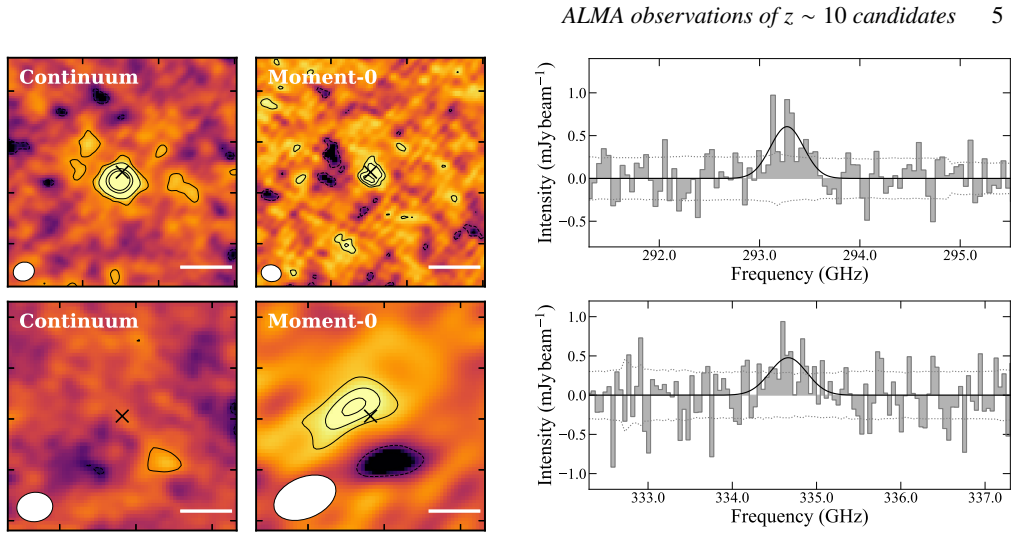
- [Section 3.2.1 and 3.3; Eq. (1)] The identification of the 293.27 GHz line as CO(J=9-8) rests entirely on the unpublished JWST/NIRSpec redshift of z=2.54 (R. Larson et al., in prep.). The ALMA data alone are marginal: peak S/N of 4.46, line-flux S/N of ~2.9, a 0.16 arcsec offset versus the expected 0.10 arcsec astrometric accuracy, and a 4.5% false-positive probability from the clump search in Appendix B. Without the NIRSpec data, the line could be a noise fluctuation or a different transition. The manuscript should include the NIRSpec redshift information (line list, signal-to-noise, or spectrum) or, failing that, explicitly state that the CO(9-8) identification and all derived quantities (L'_CO, L_FIR-based ULIRG classification, position on the L_FIR-L'_CO diagram) are tentative pending publication of the NIRSpec results.
- [Table 1 and Section 3.3] The ULIRG classification is not robust against the uncorrected magnification factor mu=1.35 listed in Table 1. The paper quotes L_FIR=1.1e12 L_sun with mu uncorrected; dividing by mu=1.35 gives about 0.8e12 L_sun, below the conventional 1e12 L_sun ULIRG threshold. Moreover, the reported 1-sigma range (L_FIR=1.1+1.0-0.3 x 10^12 L_sun) already extends below 1e12 L_sun. The authors should either correct the luminosities for magnification (quantifying the uncertainty in mu) or restate the ULIRG classification as conditional on mu<1.35, and should adjust the abstract and conclusion accordingly.
- [Section 3.3, after Eq. (1)] The quoted CO line luminosity, L'_CO(J=9-8) = 1.53 ± 0.54 K km s^-1 pc^2, is missing a factor of 10^9. Using Eq. (1) with the listed line flux (0.397 Jy km/s), D_L at z=2.536, and nu_obs=293.27 GHz gives L'_CO ~ 1.5e9 K km s^-1 pc^2, consistent with the axis range in Figure 3. The text should read (1.53 ± 0.54) x 10^9 K km s^-1 pc^2. This is a numerical error in the central measurement of the paper and must be corrected.
- [Section 3.3, dust temperature and beta] The L_FIR estimate is derived from a single continuum measurement with a fixed emissivity index beta=2.0 and a dust temperature assigned from the Sommovigo et al. (2022) relation with a uniform metallicity prior of Z=0-2 Z_sun. The resulting L_FIR has an asymmetry (1.1+1.0-0.3 x 10^12 L_sun) that spans below the ULIRG threshold even before magnification correction, and the central value is largely set by the assumed T_d. The authors should discuss the sensitivity of the ULIRG classification to the choice of beta and to the T_d relation, and ideally provide a table of L_FIR for a grid of T_d and beta values.
minor comments (4)
- [Section 3.2.2 vs Table 4] The line properties for COSMOS-z10-2 are inconsistent between the text and Table 4: the text gives line flux 0.475±0.169 Jy km/s, central frequency 334.66±0.07 GHz, and FWHM 463.06±73.77 km/s, while Table 4 lists 0.439±0.157 Jy km/s, 334.67±0.06 GHz, and 415.42±63.16 km/s. Please reconcile these values.
- [Section 5.2.1] The purity estimates of ~45% and ~75% are quoted without the number of galaxies in the respective redshift bins. Since the underlying JADES/CANUCS sample is incomplete and may be biased toward strong breaks, it would be helpful to state the sample sizes (N_z>8.5 and N_interloper) and the exact cuts used (including S/N_F090W<2 and S/N_F150W>5) so that readers can assess the statistical weight of the proposed F115W-F150W>1.0 threshold.
- [Appendix B] The false-positive probability for UDS_18697 uses the number of clumps on the inverted map (N_neg) as the background estimate, but N_pos and N_neg differ by a factor of about 2.5 in the 1-arcsec aperture. The authors note this may be statistical fluctuation, but a bootstrap or Monte Carlo estimate of the false-positive rate would be more robust; currently the 4.5% probability is tied to a single noisy measurement of N_neg.
- [Section 3.2.1] The statement that the line is 'co-spatial with the position of UDS_18697' is in tension with the reported 0.16 arcsec offset, which is larger than the expected 0.10 arcsec astrometric accuracy. Please clarify the positional tolerance used in this assessment.
Circularity Check
No circularity found: empirical inputs (ALMA line/continuum, JWST photometry, JADES/CANUCS spectra) are independent, with no fitted parameter renamed as a prediction.
full rationale
The paper is an empirical observational study. The central claims are: (1) UDS_18697 hosts a CO(J=9-8) line at z~2.54; (2) it is a ULIRG with L_FIR~1.1e12 L_sun; and (3) a brighter Lyman-break colour threshold improves z>8.5 sample purity. None of these claims reduces to its own input. The CO(J=9-8) assignment uses the ALMA line frequency (293.27 GHz) combined with the external JWST/NIRSpec redshift z=2.54 from R. Larson et al. in prep.; the redshift is not derived from the ALMA line, and the ALMA line is not fitted to the redshift. L'_CO is computed directly from the measured line flux via the standard Solomon et al. (1992) formula. L_FIR is computed from the measured 30-sigma continuum plus a dust temperature T_d=42.8 K obtained from the published Sommovigo et al. (2022) relation with fixed beta=2.0; T_d is not fit to this target's SED, and the luminosity is not adjusted to force any correlation. The L_FIR versus L'_CO(9-8) comparison uses independent literature samples (Rosenberg et al. 2015; Liu et al. 2015; Riechers et al. 2021; Butler et al. 2023), so that statement is not circular. The photometric-redshift revisit uses JWST/NIRCam photometry from the ASTRODEEP-JWST catalogue and bagpipes fitting, independently of the ALMA data. The colour-selection purity analysis is based on independent JADES and CANUCS spectroscopic catalogues, not on the paper's own targets; the estimated purity increase from ~45% to ~75% when raising F115W-F150W from 0.5 to 1.0 is therefore an empirical benchmark test, not a construction. The only caveat is that the NIRSpec redshift anchoring the CO identification is cited as in-preparation work by co-authors and is not shown; this is a verifiability gap, not circularity, because the spectrum is an external observation that does not depend on the ALMA measurements or on any parameter fitted in this paper. No equation in the paper is equivalent by construction to its inputs, and no fitted parameter is relabelled as a prediction. Score 0 is therefore appropriate.
Assumptions & free parameters
free parameters (4)
- Dust temperature T_d =
42.8 +8.7 -3.5 K
- Emissivity index beta =
2.0
- Metallicity prior Z =
random uniform in 0-2 Zsun
- Magnification factor mu =
1.35
assumptions (4)
- standard math Flat Lambda-CDM cosmology with Omega_M=0.310 and H0=67.7 km/s/Mpc (Planck 2020)
- domain assumption Calzetti et al. (2000) dust attenuation law and delayed-tau star formation history in SED fitting
- domain assumption Single-temperature modified blackbody with beta=2.0 represents the FIR SED
- domain assumption The JADES/CANUCS spectroscopic sample is representative enough to measure purity fractions
Cite this review
Pith. "Pith review of ALMA observations of pre-JWST z ~ 10 galaxy candidates: A CO(J = 9-8) line from a ULIRG at z = 2.54 and revisit of the photometric redshifts with JWST photometry." pith.science (2026). https://pith.science/paper/ILWRP3UT
@misc{pith2026260812708,
  author       = {Pith},
  title        = {Pith review of: ALMA observations of pre-JWST z ~ 10 galaxy candidates: A CO(J = 9-8) line from a ULIRG at z = 2.54 and revisit of the photometric redshifts with JWST photometry},
  year         = {2026},
  howpublished = {\url{https://pith.science/paper/ILWRP3UT}},
  note         = {Machine review of arXiv:2608.12708}
}
abstract
We present Atacama Large Millimetre/submillimetre Array (ALMA) observations targeting the [OIII]$88\,\mu$m line for six $z\sim10$ galaxy candidates selected with the Hubble Space Telescope and the Spitzer Space Telescope. We detect a line ($4.5\sigma$) and dust continuum emission ($30\sigma$) in UDS_18697, while detecting neither robust line nor continuum emission in the remaining five objects. The detected line in UDS_18697 is identified as CO($J=9-8$), because follow-up James Webb Space Telescope (JWST) NIRSpec observations have confirmed the redshift as $z=2.54$. UDS_18697 is classified as an ultra luminous infrared galaxy (ULIRG) with far-infrared (FIR) luminosity of $L_\mathrm{FIR}\approx1.1\times10^{12}\,L_\odot$, assuming a dust temperature of $T_\mathrm{d}\approx42\,$K, estimated using a physically-motivated method. We find that UDS_18697 follows the $L_\mathrm{FIR}-L'_\mathrm{CO}$ relation for local and $z>2$ galaxies, albeit being slightly brighter in CO($J=9-8$). Also, based on the follow-up NIRSpec observations and spectral energy distribution fitting using JWST/NIRCam photometry, we found that most of our targets are suggested to be low-$z$ interlopers. Motivated by these redshift misclassifications, we investigate colour--colour selection criteria for high-$z$ galaxies using JWST spectroscopic survey catalogues. We find that elevating a colour threshold tracing the Lyman break is crucial for constructing a robust high-$z$ sample, particularly for wide field surveys such as Euclid Deep Fields and Roman High-Latitude Wide-Area Survey.
Figures


Figures from the paper (1 more)

Reference graph
Works this paper leans on
-
[1]
Detection of [O III] _ 88 m in JADES-GS-z14-0 at z = 14.1793. , keywords =. doi:10.3847/1538-4357/adbf1b , archivePrefix =. 2409.20549 , primaryClass =
-
[2]
JWST, ALMA, and Keck Spectroscopic Constraints on the UV Luminosity Functions at z 7 14: Clumpiness and Compactness of the Brightest Galaxies in the Early Universe. , keywords =. doi:10.3847/1538-4357/ad9b2c , archivePrefix =. 2406.18352 , primaryClass =
-
[3]
ASTRODEEP-JWST: NIRCam-HST multi-band photometry and redshifts for half a million sources in six extragalactic deep fields. , keywords =. doi:10.1051/0004-6361/202451409 , archivePrefix =. 2409.00169 , primaryClass =
-
[4]
JWST/NIRSpec spectroscopy of intermediate-mass quiescent galaxies at z 3-4. , keywords =. doi:10.1093/mnras/stae2300 , archivePrefix =. 2410.08745 , primaryClass =
-
[5]
A Search for H-Dropout Lyman Break Galaxies at z 12-16. , keywords =. doi:10.3847/1538-4357/ac53a9 , archivePrefix =. 2112.09141 , primaryClass =
-
[6]
COSMOS2020: A Panchromatic View of the Universe to z 10 from Two Complementary Catalogs. , keywords =. doi:10.3847/1538-4365/ac3078 , archivePrefix =. 2110.13923 , primaryClass =
-
[7]
Planck 2018 results. VI. Cosmological parameters. , keywords =. doi:10.1051/0004-6361/201833910 , archivePrefix =. 1807.06209 , primaryClass =
arXiv 2018
-
[8]
Big Three Dragons: A z = 7.15 Lyman-break galaxy detected in [O III] 88 m, [C II] 158 m, and dust continuum with ALMA. , keywords =. doi:10.1093/pasj/psz049 , archivePrefix =. 1806.00486 , primaryClass =
Show all 140 references
-
[9]
, keywords =
The Bright-end Galaxy Candidates at z 9 from 79 Independent HST Fields. , keywords =. doi:10.3847/1538-4357/aae68c , archivePrefix =. 1809.07604 , primaryClass =
-
[10]
, keywords =
Inferring the star formation histories of massive quiescent galaxies with BAGPIPES: evidence for multiple quenching mechanisms. , keywords =. doi:10.1093/mnras/sty2169 , archivePrefix =. 1712.04452 , primaryClass =
-
[11]
, keywords =
Dust in the Reionization Era: ALMA Observations of a z = 8.38 Gravitationally Lensed Galaxy. , keywords =. doi:10.3847/2041-8213/aa62aa , archivePrefix =. 1703.02039 , primaryClass =
-
[12]
Science , keywords =
Detection of an oxygen emission line from a high-redshift galaxy in the reionization epoch. Science , keywords =. doi:10.1126/science.aaf0714 , archivePrefix =. 1606.04989 , primaryClass =
-
[13]
, keywords =
EAZY: A Fast, Public Photometric Redshift Code. , keywords =. doi:10.1086/591786 , archivePrefix =. 0807.1533 , primaryClass =
-
[14]
Astronomical Data Analysis Software and Systems XVI , year = 2007, editor =
CASA Architecture and Applications. Astronomical Data Analysis Software and Systems XVI , year = 2007, editor =
2007
-
[15]
, keywords =
The Dust Content and Opacity of Actively Star-forming Galaxies. , keywords =. doi:10.1086/308692 , archivePrefix =. astro-ph/9911459 , primaryClass =
-
[16]
, keywords =
Secondary standard stars for absolute spectrophotometry. , keywords =. doi:10.1086/160817 , adsurl =
-
[17]
, keywords =
A Census of the Bright z = 8.5-11 Universe with the Hubble and Spitzer Space Telescopes in the CANDELS Fields. , keywords =. doi:10.3847/1538-4357/ac3aed , archivePrefix =. 2106.13813 , primaryClass =
-
[18]
, keywords =
The eventful life of a luminous galaxy at z = 14: metal enrichment, feedback, and low gas fraction?. , keywords =. doi:10.1051/0004-6361/202452451 , archivePrefix =. 2409.20533 , primaryClass =
-
[19]
, keywords =
The Bright End of the z 9 and z 10 UV Luminosity Functions Using All Five CANDELS Fields*. , keywords =. doi:10.3847/0004-637X/830/2/67 , archivePrefix =. 1506.01035 , primaryClass =
-
[20]
, keywords =
JADES Data Release 3: NIRSpec/Microshutter Assembly Spectroscopy for 4000 Galaxies in the GOODS Fields. , keywords =. doi:10.3847/1538-4365/ada148 , archivePrefix =. 2404.06531 , primaryClass =
-
[21]
, keywords =
JADES NIRSpec initial data release for the Hubble Ultra Deep Field: Redshifts and line fluxes of distant galaxies from the deepest JWST Cycle 1 NIRSpec multi-object spectroscopy. , keywords =. doi:10.1051/0004-6361/202347094 , archivePrefix =. 2306.02467 , primaryClass =
- [22]
-
[23]
, keywords =
The Cosmos in Its Infancy: JADES Galaxy Candidates at z > 8 in GOODS-S and GOODS-N. , keywords =. doi:10.3847/1538-4357/ad1ee4 , archivePrefix =. 2306.02468 , primaryClass =
- [24]
-
[25]
, keywords =
Confirmation and refutation of very luminous galaxies in the early Universe. , keywords =. doi:10.1038/s41586-023-06521-7 , archivePrefix =. 2303.15431 , primaryClass =
-
[26]
CEERS Key Paper. I. An Early Look into the First 500 Myr of Galaxy Formation with JWST. , keywords =. doi:10.3847/2041-8213/acade4 , archivePrefix =. 2211.05792 , primaryClass =
-
[27]
, keywords =
The evolution of the galaxy UV luminosity function at redshifts z ≃ 8 - 15 from deep JWST and ground-based near-infrared imaging. , keywords =. doi:10.1093/mnras/stac3472 , archivePrefix =. 2207.12356 , primaryClass =
-
[28]
Nature Astronomy , keywords =
Photometric detection at 7.7 m of a galaxy beyond redshift 14 with JWST/MIRI. Nature Astronomy , keywords =. doi:10.1038/s41550-025-02503-z , archivePrefix =. 2405.18462 , primaryClass =
-
[29]
, keywords =
Spectroscopic confirmation of two luminous galaxies at a redshift of 14. , keywords =. doi:10.1038/s41586-024-07860-9 , archivePrefix =. 2405.18485 , primaryClass =
-
[30]
Nature Astronomy , keywords =
Identification and properties of intense star-forming galaxies at redshifts z > 10. Nature Astronomy , keywords =. doi:10.1038/s41550-023-01921-1 , archivePrefix =. 2212.04480 , primaryClass =
-
[31]
Nature Astronomy , keywords =
Spectroscopic confirmation of four metal-poor galaxies at z = 10.3-13.2. Nature Astronomy , keywords =. doi:10.1038/s41550-023-01918-w , archivePrefix =. 2212.04568 , primaryClass =
-
[32]
, keywords =
Seven wonders of Cosmic Dawn: JWST confirms a high abundance of galaxies and AGN at z ≃ 9 11 in the GLASS field. , keywords =. doi:10.1051/0004-6361/202452090 , archivePrefix =. 2410.10967 , primaryClass =
-
[33]
, keywords =
Two Remarkably Luminous Galaxy Candidates at z 10-12 Revealed by JWST. , keywords =. doi:10.3847/2041-8213/ac9b22 , archivePrefix =. 2207.09434 , primaryClass =
-
[34]
Early Results from GLASS-JWST. XIX. A High Density of Bright Galaxies at z 10 in the A2744 Region. , keywords =. doi:10.3847/2041-8213/accea5 , archivePrefix =. 2212.06666 , primaryClass =
-
[35]
, keywords =
JADES Imaging of GN-z11: Revealing the Morphology and Environment of a Luminous Galaxy 430 Myr after the Big Bang. , keywords =. doi:10.3847/1538-4357/acdbc6 , archivePrefix =. 2302.07234 , primaryClass =
-
[36]
, keywords =
JWST NIRSpec Spectroscopy of the Remarkable Bright Galaxy GHZ2/GLASS-z12 at Redshift 12.34. , keywords =. doi:10.3847/1538-4357/ad5f88 , archivePrefix =. 2403.10238 , primaryClass =
-
[37]
arXiv e-prints , keywords =
On the origins of oxygen: ALMA and JWST characterise the multi-phase, metal-enriched, star-bursting medium within a 'normal' z > 11 galaxy. arXiv e-prints , keywords =. doi:10.48550/arXiv.2507.22888 , archivePrefix =. 2507.22888 , primaryClass =
-
[38]
, keywords =
ALMA Detection of [O III] 88 m at z = 12.33: Exploring the Nature and Evolution of GHZ2 as a Massive Compact Stellar System. , keywords =. doi:10.3847/2041-8213/ad8f38 , archivePrefix =. 2411.03593 , primaryClass =
-
[39]
, keywords =
JADES Initial Data Release for the Hubble Ultra Deep Field: Revealing the Faint Infrared Sky with Deep JWST NIRCam Imaging. , keywords =. doi:10.3847/1538-4365/acf44d , archivePrefix =. 2306.02466 , primaryClass =
-
[40]
arXiv e-prints , keywords =
Pushing JWST to the extremes: search and scrutiny of bright galaxy candidates at z 15-30. arXiv e-prints , keywords =. doi:10.48550/arXiv.2504.05893 , archivePrefix =. 2504.05893 , primaryClass =
-
[41]
Euclid preparation. XXI. Intermediate-redshift contaminants in the search for z > 6 galaxies within the Euclid Deep Survey. , keywords =. doi:10.1051/0004-6361/202243950 , archivePrefix =. 2205.02871 , primaryClass =
-
[42]
, keywords =
High-J CO versus Far-infrared Relations in Normal and Starburst Galaxies. , keywords =. doi:10.1088/2041-8205/810/2/L14 , archivePrefix =. 1504.05897 , primaryClass =
-
[43]
, keywords =
Neutral outflows in high-z QSOs. , keywords =. doi:10.1051/0004-6361/202346271 , archivePrefix =. 2305.04098 , primaryClass =
-
[44]
, keywords =
Do Unusually Cold Starburst Galaxies Exist? A Case Study. , keywords =. doi:10.3847/1538-4357/ada4ac , archivePrefix =. 2401.05487 , primaryClass =
-
[45]
, keywords =
Warm Molecular Gas in the Primeval Galaxy IRAS 10214+4724. , keywords =. doi:10.1086/186569 , adsurl =
-
[46]
, keywords =
The GADOT Galaxy Survey: Dense Gas and Feedback in Herschel-selected Starburst Galaxies at Redshifts 2 to 6. , keywords =. doi:10.3847/1538-4357/abf6d7 , archivePrefix =. 2101.11006 , primaryClass =
-
[47]
, keywords =
The Herschel Comprehensive (U)LIRG Emission Survey (HERCULES): CO Ladders, Fine Structure Lines, and Neutral Gas Cooling. , keywords =. doi:10.1088/0004-637X/801/2/72 , archivePrefix =. 1501.02985 , primaryClass =
-
[48]
, keywords =
Planck's dusty GEMS: The brightest gravitationally lensed galaxies discovered with the Planck all-sky survey. , keywords =. doi:10.1051/0004-6361/201425128 , archivePrefix =. 1506.01962 , primaryClass =
-
[49]
Planck's dusty GEMS. VI. Multi-J CO excitation and interstellar medium conditions in dusty starburst galaxies at z = 2-4. , keywords =. doi:10.1051/0004-6361/201833625 , archivePrefix =. 1811.11215 , primaryClass =
-
[50]
, keywords =
The ALMA REBELS Survey: cosmic dust temperature evolution out to z 7. , keywords =. doi:10.1093/mnras/stac302 , archivePrefix =. 2202.01227 , primaryClass =
-
[51]
, keywords =
Dusty Starbursts Masquerading as Ultra-high Redshift Galaxies in JWST CEERS Observations. , keywords =. doi:10.3847/2041-8213/acacfe , archivePrefix =. 2208.01816 , primaryClass =
-
[52]
, keywords =
Earliest Galaxy Evolution in the CANUCS+Technicolor Fields: Galaxy Properties at z 10─16 Seen with the Full NIRCam Medium- and Broadband Filters. , keywords =. doi:10.3847/1538-4357/ae1f8d , archivePrefix =. 2507.03124 , primaryClass =
-
[53]
, year = 2016, month = sep, volume =
Galaxies in the First Billion Years After the Big Bang. , year = 2016, month = sep, volume =. doi:10.1146/annurev-astro-081915-023417 , adsurl =
2016 doi
-
[54]
, keywords =
The First Systematic Survey for Ly Emitters at z = 7.3 with Red-sensitive Subaru/Suprime-Cam. , keywords =. doi:10.1088/0004-637X/752/2/114 , archivePrefix =. 1112.3997 , primaryClass =
-
[55]
, keywords =
Cold dust and low [O III]/[C II] ratios: an evolved star-forming population at redshift 7. , keywords =. doi:10.1093/mnras/stad3111 , archivePrefix =. 2301.09659 , primaryClass =
-
[56]
arXiv e-prints , keywords =
REBELS-IFU: on the origin of the elevated [OIII]/[CII] ratios in the early Universe. arXiv e-prints , keywords =. doi:10.48550/arXiv.2509.16071 , archivePrefix =. 2509.16071 , primaryClass =
-
[57]
, keywords =
ALMA Will Determine the Spectroscopic Redshift z > 8 with FIR [O III] Emission Lines. , keywords =. doi:10.1088/2041-8205/780/2/L18 , archivePrefix =. 1312.0684 , primaryClass =
-
[58]
, keywords =
Detection of the Far-infrared [O III] and Dust Emission in a Galaxy at Redshift 8.312: Early Metal Enrichment in the Heart of the Reionization Era. , keywords =. doi:10.3847/1538-4357/ab0374 , archivePrefix =. 1806.04132 , primaryClass =
-
[59]
, keywords =
The onset of star formation 250 million years after the Big Bang. , keywords =. doi:10.1038/s41586-018-0117-z , archivePrefix =. 1805.05966 , primaryClass =
-
[60]
Deep Imaging of redshift QSO Fields Below the Lyman Limit. I. The Field of Q0000-263 and galaxies at Z= 3.4. , keywords =. doi:10.1086/116287 , adsurl =
-
[61]
, keywords =
Unveiling the nature of bright z ≃ 7 galaxies with the Hubble Space Telescope. , keywords =. doi:10.1093/mnras/stw3296 , archivePrefix =. 1605.05325 , primaryClass =
-
[62]
, keywords =
Euclid: Early Release Observations NISP-only sources and the search for luminous z = 6 8 galaxies. , keywords =. doi:10.1051/0004-6361/202450794 , archivePrefix =. 2405.13505 , primaryClass =
-
[63]
, keywords =
Radiative equilibrium estimates of dust temperature and mass in high-redshift galaxies. , keywords =. doi:10.1093/mnras/staa1203 , archivePrefix =. 2004.12612 , primaryClass =
2004 arXiv
-
[64]
, keywords =
Star Formation at the Epoch of Reionization with CANUCS: The Ages of Stellar Populations in MACS1149-JD1. , keywords =. doi:10.3847/2041-8213/ad0e73 , archivePrefix =. 2308.13288 , primaryClass =
-
[65]
Early Results from GLASS-JWST. III. Galaxy Candidates at z 9-15. , keywords =. doi:10.3847/2041-8213/ac94d0 , archivePrefix =. 2207.09436 , primaryClass =
-
[66]
, keywords =
Discovery and properties of ultra-high redshift galaxies (9 < z < 12) in the JWST ERO SMACS 0723 Field. , keywords =. doi:10.1093/mnras/stac3347 , archivePrefix =. 2207.11217 , primaryClass =
-
[67]
, keywords =
Revealing galaxy candidates out to z 16 with JWST observations of the lensing cluster SMACS0723. , keywords =. doi:10.1093/mnras/stac3144 , archivePrefix =. 2207.12338 , primaryClass =
-
[68]
, keywords =
A Long Time Ago in a Galaxy Far, Far Away: A Candidate z 12 Galaxy in Early JWST CEERS Imaging. , keywords =. doi:10.3847/2041-8213/ac966e , archivePrefix =. 2207.12474 , primaryClass =
- [69]
-
[70]
, keywords =
JWST unveils heavily obscured (active and passive) sources up to z 13. , keywords =. doi:10.1093/mnrasl/slac115 , archivePrefix =. 2208.02825 , primaryClass =
-
[71]
, keywords =
New Determinations of the UV Luminosity Functions from z 9 to 2 Show a Remarkable Consistency with Halo Growth and a Constant Star Formation Efficiency. , keywords =. doi:10.3847/1538-3881/abf83e , archivePrefix =. 2102.07775 , primaryClass =
-
[72]
, keywords =
Hubble Frontier Fields First Complete Cluster Data: Faint Galaxies at z -0.5ex 5-10 for UV Luminosity Functions and Cosmic Reionization. , keywords =. doi:10.1088/0004-637X/799/1/12 , archivePrefix =. 1408.6903 , primaryClass =
-
[73]
, keywords =
Precise Strong Lensing Mass Modeling of Four Hubble Frontier Field Clusters and a Sample of Magnified High-redshift Galaxies. , keywords =. doi:10.3847/0004-637X/819/2/114 , archivePrefix =. 1510.06400 , primaryClass =
-
[74]
, keywords =
A magnified young galaxy from about 500 million years after the Big Bang. , keywords =. doi:10.1038/nature11446 , archivePrefix =. 1204.2305 , primaryClass =
-
[75]
, keywords =
The Rise of the Galactic Empire: Ultraviolet Luminosity Functions at z 17 and z 25 Estimated with the MIDIS+NGDEEP Ultra-deep JWST/NIRCam Data Set. , keywords =. doi:10.3847/1538-4357/adf8c9 , archivePrefix =. 2503.15594 , primaryClass =
-
[76]
, keywords =
First Batch of z 11-20 Candidate Objects Revealed by the James Webb Space Telescope Early Release Observations on SMACS 0723-73. , keywords =. doi:10.3847/2041-8213/aca80c , archivePrefix =. 2207.11558 , primaryClass =
-
[77]
, keywords =
A Steep Decline in the Galaxy Space Density beyond Redshift 9 in the CANUCS UV Luminosity Function. , keywords =. doi:10.3847/1538-4357/ad35bc , archivePrefix =. 2311.12234 , primaryClass =
-
[78]
, keywords =
A Remarkably Luminous Galaxy at z=11.1 Measured with Hubble Space Telescope Grism Spectroscopy. , keywords =. doi:10.3847/0004-637X/819/2/129 , archivePrefix =. 1603.00461 , primaryClass =
-
[79]
, keywords =
The Most Luminous z -0.5ex 9-10 Galaxy Candidates Yet Found: The Luminosity Function, Cosmic Star-formation Rate, and the First Mass Density Estimate at 500 Myr. , keywords =. doi:10.1088/0004-637X/786/2/108 , archivePrefix =. 1309.2280 , primaryClass =
-
[80]
, keywords =
JADES NIRSpec Spectroscopy of GN-z11: Lyman- emission and possible enhanced nitrogen abundance in a z = 10.60 luminous galaxy. , keywords =. doi:10.1051/0004-6361/202346159 , archivePrefix =. 2302.07256 , primaryClass =
-
[81]
, keywords =
Spectroscopic Confirmation of Two Lyman Break Galaxies at Redshift Beyond 7. , keywords =. doi:10.1088/2041-8205/730/2/L35 , archivePrefix =. 1011.5500 , primaryClass =
-
[82]
, keywords =
Lyman Emission from a Luminous z = 8.68 Galaxy: Implications for Galaxies as Tracers of Cosmic Reionization. , keywords =. doi:10.1088/2041-8205/810/1/L12 , archivePrefix =. 1507.02679 , primaryClass =
-
[83]
, keywords =
UV Luminosity Functions at Redshifts z 4 to z 10: 10,000 Galaxies from HST Legacy Fields. , keywords =. doi:10.1088/0004-637X/803/1/34 , archivePrefix =. 1403.4295 , primaryClass =
-
[84]
, keywords =
The Luminosity Function at z -0.5ex 8 from 97 Y-band Dropouts: Inferences about Reionization. , keywords =. doi:10.1088/0004-637X/786/1/57 , archivePrefix =. 1402.4129 , primaryClass =
-
[85]
, keywords =
The impact of medium-width bands on the selection and subsequent luminosity function measurements of high-z galaxies. , keywords =. doi:10.1093/mnras/staf1153 , archivePrefix =. 2502.10282 , primaryClass =
-
[86]
GOLDRUSH. II. Clustering of galaxies at z 4-6 revealed with the half-million dropouts over the 100 deg ^ 2 area corresponding to 1 Gpc ^ 3. , keywords =. doi:10.1093/pasj/psx097 , archivePrefix =. 1704.06535 , primaryClass =
-
[87]
Great Optically Luminous Dropout Research Using Subaru HSC (GOLDRUSH). I. UV luminosity functions at z 4-7 derived with the half-million dropouts on the 100 deg ^ 2 sky. , keywords =. doi:10.1093/pasj/psx103 , archivePrefix =. 1704.06004 , primaryClass =
-
[88]
Subaru Deep Survey. V. A Census of Lyman Break Galaxies at z -0.5ex =4 and 5 in the Subaru Deep Fields: Photometric Properties. , keywords =. doi:10.1086/422207 , archivePrefix =. astro-ph/0309655 , primaryClass =
-
[89]
, keywords =
RELICS: A Candidate z 10 Galaxy Strongly Lensed into a Spatially Resolved Arc. , keywords =. doi:10.3847/2041-8213/aadc10 , archivePrefix =. 1801.03103 , primaryClass =
-
[90]
, keywords =
The Dearth of z 10 Galaxies in All HST Legacy Fields The Rapid Evolution of the Galaxy Population in the First 500 Myr. , keywords =. doi:10.3847/1538-4357/aab03f , archivePrefix =. 1710.11131 , primaryClass =
-
[91]
, keywords =
The Brightest z 8 Galaxies over the COSMOS UltraVISTA Field. , keywords =. doi:10.3847/1538-4357/ab3792 , archivePrefix =. 1902.10713 , primaryClass =
1902 arXiv
-
[92]
, keywords =
Frontier Fields: Combining HST, VLT, and Spitzer data to explore the z -0.5ex 8 Universe behind the lensing cluster MACSJ0416.1-2403. , keywords =. doi:10.1051/0004-6361/201425040 , archivePrefix =. 1412.1089 , primaryClass =
-
[93]
, keywords =
The Super Eight Galaxies: Properties of a Sample of Very Bright Galaxies at 7 < z < 8. , keywords =. doi:10.3847/1538-4357/ab3213 , archivePrefix =. 1907.05512 , primaryClass =
1907 arXiv
-
[94]
, keywords =
Large Population of ALMA Galaxies at z > 6 with Very High [O III] 88 m to [C II] 158 m Flux Ratios: Evidence of Extremely High Ionization Parameter or PDR Deficit?. , keywords =. doi:10.3847/1538-4357/ab94bd , archivePrefix =. 1910.10927 , primaryClass =
-
[95]
, keywords =
Extended ionised and clumpy gas in a normal galaxy at z = 7.1 revealed by ALMA. , keywords =. doi:10.1051/0004-6361/201630366 , archivePrefix =. 1701.03468 , primaryClass =
-
[96]
, keywords =
Galaxy growth in a massive halo in the first billion years of cosmic history. , keywords =. doi:10.1038/nature24629 , archivePrefix =. 1712.03020 , primaryClass =
-
[97]
, keywords =
Detections of [O III] 88 m in two quasars in the reionization epoch. , keywords =. doi:10.1093/pasj/psz094 , archivePrefix =. 1811.00030 , primaryClass =
-
[98]
, keywords =
Updated Measurements of [O III] 88 m, [C II] 158 m, and Dust Continuum Emission from a z = 7.2 Galaxy. , keywords =. doi:10.3847/1538-4357/acb8ab , archivePrefix =. 2302.02365 , primaryClass =
-
[99]
, keywords =
Dual constraints with ALMA: new [O III] 88- m and dust-continuum observations reveal the ISM conditions of luminous LBGs at z 7. , keywords =. doi:10.1093/mnras/stac1905 , archivePrefix =. 2207.00022 , primaryClass =
-
[100]
, keywords =
ALMA Detections of [O III] and [C II] Emission Lines From A1689-zD1 at z = 7.13. , keywords =. doi:10.3847/1538-4357/ac5cc7 , adsurl =
-
[101]
, keywords =
The Infrared Array Camera (IRAC) for the Spitzer Space Telescope. , keywords =. doi:10.1086/422843 , archivePrefix =. astro-ph/0405616 , primaryClass =
-
[102]
, keywords =
The Science Performance of JWST as Characterized in Commissioning. , keywords =. doi:10.1088/1538-3873/acb293 , archivePrefix =. 2207.05632 , primaryClass =
-
[103]
, keywords =
The UNCOVER Survey: A First-look HST + JWST Catalog of 60,000 Galaxies near A2744 and beyond. , keywords =. doi:10.3847/1538-4365/ad07e0 , archivePrefix =. 2301.02671 , primaryClass =
-
[104]
, keywords =
Life beyond 30: Probing the -20 < M _ UV < -17 Luminosity Function at 8 < z < 13 with the NIRCam Parallel Field of the MIRI Deep Survey. , keywords =. doi:10.3847/2041-8213/acd9d0 , archivePrefix =. 2302.02429 , primaryClass =
-
[105]
GOLDRUSH. IV. Luminosity Functions and Clustering Revealed with 4,000,000 Galaxies at z 2-7: Galaxy-AGN Transition, Star Formation Efficiency, and Implication for Evolution at z > 10. , keywords =. doi:10.3847/1538-4365/ac3dfc , archivePrefix =. 2108.01090 , primaryClass =
-
[106]
, keywords =
A Comprehensive Study of Galaxies at z 9-16 Found in the Early JWST Data: Ultraviolet Luminosity Functions and Cosmic Star Formation History at the Pre-reionization Epoch. , keywords =. doi:10.3847/1538-4365/acaaa9 , archivePrefix =. 2208.01612 , primaryClass =
-
[107]
arXiv e-prints , keywords =
Highly-ionized gas in lensed z = 6.027 Little Red Dot seen through [OIII] 88 μ m with ALMA. arXiv e-prints , keywords =. doi:10.48550/arXiv.2512.05097 , archivePrefix =. 2512.05097 , primaryClass =
-
[108]
, keywords =
A lack of evolution in the very bright end of the galaxy luminosity function from z ≃ 8 to 10. , keywords =. doi:10.1093/mnras/staa313 , archivePrefix =. 1911.12832 , primaryClass =
1911 arXiv
-
[109]
The Near-infrared Imager and Slitless Spectrograph for the James Webb Space Telescope. II. Wide Field Slitless Spectroscopy. , keywords =. doi:10.1088/1538-3873/ac5158 , archivePrefix =. 2202.01714 , primaryClass =
- [110]
-
[111]
arXiv e-prints , keywords =
Euclid Quick Data Release (Q1): Hunting for luminous z > 6 galaxies in the Euclid Deep Fields -- forecasts and first bright detections. arXiv e-prints , keywords =. doi:10.48550/arXiv.2511.02926 , archivePrefix =. 2511.02926 , primaryClass =
-
[112]
arXiv e-prints , keywords =
Roman Observations Time Allocation Committee: Final Report and Recommendations. arXiv e-prints , keywords =. doi:10.48550/arXiv.2505.10574 , archivePrefix =. 2505.10574 , primaryClass =
-
[113]
, keywords =
Physical Characterization of Early Galaxies in the Webb's First Deep Field SMACS J0723.3-7323. , keywords =. doi:10.3847/2041-8213/acbf50 , archivePrefix =. 2207.11671 , primaryClass =
-
[114]
, keywords =
Pure Spectroscopic Constraints on UV Luminosity Functions and Cosmic Star Formation History from 25 Galaxies at z _ spec = 8.61-13.20 Confirmed with JWST/NIRSpec. , keywords =. doi:10.3847/1538-4357/ad0b7e , archivePrefix =. 2304.06658 , primaryClass =
-
[115]
, keywords =
UNCOVER: A NIRSpec Census of Lensed Galaxies at z = 8.50 13.08 Probing a High-AGN Fraction and Ionized Bubbles in the Shadow. , keywords =. doi:10.3847/1538-4357/ad9027 , archivePrefix =. 2308.11609 , primaryClass =
-
[116]
, keywords =
JWST UNCOVER: discovery of z > 9 galaxy candidates behind the lensing cluster Abell 2744. , keywords =. doi:10.1093/mnras/stad1998 , archivePrefix =. 2305.01793 , primaryClass =
-
[117]
, keywords =
The Evolution of the Galaxy Rest-frame Ultraviolet Luminosity Function over the First Two Billion Years. , keywords =. doi:10.1088/0004-637X/810/1/71 , archivePrefix =. 1410.5439 , primaryClass =
-
[118]
arXiv e-prints , keywords =
COSMOS2025: The COSMOS-Web galaxy catalog of photometry, morphology, redshifts, and physical parameters from JWST, HST, and ground-based imaging. arXiv e-prints , keywords =. doi:10.48550/arXiv.2506.03243 , archivePrefix =. 2506.03243 , primaryClass =
-
[119]
, keywords =
SExtractor: Software for source extraction. , keywords =. doi:10.1051/aas:1996164 , adsurl =
-
[120]
, keywords =
A-PHOT: a new, versatile code for precision aperture photometry. , keywords =. doi:10.1051/0004-6361/201833991 , archivePrefix =. 1812.00727 , primaryClass =
-
[121]
Early Results from GLASS-JWST. II. NIRCam Extragalactic Imaging and Photometric Catalog. , keywords =. doi:10.3847/2041-8213/ac8f93 , archivePrefix =. 2207.11701 , primaryClass =
-
[122]
Physics and Chemistry of Star Formation: The Dynamical ISM Across Time and Spatial Scales , year = 2023, editor =
The ALMA Wideband Sensitivity Upgrade. Physics and Chemistry of Star Formation: The Dynamical ISM Across Time and Spatial Scales , year = 2023, editor =. doi:10.48550/arXiv.2211.00195 , archivePrefix =. 2211.00195 , primaryClass =
-
[123]
, keywords =
Lyman Break Galaxies at Redshift z -0.5ex 3: Survey Description and Full Data Set. , keywords =. doi:10.1086/375772 , archivePrefix =. astro-ph/0305378 , primaryClass =
-
[124]
, keywords =
On the Effect of the Cosmic Microwave Background in High-redshift (Sub-)millimeter Observations. , keywords =. doi:10.1088/0004-637X/766/1/13 , archivePrefix =. 1302.0844 , primaryClass =
-
[125]
, keywords =
Templates for Fitting Photometry of Ultra-high-redshift Galaxies. , keywords =. doi:10.3847/2041-8213/acdef6 , archivePrefix =. 2208.07879 , primaryClass =
-
[126]
12.3, ver
ALMA Technical Handbook, ALMA Doc. 12.3, ver. 1.5
-
[127]
Overview of the Euclid mission
Euclid: I. Overview of the Euclid mission. , keywords =. doi:10.1051/0004-6361/202450810 , archivePrefix =. 2405.13491 , primaryClass =
- [128]
-
[129]
, keywords =
Estimating dust temperature and Far-IR luminosity of high-redshift galaxies using ALMA single-band continuum observations. , keywords =. doi:10.1093/mnras/stad743 , archivePrefix =. 2206.01879 , primaryClass =
-
[130]
Euclid preparation. XVII. Cosmic Dawn Survey: Spitzer Space Telescope observations of the Euclid deep fields and calibration fields. , keywords =. doi:10.1051/0004-6361/202142361 , archivePrefix =. 2110.13928 , primaryClass =
-
[131]
, keywords =
Newly Discovered Bright z 9-10 Galaxies and Improved Constraints on Their Prevalence Using the Full CANDELS Area. , keywords =. doi:10.3847/1538-4357/ab24c5 , archivePrefix =. 1905.05202 , primaryClass =
1905 arXiv
-
[132]
, keywords =
Dust temperature and mid-to-total infrared color distributions for star-forming galaxies at 0 < z < 4. , keywords =. doi:10.1051/0004-6361/201731506 , archivePrefix =. 1710.10276 , primaryClass =
-
[133]
, keywords =
The Complete Redshift Distribution of Dusty Star-forming Galaxies from the SPT-SZ Survey. , keywords =. doi:10.3847/1538-4357/abb599 , archivePrefix =. 2006.14060 , primaryClass =
2006 arXiv
-
[134]
, keywords =
The Astropy Project: Sustaining and Growing a Community-oriented Open-source Project and the Latest Major Release (v5.0) of the Core Package. , keywords =. doi:10.3847/1538-4357/ac7c74 , archivePrefix =. 2206.14220 , primaryClass =
-
[135]
and Robitaille, T
Bradley, Larry and Sipőcz, Brigitta M. and Robitaille, T. P. and Tollerud, E. J. and Vinícius, Zé and Deil, Christoph and Barbary, Kyle and Wilson, Tom J. and Busko, Ivo and Donath, Axel and Günther, Hans Moritz and Cara, Mihai and Lim, P. L. and Meßlinger, Sebastian and Conse...
-
[136]
ALMA High-J CO Spectroscopy of High-Redshift Galaxies. I. An Archive-based Catalog of CO Spectral Line Energy Distributions. arXiv e-prints , keywords =. doi:10.48550/arXiv.2602.23521 , archivePrefix =. 2602.23521 , primaryClass =
-
[137]
, keywords =
A Spatially Resolved Study of Cold Dust, Molecular Gas, H II Regions, and Stars in the z = 2.12 Submillimeter Galaxy ALESS67.1. , keywords =. doi:10.3847/1538-4357/aa863a , archivePrefix =. 1708.08937 , primaryClass =
-
[138]
, keywords =
Resolving the ISM at the Peak of Cosmic Star Formation with ALMA: The Distribution of CO and Dust Continuum in z 2.5 Submillimeter Galaxies. , keywords =. doi:10.3847/1538-4357/aacffa , archivePrefix =. 1804.06852 , primaryClass =
-
[139]
, keywords =
An ALMA Survey of Submillimeter Galaxies in the Extended Chandra Deep Field South: Near-infrared Morphologies and Stellar Sizes. , keywords =. doi:10.1088/0004-637X/799/2/194 , archivePrefix =. 1412.0668 , primaryClass =
-
[140]
, keywords =
ALESS-JWST: Joint (Sub)kiloparsec JWST and ALMA Imaging of z -0.5ex 3 Submillimeter Galaxies Reveals Heavily Obscured Bulge Formation Events. , keywords =. doi:10.3847/1538-4357/ad9a52 , archivePrefix =. 2407.15846 , primaryClass =
Reviewed August 16, 2026 · model on record in the stance chip above.
Discussion (0). Continue with ORCID to comment.