REVIEW 3 major objections 5 minor 60 references
AmalthAI: An Open-Source Computer Vision Platform for Cultural Heritage
T0 review · 3 major / 5 minor · reviewed 2026-08-14 · deepseek-v4-flash
Pith's one-line read Textile imprints on clay preserve visual features that trained classifiers can read, and a no-code platform lets archaeologists do the reading.
desk verdict AmalthAI is a genuine open-source platform contribution; the archaeological hypothesis test is honestly framed but not yet leakage-controlled. read the letter →
The pith
A machine-rendered reading of the paper's core claim, the machinery that carries it, and where it could break.
The reading
What carries the argument
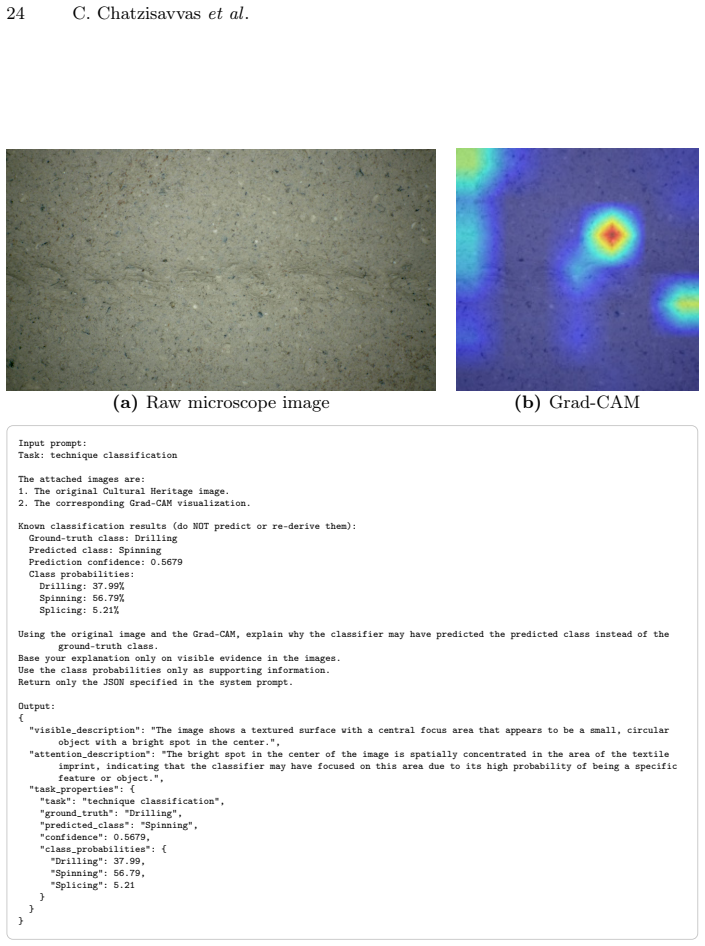
The central mechanism is AmalthAI's closed human-in-the-loop workflow. A web interface hides dataset management, training, and inference behind guided forms; an orchestration layer runs parallel hyperparameter-search trials and keeps the best checkpoint; inference runs in disposable containers built from the same training environment; and Grad-CAM (a heatmap technique showing which image regions drove the prediction) is fed, together with the original image and prediction metadata, to a vision-language model that writes a plain-language account of where the model looked and why it may have erred. The same storage layer can run fully on-site or synchronize with an external data service, which is what makes restricted artifact data usable in the first place.
What would settle it
Take the same experimental materials and images, then retrain and test under a protocol where clay preparation, lighting, and camera settings are systematically crossed with material and technique labels; if accuracy drops to near chance when the trained model is evaluated on imprint classes imaged under unseen clay and lighting conditions, or when those covariates are shuffled, the hypothesis that imprints preserve recoverable textile information would be refuted.
Extended reading notes
Core claim
On the paper's own terms, the discovery is that experimentally produced clay imprints carry recoverable label-relevant information about the original textile: misclassifications concentrate in classes that archaeologists themselves find visually hard to separate, which the authors read as evidence that the models are exploiting textile-related properties. The supporting design discovery is that a single graphical platform can carry a non-expert from raw images to trained, reusable classifiers and segmenters; repeated train/test splits yielded similar scores, and the best-performing classification model produced the headline accuracies. The stated scope is deliberately modest: the results are consistent with the hypothesis that imprints preserve such information, not proof that every imprint does, and not a replacement for expert analysis.
Load-bearing premise
The claim stands or falls on whether the models' accuracy reflects the textile attributes rather than incidental visual cues — clay texture, lighting, and camera settings — that co-vary with the classes in the experimental images.
Editorial extensions
If this is right
- Archaeologists without programming skills can train, compare, and reuse models for multiple label schemas from a single interface, so the same platform can test several hypotheses on one corpus.
- Because all assets can stay on institutional hardware, the workflow is compatible with state-owned or rights-encumbered artifact collections that cannot be uploaded to vendor clouds.
- The segmentation layer lets subsequent analysis concentrate on the imprint alone, screening out clay texture, lighting, and background irregularities.
- Misclassification patterns across classes give a first-pass signal of which textile distinctions are visually confusable, and can direct experts to inspect those cases with the explanation loop.
- Repeated splits with similar scores suggest the results are not an artifact of one favorable data partition, so the platform's default training setup can serve as a repeatable protocol.
Reading between the lines
- Beyond the paper: the strongest test of the archaeological claim would be cross-condition generalization — training on imprints made with one clay preparation and lighting regime, then testing on imprints made with different clay and illumination; a collapse to chance would show the classifiers are reading dataset-specific cues rather than textile properties.
- Beyond the paper: Grad-CAM plus a vision-language description could be used as a post-hoc shortcut detector for non-experts, but the paper does not measure whether this loop changes expert trust or improves final conclusions.
- Beyond the paper: the same no-code workflow could be applied to other indirect archaeological evidence, such as tool marks or residues, whenever experts can define classes on archaeological grounds.
- Beyond the paper: the platform's per-user data isolation and content-addressed storage design point toward a general pattern for privacy-preserving ML in heritage settings, but the paper does not evaluate multi-institution collaborative workflows.
Signed reviews
Editorial analysis
A structured set of objections, weighed in public.
Referee Report
Summary. The paper introduces AmalthAI, an open-source, self-hostable web-based machine learning platform aimed at cultural heritage (CH) researchers without machine learning expertise. The platform supports image classification, semantic segmentation, and object detection, with dataset management, training via Kubeflow/Katib, hyperparameter search, Grad-CAM explanations, and a vision-language assistant. The authors validate the platform on an experimental archaeology case study: textile imprints on clay. They report segmentation mIoU around 90%, material classification accuracy of 77.53%, and production-technique accuracy of 85.57%, with repeated random splits yielding consistent results. They argue these results support the hypothesis that clay imprints preserve visual features informative of the original textile's raw material and production technique, while acknowledging that the results do not by themselves exclude reliance on dataset-specific cues.
Significance. If the platform works as described, it addresses a real accessibility gap: CH researchers often cannot configure, train, and evaluate CV models, and many restricted heritage datasets cannot be uploaded to commercial cloud platforms. The paper's engineering is detailed and credible: the architecture is modular, the code is released, inference is run in ephemeral containers matching the training environment, storage is content-addressed and supports on-premise deployment, and the multi-user/OAuth design is sensible. The repeated-split reporting with means and standard deviations is stronger than a single-split evaluation. However, the central archaeological finding is not yet rigorously established: the case-study dataset spans different clay textures, lighting conditions, and camera settings, and the classification models were trained on full images, leaving open the possibility that accuracy reflects acquisition covariates rather than textile-structure information. The usability evidence also rests on self-evaluation by co-author experts. These issues are fixable, but they currently limit the strength of the paper's headline claims.
major comments (3)
- [Sec. 4.3, Table 3, Fig. 5] The headline archaeological conclusion is not secured against covariate leakage. The dataset is described in Fig. 5 as spanning different clay textures, lighting conditions and camera settings, yet the paper reports no per-image metadata, no balance checks across these covariates, and classification is trained on full images rather than on the segmented imprint region. Because a covariate that is stable within a material or technique class survives repeated random splits, the reported 77.53% material and 85.57% technique accuracies could reflect background or acquisition cues rather than textile-structure information in the imprints. The authors' own caveat in Sec. 4.3 ('does not by itself exclude reliance on dataset specific cues') is to the point. I request leakage-controlled evidence: classification restricted to the segmented imprint ROI, cross-clay or cross-lighting generalization experiments, or explicit demonstration that covariates are balanced across classes.
- [Sec. 4.2] The usability claim that CH experts with minimal ML knowledge can independently produce and validate findings is supported only by a self-evaluation by co-author experts. The experts who ran the experiments are also authors of the platform and of the prior framework [3]; no independent participant pool, task-completion metrics, time-on-task, error rates, or comparison against a baseline workflow is reported. This is not fatal for a systems paper, but the phrasing 'enabling non-ML CH experts to independently produce and validate archaeologically meaningful findings' in the Abstract overstates the evidence. Please either soften the claim or add a structured usability assessment.
- [Sec. 4.1, Sec. 4.3] The hypothesis success condition requires that misclassifications be attributable to structural similarities between textile classes, but the only evidence is qualitative expert opinion. Table 3 shows nettle and splicing have lower accuracies, and the text states these are 'according to CH experts' difficult cases, without a formal confusion-pattern analysis, a human-baseline comparison, or pre-registered criteria. This leaves the link between model errors and domain-valid similarity anecdotal and compounds the confound identified in the previous comment.
minor comments (5)
- [Tables 2 and 3] Please clarify why EfficientNetB0 material accuracy is 76.32±1.21 in Table 2 but 77.53% in Table 3; if Table 3 uses the best split or a different test set, state this explicitly and provide variance for the reported inference results.
- [Sec. 4.2] The sentence 'with only a few samples outside the defined classes' is vague; report exact counts or explain how such samples were treated in the experiments.
- [Sec. 3.4 and Figures 7–10] The VLM system prompt forbids describing materials as 'clay', but the examples in Figures 8 and 10 describe 'clay imprint' and 'clay or similar material'; the prompt-output inconsistency should be resolved or explicitly discussed.
- [General] The case-study dataset is not released, so the quantitative results cannot be reproduced independently; given the data-sovereignty motivation this is understandable, but the paper should state explicitly which parts of the case study can be reproduced from the public code and which require the private dataset.
- [Sec. 1, contribution 3] The phrase 'demonstrating its practical effectiveness and usability' is asserted from a single case study; consider 'demonstrated in a case study' to avoid overclaiming generalizations about usability.
Circularity Check
No circularity found: the archaeological hypothesis and platform claims are evaluated empirically on held-out data, not derived from the model inputs by construction.
full rationale
The paper's central claim is that clay textile imprints retain visual information about raw material and production technique, and that a no-code platform can let cultural heritage experts train models to recover that information. This claim is tested empirically: classification accuracy is measured on held-out test splits after training on curated labels, and segmentation mIoU is measured on expert-annotated masks. The reported numbers (e.g., 77.53% material accuracy, 85.57% technique accuracy, roughly 90% mIoU) are experimental outputs, not quantities that the platform or hypothesis definition forces by construction. No fitted parameter is relabeled as a prediction, and no equation-level identity between input and output is present. The citation to prior work [3] for modularity principles is a normal self-citation and is not load-bearing: the architecture choices described in Section 3 are presented as design decisions, not as a theorem or derivation. The paper's caveat in Section 4.3 that the results 'do not by itself exclude reliance on dataset specific cues' flags a potential confounding problem (e.g., clay texture, lighting, camera settings correlated with class labels), but that is an external-validity or correctness risk, not circularity. The repeated-split results in Table 2 provide some evidence against favorable-partition artifacts, and the authors explicitly frame the results as workflow-validation evidence rather than benchmark claims. Overall, the derivation chain is empirical and self-contained; no load-bearing step reduces to its own inputs, and no self-citation chain forces the conclusion.
Assumptions & free parameters
free parameters (3)
- Katib hyperparameter search ranges =
LR 0.001-0.1; batch size 4-16; epochs 30-50 (classification); LR 0.001-0.1; batch 8-16; epochs 20-30 (segmentation)
- Data augmentation policies
- VLM system prompt and in-context examples =
Hand-written JSON prompt with four examples (Figs. 6-10)
assumptions (4)
- domain assumption The experimental clay-imprint dataset is representative of archaeological textile imprints and labels are correct.
- domain assumption Held-out classification accuracy on this dataset is not driven by dataset-specific cues such as imaging conditions or near-duplicate samples.
- domain assumption Standard i.i.d. train/test splits on images do not leak across multiple images of the same textile sample.
- domain assumption Grad-CAM and Qwen2-VL outputs are reliable enough for expert review to validate model reasoning.
Cite this review
Pith. "Pith review of AmalthAI: An Open-Source Computer Vision Platform for Cultural Heritage." pith.science (2026). https://pith.science/paper/VK6YQ3HV
@misc{pith2026260813343,
  author       = {Pith},
  title        = {Pith review of: AmalthAI: An Open-Source Computer Vision Platform for Cultural Heritage},
  year         = {2026},
  howpublished = {\url{https://pith.science/paper/VK6YQ3HV}},
  note         = {Machine review of arXiv:2608.13343}
}
read the original abstract
Computer vision (CV) and machine learning (ML) offer new tools for cultural heritage (CH) artifact analysis, but the CV/ML pipeline remains largely inaccessible to CH domain experts, who lack the background to configure, train, or assess models. We present AmalthAI, an open-source CV platform that bridges this gap, enabling non-ML CH experts to independently produce and validate archaeologically meaningful findings. The interface covers dataset management, training, and inference for classification, segmentation, and object detection, with Kubeflow and Katib handling scalable training and hyperparameter search. Grad-CAM localizes the image region behind a prediction, and a vision-language model (VLM) adds a text description of it for expert review. Since archaeological data is often state-owned or rights-encumbered and cannot leave institutional custody, AmalthAI's self-hostable deployment ensures sensitive data is kept within premises. We test the platform on an archaeological use case built on a custom dataset of clay textile imprints, where CH experts trained and validated segmentation, and classification models for hypothesis testing. We provide the implementation code at https://github.com/TEXTaiLES/AmalthAI.
Figures


Figures from the paper (9 more)




Reference graph
Works this paper leans on
-
[3]
In: Computer Applica- tions and Quantitative Methods in Archaeology Conference (CAA2025)
Chatzisavvas, C., Pappas, T., Rigas, P., Mitianoudis, N., Pavlidis, G., Kiourt, C., Koutsoudis, A., Katsouros, V., Ioannakis, G.: Towards an easy-to-use ma- chine learning framework for cultural heritage scientists. In: Computer Applica- tions and Quantitative Methods in Archaeology Conference (CAA2025). Athens, Greece (May 2026).https://doi.org/10.5281/z...
-
[1]
In: 12th USENIX symposium on operating systems design and implementation (OSDI 16)
Abadi, M., Barham, P., Chen, J., Chen, Z., Davis, A., Dean, J., Devin, M., Ghe- mawat, S., Irving, G., Isard, M., et al.: TensorFlow: a system for Large-Scale ma- chine learning. In: 12th USENIX symposium on operating systems design and implementation (OSDI 16). pp. 265–283 (2016) 16 C. Chatzisavvaset al
work page 2016
- [2]
-
[4]
In: Proceedings of the European conference on computer vision (ECCV)
Chen, L.C., Zhu, Y., Papandreou, G., Schroff, F., Adam, H.: Encoder-decoder with atrous separable convolution for semantic image segmentation. In: Proceedings of the European conference on computer vision (ECCV). pp. 801–818 (2018)
2018
-
[5]
Computers in Industry134, 103551 (2022)
Chen, M., Yu, L., Zhi, C., Sun, R., Zhu, S., Gao, Z., Ke, Z., Zhu, M., Zhang, Y.: Improved faster R-CNN for fabric defect detection based on Gabor filter with Genetic Algorithm optimization. Computers in Industry134, 103551 (2022)
work page 2022
- [6]
- [7]
-
[8]
Fibres and Textiles in Eastern Europe15, 64–65 (01 2007)
Cybulska, M.: Archaeological textiles–a need for new methods of analysis and re- construction. Fibres and Textiles in Eastern Europe15, 64–65 (01 2007)
work page 2007
Show all 60 references
-
[9]
29, 2026
Directus: Directus: The collaborative backend and headless cms.https : / / directus.com(2026), accessed: Jun. 29, 2026
2026
-
[10]
25, 2026
Dwyer, B., Nelson, J., Hansen, T., et al.: Roboflow (version 1.0) (2026),https: //roboflow.com, accessed: Jun. 25, 2026
2026
-
[11]
Advances in Archaeological Practice11(2), 152–163 (2023)
Eberl, M., Bell, C.S., Spencer-Smith, J., Raj, M., Sarubbi, A., Johnson, P.S., Rieth, A.E., Chaudhry, U., Aguila, R.E., McBride, M.: Machine learning–based identifi- cation of lithic microdebitage. Advances in Archaeological Practice11(2), 152–163 (2023)
2023
-
[12]
Journal of Cultural Heritage78, 228–237 (2026)
ElBehairy, A., El-Nasr, N.A.A., Grimberg, P., Said, L.A.: A comprehensive review of deep learning methods in damage classification, detection, and segmentation of cultural heritage sites. Journal of Cultural Heritage78, 228–237 (2026)
2026
-
[13]
Journal of Computer Applications in Ar- chaeology (Jun 2025).https://doi.org/10.5334/jcaa.190
Eleftheriadou, A., McPherron, S.P., Marreiros, J.: Machine learning applications in use-wear analysis: A critical review. Journal of Computer Applications in Ar- chaeology (Jun 2025).https://doi.org/10.5334/jcaa.190
2025 doi
-
[14]
Pattern Recognition Letters133, 102–108 (2020)
Fiorucci, M., Khoroshiltseva, M., Pontil, M., Traviglia, A., Del Bue, A., James, S.: Machine learning for cultural heritage: A survey. Pattern Recognition Letters133, 102–108 (2020)
2020
-
[15]
Hardt,D.:TheOAuth2.0AuthorizationFramework.RFC6749(Oct2012).https: //doi.org/10.17487/RFC6749,https://www.rfc-editor.org/info/rfc6749/
-
[16]
He,K.,Zhang,X.,Ren,S.,Sun,J.:Deepresiduallearningforimagerecognition.In: Proceedings of the IEEE conference on computer vision and pattern recognition. pp. 770–778 (2016)
2016
-
[17]
25, 2026
Intel: Intel Geti (2023),https://github.com/open- edge- platform/geti, ac- cessed: Jun. 25, 2026
2023
-
[18]
Textile research journal92(1-2), 30–42 (2022)
Jing, J., Wang, Z., Rätsch, M., Zhang, H.: Mobile-Unet: An efficient convolutional neural network for fabric defect detection. Textile research journal92(1-2), 30–42 (2022)
2022
-
[19]
arXiv preprint arXiv:2606.03748 (2026)
Jocher, G., Qiu, J., Liu, M., Lyu, S., Akyon, F.C., Kalfaoglu, M.E.: Ultra- lytics YOLO26: Unified Real-Time End-to-End Vision Models. arXiv preprint arXiv:2606.03748 (2026)
2026 arXiv
-
[20]
keycloak.org(2026), accessed: Jun
Keycloak: Keycloak: Open source identity and access management.https://www. keycloak.org(2026), accessed: Jun. 28, 2026 AmalthAI: An Open-Source Computer Vision Platform for Cultural Heritage 17
2026
-
[21]
In: Proceedings of the IEEE/CVF international conference on computer vision
Kirillov, A., Mintun, E., Ravi, N., Mao, H., Rolland, C., Gustafson, L., Xiao, T., Whitehead, S., Berg, A.C., Lo, W.Y., et al.: Segment anything. In: Proceedings of the IEEE/CVF international conference on computer vision. pp. 4015–4026 (2023)
2023
-
[22]
IEEE access11, 31866–31879 (2023)
Kreuzberger, D., Kühl, N., Hirschl, S.: Machine learning operations (MLops): Overview, definition, and architecture. IEEE access11, 31866–31879 (2023)
2023
-
[23]
kubeflow.org/, accessed: Jun
Kubeflow: A machine learning toolkit for Kubernetes (2021),https://www. kubeflow.org/, accessed: Jun. 28, 2026
2021
-
[24]
Applied Physics A106, 309 – 323 (2011)
Liang, H.: Advances in multispectral and hyperspectral imaging for archaeology and art conservation. Applied Physics A106, 309 – 323 (2011)
2011
-
[25]
In: European conference on computer vision
Lin, T.Y., Maire, M., Belongie, S., Hays, J., Perona, P., Ramanan, D., Dollár, P., Zitnick, C.L.: Microsoft coco: Common objects in context. In: European conference on computer vision. pp. 740–755. Springer (2014)
2014
-
[26]
IEEE Ac- cess12, 100167–100185 (2024)
Ling, Z., Delnevo, G., Salomoni, P., Mirri, S.: Findings on machine learning for identification of archaeological ceramics: A systematic literature review. IEEE Ac- cess12, 100167–100185 (2024)
2024
-
[27]
Proceedings of the IEEE/CVF Conference on Computer Vision and Pattern Recognition (CVPR) (2022)
Liu, Z., Mao, H., Wu, C.Y., Feichtenhofer, C., Darrell, T., Xie, S.: A convnet for the 2020s. Proceedings of the IEEE/CVF Conference on Computer Vision and Pattern Recognition (CVPR) (2022)
2022
-
[28]
In: Proceedings of the IEEE conference on computer vision and pattern recognition
Long, J., Shelhamer, E., Darrell, T.: Fully convolutional networks for semantic segmentation. In: Proceedings of the IEEE conference on computer vision and pattern recognition. pp. 3431–3440 (2015)
2015
-
[29]
In: Proceedings of the European conference on computer vision (ECCV)
Ma, N., Zhang, X., Zheng, H.T., Sun, J.: Shufflenet v2: Practical guidelines for efficient CNN architecture design. In: Proceedings of the European conference on computer vision (ECCV). pp. 116–131 (2018)
2018
-
[30]
on the problem of the most efficient tests of statisti- cal hypotheses
Neyman, J., Pearson, E.S.: Ix. on the problem of the most efficient tests of statisti- cal hypotheses. Philosophical Transactions of the Royal Society of London, Series A: Containing Papers of a Mathematical or Physical Character231(694-706), 289– 337 (02 1933)
1933
-
[31]
Journal of Archaeological Science191, 106607 (2026)
Orengo, H., Berganzo-Besga, I., Esmoris, J., Lumbreras, F., Aliende, P., Wallace, M., Livarda, A.: High-performance 3D morphometrics via deep learning and tabu- lar foundation models: a case study on complex cereal grain classification. Journal of Archaeological Science191, 10...
2026
-
[32]
Journal of Cultural Heritage74, 214–224 (2025)
Ottoni, A.L.C., Ottoni, L.T.C.: A deep learning approach for cultural heritage building classification using transfer learning and data augmentation. Journal of Cultural Heritage74, 214–224 (2025)
2025
-
[33]
World Archaeology 40(1), 1–6 (2008)
Outram, A.K.: Introduction to experimental archaeology. World Archaeology 40(1), 1–6 (2008)
2008
-
[34]
https://palletsprojects.com (2024), accessed: Jun
Pallets: Flask (version 3.1.0). https://palletsprojects.com (2024), accessed: Jun. 28, 2026
2024
-
[35]
Advances in neural information processing sys- tems32(2019)
Paszke, A., Gross, S., Massa, F., Lerer, A., Bradbury, J., Chanan, G., Killeen, T., Lin, Z., Gimelshein, N., Antiga, L., et al.: Pytorch: An imperative style, high- performance deep learning library. Advances in neural information processing sys- tems32(2019)
2019
-
[36]
Expert systems with applications239, 122399 (2024)
Pei, H., Zhang, C., Zhang, X., Liu, X., Ma, Y.: Recognizing materials in cultural relic images using computer vision and attention mechanism. Expert systems with applications239, 122399 (2024)
2024
-
[37]
In: 2020 25th International Conference on Pattern Recognition (ICPR)
Ragusa, F., Di Mauro, D., Palermo, A., Furnari, A., Farinella, G.M.: Semantic object segmentation in cultural sites using real and synthetic data. In: 2020 25th International Conference on Pattern Recognition (ICPR). pp. 1964–1971. IEEE (2021) 18 C. Chatzisavvaset al
2021
-
[38]
arXiv preprint arXiv:2406.00423 (2024)
Rei, L., Mladenić, D., Dorozynski, M., Rottensteiner, F., Schleider, T., Troncy, R., Lozano, J.S., Salvatella, M.G.: Multimodal metadata assignment for cultural heritage artifacts. arXiv preprint arXiv:2406.00423 (2024)
2024 arXiv
-
[39]
In: International Conference on Medical image computing and computer-assisted intervention
Ronneberger, O., Fischer, P., Brox, T.: U-net: Convolutional networks for biomedi- cal image segmentation. In: International Conference on Medical image computing and computer-assisted intervention. pp. 234–241. Springer (2015)
2015
-
[40]
International journal of computer vision115(3), 211–252 (2015)
Russakovsky, O., Deng, J., Su, H., Krause, J., Satheesh, S., Ma, S., Huang, Z., Karpathy, A., Khosla, A., Bernstein, M., et al.: Imagenet large scale visual recog- nition challenge. International journal of computer vision115(3), 211–252 (2015)
2015
-
[41]
The OpenID Foundation, specification 335(2014)
Sakimura, N., Bradley, J., Jones, M., De Medeiros, B., Mortimore, C.: Openid connect core 1.0 incorporating errata set 1. The OpenID Foundation, specification 335(2014)
2014
-
[42]
In: Proceedings of the IEEE conference on computer vision and pattern recognition
Sandler, M., Howard, A., Zhu, M., Zhmoginov, A., Chen, L.C.: Mobilenetv2: In- verted residuals and linear bottlenecks. In: Proceedings of the IEEE conference on computer vision and pattern recognition. pp. 4510–4520 (2018)
2018
-
[43]
In- ternational journal of computer vision128(2), 336–359 (2020)
Selvaraju, R.R., Cogswell, M., Das, A., Vedantam, R., Parikh, D., Batra, D.: Grad- cam: visual explanations from deep networks via gradient-based localization. In- ternational journal of computer vision128(2), 336–359 (2020)
2020
-
[44]
Journal of Archaeological Method and Theory32(1), 31 (2025)
Sferrazza, P.: Archaeological and experimental lithic microwear classification through 2D textural analysis and machine learning. Journal of Archaeological Method and Theory32(1), 31 (2025)
2025
-
[45]
International Journal of Computational Intelligence Systems17(1), 11 (2024)
Sha, S., Li, Y., Wei, W., Liu, Y., Chi, C., Jiang, X., Deng, Z., Luo, L.: Image classi- fication and restoration of ancient textiles based on convolutional neural network. International Journal of Computational Intelligence Systems17(1), 11 (2024)
2024
-
[46]
In: International conference on machine learning
Tan, M., Le, Q.: Efficientnet: Rethinking model scaling for convolutional neural networks. In: International conference on machine learning. pp. 6105–6114. PMLR (2019)
2019
-
[47]
In: Banck-Burgess, J., Marinova, E., Mischka, D
Ulanowska,A.:Whynotwool?Evidenceforrawmaterialsandtechnicalusesoftex- tiles based on imprints on the undersides of clay sealings from Bronze Age Greece. In: Banck-Burgess, J., Marinova, E., Mischka, D. (eds.) THE SIGNIFICANCE OF ARCHAEOLOGICAL TEXTILES Papers of the Interna-ti...
2023
-
[48]
25, 2026
Ultralytics: Ultralytics Platform (2026),https://platform.ultralytics.com/, accessed: Jun. 25, 2026
2026
-
[49]
arXiv preprint arXiv:2409.12191 (2024)
Wang, P., Bai, S., Tan, S., Wang, S., Fan, Z., Bai, J., Chen, K., Liu, X., Wang, J., Ge, W., et al.: Qwen2-vl: Enhancing vision-language model’s perception of the world at any resolution. arXiv preprint arXiv:2409.12191 (2024)
2024 arXiv
-
[50]
Scientific Re- ports12(1), 13468 (2022)
Winterbottom, T., Leone, A., Al Moubayed, N.: A deep learning approach to fight illicit trafficking of antiquities using artefact instance classification. Scientific Re- ports12(1), 13468 (2022)
2022
-
[51]
In: International Conference on Computers in Urban Planning and Urban Management
Yoshimura, Y., Cai, B., Wang, Z., Ratti, C.: Deep learning architect: classification for architectural design through the eye of artificial intelligence. In: International Conference on Computers in Urban Planning and Urban Management. pp. 249–
-
[52]
IEEE Data Eng
Zaharia, M.A., Chen, A., Davidson, A., Ghodsi, A., Hong, S.A., Konwinski, A., Murching, S., Nykodym, T., Ogilvie, P., Parkhe, M., Xie, F., Zumar, C.: Accel- erating the Machine Learning Lifecycle with MLflow. IEEE Data Eng. Bull.41, 39–45 (2018) AmalthAI: An Open-Source Comput...
2018
-
[53]
In: Proceedings of the IEEE conference on computer vision and pattern recognition
Zhao, H., Shi, J., Qi, X., Wang, X., Jia, J.: Pyramid scene parsing network. In: Proceedings of the IEEE conference on computer vision and pattern recognition. pp. 2881–2890 (2017) 20 C. Chatzisavvaset al. A Supplementary Material A.1 Hardware Requirements & Technical Backgrou...
2017
-
[54]
Image 1 (raw): the actual microscope photograph of the clay imprint
-
[55]
Rules:\n
Image 2 (Grad-CAM): a heatmap overlay showing where the classifier focused. "Rules:\n" "- visible_description: describe ONLY what you see in Image 1. " "Do NOT mention the heatmap or Grad-CAM here.\n" "- attention_description: describe WHERE the heat in Image 2 is spatially " ...
-
[57]
visible_description
The corresponding Grad-CAM visualization. Known classification results (do NOT predict or re-derive them): Ground-truth class: Wool Predicted class: Nettle Prediction confidence: 0.4438 Class probabilities: Flax: 0.37% Nettle: 44.38% Tree bast_lime: 34.35% Wool: 20.90% Using t...
-
[59]
visible_description
The corresponding Grad-CAM visualization. Known classification results (do NOT predict or re-derive them): Ground-truth class: Nettle Predicted class: Wool Prediction confidence: 0.6959 Class probabilities: Flax: 0.25% Nettle: 20.73% Tree bast_lime: 9.43% Wool: 69.59% Using th...
-
[61]
visible_description
The corresponding Grad-CAM visualization. Known classification results (do NOT predict or re-derive them): Ground-truth class: Drilling Predicted class: Spinning Prediction confidence: 0.5679 Class probabilities: Drilling: 37.99% Spinning: 56.79% Splicing: 5.21% Using the orig...
-
[62]
The original Cultural Heritage image
-
[63]
visible_description
The corresponding Grad-CAM visualization. Known classification results (do NOT predict or re-derive them): Ground-truth class: Drilling Predicted class: Splicing Prediction confidence: 0.3488 Class probabilities: Drilling: 31.39% Spinning: 33.73% Splicing: 34.88% Using the ori...
Reviewed August 14, 2026 · model on record in the stance chip above.
Discussion (0). Continue with ORCID to comment.