REVIEW 3 major objections 4 minor 83 references
Widefield Arecibo Virgo Extragalactic Survey: II. Characterizing the HI properties and environment of the WAVES South region
T0 review · 3 major / 4 minor · reviewed 2026-08-14 · deepseek-v4-flash
Pith's one-line read The WAVES South region of Virgo is already stripped of most of its neutral hydrogen.
desk verdict Solid WAVES South HI catalog and stacking limits; the 'more relaxed than VC1' interpretation is plausible but not proven given different noise, different non-detected sample construction, and a contradictory HI deficiency trend. read the letter →
The pith
A machine-rendered reading of the paper's core claim, the machinery that carries it, and where it could break.
The reading
What carries the argument
The central diagnostic is the HI detection fraction, computed as the number of HI-detected galaxies divided by the number of optical catalog members from the Virgo Cluster Catalog, compared between WAVES South and VC1. This comparison is supported by velocity-distribution tests (Mann–Whitney and Kolmogorov–Smirnov), HI deficiency measurements relative to the projected M87–M49 X-ray filament, variance-defined spectral stacking to push sensitivity below the nominal detection limit, and renzogram visualizations used to trace faint HI bridges. The named central object is the WAVES South HI data cube, whose sources were extracted by two visual searches and the SoFiA source finder, yielding 56 HI detections.
What would settle it
Re-run the detection-fraction comparison using only VCC galaxies in both regions, with source-injection simulations matched to each region's noise (0.8 versus 0.6 mJy rms) to set identical completeness limits; if the deficit disappears once completeness is matched, the relaxed-environment conclusion collapses. Alternatively, a deeper 21-cm survey reaching roughly 0.1 mJy rms over WAVES South that recovers a population of faint HI sources in the same velocity range would directly falsify the claim that gas removal is already complete.
Extended reading notes
Core claim
The paper claims that WAVES South, centered on the X-ray filament between M87 and M49, is a dynamically relaxed and evolved part of the Virgo cluster. The claim rests on three comparisons with the AGES VC1 region observed with the same receiver and drift-scan technique: the HI detection fraction among Virgo Cluster Catalog members is roughly 14% in WAVES South versus 22% in VC1, the deficit persists at the 17 Mpc distance (11% versus 17%), and the velocity distributions of HI-detected and HI-non-detected galaxies are statistically indistinguishable in WAVES South while clearly different in VC1. The paper interprets the similar velocity distributions as evidence that gas-rich and gas-poor systems have had time to mix dynamically, meaning the environment has already completed most of its gas-removal work. It further identifies two early-type dwarfs, WCS 47 and WCS 51, with residual HI at low gas fractions, reading them as late-stage examples of the dwarf irregular to dwarf elliptical transformation driven by ram-pressure stripping. A stacking analysis of 157 galaxies across WAVES South, VC1, and VC2 reaches rms 0.080 mJy with no detection, placing a 3σ upper limit of about $1.26\times10^6\,M_\odot$ on hidden neutral gas and suggesting that once a galaxy's HI drops below a critical level, the remaining gas is rapidly removed or ionized.
Load-bearing premise
The comparison assumes that the optical galaxy catalog used to count non-detections is equally complete in WAVES South and VC1 and that the two non-detected samples were assembled in the same way; if those assumptions fail, the lower detection fraction could be a selection artifact rather than evidence of a more evolved environment.
Editorial extensions
If this is right
- If WAVES South is more evolved than VC1, then most environmentally driven gas removal in this part of Virgo has already happened, and the residual HI in WCS 47 and WCS 51 represents the final phase of dwarf irregular to dwarf elliptical transformation.
- The absence of a stacked HI signal implies that there is no hidden reservoir of neutral gas below the detection limits; once a galaxy's gas content is reduced below a critical level, the remaining HI is efficiently stripped or ionized.
- HI deficiency declines with distance from the M87–M49 filament, indicating that the dense intracluster medium traced by the X-ray gas is the primary driver of stripping in this region.
- The dark cloud candidate WCS 54, connected to the galaxy WCS 40 by an HI bridge, is likely a recently stripped system caught in the early stages of gas removal rather than an isolated, long-lived dark cloud.
- The similar number of blue blobs in WAVES South and VC1, despite their different evolutionary states, suggests that blue blob formation is not directly tied to the current rate of stripping events.
Reading between the lines
- If the relaxed-environment interpretation holds, WAVES South can serve as a benchmark for the end state of cluster processing; future deep HI surveys of other Virgo subclusters should find fewer isolated dark clouds in regions that have already undergone most of their gas removal.
- The proposed dark-cloud-to-blue-blob evolutionary link could be tested by searching for young stellar populations inside known isolated dark clouds with deep optical and ultraviolet imaging; the presence of such stars would support the precursor-stage hypothesis.
- The apparent HI mass cutoff near $10^7\,M_\odot$ in Virgo, compared with a higher cutoff in Coma, suggests that the threshold for efficient gas removal scales with cluster environment; comparing HI mass functions across clusters of varying ICM density would test this scaling.
- Equal blue-blob numbers in a relaxed and an unrelaxed region imply that blue blobs are either long-lived systems or form through multiple channels; distinguishing these requires a larger, cluster-wide census of blue blobs with HI data.
Editorial analysis
A structured set of objections, weighed in public.
Referee Report
Summary. This paper presents the WAVES South catalog of 21-cm HI sources in a 20 deg^2 region of the Virgo cluster, obtained with the Arecibo telescope. The catalog contains 56 HI sources, including 47 galaxies, two gas clouds, and the ALFALFA Virgo 7 complex. The authors compare the HI properties of WAVES South with the previously published AGES VC1 region, finding a lower HI detection fraction, similar velocity distributions between HI-detected and HI-non-detected galaxies in WAVES South, and a nearby dark cloud candidate (WCS 54) connected to a galaxy. They argue that these results imply WAVES South is a dynamically more relaxed and evolved environment than VC1, and they discuss implications for dwarf-to-elliptical transformation and the possible connection between optically dark clouds and 'blue blobs'. They also perform a spectral stacking analysis that reaches an rms of 0.080 mJy and yields no new HI detections, placing upper limits on the gas content of the undetected population.
Significance. If the central conclusion is correct, the paper provides evidence for spatial variation in the evolutionary state within the Virgo cluster and supports a specific picture of environmentally driven gas removal. The WAVES South catalog itself is a useful resource, and the stacking analysis is carefully conducted: the noise model is checked against measured rms values, the weighting scheme is described in detail, and the upper limits are presented transparently. The paper also makes a credible attempt to connect newly discovered 'blue blobs' to the dark cloud population, though the sample sizes are small. The main significance, however, rests on the detection-fraction comparison, and that comparison is not yet convincing because of sample-construction and completeness issues. The HI deficiency analysis points in the opposite direction from the paper's main claim, and the inconsistency is not resolved.
major comments (3)
- [Sect. 4.1 and Sect. 3.6] The central detection-fraction comparison (14% vs 22%, and 16% vs 28% in Sect. 5.1) uses denominators constructed from VCC/GOLDMine galaxies with assigned distances 'irrespective of their radial velocities' (Sect. 4.1), while the non-detected samples are built differently in the two regions: WAVES South adds NED-selected objects, whereas VC1 non-detections were purely VCC. The assertion that the VCC count is 'a reasonable approximation of the true total number of galaxies present' is not tested, and differential completeness between the footprints could produce the reported fractions without any physical difference. The authors should recompute the fractions using identical, velocity-confirmed selections in both regions, or quantify the completeness of the VCC denominators separately for each footprint.
- [Sect. 4.7 and Sect. 5.1] The HI deficiency analysis reports median DEF_HI of 0.48 for WAVES South and 0.70 for VC1, with both Mann-Whitney and Kolmogorov-Smirnov tests indicating the distributions differ at the 99.3% confidence level. This is a strong statistical result, yet Sect. 5.1 dismisses it by saying 'the statistical significance of this is low due to the low sample size.' A 99.3% confidence level is not low significance, and the direction of the effect is opposite to what a more evolved, more stripped region would be expected to show. This is an internal inconsistency that must be addressed before the 'more evolved' conclusion can be accepted.
- [Sect. 4.4 and Sect. 3.6] The velocity-distribution comparison in Fig. 4 is not conclusive for the dynamical-mixing argument. The non-detected sample in WAVES South is restricted to galaxies with reliable optical velocities, and such velocities in this region are preferentially available for 17 Mpc members (as described in Sect. 3.6). The VC1 non-detected sample, by contrast, was selected purely from VCC. The similar velocity distributions in WAVES South could therefore be a selection effect rather than evidence of dynamical mixing. A velocity-matched comparison using identical selection criteria for both regions is needed.
minor comments (4)
- [Sect. 1] The sentence 'the H i gas, although it does not directly contribute to star formation, it does act as a reservoir' contains a redundant 'it'; it should read 'the H i gas, although it does not directly contribute to star formation, acts as a reservoir.'
- [Abstract and throughout] The chemical symbol for neutral hydrogen is typeset inconsistently as 'Hi' in many places; 'H i' should be used uniformly.
- [Sect. 4.2] When comparing VC1 and WAVES South detection counts relative to ALFALFA, it would help to state explicitly that the 93 and 64 numbers refer to detections within the same velocity range and footprint, to avoid ambiguity.
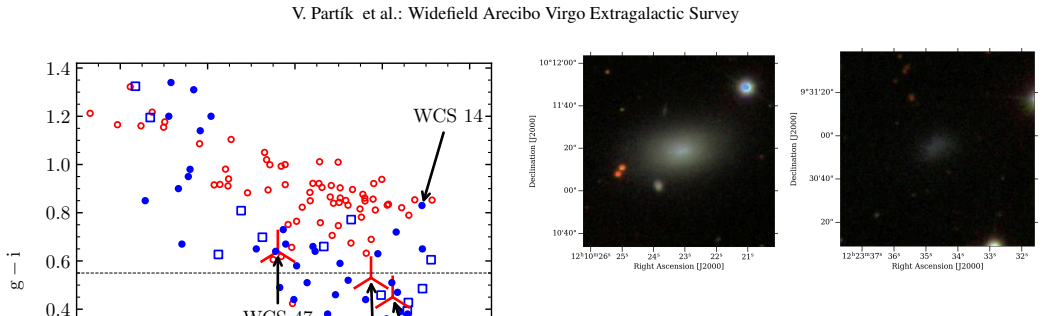
- [Fig. 2] The caption describes 'open circles' for optical-only galaxies, but the text in Sect. 4.1 uses different terminology; please unify the marker descriptions so the figure is self-explanatory.
Circularity Check
No circularity: the HI catalog, detection fractions, and environmental comparisons are observed quantities with stated assumptions; the inference is not forced by any fitted parameter or self-citation.
full rationale
The paper's derivation chain is self-contained. The HI catalog is built from visual and SoFiA source extraction with fixed S/N thresholds (Saintonge 2007; Taylor 2025b) and is checked by a second visual pass and by requiring SoFiA to recover all 56 visually cataloged objects. HI masses, deficiencies, and stellar masses use external calibrations (Solanes et al. 1996; Taylor et al. 2011; Gavazzi et al. 1999), and no fitted parameter is later renamed as a prediction. The stacking noise model (Eq. 9) is validated against measured rms values in Fig. 12 and is used only to set upper limits, not to claim a detection. The central comparison, the lower HI detection fraction in WAVES South relative to VC1, is a ratio of detected sources to VCC/GOLDMine counts; the paper explicitly states the assumption that these counts approximate the true total number of galaxies (Sect. 4.1), so any completeness concern is a selection-effect/correctness risk rather than a circular reduction. The velocity-distribution argument (Sect. 4.4) uses measured samples and is an interpretive inference, not an equation that reproduces its input. Self-citations to T12 and T13 are prior, independently observed AGES data sets used as comparison samples, not as unverified premises that force the relaxed-environment conclusion; methodological citations (Taylor 2025a,b) are calibrations, not load-bearing proof. No uniqueness theorem, ansatz smuggled via citation, or renaming of a known result is invoked. Hence no step reduces by construction to its inputs.
Assumptions & free parameters
free parameters (3)
- HI deficiency reference relation coefficients (a, b) =
a = 7.51, b = 1.460
- Stellar mass relation coefficients =
intercept = -0.68, color slope = 0.7, M_sun,i = 4.58
- Substructure distances =
17, 23, 32 Mpc
assumptions (4)
- domain assumption The Virgo Cluster Catalog is approximately complete and equally representative in WAVES South and VC1, so VCC-based detection fractions can be compared directly.
- domain assumption Optical counterparts within 1.75 arcmin with a velocity difference under 200 km/s are the correct associations for HI detections.
- domain assumption The X-ray filament between M87 and M49 can be approximated as a straight line, and projected distance from this line at 17 Mpc traces the density of the intracluster medium.
- standard math Standard 21 cm relations apply: M_HI = 2.36e5 d^2 F_HI (Eq. 2) and the HI deficiency definitions (Eqs. 4 and 5).
Cite this review
Pith. "Pith review of Widefield Arecibo Virgo Extragalactic Survey: II. Characterizing the HI properties and environment of the WAVES South region." pith.science (2026). https://pith.science/paper/5J5K6CQK
@misc{pith2026260813411,
  author       = {Pith},
  title        = {Pith review of: Widefield Arecibo Virgo Extragalactic Survey: II. Characterizing the HI properties and environment of the WAVES South region},
  year         = {2026},
  howpublished = {\url{https://pith.science/paper/5J5K6CQK}},
  note         = {Machine review of arXiv:2608.13411}
}
read the original abstract
Context. Galaxy clusters are extreme environments where interactions with the hot intracluster medium drive rapid galaxy evolution. These processes can result in the formation of optically dark gas clouds, as previously observed in Virgo and other clusters. Aims. We investigate the distribution and properties of neutral hydrogen (HI) in two large adjoining regions of the Virgo cluster to understand how the cluster environment influences galaxy transformation. Specifically, we examine the gas content of both star-forming and quiescent populations and search for evidence of gas-loss driven evolution. Methods. We cataloged the 21cm HI Widefield Arecibo Virgo Extragalactic Survey (WAVES) South data using visual and automatic source extraction methods. By combining these results with an optically selected sample, we compared the HI properties of WAVES South with the previously studied VC1 region. To probe gas reservoirs below the nominal detection limit, we performed a stacking analysis of radio spectra across the WAVES South, VC1 and VC2 footprints. Results. We detected 56 HI sources with a median root mean square (rms) noise of 0.8 mJy, including 50 galaxies, two gas clouds (one being optically dark), and the ALFALFA Virgo 7 complex. Our results reveal a significantly lower detection fraction in WAVES South compared to the VC1 region. Stacking showed no new HI detection at a 0.080 mJy rms with a maximum of 157 stacked objects from WAVES South, VC1, and VC2. Conclusions. The lower HI detection fraction suggests that WAVES South is a more dynamically relaxed and evolved environment than the VC1 region. The presence of residual HI in a small subset of early-type galaxies supports a model of dwarf irregular to dwarf elliptical transformation via environmental stripping. Finally, we note a possible evolutionary link between optically dark clouds and recently discovered "blue blobs."
Figures


Figures from the paper (9 more)



Reference graph
Works this paper leans on
-
[1]
Greenwade
George D. Greenwade. The C omprehensive T ex A rchive N etwork ( CTAN ). TUGBoat. 1993
1993
-
[2]
The Widefield Arecibo Virgo Extragalactic Survey. I. New structures in the ALFALFA Virgo 7 cloud complex and an extended tail on NGC 4522 , author=. AJ , volume=. 2019 , publisher=
2019
-
[3]
MNRAS , volume=
The Arecibo Galaxy Environment Survey: precursor observations of the NGC 628 group , author=. MNRAS , volume=. 2006 , publisher=
2006
-
[4]
The Virgo cluster (I) , author=
The Arecibo Galaxy Environment Survey--V. The Virgo cluster (I) , author=. MNRAS , volume=. 2012 , publisher=
work page 2012
-
[5]
The Virgo cluster (II) , author=
The Arecibo Galaxy Environment Survey--VI. The Virgo cluster (II) , author=. MNRAS , volume=. 2013 , publisher=
work page 2013
-
[6]
II-A catalog of 2096 galaxies in the Virgo Cluster area
Studies of the Virgo Cluster. II-A catalog of 2096 galaxies in the Virgo Cluster area. , author=. AJ (ISSN 0004-6256), vol. 90, Sept. 1985, p. 1681-1759. SNSF-supported research. , volume=
work page 1985
-
[7]
Introducing GOLDMine: A new galaxy database on the WEB , author=. A&A , volume=. 2003 , publisher=
work page 2003
-
[8]
The kinematics of the Virgo cluster revisited , author=. A&AS (ISSN 0365-0138), vol. 98, no. 2, p. 275-296. , volume=
Show all 83 references
-
[9]
A dense filament with extremely long H i streams , author=
The Arecibo Galaxy Environment Survey--VII. A dense filament with extremely long H i streams , author=. MNRAS , volume=. 2014 , publisher=
2014
-
[10]
Astronomy and Computing , volume=
FRELLED: A realtime volumetric data viewer for astronomers , author=. Astronomy and Computing , volume=. 2015 , publisher=
2015
-
[11]
The arecibo legacy fast alfa survey. iv. strategies for signal identification and survey catalog reliability , author=. AJ , volume=. 2007 , publisher=
2007
-
[12]
Chinese astronomy and astrophysics , volume=
The radial velocity membership of the Virgo Cluster , author=. Chinese astronomy and astrophysics , volume=. 1991 , publisher=
1991
-
[13]
The role of the cluster environment on galaxy evolution , author=
The GALEX Ultraviolet Virgo Cluster Survey (GUViCS)-IV. The role of the cluster environment on galaxy evolution , author=. A&A , volume=. 2014 , publisher=
2014
-
[14]
MNRAS , volume=
The 3D structure of the Virgo cluster from H-band Fundamental Plane and Tully—Fisher distance determinations , author=. MNRAS , volume=. 1999 , publisher=
1999
-
[15]
Nat , volume=
The structure of the Virgo cluster of galaxies from Rosat X-ray images , author=. Nat , volume=. 1994 , publisher=
1994
-
[16]
The expanded Abell 1367 field: Data catalogue and H I census over the surveyed volume , author=
The Arecibo Galaxy Environment Survey (AGES)-XI. The expanded Abell 1367 field: Data catalogue and H I census over the surveyed volume , author=. A&A , volume=. 2022 , publisher=
2022
-
[17]
ApJ , volume=
Measuring reddening with Sloan Digital Sky Survey stellar spectra and recalibrating SFD , author=. ApJ , volume=. 2011 , publisher=
2011
-
[18]
ApJ , volume=
Maps of dust infrared emission for use in estimation of reddening and cosmic microwave background radiation foregrounds , author=. ApJ , volume=. 1998 , publisher=
1998
-
[19]
The H i Content of Spirals. I. Field Galaxy H i Mass Functions and H i Mass--Optical Size Regressions. , keywords =. doi:10.1086/177089 , archivePrefix =. astro-ph/9511003 , primaryClass =
-
[20]
Astrophysical Journal, Part 1 (ISSN 0004-637X), vol
Gas deficiency in cluster galaxies-A comparison of nine clusters , author=. Astrophysical Journal, Part 1 (ISSN 0004-637X), vol. 292, May 15, 1985, p. 404-425. , volume=
1985
-
[21]
A cluster inventory , author=
The Herschel Virgo Cluster Survey--XVI. A cluster inventory , author=. MNRAS , volume=. 2014 , publisher=
2014
-
[22]
MNRAS , volume=
Galaxy And Mass Assembly (GAMA): stellar mass estimates , author=. MNRAS , volume=. 2011 , publisher=
2011
-
[23]
ApJ , volume=
AGC 226178 and NGVS 3543: Two Deceptive Dwarfs toward Virgo , author=. ApJ , volume=. 2022 , publisher=
2022
-
[24]
VizieR Online Data Catalog , volume=
VizieR Online Data Catalog: NGVS 3543 images at 8 wavelengths (Junais+, 2021) , author=. VizieR Online Data Catalog , volume=
2021
-
[25]
Systematically measuring ultra-diffuse galaxies (smudges). v. the complete smudges catalog and the nature of ultradiffuse galaxies , author=. ApJS , volume=. 2023 , publisher=
2023
-
[26]
ApJ , volume=
The origin of dwarf ellipticals in the Virgo Cluster , author=. ApJ , volume=. 2008 , publisher=
2008
-
[27]
The Arecibo legacy fast alfa survey. VI. Second HI source catalog of the Virgo cluster region , author=. AJ , volume=. 2008 , publisher=
2008
-
[28]
Galaxy Populations and Evolution in Clusters. IV. Deep HI Observations of Dwarf Elliptical Galaxies in the Virgo Cluster , author=. ApJ , volume=. 2003 , publisher=
2003
-
[29]
Does the bulge quench ongoing star formation in early-type galaxies? , author=
ALFALFA H i data stacking--I. Does the bulge quench ongoing star formation in early-type galaxies? , author=. MNRAS , volume=. 2011 , publisher=
2011
-
[30]
ApJ , volume=
Optically unseen HI detections toward the Virgo cluster detected in the Arecibo Legacy Fast ALFA survey , author=. ApJ , volume=. 2007 , publisher=
2007
-
[31]
The Arecibo Legacy Fast ALFA Survey. VII. A Neutral Hydrogen Cloud Complex in the Virgo Cluster , author=. ApJ , volume=. 2009 , publisher=
2009
-
[32]
ApJ , volume=
Dark No More: The Low-luminosity Stellar Counterpart of a Dark Cloud in the Virgo Cluster , author=. ApJ , volume=. 2024 , publisher=
2024
-
[33]
PASP , volume=
Environmental Effects on Late-Type Galaxies in Nearby Clusters , author=. PASP , volume=. 2006 , publisher=
2006
-
[34]
MNRAS , volume=
SOFIA: a flexible source finder for 3D spectral line data , author=. MNRAS , volume=. 2015 , publisher=
2015
-
[35]
MNRAS , volume=
sofia 2--an automated, parallel H i source finding pipeline for the WALLABY survey , author=. MNRAS , volume=. 2021 , publisher=
2021
- [36]
-
[37]
ApJ, Part 1, vol
Galaxy morphology in rich clusters-Implications for the formation and evolution of galaxies , author=. ApJ, Part 1, vol. 236, Mar. 1, 1980, p. 351-365. , volume=
1980
-
[38]
Sloan Digital Sky Survey. V. Pioneering Panoptic Spectroscopy. , keywords =. doi:10.3847/1538-3881/ae0576 , archivePrefix =. 2507.06989 , primaryClass =
-
[39]
AJ , volume=
Overview of the DESI legacy imaging surveys , author=. AJ , volume=. 2019 , publisher=
2019
-
[40]
MNRAS , volume=
Attack of the flying snakes: formation of isolated H i clouds by fragmentation of long streams , author=. MNRAS , volume=. 2016 , publisher=
2016
-
[41]
AJ , volume=
Gas-bearing early-type dwarf galaxies in Virgo: evidence for recent accretion , author=. AJ , volume=. 2012 , publisher=
2012
-
[42]
ApJS , volume=
The extended virgo cluster catalog , author=. ApJS , volume=. 2014 , publisher=
2014
-
[43]
Young, blue, and isolated stellar systems in the virgo cluster. I. 2D Optical spectroscopy , author=. ApJ , volume=. 2022 , publisher=
2022
-
[44]
ApJ , volume=
Citizen Science Identification of Isolated Blue Stellar Systems in the Virgo Cluster , author=. ApJ , volume=. 2025 , publisher=
2025
-
[45]
Astronomy and Computing , volume=
FRELLED Reloaded: Multiple techniques for astronomical data visualisation in Blender , author=. Astronomy and Computing , volume=. 2025 , publisher=
2025
-
[46]
I-Statistical analysis of HI deficiency and colors , author=
Evolution of spiral galaxies in the Virgo Cluster. I-Statistical analysis of HI deficiency and colors , author=. A&A (ISSN 0004-6361), vol. 151, no. 1, Oct. 1985, p. 108-120. , volume=
1985
-
[47]
Broad-band optical and infrared colours , author=
The formation and evolution of Virgo cluster galaxies--I. Broad-band optical and infrared colours , author=. MNRAS , volume=. 2011 , publisher=
2011
-
[48]
The Next Generation Virgo Cluster Survey (NGVS). XXIV. The Red Sequence to 106 L⊙ and Comparisons with Galaxy Formation Models , author=. ApJ , volume=. 2017 , publisher=
2017
-
[49]
MNRAS , volume=
Kinematic clues to the origins of starless H i clouds: dark galaxies or tidal debris? , author=. MNRAS , volume=. 2017 , publisher=
2017
-
[50]
ApJ , volume=
Ram pressure stripping and galaxy orbits: The case of the Virgo cluster , author=. ApJ , volume=. 2001 , publisher=
2001
-
[51]
ApJ, vol
On the infall of matter into clusters of galaxies and some effects on their evolution , author=. ApJ, vol. 176, p. 1 , volume=
-
[52]
The HI Content of Spirals. II. Gas Deficiency in ClusterGalaxies , author=. ApJ , volume=. 2001 , publisher=
2001
-
[53]
Nat , volume=
H i 21-centimetre emission from an ensemble of galaxies at an average redshift of one , author=. Nat , volume=. 2020 , publisher=
2020
-
[54]
Young, blue, and isolated stellar systems in the Virgo Cluster. II. A new class of stellar system , author=. ApJ , volume=. 2022 , publisher=
2022
-
[55]
Almost Darks
The ALFALFA “Almost Darks” campaign: pilot VLA Hi observations of five high mass-to-light ratio systems , author=. AJ , volume=. 2015 , publisher=
2015
-
[56]
ApJS , volume=
Searching for Dark Galaxies with HI detection from the Arecibo Legacy Fast ALFA (ALFALFA) survey , author=. ApJS , volume=. 2025 , publisher=
2025
-
[57]
ApJ , volume=
The Arecibo Legacy Fast ALFA survey: the ALFALFA extragalactic H i source catalog , author=. ApJ , volume=. 2018 , publisher=
2018
-
[58]
ApJ , volume=
Discovery of an isolated dark dwarf galaxy in the nearby universe , author=. ApJ , volume=. 2023 , publisher=
2023
-
[59]
the structure of halo gas around m33 , author=
The arecibo galaxy environment survey--x. the structure of halo gas around m33 , author=. MNRAS , volume=. 2016 , publisher=
2016
-
[60]
10.1051/0004-6361/202555150
Unveiling the nature and fate of the almost-dark cloud AGC 226178 through H I mapping , DOI= "10.1051/0004-6361/202555150", url= "https://doi.org/10.1051/0004-6361/202555150", journal =
-
[61]
MNRAS , volume=
Probing the low surface brightness dwarf galaxy population of the virgo cluster , author=. MNRAS , volume=. 2015 , publisher=
2015
-
[62]
AJ , volume=
Faint and Fading Tails: The Fate of Stripped H i Gas in Virgo Cluster Galaxies , author=. AJ , volume=. 2020 , publisher=
2020
-
[63]
MNRAS , volume=
Evolutionary paths to and from the red sequence: star formation and H i properties of transition galaxies at z 0 , author=. MNRAS , volume=. 2009 , publisher=
2009
-
[64]
A&A , volume=
Atomic hydrogen reservoirs in quiescent galaxies at z= 0.4 , author=. A&A , volume=. 2025 , publisher=
2025
-
[65]
The Arecibo Galaxy Environment Survey. XII. Optically Dark H i Clouds in the Leo I Group , author=. AJ , volume=. 2022 , publisher=
2022
-
[66]
AJ , volume=
Smooth H i Low Column Density Outskirts in Nearby Galaxies , author=. AJ , volume=. 2018 , publisher=
2018
-
[67]
MNRAS , volume=
Tracing the kinematics of the whole ram-pressure-stripped tails in ESO 137-001 , author=. MNRAS , volume=. 2023 , publisher=
2023
-
[68]
AJ , volume=
The star formation efficiency in nearby galaxies: measuring where gas forms stars effectively , author=. AJ , volume=. 2008 , publisher=
2008
-
[69]
The origin of SECCO 1, an isolated star-forming gas cloud in the Virgo cluster , author=
Alone on a wide wide sea. The origin of SECCO 1, an isolated star-forming gas cloud in the Virgo cluster , author=. MNRAS , volume=. 2018 , publisher=
2018
-
[70]
MNRAS , volume=
Hydrodynamic simulations of an isolated star-forming gas cloud in the Virgo cluster , author=. MNRAS , volume=. 2020 , publisher=
2020
-
[71]
The large-scale distribution of neutral hydrogen in the local universe , author=. Ph. D. Thesis , year=
-
[72]
and Partík, V
Taylor, R. and Partík, V. and Minchin, R. , title =. doi:10.1051/0004-6361/202557543
-
[73]
ApJ , volume=
High-resolution Observations of “Dark” Neutral Hydrogen Clouds in the Virgo Cluster with the Very Large Array , author=. ApJ , volume=. 2026 , publisher=
2026
-
[74]
MNRAS , volume=
H i observations of galaxies in the southern filament of the Virgo Cluster with the Square Kilometre Array Pathfinder KAT-7 and the Westerbork Synthesis Radio Telescope , author=. MNRAS , volume=. 2017 , publisher=
2017
-
[75]
ApJ , volume=
Virgo galaxies with long one-sided HI tails , author=. ApJ , volume=
-
[76]
Research Notes of the AAS , volume=
The Widefield Arecibo Virgo Extragalactic Survey: Early Results on Known Dark Sources , author=. Research Notes of the AAS , volume=. 2021 , publisher=
2021
-
[77]
The arecibo legacy fast ALFA survey. II. Results of precursor observations , author=. AJ , volume=
-
[78]
The rapid removal of H I from dwarf galaxies in the Fornax cluster , author=
The MeerKAT Fornax Survey-II. The rapid removal of H I from dwarf galaxies in the Fornax cluster , author=. A&A , volume=. 2023 , publisher=
2023
-
[79]
A&A , volume=
H I content in Coma cluster substructure , author=. A&A , volume=. 2021 , publisher=
2021
-
[80]
The collapse of the galaxy H I Mass Function in Fornax , author=
The MeerKAT Fornax Survey-VI. The collapse of the galaxy H I Mass Function in Fornax , author=. A&A , volume=. 2025 , publisher=
2025
-
[81]
The NGC 7448 region and the H i mass function , author=
The Arecibo Galaxy Environment Survey--IV. The NGC 7448 region and the H i mass function , author=. MNRAS , volume=. 2011 , publisher=
2011
-
[82]
A&A , volume=
The ViCTORIA project-Description of a multi-frequency radio survey of the Virgo galaxy cluster , author=. A&A , volume=. 2025 , publisher=
2025
-
[83]
AJ , volume=
The 1000 brightest HIPASS galaxies: HI properties , author=. AJ , volume=
Reviewed August 14, 2026 · model on record in the stance chip above.
Discussion (0). Continue with ORCID to comment.