REVIEW 3 major objections 5 minor 53 references
Density-wave like behavior in a new Kagome material Ce$_{2}$Ru$_{3}$Si
T0 review · 3 major / 5 minor · reviewed 2026-08-12 · deepseek-v4-flash
Pith's one-line read Resistivity and specific-heat measurements show that the new kagome compound Ce2Ru3Si has a density-wave-like transition near 137 K, likely tied to a Mexican-hat-shaped Ru-4d band.
desk verdict New Ru-kagome compound with a plausible 137 K anomaly, but the specific-heat residual doesn't rule out a Ce-4f Schottky contribution, so 'density-wave-like' remains an open label. read the letter →
The pith
A machine-rendered reading of the paper's core claim, the machinery that carries it, and where it could break.
The reading
What carries the argument
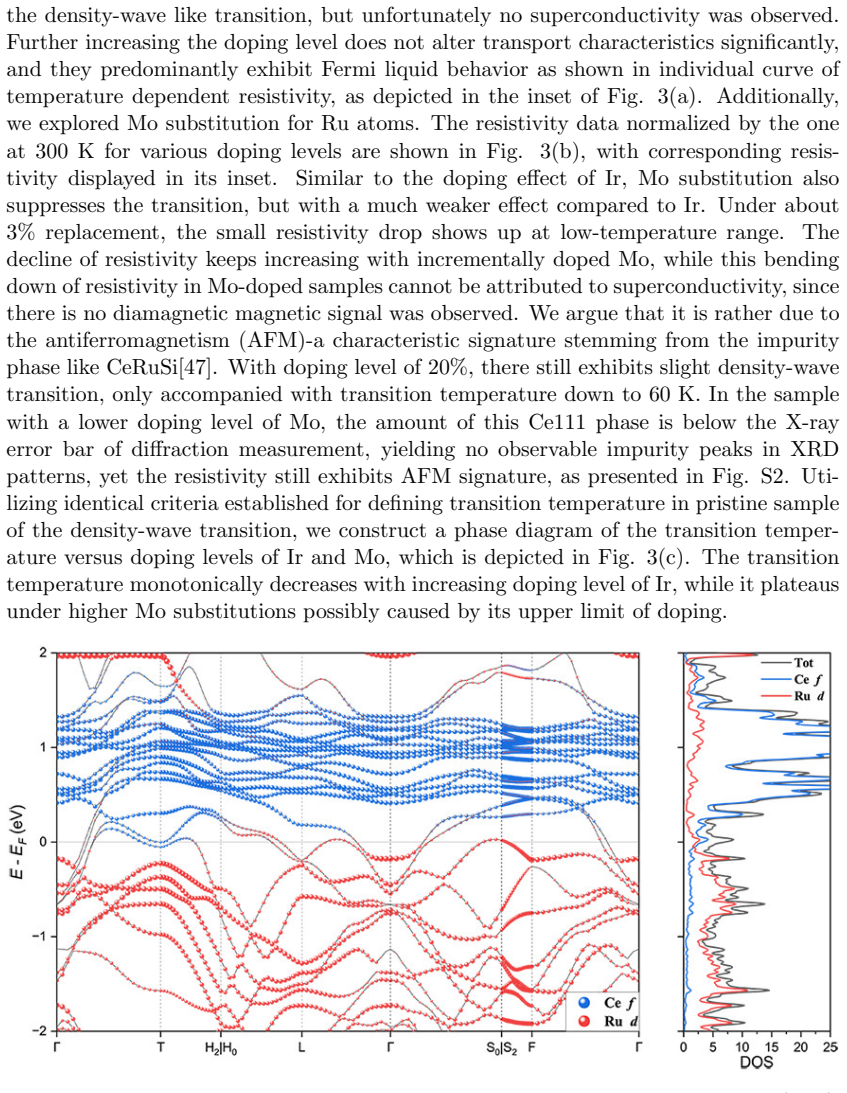
The central object is the Ru kagome plane in Ce2Ru3Si and the Mexican-hat-shaped Ru-4d band it produces near the Fermi energy; a Mexican-hat dispersion is an inverted band whose density of states peaks in a van Hove singularity at the band edge. This van Hove singularity is the proposed instability: a high density of states near the Fermi level can drive a Fermi-surface instability, which the paper detects as a resistivity shoulder and a specific-heat bump. The same machinery also includes the moderate 4f-4d hybridization inferred from the small Ce effective moment and the Wilson ratio of 3.1.
What would settle it
Cool a phase-pure single crystal of Ce2Ru3Si through 137 K and collect X-ray or neutron diffraction: an intrinsic density wave should produce new superlattice reflections or diffuse scattering below the transition, and their absence despite a reproducible resistivity shoulder would falsify the density-wave interpretation.
Extended reading notes
Core claim
On the authors' account, Ce2Ru3Si is a hexagonal Laves-phase compound (space group R-3m) with a Ru kagome plane, and it develops a density-wave-like order below a transition temperature they define as 137 K from the minimum of $d\rho/dT$. The transport anomaly is a broad resistivity shoulder from about 150 K down to 125 K, and the specific heat deviates from a Debye-plus-two-Einstein phonon fit over 66-171 K with a peak in $C_{\rm exp}-C_{\rm fit}$ that tracks the transport feature. Magnetization obeys Curie-Weiss behavior with no phase-transition anomaly, which rules out a spin density wave and points toward a charge density wave; the small effective moment ($\mu_{\rm eff}=0.48\,\mu_B$) suggests the Ce-4f electrons are substantially delocalized. The authors extract $\gamma_n=40.05$ mJ mol$^{-1}$ K$^{-2}$ and a Wilson ratio of 3.1, indicating moderate correlations. Their DFT calculation shows Ce-4f and Ru-4d bands crossing the Fermi level, with a Mexican-hat-shaped Ru-4d band at $\Gamma$ that produces a van Hove singularity, which they propose as the likely driver of the order. Ir doping suppresses the transition rapidly (x=0.1 lowers it to 60 K; x=0.2 removes it), while Mo doping suppresses it more weakly, and the low-temperature resistivity downturn in Mo-doped samples is attributed to a CeRuSi impurity phase rather than superconductivity.
Load-bearing premise
The claim of an intrinsic density-wave transition rests on the assumption that the resistivity shoulder and the specific-heat bump come from the bulk Ce2Ru3Si phase itself, not from a hidden impurity or from the assumed phonon background; the authors' own Mo-doping data show that such hidden impurity signatures are a real possibility.
Editorial extensions
If this is right
- Ce2Ru3Si becomes a new Ru-based kagome platform in which a 137 K density-wave-like order coexists with moderately correlated 4f electrons, extending kagome density-wave studies beyond 3d-element kagome metals.
- Because magnetization shows no anomaly, the order is expected to be a charge density wave rather than a spin density wave, so diffraction or local-probe experiments should find a lattice or electronic modulation below 137 K.
- The doping phase diagram shows that Ir substitution at the Ru site is a sharp tuning knob: 10% lowers the transition to 60 K and 20% removes it, while Mo is gentler; no superconductivity appears in either series down to low temperature.
- The large specific-heat coefficient ($\gamma_n \approx 40$ mJ mol$^{-1}$ K$^{-2}$) and Wilson ratio 3.1 place the material in an intermediate-correlation regime where the density wave may be interaction-driven rather than purely nesting-driven.
- The CeRuSi impurity signature in Mo-doped samples serves as a caution: resistivity features of similar shape can be produced by minority phases below X-ray detection.
Reading between the lines
- Editorial inference: If the density wave is tied to the Mexican-hat van Hove singularity, then pressure, strain, or electron doping that moves the vHS relative to the Fermi level should tune the 137 K transition; the paper reports only chemical doping, so this is a testable extension.
- Editorial inference: The authors' own Mo-doping data show that a CeRuSi impurity below X-ray detection still leaves a clear resistivity signature, so the pristine sample's shoulder should be verified in a phase-pure single crystal or by local probes such as STM and X-ray diffraction before the intrinsic-order interpretation is fully settled.
- Editorial inference: Because the effective Ce moment is small and no heavy-fermion flat band appears near the Fermi level, Ce likely sits in an intermediate-valence state; resonant X-ray absorption or angle-resolved photoemission could directly test whether 4f delocalization controls the transition temperature.
Signed reviews
Editorial analysis
A structured set of objections, weighed in public.
Referee Report
Summary. The manuscript reports the synthesis and basic characterization of a new hexagonal Laves-phase compound, Ce2Ru3Si, in which Ru atoms form kagome planes. The authors observe a broad shoulder in the electrical resistivity with a minimum in dρ/dT at 137 K, a bump in the specific heat after subtracting a six-parameter phonon baseline between about 66 K and 171 K, and a Curie-Weiss magnetic susceptibility with an effective moment of 0.48 μB. They interpret the transport and specific-heat anomalies as evidence for a density-wave-like transition, construct a doping phase diagram for Ir and Mo substitution, report a Wilson ratio of 3.1, and present DFT band-structure calculations showing a Mexican-hat-shaped Ru-4d band near the Fermi energy. The central claim is that Ce2Ru3Si is a new Ru-kagome platform with an intrinsic density-wave-like order near 137 K.
Significance. If the transition is intrinsic, the paper would introduce a new Ru-kagome material with moderate electronic correlations, 4f-4d hybridization, and a Mexican-hat band, which is a valuable addition to the kagome family and connects to ongoing studies of density-wave order in kagome systems. The manuscript has clear merits: it reports a new ternary Laves-phase compound with good Rietveld refinement, a systematic chemical-doping series, and independent DFT calculations that are not derived from the transport fits. However, the load-bearing evidence for the density-wave transition is the specific-heat residual, and that evidence is currently not robust against an alternative single-ion Ce crystal-field or impurity-phase explanation. The paper's own wording acknowledges ambiguity in the resistivity shoulder and shows that below-XRD-detection CeRuSi impurities can produce resistivity signatures, so the central claim needs additional work before it can be accepted.
major comments (3)
- [§3, Fig. 2(c) and (d)] The thermodynamic evidence for the transition is the residual C_exp − C_fit obtained after subtracting the model C(T) = a·D(θ_D,T) + b·E(θ_E1,T) + c·E(θ_E2,T) + γ_nT. This baseline contains no contribution from the Ce 4f electrons, even though the magnetization shows Curie-Weiss behavior with μ_eff = 0.48 μB, indicating at least partially localized or crystal-field-reduced 4f moments. In Ce intermetallics, crystal-electric-field splitting of the J = 5/2 multiplet produces a broad Schottky anomaly, and for a splitting Δ ≈ 250–350 K that peak falls precisely in the 66–171 K window reported here. Because the phonon model has six adjustable parameters and the fit is quoted without uncertainties, the residual in Fig. 2(d) is not presently distinguishable from a single-ion Ce contribution. The authors should include a Ce CEF Schottky term in the baseline fit, measure a nonmagnetic analog (e.g., La2Ru3Si if it can be synthesized), or provide another direct test that rules out the CEF scenario.
- [§3 and Supplementary Fig. S2] The paper itself shows that a CeRuSi impurity phase below the X-ray detection limit can produce a resistivity signature in Mo-doped samples, and the authors describe the pristine resistivity shoulder as having an ambiguous nature. No low-temperature diffraction, neutron scattering, or STM evidence for a superlattice or an order parameter is presented. As a result, the possibility that the resistivity anomaly and the specific-heat residual arise from a minor extrinsic phase or from a different intrinsic mechanism (rather than a density wave) is not excluded. A specific test, such as high-resolution low-temperature XRD showing a superlattice reflection, resonant X-ray scattering, or a microscopic probe of the order, is needed to support the density-wave assignment.
- [§3, Fig. 2(c) and Wilson-ratio analysis] The values γ_n = 40.05 mJ mol⁻¹ K⁻² and θ_D = 218.6 K are obtained from a low-temperature Debye fit, but the fit range, the number of points, and the statistical uncertainties of these parameters are not reported. Since γ_n is used not only in the Wilson ratio R_W = 3.1 but also as a fixed parameter in the phonon baseline that generates the specific-heat residual, the absence of error bars makes it impossible to assess whether the anomaly is significant relative to the baseline uncertainty. The authors should report the fit range, residuals, and error bars for γ_n, θ_D, and the Einstein/Debye weights.
minor comments (5)
- [§3, magnetization equation] The Curie-Weiss equation is printed as χ(T) = χ(0) + C(T + T0), which is dimensionally incorrect without a division by (T + T0); the intended formula is presumably χ(T) = χ(0) + C/(T + T0). This should be corrected so that the fitted μ_eff and χ(0) are reproducible.
- [Abstract and Introduction] The phrase 'trinary Laves phase' should be 'ternary Laves phase', and 'an useful platform' should be 'a useful platform'.
- [§3, first paragraph] There are several typographical errors: 'samall values' should be 'small values', 'experimental date' should be 'experimental data', and 'mainfesting' should be 'manifesting'.
- [§3, Fig. 2(d)] The difference curve C_exp − C_fit is presented without error bars, although both C_exp and the six-parameter fit carry uncertainties; adding a confidence band would help the reader judge the significance of the peak.
- [§4, Conclusions] The conclusion says that the lack of a magnetization anomaly rules out spin-density wave and that the transition is 'very likely related to charge density wave', but this is stronger than the body text's statement that 'the nature of this shoulder is ambiguous'. The wording should be aligned with the caution expressed in §3.
Circularity Check
No significant circularity: transition temperature is an operational definition, the specific-heat residual is a background subtraction, and self-citations are not load-bearing.
full rationale
The central claim—a density-wave-like transition near 137 K in Ce2Ru3Si—rests on two independent data sets. The transport transition temperature is an operational criterion (minimum of dρ/dT), not a fitted parameter later renamed as a prediction. The specific-heat evidence is a residual C_exp − C_fit after subtracting a Debye+two-Einstein+γT background; this is a standard background-subtraction display, and although the residual is by construction whatever the model does not absorb (so a Ce-4f Schottky anomaly is a plausible competing explanation), the paper does not fit the transition parameters and then claim to predict them. The Wilson ratio combines separately fitted χ(0) and γ_n through a standard formula and is a secondary characterization, not evidence for the transition. The DFT calculation of the band structure and Mexican-hat band is independent of the transport and specific-heat fits. The self-citations (refs 14, 15, 20, 23, 33, 45, 54) are background literature or analogies for phonon models and Mexican-hat bands, and no load-bearing claim depends on them. No uniqueness theorem or ansatz is imported from the authors' prior work. Therefore no circular step is identifiable; the weaknesses (impurity phase, phonon-baseline ambiguity) are experimental robustness issues, not circularity.
Assumptions & free parameters
free parameters (4)
- gamma_n (Sommerfeld coefficient) =
40.05 mJ mol^-1 K^-2
- theta_D (Debye temperature) =
218.6 K
- Phonon model weights a, b, c and Einstein temperatures theta_E1, theta_E2 =
not reported
- Curie-Weiss parameters chi(0), C, T0 =
chi(0) = 0.00171 emu mol^-1 Oe^-1; mu_eff = 0.48 mu_B
assumptions (4)
- domain assumption GGA-PBE with spin-orbit coupling accurately places the Ce 4f and Ru 4d bands near the Fermi level in Ce2Ru3Si.
- domain assumption The polycrystalline sample is phase-pure and stoichiometric enough that resistivity and specific heat reflect bulk Ce2Ru3Si.
- ad hoc to paper The one-Debye-plus-two-Einstein phonon model correctly describes the lattice heat capacity, so the residual C_exp minus C_fit is a genuine electronic transition anomaly.
- domain assumption A broad resistivity shoulder plus a broad specific-heat bump indicates a density-wave-like phase transition rather than a gradual crossover or impurity contribution.
Cite this review
Pith. "Pith review of Density-wave like behavior in a new Kagome material Ce$_{2}$Ru$_{3}$Si." pith.science (2026). https://pith.science/paper/26EPG3HW
@misc{pith2026241109907,
  author       = {Pith},
  title        = {Pith review of: Density-wave like behavior in a new Kagome material Ce$_2$Ru$_3$Si},
  year         = {2026},
  howpublished = {\url{https://pith.science/paper/26EPG3HW}},
  note         = {Machine review of arXiv:2411.09907}
}
abstract
Kagome materials with inherent geometric frustration can produce many interesting physical properties, such as flat bands, quantum spin liquid, chiral magnetism, superconductivity and density-wave orders. Sometimes, the localized 4$f$ electrons from Ce atoms coupled with other conduction electrons would also give rise to the flat bands near the Fermi level, and results in the formation of heavy fermion. Thus, it is highly probable that kagome material incorporating Ce element will display nontrivial physical properties. In this study, we present a new Kagome material belonging to the trinary Laves phase, Ce$_{2}$Ru$_{3}$Si, in which kagome plane is formed by Ru atoms. Electrical transport and specific heat measurements reveal a density-wave like transition. A Curie-Weiss behavior is observed in low-temperature region. Meanwhile we also find a relatively large specific coefficient $\gamma_{n}(0)$. The calculated Wilson ratio $R_\mathrm{W}\propto{\chi(0)/\gamma_{n}}$ is approximately 3.1, indicating a moderate electron correlation effect. Chemical doping of Ir at the Ru site rapidly suppresses this density-wave like transition, while Mo doping leads to a gradual decrease in transition temperature. Theoretical calculation indicates both the Ce-4$f$ and Ru-4$d$ electronic bands cross the Fermi level, forming a Mexican-hat-shape Fermi surface close to the Fermi energy, potentially accounting for the observed density-wave like transition. Our findings provide an useful platform for investigating how hybridization between 4$f$ and 4$d$ electrons influences the electronic transport, and the relationship between the density-wave transition and kagome structure.
Figures


Figures from the paper (1 more)
Reference graph
Works this paper leans on
-
[1]
Syozi, Statistics of kagome lattice, Prog
I. Syozi, Statistics of kagome lattice, Prog. Theor. Phys. 6 (1951) 306. doi:10. 1143/ptp/6.3.306
work page 1951
-
[2]
M. P. Shores, E. A. Nytko, B. M. Bartlett, D. G. Nocera, A structurally perfect s = 1/2 kagom´ e antiferromagnet, J. Am. Chem. Soc. 127 (2005) 13462. doi:10.1021/ ja053891p
work page 2005
-
[3]
M. L. Kiesel, R. Thomale, Sublattice interference in the kagome hubbard model, Phys. Rev. B 86 (2012) 121105(R). doi:10.1103/PhysRevB.86.121105
-
[4]
M. L. Kiesel, C. Platt, R. Thomale, Unconventional fermi surface instabilities in the kagome hubbard model, Phys. Rev. Lett. 110 (2013) 126405. doi:10.1103/ PhysRevLett.110.126405
work page 2013
-
[5]
W.-S. Wang, Z.-Z. Li, Y.-Y. Xiang, Q.-H. Wang, Competing electronic orders on kagome lattices at van hove filling, Phys. Rev. B 87 (2013) 115135. doi:10.1103/ PhysRevB.87.115135
work page 2013
-
[6]
Y. Wang, H. Wu, G. T. McCandless, J. Y. Chan, M. N. Ali, Quantum states and intertwining phases in kagome materials, Nat. Rev. Phys. 5 (2023) 635. doi: 10.1038/s42254-023-00635-7
-
[7]
J.-X. Yin, W. Ma, T. A. Cochran, X. Xu, S. S. Zhang, H.-J. Tien, N. Shumiya, G. Cheng, K. Jiang, B. Lian, Z. Song, G. Chang, I. Belopolski, D. Multer, M. Litske- vich, Z.-J. Cheng, X. P. Yang, B. Swidler, H. Zhou, H. Lin, T. Neupert, Z. Wang, N. Yao, T.-R. Chang, S. Jia, M. Zahid Hasan, Quantum-limit chern topological mag- netism in tbmn6sn6, Nature 583 (...
-
[8]
H. M. Guo, M. Franz, Topological insulator on the kagome lattice, Phys. Rev. B 80 (2009) 113102. doi:10.1103/PhysRevB.80.113102
Show all 53 references
-
[9]
J. Wen, A. R¨ uegg, C. C. J. Wang, G. A. Fiete, Interaction-driven topological insu- lators on the kagome and the decorated honeycomb lattices, Phys. Rev. B 82 (2010) 075125. doi:10.1103/PhysRevB.82.075125
2010 doi
-
[10]
Green, L
D. Green, L. Santos, C. Chamon, Isolated flat bands and spin-1 conical bands in two-dimensional lattices, Phys. Rev. B 82 (2010) 075104. doi:10.1103/PhysRevB. 82.075104. 10
2010 doi
-
[11]
Bolens, N
A. Bolens, N. Nagaosa, Topological states on the breathing kagome lattice, Phys. Rev. B 99 (2019) 165141. doi:10.1103/PhysRevB.99.165141
2019 doi
-
[12]
B. R. Ortiz, L. C. Gomes, J. R. Morey, M. Winiarski, M. Bordelon, J. S. Mangum, I. W. H. Oswald, J. A. Rodriguez-Rivera, J. R. Neilson, S. D. Wilson, E. Ertekin, T. M. McQueen, E. S. Toberer, New kagome prototype materials: discovery of kv3sb5, rbv3sb5 and csv3sb5, Phys. Rev. ...
2019
-
[14]
X. Zhou, Y. Li, X. Fan, J. Hao, Y. Xiang, Z. Liu, Y. Dai, Z. Wang, Y. Yao, H.-H. Wen, Electronic correlations and evolution of the charge density wave in the kagome metals av3sb5 (a=k,rb,cs), Phys. Rev. B 107 (2023) 165123. doi: 10.1103/PhysRevB.107.165123
2023 doi
-
[15]
X. Zhou, Y. Li, X. Fan, J. Hao, Y. Dai, Z. Wang, Y. Yao, H.-H. Wen, Origin of charge density wave in the kagome metal csv3sb5 as revealed by optical spectroscopy, Phys. Rev. B 104 (2021) L041101. doi:10.1103/PhysRevB.104.L041101
2021 doi
-
[16]
B. R. Ortiz, P. M. Sarte, E. M. Kenney, M. J. Graf, S. M. L. Teicher, R. Seshadri, S. D. Wilson, Superconductivity in the z2 kagome metal kv3sb5, Phys. Rev. Mater. 5 (2021) 034801. doi:10.1103/PhysRevMaterials.5.034801
2021 doi
-
[17]
Neupert, M
T. Neupert, M. M. Denner, J.-X. Yin, R. Thomale, M. Z. Hasan, Charge order and superconductivity in kagome materials, Nat. Phys. 18 (2021) 137. doi:10.1038/ s41567-021-01404-y
2021
-
[18]
Jiang, T
K. Jiang, T. Wu, J.-X. Yin, Z. Wang, M. Z. Hasan, S. D. Wilson, X. Chen, J. Hu, Kagome superconductors av3sb5 (a = k, rb, cs), Natl. Sci. Rev. 10 (2023) nwac199. doi:10.1093/nsr/nwac199
2023 doi
-
[19]
H. Zhao, H. Li, B. R. Ortiz, S. M. L. Teicher, T. Park, M. Ye, Z. Wang, L. Balents, S. D. Wilson, I. Zeljkovic, Cascade of correlated electron states in the kagome super- conductor csv3sb5, Nature 599 (2021) 216. doi:10.1038/s41586-021-03946-w
2021 doi
-
[20]
Xiang, Q
Y. Xiang, Q. Li, Y. Li, W. Xie, H. Yang, Z. Wang, Y. Yao, H.-H. Wen, Twofold symmetry of c-axis resistivity in topological kagome superconductor csv3sb5 with in-plane rotating magnetic field, Nat. Commun. 12 (2021) 6727. doi:10.1038/ s41467-021-27084-z
2021
-
[21]
Liu, Z.-Y
Y. Liu, Z.-Y. Liu, J.-K. Bao, P.-T. Yang, L.-W. Ji, S.-Q. Wu, Q.-X. Shen, J. Luo, J. Yang, J.-Y. Liu, C.-C. Xu, W.-Z. Yang, W.-L. Chai, J.-Y. Lu, C.-C. Liu, B.-S. 11 Wang, H. Jiang, Q. Tao, Z. Ren, X.-F. Xu, C. Cao, Z.-A. Xu, R. Zhou, J.-G. Cheng, G.-H. Cao, Superconductivity ...
-
[22]
X. Teng, L. Chen, F. Ye, E. Rosenberg, Z. Liu, J.-X. Yin, Y.-X. Jiang, J. S. Oh, M. Z. Hasan, K. J. Neubauer, B. Gao, Y. Xie, M. Hashimoto, D. Lu, C. Jozwiak, A. Bostwick, E. Rotenberg, R. J. Birgeneau, J.-H. Chu, M. Yi, P. Dai, Discovery of charge density wave in a kagome lat...
2022 doi
-
[23]
S. Li, B. Zeng, X. Wan, J. Tao, F. Han, H. Yang, Z. Wang, H.-H. Wen, Anomalous properties in the normal and superconducting states of laru3si2, Phys. Rev. B 84 (2011) 214527. doi:10.1103/physrevb.84.214527
2011 doi
-
[24]
Plokhikh, C
I. Plokhikh, C. Mielke, H. Nakamura, V. Petricek, Y. Qin, V. Sazgari, J. K¨ uspert, I. Bia lo, S. Shin, O. Ivashko, J. N. Graham, M. V. Zimmermann, M. Medarde, A. Amato, R. Khasanov, H. Luetkens, M. H. Fischer, M. Z. Hasan, J.-X. Yin, T. Neupert, J. Chang, G. Xu, S. Nakatsuji,...
2024
-
[25]
Guguchia, R
Z. Guguchia, R. Khasanov, H. Luetkens, Unconventional charge order and super- conductivity in kagome-lattice systems as seen by muon-spin rotation, npj Quantum Mater. 8 (2023) 41. doi:10.1038/s41535-023-00574-7
2023 doi
-
[26]
L. Z. Deng, M. Gooch, H. X. Liu, T. Bontke, J. Y. You, S. Shao, J. X. Yin, D. Schulze, Y. G. Shi, Y. P. Feng, G. Chang, Q. M. Si, C. W. Chu, Magnetic kagome superconductor CeRu 2 (2022). doi:10.48550/arXiv.2204.00553
2022 doi
-
[27]
J. W. Allen, S. J. Oh, I. Lindau, M. B. Maple, J. F. Suassuna, S. B. Hagstr¨ om, Ceru2 and ceco2: Superconductors with 4f electrons, Phys. Rev. B 26 (1982) 445. doi:10.1103/PhysRevB.26.445
1982 doi
-
[28]
S. B. Roy, P. Chaddah, Interesting normal state and superconducting properties of the intermediate valence compound ceru2, Pramana 53 (1999) 659. doi:10.1007/ s12043-999-0103-y
1999
-
[29]
J. G. Checkelsky, B. A. Bernevig, P. Coleman, Q. Si, S. Paschen, Flat bands, strange metals and the kondo effect, Nat. Rev. Mater. 9 (2024) 509. doi:10.1038/ s41578-023-00644-z
2024
-
[30]
K. S. Kumar, P. M. Hazzledine, Polytypic transformations in laves phases, Inter- metallics 12 (2004) 763. doi:10.1016/j.intermet.2004.02.017
2004 doi
-
[31]
A. K. Sinha, Topologically close-packed structures of transition metal alloys, Prog. Mater Sci. 15 (1972) 81. 12
1972
-
[32]
K. Kudo, H. Hiiragi, T. Honda, K. Fujimura, H. Idei, M. Nohara, Superconductivity in mg2ir3si: A fully ordered laves phase, J. Phys. Soc. Jpn. 89 (2020).doi:10.7566/ jpsj.89.013701
2020
-
[33]
Z. Zhu, Y. Wu, S. Fan, Y. Fan, Y. Li, Y. Ye, X. Zhu, H. Zhang, H.-H. Wen, Anomalous properties in normal and superconducting states of sc2ir4-xsix due to flat band effect driven by spin-orbit coupling, Commun. Mater. 5 (2024) 85. doi: 10.1038/s43246-024-00521-4
2024 doi
-
[34]
H. M. Rietveld, A profile refinement method for nuclear and magnetic structures, J. Appl. Crystallogr. 2 (1969) 65. doi:10.1107/s0021889869006558
1969 doi
-
[35]
R. W. Cheary, A. Coelho, A fundamental parameters approach to x-ray line-profile fitting, J. Appl. Crystallogr. 25 (1992) 109. doi:10.1107/s0021889891010804
1992 doi
-
[36]
Kresse, J
G. Kresse, J. Furthm¨ uller, Efficiency of ab-initio total energy calculations for metals and semiconductors using a plane-wave basis set, Comput. Mater. Sci 6 (1996) 15. doi:https://doi.org/10.1016/0927-0256(96)00008-0
1996 doi
-
[37]
Kresse, J
G. Kresse, J. Furthm¨ uller, Efficient iterative schemes for ab initio total-energy calculations using a plane-wave basis set, Phys. Rev. B 54 (1996) 11169. doi: 10.1103/PhysRevB.54.11169
1996 doi
-
[38]
Kresse, D
G. Kresse, D. Joubert, From ultrasoft pseudopotentials to the projector augmented- wave method, Phys. Rev. B 59 (1999) 1758. doi:10.1103/PhysRevB.59.1758
1999 doi
-
[39]
Kresse, J
G. Kresse, J. Hafner, Ab initio molecular dynamics for liquid metals, Phys. Rev. B 47 (1993) 558. doi:10.1103/PhysRevB.47.558
1993 doi
-
[40]
J. P. Perdew, K. Burke, M. Ernzerhof, Generalized gradient approximation made simple, Phys. Rev. Lett. 77 (1996) 3865. doi:10.1103/PhysRevLett.77.3865
1996 doi
-
[41]
Morosan, H
E. Morosan, H. W. Zandbergen, B. S. Dennis, J. W. G. Bos, Y. Onose, T. Klimczuk, A. P. Ramirez, N. P. Ong, R. J. Cava, Superconductivity in cuxtise2, Nat. Phys. 2 (2006) 544. doi:10.1038/nphys360
2006 doi
-
[42]
W. P. Beyermann, M. F. Hundley, J. D. Thompson, F. N. Diederich, G. Gr¨ uner, Low-temperature specific heat of c60, Phys. Rev. Lett. 68 (1992) 2046. doi:10. 1103/PhysRevLett.68.2046
1992
-
[43]
L. Wu, J. Schliesser, B. F. Woodfield, H. Xu, A. Navrotsky, Heat capacities, stan- dard entropies and gibbs energies of sr-, rb- and cs-substituted barium aluminoti- tanate hollandites, J. Chem. Thermodynamics 93 (2016) 1. doi:10.1016/j.jct. 2015.09.019
2016 doi
-
[44]
C. Kant, J. Deisenhofer, A. G¨ unther, F. Schrettle, A. Loidl, M. Rotter, D. Johrendt, Magnetic and superconducting transitions in ba1-xkxfe2as2 studied by specific heat, Phys. Rev. B 81 (2010) 014529. doi:10.1103/physrevb.81.014529. 13
2010 doi
-
[45]
Y. Li, Z. Zhu, Y. Ye, W. Hong, Y. Li, S. Li, H. Luo, H.-H. Wen, Multiband super- conductivity and a deep gap minimum from the specific heat in kca2(fe1xnix)4as4f (x=0, 0.05, 0.13), Phys. Rev. B 109 (2024) 014506. doi:10.1103/PhysRevB.109. 014506
2024 doi
-
[46]
K. G. Wilson, The renormalization group: Critical phenomena and the kondo prob- lem, Rev. Mod. Phys. 47 (1975) 773. doi:10.1103/revmodphys.47.773
1975 doi
-
[47]
Rebelsky, K
L. Rebelsky, K. Reilly, S. Horn, H. Borges, J. D. Thompson, J. O. Willis, R. Aikin, R. Caspari, C. D. Bredl, Heavy fermion behavior in ceptsi and cerusi, J. Appl. Phys. 63 (1988) 3405. doi:10.1063/1.340775
1988 doi
-
[48]
Y. Cao, V. Fatemi, S. Fang, K. Watanabe, T. Taniguchi, E. Kaxiras, P. Jarillo- Herrero, Unconventional superconductivity in magic-angle graphene superlattices, Nature 556 (2018) 43. doi:10.1038/nature26160
2018 doi
-
[49]
Marchenko, D
D. Marchenko, D. V. Evtushinsky, E. Golias, A. Varykhalov, T. Seyller, O. Rader, Extremely flat band in bilayer graphene, Sci. Adv. 4 (2018) eaau0059. doi:10. 1126/sciadv.aau0059
2018
-
[50]
Y. Li, Z. Yin, Z. Liu, W. Wang, Z. Xu, Y. Song, L. Tian, Y. Huang, D. Shen, D. Abernathy, J. Niedziela, R. Ewings, T. Perring, D. M. Pajerowski, M. Matsuda, P. Bourges, E. Mechthild, Y. Su, P. Dai, Coexistence of ferromagnetic and stripe antiferromagnetic spin fluctuations in ...
2019 doi
-
[51]
Tarnopolsky, A
G. Tarnopolsky, A. J. Kruchkov, A. Vishwanath, Origin of magic angles in twisted bilayer graphene, Phys. Rev. Lett. 122 (2019) 106405. doi:10.1103/physrevlett. 122.106405
2019 doi
-
[52]
Yankowitz, S
M. Yankowitz, S. Chen, H. Polshyn, Y. Zhang, K. Watanabe, T. Taniguchi, D. Graf, A. F. Young, C. R. Dean, Tuning superconductivity in twisted bilayer graphene, Science 363 (2019) 1059. doi:10.1126/science.aav1910
2019 doi
-
[53]
J.-X. Yin, S. S. Zhang, G. Chang, Q. Wang, S. S. Tsirkin, Z. Guguchia, B. Lian, H. Zhou, K. Jiang, I. Belopolski, N. Shumiya, D. Multer, M. Litskevich, T. A. Cochran, H. Lin, Z. Wang, T. Neupert, S. Jia, H. Lei, M. Z. Hasan, Negative flat band magnetism in a spin–orbit-coupled...
2019 doi
-
[54]
Jiang, B
W. Jiang, B. Li, X. Wang, G. Chen, T. Chen, Y. Xiang, W. Xie, Y. Dai, X. Zhu, H. Yang, J. Sun, H.-H. Wen, Van hove singularity arising from mexican-hat-shaped inverted bands in the topological insulator sn-doped bi1.1sb0.9te2s, Phys. Rev. B 101 (2020). doi:10.1103/physrevb.101...
2020 doi
Reviewed August 12, 2026 · model on record in the stance chip above.
Discussion (0). Continue with ORCID to comment.