Non-Local and Non-Markovian Effects of a Microscopic Two-Level Defect in Superconducting Quantum Circuits
Pith reviewed 2026-05-25 04:53 UTC · model grok-4.3
The pith
A coherent two-level defect inside a tunable coupler couples simultaneously to two distant superconducting qubits.
A machine-rendered reading of the paper's core claim, the machinery that carries it, and where it could break.
Core claim
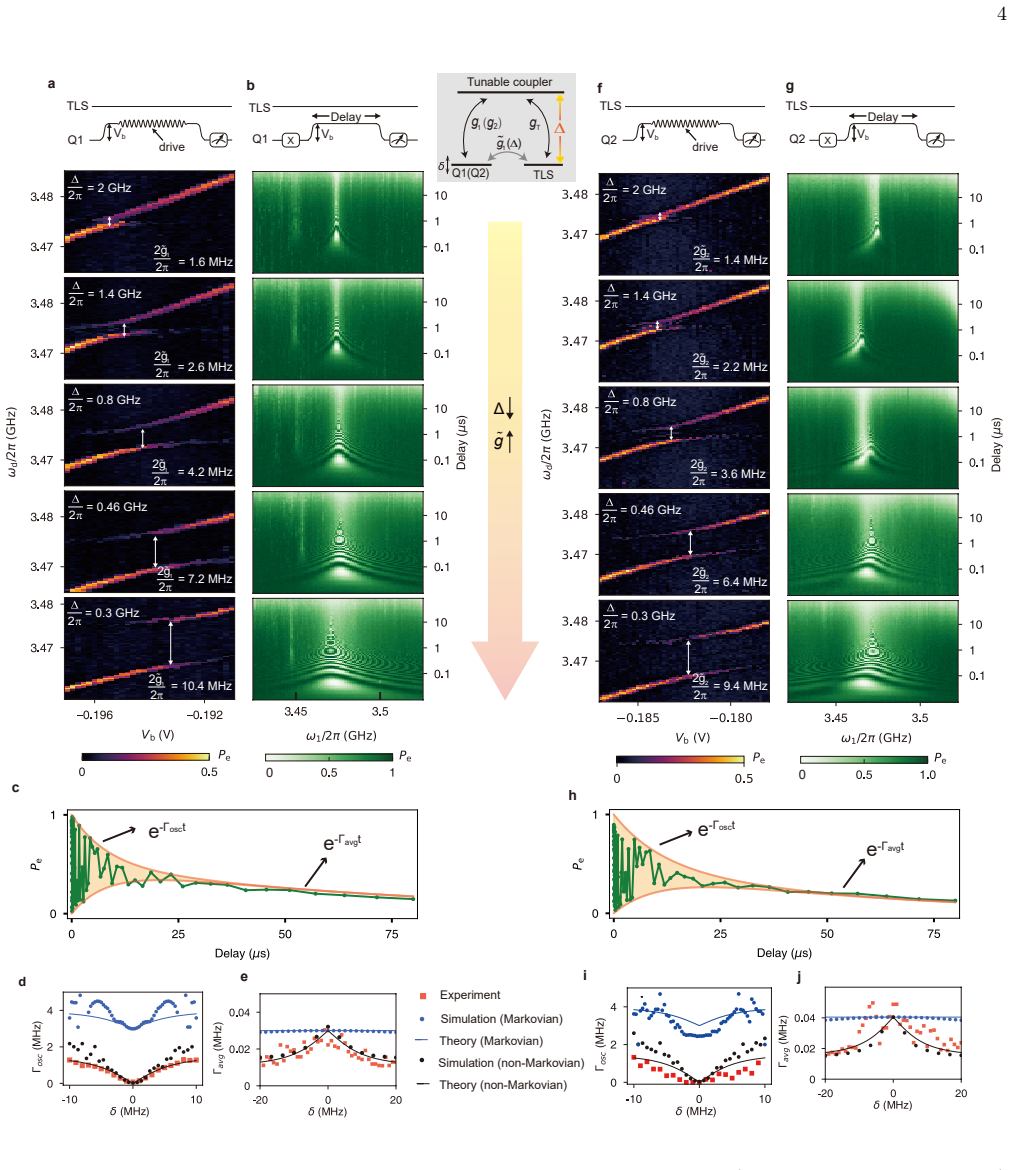
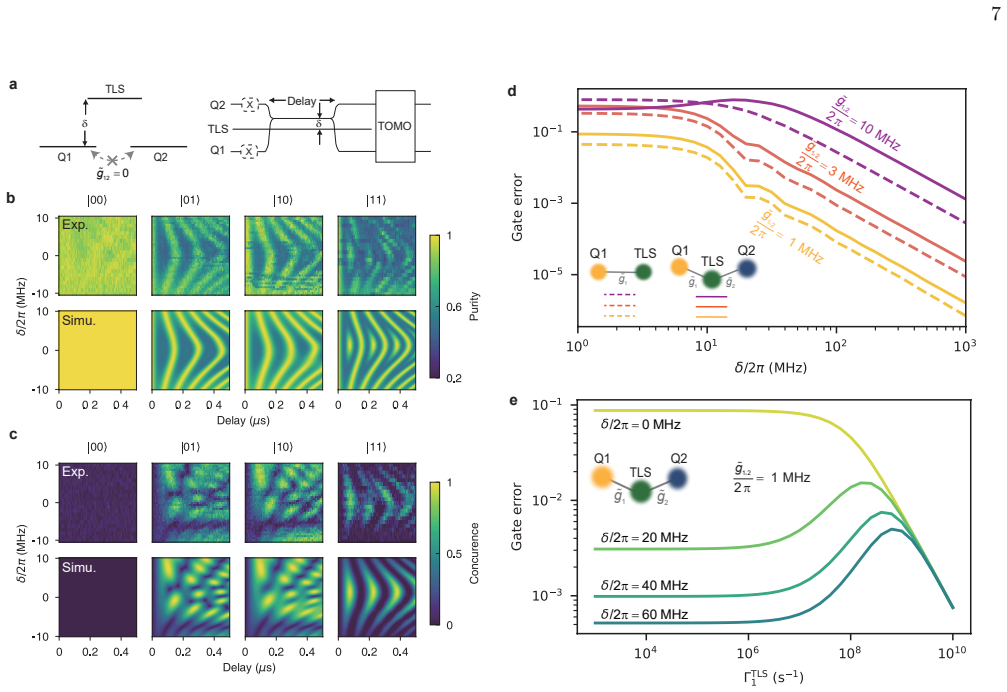
We report the observation of a coherent TLS that couples simultaneously to two spatially distant superconducting qubits. The TLS is identified to reside within the tunable coupler linking the qubits, enabling controllability of the TLS-qubit coupling strength via coupler frequency. This tunability allows systematic probing of how the TLS distorts qubit dynamics, including reconstruction of the TLS frequency fluctuation spectrum as 1/f noise spanning more than ten orders of magnitude. Quantum process tomography further reveals TLS-induced correlated qubit dynamics, establishing the long-lived TLS as an effective source of non-Markovianity in the system.
What carries the argument
The tunable coupler that hosts the TLS, whose frequency sets the TLS-qubit coupling strength and thereby controls the non-local interaction.
If this is right
- Defects embedded in coupling elements can simultaneously affect multiple qubits with variable impact.
- System characterization and calibration must account for non-local TLS effects.
- The tunable coupler provides a controllable testbed for studying defect-driven quantum dynamics.
- Error suppression strategies and architecture design for scalable processors need to address non-local, non-Markovian contributions from couplers.
Where Pith is reading between the lines
- Larger processors may contain hidden coupler defects that create unexpected long-range correlated errors not captured by local noise models.
- Routine calibration sequences could be extended to sweep coupler frequencies and isolate individual TLS signatures in situ.
- The same hardware could serve as an experimental platform for testing multi-qubit non-Markovian noise mitigation techniques.
- Architecture layouts may need to treat couplers as potential multi-qubit noise hubs rather than passive connectors.
Load-bearing premise
The observed coherent coupling, tunability, and correlated dynamics all arise from one TLS located inside the tunable coupler rather than from other defects or mechanisms.
What would settle it
If the strength of the observed TLS-qubit interaction showed no dependence on the coupler frequency, or if process tomography found no correlated evolution between the two qubits, the claim that a single controllable TLS resides in the coupler would be ruled out.
Figures

read the original abstract
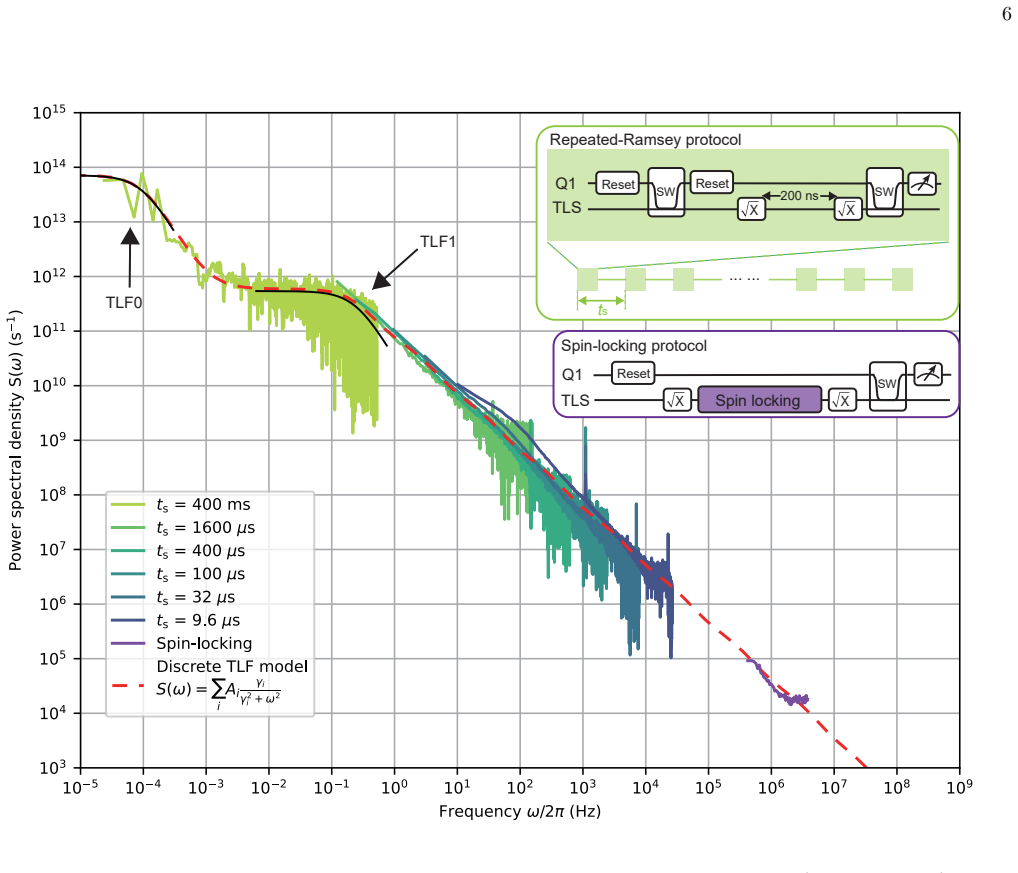
Microscopic two-level systems (TLS) -- ubiquitous atomic-scale defects in solid-state quantum devices -- are a dominant source of qubit decoherence, yet their role is often considered local and short-memoried. Here, we report the observation of a coherent TLS that couples simultaneously to two spatially distant superconducting qubits. The TLS is identified to reside within the tunable coupler linking the qubits, enabling controllability of the TLS-qubit coupling strength via coupler frequency -- a capability absent in earlier studies. This tunability allows us to systematically probe how TLS distorts qubit dynamics, revisiting the decoherence model in the presence of non-Markovian TLS dephasing noise. This is corroborated by the reconstructed $1/f$ noise spectrum of TLS frequency fluctuation spanning more than ten orders of magnitude (0.1\,mHz -- 1\,MHz) that reveals discrete fluctuator signatures. Quantum process tomography further unveils TLS-induced correlated qubit dynamics, highlighting the long-lived TLS as an effective source of non-Markovianity. Our findings expose a previously overlooked interaction mechanism in scalable quantum architectures: defects embedded in coupling elements can simultaneously affect multiple qubits with variable impact. Beyond immediate implications for system characterization and calibration, this situation provides a powerful testbed for studying defect-driven quantum dynamics, refining error suppression strategies, and advancing architecture design for scalable quantum technologies.
Editorial analysis
A structured set of objections, weighed in public.
Referee Report
Summary. The paper reports the experimental observation of a coherent microscopic two-level system (TLS) that couples simultaneously to two spatially distant superconducting qubits. The TLS is identified as residing in the tunable coupler, which enables control of the TLS-qubit coupling strength by varying the coupler frequency. This setup is used to study non-Markovian TLS dephasing, reconstruct a 1/f noise spectrum of TLS frequency fluctuations over more than ten orders of magnitude (0.1 mHz to 1 MHz), and perform quantum process tomography to demonstrate TLS-induced correlated qubit dynamics.
Significance. If the single-TLS localization to the coupler and the supporting data hold, the result would be significant for exposing non-local defect effects in multi-qubit architectures and providing a controllable testbed for non-Markovian noise. The broad-band spectrum reconstruction and tomography results would strengthen the case for revisiting decoherence models in the presence of long-lived defects.
major comments (2)
- [Main text (TLS identification and frequency-dependence analysis)] The central claim that the TLS resides specifically within the tunable coupler (rather than near one qubit or elsewhere) rests on the observed dependence of the effective coupling on coupler frequency. Without explicit modeling or independent variation of qubit frequencies to exclude qubit-local defects whose interaction is mediated by the coupler, alternative locations remain consistent with the data; this assignment is load-bearing for the non-local and architecture-implication conclusions.
- [Spectrum reconstruction section] The reconstruction of the TLS frequency fluctuation spectrum spanning 0.1 mHz to 1 MHz is presented as revealing discrete fluctuator signatures, but the methods for combining measurements across this range, the fitting procedures, and error analysis are not detailed enough to assess whether the 1/f form and the ten-order span are robustly supported.
minor comments (1)
- The abstract states the TLS is 'identified to reside within the tunable coupler' but the full manuscript should include a dedicated subsection explicitly addressing alternative defect locations and why they are ruled out.
Simulated Author's Rebuttal
We thank the referee for the careful and constructive review. We address the two major comments point by point below, indicating revisions where the manuscript requires strengthening.
read point-by-point responses
-
Referee: [Main text (TLS identification and frequency-dependence analysis)] The central claim that the TLS resides specifically within the tunable coupler (rather than near one qubit or elsewhere) rests on the observed dependence of the effective coupling on coupler frequency. Without explicit modeling or independent variation of qubit frequencies to exclude qubit-local defects whose interaction is mediated by the coupler, alternative locations remain consistent with the data; this assignment is load-bearing for the non-local and architecture-implication conclusions.
Authors: We agree that the localization argument would be strengthened by explicit modeling. The manuscript shows that the effective TLS-qubit coupling varies systematically with coupler frequency while qubit frequencies remain fixed; this dependence is difficult to reconcile with a purely qubit-local TLS. Nevertheless, to exclude mediated alternatives rigorously, the revised manuscript will include a theoretical model comparing expected frequency dependence for coupler-embedded versus qubit-local TLS locations. We will also add supplementary data from independent qubit-frequency sweeps confirming that coupling changes occur only when the coupler frequency is varied. revision: yes
-
Referee: [Spectrum reconstruction section] The reconstruction of the TLS frequency fluctuation spectrum spanning 0.1 mHz to 1 MHz is presented as revealing discrete fluctuator signatures, but the methods for combining measurements across this range, the fitting procedures, and error analysis are not detailed enough to assess whether the 1/f form and the ten-order span are robustly supported.
Authors: We concur that the spectrum-reconstruction methods require fuller documentation. The revised manuscript will expand the relevant section to detail the procedures used to combine data from different time/frequency regimes, the fitting routines applied, and the complete error analysis. These additions will allow direct evaluation of the robustness of the reported 1/f spectrum and its span over more than ten orders of magnitude. revision: yes
Circularity Check
No circularity: experimental observation report with no derivation chain
full rationale
The paper is an experimental report of TLS observation in superconducting circuits, identifying location via frequency dependence of coupling. No mathematical derivations, fitted parameters renamed as predictions, self-citations as load-bearing uniqueness theorems, or ansatzes are present in the provided text. The central claims rest on direct measurements and process tomography rather than any reduction to inputs by construction. This is the most common honest finding for empirical observation papers, which are self-contained against external benchmarks.
discussion (0)
Sign in with ORCID, Apple, or X to comment. Anyone can read and Pith papers without signing in.