REVIEW 5 major objections 6 minor 73 references
Causal Analysis of ASR Errors for Children: Quantifying the Impact of Physiological, Cognitive, and Extrinsic Factors
T0 review · 5 major / 6 minor · reviewed 2026-08-08 · deepseek-v4-flash
Pith's one-line read A causal analysis of children's ASR errors finds the number of words in an utterance is the strongest driver of errors, ahead of age, with gender nearly irrelevant.
desk verdict The benchmarking part is solid and worth reading, but the paper's own Table 6 contradicts its central causal ranking, so the causal section needs major revision before the findings can be trusted. read the letter →
The pith
A machine-rendered reading of the paper's core claim, the machinery that carries it, and where it could break.
The reading
What carries the argument
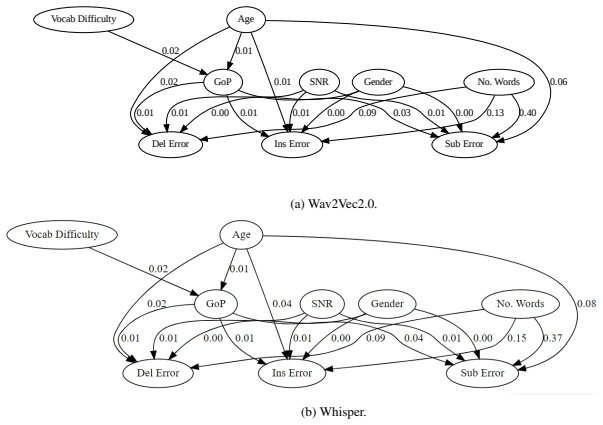
The load-bearing object is a directed acyclic graph (DAG) encoding assumed causal relations among age, gender, goodness-of-pronunciation, vocabulary difficulty, signal-to-noise ratio, number of words, and the three ASR error types. Causal strength is quantified by average causal effect (ACE) for linear relationships and conditional mutual information (CMI) for nonlinear dependence, computed under the DAG's factorization. The DAG lets the analysis treat the factors jointly instead of measuring each in isolation as prior studies did.
What would settle it
A matched-pair study that holds age, gender, SNR, and word difficulty constant while varying only the number of words in otherwise similar prompts would directly test the top-ranked cause; if WER does not rise for shorter utterances under this design, the number-of-words effect is not causal as claimed.
Extended reading notes
Core claim
The authors claim that a causal analysis establishes a clear ranking of influences on children's ASR errors: the extrinsic factor "number of words in the utterance" has the highest average causal effect and conditional mutual information on errors for all four models; age is second; background noise and pronunciation ability follow; gender is negligible; and pronunciation ability is the least sensitive factor among the three categories. They further claim that vocabulary difficulty affects pronunciation more than age does, and that fine-tuning reduces sensitivity to age most strongly, moderately to pronunciation, while sensitivity to the number of words in context remains high.
Load-bearing premise
The entire ranking of causes assumes the paper's causal diagram of which variables cause which is correct and complete, with no unmeasured confounders like recording quality, dialect, or motivation; the authors themselves note this choice is subjective.
Editorial extensions
If this is right
- Whisper, among the open-source models tested, has the lowest sensitivity to age and number of words, making it the most suitable for children's ASR before fine-tuning.
- Fine-tuning reduces sensitivity to age most and to pronunciation moderately, but the persistent sensitivity to short utterances means fine-tuning alone will not fix errors on single-word or very short commands.
- Because word count and age are the dominant causes, error analyses that report only age effects may be confounded by prompt length.
- Vocabulary difficulty shapes pronunciation more than age does, so efforts to make models robust to mispronunciation should target hard words.
- Substitution errors are affected most by the dominant causes, so reducing substitutions is the most promising lever for WER reduction.
Reading between the lines
- If short-context sensitivity is architectural, then data augmentation that supplies longer contexts, rather than simply more age-diverse data, may be the most direct way to close the child-adult accuracy gap.
- The same causal protocol could be applied to other speaker-attribute questions, such as quantifying how much of a speaker verification failure is caused by age mismatch versus recording conditions.
- A natural extension would be to check whether the age effect shrinks when utterance length is statistically balanced across age groups; if it does, part of the reported age cause is actually a length effect.
Editorial analysis
A structured set of objections, weighed in public.
Referee Report
Summary. The paper benchmarks four speech foundation models (Wav2Vec2.0, HuBERT, Whisper, MMS) on two children's speech corpora, and then applies causal inference on a manually constructed DAG to quantify the impact of physiological (age, gender), cognitive (GoP), and extrinsic (vocabulary difficulty, SNR, number of words) factors on substitution, deletion, and insertion errors. It further examines how fine-tuning changes these sensitivities. The central claims are that the number of words in audio and age have the highest causal impact, gender has negligible impact, the cognitive factor has the least sensitivity, and fine-tuning reduces age sensitivity while preserving sensitivity to short contexts.
Significance. If the causal estimates were valid, the study would be a useful step beyond correlational analyses of children's ASR errors: it uses multiple model families, two corpora, disaggregated error types, and attempts a joint causal treatment of physiological, cognitive, and extrinsic factors. The authors are also candid about the subjectivity of the DAG. The paper's strengths include the breadth of benchmarking and the explicit goal of moving from association to causal quantities. However, the load-bearing technical problems below mean that the reported ACE and CMI values, and the ranking based on them, are not currently supported.
major comments (5)
- [Section 4, Eq. (2) and Fig. 3(d)-(e)] The factorization in Eq. (2) is incorrect for the stated DAG. In Fig. 3(d), GoP has two parents, Age and Vocab Difficulty, so the joint distribution must contain the factor p(GoP | Age, Vocab Difficulty). Eq. (2) instead contains p(GoP | Age) * p(GoP | Vocab Difficulty), which is not equal to the conditional distribution given both parents except under a conditional independence assumption that the DAG explicitly denies. This invalidates the joint distribution that underlies the reported ACE and CMI computations.
- [Appendix A.1 and Tables 6/7] ACE is defined in Eq. (A.2) only for a binary treatment variable, yet Tables 6 and 7 report ACE values for age (11 ordered levels), GoP (three levels), SNR (effectively continuous), and number of words in audio (a count). No generalization of ACE to multi-level or continuous causes, no adjustment set derived from the DAG, and no estimator or software are described. The numeric ACE values are therefore not interpretable or reproducible as reported.
- [Section 5.2.1, Q1 Answer vs. Table 6] The Q1 answer states that the cognitive factor has the least sensitivity among physiological, cognitive, and extrinsic factors, but the table contradicts this. Using absolute ACE values, |ACE(Gender)| < |ACE(GoP)| in 10 of the 12 model-by-error-type comparisons: all three error types for Wav2Vec2.0, HuBERT, and MMS, and substitution for Whisper. In the two remaining Whisper comparisons (deletion and insertion), the GoP ACE is smaller than the gender ACE. Thus the reported numbers support the opposite ranking, and the stated conclusion is internally inconsistent with the paper's own results.
- [Section 4.1 and Discussion (Section 6)] The causal interpretation of all ACE and CMI values depends on the assumed DAG being correct and causally sufficient. The paper acknowledges in the Discussion that the choice of variables and relations 'remains somewhat subjective,' but it provides no sensitivity analysis, no tests of DAG assumptions, and no discussion of plausible unmeasured confounders such as recording equipment, dialect, or speaker motivation. Given that the entire causal ranking rests on this graph, the absence of any robustness check is a load-bearing gap.
- [Tables 4, 5, and 6 (fine-tuning results)] The fine-tuning results are internally inconsistent. In the first version, Table 4 reports a fine-tuned Wav2Vec2.0 WER of 32.4% on CSLU Read, while Table 5's grade-wise fine-tuned Wav2Vec2.0 WERs are all above 45% (and above 88% for kindergarten), which cannot average to 32.4. In the second version, Table 6's fine-tuned rows appear to reuse open-source numbers for several grade groups. These inconsistencies undermine the benchmarking and the fine-tuning conclusions that are part of the paper's contributions.
minor comments (6)
- [Throughout] The manuscript appears to contain two overlapping full versions of the paper (different introductions, section numbering, and duplicated tables and figures); this needs to be reconciled into a single submission.
- [Section 2 and Section 4.2] There are several placeholder or incomplete references, including '[?]' and 'Section ??', which must be resolved before publication.
- [Section 3 (second version)] The text says GoP acts as a confounder, but in the proposed DAG GoP is a collider between Age and Vocab Difficulty and a mediator on the paths to the error variables; this terminology should be corrected.
- [Table 3 (second version)] The parameter counts are inconsistent and unclear: HuBERT is listed as '317M million (base)' and Whisper as '244M (small)' although the text describes Whisper-base as a base model; these entries should be corrected.
- [Figures 5-8] Many CMI values are identical across different models (e.g., Vocab Difficulty to GoP is 0.02 in all panels, and Gender to all errors is 0.00 in every panel); the paper should state whether these are rounded values and explain why they do not vary across models, or these figures should be revised.
- [Appendix A.2] The ANOVA subsection is never used in the main text; it should either be removed or explicitly connected to the analysis.
Circularity Check
No significant circularity: the causal estimates are data-derived quantities computed under an explicitly subjective DAG, with no fitted parameter relabeled as a prediction and no load-bearing self-citation.
full rationale
The paper's causal analysis computes ACE and CMI from observed CSLU Kids data under a manually specified DAG (Fig. 3d). These quantities are not defined in terms of the paper's conclusions: the ranking of factor sensitivity is read off the estimated ACE/CMI values rather than being imposed by the estimator, and no free parameter is fitted to reproduce a target result. The discretization of GoP and vocabulary difficulty uses data-dependent thresholds (mean ± sigma; local minima in KDEs), but these are preprocessing choices that do not encode the final ranking or error rates. Self-citations, such as the dataset protocol attributed to [9] in Table 2, concern corpus preparation and prior benchmarking; they are not the load-bearing justification for the causal findings. The Discussion explicitly acknowledges that the choice of variables and DAG relations 'remains somewhat subjective,' which is a validity limitation, not circularity. The internal inconsistency between the Q1 answer's claim that the cognitive factor has the least sensitivity and the Table 7 ACE values (where gender is smaller in many comparisons) is a correctness/consistency issue unrelated to derivation-equals-input circularity. For these reasons, no circular step can be exhibited, and the appropriate score is 0.
Assumptions & free parameters
free parameters (4)
- GoP discretization thresholds =
mean +/- sigma: approx -4.24 and -1.85
- Vocabulary difficulty discretization thresholds =
126.2 and 297.9
- Vocabulary difficulty combination weight =
1 (equal sum of rarity and readability)
- SNR estimation method parameters =
unknown
assumptions (5)
- domain assumption The causal DAG in Fig 3(d) correctly represents the true causal structure of children's ASR errors
- standard math Causal Markov condition and causal sufficiency (no unmeasured confounders)
- domain assumption GoP computed via Montreal Forced Aligner is a valid measure of children's pronunciation ability
- domain assumption Vocabulary difficulty metric (rarity + readability) reflects word difficulty for children
- ad hoc to paper ACE as defined for binary treatments extends to multi-level and count variables like age and number of words
Cite this review
Pith. "Pith review of Causal Analysis of ASR Errors for Children: Quantifying the Impact of Physiological, Cognitive, and Extrinsic Factors." pith.science (2026). https://pith.science/paper/2CCTV4JB
@misc{pith2026250208587,
  author       = {Pith},
  title        = {Pith review of: Causal Analysis of ASR Errors for Children: Quantifying the Impact of Physiological, Cognitive, and Extrinsic Factors},
  year         = {2026},
  howpublished = {\url{https://pith.science/paper/2CCTV4JB}},
  note         = {Machine review of arXiv:2502.08587}
}
read the original abstract
The increasing use of children's automatic speech recognition (ASR) systems has spurred research efforts to improve the accuracy of models designed for children's speech in recent years. The current approach utilizes either open-source speech foundation models (SFMs) directly or fine-tuning them with children's speech data. These SFMs, whether open-source or fine-tuned for children, often exhibit higher word error rates (WERs) compared to adult speech. However, there is a lack of systemic analysis of the cause of this degraded performance of SFMs. Understanding and addressing the reasons behind this performance disparity is crucial for improving the accuracy of SFMs for children's speech. Our study addresses this gap by investigating the causes of accuracy degradation and the primary contributors to WER in children's speech. In the first part of the study, we conduct a comprehensive benchmarking study on two self-supervised SFMs (Wav2Vec2.0 and Hubert) and two weakly supervised SFMs (Whisper and MMS) across various age groups on two children speech corpora, establishing the raw data for the causal inference analysis in the second part. In the second part of the study, we analyze the impact of physiological factors (age, gender), cognitive factors (pronunciation ability), and external factors (vocabulary difficulty, background noise, and word count) on SFM accuracy in children's speech using causal inference. The results indicate that physiology (age) and particular external factor (number of words in audio) have the highest impact on accuracy, followed by background noise and pronunciation ability. Fine-tuning SFMs on children's speech reduces sensitivity to physiological and cognitive factors, while sensitivity to the number of words in audio persists. Keywords: Children's ASR, Speech Foundational Models, Causal Inference, Physiology, Cognition, Pronunciation
Figures


Figures from the paper (11 more)






Reference graph
Works this paper leans on
-
[1]
New technologies and 21st century children,
Graafland, J. H. ( 2018). “New technologies and 21st century children,” Organization for Economic Co-operation and Development (OECD) (179), www.oecd-ilibrary.org/content/paper/e071a505-en
work page 2018
-
[2]
Digital natives? new and old media and children’s outcomes,
Bittman, M., Rutherford, L., Brown, J., and Unsworth, L. ( 2011). “Digital natives? new and old media and children’s outcomes,” Australian Journal of Education 55, 161–175
work page 2011
-
[3]
The OGI kids’ speech corpus and recognizers,
Shobaki, K., Hosom, J.-P., and Cole, R. ( 2000). “The OGI kids’ speech corpus and recognizers,” in Proc. Interspeech
work page 2000
-
[4]
My science tutor (MyST)–a large corpus of children’s conversational speech,
Pradhan, S. S., Cole, R. A., and Ward, W. H. ( 2023). “My science tutor (MyST)–a large corpus of children’s conversational speech,” arXiv preprint arXiv:2309.13347. 15
arXiv 2023
-
[5]
The SLT 2021 Children Speech Recognition Challenge: Open Datasets, Rules and Baselines,
Yu, F., et. al. ( 2020). “The SLT 2021 Children Speech Recognition Challenge: Open Datasets, Rules and Baselines,” 2021 IEEE Spoken Language Technology Workshop (SLT), 1117–1123
work page 2020
-
[6]
Spectral Modification Based Data Augmentation For Improving End-to-End ASR For Children’s Speech,
Singh, V . P., Sailor, H., Bhattacharya, S., and Pandey, A. (2022). “Spectral Modification Based Data Augmentation For Improving End-to-End ASR For Children’s Speech,” Proc. Interspeech
work page 2022
-
[7]
Improving End-to-End Models for Children’s Speech Recognition,
Patel, T. and Scharenborg, O. ( 2024). “Improving End-to-End Models for Children’s Speech Recognition,” Applied Sciences14(6), 2353
work page 2024
-
[8]
Benchmarking Children’s ASR with Supervised and Self-supervised Speech Foundation Mod- els,
Fan, R., Shankar, N., and Alwan, A. ( 2024). “Benchmarking Children’s ASR with Supervised and Self-supervised Speech Foundation Mod- els,” Interspeech
work page 2024
Show all 73 references
-
[9]
A Wav2Vec2-Based Experimental Study on Self- Supervised Learning Methods to Improve Child Speech Recognition,
Jain, R., Barcovschi, A., Yiwere, M. Y ., Bigioi, D., Corcoran, P., and Cucu, H. ( 2023). “A Wav2Vec2-Based Experimental Study on Self- Supervised Learning Methods to Improve Child Speech Recognition,” IEEE Access 11, 46938–46948
2023
-
[10]
End-to-end neural systems for automatic children speech recognition: An empirical study,
Gurunath Shivakumar, P. and Narayanan, S. ( 2022). “End-to-end neural systems for automatic children speech recognition: An empirical study,” Computer Speech & Language72, 101289
2022
-
[11]
A Large-Scale Evaluation of Speech Foundation Models,
Yang, Shu-wen, et. al.. ( 2024). “A Large-Scale Evaluation of Speech Foundation Models,” IEEE/ACM Transactions on Audio, Speech, and Language Processing, 32, 2884–2899
2024
-
[12]
Self-Supervised ASR Models and Features for Dysarthric and Elderly Speech Recognition,
Hu, Shujie, et. al.. ( 2024). “Self-Supervised ASR Models and Features for Dysarthric and Elderly Speech Recognition,” IEEE /ACM Trans- actions on Audio, Speech, and Language Processing, 32, 3561–3575
2024
-
[13]
A Comparative Analysis of Automatic Speech Recognition Errors in Small Group Classroom Discourse,
Cao, Jie, et. al.. ( 2023). “A Comparative Analysis of Automatic Speech Recognition Errors in Small Group Classroom Discourse,” Proceed- ings of the 31st ACM Conference on User Modeling, Adaptation and Personalization, pp. 250–262
2023
-
[14]
How pronunciation distance impacts word recognition in children and adults,
Bent, T., et. al.. ( 2021). “How pronunciation distance impacts word recognition in children and adults,” J Acoust Soc Am 150, 6, 4103
2021
-
[15]
Automatic Speech Recognition Tuned for Child Speech in the Classroom,
Southwell, R., et. al.. ( 2024). “Automatic Speech Recognition Tuned for Child Speech in the Classroom,” IEEE International Conference on Acoustics, Speech and Signal Processing (ICASSP), pp. 12291-12295
2024
-
[16]
An analysis of the causes of increased error rates in children’s speech recognition,
Li, Qun, and Martin Russell. ( 2002). “An analysis of the causes of increased error rates in children’s speech recognition,” Proceedings of the International Conference on Spoken Language Processing (ICSLP), 09, doi: 10.21437/ICSLP.2002-221
2002 doi
-
[17]
The Development of Temporal Concepts: Linguistic Factors and Cognitive Processes,
Zhang, Min, and Jennifer A. Hudson. ( 2018). “The Development of Temporal Concepts: Linguistic Factors and Cognitive Processes,” Fron- tiers in Psychology, 9, 12, 2451, doi: 10.3389/fpsyg.2018.02451. PMID: 30568621; PMCID: PMC6290033
2018
-
[18]
Transforming the Workforce for Children Birth Through Age 8: A Unifying Foundation,
Committee on the Science of Children Birth to Age 8: Deepening and Broadening the Foundation for Success, Board on Children, Youth, and Families, Institute of Medicine, National Research Council, Allen, L., Kelly, B.B. ( 2015). “Transforming the Workforce for Children Birth Th...
2015
-
[19]
Kid-Whisper: Towards Bridging the Performance Gap in Automatic Speech Recognition for Children VS. Adults,
Attia, Ahmed Adel, et. al.. ( 2023). “Kid-Whisper: Towards Bridging the Performance Gap in Automatic Speech Recognition for Children VS. Adults,” ArXiv, abs/2309.07927
2023 arXiv
-
[20]
Adaptation of Whisper models to child speech recognition,
Jain, Rishabh, et. al.. ( 2023). “Adaptation of Whisper models to child speech recognition,” ArXiv, abs/2307.13008
2023 arXiv
-
[21]
Efficient Estimation of Word Representations in Vector Space,
Mikolov, Tomas, Kai Chen, G.s Corrado, and Jeffrey Dean. (2013). “Efficient Estimation of Word Representations in Vector Space,” Proceed- ings of Workshop at ICLR, 2013, 01
2013
-
[22]
wav2vec 2.0: A Framework for Self-Supervised Learning of Speech Representations,
Baevski, Alexei, Yuhao Zhou, Abdelrahman Mohamed, and Michael Auli. (2020). “wav2vec 2.0: A Framework for Self-Supervised Learning of Speech Representations,” Proc. Advances in Neural Information Processing Systems
2020
-
[23]
HuBERT: Self-Supervised Speech Representation Learning by Masked Prediction of Hidden Units,
Hsu, Wei-Ning, et. al.. ( 2021). “HuBERT: Self-Supervised Speech Representation Learning by Masked Prediction of Hidden Units,” IEEE/ACM Trans. Audio, Speech and Lang. Proc. 29, 3451–3460
2021
-
[24]
Robust speech recognition via large-scale weak supervision,
Radford, Alec, et. al.. ( 2023). “Robust speech recognition via large-scale weak supervision,” Proceedings of the 40th International Conference on Machine Learning
2023
-
[25]
Scaling Speech Technology to 1,000+ Languages,
Pratap, Vineel, et al.. ( 2024). “Scaling Speech Technology to 1,000+ Languages,” Journal of Machine Learning Research 25, 97, 1–52
2024
-
[26]
Towards Better Domain Adaptation for Self-Supervised Models: A Case Study of Child ASR,
Fan, Ruchao, Yunzheng Zhu, Jinhan Wang, and Abeer Alwan. ( 2022). “Towards Better Domain Adaptation for Self-Supervised Models: A Case Study of Child ASR,” IEEE Journal of Selected Topics in Signal Processing16, 6, 1242-1252
2022
-
[27]
Explanation in artificial intelligence: Insights from the social sciences.,
Miller, T. ( 2017). “Explanation in artificial intelligence: Insights from the social sciences.,” In CoRR, abs/1706.07269
2017 arXiv
-
[28]
Towards a rigorous science of interpretable machine learning.,
Doshi-Velez, F., & Kim, B. ( 2017). “Towards a rigorous science of interpretable machine learning.,” In arXiv preprint arXiv:1702.08608
2017 arXiv
-
[29]
Neural machine translation by jointly learning to align and translate.,
Bahdanau, D., Cho, K., & Bengio, Y . ( 2014). “Neural machine translation by jointly learning to align and translate.,” In arXiv preprint arXiv:1409.0473
2014 arXiv
-
[30]
Examples are not enough, learn to criticize! criticism for interpretability.,
Kim, B., Khanna, R., & Koyejo, O. O. ( 2016). “Examples are not enough, learn to criticize! criticism for interpretability.,” In Advances in Neural Information Processing Systems, 2280–2288
2016
-
[31]
Toward an instructionally oriented theory of example-based learning.,
Renkl, A. ( 2014). “Toward an instructionally oriented theory of example-based learning.,” In Cognitive science,38(1), 1–37
2014
-
[32]
Visualizing higher-layer features of a deep network.,
Erhan, D., Bengio, Y ., Courville, A., & Vincent, P. (2009). “Visualizing higher-layer features of a deep network.,” In University of Montreal, 1341(3), 1
2009
-
[33]
Deep Inside Convolutional Networks: Visualising Image Classification Models and Saliency Maps.,
Simonyan, K., Vedaldi, A., & Zisserman, A. ( 2013). “Deep Inside Convolutional Networks: Visualising Image Classification Models and Saliency Maps.,” In Proceedings of the ICLR 2014 Workshop
2013
-
[34]
Why should i trust you?: Explaining the predictions of any classifier.,
Ribeiro, M. T., Singh, S., & Guestrin, C. ( 2016). “Why should i trust you?: Explaining the predictions of any classifier.,” In Proceedings of the 22nd ACM SIGKDD international conference on knowledge discovery and data mining, 1135–1144. ACM
2016
-
[35]
Attention is all you need.,
Vaswani, A., Shazeer, N., Parmar, N., Uszkoreit, J., Jones, L., Gomez, A. N., Kaiser, L., & Polosukhin, I. (2017). “Attention is all you need.,” In Advances in neural information processing systems, 5998–6008
2017
-
[36]
Pc-fairness: A unified framework for measuring causality-based fairness.,
Wu, Y ., Zhang, L., Wu, X., & Tong, H. ( 2019). “Pc-fairness: A unified framework for measuring causality-based fairness.,” In Advances in Neural Information Processing Systems, 3399–3409
2019
-
[37]
Hierarchical attention networks for document classification.,
Yang, Z., Yang, D., Dyer, C., He, X., Smola, A., & Hovy, E. ( 2016). “Hierarchical attention networks for document classification.,” In Pro- ceedings of the 2016 conference of the North American chapter of the association for computational linguistics: human language technolog...
2016
-
[38]
Evaluating explanation without ground truth in interpretable machine learning,
Yang, F., Du, M., & Hu, X. ( 2019). “Evaluating explanation without ground truth in interpretable machine learning,”
2019
-
[39]
Causal Interpretability for Machine Learning - Problems, Methods and Evaluation.,
Mora ffah, R., Karami, M., Guo, R., Raglin, A., & Liu, H. ( 2020). “Causal Interpretability for Machine Learning - Problems, Methods and Evaluation.,” In SIGKDD Explor. Newsl., 22, 1, 18–33. Association for Computing Machinery, New York, NY , USA.https://doi.org/ 10.1145/34000...
2020
- [40]
-
[41]
Learning high-dimensional directed acyclic graphs with latent and selection variables.,
Colombo, D., Maathuis, M. H., Kalisch, M., & Richardson, T. S. ( 2012). “Learning high-dimensional directed acyclic graphs with latent and selection variables.,” The Annals of Statistics, 40, 294–321
2012
-
[42]
CausalABSC: Causal Inference for Aspect Debiasing in Aspect-Based Sentiment Classification.,
Zhou, J., Lin, Y ., Chen, Q., Zhang, Q., Huang, X., & He, L. ( 2024). “CausalABSC: Causal Inference for Aspect Debiasing in Aspect-Based Sentiment Classification.,” IEEE/ACM Transactions on Audio, Speech, and Language Processing, 32, 830-840
2024
-
[43]
Data Analysis Using Regression and Multilevel /Hierarchical Models.,
Gelman, A., & Hill, J. ( 2006). “Data Analysis Using Regression and Multilevel /Hierarchical Models.,” Cambridge: Cambridge University Press
2006
-
[44]
Relating Graph Neural Networks to Structural Causal Models.,
Zecevic, M., Dhami, D. S., Velickovic, P., & Kersting, K. ( 2021). “Relating Graph Neural Networks to Structural Causal Models.,” CoRR, abs/2109.04173
2021 arXiv
-
[45]
Causality (2 ed.).,
Pearl, J. ( 2009). “Causality (2 ed.).,” Cambridge University Press
2009
-
[46]
The Causal-Neural Connection: Expressiveness, Learnability, and Inference.,
Xia, K., Lee, K. Z., Bengio, Y ., & Bareinboim, E. (2021). “The Causal-Neural Connection: Expressiveness, Learnability, and Inference.,” In Advances in Neural Information Processing Systems, NeurIPS 2021
2021
-
[47]
An Algorithm for Fast Recovery of Sparse Causal Graphs.,
Spirtes, P., & Glymour, C. ( 1991). “An Algorithm for Fast Recovery of Sparse Causal Graphs.,” Social Science Computer Review, 9, 1, 62–72
1991
-
[48]
Causation, Prediction, and Search.,
Spirtes, P., Glymour, C. N., & Scheines, R. ( 2000). “Causation, Prediction, and Search.,” MIT Press
2000
-
[49]
Explainable AI in Machine Learning Regression: Creating Transparency of a Regression Model,
Nakatsu, R.T.. ( 2024). “Explainable AI in Machine Learning Regression: Creating Transparency of a Regression Model,”. In: Nah, F.FH., and Siau, K.L., (eds) HCI in Business, Government and Organizations. HCII 2024. Lecture Notes in Computer Science, vol 14720. Springer, Cham
2024
-
[50]
On the limits of automatic speaker verification: Explaining degraded recog- nizer scores through acoustic changes resulting from voice disguise,
Gonzalez Hautam ¨aki, R., Hautam¨aki, V ., Kinnunen, T. (2019). “On the limits of automatic speaker verification: Explaining degraded recog- nizer scores through acoustic changes resulting from voice disguise,” Journal of Acoustical Society of America, 146, 1, 693
2019
-
[51]
Speaker Verification Across Ages: Investigating Deep Speaker Embedding Sensitivity to Age Mismatch in Enrollment and Test Speech,
Singh, V . P., Sahidullah, M., Kinnunen, T. (2023). “Speaker Verification Across Ages: Investigating Deep Speaker Embedding Sensitivity to Age Mismatch in Enrollment and Test Speech,” Proc. Interspeech 2023, 1948–1952
2023
-
[52]
Linear Mixed-Model Analysis to Examine Longitudinal Trajectories in V ocabulary Depth and Breadth in Children Who Are Hard of Hearing,
Walker, E. A., Redfern, A., Oleson, J. J. ( 2019). “Linear Mixed-Model Analysis to Examine Longitudinal Trajectories in V ocabulary Depth and Breadth in Children Who Are Hard of Hearing,” J. Speech Lang. Hear. Res.62, 3, 525–542
2019
-
[53]
Automatic Speech Recognition and Pronunciation Error Detection of Dutch Non-native Speech: cumulating speech resources in a pluricentric language,
Wei, Author. ( 2022). “Automatic Speech Recognition and Pronunciation Error Detection of Dutch Non-native Speech: cumulating speech resources in a pluricentric language,” Speech Communication, 144, 1–9
2022
-
[54]
Estimating Word Di fficulty In English Using Python: A Practical Guide,
Duskin, Omer. ( 2023). “Estimating Word Di fficulty In English Using Python: A Practical Guide,” Available online: https://medium.com/@omerduskin/estimating-word-difficulty-in-english-using-python-a-practical-guide-8f6812de5122
2023
-
[55]
Function words in early speech perception.,
Shi, R., Werker, J., & Cutler, A. ( 2003). “Function words in early speech perception.,” In Proceedings of the 15th International Congress of Phonetic Sciences, 3009–3012
2003
-
[56]
The power of vowels: Contributions of vowel, consonant, and digit RAN to clinical approaches in reading development.,
Hornung, C., Martin, R., & Fayol, M. (2017). “The power of vowels: Contributions of vowel, consonant, and digit RAN to clinical approaches in reading development.,” Learning and Individual Differences, 57, 85–102
2017
-
[57]
Automatic detection of phone-level mispronunciation for language learning,
Franco, Horacio, Lee Neumeyer, Mari Ostendorf, and Howard Bratt. ( 1999). “Automatic detection of phone-level mispronunciation for language learning,” In Sixth European Conference on Speech Communication and Technology
1999
-
[58]
Automatic mispronunciation detection for Mandarin,
Zhang, Fan, Chao Huang, Frank K. Soong, Min Chu, and Ren-Hua Wang. ( 2008). “Automatic mispronunciation detection for Mandarin,” ICASSP, IEEE International Conference on Acoustics, Speech and Signal Processing - Proceedings, 5077–5080
2008
-
[59]
The Impact of Forced-Alignment Errors on Automatic Pronunciation Evaluation,
Mathad, Vikram C., Tristan J. Mahr, Nancy Scherer, Kathy Chapman, Katherine C. Hustad, Julie Liss, and Visar Berisha. (2021). “The Impact of Forced-Alignment Errors on Automatic Pronunciation Evaluation,” Proc. Interspeech 2021, 1922–1926. doi:10.21437 /Interspeech.2021- 1403
2021
-
[60]
Montreal Forced Aligner: Train- able Text-Speech Alignment Using Kaldi,
McAuli ffe, Michael, Michaela Socolof, Sarah Mihuc, Michael Wagner, and Morgan Sonderegger. (2017). “Montreal Forced Aligner: Train- able Text-Speech Alignment Using Kaldi,” Proc. Interspeech 2017, 498–502. doi:10.21437/Interspeech.2017-1386
2017 doi
-
[61]
A Survey on Causal Inference,
Yao, Liuyi, Zhixuan Chu, Sheng Li, Yaliang Li, Jing Gao, and Aidong Zhang. ( 2021). “A Survey on Causal Inference,” ACM Trans. Knowl. Discov. Data 15(5)
2021
-
[62]
QUANTIFYING CAUSAL INFLUENCES,
Janzing, Dominik, et al. ( 2013). “QUANTIFYING CAUSAL INFLUENCES,” The Annals of Statistics41(5), 2324–58
2013
-
[63]
Causal Interpretability for Machine Learning - Problems, Methods and Evaluation,
Mora ffah, Raha, Mansooreh Karami, Ruocheng Guo, Adrienne Raglin, and Huan Liu. (2020). “Causal Interpretability for Machine Learning - Problems, Methods and Evaluation,” SIGKDD Explor. Newsl.22(1), 18–33
2020
-
[64]
Locatello, S
Sch ¨olkopf, B., F. Locatello, S. Bauer, N. R. Ke, N. Kalchbrenner, A. Goyal, and Y . Bengio. ( 2021). “,” Proceedings of the IEEE 109(5), 612–634
2021
-
[65]
Causality matters in medical imaging,
Castro, D.C., Walker, I., and Glocker, B. ( 2020). “Causality matters in medical imaging,” Nat Commun, 11, 3673
2020
-
[66]
Machine Learning Explanations by Surrogate Causal Models (MaLESCaMo),
Termine, A., A. Antonucci, and A. Facchini. ( 2023). “Machine Learning Explanations by Surrogate Causal Models (MaLESCaMo),” xAI (Late-breaking Work, Demos, Doctoral Consortium)
2023
-
[67]
Large language models and causal inference in collaboration: A comprehensive survey,
Liu, Xiaoyu, et al. ( 2024). “Large language models and causal inference in collaboration: A comprehensive survey,” arXiv preprint arXiv:2403.09606
2024 arXiv
-
[68]
Causal Inference in Natural Language Processing: Estimation, Prediction, Interpretation and Beyond,
Feder, Amir, et. al.. ( 2022). “Causal Inference in Natural Language Processing: Estimation, Prediction, Interpretation and Beyond,” Transac- tions of the Association for Computational Linguistics
2022
-
[69]
Connectionist temporal classification: Labelling unsegmented sequence data with recurrent neural networks,
Graves, Alex, Santiago Fern ´andez, Faustino Gomez, and J ¨urgen Schmidhuber. ( 2006). “Connectionist temporal classification: Labelling unsegmented sequence data with recurrent neural networks,” Proc. ICML
2006
-
[70]
Attention is All You Need,
Vaswani, Ashish, et. al.. ( 2017). “Attention is All You Need,” Proc. Advances in Neural Information Processing Systems
2017
-
[71]
A simple framework for contrastive learning of visual representations,
Chen, Ting, Simon Kornblith, Mohammad Norouzi, and Geo ffrey Hinton. ( 2020). “A simple framework for contrastive learning of visual representations,” Pro. ICML
2020
-
[72]
SpecAugment: A Simple Data Augmentation Method for Automatic Speech Recognition,
Park, Daniel S., William Chan, Yu Zhang, Chung-Cheng Chiu, Barret Zoph, Ekin Dogus Cubuk, and Quoc V . Le. (2019). “SpecAugment: A Simple Data Augmentation Method for Automatic Speech Recognition,” Proc. Interspeech
2019
-
[73]
LibriSpeech: An ASR corpus based on public domain audio books,
Panayotov, Vassil, Guoguo Chen, Daniel Povey, and Sanjeev Khudanpur. ( 2015). “LibriSpeech: An ASR corpus based on public domain audio books,” Proc. ICASSP. 17 V ocab Difficulty GoP 0.02 Del Error 0.01 Ins Error 0.01 Sub Error 0.04 Age 0.01 0.02 0.02 0.09Gender 0.00 0.00 0.00 ...
2015
Reviewed August 8, 2026 · model on record in the stance chip above.
Discussion (0). Continue with ORCID to comment.