Modeling Doppler Shifts in Radial-Velocity Data with Deep Learning toward Earth-mass Exoplanet Detection
Pith reviewed 2026-06-26 22:14 UTC · model grok-4.3
The pith
A neural network trained on solar spectra recovers planetary Doppler signals down to 25 cm/s amplitude
A machine-rendered reading of the paper's core claim, the machinery that carries it, and where it could break.
Core claim
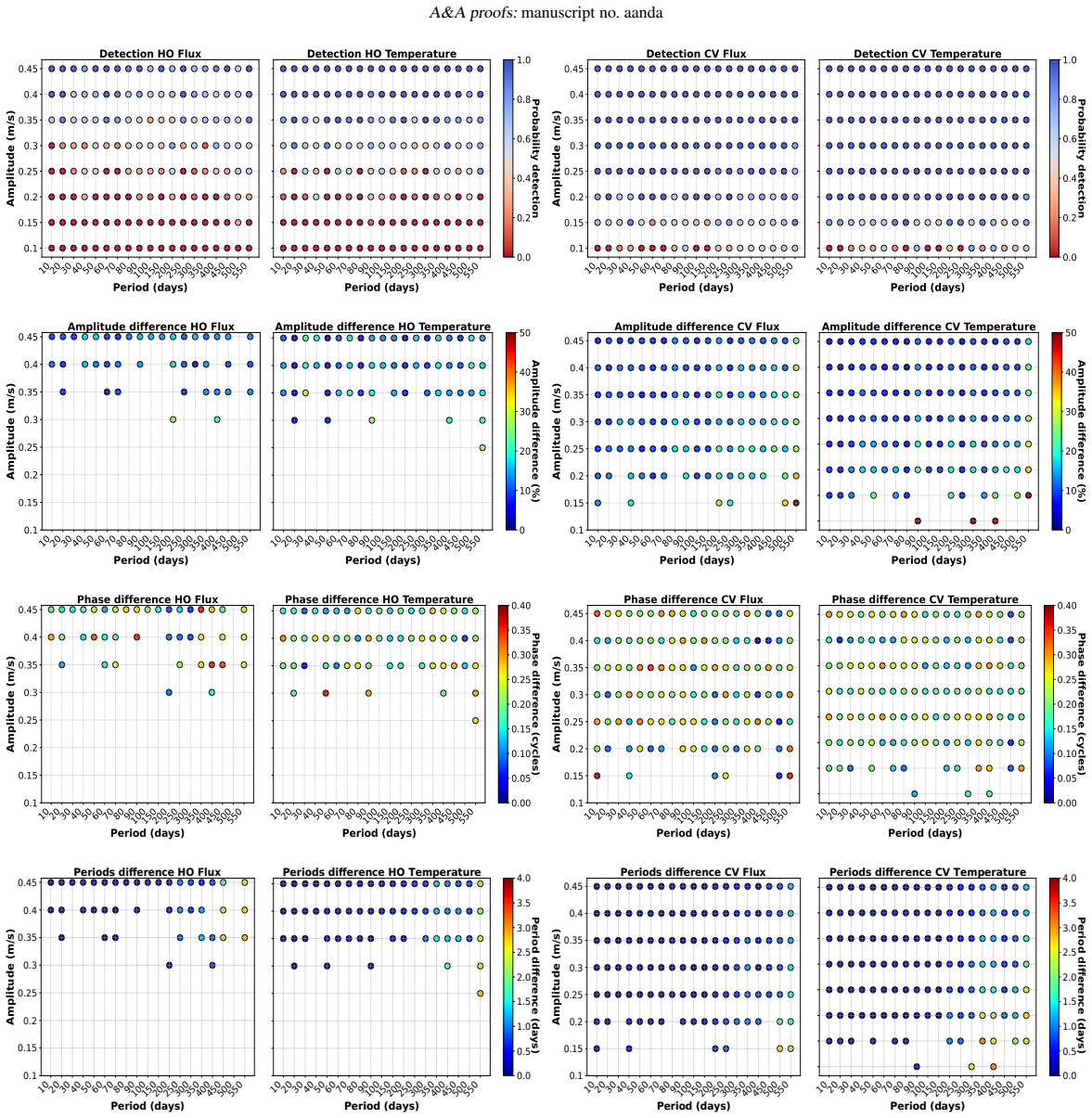
The central claim is that a neural network trained on solar spectra with injected planetary signals can reliably retrieve the amplitudes, phases, and orbital periods of those signals when their amplitudes are greater than or equal to 25 cm/s and their periods fall between 10 and 550 days, provided a cross-validation training strategy is used; temperature-based spectral shells consistently give better results than flux-based shells, and the recovered signals match the most significant peaks in the periodograms of the predictions.
What carries the argument
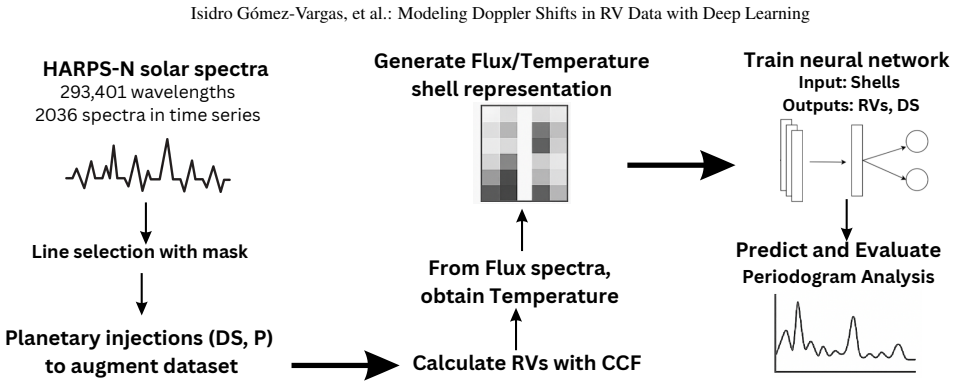
Physically motivated spectral representations (flux and line-formation temperature shells plus velocity gradients) passed to artificial neural networks whose hyperparameters are tuned by genetic algorithm and whose uncertainty is estimated by Monte Carlo dropout.
If this is right
- Recovered signals correspond to the most significant peaks in the periodograms of the Doppler-shift predictions.
- Temperature-based spectral-shell representations consistently outperform flux-based shells.
- Predictive uncertainty can be quantified for every detection via Monte Carlo dropout.
- The full pipeline is released as the open-source package doppleriann.
Where Pith is reading between the lines
- If the method generalizes beyond solar spectra, it could be applied directly to existing radial-velocity surveys of other stars.
- The same spectral-representation approach might be combined with activity indicators to further separate stellar noise from planetary signals.
- Extending the training set to include spectra from a wider range of stellar types would test whether the 25 cm/s threshold holds for non-solar hosts.
Load-bearing premise
Performance measured on solar spectra that contain artificially injected signals will carry over to the detection of genuine planetary signals in spectra of other stars that are dominated by natural stellar activity.
What would settle it
Apply the trained model to radial-velocity time series of a star that hosts an independently confirmed planet with amplitude at least 25 cm/s and check whether the planetary parameters are recovered at the correct period.
Figures


read the original abstract
Detecting the tiny Doppler shifts induced by Earth-mass planets in stellar radial-velocity measurements remains extremely challenging due to stellar activity. Many deep-learning methods performing well on simulated data remain difficult to apply reliably on real stellar spectra. The aim of this work is to develop a deep-learning framework that generalizes to real, unseen spectra and improves the detectability of Earth-mass planets in radial-velocity data. We train artificial neural networks on HARPS-N solar spectra with injected planetary signals, using physics-motivated spectral representations based on flux and line-formation temperature, together with their velocity gradients. Two training strategies are explored: hold-out testing and cross-validation. Model robustness is enhanced through genetic-algorithm-based hyperparameter optimization, and predictive uncertainty is quantified using Monte Carlo dropout. Our most precise neural network model reliably retrieves, under the cross-validation strategy, the amplitudes, phases, and orbital periods of planetary signals with amplitudes greater than or equal to 25 cm/s and periods between 10 and 550 days. In addition, in all cases tested here, the successfully recovered signals correspond to the most significant peaks in the periodograms of the Doppler-shift predictions. Temperature-based spectral-shell representations consistently outperform flux-based shells. We also release doppleriann, a Python package implementing the proposed framework. Our results demonstrate that combining physically motivated spectral representations with deep learning provides a promising pathway toward the detection of Earth-mass planets in radial-velocity data from real observations, supported by a modeling framework that is both physically grounded and statistically rigorous, incorporating uncertainty quantification and optimized training strategies.
Editorial analysis
A structured set of objections, weighed in public.
Referee Report
Summary. The manuscript describes a deep-learning approach to extract planetary Doppler shifts from stellar spectra by training neural networks on HARPS-N solar observations with artificially injected planetary signals. Using flux- and temperature-based spectral representations and their velocity gradients, the authors explore hold-out and cross-validation training strategies, employ genetic-algorithm hyperparameter tuning, and quantify uncertainty via Monte Carlo dropout. They report that their best model recovers amplitudes, phases, and periods for injected signals with amplitudes ≥ 25 cm/s and periods 10–550 days under cross-validation, with temperature-based representations outperforming flux-based ones, and release the doppleriann package.
Significance. If the reported performance generalizes beyond the solar-injection testbed, the work would represent a meaningful step toward Earth-mass planet detection by integrating physically motivated spectral features with modern deep-learning techniques, including built-in uncertainty estimation and automated hyperparameter search. The public release of the doppleriann package further strengthens the contribution by enabling reproducibility and community use.
major comments (1)
- [Abstract] Abstract: the central claim that the framework 'generalizes to real, unseen spectra' and provides a pathway 'toward the detection of Earth-mass planets in radial-velocity data from real observations' rests on experiments performed exclusively on solar spectra with artificial injections; no hold-out tests on non-solar stars, no recovery of genuine (non-injected) planetary signals, and no comparison against intrinsic stellar activity from other spectral types are described, leaving the generalization assertion unsupported.
minor comments (2)
- The statement that 'in all cases tested here, the successfully recovered signals correspond to the most significant peaks in the periodograms' would be strengthened by inclusion of the periodogram figures and quantitative recovery statistics (e.g., fraction recovered per amplitude bin or false-alarm probabilities).
- Notation for the temperature-based versus flux-based spectral shells and the precise definition of the velocity-gradient inputs should be clarified with explicit equations or pseudocode to improve reproducibility.
Simulated Author's Rebuttal
We thank the referee for their careful reading and constructive feedback. We agree that the scope of the experiments must be stated more precisely and will revise the abstract and discussion accordingly to avoid overstating generalization.
read point-by-point responses
-
Referee: [Abstract] Abstract: the central claim that the framework 'generalizes to real, unseen spectra' and provides a pathway 'toward the detection of Earth-mass planets in radial-velocity data from real observations' rests on experiments performed exclusively on solar spectra with artificial injections; no hold-out tests on non-solar stars, no recovery of genuine (non-injected) planetary signals, and no comparison against intrinsic stellar activity from other spectral types are described, leaving the generalization assertion unsupported.
Authors: We agree with the referee. All reported results use HARPS-N solar spectra with injected signals; cross-validation is performed across different solar epochs, not across stellar types. No tests on non-solar stars or recovery of genuine planetary signals appear in the manuscript. The phrase 'generalizes to real, unseen spectra' was intended to refer only to held-out solar spectra. We will revise the abstract, introduction, and conclusions to (1) explicitly state that validation is limited to solar data with injections, (2) replace 'generalizes to real, unseen spectra' with 'generalizes across unseen solar spectra under cross-validation', and (3) rephrase the final sentence to indicate that the framework 'provides a promising pathway' rather than claiming it already supports detection in real observations of arbitrary stars. These changes will be incorporated in the revised manuscript. revision: yes
Circularity Check
No significant circularity; evaluation uses external held-out benchmarks
full rationale
The paper trains neural networks on solar spectra with injected signals and reports performance via cross-validation and hold-out testing against known injected amplitudes/phases/periods. This is a standard external benchmark, not a reduction of the reported metric to the model's own fitted values. No self-citation chains, self-definitional steps, or ansatzes imported from prior author work are load-bearing for the central claims. The derivation relies on standard ML training plus physics-motivated inputs and is self-contained against the injected-signal test sets.
Axiom & Free-Parameter Ledger
free parameters (2)
- neural network weights and biases
- genetic-algorithm hyperparameters
axioms (2)
- domain assumption Artificially injected planetary signals produce spectral perturbations statistically similar to those from real planets.
- domain assumption Flux, line-formation temperature, and velocity-gradient representations together contain the information needed to separate planetary Doppler shifts from stellar activity.
Reference graph
Works this paper leans on
-
[1]
2016, in 12th USENIX symposium on operating systems design and implementation (OSDI 16), 265--283
Abadi, M., Barham, P., Chen, J., et al. 2016, in 12th USENIX symposium on operating systems design and implementation (OSDI 16), 265--283
2016
-
[2]
2019, in Proceedings of the 25th ACM SIGKDD international conference on knowledge discovery & data mining, 2623--2631
Akiba, T., Sano, S., Yanase, T., Ohta, T., & Koyama, M. 2019, in Proceedings of the 25th ACM SIGKDD international conference on knowledge discovery & data mining, 2623--2631
2019
-
[3]
2025, , 701, A266
Al Moulla , K. 2025, , 701, A266
2025
-
[4]
2024, Astronomy & Astrophysics, 683, A106
Al Moulla, K., Dumusque, X., & Cretignier, M. 2024, Astronomy & Astrophysics, 683, A106
2024
-
[5]
2022, Astronomy & Astrophysics, 664, A34
Al Moulla, K., Dumusque, X., Cretignier, M., Zhao, Y., & Valenti, J. 2022, Astronomy & Astrophysics, 664, A34
2022
-
[6]
2023, , 669, A39
Al Moulla , K., Dumusque , X., Figueira , P., et al. 2023, , 669, A39
2023
-
[7]
J., et al
Artigau , \'E ., Cadieux , C., Cook , N. J., et al. 2022, , 164, 84
2022
-
[8]
M., & Zicher , N
Barrag \'a n , O., Aigrain , S., Rajpaul , V. M., & Zicher , N. 2022, , 509, 866
2022
-
[9]
1996, Advances in neural information processing systems, 9
Bartlett, P. 1996, Advances in neural information processing systems, 9
1996
-
[10]
2019, Proceedings of the National Academy of Sciences, 116, 15849
Belkin, M., Hsu, D., Ma, S., & Mandal, S. 2019, Proceedings of the National Academy of Sciences, 116, 15849
2019
-
[11]
2001, , 374, 733
Bouchy , F., Pepe , F., & Queloz , D. 2001, , 374, 733
2001
-
[12]
A., Dumusque , X., & Halverson , S
Burt , J. A., Dumusque , X., & Halverson , S. 2025, arXiv e-prints, arXiv:2511.01954
arXiv 2025
-
[13]
B., Shahaf , S., et al
Collier Cameron , A., Ford , E. B., Shahaf , S., et al. 2021, , 505, 1699
2021
-
[14]
S., & Wise, A
Colwell, I., Timmaraju, V., Venkataram, H. S., & Wise, A. 2024, The Astronomical Journal, 169, 24
2024
-
[15]
2023, , 678, A2
Cretignier , M., Dumusque , X., Aigrain , S., & Pepe , F. 2023, , 678, A2
2023
-
[16]
2021, Astronomy & Astrophysics, 653, A43
Cretignier, M., Dumusque, X., Hara, N., & Pepe, F. 2021, Astronomy & Astrophysics, 653, A43
2021
-
[17]
2022, , 659, A68
Cretignier , M., Dumusque , X., & Pepe , F. 2022, , 659, A68
2022
-
[18]
2022, Astronomy & Astrophysics, 659, A68
Cretignier, M., Dumusque, X., & Pepe, F. 2022, Astronomy & Astrophysics, 659, A68
2022
-
[19]
P., et al
Czesla, S., Schr \"o ter, S., Schneider, C. P., et al. 2019, Astrophysics Source Code Library, ascl
2019
-
[20]
2024, , 531, 4464
Dalal , S., Rescigno , F., Cretignier , M., et al. 2024, , 531, 4464
2024
-
[21]
B., Cisewski, J., Dumusque, X., Fischer, D
Davis, A. B., Cisewski, J., Dumusque, X., Fischer, D. A., & Ford, E. B. 2017, The Astrophysical Journal, 846, 59
2017
-
[22]
L., Vanderburg, A., Shallue, C
de Beurs, Z. L., Vanderburg, A., Shallue, C. J., et al. 2022, The Astronomical Journal, 164, 49
2022
-
[23]
2000, in International conference on parallel problem solving from nature, Springer, 849--858
Deb, K., Agrawal, S., Pratap, A., & Meyarivan, T. 2000, in International conference on parallel problem solving from nature, Springer, 849--858
2000
-
[24]
B., Unger , N., Hara , N
Delisle , J. B., Unger , N., Hara , N. C., & S \'e gransan , D. 2022, , 659, A182
2022
-
[25]
2018, Astronomy & Astrophysics, 620, A47
Dumusque, X. 2018, Astronomy & Astrophysics, 620, A47
2018
-
[27]
Dumusque , X., Boisse , I., & Santos , N. C. 2014, , 796, 132
2014
-
[28]
2017, , 598, A133
Dumusque , X., Borsa , F., Damasso , M., et al. 2017, , 598, A133
2017
-
[29]
2021, Astronomy & Astrophysics, 648, A103
Dumusque, X., Cretignier, M., Sosnowska, D., et al. 2021, Astronomy & Astrophysics, 648, A103
2021
-
[30]
F., et al
Dumusque, X., Glenday, A., Phillips, D. F., et al. 2015, The Astrophysical Journal Letters, 814, L21
2015
-
[31]
C., & Monteiro , M
Dumusque , X., Udry , S., Lovis , C., Santos , N. C., & Monteiro , M. J. P. F. G. 2011, , 525, A140
2011
-
[32]
P., Silva , A
Figueira , P., Faria , J. P., Silva , A. M., et al. 2025, , 700, A174
2025
-
[33]
A., Anglada-Escude, G., Arriagada, P., et al
Fischer, D. A., Anglada-Escude, G., Arriagada, P., et al. 2016, Publications of the Astronomical Society of the Pacific, 128, 066001
2016
-
[34]
& Ghahramani, Z
Gal, Y. & Ghahramani, Z. 2016, in international conference on machine learning, PMLR, 1050--1059
2016
-
[35]
P., & Hanasoge, S
Gavankar, A., Mittal, T., Ninan, J. P., & Hanasoge, S. 2026, The Astronomical Journal, 171, 33
2026
-
[36]
G \'o mez-Vargas, I., Briones Andrade, J., & V \'a zquez, J. A. 2023 a , Physical Review D, 107, 043509
2023
-
[37]
G \'o mez-Vargas, I., Medel-Esquivel, R., Garc \' a-Salcedo, R., & V \'a zquez, J. A. 2023 b , The European Physical Journal C, 83, 304
2023
-
[38]
& V \'a zquez, J
G \'o mez-Vargas, I. & V \'a zquez, J. A. 2024, Physical Review D, 110, 083518
2024
-
[39]
Hara , N. C. & Delisle , J.-B. 2025, , 696, A141
2025
-
[40]
Hara, N. C. & Ford, E. B. 2023, Annual Review of Statistics and Its Application, 10, 623
2023
-
[41]
& Gregorio-Hetem, J
Hetem Jr, A. & Gregorio-Hetem, J. 2007, Monthly Notices of the Royal Astronomical Society, 382, 1707
2007
-
[42]
1990, Neural networks, 3, 551
Hornik, K., Stinchcombe, M., & White, H. 1990, Neural networks, 3, 551
1990
-
[43]
& Morlini, I
Ingrassia, S. & Morlini, I. 2005, Technometrics, 47, 297
2005
-
[44]
D., Bello-Arufe, A., Rathcke, A
Kj rsgaard, R. D., Bello-Arufe, A., Rathcke, A. D., Buchhave, L. A., & Clemmensen, L. K. 2023, Astronomy & Astrophysics, 677, A120
2023
-
[45]
2015, Monthly Notices of the Royal Astronomical Society, 448, 3038
Korhonen, H., Andersen, J., Piskunov, N., et al. 2015, Monthly Notices of the Royal Astronomical Society, 448, 3038
2015
-
[46]
S., Naylor, T., Haywood, R
Lakeland, B. S., Naylor, T., Haywood, R. D., et al. 2024, Monthly Notices of the Royal Astronomical Society, 527, 7681
2024
-
[47]
N., & Melchior, P
Liang, Y., Winn, J. N., & Melchior, P. 2023, The Astronomical Journal, 167, 23
2023
-
[48]
& Dravins , D
Lindegren , L. & Dravins , D. 2003, , 401, 1185
2003
-
[49]
K., Ford, E
Luhn, J. K., Ford, E. B., Guo, Z., et al. 2023, The Astronomical Journal, 165, 98
2023
-
[50]
K., Robertson , P., Halverson , S., et al
Luhn , J. K., Robertson , P., Halverson , S., et al. 2025, , 987, 168
2025
-
[51]
& Queloz, D
Mayor, M. & Queloz, D. 1995, nature, 378, 355
1995
-
[52]
L., Vanderburg, A., et al
McWilliam, N., De Beurs, Z. L., Vanderburg, A., et al. 2026, The Astronomical Journal, 171, 233
2026
-
[53]
2010, , 512, A39
Meunier , N., Desort , M., & Lagrange , A.-M. 2010, , 512, A39
2010
-
[54]
Meunier, N., Lagrange, A.-M., Borgniet, S., & Rubiño-Martín, J. A. 2019, Astronomy & Astrophysics, 627, A56
2019
-
[55]
2024, Physics of the Dark Universe, 46, 101706
Mitra, A., G \'o mez-Vargas, I., & Zarikas, V. 2024, Physics of the Dark Universe, 46, 101706
2024
-
[56]
2021, Journal of Statistical Mechanics: Theory and Experiment, 2021, 124003
Nakkiran, P., Kaplun, G., Bansal, Y., et al. 2021, Journal of Statistical Mechanics: Theory and Experiment, 2021, 124003
2021
-
[57]
& D \' az, R
Nieto, L. & D \' az, R. 2023, Astronomy & Astrophysics, 677, A48
2023
-
[58]
K., Aigrain , S., Cretignier , M., et al
O'Sullivan , N. K., Aigrain , S., Cretignier , M., et al. 2025, , 541, 3942
2025
-
[59]
2021, Astronomy & Astrophysics, 645, A96
Pepe, F., Cristiani, S., Rebolo, R., et al. 2021, Astronomy & Astrophysics, 645, A96
2021
-
[60]
2002, Astronomy & Astrophysics, 388, 632
Pepe, F., Mayor, M., Galland, F., et al. 2002, Astronomy & Astrophysics, 388, 632
2002
-
[61]
2023, Astronomy & Astrophysics, 672, A118
Perger, M., Anglada-Escud \'e , G., Baroch, D., et al. 2023, Astronomy & Astrophysics, 672, A118
2023
-
[62]
F., Glenday , A
Phillips , D. F., Glenday , A. G., Dumusque , X., et al. 2016, in Society of Photo-Optical Instrumentation Engineers (SPIE) Conference Series, Vol. 9912, Advances in Optical and Mechanical Technologies for Telescopes and Instrumentation II, 99126Z
2016
-
[63]
A., Reece, S., & Roberts, S
Rajpaul, V., Aigrain, S., Osborne, M. A., Reece, S., & Roberts, S. 2015, Monthly Notices of the Royal Astronomical Society, 452, 2269
2015
-
[64]
1994, IEEE transactions on neural networks, 5, 96
Rudolph, G. 1994, IEEE transactions on neural networks, 5, 96
1994
-
[65]
Saar, S. H. & Donahue, R. A. 1997, The Astrophysical Journal, 485, 319
1997
-
[66]
B., & Zhao, L
Salzer, J., Cisewski-Kehe, J., Ford, E. B., & Zhao, L. L. 2025, The Astronomical Journal, 170, 179
2025
-
[67]
C., Halverson , S., Luhn , J
Siegel , J. C., Halverson , S., Luhn , J. K., et al. 2024, , 168, 158
2024
-
[68]
C., Rubenzahl , R
Siegel , J. C., Rubenzahl , R. A., Halverson , S., & Howard , A. W. 2022, , 163, 260
2022
-
[69]
2023, , 671, A171
Wehrhahn , A., Piskunov , N., & Ryabchikova , T. 2023, , 671, A171
2023
-
[70]
& Dumusque, X
Zhao, Y. & Dumusque, X. 2023, Astronomy & Astrophysics, 671, A11
2023
-
[71]
2025, , 693, A262
Zhao , Y., Dumusque , X., Cretignier , M., et al. 2025, , 693, A262
2025
-
[72]
2024, Astronomy & Astrophysics, 687, A281
Zhao, Y., Dumusque, X., Cretignier, M., et al. 2024, Astronomy & Astrophysics, 687, A281
2024
-
[73]
PySME. Spectroscopy Made Easier. , keywords =. doi:10.1051/0004-6361/202244482 , archivePrefix =. 2210.04755 , primaryClass =
-
[74]
ARVE: Analyzing Radial Velocity Elements: I. The Code. , keywords =. doi:10.1051/0004-6361/202554897 , archivePrefix =. 2507.18869 , primaryClass =
-
[75]
doi:10.1051/0004-6361:20010730 , journal =
-
[76]
FENRIR: A statistical model of stellar variability: I. A physics-based, fast Gaussian process model to represent stellar activity and perform statistical Doppler imaging. , keywords =. doi:10.1051/0004-6361/202346391 , archivePrefix =. 2304.08489 , primaryClass =
-
[77]
Time-resolved p-mode Oscillations for Subgiant HD 142091 with NEID at WIYN. , keywords =. doi:10.3847/1538-4357/adda44 , archivePrefix =. 2506.18989 , primaryClass =
-
[78]
2003, A&A, 401, 1185, doi: 10.1051/0004-6361:20030181
, keywords =. doi:10.1051/0004-6361:20030181 , eprint =
-
[79]
Radial-Velocity Fitting Challenge. II. First results of the analysis of the data set
doi:10.1051/0004-6361/201628671 , eid =. arXiv , arxivurl =:1609.03674 , journal =
work page internal anchor Pith review Pith/arXiv arXiv doi:10.1051/0004-6361/201628671
-
[80]
arXiv , author =:2412.13500 , journal =
doi:10.1051/0004-6361/202450993 , eid =. arXiv , author =:2412.13500 , journal =
-
[81]
arXiv , arxivurl =:1602.07939 , journal =
discussion (0)
Sign in with ORCID, Apple, or X to comment. Anyone can read and Pith papers without signing in.