REVIEW 4 major objections 5 minor 98 references
The SRG/eROSITA All-Sky Survey: A comprehensive X-ray analysis of the Hydra I galaxy cluster
T0 review · 4 major / 5 minor · reviewed 2026-08-03 · deepseek-v4-flash
Pith's one-line read Hydra I's outskirts are still assembling: soft X-ray excesses beyond R200 and weak shocks show ongoing baryon inflow.
desk verdict Careful eROSITA/Chandra study of Hydra I with genuinely new outskirts detections, but the headline 5.8σ accretion signal is internally inconsistent (3.9σ in the abstract) and rests on a hand-picked background box; deserves review after those numbers are reconciled. read the letter →
The pith
A machine-rendered reading of the paper's core claim, the machinery that carries it, and where it could break.
The reading
What carries the argument
The argument leans on the sector-based surface-brightness significance analysis (Eq. C.2) that compares profile bins to a local cosmic X-ray background estimated from eight off-cluster boxes, and on a broken-power-law deprojection (Eqs. 3–5) that turns density jumps into Mach numbers. The modified β-model (Eq. 2), with an added central power-law term, fits the profile out to 3R200, while the CXB spectral model (apec + nei + powerlaw) fixes foreground emission from the Antlia supernova remnant.
What would settle it
An independent deep X-ray observation that resolves the northern sector, or a CXB model that raises the local background by more than 20%, would test the excess. Alternatively, measuring the iron abundance across the eastern edge and finding no drop would falsify the iron-front identification.
Extended reading notes
Core claim
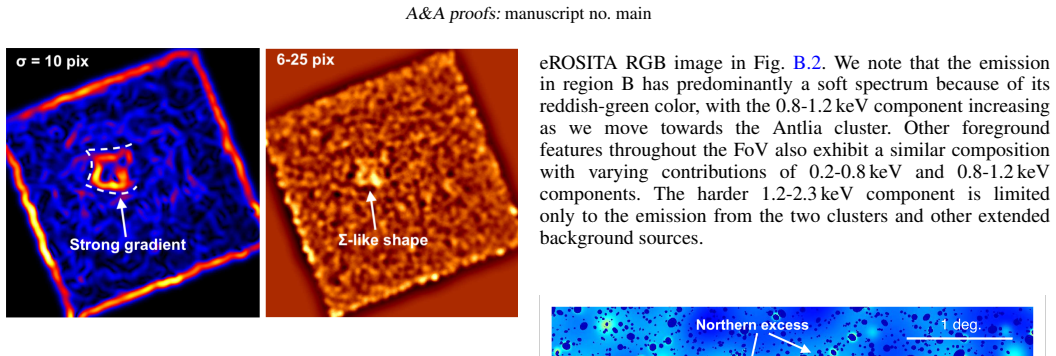
Hydra I's X-ray morphology is relaxed within R500, but the analysis detects multiple soft X-ray excesses beyond R200—the northern one significant at 5.8σ above the local cosmic X-ray background—that correlate with the 2D optical galaxy distribution. Two surface-brightness discontinuities near NGC 3311 imply weak ICM shocks with Mach numbers 1.25 and 1.53, which overlap the diffuse 'Flying Fox' radio source; the authors take these as ram-pressure/iron fronts. The combination supports the paper's central claim that Abell 1060 is actively accreting baryons in its outskirts.
Load-bearing premise
The assumption that the north-western background box and the Antlia SNR model properly account for the local cosmic X-ray background; if the true background near the cluster is higher, the 5.8σ northern excess could become insignificant.
Editorial extensions
If this is right
- If correct, Hydra I joins a small set of clusters where baryon accretion into the outskirts is directly observable, and the northern excess extends a known galaxy overdensity to 3R200.
- The two weak shocks reinforce the idea that the radio source 'Flying Fox' is powered by re-acceleration of fossil electrons, not by a current AGN outburst.
- The modified β-model with a weak central cusp (α=0.33) describes the entire 3R200 surface brightness profile, pointing to a mild cool-core state rather than a strong one.
- The temperature and metallicity profiles, lower than earlier measurements by about 0.3 keV and 0.1 Z_sun, are consistent with a multi-temperature ICM and the Fe bias; future high-resolution spectra could confirm this.
Reading between the lines
- If the 5.8σ excess holds under a better background model, clusters in similar mass and redshift ranges should show comparable soft excesses in eROSITA data; a survey could map accretion directions statistically.
- A direct test of the iron-front interpretation is to measure the Fe abundance jump across the eastern and southern edges; an iron front would show a drop in Fe beyond the edge, while a sloshing front would not.
- The abstract's 3.9σ and body's 5.8σ for the same northern excess point to sensitivity to the CXB treatment; reconciling this with a single robust measurement would strengthen the central claim.
Editorial analysis
A structured set of objections, weighed in public.
Referee Report
Summary. The manuscript presents an eROSITA eRASS:4 and Chandra study of Abell 1060 (Hydra I), combining wide-field surface-brightness and spectral analyses out to 3R200 with Chandra imaging of the inner core. It reports a relaxed ICM within R500, two surface-brightness edges near NGC 3311 interpreted as weak shocks (M≈1.25 and 1.53) that align with diffuse radio emission, and multiple soft X-ray excesses beyond R200. The northern excess is quoted at 5.8σ in the body and 3.9σ in the abstract above the local CXB; the paper interprets these excesses as evidence for ongoing baryon accretion in the cluster outskirts. It also derives temperature and metallicity profiles, a galaxy redshift distribution, and argues for a weak cool-core classification. The data reduction follows standard eROSITA/Chandra procedures used by the same group in prior papers.
Significance. If the detections are robust, this is a valuable multiwavelength study of a nearby cluster, extending the characterization of Hydra I beyond R200 and connecting X-ray edges to diffuse radio emission. Strengths include the use of eROSITA's large field of view, careful treatment of particle background, exposure and N_H variations, a quantitative multi-box CXB model, and joint use of Chandra for fine-scale edges. The paper is also appropriately hedged in several interpretive places, e.g., the distinction between ICM and foreground in the south-west. However, the quantitative credibility of the headline accretion claim depends on the choice of CXB background and on an unpublished foreground model; these issues must be resolved or explicitly bounded before the claim can be accepted.
major comments (4)
- [Abstract vs Secs. 3.3.1 and 3.4] The abstract and body quote contradictory values for the same quantities: the northern soft excess is 3.9σ in the abstract but 5.8σ in Sec. 3.3.1 and in the Summary; the average 0.2–0.5 R500 temperature is 2.51 keV in the abstract but 2.27 keV in Sec. 3.4 and Table E.1. This is not a cosmetic issue, because the abstract conclusion about accreting baryons rests on the lower significance. Please reconcile the values and state explicitly which background definition produces each significance.
- [Secs. 3.3.1, Eq. C.2, Fig. C.1, App. D] The sector significance in Eq. C.2 does not specify whether the CXB reference is the average of the eight 3°×1° boxes, (4.25±0.63)×10−4 counts s−1 arcmin−2, or a per-sector box. The insets of Fig. C.1 and the choice of the NW box in App. D suggest that per-sector boxes are used. The NW box has among the lowest LHB and MWH normalizations, so a 5.8σ excess over that locally minimal background is not the same as 5.8σ over the average CXB. Please report the northern-excess significance using (i) the average CXB with its box-to-box dispersion and (ii) the most conservative single box, and discuss the impact of the quoted ±0.63×10⁻⁴ systematic. Also state whether the peak significance is corrected for the a posteriori selection among eight sectors and many radial bins. If the robust value is ≈3.9σ or lower, the 'actively accreting baryons' claim should be softened accordingly.
- [Sec. 3.4, Fig. 13] The statement that the eROSITA temperature profile is 'broadly consistent' with the average profiles from Burns et al. (2010) and Reiprich et al. (2013) is weakened by the fact that both comparison profiles are explicitly normalized using the paper's own measured ⟨kT⟩=2.27 keV. This sets the vertical scale by construction and makes the agreement partly circular. Please show the comparison without renormalizing to the measured value, or explicitly label it as a shape check rather than independent confirmation.
- [Sec. 2.4, App. D, Table D.1] The soft-X-ray foreground is modelled with the Antlia SNR parameters from Knies et al. (in prep), an unpublished model. The northern excess lies in the energy range where the LHB and SNR components dominate, so the detection significance depends on the reliability of this model. Please add a sensitivity test: vary the fixed nei parameters (kT, ionization timescale, normalization) within ranges consistent with the XL bolometric data and re-compute the northern-excess significance. If the excess is insensitive, state this; if not, quote a systematic error and adjust the claim accordingly.
minor comments (5)
- [Sec. 1] Typo: 'NCG 3311' should be 'NGC 3311'.
- [Sec. 3.3.1 / Fig. 11] The term 'median significance' should be defined explicitly (e.g., median of the per-bin significances between R200 and 3R200) so the reader can reproduce the quoted values.
- [Fig. C.1 caption] Please specify in the caption which background box is used for which sector profile. The current caption says 'the background box used to estimate the CXB level' but does not identify boxes by direction.
- [Eq. C.2] The significance formula treats SB_region and SB_CXB as independent. If both are derived from the same image with PIB subtraction, they may share a small covariance. This is likely negligible, but the assumption should be stated.
- [Table E.1] The last row (0.2–0.5 R500) overlaps with the earlier annuli. Please clarify that this is a re-binned extraction of the same data, not an additional independent annulus.
Circularity Check
Only mild circularity: the comparison temperature profiles are normalized with the paper's own measured average temperature; the main detections are data-driven.
-
fitted input called prediction
[Sect. 3.4 (Fig. 13, middle); echoed in Abstract]
"We additionally compared our profile in the radial range 0.28R200≤R≤R200 (19.′29≤R≤69.′82) to the average temperature profile obtained from hydrodynamical simulations by Burns et al. (2010) and 162 Suzaku temperature measurements from Reiprich et al. (2013), both of which are normalized using the average temperature of ⟨kT⟩=2.27+0.15−0.11 keV (green and blue dashed lines and shaded regions in Fig. 13 middle)."
The external Burns et al. (2010) and Suzaku average temperature profiles are rescaled by the paper's own measured average ICM temperature, ⟨kT⟩=2.27 keV, derived from the same 0.2-0.5R500 annulus. The conclusion 'broadly consistent' is therefore partly enforced by the choice of normalization: matching at the normalization point is by construction rather than an independent check. The comparison retains independent information only in the shape/slope across 0.28R200-R200, so this is a mild, non-central circular step.
full rationale
The two headline results are direct fits/detections: the outer soft X-ray excess is a surface-brightness significance above a measured local CXB level (Eq. C.2), the 'iron fronts' are broken-power-law fits to Chandra profiles (Eqs. 3-5), and the ICM temperature/metallicity profiles are XSPEC fits to eROSITA spectra. None of these outputs is defined by or fitted to the quantity it claims to predict. The one concrete circular element is the Sect. 3.4 consistency check: Burns et al. (2010) and Reiprich et al. (2013) profiles are normalized using the paper's own measured average temperature, so the reported broad consistency is partly by construction. This does not infect the main accretion/shock claims. The Antlia SNR foreground model attributed to Knies et al. (in prep) is an unpublished overlapping-author dependency and should be externally verified, but it is derived from a separate southern region and is not a re-use of the paper's target values; therefore it is a robustness/self-citation concern rather than circularity. The abstract/body significance discrepancy (3.9σ vs 5.8σ) is likewise an internal-consistency issue, not a circular-derivation issue.
Assumptions & free parameters
free parameters (5)
- Modified β-model parameters =
S_X(0)=(4.74±0.12)e-2 counts s^-1 arcmin^-2, r_c=5.91±0.33 arcmin, α=0.33±0.03, β=0.59±0.01
- Broken power-law/deprojection parameters =
East: J=1.36±0.16, M=1.25+0.09/-0.08; South: J=1.76±0.41, M=1.53±0.23; North: J=0.99±0.12, M=0.99±0.07 (Table C.1)
- ICM spectral parameters per annulus =
kT from 2.84+0.18/-0.19 keV to 1.15+0.07/-0.09 keV; Z from 0.32 to ~0 Z_sun (Table E.1)
- CXB component normalizations =
NW box: LHB 2.55e-6, MWH 6.55e-7, nei 5.30e-8, powerlaw 4.82e-7 (units as in Table D.1)
- Average CXB level for surface brightness significance =
(4.25±0.63)×10^-4 counts s^-1 arcmin^-2
assumptions (6)
- domain assumption Flat ΛCDM cosmology (Ωm=0.3, ΩΛ=0.7, H0=70)
- domain assumption Single-temperature apec model for each ICM bin
- domain assumption Polytropic gas density-jump relation and γ=5/3
- domain assumption Spherical symmetry and broken power-law deprojection for Chandra edges
- ad hoc to paper NW background box representative of local CXB within R200
- ad hoc to paper Antlia SNR model parameters from Knies et al. (in prep)
Cite this review
Pith. "Pith review of The SRG/eROSITA All-Sky Survey: A comprehensive X-ray analysis of the Hydra I galaxy cluster." pith.science (2026). https://pith.science/paper/2DZAIVJS
@misc{pith2026251200518,
  author       = {Pith},
  title        = {Pith review of: The SRG/eROSITA All-Sky Survey: A comprehensive X-ray analysis of the Hydra I galaxy cluster},
  year         = {2026},
  howpublished = {\url{https://pith.science/paper/2DZAIVJS}},
  note         = {Machine review of arXiv:2512.00518}
}
abstract
The Hydra I galaxy cluster (Abell 1060) is a nearby example of a low-temperature cluster that exhibits intermediate cool core and non-cool core properties. Our aims are to extend the characterization of the intracluster medium (ICM) properties at least until $R_{200}$ and study the correlation between the X-ray emission and non-thermal emission within $R=0.15$$R_{500}$, and optical/IR galaxy distribution beyond $R_{200}$. We used data from the first four SRG/eROSITA All-Sky Surveys and an archival Chandra observation to image the X-ray emission from Abell 1060. We also used multiwavelength data from TGSS (radio), 2MASS (IR), and NED (optical) to investigate the non-thermal emission, 2D galaxy distribution, and its redshift evolution, respectively. The surface brightness and spectral analyses are also extended until 3$R_{200}$ and $R_{200}$, respectively, following a detailed cosmic X-ray background (CXB) analysis. Our fully corrected eROSITA image showcases a relaxed ICM morphology within $R_{500}$. We detected two surface brightness discontinuities near the central galaxy NGC~3311 that spatially coincide with diffuse radio emission along the line of sight. Furthermore, we detected two soft X-ray excesses with high spatial correlation with the 2D optical galaxy distribution beyond $R_{200}$. In particular, the excess in the north has a significance of $3.9\sigma$ above the local CXB level. This suggests that Abell 1060's outskirts are actively accreting baryons. We also estimated the average ICM temperature and metallicity of $\langle k_\mathrm{B}T \rangle=2.51\substack{+0.21\\-0.21}\thinspace$ keV and $\langle Z\rangle=0.19\substack{+0.10\\-0.10}\thinspace Z_\odot$, respectively, from the 0.2-0.5$R_{500}$ annulus. Overall, the temperature profile is broadly consistent with the average temperature profiles from hydrodynamical simulation and Suzaku between 0.43$R_{500}$ and $R_{500}$.
Figures


Figures from the paper (8 more)


Reference graph
Works this paper leans on
-
[1]
, " * write output.state after.block = add.period write newline
ENTRY address archiveprefix author booktitle chapter edition editor howpublished institution eprint journal key month note number organization pages publisher school series title type volume year label extra.label sort.label short.list INTEGERS output.state before.all mid.sentence after.sentence after.block FUNCTION init.state.consts #0 'before.all := #1 ...
-
[2]
write newline
" write newline "" before.all 'output.state := FUNCTION n.dashify 't := "" t empty not t #1 #1 substring "-" = t #1 #2 substring "--" = not "--" * t #2 global.max substring 't := t #1 #1 substring "-" = "-" * t #2 global.max substring 't := while if t #1 #1 substring * t #2 global.max substring 't := if while FUNCTION word.in bbl.in " " * FUNCTION format....
-
[3]
& Grevesse , N
Anders , E. & Grevesse , N. 1989, , 53, 197
1989
-
[4]
Arnaud , K. A. 1996, in Astronomical Society of the Pacific Conference Series, Vol. 101, Astronomical Data Analysis Software and Systems V, ed. G. H. Jacoby & J. Barnes , 17
1996
-
[5]
J., & Scott , P
Asplund , M., Grevesse , N., Sauval , A. J., & Scott , P. 2009, , 47, 481
2009
-
[6]
& Arnouts , S
Bertin , E. & Arnouts , S. 1996, , 117, 393
1996
-
[7]
2023, Science China Physics, Mechanics, and Astronomy, 66, 299513
Bregman , J., Cen , R., Chen , Y., et al. 2023, Science China Physics, Mechanics, and Astronomy, 66, 299513
2023
-
[8]
2022, , 661, A1
Brunner , H., Liu , T., Lamer , G., et al. 2022, , 661, A1
2022
Show all 98 references
-
[9]
2024, , 685, A106
Bulbul , E., Liu , A., Kluge , M., et al. 2024, , 685, A106
2024
-
[10]
Buote , D. A. 2000, , 311, 176
2000
-
[11]
O., Hallman , E
Burns , J. O., Hallman , E. J., Gantner , B., Motl , P. M., & Norman , M. L. 2008, , 675, 1125
2008
-
[12]
O., Skillman , S
Burns , J. O., Skillman , S. W., & O'Shea , B. W. 2010, , 721, 1105
2010
-
[13]
1979, , 228, 939
Cash , W. 1979, , 228, 939
1979
-
[14]
W., Donahue , M., Voit , G
Cavagnolo , K. W., Donahue , M., Voit , G. M., & Sun , M. 2009, , 182, 12
2009
-
[15]
& Fusco-Femiano , R
Cavaliere , A. & Fusco-Femiano , R. 1976, , 49, 137
1976
-
[16]
& Ostriker , J
Cen , R. & Ostriker , J. P. 1999, , 514, 1
1999
-
[17]
H., B \"o hringer , H., Ikebe , Y., & Zhang , Y
Chen , Y., Reiprich , T. H., B \"o hringer , H., Ikebe , Y., & Zhang , Y. Y. 2007, , 466, 805
2007
-
[18]
M., Pomar \`e de , D., Tully , R
Courtois , H. M., Pomar \`e de , D., Tully , R. B., Hoffman , Y., & Courtois , D. 2013, , 146, 69
2013
-
[19]
H., et al
Dietl , J., Pacaud , F., Reiprich , T. H., et al. 2024, , 691, A286
2024
-
[20]
Dong , R., Rasmussen , J., & Mulchaey , J. S. 2010, , 712, 883
2010
-
[21]
Drury , L. O. 1983, Reports on Progress in Physics, 46, 973
1983
-
[22]
2020, The Open Journal of Astrophysics, 3, 12
Eckert , D., Finoguenov , A., Ghirardini , V., et al. 2020, The Open Journal of Astrophysics, 3, 12
2020
-
[23]
2001, , 122, 2222
Einasto , M., Einasto , J., Tago , E., M \"u ller , V., & Andernach , H. 2001, , 122, 2222
2001
-
[24]
W., Lang , D., & Goodman , J
Foreman-Mackey , D., Hogg , D. W., Lang , D., & Goodman , J. 2013, , 125, 306
2013
-
[25]
2020, in SPIE, Vol
Freyberg , M., Perinati , E., Pacaud , F., et al. 2020, in SPIE, Vol. 11444, Space Telescopes and Instrumentation 2020: Ultraviolet to Gamma Ray, ed. J.-W. A. den Herder , S. Nikzad , & K. Nakazawa , 114441O
2020
-
[26]
C., Allen , G
Fruscione , A., McDowell , J. C., Allen , G. E., et al. 2006, in SPIE, Vol. 6270, Observatory Operations: Strategies, Processes, and Systems, ed. D. R. Silva & R. E. Doxsey , 62701V
2006
-
[27]
Y., & Ohashi , T
Furusho , T., Yamasaki , N. Y., & Ohashi , T. 2002, arXiv e-prints, astro
2002
-
[28]
Y., Ohashi , T., et al
Furusho , T., Yamasaki , N. Y., Ohashi , T., et al. 2001, , 53, 421
2001
-
[29]
N., et al
Ghirardini , V., Bulbul , E., Hoang , D. N., et al. 2021, , 647, A4
2021
-
[30]
2012, , 749, 186
Gu , L., Xu , H., Gu , J., et al. 2012, , 749, 186
2012
-
[31]
Y., Ishida , M., & Ohashi , T
Hayakawa , A., Furusho , T., Yamasaki , N. Y., Ishida , M., & Ohashi , T. 2004, , 56, 743
2004
-
[32]
2006, , 58, 695
Hayakawa , A., Hoshino , A., Ishida , M., et al. 2006, , 58, 695
2006
-
[33]
M., Kotulla , R., Chen , H., et al
Hess , K. M., Kotulla , R., Chen , H., et al. 2022, , 668, A184
2022
-
[34]
2016, , 594, A116
HI4PI Collaboration , Ben Bekhti , N., Fl \"o er , L., et al. 2016, , 594, A116
2016
-
[35]
Hickox , R. C. & Markevitch , M. 2006, , 645, 95
2006
-
[36]
S., Mittal , R., Reiprich , T
Hudson , D. S., Mittal , R., Reiprich , T. H., et al. 2010, , 513, A37
2010
-
[37]
T., Jagannathan, P
Intema , H. T., Jagannathan, P. , Mooley, K. P. , & Frail, D. A. 2017, , 598, A78
2017
-
[38]
H., Chester , T., Cutri , R., et al
Jarrett , T. H., Chester , T., Cutri , R., et al. 2000, , 119, 2498
2000
-
[39]
Kang , H., Ryu , D., Cen , R., & Ostriker , J. P. 2007, , 669, 729
2007
-
[40]
Kang , H., Ryu , D., & Jones , T. W. 2012, , 756, 97
2012
-
[41]
Kettula , K., Nevalainen , J., & Miller , E. D. 2013, , 552, A47
2013
-
[42]
Kuntz , K. D. & Snowden , S. L. 2000, , 543, 195
2000
-
[43]
2024, , 76, L8
Kurahara , K., Akahori , T., Oki , A., Omiya , Y., & Nakazawa , K. 2024, , 76, L8
2024
-
[44]
1966, , 16, 45
Kwast , T. 1966, , 16, 45
1966
-
[45]
& Lifshitz , E
Landau , L. & Lifshitz , E. 1987, in Fluid Mechanics (Second Edition), second edition edn., ed. L. Landau & E. Lifshitz (Pergamon), 313--360
1987
-
[46]
O., Jorsater , S., & Sandqvist , A
Lindblad , P. O., Jorsater , S., & Sandqvist , A. 1985, , 144, 496
1985
-
[47]
2022, , 661, A2
Liu , A., Bulbul , E., Ghirardini , V., et al. 2022, , 661, A2
2022
-
[48]
R., et al
Liu , W., Chiao , M., Collier , M. R., et al. 2017, , 834, 33
2017
-
[49]
N., Xue , Y
Luo , B., Brandt , W. N., Xue , Y. Q., et al. 2017, , 228, 2
2017
-
[50]
2005, , 621, 663
Machacek , M., Dosaj , A., Forman , W., et al. 2005, , 621, 663
2005
-
[51]
R., & Nulsen , P
Machacek , M., Jones , C., Forman , W. R., & Nulsen , P. 2006, , 644, 155
2006
-
[52]
& Vikhlinin , A
Markevitch , M. & Vikhlinin , A. 2007, , 443, 1
2007
-
[53]
2004, , 354, 10
Mazzotta , P., Rasia , E., Moscardini , L., & Tormen , G. 2004, , 354, 10
2004
-
[54]
H., Veronica , A., et al
McCall , H., Reiprich , T. H., Veronica , A., et al. 2024, , 689, A113
2024
-
[55]
J., Greene , G
McLean , B. J., Greene , G. R., Lattanzi , M. G., & Pirenne , B. 2000, in Astronomical Society of the Pacific Conference Series, Vol. 216, Astronomical Data Analysis Software and Systems IX, ed. N. Manset , C. Veillet , & D. Crabtree , 145
2000
-
[56]
2024, , 688, A107
Migkas , K., Kox , D., Schellenberger , G., et al. 2024, , 688, A107
2024
-
[57]
2011, , 531, A4
Misgeld , I., Mieske , S., Hilker , M., et al. 2011, , 531, A4
2011
-
[58]
& Pizzolato , F
Molendi , S. & Pizzolato , F. 2001, , 560, 194
2001
-
[59]
More , S., Diemer , B., & Kravtsov , A. V. 2015, , 810, 36
2015
-
[60]
2006, , 372, 578
Pacaud , F., Pierre , M., Refregier , A., et al. 2006, , 372, 578
2006
-
[61]
Pahre , M. A. 1999, , 124, 127
1999
-
[62]
W., Pointecouteau , E., & Melin , J
Piffaretti , R., Arnaud , M., Pratt , G. W., Pointecouteau , E., & Melin , J. B. 2011, , 534, A109
2011
-
[63]
Pratt , G. W. & Arnaud , M. 2002, , 394, 375
2002
-
[64]
2021, , 647, A1
Predehl , P., Andritschke , R., Arefiev , V., et al. 2021, , 647, A1
2021
-
[65]
A., Becker , W., et al
Predehl , P., Sunyaev , R. A., Becker , W., et al. 2020, , 588, 227
2020
-
[66]
E., Pacaud , F., Reiprich , T
Ramos-Ceja , M. E., Pacaud , F., Reiprich , T. H., et al. 2019, , 626, A48
2019
-
[67]
H., Basu , K., Ettori , S., et al
Reiprich , T. H., Basu , K., Ettori , S., et al. 2013, , 177, 195
2013
-
[68]
H., Sarazin , C
Reiprich , T. H., Sarazin , C. L., Kempner , J. C., et al. 2003, in American Institute of Physics Conference Series, Vol. 666, The Emergence of Cosmic Structure, ed. S. H. Holt & C. S. Reynolds (AIP), 319--322
2003
-
[69]
H., Veronica , A., Pacaud , F., et al
Reiprich , T. H., Veronica , A., Pacaud , F., et al. 2021, , 647, A2
2021
-
[70]
H., Veronica , A., Pacaud , F., et al
Reiprich , T. H., Veronica , A., Pacaud , F., et al. 2025, arXiv e-prints, arXiv:2503.02884
2025
-
[71]
Richter , O. G. & Huchtmeier , W. K. 1983, , 125, 187
1983
-
[72]
G., Materne , J., & Huchtmeier , W
Richter , O. G., Materne , J., & Huchtmeier , W. K. 1982, , 111, 193
1982
-
[73]
S., Fabian , A
Sanders , J. S., Fabian , A. C., Russell , H. R., Walker , S. A., & Blundell , K. M. 2016 a , , 460, 1898
2016
-
[74]
S., Fabian , A
Sanders , J. S., Fabian , A. C., Taylor , G. B., et al. 2016 b , , 457, 82
2016
-
[75]
2023, , 944, 132
Sarkar , A., Randall , S., Su , Y., et al. 2023, , 944, 132
2023
-
[76]
Y., Ishida , M., et al
Sato , K., Yamasaki , N. Y., Ishida , M., et al. 2007, , 59, 299
2007
-
[77]
Shin , J., Woo , J.-H., & Mulchaey , J. S. 2016, , 227, 31
2016
-
[78]
P., Westergaard , N
Singh , K. P., Westergaard , N. J., & Schnopper , H. W. 1988, , 330, 620
1988
-
[79]
Smith , M. G. & Weedman , D. W. 1976, , 205, 709
1976
-
[80]
K., Brickhouse , N
Smith , R. K., Brickhouse , N. S., Liedahl , D. A., & Raymond , J. C. 2001, , 556, L91
2001
-
[81]
Smyth , R. J. & Stobie , R. S. 1980, , 190, 631
1980
-
[82]
S., et al
Spavone , M., Iodice , E., Lohmann , F. S., et al. 2024, , 689, A306
2024
-
[83]
S., Fukazawa , Y., et al
Tamura , T., Day , C. S., Fukazawa , Y., et al. 1996, , 48, 671
1996
-
[84]
2000, , 535, 602
Tamura , T., Makishima , K., Fukazawa , Y., Ikebe , Y., & Xu , H. 2000, , 535, 602
2000
-
[85]
P., Wise , M
van Haarlem , M. P., Wise , M. W., Gunst , A. W., et al. 2013, , 556, A2
2013
-
[86]
H., Pacaud , F., et al
Veronica , A., Reiprich , T. H., Pacaud , F., et al. 2024, , 681, A108
2024
-
[87]
H., Pacaud , F., et al
Veronica , A., Reiprich , T. H., Pacaud , F., et al. 2025, , 694, A168
2025
-
[88]
R., et al
Vikhlinin , A., Burenin , R., Forman , W. R., et al. 2007, in Heating versus Cooling in Galaxies and Clusters of Galaxies, ed. H. B \"o hringer , G. W. Pratt , A. Finoguenov , & P. Schuecker , 48
2007
-
[89]
E., et al
Virtanen , P., Gommers , R., Oliphant , T. E., et al. 2020, Nature Methods, 17, 261
2020
-
[90]
A., Mirakhor , M
Walker , S. A., Mirakhor , M. S., ZuHone , J., et al. 2022, , 929, 37
2022
-
[91]
C., Tananbaum , H
Weisskopf , M. C., Tananbaum , H. D., Van Speybroeck , L. P., & O'Dell , S. L. 2000, in SPIE, Vol. 4012, X-Ray Optics, Instruments, and Missions III, ed. J. E. Truemper & B. Aschenbach , 2--16
2000
-
[92]
Willingale , R., Starling , R. L. C., Beardmore , A. P., Tanvir , N. R., & O'Brien , P. T. 2013, , 431, 394
2013
-
[93]
2000, , 542, 914
Wilms , J., Allen , A., & McCray , R. 2000, , 542, 914
2000
-
[94]
A., Wik , D
Wong , K.-W., Irwin , J. A., Wik , D. R., et al. 2016, , 829, 49
2016
-
[95]
2020, arXiv e-prints, arXiv:2003.04962
XRISM Science Team . 2020, arXiv e-prints, arXiv:2003.04962
2020 arXiv
-
[96]
Y., Ohashi , T., & Furusho , T
Yamasaki , N. Y., Ohashi , T., & Furusho , T. 2002, , 578, 833
2002
-
[97]
Yeung , M. C. H., Freyberg , M. J., Ponti , G., et al. 2023, , 676, A3
2023
-
[98]
2024, , 681, A77
Zheng , X., Ponti , G., Freyberg , M., et al. 2024, , 681, A77
2024
Reviewed August 3, 2026 · model on record in the stance chip above.
Discussion (0). Continue with ORCID to comment.