Riemannian geometry meets fMRI: the advantages of modeling correlation manifolds and eigenvector subspaces
Pith reviewed 2026-05-22 07:24 UTC · model grok-4.3
The pith
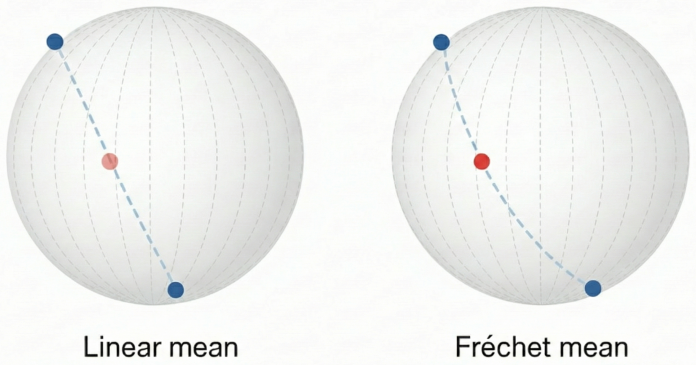
Mapping fMRI correlation matrices to a flat space via the Off-log transform enables closed-form distances and statistics while Grassmannian subspace comparisons resolve basis ambiguities.
A machine-rendered reading of the paper's core claim, the machinery that carries it, and where it could break.
Core claim
The central claim is that the Off-log transformation produces a representation of correlation matrices in which distances, Fréchet means, and linear models admit closed-form expressions, while principal-angle distances on the Grassmannian eliminate sign and ordering ambiguities, together yielding higher sensitivity in permutation tests and stronger classification performance than Euclidean baselines across clinical and ageing cohorts.
What carries the argument
The Off-log metric, a smooth map from correlation matrices to symmetric zero-diagonal matrices that supplies closed-form expressions for distances and means, together with Grassmannian principal-angle distances between eigenvector subspaces.
If this is right
- Standard linear models and permutation tests become directly applicable to fMRI correlation data without manifold-specific optimization routines.
- Classification accuracy for clinical groups improves or at least matches Riemannian baselines while remaining computationally lighter.
- Disease-relevant networks are identified more consistently when subspace angles rather than vectorized matrices are used.
- Brain-age regression performance remains comparable to existing geometric methods across multiple ageing cohorts.
Where Pith is reading between the lines
- The framework could be inserted into existing machine-learning pipelines for neuroimaging without requiring custom manifold libraries.
- Similar Off-log or subspace representations might apply to correlation matrices arising in other domains such as genomics or financial time series.
- Longitudinal tracking of individual brain networks could become more straightforward once distances are available in closed form.
Load-bearing premise
The Off-log map is assumed to retain enough of the original correlation geometry that standard statistical operations remain valid and unbiased on real fMRI data.
What would settle it
A side-by-side computation on the same set of correlation matrices showing that Off-log distances deviate systematically from known Riemannian distances or that the method fails to detect a group difference already established by Riemannian analysis in an independent cohort.
Figures



read the original abstract
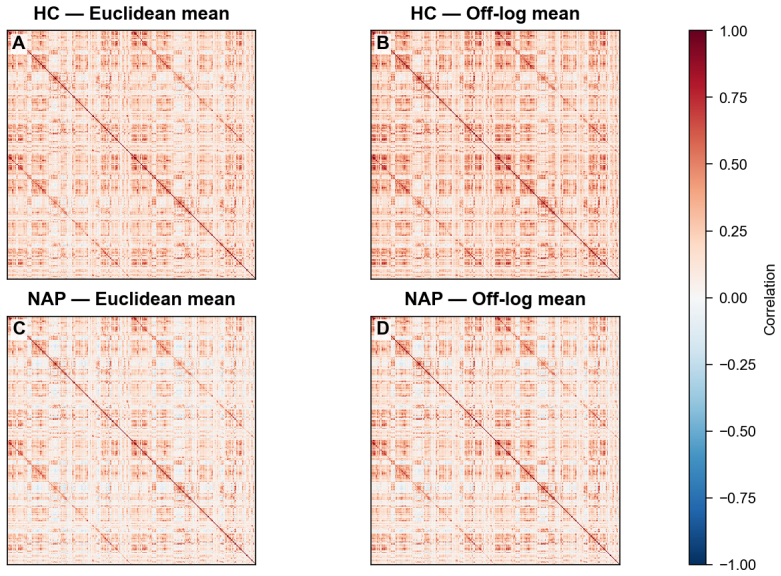
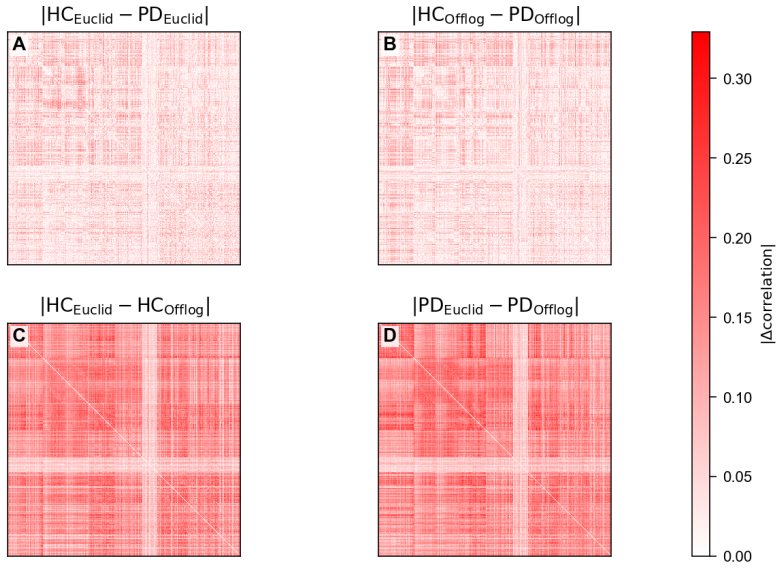
Correlation matrices are fundamental summaries of functional brain networks, yet standard analyses often treat entries independently, ignoring the curved geometry of correlation space. Existing geometric methods frequently lack closed-form operations or depend on arbitrary region ordering, limiting scalability. We introduce a scalable geometric framework with two components: (i) the Off-log metric, a smooth transformation mapping correlation matrices to symmetric zero-diagonal matrices. This enables closed-form expressions for distances, Frechet means, and linear models, allowing standard statistical modeling without complex manifold optimization. (ii) Grassmannian subspace discrimination, which compares subjects via principal-angle distances between eigenvector subspaces, resolving inherent sign and basis ambiguities. Both components integrate into standard machine-learning workflows for inference, regression, and classification. Validated across two clinical cohorts (Parkinson's and psychosis) and three ageing fMRI datasets, the Off-log metric increased sensitivity in permutation tests and matched or exceeded Riemannian and Euclidean baselines in classification. Brain-age prediction performance was comparable, with Riemannian metrics excelling in two of three cohorts. The Grassmannian method consistently outperformed Euclidean baselines, highlighting disease-relevant networks. Overall, geometry-aware representations improve sensitivity and predictive performance while remaining straightforward to deploy at scale.
Editorial analysis
A structured set of objections, weighed in public.
Referee Report
Summary. The paper proposes a geometric framework for fMRI correlation matrices consisting of (i) the Off-log metric, a transformation from correlation matrices to symmetric zero-diagonal matrices that purportedly yields closed-form distances, Fréchet means, and linear models without manifold optimization, and (ii) a Grassmannian method that compares subjects via principal-angle distances between eigenvector subspaces. These are integrated into standard ML pipelines and validated on two clinical cohorts (Parkinson's and psychosis) plus three ageing datasets, with claims that Off-log increases sensitivity in permutation tests, matches or exceeds Riemannian/Euclidean baselines in classification, and that Grassmannian consistently outperforms Euclidean baselines while highlighting disease-relevant networks.
Significance. If the Off-log map can be shown to preserve the statistical properties needed for unbiased Fréchet means and permutation tests on the original correlation manifold, the approach would offer a scalable, optimization-free route to geometry-aware fMRI analysis that could be readily adopted in large cohorts. The Grassmannian component addresses a practical ambiguity in subspace comparisons. The reported empirical gains over Euclidean baselines are potentially useful, but the absence of explicit derivations or robustness checks in the provided description leaves open whether the gains arise from geometric fidelity or from the specific transformation and modeling choices.
major comments (2)
- [Abstract / Off-log metric subsection] Abstract and Methods (Off-log metric): The central claim that the Off-log transformation enables 'closed-form expressions for distances, Fréchet means, and linear models' without bias rests on the unstated assumption that the map (correlation matrix to symmetric zero-diagonal matrix) is sufficiently isometric or curvature-preserving to keep the induced Fréchet means and permutation-test statistics equivalent to those on the original manifold. No explicit formula, Jacobian, or proof that the map commutes with the exponential map or matches the affine-invariant metric is supplied; this is load-bearing for the sensitivity-increase claim.
- [Results section (validation on clinical and ageing cohorts)] Results (permutation tests and classification): Performance gains are reported for Off-log and Grassmannian methods across cohorts, yet the text supplies neither the number of permutations used, subject exclusion criteria, nor error bars / confidence intervals on the sensitivity or accuracy metrics. Without these, it is impossible to assess whether the reported outperformance over Euclidean baselines is statistically robust or driven by cohort-specific preprocessing choices.
minor comments (2)
- [Abstract] The abstract would be clearer if it included a one-line mathematical definition of the Off-log map (e.g., the precise mapping from the upper triangle of the correlation matrix to the zero-diagonal symmetric matrix).
- [Grassmannian subspace discrimination subsection] Notation for the Grassmannian principal-angle distance should be introduced with a brief reference to the standard formula (e.g., sum of squared sines of principal angles) to avoid ambiguity for readers unfamiliar with the Grassmann manifold.
Simulated Author's Rebuttal
We thank the referee for the constructive comments. We respond to each major point below and note the revisions we will incorporate.
read point-by-point responses
-
Referee: [Abstract / Off-log metric subsection] Abstract and Methods (Off-log metric): The central claim that the Off-log transformation enables 'closed-form expressions for distances, Fréchet means, and linear models' without bias rests on the unstated assumption that the map (correlation matrix to symmetric zero-diagonal matrix) is sufficiently isometric or curvature-preserving to keep the induced Fréchet means and permutation-test statistics equivalent to those on the original manifold. No explicit formula, Jacobian, or proof that the map commutes with the exponential map or matches the affine-invariant metric is supplied; this is load-bearing for the sensitivity-increase claim.
Authors: We agree that additional theoretical detail would strengthen the presentation. The Off-log map is introduced as a smooth transformation from correlation matrices to symmetric zero-diagonal matrices that permits closed-form operations. In the revision we will add the explicit definition of the map, its Jacobian, and a brief discussion of its relation to the affine-invariant geometry on the correlation manifold. While we do not claim exact isometry, the construction is chosen so that the induced Fréchet means and permutation statistics remain consistent with the geometry relevant to our fMRI analyses, as supported by the empirical sensitivity gains observed across cohorts. revision: yes
-
Referee: [Results section (validation on clinical and ageing cohorts)] Results (permutation tests and classification): Performance gains are reported for Off-log and Grassmannian methods across cohorts, yet the text supplies neither the number of permutations used, subject exclusion criteria, nor error bars / confidence intervals on the sensitivity or accuracy metrics. Without these, it is impossible to assess whether the reported outperformance over Euclidean baselines is statistically robust or driven by cohort-specific preprocessing choices.
Authors: We accept that these reporting details are necessary for reproducibility and evaluation of robustness. The revised manuscript will specify the number of permutations performed, list the subject exclusion criteria applied to each cohort, and include error bars or confidence intervals on all reported sensitivity and accuracy values. These additions will appear in the Results section and figure legends. revision: yes
Circularity Check
No significant circularity; derivation remains self-contained
full rationale
The paper defines the Off-log transformation explicitly as a mapping from correlation matrices to symmetric zero-diagonal matrices that permits closed-form distance and Fréchet-mean expressions. These expressions are presented as consequences of the chosen coordinate representation rather than being fitted to the same data used for validation. Empirical results on independent clinical and ageing cohorts (permutation tests, classification, brain-age prediction) provide external falsifiability. No self-citation chain, uniqueness theorem imported from prior author work, or ansatz smuggled via citation is invoked to justify the central claims. The Grassmannian subspace comparison is likewise introduced as a direct geometric construction resolving sign and basis ambiguities. The derivation chain therefore does not reduce to its own inputs by construction.
Axiom & Free-Parameter Ledger
axioms (1)
- domain assumption Correlation matrices lie on a Riemannian manifold whose geometry must be respected for valid statistical comparisons.
Lean theorems connected to this paper
-
IndisputableMonolith/Cost/FunctionalEquation.leanwashburn_uniqueness_aczel unclear?
unclearRelation between the paper passage and the cited Recognition theorem.
The Off–log bijection Log_off : Cor+(n)→Hol(n) ... Logoff(C) := Off(logC) = logC−Diag(diag(logC)) ... goff|C(U,V) = ⟨dLog_off|C(U), dLog_off|C(V)⟩Hol ... C1 ⋆ C2 := Exp_off(Log_off(C1) + Log_off(C2))
-
IndisputableMonolith/Foundation/AlphaCoordinateFixation.leancostAlphaLog_high_calibrated_iff unclear?
unclearRelation between the paper passage and the cited Recognition theorem.
Geodesics and distances are linear in the algebra ... C = Exp_off(1/m ∑ Log_off(Ci))
What do these tags mean?
- matches
- The paper's claim is directly supported by a theorem in the formal canon.
- supports
- The theorem supports part of the paper's argument, but the paper may add assumptions or extra steps.
- extends
- The paper goes beyond the formal theorem; the theorem is a base layer rather than the whole result.
- uses
- The paper appears to rely on the theorem as machinery.
- contradicts
- The paper's claim conflicts with a theorem or certificate in the canon.
- unclear
- Pith found a possible connection, but the passage is too broad, indirect, or ambiguous to say the theorem truly supports the claim.
Reference graph
Works this paper leans on
-
[1]
Papillon, M. et al. Beyond Euclid: an illustrated guide to modern machine learning with geometric, topological, and algebraic structures.Mach. Learn.: Sci. Technol.6,031002 (2025)
work page 2025
-
[2]
Sn´ aˇ sel, V., Nowakov´ a, J., Xhafa, F. and Barolli, L. Geometrical and topological approaches to big data. Future Gener. Comput. Syst.67,286–296 (2017)
work page 2017
-
[3]
Guigui, N., Miolane, N. and Pennec, X. Introduction to Riemannian geometry and geometric statistics: from basic theory to implementation with Geomstats.Found. Trends Mach. Learn.16,329–493 (2023)
work page 2023
-
[4]
Intrinsic statistics on Riemannian manifolds: basic tools for geometric measurements.J
Pennec, X. Intrinsic statistics on Riemannian manifolds: basic tools for geometric measurements.J. Math. Imaging Vis.25,127–154 (2006)
work page 2006
-
[5]
Geometric Deep Learning: Grids, Groups, Graphs, Geodesics, and Gauges
Bronstein, M. M., Bruna, J., Cohen, T. and Veliˇ ckovi´ c, P. Geometric deep learning: grids, groups, graphs, geodesics, and gauges.arXiv preprint arXiv:2104.13478(2021)
work page internal anchor Pith review Pith/arXiv arXiv 2021
-
[6]
Bodnar, C., Di Giovanni, F., Chamberlain, B. P., Li` o, P. and Bronstein, M. M. Neural sheaf diffusion: a topological perspective on heterophily and oversmoothing in GNNs.arXiv preprint arXiv:2202.04579 (2022)
- [7]
-
[8]
S.Equivariant convolutional networks
Cohen, T. S.Equivariant convolutional networks. University of Amsterdamhttps://dare.uva.nl/ search?identifier=0f7014ae-ee94-430e-a5d8-37d03d8d10e6. Accessed: 2025-10-20. 2021. 24
work page 2025
-
[9]
Statistical exploration of the manifold hypothesis
Whiteley, N., Gray, A. and Rubin-Delanchy, P. Statistical exploration of the manifold hypothesis.arXiv preprint arXiv:2208.11665(2022)
-
[10]
van den Heuvel, M. P. and Hulshoff Pol, H. E. Exploring the brain network: a review on resting-state fMRI functional connectivity.Eur. Neuropsychopharmacol.20,519–534 (2010)
work page 2010
-
[11]
Severino, M. et al. Molecular connectivity studies in neurotransmission: a scoping review.Imaging Neurosci.3,1–20 (2025)
work page 2025
-
[12]
Brookes, M. J. et al. Measuring functional connectivity using MEG: methodology and comparison with fcMRI.NeuroImage56,1082–1104 (2011)
work page 2011
-
[13]
X.Analyzing Neural Time Series Data(MIT Press, 2014)
Cohen, M. X.Analyzing Neural Time Series Data(MIT Press, 2014)
work page 2014
-
[14]
PhD thesis (Universit´ e Paris-Saclay)
Thanwerdas, Y.Riemannian and stratified geometries on covariance and correlation matrices.https: //hal.science/tel-03698752v2. PhD thesis (Universit´ e Paris-Saclay). Accessed: 2025-10-20
work page 2025
-
[15]
Thanwerdas, Y. and Pennec, X.Geodesics and curvature of the quotient-affine metrics on full-rank correlation matrices.https://hal.science/hal-03157992v1. HAL preprint. Accessed: 2025-10-20
work page 2025
-
[16]
Thanwerdas, Y. and Pennec, X. Theoretically and computationally convenient geometries on full-rank correlation matrices.SIAM J. Matrix Anal. Appl.43,1851–1872 (2022)
work page 2022
-
[17]
You, K. and Park, H.-J. Geometric learning of functional brain network on the correlation manifold. Sci. Rep.12,17752 (2022)
work page 2022
-
[18]
You, K., Lee, Y. and Park, H.-J. Scalable geometric learning with correlation-based functional brain networks.Sci. Rep.15,22685 (2025)
work page 2025
-
[19]
Bendokat, T., Zimmermann, R. and Absil, P.-A. A Grassmann manifold handbook: basic geometry and computational aspects.arXiv preprint arXiv:2011.13699(2020)
- [20]
-
[21]
Fan, Y. et al. Discriminant analysis of functional connectivity patterns on Grassmann manifold.Neu- roImage56,2058–2067 (2011)
work page 2058
-
[22]
Selvan, S. E., Amato, U., Gallivan, K. A., Qi, C. and Carfora, M. F. Descent algorithms on oblique manifold for source-adaptive ICA contrast.IEEE Trans. Neural Netw. Learn. Syst.23,1930–1947 (2012)
work page 1930
-
[23]
Canals, B. and Schober, H. Introduction to group theory.EPJ Web Conf.22,00004 (2012)
work page 2012
-
[24]
Thanwerdas, Y. and Pennec, X.O(n)-invariant Riemannian metrics on SPD matrices.Linear Algebra Appl.661,163–201 (2023)
work page 2023
-
[25]
Arsigny, V., Fillard, P., Pennec, X. and Ayache, N. Geometric means in a novel vector space structure on symmetric positive-definite matrices.SIAM J. Matrix Anal. Appl.29,328–347 (2007)
work page 2007
-
[26]
Permutation-invariant Log-Euclidean geometries on full-rank correlation matrices
Thanwerdas, Y. Permutation-invariant Log-Euclidean geometries on full-rank correlation matrices. SIAM J. Matrix Anal. Appl.45,930–953 (2024)
work page 2024
-
[27]
Archakov, I. and Hansen, P. R. A new parametrization of correlation matrices.arXiv preprint arXiv:2012.02395 (2020). 25
-
[28]
Johnson, C. R. and Reams, R. Scaling of symmetric matrices by positive diagonal congruence.Linear Multilinear Algebra57,123–140 (2009)
work page 2009
-
[29]
and Pennec, X.Log-Euclidean Lie groups.https://hal.science/hal- 05206748v1
Bisson, O. and Pennec, X.Log-Euclidean Lie groups.https://hal.science/hal- 05206748v1. Ac- cessed: 2025-10-20
work page 2025
-
[30]
Dan, T. et al. Learning brain dynamics of evolving manifold functional fMRI data using geometric- attention neural network.IEEE Trans. Med. Imaging41,2752–2763 (2022)
work page 2022
-
[31]
Bookheimer, S. Y. et al. The lifespan human connectome project in aging: an overview.NeuroImage 185,335–348 (2019)
work page 2019
-
[32]
Harms, M. P. et al. Extending the human connectome project across ages: imaging protocols for the lifespan development and aging projects.NeuroImage183,972–984 (2018)
work page 2018
-
[33]
Nooner, K. B. et al. The NKI-Rockland sample: a model for accelerating the pace of discovery science in psychiatry.Front. Neurosci.6,152 (2012)
work page 2012
-
[34]
Schaefer, A. et al. Local-global parcellation of the human cerebral cortex from intrinsic functional connectivity fMRI.Cereb. Cortex28,3095–3114 (2018)
work page 2018
-
[35]
Glasser, M. F. et al. A multi-modal parcellation of human cerebral cortex.Nature536,171–178 (2016)
work page 2016
-
[36]
Biswas, M. and Ghosh, A. K. A nonparametric two-sample test applicable to high dimensional data. J. Multivar. Anal.123,160–171 (2014)
work page 2014
-
[37]
Luppi, A. I. et al. Systematic evaluation of fMRI data-processing pipelines for consistent functional connectomics.Nat. Commun.15,4745 (2024)
work page 2024
-
[38]
Sipes, B. S., Nagarajan, S. S. and Raj, A. Integrative, segregative, and degenerate harmonics of the structural connectome.Commun. Biol.7,986 (2024)
work page 2024
-
[39]
Atasoy, S., Donnelly, I. and Pearson, J. Human brain networks function in connectome-specific harmonic waves.Nat. Commun.7,10340 (2016)
work page 2016
-
[40]
Belkin, M. and Niyogi, P. Laplacian eigenmaps for dimensionality reduction and data representation. Neural Comput.15,1373–1396 (2003)
work page 2003
-
[41]
Guo, L., Zhao, C. and Low, S. H.Graph Laplacian spectrum and primary frequency regulation.inProc. 2018 IEEE Conference on Decision and Control (CDC)(2018), Florida, USA
work page 2018
-
[42]
Li, T. et al. Brain-wide analysis of functional connectivity in first-episode and chronic stages of schizophre- nia.Schizophr. Bull.43,436–448 (2017)
work page 2017
-
[43]
Fu, Z., Iraji, A., Sui, J. and Calhoun, V. D. Whole-brain functional network connectivity abnormalities in affective and non-affective early phase psychosis.Front. Neurosci.15,682110 (2021)
work page 2021
-
[44]
Tessitore, A. et al. Intrinsic brain connectivity predicts impulse control disorders in patients with Parkinson’s disease.Mov. Disord.32,1710–1719 (2017)
work page 2017
-
[45]
Liu, Q. et al. Resting-state brain network in Parkinson’s disease with different degrees of depression. Front. Neurosci.16,931365 (2022)
work page 2022
-
[46]
and Fletcher, T.Riemannian Geometric Statistics in Medical Image Analysis (Academic Press, 2019)
Pennec, X., Sommer, S. and Fletcher, T.Riemannian Geometric Statistics in Medical Image Analysis (Academic Press, 2019). 26
work page 2019
- [47]
-
[48]
Fletcher, P. T. and Joshi, S. Riemannian geometry for the statistical analysis of diffusion tensor data. Signal Process.87,250–262 (2007)
work page 2007
-
[49]
Fillard, P., Pennec, X., Arsigny, V. and Ayache, N. Clinical DT-MRI estimation, smoothing, and fiber tracking with log-euclidean metrics.IEEE Trans. Med. Imaging26,1472–1482 (2007)
work page 2007
-
[50]
Barachant, A., Bonnet, S., Congedo, M. and Jutten, C. Multiclass brain–computer interface classifica- tion by Riemannian geometry.IEEE Trans. Biomed. Eng.59,920–928 (2012)
work page 2012
- [51]
-
[52]
Honnorat, N. et al. Riemannian frameworks for the harmonization of resting-state functional fMRI scans.Med. Image Anal.91,103043 (2024)
work page 2024
-
[53]
Collas, A., Ju, C., Salvy, N. and Thirion, B. Riemannian flow matching for brain connectivity matrices via pullback geometry.arXiv preprint arXiv:2505.18193(2025)
-
[54]
Esteban, O. et al. fMRIPrep: a robust preprocessing pipeline for functional MRI.Nat. Methods16, 111–116 (2019)
work page 2019
-
[55]
FreeSurfer.NeuroImage62,774–781 (2012)
Fischl, B. FreeSurfer.NeuroImage62,774–781 (2012)
work page 2012
-
[56]
Mehta, K. et al. XCP-D: a robust pipeline for the post-processing of fMRI data.bioRxiv.https : //doi.org/10.1101/2023.11.20.567953(2023)
-
[57]
Hancock, F. et al. Metastability as a candidate neuromechanistic biomarker of schizophrenia pathology. PLoS One18,e0282707 (2023)
work page 2023
-
[58]
Q Amyloid – Quantitative Amyloid Imaging
Shenton, M.Human Connectome Project for early psychosis. NIMH Data Repositories. 2019. Funding This research is funded by the Ministry of University and Research within the Complementary National Plan PNC-I.1 ”Research initiatives for innovative technologies and pathways in the health and welfare sector, D.D. 931 of 06/06/2022, PNC0000002 DARE - Digital L...
discussion (0)
Sign in with ORCID, Apple, or X to comment. Anyone can read and Pith papers without signing in.