REVIEW 5 major objections 5 minor 28 references
DistB-VNET: Distributed Cluster-based Blockchain Vehicular Ad-Hoc Networks through SDN-NFV for Smart City
T0 review · 5 major / 5 minor · reviewed 2026-08-11 · deepseek-v4-flash
Pith's one-line read A blockchain-SDN-NFV VANET architecture claims 99.23% accuracy in blocking malicious traffic while improving latency, throughput, and congestion in smart-city vehicle networks.
desk verdict A plausible architecture sketch with an unreproducible performance table and a cryptographic error; not referee-ready. read the letter →
The pith
A machine-rendered reading of the paper's core claim, the machinery that carries it, and where it could break.
The reading
What carries the argument
The central mechanism is a three-stage pipeline: an unsupervised isolation-forest classifier placed after the cluster head filters edge traffic and blocks malicious flows; a dual-layer blockchain (distributed among vehicles, centralized in the cloud) ensures tamper-resistant data integrity and two-step verification; and SDN-NFV controllers dynamically allocate resources and manage routing through cluster heads. Isolation forest is a tree-based anomaly detector that isolates outliers rather than profiling normal behavior, which the paper justifies as necessary for detecting novel attacks that supervised models miss.
What would settle it
Re-running the simulation with a stated traffic model, explicit delay values for blockchain, SDN, NFV, and intra-cluster communication, and the same configuration for both systems: if the proposed system fails to beat IEAOCGO-C on at least one of the reported metrics, or if the 99.23% isolation-forest accuracy drops when evaluated on a held-out subset of IDS 2018, the central claims fail.
Extended reading notes
Core claim
The authors claim that their DistB-VNET architecture—a cluster-based VANET where a distributed blockchain secures vehicle-to-vehicle communication, a centralized cloud blockchain verifies and stores data, SDN separates control from data planes, and NFV automates resource allocation—achieves better security and network performance than current alternatives. The isolation-forest model, trained on the IDS 2018 intrusion dataset in an unsupervised manner, is reported to reach 99.23% accuracy, 99.14% precision, 99.15% recall, and 99.07% F1-score for classifying benign versus malicious traffic. Against the IEAOCGO-C baseline, the proposed system reports higher network lifetime, packet delivery ratio, and throughput, with lower end-to-end delay and energy consumption across 20–50 vehicles.
Load-bearing premise
The central performance comparison assumes that the simulation produced realistic, comparable numbers for both DistB-VNET and the IEAOCGO-C baseline, even though the paper does not specify the traffic model, blockchain gas parameters, or how the baseline was configured.
Editorial extensions
If this is right
- Smart-city vehicle networks could use this architecture to block previously unseen malicious traffic at the edge before it reaches the core network.
- If the performance gains are reproducible, combining blockchain with SDN-NFV could become a standard design pattern for secure vehicular communication, pushing toward lower-latency traffic management.
- The reported throughput equations offer a simple quantitative model for how blockchain, SDN, and NFV delays jointly affect vehicular throughput as cluster size or vehicle count grows.
- The unsupervised detection approach implies that the IDS can adapt to evolving cyber-attacks without requiring frequent retraining on labeled attack data.
Reading between the lines
- A natural testable extension is to evaluate the same isolation-forest placement on current benchmark datasets such as CICIDS2017 or 2019, which include more recent attack families, to see whether the 99.23% accuracy persists outside the IDS 2018 distribution.
- The architecture's separation of control and data planes combined with edge anomaly detection could generalize beyond vehicles to other IoT domains, such as smart-grid or healthcare monitoring, where low latency and novel-attack detection are both critical.
- The paper's own conclusion admits the system has not been tested under rising transmission costs and gas fees as vehicle numbers grow, so the scalability claim remains conditional on those costs not eroding the throughput advantage.
Signed reviews
Editorial analysis
A structured set of objections, weighed in public.
Referee Report
Summary. The manuscript proposes DistB-VNET, a distributed blockchain-based vehicular ad-hoc network architecture that integrates SDN, NFV, and an unsupervised Isolation Forest intrusion detection system for smart city VANETs. The architecture uses a dual-layer blockchain (distributed for vehicle communication, centralized for cloud verification) and cluster-based communication with RSUs. The paper claims 99.23% accuracy for malicious traffic detection on the IDS 2018 dataset and, via a comparison with IEAOCGO-C in Table II, claims reduced latency, increased security, and reduced congestion. The evaluation also includes throughput equations, plots of throughput and communication overhead, and gas consumption data.
Significance. If the reported results are correct, the combination of edge-level unsupervised intrusion detection with blockchain-backed SDN-NFV management would be a useful contribution to secure vehicular networks. The use of a public dataset (IDS 2018) for the ML evaluation is a positive feature, and the architecture description is reasonably detailed. However, the central quantitative claims are not presently reproducible: the network performance comparison in Table II lacks simulation methodology, the ML result lacks preprocessing and hyperparameter details, and Algorithm 1 contains a cryptographic direction error. The contribution is therefore interesting in scope but not yet substantiated at the standard required for publication.
major comments (5)
- [Section IV-C, Table II] The comparison against IEAOCGO-C is the sole quantitative evidence for the claimed performance improvement, but it is not reproducible. Section IV-B lists only the emulator, blockchain platform, node count, speed, and packet size; it does not specify the traffic model, mobility model, the delay components tb, ts, tn, tc, tv used in Eqs. (1)–(2), blockchain gas parameters, or how the baseline IEAOCGO-C was configured and run. Table II also has inconsistent units: ETED is labeled mJ (millijoules, an energy unit) and ECM is labeled ms (milliseconds, a time unit). These problems mean the claimed improvements cannot be distinguished from artifact.
- [Algorithm 1, lines 14–15] The secure communication procedure performs encryption with the private key and decryption with the public key. This does not provide confidentiality; it is message signing and verification. The abstract and introduction claim confidentiality, so this is a load-bearing security error. If confidentiality is intended, the algorithm should encrypt with the public key and decrypt with the private key.
- [Section III-A, Table IV] The 99.23% accuracy on the IDS 2018 dataset is not verifiable. The paper does not report preprocessing steps, feature selection, train/test split, class imbalance handling, or Isolation Forest hyperparameters (e.g., n_estimators, max_samples, contamination), and no code or reproducible artifact is provided. Without these details, the accuracy result could reflect data leakage or an optimistic evaluation setup.
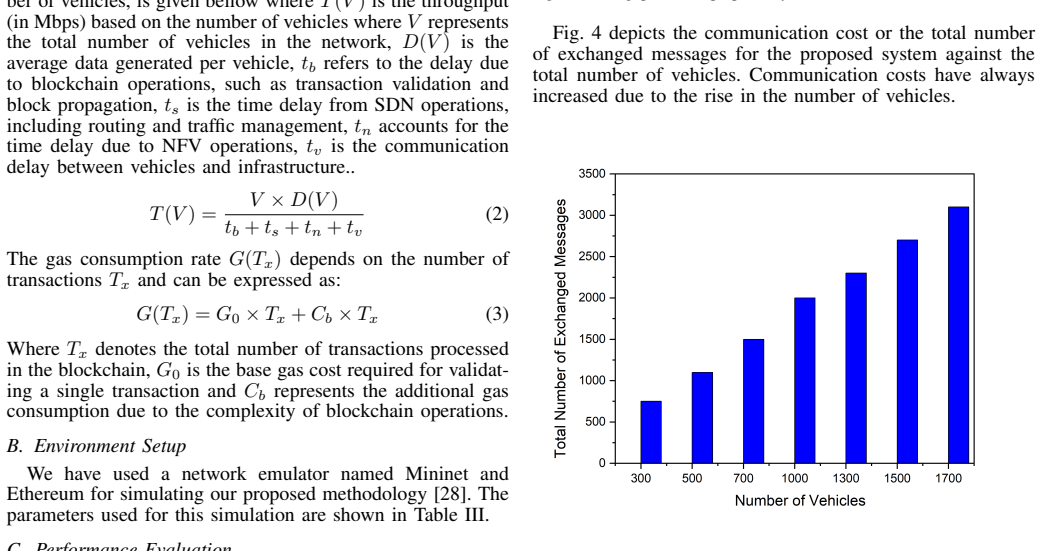
- [Section IV-A, Eqs. (1)–(3)] Equations (1)–(3) are definitions with free parameters (tb, ts, tn, tc, tv, G0, Cb); they do not constitute a derivation or a measurement procedure. No values for these delays or gas coefficients are given, and the paper does not explain how they were estimated in the Mininet/Ethereum setup. Consequently, the throughput and gas-consumption claims in Figures 3–5 and Table II are not supported by these equations.
- [Section IV-C, Fig. 3] The text states that for each fixed cluster size, throughput decreases as the number of vehicle nodes increases. This contradicts Eq. (2), which predicts throughput increasing with V for constant D(V) and constant delay components. The paper provides no explanation of how the delay model reverses this trend, so the reported behavior is internally inconsistent with the presented throughput equation.
minor comments (5)
- [Abstract and throughout] There are repeated typographical issues such as 'V ANETs' with nonbreaking spaces and 'noble isolation forest' in the abstract; these should be corrected to 'VANETs' and 'novel isolation forest'.
- [Table I] The table contains the typo 'achevied' for 'achieved', and the column formatting should be aligned for readability.
- [Table IV] The caption says 'anf f-score' and should read 'and F1-score'.
- [Section IV-B, Table III] The 'Max. vehicle speed' parameter is listed as 50 m/s^2; the unit should be m/s, not an acceleration unit.
- [Reference [23]] The IDS 2018 dataset reference should specify the exact subset of the CSE-CIC-IDS2018 data used, the access date, and any filtering or normalization applied.
Circularity Check
No significant circularity: the accuracy result is benchmarked on an external dataset, and the performance claims are presented as simulation measurements rather than as consequences of self-cited work.
full rationale
The paper's main quantitative claims are not circular. The 99.23% accuracy claim is evaluated on the external IDS 2018 Kaggle dataset ([23]), so it is an independent benchmark rather than a fitted input renamed as a prediction. The throughput, gas-consumption, and delay expressions in Eqs. (1)-(3) are definitions of metrics, and no performance conclusion is derived from them by algebraic reduction; the comparisons in Table II are asserted as measurement results against an external baseline [27], not as consequences of those equations. The numerous self-citations ([2]-[4], [8], [9], [20], [24]-[26], [28]) are used for background, architectural inspiration, or simulation tooling, and the load-bearing empirical claims do not reduce to those citations. Algorithm 1's public/private key misuse is a correctness flaw, and Table II's missing simulation configuration is a reproducibility problem, but neither exhibits the definitional or self-citational reduction that would constitute circularity. Accordingly, no circular step is identified.
Assumptions & free parameters
free parameters (3)
- Delay components tb, ts, tn, tc, tv in Equations 1 and 2 =
not reported
- Gas cost coefficients G0 and Cb in Equation 3 =
not reported
- Isolation Forest hyperparameters (contamination, tree count, sample size) =
not reported
assumptions (5)
- domain assumption Blockchain immutability and public/private key operations provide secure and tamper-resistant communication.
- domain assumption Isolation Forest trained on the IDS 2018 intrusion dataset generalizes to real VANET edge traffic.
- ad hoc to paper Throughput can be modeled by the additive-delay ratios in Equations 1 and 2.
- domain assumption The IEAOCGO-C baseline values in Table II were obtained under equivalent, fair conditions.
- domain assumption SDN/NFV integration yields decreased latency and reduced congestion as stated.
Cite this review
Pith. "Pith review of DistB-VNET: Distributed Cluster-based Blockchain Vehicular Ad-Hoc Networks through SDN-NFV for Smart City." pith.science (2026). https://pith.science/paper/2KK72RV4
@misc{pith2026241204222,
  author       = {Pith},
  title        = {Pith review of: DistB-VNET: Distributed Cluster-based Blockchain Vehicular Ad-Hoc Networks through SDN-NFV for Smart City},
  year         = {2026},
  howpublished = {\url{https://pith.science/paper/2KK72RV4}},
  note         = {Machine review of arXiv:2412.04222}
}
read the original abstract
In the developing topic of smart cities, Vehicular Ad-Hoc Networks (VANETs) are crucial for providing successful interaction between vehicles and infrastructure. This research proposes a distributed Blockchain-based Vehicular Ad-hoc Network (DistB-VNET) architecture that includes binary malicious traffic classification, Software Defined Networking (SDN), and Network Function Virtualization (NFV) to ensure safe, scalable, and reliable vehicular networks in smart cities. The suggested framework is the decentralized blockchain for safe data management and SDN-NFV for dynamic network management and resource efficiency and a noble isolation forest algorithm works as an IDS (Intrusion Detection System). Further, "DistB-VNET" offers a dual-layer blockchain system, where a distributed blockchain provides safe communication between vehicles, while a centralized blockchain in the cloud is in charge of data verification and storage. This improves security, scalability, and adaptability, ensuring better traffic management, data security, and privacy in VANETs. Furthermore, the unsupervised isolation forest model achieves a high accuracy of 99.23% for detecting malicious traffic. Additionally, reveals that our method greatly improves network performance, offering decreased latency, increased security, and reduced congestion, an effective alternative for existing smart city infrastructures.
Figures


Figures from the paper (1 more)
Reference graph
Works this paper leans on
-
[1]
Z. H. Ali, N. A. Sakr, N. El-Rashidy, and H. A. Ali, “A reliable position- based routing scheme for controlling excessive data dissemination in vehicular ad-hoc networks,” Computer Networks , vol. 229, p. 109785, 2023
work page 2023
-
[2]
Blocksd-5gnet: Enhancing security of 5g network through blockchain-sdn with ml-based bandwidth prediction,
A. Rahman, M. S. I. Khan, A. Montieri, M. J. Islam, M. R. Karim, M. Hasan, D. Kundu, M. K. Nasir, and A. Pescap `e, “Blocksd-5gnet: Enhancing security of 5g network through blockchain-sdn with ml-based bandwidth prediction,” Transactions on Emerging Telecommunications Technologies, vol. 35, no. 4, p. e4965, 2024
2024
-
[3]
A. Rahman, M. A. H. Wadud, M. J. Islam, D. Kundu, T. A.-U.-H. Bhuiyan, G. Muhammad, and Z. Ali, “Internet of medical things and blockchain-enabled patient-centric agent through sdn for remote patient monitoring in 5g network,” Scientific Reports , vol. 14, no. 1, p. 5297, 2024
work page 2024
-
[4]
Towards a blockchain-sdn-based secure architecture for cloud computing in smart industrial iot,
A. Rahman, M. J. Islam, S. S. Band, G. Muhammad, K. Hasan, and P. Tiwari, “Towards a blockchain-sdn-based secure architecture for cloud computing in smart industrial iot,” Digital Communications and Networks, vol. 9, no. 2, pp. 411–421, 2023
2023
-
[5]
Survey on blockchain- based applications in internet of vehicles,
L. Mendiboure, M. A. Chalouf, and F. Krief, “Survey on blockchain- based applications in internet of vehicles,” Computers & Electrical Engineering, vol. 84, p. 106646, 2020
work page 2020
-
[6]
Decentralized edge collab- oration for seamless handover authentication in zero-trust iov,
H. Fang, Y . Zhu, Y . Zhang, and X. Wang, “Decentralized edge collab- oration for seamless handover authentication in zero-trust iov,” IEEE Transactions on Wireless Communications , 2024
work page 2024
-
[7]
A. Hakiri, B. Sellami, and S. B. Yahia, “Joint energy efficiency and network optimization for integrated blockchain-sdn-based internet of things networks,” Future Generation Computer Systems , p. 107519, 2024
work page 2024
-
[8]
Smartblock- sdn: An optimized blockchain-sdn framework for resource management in iot,
A. Rahman, M. J. Islam, A. Montieri, M. K. Nasir, M. M. Reza, S. S. Band, A. Pescape, M. Hasan, M. Sookhak, and A. Mosavi, “Smartblock- sdn: An optimized blockchain-sdn framework for resource management in iot,” IEEE Access, vol. 9, pp. 28 361–28 376, 2021
2021
Show all 28 references
-
[9]
Sdn–iot empowered intelligent framework for industry 4.0 applications during covid-19 pandemic,
A. Rahman, C. Chakraborty, A. Anwar, M. R. Karim, M. J. Islam, D. Kundu, Z. Rahman, and S. S. Band, “Sdn–iot empowered intelligent framework for industry 4.0 applications during covid-19 pandemic,” Cluster Computing, pp. 1–18, 2022
2022
-
[10]
A survey on security attacks in vanets: Communication, applications and challenges,
M. Arif, G. Wang, M. Z. A. Bhuiyan, T. Wang, and J. Chen, “A survey on security attacks in vanets: Communication, applications and challenges,” Vehicular Communications, vol. 19, p. 100179, 2019
2019
-
[11]
Software defined vehicular networks: A comprehensive review,
J. Bhatia, Y . Modi, S. Tanwar, and M. Bhavsar, “Software defined vehicular networks: A comprehensive review,” International Journal of Communication Systems, vol. 32, no. 12, p. e4005, 2019
2019
-
[12]
Software-defined networking (sdn) and network function virtualization (nfv) for a hyperconnected world: Challenges, applications, and major advancements
A. Bradai, M. H. Rehmani, I. Haque, M. Nogueira, and S. H. R. Bukhari, “Software-defined networking (sdn) and network function virtualization (nfv) for a hyperconnected world: Challenges, applications, and major advancements.” J. Network Syst. Manage. , vol. 28, no. 3, pp. 433...
2020
-
[13]
Re- architecting nfv ecosystem with microservices: State of the art and research challenges,
S. R. Chowdhury, M. A. Salahuddin, N. Limam, and R. Boutaba, “Re- architecting nfv ecosystem with microservices: State of the art and research challenges,” IEEE Network, vol. 33, no. 3, pp. 168–176, 2019
2019
-
[14]
Designing blockchain based secure autonomous vehicular internet of things (iot) architecture with efficient smart contracts,
Hemani, D. Singh, and R. K. Dwivedi, “Designing blockchain based secure autonomous vehicular internet of things (iot) architecture with efficient smart contracts,” International Journal of Information Technol- ogy, pp. 1–17, 2024
2024
-
[15]
Synergizing blockchain, iot, and ai with vanet for intelligent transport solutions,
S. Zalte, V . Ghorpade, and R. K. Kamat, “Synergizing blockchain, iot, and ai with vanet for intelligent transport solutions,” Emerging Computing Paradigms: Principles, Advances and Applications, pp. 193– 210, 2022
2022
-
[16]
A scalable blockchain-based scheme for traffic-related data sharing in vanets,
E.-h. Diallo, O. Dib, and K. Al Agha, “A scalable blockchain-based scheme for traffic-related data sharing in vanets,” Blockchain: Research and Applications, vol. 3, no. 3, p. 100087, 2022
2022
-
[17]
A privacy-preservation framework based on biometrics blockchain (bbc) to prevent attacks in vanet,
A. Alharthi, Q. Ni, and R. Jiang, “A privacy-preservation framework based on biometrics blockchain (bbc) to prevent attacks in vanet,” Ieee Access, vol. 9, pp. 87 299–87 309, 2021
2021
-
[18]
Blockchain in digital twins-based vehicle management in vanets,
H. Feng, D. Chen, and Z. Lv, “Blockchain in digital twins-based vehicle management in vanets,” IEEE Transactions on Intelligent Transportation Systems, vol. 23, no. 10, pp. 19 613–19 623, 2022
2022
-
[19]
A promising integration of sdn and blockchain for iot networks: A survey,
S. W. Turner, M. Karakus, E. Guler, and S. Uludag, “A promising integration of sdn and blockchain for iot networks: A survey,” IEEE Access, vol. 11, pp. 29 800–29 822, 2023
2023
-
[20]
On the icn-iot with federated learning integration of communication: Concepts, security-privacy issues, applications, and future perspectives,
A. Rahman, K. Hasan, D. Kundu, M. J. Islam, T. Debnath, S. S. Band, and N. Kumar, “On the icn-iot with federated learning integration of communication: Concepts, security-privacy issues, applications, and future perspectives,” Future Generation Computer Systems, vol. 138, pp. ...
2023
-
[21]
A decentralized blockchain- based trust management framework for vehicular ad hoc networks,
T. Gazdar, O. Alboqomi, and A. Munshi, “A decentralized blockchain- based trust management framework for vehicular ad hoc networks,” Smart Cities, vol. 5, no. 1, pp. 348–363, 2022
2022
-
[22]
Networking controller based real time traffic prediction in clustered vehicular adhoc networks,
T. Balaji and S. Srinivasan, “Networking controller based real time traffic prediction in clustered vehicular adhoc networks,”Intelligent Automation & Soft Computing , vol. 35, no. 2, pp. 2189–2203, 2023
2023
-
[23]
Ids intrusion csv dataset,
solarmainframe, “Ids intrusion csv dataset,” 2018, accessed: 2024-09-28. [Online]. Available: https://www.kaggle.com/datasets/solarmainframe/ ids-intrusion-csv/data
2018
-
[24]
Impacts of blockchain in software-defined internet of things ecosystem with network function virtualization for smart applications: Present perspectives and future directions,
A. Rahman, J. Islam, D. Kundu, R. Karim, Z. Rahman, S. S. Band, M. Sookhak, P. Tiwari, and N. Kumar, “Impacts of blockchain in software-defined internet of things ecosystem with network function virtualization for smart applications: Present perspectives and future directions,...
2023
-
[25]
Distb-condo: Distributed blockchain-based iot-sdn model for smart condominium,
A. Rahman, M. J. Islam, Z. Rahman, M. M. Reza, A. Anwar, M. P. Mahmud, M. K. Nasir, and R. M. Noor, “Distb-condo: Distributed blockchain-based iot-sdn model for smart condominium,” IEEE Access, vol. 8, pp. 209 594–209 609, 2020
2020
-
[26]
Block-sdotcloud: Enhancing security of cloud storage through blockchain-based sdn in iot network,
A. Rahman, M. J. Islam, M. S. I. Khan, S. Kabir, A. I. Pritom, and M. R. Karim, “Block-sdotcloud: Enhancing security of cloud storage through blockchain-based sdn in iot network,” in 2020 2nd International Conference on Sustainable Technologies for Industry 4.0 (STI) . IEEE, 2...
2020
-
[27]
Intelligent energy aware optimization protocol for vehicular adhoc networks,
M. Elhoseny, I. M. El-Hasnony, and Z. Tarek, “Intelligent energy aware optimization protocol for vehicular adhoc networks,” Scientific Reports, vol. 13, no. 1, p. 9019, 2023
2023
-
[28]
Blockchain-sdn-based energy-aware and distributed secure architecture for iot in smart cities,
M. J. Islam, A. Rahman, S. Kabir, M. R. Karim, U. K. Acharjee, M. K. Nasir, S. S. Band, M. Sookhak, and S. Wu, “Blockchain-sdn-based energy-aware and distributed secure architecture for iot in smart cities,” IEEE Internet of Things Journal , vol. 9, no. 5, pp. 3850–3864, 2021
2021
Reviewed August 11, 2026 · model on record in the stance chip above.
Discussion (0). Continue with ORCID to comment.