REVIEW 4 major objections 5 minor 1 cited by
The cosmic web's Lyman-$\alpha$ glow at $z \approx 2.5$; hydrodynamic models, dust, and wide-field, narrow-band detection
T0 review · 4 major / 5 minor · reviewed 2026-08-04 · deepseek-v4-flash
Pith's one-line read The paper argues that the ultraviolet excess seen in a deep, wide-field narrow-band image taken by the Condor Array Telescope is Lyman-α emission from the cosmic web at redshift z≈2.5, a claim supported by synthetic maps built from five ind
desk verdict A useful multi-simulation Lyα forecast whose claimed validation of the Condor excess is asserted, not demonstrated — and the paper's own final caveat admits unresolved sources. read the letter →
The pith
A machine-rendered reading of the paper's core claim, the machinery that carries it, and where it could break.
The reading
What carries the argument
The central machinery is a set of synthetic Lyman-α surface-brightness maps produced by post-processing five full-physics hydrodynamic simulations (IllustrisTNG, EAGLE, CROCODILE, SIMBA, Sherwood) onto a common grid, using semi-analytic separation of hydrogen species and emissivities from recombination, collisional excitation, and star formation. Dust attenuation is treated particle-by-particle via a slab-geometry escape fraction with an SMC extinction curve and a dust-to-baryon scaling. The Anderson-Darling statistic, which weights the tails of the brightness distribution, is then applied to noisy simulated maps to quantify detection thresholds against pure Gaussian noise.
What would settle it
A narrow-band image of the same COSMOS field taken with a filter offset by a few ångströms (so Lyα at z=2.4754 falls outside but [OII] at z=0.1332 remains inside) should show the excess vanish if it is Lyα; if it persists, the signal is not the cosmic-web glow. Alternatively, a future 5σ detection of the diffuse component at noise ~2×10^-19 erg s^-1 cm^-2 arcsec^-2 would confirm the most optimistic simulation.
Extended reading notes
Core claim
On the paper's own terms, the central discovery is that the surface-brightness distribution of narrow-band Lyman-α emission predicted by hydrodynamic simulations of the z≈2.5 cosmic web is statistically consistent with the UV excess in the Condor Array Telescope image reported by Lanzetta et al. (2024). Using the Anderson-Darling statistic, the authors show that three of the four simulations that include dust predict a 5σ deviation from pure Gaussian noise for fluxes brighter than roughly 8×10^-17 erg s^-1 cm^-2 arcsec^-2, and that isolating the low-density diffuse component requires noise below about 2×10^-19 erg s^-1 cm^-2 arcsec^-2, reachable only by the most optimistic simulation (Illust
Load-bearing premise
The local-universe dust escape model—SMC extinction with dust-to-baryon proportionality—correctly describes how Lyman-α photons escape from z≈2.5 gas, even though no dust constraints exist at those redshifts on simulation-particle scales.
Editorial extensions
If this is right
- If the simulations are right, the Condor UV excess is Lyman-α emission from intergalactic and circumgalactic gas at z≈2.48, making it the first wide-field detection of the cosmic web in emission.
- Wide-field narrow-band surveys with sensitivities around 10^-17 erg s^-1 cm^-2 arcsec^-2 or better can statistically detect the total cosmic-web Lyman-α glow over volumes of hundreds of thousands of cubic megaparsecs.
- Detecting the truly diffuse, low-density component requires roughly two orders of magnitude deeper imaging (noise below ~2×10^-19 erg s^-1 cm^-2 arcsec^-2 in the most optimistic case), a target for next-generation facilities.
- The broad agreement across four independent simulations, despite large differences in subgrid physics, suggests the statistical detection is not an artifact of a single baryon model, though the bright end is dust-sensitive.
- Contaminating lines such as [OII] at z≈0.13 are shown to contribute at most a few tenths of a percent of the signal, so the 422 nm narrow-band excess is effectively pure Lyman-α.
Reading between the lines
- If a follow-up observation with a detuned filter (a few ångströms off the Lyα redshift) shows the excess disappearing, the cosmic-web interpretation is strongly confirmed; this is the most direct test the paper leaves implicit.
- The paper's own caveat that the signal is likely unresolved sources rather than diffuse gas implies that 'cartographic mapping' of the filamentary network may first require separating a population of faint, clustered emitters before the diffuse component becomes visible.
- The same semi-analytic pipeline could be adapted to other redshifts and emission lines, turning wide-field imagers into systematic probes of diffuse baryons, provided dust models can be validated at those epochs.
- The markedly different surface-brightness PDFs produced by the dust-escape model versus high-density culling indicate that the claimed 5σ threshold for the total component is not yet pinned down; calibrating dust-to-gas at z~2.5 would materially sharpen the forecasts.
Editorial analysis
A structured set of objections, weighed in public.
Referee Report
Summary. The paper post-processes five cosmological hydrodynamic simulations (IllustrisTNG, EAGLE, CROCODILE, SIMBA, Sherwood) at redshifts 2.0–2.74 to predict narrow-band Lyman-α surface brightness from the cosmic web. Emission is computed from recombination, collisional excitation, and star formation, with hydrogen species separated using published fitting functions (Rahmati et al.; Gnedin & Kravtsov). High-density gas is treated either with an SMC-based dust attenuation model (Eqs. 15–18) or by culling particles above a self-shielding density threshold (Sec. 2.8). The projected surface-brightness maps are then degraded by Gaussian noise, and the Anderson-Darling statistic is used to estimate detection thresholds. The authors report that a 5σ detection of total intergalactic/circumgalactic Lyman-α emission should be possible at fluxes brighter than ≈8×10^-17 erg s^-1 cm^-2 arcsec^-2, while the low-density cosmic-web component requires noise below ≈2×10^-19. The abstract and conclusions further claim that these predictions are consistent with the UV excess detected in the Condor Array Telescope narrow-band image reported by Lanzetta et al. (2024).
Significance. If the central consistency claim could be substantiated, the paper would provide a useful framework for planning wide-field narrow-band surveys of diffuse Lyman-α emission and for quantifying the sensitivity needed to map the cosmic web in emission. The multi-simulation comparison is a genuine strength: five independent hydrodynamic codes are processed through a common pipeline, and the derived neutral-hydrogen CDDFs are checked against quasar absorption measurements. The paper is also unusually candid about the limitations of the dust model and about inter-simulation scatter. However, the headline claim of consistency with the Condor detection is not demonstrated by the statistical analysis actually presented, and the conclusions contain an admission that the observed UV excess may be dominated by unresolved sources rather than diffuse Lyman-α. With a direct comparison to the observed image or a reframing as forward predictions only, the simulation methodology and threshold estimates would still be a useful contribution.
major comments (4)
- [§3.3.2, Fig. 6] The Anderson-Darling statistic is computed only between (simulated map + Gaussian noise) and pure Gaussian noise. It is never computed for the actual masked Condor narrow-band-minus-luminance image described in §3.3.1, nor is the observed pixel PDF compared with the simulated PDFs. The statement in §3.3.1 that the two datasets can be 'compared meaningfully' is not followed by a comparison. Therefore the abstract and §4 claim that the simulation predictions are 'consistent with' the Condor UV excess is not supported by the analysis shown. Please either compute A2 (or an equivalent statistic) for the observed masked difference image, or explicitly downgrade the consistency claim to simulation-only detectability predictions.
- [§4, concluding paragraphs] The paper itself states that Fig. 6 suggests that Condor has not detected the diffuse component but 'more likely the statistical effect of unresolved sources.' This directly undermines the central claim that the Condor UV excess validates diffuse Lyman-α cosmic-web emission. If unresolved sources dominate the measured excess, then agreement with diffuse-emission simulations is not evidence for detection of the diffuse cosmic web. The manuscript must distinguish between (a) a claimed detection of diffuse IGM/CGM Lyman-α, and (b) a UV excess consistent with unresolved sources plus perhaps a subdominant diffuse component. The current wording conflates the two, and the conclusions should be revised to state precisely which claim is intended.
- [§2.7, Eqs. 15–18; §2.8; Fig. 6] The dust escape model is derived from local-universe relations, and the paper concedes in §2.1 that no dust constraints exist at z≈2.5 on simulation-particle scales. This model controls the bright end of the surface-brightness distribution and hence the quoted 5σ threshold near 8×10^-17 in the left panel of Fig. 6. The alternative density-culling treatment in §2.8 yields 'dramatically different' PDFs and threshold curves (right panel of Fig. 6). Because no observed comparison anchors the choice between these treatments, the central threshold claim is sensitive to an unvalidated modeling assumption. Please quantify the dependence of the 5σ threshold on dust-model parameters (e.g., albedo, metallicity scaling, SMC vs. LMC curve) and state whether the threshold is robust across the two adopted treatments or only a property of the fiducial dust prescription.
- [§3.2.1, Table 2] The factor-of-six spread in predicted diffuse IGM temperatures is presented as an inter-simulation result, but the paper also notes that all five simulations overestimate the observationally inferred Lyman-α forest temperature. This is more than a diagnostic aside: the temperature enters the emissivity calculations directly, so the bright-end predictions inherit this systematic scatter. A quantitative statement of how much of the simulation-to-simulation spread in Fig. 6 is driven by temperature differences (as opposed to density/star-formation prescriptions) would strengthen the paper and help the reader judge whether the claimed consistency threshold is robust.
minor comments (5)
- [§1; §3.3.1] Section 1 states that the Condor narrow-band filter probes z=2.24754±0.0030, while §3.3.1 and §4 use z=2.4754. For λ_Lyα=121.567 nm and λ_filter=422.5 nm, z≈2.4754. The first value appears to be a typo and should be corrected.
- [Fig. 3 text vs caption] The main text says 'the intensity scaling is kept the same for all panels,' but the figure caption says 'each simulation has its own colour map... numerical display ranges are not the same.' Please reconcile these statements.
- [Eq. (17)] The summation notation in Eq. (17) is undefined: the sums over Z_i and Z_i,0 are not specified (over which elements? per particle? solar abundances?). Please define all indices and reference abundances explicitly.
- [Fig. 6] The horizontal '5 sd.' threshold is attributed to SciPy but the corresponding Anderson-Darling critical value or p-value conversion is not given. Please state the numerical threshold used so the claim is reproducible.
- [Throughout] Small typos include 'Anderson-Darling statistical text' (§3.3.2), 'observational and stimulation data' (§3.1), and the bibliographic entry 'Lanzetta et al K. M., 2024', which should be formatted consistently.
Circularity Check
No equation-level circularity: the Lyα surface-brightness predictions are computed from simulation physics and external fitting functions, not fitted to the Condor image; the main weakness is that the claimed consistency with the Condor UV excess is asserted rather than demonstrated.
full rationale
The derivation chain is not circular by construction. Equations (1)–(26) compute Lyα emissivities, hydrogen fractions, dust escape fractions, and surface brightness from hydrodynamic simulation outputs using external fits (Rahmati et al. 2013a; Gnedin & Kravtsov 2011; Laursen et al. 2009b; Pei 1992; Haardt & Madau 2012), with no parameter fitted to the Condor measurement. The Anderson–Darling thresholds in Fig. 6 are computed from simulated maps plus Gaussian noise versus a Gaussian null; they are predictions, not fits to the observed UV excess. The paper does not compute A² for the actual masked Condor difference image (the comparison is only described in §3.3.1, where the authors say 'we are nevertheless able to compare the two meaningfully' without performing an observed-versus-simulated A² test). Its own concluding paragraph weakens the discovery claim: 'Fig.6 suggests that Condor has not detected the diffuse component, but more likely the statistical effect of unresolved sources' — a support gap, not a circular reduction. The observational target is taken from Lanzetta et al. (2024), a companion paper with overlapping authors; this is a self-referential evidentiary link, but the theoretical result does not reduce to that citation. The CDDF comparison against external quasar absorption measurements provides independent benchmark support. No self-definitional, fitted-input-as-prediction, uniqueness-imported, ansatz-smuggled, or renaming circularity was found. Score 1 reflects the minor self-referential observational anchor and the unquantified 'consistency' assertion, not derivation-level circularity.
Assumptions & free parameters
free parameters (4)
- Star-formation Ly-alpha emissivity normalization =
10^42 erg s^-1 per (M_sun/yr)
- Rahmati et al. HI-fraction fit parameters =
alpha1=-2.28, alpha2=-0.84, f=0.02, kappa=1.64, n0=1.003 n_H,SSh
- Dust escape fit coefficients and albedo =
zeta'=2.048, eta'=0.71, A=0.32
- Gnedin-Kravtsov H2 prescription parameters =
Sigma_c=20 M_sun pc^-2 with D, U dependencies
assumptions (7)
- domain assumption Semi-analytic post-processing without full Monte Carlo radiative transfer is adequate for surface brightness PDFs.
- domain assumption The Rahmati et al. fitting functions are valid for z≳2 and the ignored helium contribution to electron density is small.
- domain assumption Case B recombination is appropriate because high-column-density gas (N_HI≳1e18 cm^-2) dominates the bright-end surface brightness.
- domain assumption The observed masked difference image traces only photon noise plus cosmic-web line emission; [OII] and other line contamination are negligible.
- domain assumption Local-universe SMC dust properties apply at z≈2.5.
- domain assumption Matter is homogeneous within each simulation particle; real clumpiness would make the cosmic web easier to detect.
- domain assumption The five simulation snapshots at z=2.00–2.74 are treated as comparable predictions for the single Condor narrow-band shell at z=2.4754 without correction for redshift evolution or box-size differences.
Cite this review
Pith. "Pith review of The cosmic web's Lyman-$\alpha$ glow at $z \approx 2.5$; hydrodynamic models, dust, and wide-field, narrow-band detection." pith.science (2026). https://pith.science/paper/2MM66EGC
@misc{pith2026251007259,
  author       = {Pith},
  title        = {Pith review of: The cosmic web's Lyman-$\alpha$ glow at $z \approx 2.5$; hydrodynamic models, dust, and wide-field, narrow-band detection},
  year         = {2026},
  howpublished = {\url{https://pith.science/paper/2MM66EGC}},
  note         = {Machine review of arXiv:2510.07259}
}
abstract
The diffuse Lyman-$\alpha$ glow of the cosmic web has long been predicted but has so far eluded direct detection over cosmologically significant volumes. We construct synthetic Lyman-$\alpha$ surface-brightness maps using five state-of-the-art hydrodynamic simulations (\texttt{IllustrisTNG, EAGLE, CROCODILE, SIMBA, and Sherwood}), modeling recombination, collisional excitation, star formation, and localized dust attenuation. Our study focuses on the redshift range $2.0<z<2.7$, motivated by the numerous detailed studies of the COSMOS region. Significant variations are seen in the results obtained from these independent simulations. Using the Anderson-Darling statistic to probe these statistical differences, we demonstrate that a $5\sigma$ statistical detection of the total intergalactic and circumgalactic Lyman-$\alpha$ emission is achievable with current facilities at flux thresholds brighter than $\sim 8 \times 10^{-17} \text{ erg s}^{-1}\text{ cm}^{-2}\text{ arcsec}^{-2}$. Conversely, isolating the underlying low-density component of the cosmic web requires ultra-deep sensitivity, with the most optimistic simulation (IllustrisTNG) reaching a 5$\sigma$ detection only for background noise levels below $\sigma \sim 2 \times 10^{-19} \text{ erg s}^{-1}\text{ cm}^{-2}\text{ arcsec}^{-2}$. These quantitative limits validate the feasibility of ongoing wide-field narrow-band campaigns, opening a new era of empirical intergalactic cartography.
Figures

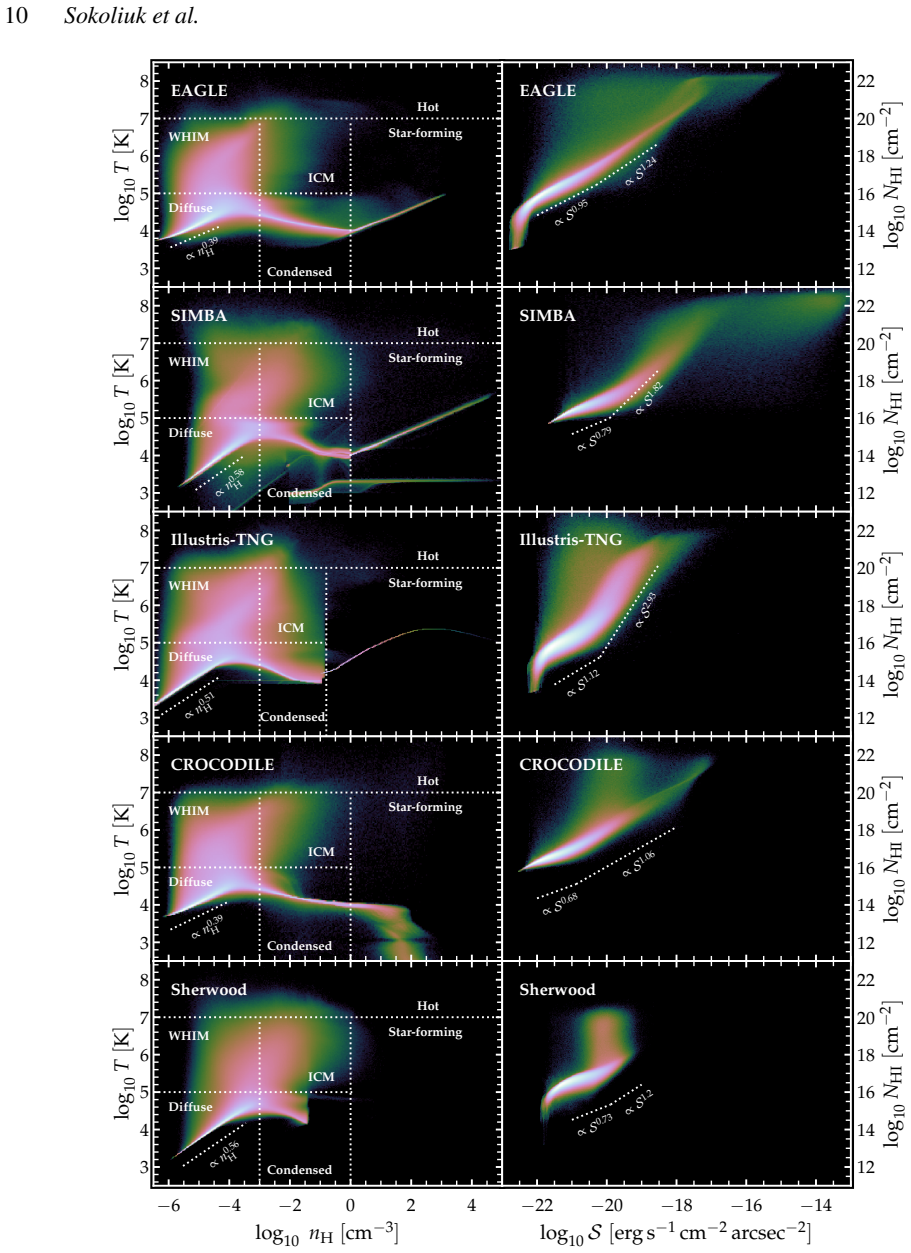

Figures from the paper (4 more)


Forward citations
Cited by 1 Pith paper
-
FEASTS and MHONGOOSE: HI Column Density Distribution at $z=0$ for $N_\mathrm{HI}>10^{17.8}\, \mathrm{cm}^{-2}$
The z=0 HI column-density distribution function has been measured for the first time down to 10^17.8 cm^-2 from 1-kpc-resolution 21-cm images, showing modest evolution since z~3 at LLS-like densities.
Reference graph
Works this paper leans on
-
[1]
Altay G., Theuns T., Schaye J., Crighton N. H. M., Dalla Vecchia C., 2011, @doi [The Astrophysical Journal Letters] 10.1088/2041-8205/737/2/L37 , 737, L37
-
[2]
Anderson T. W., Darling D. A., 1952, @doi [Annals of Mathematical Statistics] 10.1214/aoms/1177729437 , 23, 193
arXiv 1952
-
[5]
Bacon R., et al., 2021, @doi [Astron. & Astrophys.] 10.1051/0004-6361/202039887 , https://ui.adsabs.harvard.edu/abs/2021A&A...647A.107B 647, A107
-
[6]
Bacon R., et al., 2023, @doi [ ] 10.1051/0004-6361/202244187 , https://ui.adsabs.harvard.edu/abs/2023A&A...670A...4B 670, A4
-
[7]
Bacon R., Mainieri V., Randich S., et al., 2024, arXiv e-prints
2024
-
[8]
Banerjee E., Muzahid S., Schaye J., Cantalupo S., Johnson S. D., 2024, MUSEQuBES: Unveiling Cosmic Web Filaments at z 3.6 through Dual Absorption and Emission Line Analysis ( @eprint arXiv 2412.04546 ), https://arxiv.org/abs/2412.04546
arXiv 2024
-
[9]
Bauer A., Springel V., Vogelsberger M., Genel S., Torrey P., Sijacki D., Nelson D., Hernquist L., 2015, @doi [MNRAS] 10.1093/mnras/stv1893 , https://ui.adsabs.harvard.edu/abs/2015MNRAS.453.3593B 453, 3593
-
[10]
Bird S., Vogelsberger M., Haehnelt M., Sijacki D., Genel S., Torrey P., Springel V., Hernquist L., 2014, @doi [ ] 10.1093/mnras/stu1923 , https://ui.adsabs.harvard.edu/abs/2014MNRAS.445.2313B 445, 2313
Show all 153 references
-
[11]
Boess L., 2024, SPHtoGrid.jl homepage: https://github.com/LudwigBoess/SPHtoGrid.jl
2024
- [12]
-
[13]
S., Puchwein E., Sijacki D., Haehnelt M
Bolton J. S., Puchwein E., Sijacki D., Haehnelt M. G., Kim T.-S., Meiksin A., Regan J. A., Viel M., 2017, @doi [MNRAS] 10.1093/mnras/stw2397 , https://ui.adsabs.harvard.edu/abs/2017MNRAS.464..897B 464, 897
2017 doi
-
[14]
Bonatto C., Bica E., 2011, @doi [MNRAS] 10.1111/j.1365-2966.2011.18901.x , https://ui.adsabs.harvard.edu/abs/2011MNRAS.415.2827B 415, 2827
2011
-
[15]
R., Kofman L., Pogosyan D., 1996, @doi [Nature] 10.1038/380603a0 , https://ui.adsabs.harvard.edu/abs/1996Natur.380..603B 380, 603
Bond J. R., Kofman L., Pogosyan D., 1996, @doi [Nature] 10.1038/380603a0 , https://ui.adsabs.harvard.edu/abs/1996Natur.380..603B 380, 603
1996 doi
-
[16]
Brough S., et al., 2024, @doi [Monthly Notices of the Royal Astronomical Society] 10.1093/mnras/stac2045 , 528, 771
2024 doi
-
[17]
N., Elek O., Tejos N., Prochaska J
Burchett J. N., Elek O., Tejos N., Prochaska J. X., Tripp T. M., Bordoloi R., Forbes A. G., 2020, @doi [ ] 10.3847/2041-8213/ab700c , https://ui.adsabs.harvard.edu/abs/2020ApJ...891L..35B 891, L35
2020 doi
-
[18]
Byrohl C., Nelson D., 2023, @doi [MNRAS] 10.1093/mnras/stad1779 , https://ui.adsabs.harvard.edu/abs/2023MNRAS.523.5248B 523, 5248
2023 doi
-
[19]
Byrohl C., et al., 2021, @doi [ ] 10.1093/mnras/stab1958 , https://ui.adsabs.harvard.edu/abs/2021MNRAS.506.5129B 506, 5129
2021 doi
-
[20]
Caddy S., Spitler L., Ellis S., 2024, @doi [Publications of the Astronomical Society of Australia] 10.1017/pasa.2024.25 , 41, e025
2024 doi
-
[21]
J., Miniati F., 2005, @doi [ApJ] 10.1086/430758 , https://ui.adsabs.harvard.edu/abs/2005ApJ...628...61C 628, 61
Cantalupo S., Porciani C., Lilly S. J., Miniati F., 2005, @doi [ApJ] 10.1086/430758 , https://ui.adsabs.harvard.edu/abs/2005ApJ...628...61C 628, 61
2005 doi
-
[22]
J., 2008, @doi [Astrophysical Journal] 10.1086/523298 , https://ui.adsabs.harvard.edu/abs/2008ApJ...672...48C 672, 48
Cantalupo S., Porciani C., Lilly S. J., 2008, @doi [Astrophysical Journal] 10.1086/523298 , https://ui.adsabs.harvard.edu/abs/2008ApJ...672...48C 672, 48
2008 doi
-
[23]
X., Hennawi J
Cantalupo S., Arrigoni-Battaia F., Prochaska J. X., Hennawi J. F., Madau P., 2014, @doi [Nature] 10.1038/nature12898 , https://ui.adsabs.harvard.edu/abs/2014Natur.506...63C 506, 63
2014 doi
-
[24]
F., 2024, VPFIT homepage: https://people.ast.cam.ac.uk/ rfc/, https://people.ast.cam.ac.uk/ rfc/
Carswell R. F., 2024, VPFIT homepage: https://people.ast.cam.ac.uk/ rfc/, https://people.ast.cam.ac.uk/ rfc/
2024
-
[25]
F., Webb J
Carswell R. F., Webb J. K., 2014, VPFIT: Voigt profile fitting program, http://adsabs.harvard.edu/abs/2014ascl.soft08015C , Astrophysics Source Code Library ( @eprint ascl 1408.015 )
2014
-
[26]
Cautun M., van de Weygaert R., Jones B. J. T., Frenk C. S., 2014, @doi [ ] 10.1093/mnras/stu768 , https://ui.adsabs.harvard.edu/abs/2014MNRAS.441.2923C 441, 2923
2014 doi
-
[27]
G., 2018, @doi [MNRAS] 10.1093/mnras/sty992 , https://ui.adsabs.harvard.edu/abs/2018MNRAS.478.1065C 478, 1065
Chardin J., Kulkarni G., Haehnelt M. G., 2018, @doi [MNRAS] 10.1093/mnras/sty992 , https://ui.adsabs.harvard.edu/abs/2018MNRAS.478.1065C 478, 1065
2018 doi
- [28]
-
[29]
Chia-Yu H., 2024, ParticleGridMapper.jl homepage: https://github.com/huchiayu/ParticleGridMapper.jl, https://github.com/huchiayu/ParticleGridMapper.jl
2024
-
[30]
Codis S., Pogosyan D., Pichon C., 2018, @doi [MNRAS] 10.1093/mnras/sty1643 , https://ui.adsabs.harvard.edu/abs/2018MNRAS.479..973C 479, 973
2018 doi
-
[31]
Collaboration D., Aghamousa A., Aguilar J., Ahlen S., et al., 2016, arXiv e-prints
2016
- [32]
- [33]
-
[34]
A., et al., 2015, @doi [MNRAS] 10.1093/mnras/stv725 , https://ui.adsabs.harvard.edu/abs/2015MNRAS.450.1937C 450, 1937
Crain R. A., et al., 2015, @doi [MNRAS] 10.1093/mnras/stv725 , https://ui.adsabs.harvard.edu/abs/2015MNRAS.450.1937C 450, 1937
2015 doi
-
[35]
A., et al., 2017, @doi [MNRAS] 10.1093/mnras/stw2586 , https://ui.adsabs.harvard.edu/abs/2017MNRAS.464.4204C 464, 4204
Crain R. A., et al., 2017, @doi [MNRAS] 10.1093/mnras/stw2586 , https://ui.adsabs.harvard.edu/abs/2017MNRAS.464.4204C 464, 4204
2017 doi
-
[36]
& Astrophys.] 10.1051/0004-6361/201833655 , https://ui.adsabs.harvard.edu/abs/2018A&A...619A..49C 619, A49
Cucciati O., et al., 2018, @doi [Astron. & Astrophys.] 10.1051/0004-6361/201833655 , https://ui.adsabs.harvard.edu/abs/2018A&A...619A..49C 619, A49
2018 doi
-
[37]
H., Katz N., 1997, @doi [ ] 10.1086/303712 , https://ui.adsabs.harvard.edu/abs/1997ApJ...477...21D 477, 21
Dav \'e R., Hernquist L., Weinberg D. H., Katz N., 1997, @doi [ ] 10.1086/303712 , https://ui.adsabs.harvard.edu/abs/1997ApJ...477...21D 477, 21
1997 doi
-
[38]
H., 1999, @doi [ ] 10.1086/306722 , https://ui.adsabs.harvard.edu/abs/1999ApJ...511..521D 511, 521
Dav \'e R., Hernquist L., Katz N., Weinberg D. H., 1999, @doi [ ] 10.1086/306722 , https://ui.adsabs.harvard.edu/abs/1999ApJ...511..521D 511, 521
1999 doi
-
[39]
H., Appleby S., 2019, @doi [MNRAS] 10.1093/mnras/stz937 , https://ui.adsabs.harvard.edu/abs/2019MNRAS.486.2827D 486, 2827
Dav \'e R., Angl \'e s-Alc \'a zar D., Narayanan D., Li Q., Rafieferantsoa M. H., Appleby S., 2019, @doi [MNRAS] 10.1093/mnras/stz937 , https://ui.adsabs.harvard.edu/abs/2019MNRAS.486.2827D 486, 2827
2019 doi
-
[40]
S., White S
Davis M., Efstathiou G., Frenk C. S., White S. D. M., 1985, @doi [ ] 10.1086/163168 , https://ui.adsabs.harvard.edu/abs/1985ApJ...292..371D 292, 371
1985 doi
-
[41]
B., 2016, @doi [ ] 10.1051/0004-6361/201527895 , https://ui.adsabs.harvard.edu/abs/2016A&A...596A..97D 596, A97
De Cia A., Ledoux C., Mattsson L., Petitjean P., Srianand R., Gavignaud I., Jenkins E. B., 2016, @doi [ ] 10.1051/0004-6361/201527895 , https://ui.adsabs.harvard.edu/abs/2016A&A...596A..97D 596, A97
2016 doi
-
[42]
Dietrich J. P., Werner N., Clowe D., Finoguenov A., Kitching T., Miller L., Simionescu A., 2012, @doi [Nature] 10.1038/nature11224 , https://ui.adsabs.harvard.edu/abs/2012Natur.487..202D 487, 202
2012 doi
-
[43]
Dijkstra M., 2014, @doi [PASA] 10.1017/pasa.2014.33 , https://ui.adsabs.harvard.edu/abs/2014PASA...31...40D 31, e040
2014 doi
-
[44]
Dome T., Fialkov A., Sartorio N., Mocz P., 2023, @doi [MNRAS] 10.1093/mnras/stad2276 , https://ui.adsabs.harvard.edu/abs/2023MNRAS.525..348D 525, 348
2023 doi
-
[45]
T., 2011, Physics of the Interstellar and Intergalactic Medium
Draine B. T., 2011, Physics of the Interstellar and Intergalactic Medium . Princeton University Press
2011
-
[46]
Duval F., Schaerer D., \"O stlin G., Laursen P., 2014, @doi [ ] 10.1051/0004-6361/201220455 , https://ui.adsabs.harvard.edu/abs/2014A&A...562A..52D 562, A52
2014 doi
-
[47]
A., 2015, @doi [ ] 10.1093/mnrasl/slv085 , https://ui.adsabs.harvard.edu/abs/2015MNRAS.452L..36D 452, L36
Dvorkin I., Silk J., Vangioni E., Petitjean P., Olive K. A., 2015, @doi [ ] 10.1093/mnrasl/slv085 , https://ui.adsabs.harvard.edu/abs/2015MNRAS.452L..36D 452, L36
2015 doi
-
[48]
Eckert D., et al., 2015, @doi [ ] 10.1038/nature16058 , https://ui.adsabs.harvard.edu/abs/2015Natur.528..105E 528, 105
2015 doi
-
[49]
Efstathiou G., Davis M., White S. D. M., Frenk C. S., 1985, @doi [ ] 10.1086/191003 , https://ui.adsabs.harvard.edu/abs/1985ApJS...57..241E 57, 241
1985 doi
-
[50]
J., Stanway E
Eldridge J. J., Stanway E. R., Xiao L., McClelland L. A. S., Taylor G., Ng M., Greis S. M. L., Bray J. C., 2017, @doi [ ] 10.1017/pasa.2017.51 , https://ui.adsabs.harvard.edu/abs/2017PASA...34...58E 34, e058
2017 doi
-
[51]
Elias L. M., Genel S., Sternberg A., Devriendt J., Slyz A., Visbal E., Bouch \'e N., 2020, @doi [MNRAS] 10.1093/mnras/staa1059 , https://ui.adsabs.harvard.edu/abs/2020MNRAS.494.5439E 494, 5439
2020 doi
-
[52]
Euclid Collaboration 2025, @doi [ ] 10.1051/0004-6361/202450810 , https://ui.adsabs.harvard.edu/abs/2025A&A...697A...1E 697, A1
2025 doi
-
[53]
Faucher-Gigu \`e re C.-A., Kere s D., Dijkstra M., Hernquist L., Zaldarriaga M., 2010, @doi [Astrophysical Journal] 10.1088/0004-637X/725/1/633 , https://ui.adsabs.harvard.edu/abs/2010ApJ...725..633F 725, 633
2010 doi
-
[54]
Fossati M., et al., 2019, @doi [ ] 10.1093/mnras/stz2693 , https://ui.adsabs.harvard.edu/abs/2019MNRAS.490.1451F 490, 1451
2019 doi
-
[55]
R., Schaye J., Springel V., Hernquist L., 2003, @doi [ ] 10.1086/381140 , https://ui.adsabs.harvard.edu/abs/2003ApJ...599L...1F 599, L1
Furlanetto S. R., Schaye J., Springel V., Hernquist L., 2003, @doi [ ] 10.1086/381140 , https://ui.adsabs.harvard.edu/abs/2003ApJ...599L...1F 599, L1
2003 doi
-
[56]
Gaikwad P., et al., 2023, @doi [ ] 10.1093/mnras/stad2566 , https://ui.adsabs.harvard.edu/abs/2023MNRAS.525.4093G 525, 4093
2023 doi
-
[57]
J., Huchra J
Geller M. J., Huchra J. P., 1989, @doi [Science] 10.1126/science.246.4932.897 , https://ui.adsabs.harvard.edu/abs/1989Sci...246..897G 246, 897
1989 doi
-
[58]
Y., Kravtsov A
Gnedin N. Y., Kravtsov A. V., 2011, @doi [Astrophysical Journal] 10.1088/0004-637X/728/2/88 , https://ui.adsabs.harvard.edu/abs/2011ApJ...728...88G 728, 88
2011 doi
-
[59]
H., 1996, @doi [ApJ] 10.1086/177707 , https://ui.adsabs.harvard.edu/abs/1996ApJ...468..462G 468, 462
Gould A., Weinberg D. H., 1996, @doi [ApJ] 10.1086/177707 , https://ui.adsabs.harvard.edu/abs/1996ApJ...468..462G 468, 462
1996 doi
-
[60]
J.] 10.3847/1538-4357/835/2/175 , https://ui.adsabs.harvard.edu/abs/2017ApJ...835..175G 835, 175
Gurvich A., Burkhart B., Bird S., 2017, @doi [Astrophys. J.] 10.3847/1538-4357/835/2/175 , https://ui.adsabs.harvard.edu/abs/2017ApJ...835..175G 835, 175
2017 doi
-
[61]
Haardt F., Madau P., 2012, @doi [Astrophysical Journal] 10.1088/0004-637X/746/2/125 , https://ui.adsabs.harvard.edu/abs/2012ApJ...746..125H 746, 125
2012 doi
-
[62]
J., 1968, Bulletin of the Astronomical Institutes of the Netherlands, https://ui.adsabs.harvard.edu/abs/1968BAN....19..421H 19, 421
Habing H. J., 1968, Bulletin of the Astronomical Institutes of the Netherlands, https://ui.adsabs.harvard.edu/abs/1968BAN....19..421H 19, 421
1968
-
[63]
R., et al., 2020, @doi [Nature] 10.1038/s41586-020-2649-2 , 585, 357
Harris C. R., et al., 2020, @doi [Nature] 10.1038/s41586-020-2649-2 , 585, 357
2020 doi
-
[64]
M., Atek H., Kunth D., 2011, @doi [ ] 10.1088/0004-637X/730/1/8 , https://ui.adsabs.harvard.edu/abs/2011ApJ...730....8H 730, 8
Hayes M., Schaerer D., \"O stlin G., Mas-Hesse J. M., Atek H., Kunth D., 2011, @doi [ ] 10.1088/0004-637X/730/1/8 , https://ui.adsabs.harvard.edu/abs/2011ApJ...730....8H 730, 8
2011 doi
-
[65]
H., Miralda-Escud \'e J., 1996, @doi [ ] 10.1086/309899 , https://ui.adsabs.harvard.edu/abs/1996ApJ...457L..51H 457, L51
Hernquist L., Katz N., Weinberg D. H., Miralda-Escud \'e J., 1996, @doi [ ] 10.1086/309899 , https://ui.adsabs.harvard.edu/abs/1996ApJ...457L..51H 457, L51
1996 doi
-
[66]
F., O \ n orbe J., O'Meara J
Hiss H., Walther M., Hennawi J. F., O \ n orbe J., O'Meara J. M., Rorai A., Luki \'c Z., 2018, @doi [ ] 10.3847/1538-4357/aada86 , https://ui.adsabs.harvard.edu/abs/2018ApJ...865...42H 865, 42
2018 doi
-
[67]
J., Weymann R
Hogan C. J., Weymann R. J., 1987, @doi [MNRAS] 10.1093/mnras/225.1.1P , https://ui.adsabs.harvard.edu/abs/1987MNRAS.225P...1H 225, 1P
1987 doi
-
[68]
Y., 1997, @doi [ ] 10.1093/mnras/292.1.27 , https://ui.adsabs.harvard.edu/abs/1997MNRAS.292...27H 292, 27
Hui L., Gnedin N. Y., 1997, @doi [ ] 10.1093/mnras/292.1.27 , https://ui.adsabs.harvard.edu/abs/1997MNRAS.292...27H 292, 27
1997 doi
-
[69]
D., 2007, @doi [Computing in Science & Engineering] 10.1109/MCSE.2007.55 , 9, 90
Hunter J. D., 2007, @doi [Computing in Science & Engineering] 10.1109/MCSE.2007.55 , 9, 90
2007 doi
-
[70]
Kaiser N., Burgett W., Chambers K., et al., 2010, in Ground-based and Airborne Telescopes III. p. 77330E, @doi 10.1117/12.859188
2010 doi
-
[71]
H., Hernquist L., 1996, @doi [Astrophysical Journal Supplements] 10.1086/192305 , https://ui.adsabs.harvard.edu/abs/1996ApJS..105...19K 105, 19
Katz N., Weinberg D. H., Hernquist L., 1996, @doi [Astrophysical Journal Supplements] 10.1086/192305 , https://ui.adsabs.harvard.edu/abs/1996ApJS..105...19K 105, 19
1996 doi
-
[72]
S., Partl A
Kim T. S., Partl A. M., Carswell R. F., M \"u ller V., 2013, @doi [Astron. & Astrophys.] 10.1051/0004-6361/201220042 , https://ui.adsabs.harvard.edu/abs/2013A&A...552A..77K 552, A77
2013 doi
-
[73]
Kim J., et al., 2022, @doi [Astrophysical Journal] 10.3847/1538-4357/ac4750 , https://ui.adsabs.harvard.edu/abs/2022ApJ...926..179K 926, 179
2022 doi
-
[74]
S., Sinigaglia F., Balaguera-Antol \' nez A., Favole G., 2024, @doi [AAP] 10.1051/0004-6361/202345876 , https://ui.adsabs.harvard.edu/abs/2024A&A...683A.215K 683, A215
Kitaura F. S., Sinigaglia F., Balaguera-Antol \' nez A., Favole G., 2024, @doi [AAP] 10.1051/0004-6361/202345876 , https://ui.adsabs.harvard.edu/abs/2024A&A...683A.215K 683, A215
2024 doi
-
[75]
A., Shandarin S
Klypin A. A., Shandarin S. F., 1983, @doi [MNRAS] 10.1093/mnras/204.3.891 , https://ui.adsabs.harvard.edu/abs/1983MNRAS.204..891K 204, 891
1983 doi
-
[76]
A., Zasowski G., Rix H.-W., Johns M., Anderson S
Kollmeier J. A., Zasowski G., Rix H.-W., Johns M., Anderson S. F., et al., 2017, arXiv e-prints
2017
- [77]
-
[78]
Lagos C. d. P., et al., 2015, @doi [MNRAS] 10.1093/mnras/stv1488 , https://ui.adsabs.harvard.edu/abs/2015MNRAS.452.3815L 452, 3815
2015 doi
-
[79]
M., Bowen D
Lanzetta K. M., Bowen D. V., Tytler D., Webb J. K., 1995, @doi [ ] 10.1086/175459 , https://ui.adsabs.harvard.edu/abs/1995ApJ...442..538L 442, 538
1995 doi
-
[80]
M., Gromoll S., Shara M
Lanzetta K. M., Gromoll S., Shara M. M., Berg S., Valls-Gabaud D., Walter F. M., Webb J. K., 2023, @doi [PASP] 10.1088/1538-3873/acaee6 , https://ui.adsabs.harvard.edu/abs/2023PASP..135a5002L 135, 015002
2023 doi
-
[81]
M., 2024, arXiv e-prints, p
Lanzetta et al K. M., 2024, arXiv e-prints, p. arXiv:2412.10081
2024 arXiv
-
[82]
O., Sommer-Larsen J., 2009a, @doi [Astrophysical Journal] 10.1088/0004-637X/696/1/853 , https://ui.adsabs.harvard.edu/abs/2009ApJ...696..853L 696, 853
Laursen P., Razoumov A. O., Sommer-Larsen J., 2009a, @doi [Astrophysical Journal] 10.1088/0004-637X/696/1/853 , https://ui.adsabs.harvard.edu/abs/2009ApJ...696..853L 696, 853
-
[83]
C., 2009b, @doi [Astrophysical Journal] 10.1088/0004-637X/704/2/1640 , https://ui.adsabs.harvard.edu/abs/2009ApJ...704.1640L 704, 1640
Laursen P., Sommer-Larsen J., Andersen A. C., 2009b, @doi [Astrophysical Journal] 10.1088/0004-637X/704/2/1640 , https://ui.adsabs.harvard.edu/abs/2009ApJ...704.1640L 704, 1640
-
[84]
K., Carswell R
Lee C.-C., Webb J. K., Carswell R. F., Milakovi \'c D., 2021, @doi [ ] 10.1093/mnras/stab977 , https://ui.adsabs.harvard.edu/abs/2021MNRAS.504.1787L 504, 1787
2021 doi
-
[85]
K., Carswell R
Lee C.-C., Webb J. K., Carswell R. F., 2022, @doi [Mon. Not. Roy. Astron. Soc.] 10.1093/mnras/stab3779 , https://ui.adsabs.harvard.edu/abs/2022MNRAS.511..198L 511, 198
2022 doi
-
[86]
Leitherer C., et al., 1999, @doi [ ] 10.1086/313233 , https://ui.adsabs.harvard.edu/abs/1999ApJS..123....3L 123, 3
1999 doi
-
[87]
T., 2001, @doi [ ] 10.1086/323147 , https://ui.adsabs.harvard.edu/abs/2001ApJ...554..778L 554, 778
Li A., Draine B. T., 2001, @doi [ ] 10.1086/323147 , https://ui.adsabs.harvard.edu/abs/2001ApJ...554..778L 554, 778
2001 doi
-
[88]
F., Yajima H., Zhu Q., Maji M., 2020, @doi [MNRAS] 10.1093/mnras/staa733 , https://ui.adsabs.harvard.edu/abs/2020MNRAS.494.1919L 494, 1919
Li Y., Gu M. F., Yajima H., Zhu Q., Maji M., 2020, @doi [MNRAS] 10.1093/mnras/staa733 , https://ui.adsabs.harvard.edu/abs/2020MNRAS.494.1919L 494, 1919
2020 doi
-
[89]
Li Q., Narayanan D., Torrey P., Dav \'e R., Vogelsberger M., 2021, @doi [ ] 10.1093/mnras/stab2196 , https://ui.adsabs.harvard.edu/abs/2021MNRAS.507..548L 507, 548
2021 doi
-
[90]
I., et al., 2018, @doi [MNRAS] 10.1093/mnras/stx1976 , https://ui.adsabs.harvard.edu/abs/2018MNRAS.473.1195L 473, 1195
Libeskind N. I., et al., 2018, @doi [MNRAS] 10.1093/mnras/stx1976 , https://ui.adsabs.harvard.edu/abs/2018MNRAS.473.1195L 473, 1195
2018 doi
-
[91]
H., Mo H
Lim S. H., Mo H. J., Wang H., Yang X., 2018, @doi [MNRAS] 10.1093/mnras/sty2126 , https://ui.adsabs.harvard.edu/abs/2018MNRAS.480.4017L 480, 4017
2018 doi
-
[92]
Lokhorst D., Abraham R., van Dokkum P., Wijers N., Schaye J., 2019, @doi [ ] 10.3847/1538-4357/ab184e , https://ui.adsabs.harvard.edu/abs/2019ApJ...877....4L 877, 4
2019 doi
-
[93]
Lombardo S., Valls-Gabaud D., Bonino D., et al., 2019, in Proceedings of SPIE. p. 111802W, @doi 10.1117/12.2536023
2019 doi
-
[94]
W., Nugent P., White M., Meiksin A
Luki \'c Z., Stark C. W., Nugent P., White M., Meiksin A. A., Almgren A., 2015, @doi [ ] 10.1093/mnras/stu2377 , https://ui.adsabs.harvard.edu/abs/2015MNRAS.446.3697L 446, 3697
2015 doi
-
[95]
C., Darvish B., Lin Z., Cen R., Matuszewski M., Morrissey P., Neill J
Martin D. C., Darvish B., Lin Z., Cen R., Matuszewski M., Morrissey P., Neill J. D., Moore A. M., 2023, @doi [Nature Astronomy] 10.1038/s41550-023-02054-1 , https://ui.adsabs.harvard.edu/abs/2023NatAs...7.1390M 7, 1390
2023 doi
-
[96]
R., 2010, @doi [ ] 10.1111/j.1365-2966.2010.17272.x , https://ui.adsabs.harvard.edu/abs/2010MNRAS.408.1945M 408, 1945
McQuinn M., Switzer E. R., 2010, @doi [ ] 10.1111/j.1365-2966.2010.17272.x , https://ui.adsabs.harvard.edu/abs/2010MNRAS.408.1945M 408, 1945
2010
-
[97]
& Astrophys.] 10.1051/0004-6361/201834961 , https://ui.adsabs.harvard.edu/abs/2020A&A...635A.154M 635, A154
Michel-Dansac L., Blaizot J., Garel T., Verhamme A., Kimm T., Trebitsch M., 2020, @doi [Astron. & Astrophys.] 10.1051/0004-6361/201834961 , https://ui.adsabs.harvard.edu/abs/2020A&A...635A.154M 635, A154
2020 doi
-
[98]
U., 2001, @doi [A&A] 10.1051/0004-6361:20010606 , https://ui.adsabs.harvard.edu/abs/2001A&A...372L..57M 372, L57
M ller P., Fynbo J. U., 2001, @doi [A&A] 10.1051/0004-6361:20010606 , https://ui.adsabs.harvard.edu/abs/2001A&A...372L..57M 372, L57
2001 doi
-
[99]
Navdha Busch P., White S. D. M., 2025, @doi [ ] 10.1093/mnras/staf578 , https://ui.adsabs.harvard.edu/abs/2025MNRAS.539.1248N 539, 1248
2025 doi
-
[100]
A., 1990, @doi [ ] 10.1086/168375 , https://ui.adsabs.harvard.edu/abs/1990ApJ...350..216N 350, 216
Neufeld D. A., 1990, @doi [ ] 10.1086/168375 , https://ui.adsabs.harvard.edu/abs/1990ApJ...350..216N 350, 216
1990 doi
-
[101]
& Astrophys.] 10.1051/0004-6361/201220259 , https://ui.adsabs.harvard.edu/abs/2012A&A...547L...1N 547, L1
Noterdaeme P., et al., 2012, @doi [Astron. & Astrophys.] 10.1051/0004-6361/201220259 , https://ui.adsabs.harvard.edu/abs/2012A&A...547L...1N 547, L1
2012 doi
-
[102]
Oku Y., Nagamine K., 2024, @doi [ApJ] 10.3847/1538-4357/ad77d3 , https://ui.adsabs.harvard.edu/abs/2024ApJ...975..183O 975, 183
2024 doi
-
[103]
Oku Y., Tomida K., Nagamine K., Shimizu I., Cen R., 2022, @doi [ApJSupp] 10.3847/1538-4365/ac77ff , https://ui.adsabs.harvard.edu/abs/2022ApJS..262....9O 262, 9
2022 doi
-
[104]
E., Ferland G
Osterbrock D. E., Ferland G. J., 2006, Astrophysics of gaseous nebulae and active galactic nuclei., 2nd ed. / donald e. osterbrock, gary j. ferland. edn. University Science Books, Sausalito, Calif
2006
-
[105]
C., 1992, @doi [ ] 10.1086/171637 , https://ui.adsabs.harvard.edu/abs/1992ApJ...395..130P 395, 130
Pei Y. C., 1992, @doi [ ] 10.1086/171637 , https://ui.adsabs.harvard.edu/abs/1992ApJ...395..130P 395, 130
1992 doi
-
[106]
M., Stinson G., Wadsley J., 2008, @doi [Monthly Notices of the Royal Astronomical Society] 10.1111/j.1365-2966.2008.13854.x , 390, 1349
Pontzen A., Governato F., Pettini M., Booth C. M., Stinson G., Wadsley J., 2008, @doi [Monthly Notices of the Royal Astronomical Society] 10.1111/j.1365-2966.2008.13854.x , 390, 1349
2008
-
[107]
H., Rai c evi \'c M., Schaye J., 2013a, @doi [MNRAS] 10.1093/mnras/stt066 , https://ui.adsabs.harvard.edu/abs/2013MNRAS.430.2427R 430, 2427
Rahmati A., Pawlik A. H., Rai c evi \'c M., Schaye J., 2013a, @doi [MNRAS] 10.1093/mnras/stt066 , https://ui.adsabs.harvard.edu/abs/2013MNRAS.430.2427R 430, 2427
-
[108]
H., Raičević M., 2013b, @doi [Monthly Notices of the Royal Astronomical Society] 10.1093/mnras/stt310 , 431, 2261
Rahmati A., Schaye J., Pawlik A. H., Raičević M., 2013b, @doi [Monthly Notices of the Royal Astronomical Society] 10.1093/mnras/stt310 , 431, 2261
-
[109]
Rauch M., 1998, @doi [Ann.Rev.Astron.Astrophys.] 10.1146/annurev.astro.36.1.267 , https://ui.adsabs.harvard.edu/abs/1998ARA&A..36..267R 36, 267
1998 doi
-
[110]
Rauch M., et al., 2008, @doi [ ] 10.1086/525846 , https://ui.adsabs.harvard.edu/abs/2008ApJ...681..856R 681, 856
2008 doi
-
[111]
H., et al., 2021, @doi [Astron
Reiprich T. H., et al., 2021, @doi [Astron. & Astrophys.] 10.1051/0004-6361/202039590 , https://ui.adsabs.harvard.edu/abs/2021A&A...647A...2R 647, A2
2021 doi
-
[112]
Renard P., et al., 2021, @doi [ ] 10.1093/mnras/staa3783 , https://ui.adsabs.harvard.edu/abs/2021MNRAS.501.3883R 501, 3883
2021 doi
-
[113]
Renard P., Spinoso D., Montero-Camacho P., Sun Z., Zou H., Cai Z., 2024, @doi [MNRAS] 10.1093/mnras/stae2358 , https://ui.adsabs.harvard.edu/abs/2024MNRAS.535..826R 535, 826
2024 doi
-
[114]
K., Hlo z ek R., Lagu \"e A., Ivanov M
Rogers K. K., Hlo z ek R., Lagu \"e A., Ivanov M. M., Philcox O. H. E., Cabass G., Akitsu K., Marsh D. J. E., 2023, @doi [JCAP] 10.1088/1475-7516/2023/06/023 , https://ui.adsabs.harvard.edu/abs/2023JCAP...06..023R 2023, 023
2023 doi
-
[115]
Romano L. E. C., Nagamine K., Hirashita H., 2022a, @doi [MNRAS] 10.1093/mnras/stac1385 , https://ui.adsabs.harvard.edu/abs/2022MNRAS.514.1441R 514, 1441
-
[116]
Romano L. E. C., Nagamine K., Hirashita H., 2022b, @doi [MNRAS] 10.1093/mnras/stac1386 , https://ui.adsabs.harvard.edu/abs/2022MNRAS.514.1461R 514, 1461
-
[117]
F., Haehnelt M
Rorai A., Carswell R. F., Haehnelt M. G., Becker G. D., Bolton J. S., Murphy M. T., 2018, @doi [ ] 10.1093/mnras/stx2862 , https://ui.adsabs.harvard.edu/abs/2018MNRAS.474.2871R 474, 2871
2018 doi
- [118]
-
[119]
Schaye J., 2001, @doi [ApJ] 10.1086/322421 , https://ui.adsabs.harvard.edu/abs/2001ApJ...559..507S 559, 507
2001 doi
-
[120]
Schaye J., Dalla Vecchia C., 2008, @doi [MNRAS] 10.1111/j.1365-2966.2007.12639.x , https://ui.adsabs.harvard.edu/abs/2008MNRAS.383.1210S 383, 1210
2008
-
[121]
Schlieder J., et al., 2024, in Proceedings of the SPIE. SPIE, p. 130920S, @doi 10.1117/12.3020622
2024 doi
-
[122]
T., Walters H
Scholz T. T., Walters H. R. J., 1991, @doi [Astrophysical Journal] 10.1086/170587 , https://ui.adsabs.harvard.edu/abs/1991ApJ...380..302S 380, 302
1991 doi
-
[123]
T., Walters H
Scholz T. T., Walters H. R. J., Burke P. J., Scott M. P., 1990, @doi [MNRAS] 10.1093/mnras/242.4.692 , https://ui.adsabs.harvard.edu/abs/1990MNRAS.242..692S 242, 692
1990 doi
-
[124]
F., 2011, @doi [JCAP] 10.1088/1475-7516/2011/05/015 , https://ui.adsabs.harvard.edu/abs/2011JCAP...05..015S 2011, 015
Shandarin S. F., 2011, @doi [JCAP] 10.1088/1475-7516/2011/05/015 , https://ui.adsabs.harvard.edu/abs/2011JCAP...05..015S 2011, 015
2011 doi
-
[125]
F., Sunyaev R
Shandarin S. F., Sunyaev R. A., 2009, @doi [ ] 10.1051/0004-6361/200912144 , https://ui.adsabs.harvard.edu/abs/2009A&A...500...19S 500, 19
2009 doi
-
[126]
M., Danforth C
Shull J. M., Danforth C. W., Tilton E. M., 2014, @doi [ ] 10.1088/0004-637X/796/1/49 , https://ui.adsabs.harvard.edu/abs/2014ApJ...796...49S 796, 49
2014 doi
-
[127]
B., Kooistra R., Zaroubi S., 2016, @doi [MNRAS] 10.1093/mnras/stw1777 , https://ui.adsabs.harvard.edu/abs/2016MNRAS.462.1961S 462, 1961
Silva M. B., Kooistra R., Zaroubi S., 2016, @doi [MNRAS] 10.1093/mnras/stw1777 , https://ui.adsabs.harvard.edu/abs/2016MNRAS.462.1961S 462, 1961
2016 doi
-
[128]
Smith A., Safranek-Shrader C., Bromm V., Milosavljevi \'c M., 2015, @doi [MNRAS] 10.1093/mnras/stv565 , https://ui.adsabs.harvard.edu/abs/2015MNRAS.449.4336S 449, 4336
2015 doi
-
[129]
Sokoliuk O., 2025, @doi [ ] 10.1051/0004-6361/202553903 , https://ui.adsabs.harvard.edu/abs/2025A&A...699A..59S 699, A59
2025 doi
-
[130]
Springel V., Hernquist L., 2003, @doi [MNRAS] 10.1046/j.1365-8711.2003.06206.x , https://ui.adsabs.harvard.edu/abs/2003MNRAS.339..289S 339, 289
2003
-
[131]
Springel V., et al., 2018, @doi [MNRAS] 10.1093/mnras/stx3304 , https://ui.adsabs.harvard.edu/abs/2018MNRAS.475..676S 475, 676
2018 doi
-
[132]
Stevens A. R. H., et al., 2019, @doi [MNRAS] 10.1093/mnras/sty3451 , https://ui.adsabs.harvard.edu/abs/2019MNRAS.483.5334S 483, 5334
2019 doi
-
[133]
R., Thomas P
Theuns T., Leonard A., Efstathiou G., Pearce F. R., Thomas P. A., 1998, @doi [MNRAS] 10.1046/j.1365-8711.1998.02040.x , https://ui.adsabs.harvard.edu/abs/1998MNRAS.301..478T 301, 478
1998
-
[134]
Theuns T., Leonard A., Schaye J., Efstathiou G., 1999, @doi [ ] 10.1046/j.1365-8711.1999.02393.x , https://ui.adsabs.harvard.edu/abs/1999MNRAS.303L..58T 303, L58
1999
-
[135]
T., et al., 2023, @doi [Astron
Tillman M. T., et al., 2023, @doi [Astron. J.] 10.3847/1538-3881/ad02f5 , https://ui.adsabs.harvard.edu/abs/2023AJ....166..228T 166, 228
2023 doi
-
[136]
Tornotti D., et al., 2025a, @doi [Nature Astronomy] 10.1038/s41550-024-02463-w , https://ui.adsabs.harvard.edu/abs/2025NatAs.tmp...27T
-
[137]
Tornotti D., et al., 2025b, @doi [Ap.J.Lett.] 10.3847/2041-8213/adb0ba , https://ui.adsabs.harvard.edu/abs/2025ApJ...980L..43T 980, L43
-
[138]
Umehata H., et al., 2019, @doi [Science] 10.1126/science.aaw5949 , https://ui.adsabs.harvard.edu/abs/2019Sci...366...97U 366, 97
2019 doi
-
[139]
Vazza F., Feletti A., 2020, @doi [Frontiers in Physics] 10.3389/fphy.2020.525731 , https://ui.adsabs.harvard.edu/abs/2020FrP.....8..491V 8, 491
2020
-
[140]
G., Springel V., 2004, @doi [ ] 10.1111/j.1365-2966.2004.08224.x , https://ui.adsabs.harvard.edu/abs/2004MNRAS.354..684V 354, 684
Viel M., Haehnelt M. G., Springel V., 2004, @doi [ ] 10.1111/j.1365-2966.2004.08224.x , https://ui.adsabs.harvard.edu/abs/2004MNRAS.354..684V 354, 684
2004
-
[141]
Virtanen P., et al., 2020, @doi [Nature Methods] 10.1038/s41592-019-0686-2 , https://ui.adsabs.harvard.edu/abs/2020NatMe..17..261V 17, 261
2020 doi
-
[142]
Vogelsberger M., et al., 2020, @doi [Monthly Notices of the Royal Astronomical Society] 10.1093/mnras/staa137 , 492, 5167
2020 doi
-
[143]
W., Bond J
Wadsley J. W., Bond J. R., 1997, in Clarke D. A., West M. J., eds, Astronomical Society of the Pacific Conference Series Vol. 12, Computational Astrophysics; 12th Kingston Meeting on Theoretical Astrophysics. p. 332 ( @eprint arXiv astro-ph/9612148 ), @doi 10.48550/arXiv.astro...
-
[144]
V., 1967, @doi [ApJ] 10.1086/149278 , https://ui.adsabs.harvard.edu/abs/1967ApJ...149..465W 149, 465
Wagoner R. V., 1967, @doi [ApJ] 10.1086/149278 , https://ui.adsabs.harvard.edu/abs/1967ApJ...149..465W 149, 465
1967 doi
-
[145]
K., Carswell R
Webb J. K., Carswell R. F., Lee C.-C., 2021, @doi [Mon. Not. Roy. Astron. Soc.] 10.1093/mnras/stab2895 , https://ui.adsabs.harvard.edu/abs/2021MNRAS.508.3620W 508, 3620
2021 doi
-
[146]
K., Prochaska J
Werk J. K., Prochaska J. X., Thom C., Tumlinson J., Tripp T. M., O'Meara J. M., Peeples M. S., 2013, @doi [ ] 10.1088/0067-0049/204/2/17 , https://ui.adsabs.harvard.edu/abs/2013ApJS..204...17W 204, 17
2013 doi
-
[147]
Wisotzki L., et al., 2018, @doi [ ] 10.1038/s41586-018-0564-6 , https://ui.adsabs.harvard.edu/abs/2018Natur.562..229W 562, 229
2018 doi
-
[148]
G., 2021, @doi [Astron
Witstok J., Puchwein E., Kulkarni G., Smit R., Haehnelt M. G., 2021, @doi [Astron. & Astrophys.] 10.1051/0004-6361/202040187 , https://ui.adsabs.harvard.edu/abs/2021A&A...650A..98W 650, A98
2021 doi
-
[149]
Yanchulova Merica-Jones P., et al., 2017, @doi [ ] 10.3847/1538-4357/aa8a67 , https://ui.adsabs.harvard.edu/abs/2017ApJ...847..102Y 847, 102
2017 doi
-
[150]
S., 2023, @doi [Research in Astronomy and Astrophysics] 10.1088/1674-4527/acbe96 , https://ui.adsabs.harvard.edu/abs/2023RAA....23d5007Y 23, 045007
Yang L., Zheng Z., Kim T. S., 2023, @doi [Research in Astronomy and Astrophysics] 10.1088/1674-4527/acbe96 , https://ui.adsabs.harvard.edu/abs/2023RAA....23d5007Y 23, 045007
2023 doi
-
[151]
M., Frank S., 2013, @doi [Astron
Zafar T., P \'e roux C., Popping A., Milliard B., Deharveng J. M., Frank S., 2013, @doi [Astron. & Astrophys.] 10.1051/0004-6361/201321154 , https://ui.adsabs.harvard.edu/abs/2013A&A...556A.141Z 556, A141
2013 doi
-
[152]
B., 1970, , https://ui.adsabs.harvard.edu/abs/1970A&A.....5...84Z 5, 84
Zel'dovich Y. B., 1970, , https://ui.adsabs.harvard.edu/abs/1970A&A.....5...84Z 5, 84
1970
-
[153]
Zheng Z., Miralda-Escud \'e J., 2002, @doi [ApJL] 10.1086/340330 , https://ui.adsabs.harvard.edu/abs/2002ApJ...568L..71Z 568, L71
2002 doi
-
[154]
A., Prochaska J
Zwaan M. A., Prochaska J. X., 2006, @doi [Astrophys. J.] 10.1086/503191 , https://ui.adsabs.harvard.edu/abs/2006ApJ...643..675Z 643, 675
2006 doi
-
[155]
van de Voort F., Schaye J., Altay G., Theuns T., 2012, @doi [Monthly Notices of the Royal Astronomical Society] 10.1111/j.1365-2966.2012.20503.x , 421, 2809
2012
Reviewed August 4, 2026 · model on record in the stance chip above.
Discussion (0). Continue with ORCID to comment.