Family of (NxH)-polytypes with La2WO6-related stoichiometry
Pith reviewed 2026-07-01 01:16 UTC · model grok-4.3
The pith
DFT calculations identify the hypothetical La2WO6.oP36 as the ground state of the La2WO6 family.
A machine-rendered reading of the paper's core claim, the machinery that carries it, and where it could break.
Core claim
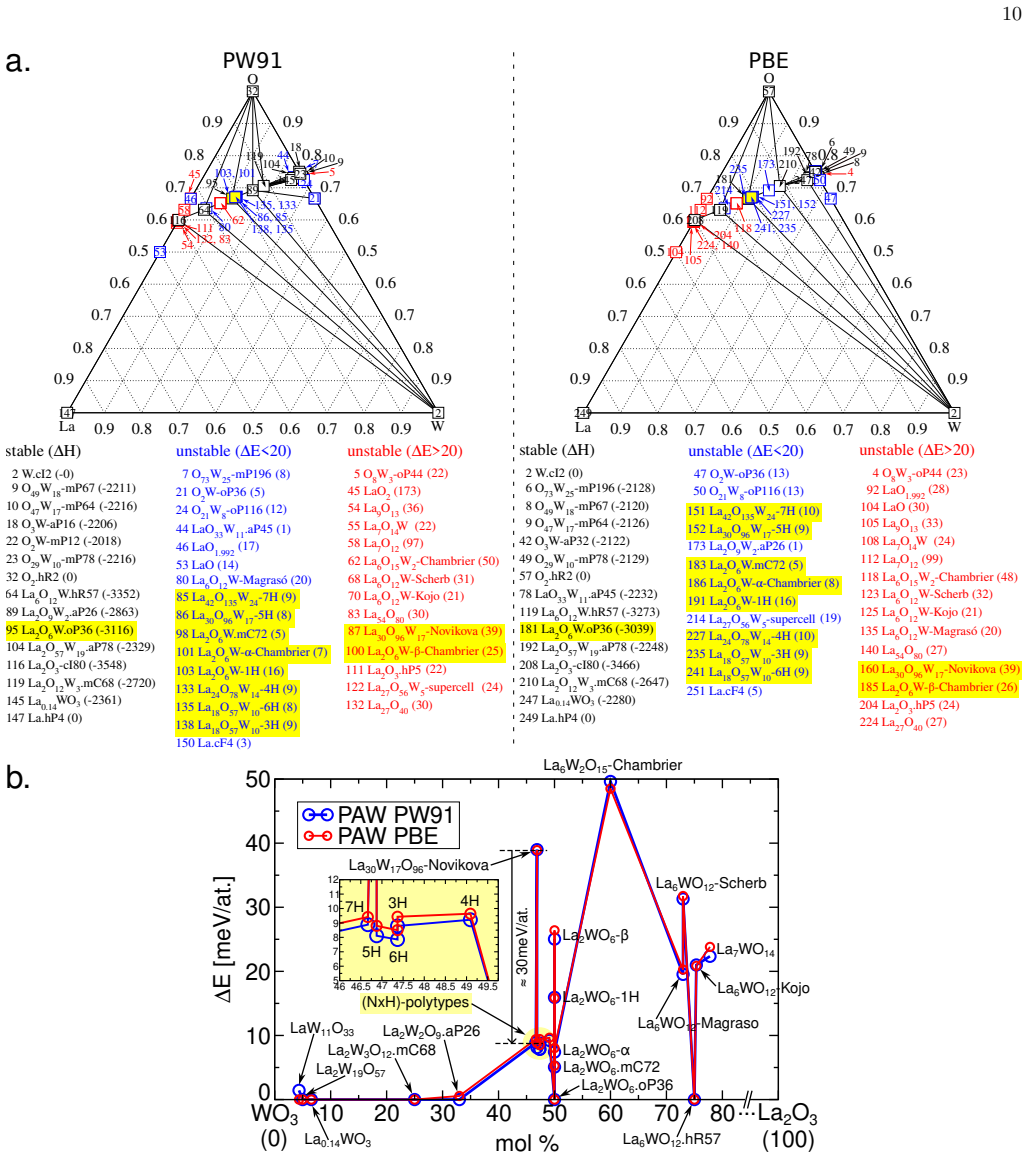
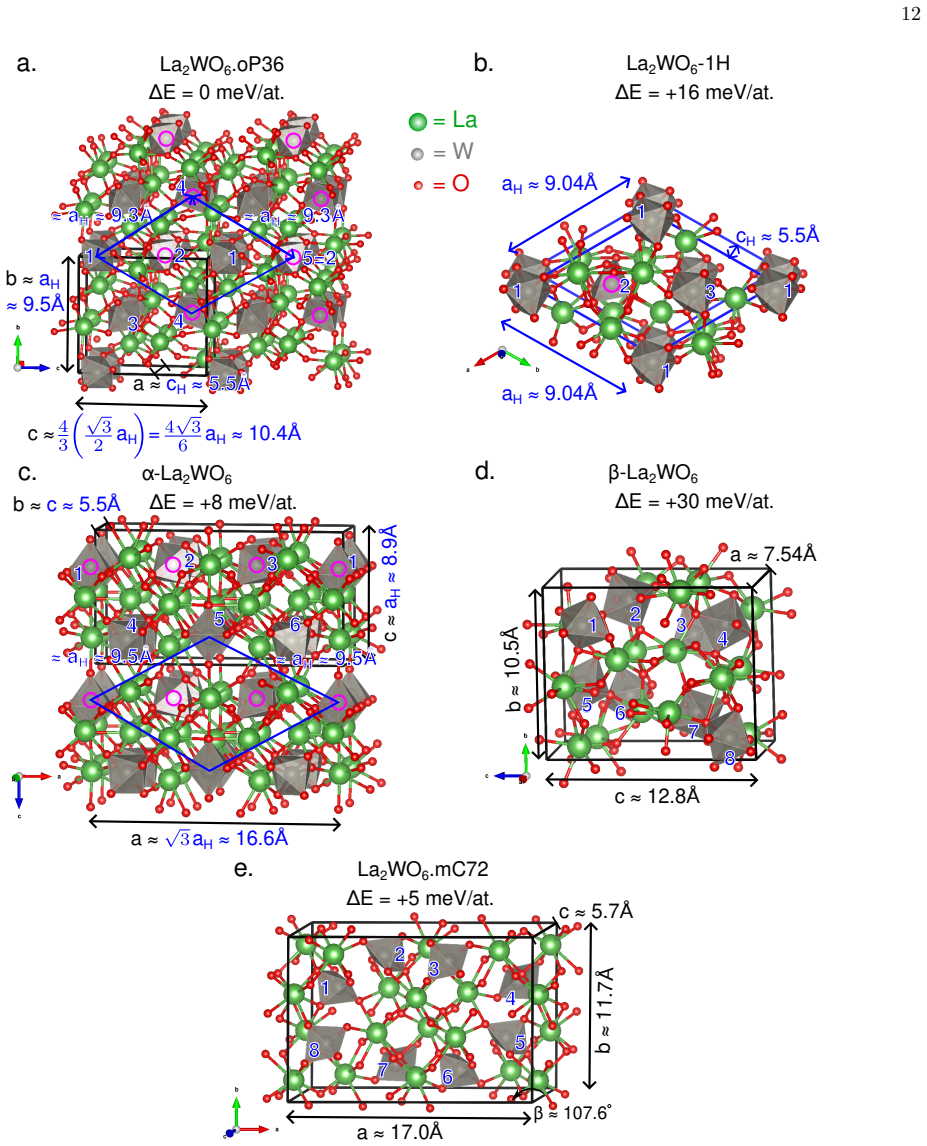
According to DFT, the ground state of the La2WO6 family is the as-yet hypothetical tungstate La2WO6.oP36, isostructural with the known compound Gd2WO6 and closely related to the basic building H-block of the polytypes. One more candidate, La2WO6.mC72 derived from the already observed Sm2MoO6, lies only ΔE ≈ 5 meV/at ≅ 60 K above the convex envelope.
What carries the argument
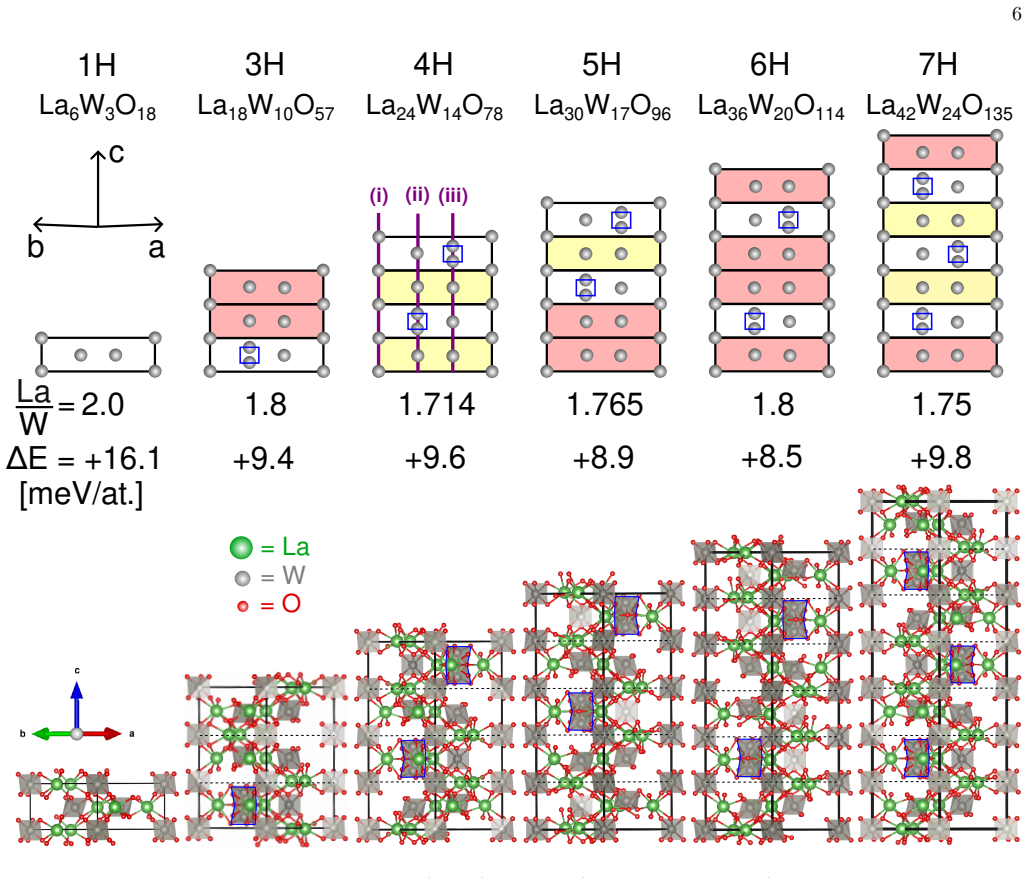
The (NxH)-polytypes constructed from H-blocks, ranked in energy by the ternary La-O-W convex hull computed via DFT.
If this is right
- The (NxH)-polytypes obey the stated construction rules and fall near the convex hull.
- La2WO6.oP36 is the lowest-energy member of the family and should be the first target for synthesis.
- La2WO6.mC72 remains a plausible low-energy polymorph reachable at moderate temperatures.
Where Pith is reading between the lines
- If the energy ordering holds, synthesis attempts in the La-O-W system should prioritize the oP36 structure over the polytypes.
- Analogous (NxH) families may appear in other rare-earth tungstates or molybdates with similar block motifs.
- The small energy gap between oP36 and mC72 suggests possible temperature-driven transitions or coexistence.
Load-bearing premise
The chosen DFT functional and convergence settings produce formation energies accurate enough to rank these structures relative to competing La-O-W phases without systematic bias exceeding a few meV per atom.
What would settle it
Synthesis or calorimetry that shows La2WO6.oP36 has a formation energy more than 5 meV per atom above the lowest observed La-O-W phase would falsify the ground-state claim.
Figures


read the original abstract
Structure and chemical composition of non-stoichiometric $\mathrm{(N \times H)}$-polytypes, $\mathrm{N} \in \{3,\,4,\,5,\,6,\,7\}$, belonging to the family of La2WO6-related tungstates, are presented and the basic rules behind their construction are formulated. The polytypes are validated from the point of view of the internal energy per atom against all the competing La-O-W compounds by means of the ternary convex hull computed by DFT. According to DFT, the ground state of the La2WO6 family surprisingly turned out to be the as-yet hypothetical tungstate La2WO6.oP36, isostructural with the known compound Gd2WO6, closely related to the basic building H-block of the polytypes. One more candidate for an experimentally accessible low-energy structure, La2WO6.mC72, derived from the already observed Sm2MoO6, has been identified to lie only $\Delta E \approx 5\:\mathrm{meV/at.} \cong 60\:\mathrm{K}$ above the convex envelope.
Editorial analysis
A structured set of objections, weighed in public.
Referee Report
Summary. The manuscript describes the construction rules for a family of (N×H)-polytypes (N=3–7) with La2WO6-related stoichiometry and validates their internal energies per atom via a ternary La-O-W convex hull computed with DFT. It reports that the hypothetical oP36 structure (isostructural with Gd2WO6) is the ground state of the family, while mC72 (derived from Sm2MoO6) lies only ~5 meV/at above the hull.
Significance. If the reported energy ordering is robust, the work supplies concrete, low-energy targets for synthesis in the La-O-W system and illustrates how polytype engineering can systematically generate candidates near the convex hull. The use of convex-hull validation against all competing phases is a standard and appropriate method.
major comments (2)
- [Computational details] Computational details section: the manuscript provides no information on the exchange-correlation functional, pseudopotential library, plane-wave cutoff, k-point density, or convergence criteria employed for the convex-hull energies. Because the central claim rests on a 5 meV/at separation that lies well within the typical range of GGA errors for tungstates and ternary oxides, explicit benchmarking against experimental formation energies of known La-O-W phases or cross-checks with at least one hybrid functional is required to establish that the hull ordering is not an artifact of the chosen setup.
- [Results] Results section describing the convex hull: the energies of oP36, mC72, and the nearest competing phases are stated only in the abstract; a table or figure listing the formation energies (with respect to the hull) for all considered structures and binaries/ternaries is needed to allow quantitative assessment of the margin and possible reordering under modest systematic shifts.
minor comments (1)
- The conversion '5 meV/at ≅ 60 K' appears without stating the Boltzmann factor or reference temperature used; a short parenthetical note would remove ambiguity.
Simulated Author's Rebuttal
We thank the referee for the constructive comments and positive assessment of the work's significance. We address each major comment below and will revise the manuscript to improve completeness while defending the core methodology on substantive grounds.
read point-by-point responses
-
Referee: [Computational details] Computational details section: the manuscript provides no information on the exchange-correlation functional, pseudopotential library, plane-wave cutoff, k-point density, or convergence criteria employed for the convex-hull energies. Because the central claim rests on a 5 meV/at separation that lies well within the typical range of GGA errors for tungstates and ternary oxides, explicit benchmarking against experimental formation energies of known La-O-W phases or cross-checks with at least one hybrid functional is required to establish that the hull ordering is not an artifact of the chosen setup.
Authors: We agree that the computational details section is incomplete and will add the missing information (GGA-PBE functional, pseudopotential library, plane-wave cutoff, k-point density, and convergence criteria) in the revised manuscript. However, we do not agree that explicit benchmarking with hybrid functionals or experimental formation energies is required to support the reported ordering. The convex hull is constructed entirely within a single, consistent DFT setup, the oP36 structure is isostructural with the experimentally realized Gd2WO6, and the ~5 meV/at margin for mC72 is presented only as identifying a low-energy candidate rather than a definitive ground-state prediction. Typical GGA uncertainties for oxides are acknowledged in the field, and the polytype construction rules remain valid independent of small absolute shifts. revision: partial
-
Referee: [Results] Results section describing the convex hull: the energies of oP36, mC72, and the nearest competing phases are stated only in the abstract; a table or figure listing the formation energies (with respect to the hull) for all considered structures and binaries/ternaries is needed to allow quantitative assessment of the margin and possible reordering under modest systematic shifts.
Authors: We agree that a dedicated table (and, if space permits, a supporting figure) would improve quantitative transparency. In the revised manuscript we will add a table reporting formation energies relative to the convex hull for every (N×H)-polytype examined as well as all binary and ternary competing phases included in the hull construction. This will enable readers to evaluate the reported margins directly. revision: yes
Circularity Check
No circularity: DFT energies computed independently against external La-O-W hull
full rationale
The paper constructs (NxH)-polytypes from explicit stacking rules, then ranks them by DFT formation energies per atom against a ternary convex hull of competing La-O-W phases. No parameters are fitted to the target energies, no self-citations carry the central claim, and the oP36 ground-state identification follows directly from the computed ΔE values without reduction to the input definitions. This is a standard external-benchmark first-principles workflow.
Axiom & Free-Parameter Ledger
axioms (1)
- domain assumption DFT formation energies are sufficiently accurate to determine the convex hull for La-O-W compounds
Reference graph
Works this paper leans on
-
[1]
All W atoms have six O nearest neighbours
-
[2]
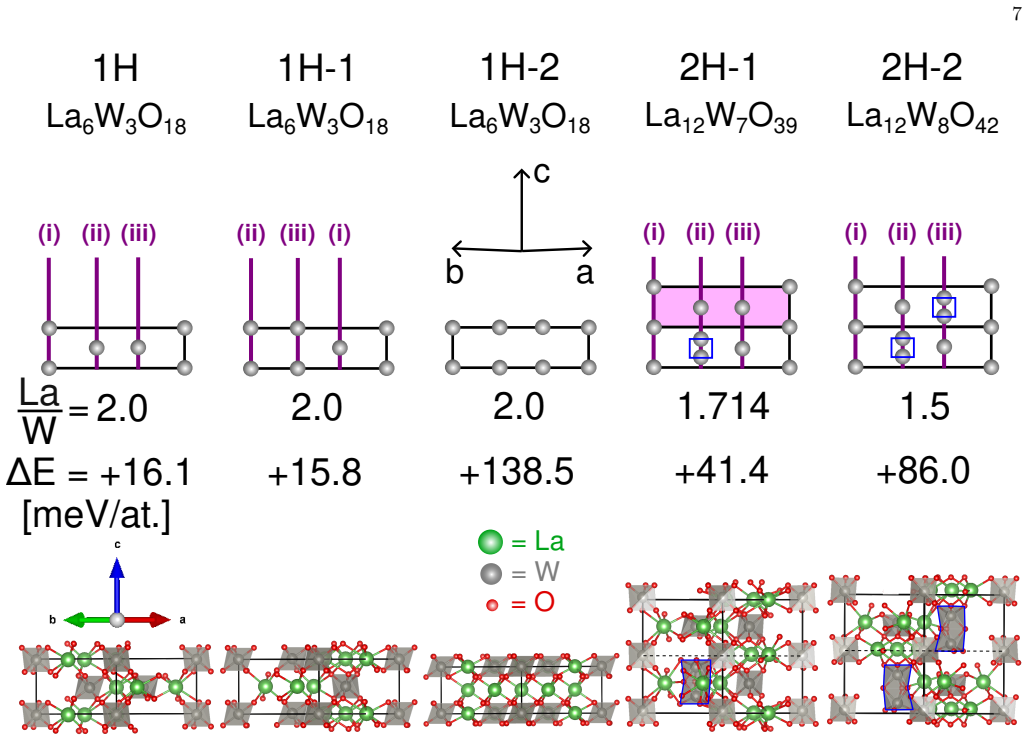
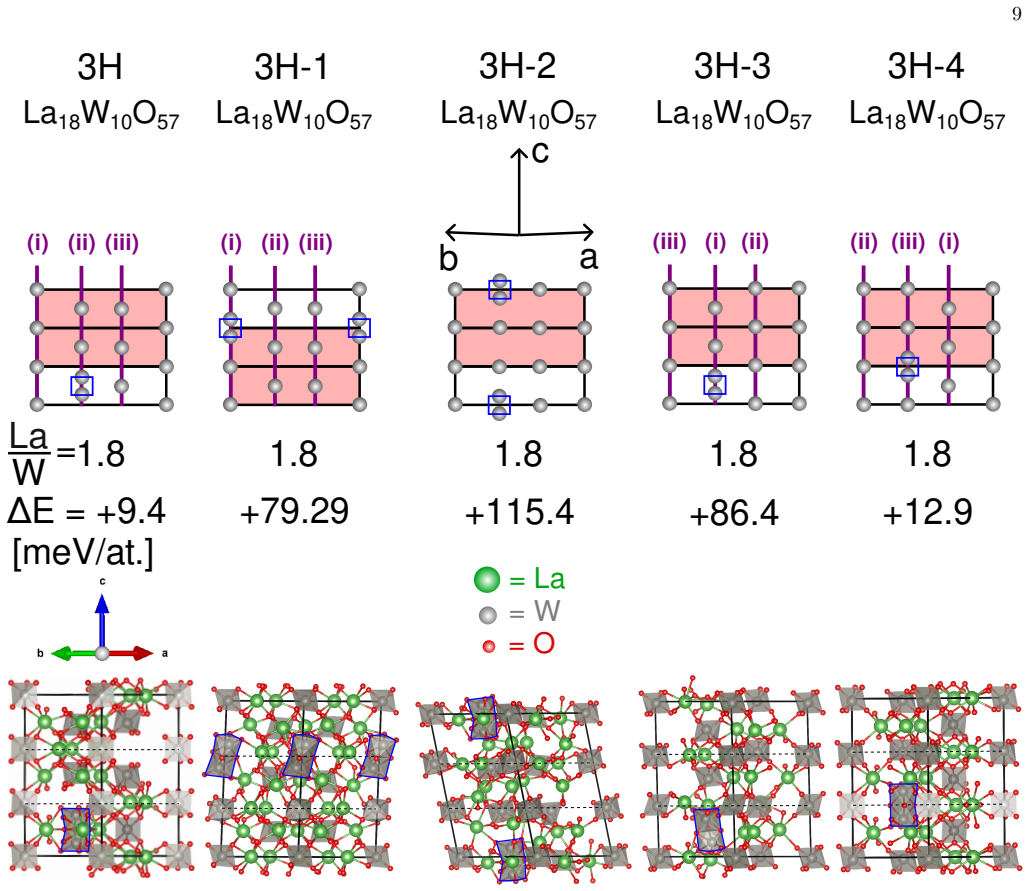
WO6 units are aligned along columns (i), (ii), (iii) in the c direction: (i) passing through the hexagonal cell vertices and (ii), (iii) running through the centers of the equilateral-triangle cell base, see Figure 1
-
[3]
All W atoms on column (i) are coordinated by trigonal prisms; W atoms on columns (ii), (iii) are mostly octahedrally coordinated
-
[4]
Column (i) is vertically shifted by H/2 with respect to (ii), (iii), which can equally well pass through the cell vertices, see Figure 4
W atoms in columns (ii), (iii) have the same vertical c positions. Column (i) is vertically shifted by H/2 with respect to (ii), (iii), which can equally well pass through the cell vertices, see Figure 4
-
[5]
All O atoms belong to the WO 6 coordination polyhedra
-
[6]
One of the two 3-La rings lies in the H-block base and the second surrounds either the interior WO 6 or the shared O 3 face of a twinned WO6
Each H-block contains 6 La atoms in two symmetrical 3-La rings centered around W columns. One of the two 3-La rings lies in the H-block base and the second surrounds either the interior WO 6 or the shared O 3 face of a twinned WO6
-
[7]
Twinned WO6 units occupy only the two W columns (ii), (iii) sharing the same c coordinates of W atoms
-
[8]
Twinned WO6 octahedra can share O 3 faces only in pairs, not in triplets, quadruplets, etc
-
[9]
(ii), W column have to be separated by at least 2H blocks along the c direction
Twinned WO6 pairs in one, e.g. (ii), W column have to be separated by at least 2H blocks along the c direction
-
[10]
2H-polytypes
A twinned WO6 pair in the other, e.g. (iii), interior W column has to be separated along the c axis by at least 1H from the closest WO 6 pair in column (ii). Table I. Simple empirical rules governing (N × H)-polytype construction. since an arbitrarily small concentration of glued WO 6 units is in compliance with the building principles 1–10. Let us emphas...
-
[11]
twinned WO6 units in a W column (i), shifted by H/2 with respect to W columns (ii), (iii),
-
[12]
those characteristic of La 2WO6.oP36 or α-La2WO6, see section IV,
different symmetry-breaking options caused by relative shifts of W columns in the c direction, e.g. those characteristic of La 2WO6.oP36 or α-La2WO6, see section IV,
-
[13]
1H or even 0H),
twinned WO6 units in the same W column mutually separated by a gap smaller than 2H (i.e. 1H or even 0H),
-
[14]
slightly unstable
twinned WO6 units in distinct W columns situated in neighboring H-blocks (mutually separated by 0H). Table II. WO6 arrangements which have to be checked in order to verify the simple empirical rules from Table I. 6 3H1H La W = 1.82.0 1.8 4H 5H 6H 7H 1.714 1.765 1.75 (i) (ii) (iii) ΔE = +16.1 [meV/at.] +8.9 +9.8+9.4 +9.6 +8.5 c ab La18W10O57 La36W20O114La2...
2018
-
[15]
A. Magras´ o et al.: In situ high temperature powder neutron diffraction study of undoped and Ca- 15 doped La 28-xW4+xO54+3x/2 (x = 0 .85), Journal of Materials Chemistry A, VOLUME 1, ISSUE 11 , 3774, https://doi.org/10.1039/c3ta00497j (2013)
-
[16]
Q. Ye, M. Barr´ e, K. Adil, A. Rousseau, F. Goutenoire: Phase Diagram Studies on Ternary La 2O3 - WO3 - CaO System, Journal of Solid State Chemistry, VOLUME 326, 124230, https://doi.org/10.1016/j.jssc.2023.124230 (2023)
-
[17]
G. Kojo, R. Tsukimura, J. Otomo: Structural and Transport Properties of Lanthanum Tungstate with High La/W Ratio: Suitability for Proton-Conducting Solid Oxide Fuel Cells Operating at Intermediate Temperature, Solid State Ionics, VOLUME 306, 89, https://doi.org/10.1016/j.ssi.2017.04.009 (2017)
-
[18]
M.-H. Chambrier, A. Le Bail, F. Giovannelli, A. Redja¨ ımia, P. Florian, D. Massiot, E. Suard, F. Goutenoire: La10W2O21: An Anion-Deficient Fluorite-Related Superstructure with Oxide Ion Conduction, Inorganic Chemistry, VOL- UME 53, ISSUE 1 , 147, https://doi.org/10.1021/ic401801u (2014)
-
[19]
A. Magras´ o et al.: Complete Structural Model for Lanthanum Tungstate: A Chemically Stable High Temperature Proton Conductor by Means of Intrinsic Defects, Journal of Materials Chemistry, VOLUME 22, ISSUE 5 , 1762, https://doi.org/10.1039/C2JM14981H (2012)
-
[20]
P. Lacorre, F. Goutenoire, O. Bohnke, R. Retoux & Y. Laligant: Designing fast oxide-ion conductors based on La 2Mo2O9, Nature, VOLUME 404, ISSUE 6780 , 856, https://doi.org/10.1038/35009069 (2000)
-
[21]
F. Goutenoire, O. Isnard, R. Retoux, and P. Lacorre: Crystal Structure of La 2Mo2O9, a New Fast Oxide-Ion Conductor, Chemistry of Materials, VOLUME 12, ISSUE 9 , 2575, https://doi.org/10.1021/cm991199l (2000)
-
[22]
N. Beronsk´ a et al.: Performance Evaluation and Oxide Layer Characterization of Self-Protective Cu/W-La2O3 Composite Electrodes Prepared by Gas Pressure Infiltration for Continuous Arcing in Air, Journal of Physics D: Applied Physics, VOLUME 58, NUMBER 18 , 185307, https://doi.org/10.1088/1361 (2025)
-
[23]
M.-H. Chambrier, A. Le Bail, S. Kodjikian, E. Suard, and F. Goutenoire: Structure Determination of La 18W10O57, Inorganic Chemistry VOLUME 48, ISSUE 14 , 6566, https://doi.org/10.1021/ic9005482 (2009)
-
[24]
M. Allix, M.-H. Chambrier, E. V´ eron, F. Porcher, M. Suchomel, and F. Goutenoire: Synthesis and Structure Deter- mination of the High Temperature Form of La 2WO6, Crystal Growth & Design, VOLUME 11, ISSUE 11 , 5105, https://doi.org/10.1021/cg201010y (2011)
-
[25]
M.-H. Chambrier, S. Kodjikian, R. M. Ibberson, F. Goutenoire: Ab-initio structure determination of β-La2WO6, Journal of Solid State Chemistry, VOLUME 182, ISSUE 2 , 209, https://doi.org/10.1016/j.jssc.2008.09.010 (2009)
-
[26]
M.-H. Chambrier, F. Goutenoire: Structural exploration on powder diffraction a nice tool for rexamination of phase diagram, JEEP - 35th Conference on Phase Equilibria, , https://doi.org/10.1051/jeep/200900022 (2009)
-
[27]
M.-H. Chambrier: Analyse Structurale au sein du Diagramme de Phase La 2O3-WO3 et Exploration des Propri´ et´ es de Con- duction Ionique, Dissertation Thesis, L’Universit´ e du Maine (2009)
2009
-
[28]
N. E. Novikova, T. A. Sorokin, A. M. Antipin, N. B. Bolotina, O. A. Alekseeva, N. I. Sorokina and V. I. Voronkova: Characteristic features of polytypism in compounds with the La 18W10O57-type structure, Acta Crystallogr. C Struct. Chem. VOLUME 75, 740, https://doi.org/10.1107/S2053229619006107 (2019)
-
[29]
V. K. Yanovskii, V. I. Voronkova: Crystallography and Properties of Lanthanum Oxytungstate, La 2WO6, Sov. Phys. – Crystallogr. (Engl. Transl.) VOLUME 20, NUMBER 3 , 354 (1975)
1975
-
[30]
V. K. Yanovskii, V. I. Voronkova: Polytypism of La 2WO6 Crystals, Kristallografiya VOLUME 26, NUMBER 3 , 604 (1981)
1981
-
[31]
M. M. Ivanova, G. M. Balagina, E. Ya. Rode, Izv. Akad. Nauk. SSSR, Neorg. Mater. VOLUME 6, NUMBER 5 , 914 (1970)
1970
-
[32]
A. Magras´ o and R. Haugsrud: Effects of the La/W ratio and doping on the structure, defect structure, stability and functional properties of proton-conducting lanthanum tungstate La 28−xW4+xO54+δ. A review, Journal of Materials Chem- istry A, VOLUME 2, ISSUE 32 , 12630, https://doi.org/10.1039/c4ta00546e (2014)
-
[34]
D. Abeysinghe, M. D. Smith, J. Yeon, T. T. Tran, R. P. Sena, J. Hadermann, P. S. Halasyamani, and H.- C. zur Loye: Crystal Growth and Structure Analysis of Ce 18W10O57: A Complex Oxide Containing Tungsten in an Unusual Trigonal Prismatic Coordination Environment, Inorganic Chemistry VOLUME 56, ISSUE 5 , 2566, https://doi.org/10.1021/acs.inorgchem.6b02710 (2017)
-
[35]
J. E. Saal, S. Kirklin, M. Aykol, B. Meredig, and C. Wolverton: Materials Design and Discovery with High-Throughput Density Functional Theory: The Open Quantum Materials Database (OQMD), The Journal of The Minerals, Metals & Materials Society (TMS) VOLUME 65, 1501, https://doi.org/10.1007/s11837 (2013)
-
[36]
S. Kirklin, J. E. Saal, B. Meredig, A. Thompson, J. W. Doak, M. Aykol, S. R¨ uhl, and C. Wolverton: The Open Quantum Materials Database (OQMD): assessing the accuracy of DFT formation energies, npj Computational Materials VOL- UME 1, 15010, https://doi.org/10.1038/npjcompumats.2015.10 (2015)
-
[37]
G. Kresse, J. Furthm¨ uller: Efficient iterative schemes for ab initio total-energy calculations using a plane-wave basis set, Physical Review B, VOLUME 54, ISSUE 16 , 11169, https://link.aps.org/doi/10.1103/PhysRevB.54.11169 (1996)
-
[38]
G. Kresse and D. Joubert: From ultrasoft pseudopotentials to the projector augmented-wave method, Physical Review B, VOLUME 59, ISSUE 3, 1758, https://link.aps.org/doi/10.1103/PhysRevB.59.1758 (1999)
-
[39]
J. P. Perdew, and K. Burke and M. Ernzerhof: Generalized Gradient Approximation Made Simple, Physical Review Letters, VOLUME 77, ISSUE 18 , 3865, https://link.aps.org/doi/10.1103/PhysRevLett.77.3865 (1996)
-
[40]
D. Zagorac, H. M¨ uller, S. Ruehl, J. Zagorac & S. Rehme: Recent Developments in the Inorganic Crystal Structure Database: Theoretical Crystal Structure Data and Related Features, Journal of Applied Crystallography, VOLUME 52, PART 5, 918, https://link.aps.org/doi/10.1107/S160057671900997X (2019). 16
-
[41]
A. Jain et al.: Commentary: The Materials Project: A Materials Genome Approach to Accelerating Materials Innovation, APL Materials VOLUME 1, ISSUE 1 , 011002, https://doi.org/10.1063/1.4812323 (2013)
-
[42]
Villars: Pearson’s Handbook, Desk Edition, Crystallographic Data for Intermetallic Phases, ASM International, VOL- UME 1, 2, ISBN: 0 (1997)
P. Villars: Pearson’s Handbook, Desk Edition, Crystallographic Data for Intermetallic Phases, ASM International, VOL- UME 1, 2, ISBN: 0 (1997)
1997
-
[43]
Posp´ ıˇ silov´ a, M
E. Posp´ ıˇ silov´ a, M. Mihalkoviˇ c, N. Beronsk´ a and M. Gebura: Ternary Cu-La-O, Cu-O-W, and La-O-W Convex Hulls, To be published soon
-
[44]
H. T. Stokes, D. M. Hatch, and B. J. Campbell, FINDSYM, ISOTROPY software suite, iso.byu.edu., https://stokes.byu.edu/i so/isotropy.php (2004)
2004
-
[45]
K. Momma and F. Izumi: VESTA 3 for Three-Dimensional Visualization of Crystal, Volumetric and Morphology Data, Journal of Applied Crystallography, VOLUME 44, NUMBER 6 , 1272, https://doi.org/10.1107/S0021889811038970 (2011)
-
[46]
N. Diot, P. B´ enard-Rocherull´ e, R. Marchand: X-ray Powder Diffraction Data and Rietveld Refinement for Ln6WO12 (Ln = Y, Ho), Powder Diffraction, VOLUME 15, NUMBER 4 , 220, https://doi.org/10.1017/S088571560001112X (2000)
-
[48]
C. B. Barber, D. P. Dobkin, and H. T. Huhdanpaa: The Quickhull Algorithm for Convex Hulls, ACM Transactions on Mathematical Software (TOMS), VOLUME 22, NUMBER 4 , 469, http://www.qhull.org (1996)
1996
-
[49]
A. V. Tyulin, V. A. Efremov: Polymorphism of Oxytungstates TR 2WO6. Analysis of Structural Type II (Gd 2WO6 and Gd 2MoO6). Mechanism of Structural Change in Gd 2WO6 in the Phase Transition II ↔ V, Kristallografiya, https://inis.iaea.org/records/eyt7f-egj04, VOLUME 32, ISSUE 2 , 371, ISSN 0023 (1987)
1987
-
[50]
P. V. Klevtsov, L. Yu. Kharchenko, R. F. Klevtsova: Crystallization and Polymorphism of Rare Earth Oxymolybdates with the Composition Ln 2MoO6, Sov. Phys. - Crystallogr. (Engl. Transl.), NSA-33-030299, https://www.osti.gov/biblio/4057003, VOLUME 20, NUMBER 3 , 349, ISSN SPHCA (1974)
arXiv 1974
-
[51]
K. V. Dorn, B. Blaschkowski, K. F¨ org, P. Netzsch, H. A. H¨ oppe, I. Hartenbach: Prism Inside: Spectroscopic and Magnetic Properties of the Lanthanide(III) Chloride Oxidotungstates(VI) Ln 3Cl3[WO6] (Ln = La - Nd, Sm - Tb), Zeitschrift f¨ ur Anorganische und Allgemeine Chemie VOLUME 643, ISSUE 21 , 1642, https://doi.org/10.1002/zaac.201700247 (2017)
-
[52]
J. B. Parise, L. H. Brixner and E. Prince: Refinement of the Structure of Trilanthanum Trichlorohexaoxotungstate, La3WO6Cl3, from Neutron Powder Diffraction Data, Acta Crystallographica Section C VOLUME 39, NUMBER 10 , 1326, https://doi.org/10.1107/S0108270183008409 (1983)
-
[53]
K. V. Dorn, B. Blaschkowski, P. Netzsch, H. A. H¨ oppe, I. Hartenbach: Blue Excitement: The Lanthanide(III) Chloride Oxidomolybdates(VI) Ln 3Cl3[MoO6] (Ln = La, Pr, and Nd) and Their Spectroscopic Properties, Inorganic Chemistry VOLUME 58, ISSUE 13 , 8308, https://doi.org/10.1021/acs.inorgchem.9b00098 (2019)
-
[54]
L. H. Brixner, H. Y. Chen, C. M. Foris: Structure and Luminescence of Some Rare Earth Halotungstates of the Type Ln3WO6Cl3, Journal of Solid State Chemistry VOLUME 44, ISSUE 1 , 99, https://doi.org/10.1016/0022 (1982)
-
[55]
K. R. Poeppelmeier, A. J. Jacobson, J. M. Longo: The Structure of Ba 3W2O9; an Example of Face-Shared Octahedra with Tungsten (VI), Materials Research Bulletin VOLUME 15, ISSUE 3 , 339, https://doi.org/10.1016/0025 (1980)
-
[56]
S. A Ivanov, S.-G Eriksson, J. Erikssen, R. Tellgren, H. Rundlof: Nuclear and Magnetic Structure of Ba3Fe2WO9, Materials Research Bulletin VOLUME 39, ISSUE 4-5 , 615, https://doi.org/10.1016/j.materresbull.2003.12.007 (2004)
-
[57]
L. Pirker, B. Viˇ si´ c, J. Kovaˇ c, S. D.ˇSkapin and M. Remˇ skar: Synthesis and Characterization of Tungsten Suboxide WnO3n-1 Nanotiles, Nanomaterials VOLUME 11, ISSUE 8 , 1985, https://doi.org/10.3390/nano11081985 (2021)
-
[58]
G. Kieslich, G. Cerretti, I. Veremchuk, R. P. Hermann, M. Panth¨ ofer, J. Grin, and W. Tremel: A Chemists View: Metal Oxides with Adaptive Structures for Thermoelectric Applications, Phys. Status Solidi A VOLUME 213, ISSUE 3, 808, https://doi.org/10.1002/pssa.201532702 (2016)
-
[59]
M. M. Elkady, M. Ohtaki: Exploring the Magn´ eli Phase of Transition Metal Oxides: A Promising Frontier for Ther- moelectric Advancements, Proceedings of International Exchange and Innovation Conference on Engineering & Sciences (IEICES) VOLUME 9, 334, https://doi.org/10.5109/7157998 (2023)
-
[60]
B. Xiao, T. M. Gesing, L. Robben, D. Bosbach, E. V. Alekseev: Dinuclear Face-Sharing Bi-octahedral Tungsten(VI) Core and Unusual Thermal Behavior in Complex Th Tungstates, Chemistry – A European Journal VOLUME 21, ISSUE 21, 7746, https://doi.org/10.1002/chem.201500500 (2015)
-
[61]
A. D. Rae, J. G. Thompson, and R. L. Withers: Structure Refinement of Commensurately Modulated Bis- muth Tungstate, Bi 2WO6, Crystallographica, Section B: Structural Science VOLUME 47, NUMBER 6 , 870, https://doi.org/10.1107/S0108768191008030 (1991)
-
[62]
J. P. Perdew & S. Kurth: Density Functionals for Non-Relativistic Coulomb Systems in the New Century, A primer in density functional theory. Berlin, Heidelberg: Springer Berlin Heidelberg , 1 (2003)
2003
-
[63]
A. V. Kovalevsky, V. V. Kharton, E. N. Naumovich: Oxygen Ion Conductivity of Hexagonal La 2W1.25O6.75, Materials Letters VOLUME 38, ISSUE 4 , 300, https://doi.org/10.1016/S0167 (1999)
-
[64]
Giustino: Materials Modelling using Density Functional Theory: Properties and Predictions, 1st ed
F. Giustino: Materials Modelling using Density Functional Theory: Properties and Predictions, 1st ed. (Oxford University Press, 198 Madison Avenue, New York, 2014)
2014
-
[65]
E. Baldin, N. Lyskov, G. Vorobieva, I. Kolbanev, O. Karyagina, D. Stolbov, V. Voronkova and A. Shlyakhtina: Synthe- sis of Hexagonal Nanophases in the La 2O3–MO3 (M = Mo, W) Systems, Energies VOLUME 16, ISSUE 15 , 5637, https://doi.org/10.3390/en16155637 (2023). Go to TOC TOC TOC TOC Go to TOC TOC TOC TOC Go to TOC TOC TOC TOC Go to TOC TOC TOC TOC Family...
discussion (0)
Sign in with ORCID, Apple, or X to comment. Anyone can read and Pith papers without signing in.