A Question of Shape: New Mechanism Governing Superheavy Nuclei Survival
Pith reviewed 2026-06-29 09:56 UTC · model grok-4.3
The pith
Hot superheavy nuclei equilibrate in deformed shapes at finite excitation energies instead of remaining spherical.
A machine-rendered reading of the paper's core claim, the machinery that carries it, and where it could break.
Core claim
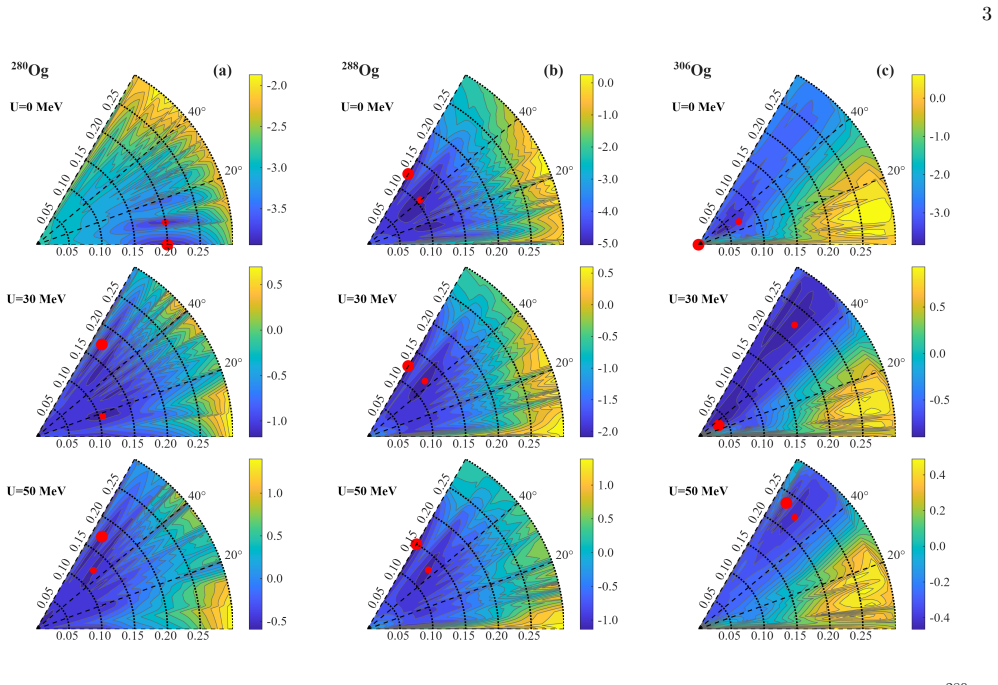
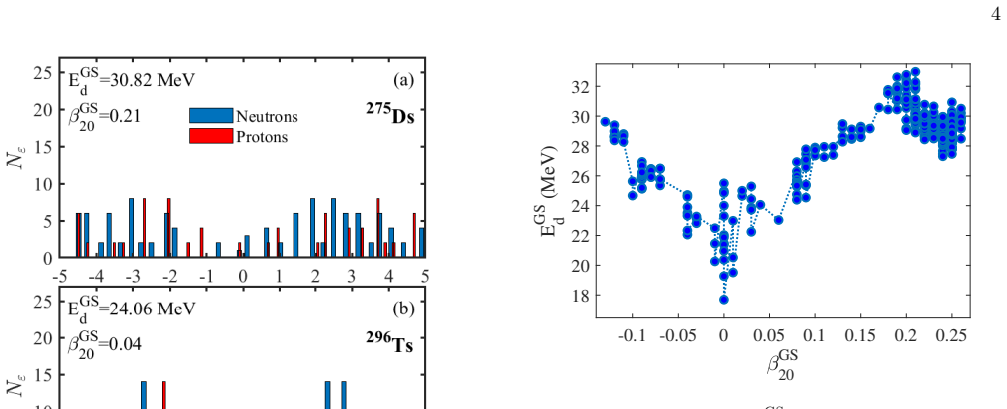
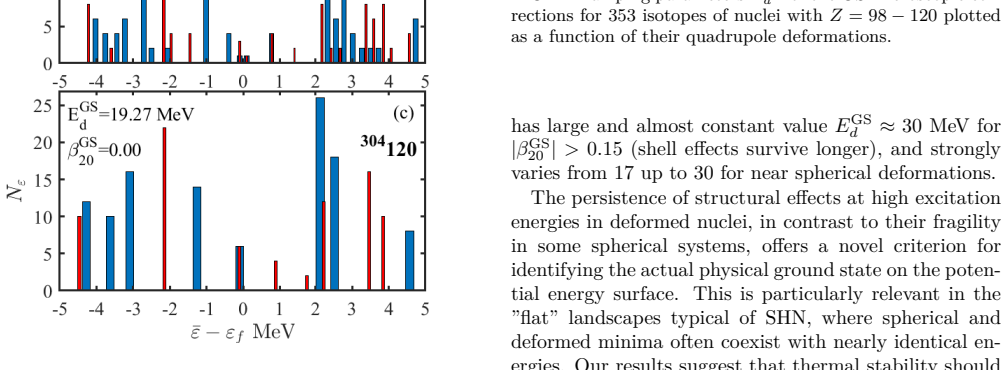
Hot superheavy nuclei do not retain spherical shapes but equilibrate in deformed, often oblate or triaxial, configurations at finite excitation energy. This arises from a Jahn-Teller analog mechanism where spherical systems' high single-particle degeneracy makes shell corrections damp faster with temperature. In the Z=118-120 region this causes a thermally induced inversion of the potential-energy landscape, favoring deformed minima at U=30-50 MeV and changing the competition between neutron evaporation and fission. A deformation-dependent correction to the survival probability is derived, exposing bias in spherical-based estimates.
What carries the argument
The temperature-dependent damping of shell corrections driven by single-particle level degeneracy, leading to shape inversion via a Jahn-Teller-like effect.
If this is right
- Thermally induced inversion where deformed minima are favored at U=30-50 MeV for Z=118-120.
- Altered competition between neutron evaporation and fission.
- Need for a deformation-dependent correction to survival probability.
- Systematic bias revealed in estimates based on spherical ground-state properties.
- Revision called for in current models of superheavy-nucleus synthesis and decay.
Where Pith is reading between the lines
- Future synthesis experiments may need to account for temperature-dependent shapes to match observed yields.
- Level density measurements in hot nuclei could provide a test of the assumed damping rates.
- The effect might extend to other regions of the nuclear chart where shell effects are important at finite temperature.
Load-bearing premise
The rates at which shell corrections damp with temperature depend primarily on the degeneracy of single-particle levels near the Fermi surface in spherical versus deformed nuclei.
What would settle it
A direct measurement showing that survival probabilities for Z=118-120 nuclei at 30-50 MeV excitation match spherical-model predictions rather than the deformation-corrected ones, or spectroscopic evidence of persistent spherical shapes in hot superheavy nuclei.
Figures

read the original abstract
We demonstrate that hot superheavy nuclei do not retain spherical shapes, as traditionally assumed, but instead equilibrate in deformed, often oblate or triaxial, configurations at finite excitation energy. This behavior arises from a mechanism analogous to the Jahn-Teller effect: spherical systems exhibit high single-particle degeneracy near the Fermi surface, causing their shell corrections to damp out significantly faster with temperature than those of deformed shapes. Using a finite-temperature framework, we reveal a thermally induced inversion of the potential-energy landscape in the Z = 118-120 region, where deformed minima become energetically favored at U = 30-50 MeV. This shape inversion fundamentally alters the competition between neutron evaporation and fission. We derive a deformation-dependent correction to the survival probability, revealing a systematic bias in estimates based on spherical ground-state properties. Our results identify a finite-temperature structural effect that calls for a revision of current models of superheavy-nucleus synthesis and decay.
Editorial analysis
A structured set of objections, weighed in public.
Referee Report
Summary. The paper claims that hot superheavy nuclei (Z=118-120) do not retain spherical shapes at finite excitation energy but equilibrate in deformed (often oblate or triaxial) configurations. This arises from a Jahn-Teller-analog mechanism in which spherical single-particle spectra near the Fermi surface produce shell corrections that damp materially faster with temperature than those of deformed shapes, producing a thermally driven inversion of the potential-energy landscape at U=30-50 MeV. The authors derive a deformation-dependent correction to the survival probability, arguing that this introduces a systematic bias in estimates based on spherical ground-state properties.
Significance. If substantiated, the result would be significant for superheavy-element synthesis modeling because it supplies an explicit, deformation-dependent correction to survival probabilities arising from finite-temperature structural effects. The manuscript gives credit to the derivation of this correction term and identifies a concrete, falsifiable prediction (shape preference at moderate excitation) that could be tested against level-density data.
major comments (1)
- [Finite-temperature framework] Finite-temperature framework section: the damping rates of shell corrections with temperature (driven by single-particle level degeneracy) are adopted without an independent derivation or direct calibration against measured level densities. This assumption is load-bearing for the central claim that spherical configurations damp faster than deformed ones, producing the landscape inversion at U=30-50 MeV and the subsequent correction to survival probability.
minor comments (1)
- [Abstract] Abstract: the range of nuclei and the precise single-particle model employed are not stated, which would help readers assess the generality of the reported shape inversion.
Simulated Author's Rebuttal
We thank the referee for the constructive comment on the finite-temperature framework. We address the concern regarding the adoption of damping rates below, providing clarification on their origin while acknowledging limitations in experimental calibration.
read point-by-point responses
-
Referee: Finite-temperature framework section: the damping rates of shell corrections with temperature (driven by single-particle level degeneracy) are adopted without an independent derivation or direct calibration against measured level densities. This assumption is load-bearing for the central claim that spherical configurations damp faster than deformed ones, producing the landscape inversion at U=30-50 MeV and the subsequent correction to survival probability.
Authors: The damping rates follow from the standard finite-temperature extension of the Strutinsky shell-correction formalism, in which the temperature-dependent factor is determined by the single-particle level density g(ε_F) at the Fermi surface. The faster damping for spherical configurations is a direct consequence of the higher degeneracy computed from our self-consistent single-particle spectra, rather than an external parameter choice. We will revise the manuscript to include an explicit derivation of the damping factor from g(ε_F) and its deformation dependence, citing the foundational references for the general method. Direct calibration against measured level densities for Z=118-120 is not feasible, as no such data exist; the framework is instead anchored in established systematics for lighter nuclei and the internal consistency of the calculated spectra. revision: partial
- Direct calibration of damping rates against measured level densities for Z=118-120 nuclei cannot be performed, as no experimental data are available in this region.
Circularity Check
No significant circularity detected
full rationale
The provided abstract and context describe a physical mechanism rooted in single-particle degeneracy causing differential damping of shell corrections with temperature, leading to shape inversion in a finite-temperature framework. No equations, parameter fits, or self-citations are exhibited that reduce the central claim (thermally driven deformation preference and survival correction) to an input by construction, a renamed fit, or a load-bearing self-citation chain. The derivation is presented as following from standard nuclear structure considerations without evident self-referential reduction, qualifying as self-contained.
Axiom & Free-Parameter Ledger
Reference graph
Works this paper leans on
-
[1]
Y. T. Oganessian and K. P. Rykaczewski, Phys. Today 68, 32 (2015)
2015
-
[2]
Y. T. Oganessian et al. , Phys. Rev. C 62, 041604(R) (2000)
2000
-
[3]
Y. T. Oganessian et al. , Phys. Rev. C 74, 044602 (2006)
2006
-
[4]
Y. T. Oganessian and V. K. Utyonkov, Rep. Prog. Phys. 78, 036301 (2015)
2015
-
[5]
Y. T. Oganessian and V. K. Utyonkov, Nucl. Phys. A 944, 62 (2015)
2015
-
[6]
Hofmann et al
S. Hofmann et al. , Eur. Phys. J. A 32, 251 (2007)
2007
-
[7]
Hofmann et al
S. Hofmann et al. , Eur. Phys. J. A 48, 62 (2012)
2012
-
[8]
C. E. Düllmann et al. , Phys. Rev. Lett. 104, 252701 (2010)
2010
-
[9]
H. A. Jahn and E. Teller, Proc. R. Soc. A 161, 220 (1937)
1937
-
[10]
Englman, The Jahn–Teller Effect in Molecules and Crystals (Wiley-Interscience, London, 1972)
R. Englman, The Jahn–Teller Effect in Molecules and Crystals (Wiley-Interscience, London, 1972)
1972
-
[11]
L. D. Landau and E. M. Lifshitz, Quantum Mechanics: Non-Relativistic Theory , 3rd ed., Course of Theoretical Physics, Vol. 3 (Pergamon Press, Oxford, U.K. and New York, U.S.A., 1977)
1977
-
[12]
D. I. Khomskii, Transition Metal Compounds (Cam- bridge University Press, United Kingdom, 2014) pp. 57– 65
2014
-
[13]
Wilkinson and F
G. Wilkinson and F. A. Cotton, Advanced Inorganic Chemistry, 2nd ed. (Interscience, 1966)
1966
-
[14]
Jachimowicz, M
P. Jachimowicz, M. Kowal, and J. Skalski, Atomic Data and Nuclear Data Tables 138, 101393 (2021)
2021
-
[15]
Jachimowicz, M
P. Jachimowicz, M. Kowal, and J. Skalski, Phys. Rev. C 83, 054302 (2011)
2011
-
[16]
Próchniak and A
L. Próchniak and A. Staszczak, Acta Physica Polonica B 44, 287 (2013)
2013
-
[17]
Rahmatinejad, T
A. Rahmatinejad, T. M. Shneidman, G. Adamian, N. V. Antonenko, P. Jachimowicz, and M. Kowal, Eur. Phys. J. A 60, 214 (2024)
2024
discussion (0)
Sign in with ORCID, Apple, or X to comment. Anyone can read and Pith papers without signing in.