REVIEW 3 major objections 5 minor 59 references
Dress-1-to-3: Single Image to Simulation-Ready 3D Outfit with Diffusion Prior and Differentiable Physics
T0 review · 3 major / 5 minor · reviewed 2026-08-09 · deepseek-v4-flash
Pith's one-line read Dress-1-to-3 turns a single image into a posed human and separated, simulation-ready garments with sewing patterns
desk verdict A competent system paper with a genuinely useful differentiable-simulation layer, but the evaluation is too thin to fully back the alignment claim. read the letter →
The pith
A machine-rendered reading of the paper's core claim, the machinery that carries it, and where it could break.
The reading
What carries the argument
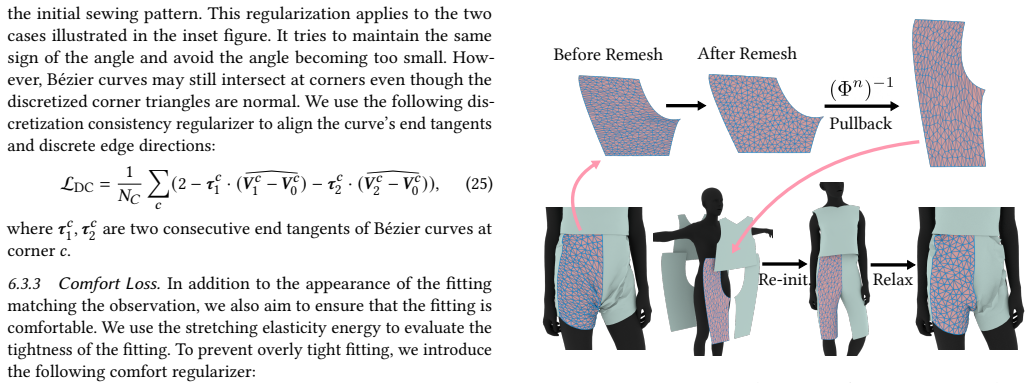
The load-bearing object is a generalized differentiable CIPC (Codimensional Incremental Potential Contact) layer: a cloth simulator that guarantees non-penetration through barrier energies and continuous collision detection, wrapped so gradients can be back-propagated to the sewing-pattern parameters. The paper derives the adjoint equations once, then lets automatic differentiation supply the per-time-step Jacobians, making the framework independent of the choice of constitutive model. Around this layer are differentiable bridges: arc-length sampling of Bézier curves into mesh vertices, fixed harmonic-coordinate cage deformations, patch symmetrization, and a pullback remeshing scheme that prevents penetrations when the pattern is re-triangulated mid-optimization. The optimizer uses rendering losses against multi-view masks, RGB, and normals plus geometric regularizers for area ratio, corner angles, seam length and curvature, comfort, and smoothness to keep the 2D patterns suitable for fabrication and the 3D drape stable.
What would settle it
Take a 3D-scanned subject from CloSe or 4D-Dress, render ground-truth multi-view images and normal maps, and rerun the same optimization in place of the diffusion-generated views; if Chamfer distance and mask overlap do not improve, the reported alignment gain is not actually driven by the multi-view prior.
Extended reading notes
Core claim
The paper's central claim is that a data-limited sewing-pattern predictor and a generative multi-view model can be bridged by differentiable physics: the coarse 2D pattern is stitched and draped onto a parameterized human body model, then its curve vertices, Bézier control points, global stretch stiffness, and bending stiffness are optimized so that rendered garment masks, RGB colors, and normals agree with diffusion-generated multi-view images of the same person. The optimization treats the CIPC cloth simulator as a differentiable layer using an adjoint formulation combined with automatic differentiation, so gradients flow through frictional contact, self-collision, and stitching. On the CloSe and 4D-Dress benchmarks, the reconstructed garments achieve lower Chamfer distance and higher mask overlap than four single-image reconstruction baselines, and the paper shows patterns for categories such as jumpsuits that were not in the training distribution. The output is a static, penetration-free draped outfit at equilibrium, ready to be animated by applying human motion as boundary conditions.
Load-bearing premise
The pipeline treats the multi-view images and normal maps produced by a generative diffusion model as the true 3D shape of the person and clothes; if those generated views are wrong or inconsistent—and the paper's limitations section says the normal maps can be—the optimized garments inherit that error.
Editorial extensions
If this is right
- A single photo can become a layered, skinned, animatable human asset without manual garment modeling, because each recovered garment is a separate mesh with its own sewing pattern and stiffness.
- Virtual try-on and garment editing can operate directly on the 2D patterns, letting users modify silhouette or fabric behavior before re-simulating.
- Garment categories outside the sewing-pattern predictor's training data, such as jumpsuits, can still be reconstructed because the optimization adapts the pattern to image evidence rather than selecting from a fixed template library.
- Physical stiffness values are inferred along with shape, so the simulated drape at the static pose matches the photo and can be re-used for motion sequences with plausible dynamics.
Reading between the lines
- Not stated in the paper: a direct swap test—using ground-truth multi-view renders from a 3D scan in place of the diffusion-generated views—would isolate how much of the reported accuracy comes from the physics optimization and how much from the generative prior.
- Not stated in the paper: the same differentiable-physics-plus-diffusion-prior recipe could be applied to other deformable objects with a 2D rest configuration, such as curtains, soft luggage, or hair, whenever consistent multi-view images can be produced.
- Not stated in the paper: re-simulating the optimized patterns under new, unseen motion sequences would test whether the inferred stiffness parameters generalize or merely fit the static drape in the input pose.
Editorial analysis
A structured set of objections, weighed in public.
Referee Report
Summary. The paper proposes Dress-1-to-3, a pipeline that takes a single in-the-wild image of a clothed human and produces a posed SMPL-X body plus separated, simulation-ready garments with sewing patterns, textures, and estimated stiffness parameters. The pipeline combines SewFormer for initial sewing patterns, MagicMan for multi-view RGB and normal generation, and a differentiable codimensional IPC simulator (CIPC) to refine pattern geometry and physics parameters against the generated views. The authors derive a unified adjoint-plus-automatic-differentiation formulation for differentiable CIPC, introduce differentiable pattern discretization and several geometric regularizers, and report quantitative comparisons on CloSe and 4D-Dress plus qualitative ablations and animation demos.
Significance. If the central claims hold, the paper offers a practical route from a single photo to separable, animatable garment assets with sewing patterns, which would be useful for virtual try-on, garment editing, and physics-based animation. The differentiable CIPC layer with adjoint-AD hybrid is a useful systems contribution, and the pattern symmetrization, remeshing, and regularizer design are thoughtfully engineered. However, the experimental evidence is not yet at the level needed to establish the headline claim of image-aligned, simulation-ready garment reconstruction: the evaluation relies on synthetic multi-view observations as ground truth, the benchmark details are sparse, and no code or data are released.
major comments (3)
- [§5.2, §6.2, Limitations] The core optimization losses in Eqs. (19)–(21) treat MagicMan-generated multi-view RGB images, normal maps, and masks as ground-truth observations, and §5.2 states this explicitly. The paper's own Limitations section concedes that MagicMan normal maps are inconsistent and smooth out details, while Figure 10 acknowledges that non-static states are approximated by static fits. Because MagicMan views are generated from the same input image, none of the losses are independent measurements of the true 3D garment. The manuscript provides no validation of MagicMan's multi-view accuracy on the CloSe/4D-Dress benchmark, so the reported improvements in CD and IoU could reflect fitting to consistent but incorrect synthetic views rather than alignment with the input image. This is load-bearing: the central claim of improved geometric alignment is not established without evidence that the generated views are sufficiently faithful to the real garments.
- [§9.1, Table 1] Table 1 reports only mean CD and IoU over a benchmark described as 'carefully selected' examples, with no sample count, no selection criteria, no per-sequence or per-category breakdown, no error bars, and no statistical significance test. The IoU metric is defined against the input front-view image, which is the very view used to generate the MagicMan multi-view set; combined with the mask, RGB, and normal losses on generated views, this metric is partly circular. Without a description of how many sequences are used, how they are chosen, how CD is computed and normalized, and how baselines are configured, the quantitative claim that Dress-1-to-3 'significantly outperforms' baselines cannot be verified. Please report full benchmark statistics, release the evaluation protocol (ideally with code), and add an evaluation that uses real multi-view captures or held-out views rather than only diffusion-generated views.
- [§4, §5.3, §6] The pipeline is a chained sequence of pretrained modules (SewFormer, OSX, MagicMan, DWPose, SegFormer), each with its own failure modes, but the experiments do not characterize how errors propagate. For example, §5.3 refines SMPL-X pose using mask and RGB losses computed on MagicMan views while explicitly excluding occluded garment regions; if the initial OSX pose or the generated views are inaccurate, the subsequent garment optimization in §6 inherits a biased human body. The ablation study in §9.4 isolates regularizers but does not ablate the choice of MagicMan views or the pose refinement, so the sensitivity of the final result to the weakest upstream component is unknown. A sensitivity analysis (e.g., replacing MagicMan views with ground-truth multi-view renderings on a subset) would directly test the central assumption.
minor comments (5)
- [§1, Contributions] The third bullet states the differentiable framework is 'agonistic to constitutive models'; the intended word is 'agnostic'.
- [§8, Balancing between Losses] The weight list ends with 'λSL = 0.1, λSL = 0.1', duplicating λSL; one of these should presumably be the seam curvature weight λSC.
- [§9.1, Baselines] The sentence beginning 'Baselines. pare our method with state-of-the-art...' contains a typo ('pare' should be 'We compare').
- [§9.4, Figure 8 caption] The caption uses shorthand 'w.o.' without defining it; please spell out 'without' in the figure caption or table legend.
- [§2.1] The related-work discussion of multi-view diffusion would benefit from distinguishing more clearly which methods are also trained on human-centric data and which are generic object-level methods, since the paper's use of MagicMan is human-specific.
Circularity Check
No significant circularity: the core optimization is guided by an external multi-view diffusion prior, and the headline geometry claim is independently benchmarked against ground-truth meshes.
full rationale
Dress-1-to-3's derivation chain is not circular. The optimization losses in Eqs. (19)-(21) are defined against multi-view RGB, normal, and mask images produced by MagicMan, an external pre-trained model, not against the paper's own outputs; fitting to these views is a feed-forward use of a learned prior, not a self-definitional loop. The central quantitative claim of geometric alignment is supported by Chamfer Distance against ground-truth meshes from CloSe and 4D-Dress (Table 1), which is independent of the optimized variables and of MagicMan's generated views. The paper's own Limitations section acknowledges that MagicMan normal maps are inconsistent and smooth details, which is a correctness and robustness caveat about the pseudo-ground-truth assumption rather than a circular reduction. The only overlap between training signal and evaluation is that the front-view IoU metric is related in spirit to the mask loss of Eq. (19), but the two use different mask sources (input front-view image versus SegFormer on generated multi-view images), so the metric is not identical to the loss by construction. Self-citations to CIPC and GarmentDreamer are to established, externally validated systems and are not load-bearing assumptions that force the paper's conclusions. Therefore no circular step meeting the evidentiary bar is present.
Assumptions & free parameters
free parameters (4)
- global stretching stiffness kappa_s
- global bending stiffness kappa_b
- human pose and shape refinement (S, R, theta, beta)
- regularizer weights lambda_Lap, lambda_Comfort, lambda_AR, lambda_SAC, lambda_DC, lambda_BC, lambda_SL =
lambda_Lap=0.001, lambda_Comfort=0.1, lambda_AR=0.01, lambda_SAC=0.01, lambda_DC=0.001, lambda_BC=0.001, lambda_SL=0.1
assumptions (7)
- domain assumption CIPC forward simulation correctly models cloth with contact
- domain assumption MagicMan-generated multi-view RGB and normal images are accurate enough to serve as ground truth
- domain assumption SewFormer's initial sewing pattern has the correct topology and component count
- domain assumption One 1-second CIPC step reaches static equilibrium, and the no-friction simulation is path-independent
- domain assumption SegFormer masks correctly identify garment regions and occlusions
- standard math Delaunay triangulation and harmonic coordinates provide a differentiable, fixed-topology mesh parameterization
- domain assumption SMPL-X with OSX and DWPose pose and shape estimates are accurate enough as a starting point
Cite this review
Pith. "Pith review of Dress-1-to-3: Single Image to Simulation-Ready 3D Outfit with Diffusion Prior and Differentiable Physics." pith.science (2026). https://pith.science/paper/2UU324NL
@misc{pith2026250203449,
  author       = {Pith},
  title        = {Pith review of: Dress-1-to-3: Single Image to Simulation-Ready 3D Outfit with Diffusion Prior and Differentiable Physics},
  year         = {2026},
  howpublished = {\url{https://pith.science/paper/2UU324NL}},
  note         = {Machine review of arXiv:2502.03449}
}
read the original abstract
Recent advances in large models have significantly advanced image-to-3D reconstruction. However, the generated models are often fused into a single piece, limiting their applicability in downstream tasks. This paper focuses on 3D garment generation, a key area for applications like virtual try-on with dynamic garment animations, which require garments to be separable and simulation-ready. We introduce Dress-1-to-3, a novel pipeline that reconstructs physics-plausible, simulation-ready separated garments with sewing patterns and humans from an in-the-wild image. Starting with the image, our approach combines a pre-trained image-to-sewing pattern generation model for creating coarse sewing patterns with a pre-trained multi-view diffusion model to produce multi-view images. The sewing pattern is further refined using a differentiable garment simulator based on the generated multi-view images. Versatile experiments demonstrate that our optimization approach substantially enhances the geometric alignment of the reconstructed 3D garments and humans with the input image. Furthermore, by integrating a texture generation module and a human motion generation module, we produce customized physics-plausible and realistic dynamic garment demonstrations. Project page: https://dress-1-to-3.github.io/
Figures


Figures from the paper (7 more)


Reference graph
Works this paper leans on
-
[8]
ACM Transac- tions on Graphics (TOG) 41, 2 (2021), 1–21
Diffpd: Differentiable projective dynamics. ACM Transac- tions on Graphics (TOG) 41, 2 (2021), 1–21. Yu Fang, Minchen Li, Chenfanfu Jiang, and Danny M Kaufman
work page 2021
-
[9]
ACM Transactions on Graphics 40, 4 (2021)
Guaranteed globally injective 3D deformation processing. ACM Transactions on Graphics 40, 4 (2021). C Daniel Freeman, Erik Frey, Anton Raichuk, Sertan Girgin, Igor Mordatch, and Olivier Bachem
work page 2021
-
[10]
arXiv preprint arXiv:2106.13281 (2021)
Brax–a differentiable physics engine for large scale rigid body simulation. arXiv preprint arXiv:2106.13281 (2021). Ruiqi Gao, Aleksander Holynski, Philipp Henzler, Arthur Brussee, Ricardo Martin- Brualla, Pratul Srinivasan, Jonathan T Barron, and Ben Poole
arXiv 2021
-
[11]
Cat3d: Create anything in 3d with multi-view diffusion models. NeurIPS (2024). Yuying Ge, Ruimao Zhang, Xiaogang Wang, Xiaoou Tang, and Ping Luo
work page 2024
-
[14]
ACM Transactions on Graphics (TOG) 43, 6 (2024), 1–17
A Mesh-based Simulation Framework using Automatic Code Generation. ACM Transactions on Graphics (TOG) 43, 6 (2024), 1–17. Jonathan Ho, Ajay Jain, and Pieter Abbeel
work page 2024
-
[15]
Advances in neural information processing systems 33 (2020), 6840–6851
Denoising diffusion probabilistic models. Advances in neural information processing systems 33 (2020), 6840–6851. Jonathan Ho, Tim Salimans, Alexey Gritsenko, William Chan, Mohammad Norouzi, and David J Fleet
work page 2020
-
[17]
Plasticinelab: A soft-body manipulation benchmark with differentiable physics. ICLR (2021). Zizhou Huang, Davi Colli Tozoni, Arvi Gjoka, Zachary Ferguson, Teseo Schneider, Daniele Panozzo, and Denis Zorin
work page 2021
-
[18]
ACM Transactions on Graphics 43, 3 (2024)
Differentiable solver for time-dependent deformation problems with contact. ACM Transactions on Graphics 43, 3 (2024). Krishna Murthy Jatavallabhula, Miles Macklin, Florian Golemo, Vikram Voleti, Linda Petrini, Martin Weiss, Breandan Considine, Jérôme Parent-Lévesque, Kevin Xie, Kenny Erleben, et al
work page 2024
Show all 59 references
-
[19]
International Conference on Learning Representations (ICLR) (2021)
gradsim: Differentiable simulation for system identifica- tion and visuomotor control. International Conference on Learning Representations (ICLR) (2021). Boyi Jiang, Juyong Zhang, Yang Hong, Jinhao Luo, Ligang Liu, and Hujun Bao
2021
-
[20]
InComputer Vision–ECCV 2020: 16th European Conference, Glasgow, UK, August 23–28, 2020, Proceedings, Part XX
Bcnet: Learning body and cloth shape from a single image. InComputer Vision–ECCV 2020: 16th European Conference, Glasgow, UK, August 23–28, 2020, Proceedings, Part XX
2020
-
[22]
ACM Transactions on Graphics (TOG) 41, 4 (2022), 1–16
Neuraltailor: Reconstructing sewing pattern structures from 3d point clouds of garments. ACM Transactions on Graphics (TOG) 41, 4 (2022), 1–16. Maria Korosteleva and Olga Sorkine-Hornung
2022
-
[23]
ACM Transactions on Graphics (TOG) 42, 6 (2023), 1–15
GarmentCode: Programming Parametric Sewing Patterns. ACM Transactions on Graphics (TOG) 42, 6 (2023), 1–15. Black Forest Labs
2023
-
[24]
ACM Transactions on Graphics 39, 6 (2020)
Modular Primitives for High-Performance Differentiable Rendering. ACM Transactions on Graphics 39, 6 (2020). Boqian Li, Xuan Li, Ying Jiang, Tianyi Xie, Feng Gao, Huamin Wang, Yin Yang, and Chenfanfu Jiang
2020
-
[25]
3DV (2025)
GarmentDreamer: 3DGS Guided Garment Synthesis with Diverse Geometry and Texture Details. 3DV (2025). Minchen Li, Zachary Ferguson, Teseo Schneider, Timothy R Langlois, Denis Zorin, Daniele Panozzo, Chenfanfu Jiang, and Danny M Kaufman
2025
-
[26]
ACM Trans
Incremental po- tential contact: intersection-and inversion-free, large-deformation dynamics. ACM Trans. Graph. 39, 4 (2020),
2020
-
[27]
ACM Trans
Codimensional Incremental Potential Contact. ACM Trans. Graph. (SIGGRAPH) 40, 4, Article 170 (2021). Peng Li, Wangguandong Zheng, Yuan Liu, Tao Yu, Yangguang Li, Xingqun Qi, Mengfei Li, Xiaowei Chi, Siyu Xia, Wei Xue, et al. 2024d. PSHuman: Photorealistic Single-view Human Rec...
2021 arXiv
-
[28]
ACM Transactions on Graphics (TOG) 42, 1 (2022), 1–20
Diffcloth: Differentiable cloth simulation with dry frictional contact. ACM Transactions on Graphics (TOG) 42, 1 (2022), 1–20. Yifei Li, Yuchen Sun, Pingchuan Ma, Eftychios Sifakis, Tao Du, Bo Zhu, and Woj- ciech Matusik. 2024c. NeuralFluid: Neural Fluidic System Design and Co...
2022
-
[29]
Advances in Neural Information Processing Systems 32 (2019)
Differentiable cloth simulation for inverse problems. Advances in Neural Information Processing Systems 32 (2019). Jing Lin, Ailing Zeng, Haoqian Wang, Lei Zhang, and Yu Li
2019
-
[30]
In Proceedings of the IEEE/CVF Conference on Computer Vision and Pattern Recognition
One-stage 3d whole-body mesh recovery with component aware transformer. In Proceedings of the IEEE/CVF Conference on Computer Vision and Pattern Recognition . 21159–21168. Lijuan Liu, Xiangyu Xu, Zhijie Lin, Jiabin Liang, and Shuicheng Yan. 2023b. Towards garment sewing patter...
2023
-
[31]
arXiv preprint arXiv:2412.14453 (2024)
Multimodal Latent Diffusion Model for Complex Sewing Pattern Generation. arXiv preprint arXiv:2412.14453 (2024). Xiaoxiao Long, Yuan-Chen Guo, Cheng Lin, Yuan Liu, Zhiyang Dou, Lingjie Liu, Yuexin Ma, Song-Hai Zhang, Marc Habermann, Christian Theobalt, et al
2024 arXiv
-
[32]
ACM Transactions on Graphics (TOG) 38, 6 (2019), 1–16
Accelerated complex- step finite difference for expedient deformable simulation. ACM Transactions on Graphics (TOG) 38, 6 (2019), 1–16. Zhongjin Luo, Haolin Liu, Chenghong Li, Wanghao Du, Zirong Jin, Wanhu Sun, Yinyu Nie, Weikai Chen, and Xiaoguang Han
2019
-
[33]
ACM Transactions on Graphics (TOG) 43, 6 (2024), 1–12
GarVerseLOD: High-Fidelity 3D Garment Reconstruction from a Single In-the-Wild Image using a Dataset with Levels of Details. ACM Transactions on Graphics (TOG) 43, 6 (2024), 1–12. Miles Macklin
2024
-
[34]
Wiley interdisciplinary reviews: data mining and knowledge discovery 9, 4 (2019), e1305
A review of automatic differentiation and its efficient im- plementation. Wiley interdisciplinary reviews: data mining and knowledge discovery 9, 4 (2019), e1305. Antoine McNamara, Adrien Treuille, Zoran Popović, and Jos Stam
2019
-
[36]
Journal of Visual Communication and Image Representation 18, 2 (2007), 109–118
Position based dynamics. Journal of Visual Communication and Image Representation 18, 2 (2007), 109–118. Kiyohiro Nakayama, Jan Ackermann, Timur Levent Kesdogan, Yang Zheng, Maria Korosteleva, Olga Sorkine-Hornung, Leonidas J Guibas, Guandao Yang, and Gor- don Wetzstein
2007
-
[37]
arXiv preprint arXiv:2412.03937 (2024)
AIpparel: A Large Multimodal Generative Model for Digital Garments. arXiv preprint arXiv:2412.03937 (2024). Uwe Naumann
2024 arXiv
-
[38]
arXiv preprint arXiv:2112.10741 (2021)
Glide: Towards photorealistic image generation and editing with text-guided diffusion models. arXiv preprint arXiv:2112.10741 (2021). Logan Numerow, Yue Li, Stelian Coros, and Bernhard Thomaszewski
2021 arXiv
-
[39]
ACM Transactions on Graphics (TOG) 43, 4 (2024), 1–11
Differ- entiable voronoi diagrams for simulation of cell-based mechanical systems. ACM Transactions on Graphics (TOG) 43, 4 (2024), 1–11. Julian Panetta, Florin Isvoranu, Tian Chen, Emmanuel Siéfert, Benoît Roman, and Mark Pauly
2024
-
[40]
ACM Transactions on Graphics (TOG) 40, 4 (2021), 1–14
Computational inverse design of surface-based inflatables. ACM Transactions on Graphics (TOG) 40, 4 (2021), 1–14. Georgios Pavlakos, Vasileios Choutas, Nima Ghorbani, Timo Bolkart, Ahmed AA Osman, Dimitrios Tzionas, and Michael J Black
2021
-
[41]
In ACM SIGGRAPH 2022 conference proceedings
Palette: Image-to-image diffusion models. In ACM SIGGRAPH 2022 conference proceedings . 1–10. Igor Santesteban, Miguel A Otaduy, and Dan Casas
2022
-
[42]
ACM Trans
High-Order Differentiable Autoencoder for Nonlinear Model Reduction. ACM Trans. Graph. 40, 4, Article 68 (jul 2021), 15 pages. Jonathan Richard Shewchuk
2021
-
[44]
arXiv preprint arXiv:2310.15110 (2023)
Zero123++: a single image to consistent multi-view diffusion base model. arXiv preprint arXiv:2310.15110 (2023). Yichun Shi, Peng Wang, Jianglong Ye, Mai Long, Kejie Li, and Xiao Yang
2023 arXiv
-
[45]
ICLR (2024)
Mvdream: Multi-view diffusion for 3d generation. ICLR (2024). Zilin Si, Gu Zhang, Qingwei Ben, Branden Romero, Zhou Xian, Chao Liu, and Chuang Gan
2024
-
[46]
ICLR (2024)
DIFFTACTILE: A Physics-based Differentiable Tactile Simulator for Contact-rich Robotic Manipulation. ICLR (2024). Michael Strecke and Joerg Stueckler
2024
-
[47]
In 2021 international conference on 3D Vision (3DV)
DiffSDFSim: Differentiable rigid-body dynamics with implicit shapes. In 2021 international conference on 3D Vision (3DV) . IEEE, 96–105. Tuur Stuyck and Hsiao-yu Chen
2021
-
[48]
Proceedings of the ACM on Computer Graphics and Interactive Techniques 6, 3 (2023), 1–14
Diffxpbd: Differentiable position-based sim- ulation of compliant constraint dynamics. Proceedings of the ACM on Computer Graphics and Interactive Techniques 6, 3 (2023), 1–14. Jiaxiang Tang, Jiawei Ren, Hang Zhou, Ziwei Liu, and Gang Zeng
2023
-
[49]
ICLR (2024)
Dreamgaussian: Generative gaussian splatting for efficient 3d content creation. ICLR (2024). Shitao Tang, Jiacheng Chen, Dilin Wang, Chengzhou Tang, Fuyang Zhang, Yuchen Fan, Vikas Chandra, Yasutaka Furukawa, and Rakesh Ranjan
2024
-
[50]
arXiv preprint arXiv:2312.02201 (2023)
Imagedream: Image-prompt multi-view diffusion for 3d generation. arXiv preprint arXiv:2312.02201 (2023). Tuanfeng Y Wang, Duygu Ceylan, Jovan Popovic, and Niloy J Mitra
2023 arXiv
-
[52]
Advances in neural information processing systems 34 (2021)
SegFormer: Simple and efficient design for semantic segmentation with transformers. Advances in neural information processing systems 34 (2021). Yuliang Xiu, Jinlong Yang, Xu Cao, Dimitrios Tzionas, and Michael J Black
2021
-
[53]
In 2022 IEEE/CVF Conference on Computer Vision and Pattern Recognition (CVPR)
Icon: Implicit clothed humans obtained from normals. In 2022 IEEE/CVF Conference on Computer Vision and Pattern Recognition (CVPR) . IEEE, 13286–13296. Jie Xu, Tao Chen, Lara Zlokapa, Michael Foshey, Wojciech Matusik, Shinjiro Sueda, and Pulkit Agrawal
2022
-
[54]
RSS (2021)
An end-to-end differentiable framework for contact-aware robot design. RSS (2021). Jie Xu, Sangwoon Kim, Tao Chen, Alberto Rodriguez Garcia, Pulkit Agrawal, Wojciech Matusik, and Shinjiro Sueda
2021
-
[55]
ICLR (2024)
Dmv3d: Denoising multi-view diffusion using 3d large reconstruction model. ICLR (2024). Jiayu Yang, Ziang Cheng, Yunfei Duan, Pan Ji, and Hongdong Li
2024
-
[56]
ACM Transactions on Graphics (TOG) 37, 5 (2018), 1–14
Physics-inspired garment recovery from a single-view image. ACM Transactions on Graphics (TOG) 37, 5 (2018), 1–14. Zhendong Yang, Ailing Zeng, Chun Yuan, and Yu Li
2018
-
[57]
In SIGGRAPH Asia 2024 Conference Papers
FabricDiffusion: High-Fidelity Texture Transfer for 3D Garments Generation from In-The-Wild Images. In SIGGRAPH Asia 2024 Conference Papers. 1–12. Lvmin Zhang, Anyi Rao, and Maneesh Agrawala
2024
-
[58]
CVPR (2025)
Design2GarmentCode: Turning Design Concepts to Tangible Garments Through Program Synthesis. CVPR (2025). Heming Zhu, Yu Cao, Hang Jin, Weikai Chen, Dong Du, Zhangye Wang, Shuguang Cui, and Xiaoguang Han
2025
-
[59]
In Computer Vision–ECCV 2020: 16th European Conference, Glasgow, UK, August 23–28, 2020, Proceedings, Part I 16
Deep fashion3d: A dataset and benchmark for 3d garment reconstruction from single images. In Computer Vision–ECCV 2020: 16th European Conference, Glasgow, UK, August 23–28, 2020, Proceedings, Part I 16 . Springer, 512–530. 16
2020
-
[1981]
Computers & Mathematics with Applications 7, 4 (1981), 333–347
Numerical estimation of the first order derivative: approximate evaluation of an optimal step. Computers & Mathematics with Applications 7, 4 (1981), 333–347. Cheng-Hsiu Chen, Jheng-Wei Su, Min-Chun Hu, Chih-Yuan Yao, and Hung-Kuo Chu. 2024b. Panelformer: Sewing Pattern Recons...
1981 arXiv
-
[2004]
ACM Transactions On Graphics (TOG) 23, 3 (2004)
Fluid control using the adjoint method. ACM Transactions On Graphics (TOG) 23, 3 (2004). Gyeongsik Moon, Hyeongjin Nam, Takaaki Shiratori, and Kyoung Mu Lee
2004
-
[2007]
ACM transactions on graphics (TOG) 26, 3 (2007), 71–es
Har- monic coordinates for character articulation. ACM transactions on graphics (TOG) 26, 3 (2007), 71–es. Maria Korosteleva and Sung-Hee Lee
2007
-
[2008]
Computer Science Division University of California at Berkeley, Berkeley, California (2008), 94720–1776
A two-dimensional quality mesh generator and Delaunay triangulator. Computer Science Division University of California at Berkeley, Berkeley, California (2008), 94720–1776. Ruoxi Shi, Hansheng Chen, Zhuoyang Zhang, Minghua Liu, Chao Xu, Xinyue Wei, Linghao Chen, Chong Zeng, and Hao Su
2008
-
[2014]
ACM trans- actions on graphics (TOG) 33, 4 (2014), 1–11
Projective dynamics: Fusing constraint projections for fast simulation. ACM trans- actions on graphics (TOG) 33, 4 (2014), 1–11. Patrick Brezillon, Jean-François Staub, Anne-Marie Perault-Staub, and Gérard Milhaud
2014
-
[2016]
ACM Trans
Physics-driven pattern adjustment for direct 3D garment editing. ACM Trans. Graph. 35, 4 (2016), 50–1. Siyuan Bian, Chenghao Xu, Yuliang Xiu, Artur Grigorev, Zhen Liu, Cewu Lu, Michael J Black, and Yao Feng
2016
-
[2018]
ACM SIGGRAPH (2018)
Learning a shared shape space for multimodal garment design. ACM SIGGRAPH (2018). Wenbo Wang, Hsuan-I Ho, Chen Guo, Boxiang Rong, Artur Grigorev, Jie Song, Juan Jose Zarate, and Otmar Hilliges
2018
-
[2019]
ACM Transactions on Graphics (TOG) 38, 6 (2019), 1–13
Real2sim: Visco-elastic parameter estimation from dynamic motion. ACM Transactions on Graphics (TOG) 38, 6 (2019), 1–13. Kai He, Kaixin Yao, Qixuan Zhang, Jingyi Yu, Lingjie Liu, and Lan Xu. 2024b. Dress- code: Autoregressively sewing and generating garments from text guidance...
2019 arXiv
-
[2020]
ACM Transactions on Graphics (TOG) 39, 6 (2020)
Add: Analytically differentiable dynamics for multi-body systems with frictional contact. ACM Transactions on Graphics (TOG) 39, 6 (2020). Artur Grigorev, Michael J Black, and Otmar Hilliges
2020
-
[2021]
Advances in neural information processing systems 34 (2021), 8780–8794
Diffusion models beat gans on image synthesis. Advances in neural information processing systems 34 (2021), 8780–8794. Tao Du, Kui Wu, Pingchuan Ma, Sebastien Wah, Andrew Spielberg, Daniela Rus, and Wojciech Matusik
2021
-
[2022]
Advances in Neural Information Processing Systems 35 (2022), 8633–8646
Video diffusion models. Advances in Neural Information Processing Systems 35 (2022), 8633–8646. Yuanming Hu, Luke Anderson, Tzu-Mao Li, Qi Sun, Nathan Carr, Jonathan Ragan- Kelley, and Frédo Durand. 2019a. Difftaichi: Differentiable programming for physical simulation. arXiv p...
2022 arXiv
-
[2023]
arXiv preprint arXiv:2303.08774 (2023)
Gpt-4 technical report. arXiv preprint arXiv:2303.08774 (2023). Dimitrije Antić, Garvita Tiwari, Batuhan Ozcomlekci, Riccardo Marin, and Gerard Pons-Moll
2023 arXiv
-
[2024]
In 2024 International Conference on 3D Vision (3DV)
CloSe: A 3D Clothing Segmentation Dataset and Model. In 2024 International Conference on 3D Vision (3DV) . IEEE, 591–601. Aric Bartle, Alla Sheffer, Vladimir G Kim, Danny M Kaufman, Nicholas Vining, and Floraine Berthouzoz
2024
-
[2025]
CVPR (2025)
ChatGarment: Garment Estimation, Generation and Editing via Large Language Models. CVPR (2025). Sofien Bouaziz, Sebastian Martin, Tiantian Liu, Ladislav Kavan, and Mark Pauly
2025
Reviewed August 9, 2026 · model on record in the stance chip above.
Discussion (0). Continue with ORCID to comment.