REVIEW 3 major objections 7 minor 90 references
On Measuring Intrinsic Causal Attributions in Deep Neural Networks
T0 review · 3 major / 7 minor · reviewed 2026-08-15 · deepseek-v4-flash
Pith's one-line read This paper claims that the intrinsic causal contribution of each input feature to a trained neural network's output can be computed uniquely from observational data, without interventions, given a known acyclic causal graph over the…
desk verdict A legitimate, mostly sound adaptation of intrinsic causal contributions to neural-network attribution, with a clean identifiability argument, but the real-data results rest on assumed causal graphs and the experiments are thinner than the theory. read the letter →
The pith
A machine-rendered reading of the paper's core claim, the machinery that carries it, and where it could break.
The reading
What carries the argument
The central object is the causal normalizing flow: a parametric triangular monotone increasing (TMI) map Fθ together with a fully factorized latent noise distribution Pθ, trained to match the observational input distribution. Its role is to recover the exogenous noise variables U behind each input feature, because ICC is defined as the uncertainty reduction in Ŷ from conditioning on those noise variables. Known identifiability results for triangular maps, namely that two matching flows differ only by independent component-wise invertible transformations, make the ICC value invariant across equally good flow fits. A second piece of machinery is Lemma 1, which identifies conditioning on noise with conditioning on observed ancestors and with the corresponding do-intervention, turning a rung-three causal quantity into an observational one.
What would settle it
Fit two differently initialized causal normalizing flows to the same synthetic dataset generated by a known chain SCM A→B→C→Ŷ, compute the ICC of B with each flow, and check that the values agree to Monte Carlo tolerance; then re-run after adding a spurious edge A→C to the supplied graph and measure how much B's attribution moves.
Extended reading notes
Core claim
The paper treats a neural network as a structural causal model over the input features X and the prediction Ŷ, and defines the intrinsic causal contribution of feature Xj as the change in conditional uncertainty of Ŷ caused by perturbing its exogenous noise Uj, after conditioning on a set I of other noise variables. Symmetrizing over all topological orderings gives ICC_To, and over all permutations gives ICC_Sh; with variance as the uncertainty measure, both decompose the total variance of Ŷ. The key identifiability result (Theorem 7) states that if two causal normalizing flows both match the same observational distribution P(X, Ŷ), their ICC values coincide, because the flows can differ only by component-wise invertible transformations of the exogenous variables, which leave the relevant conditional expectations unchanged. Lemma 1 supplies the bridge from interventions to observation: for a topological ordering, φ(Ŷ|U_T) = φ(Ŷ|X_T) = φ(Ŷ|do(X_T)), so the contributions are computable from observational conditionals. A Monte Carlo algorithm based on the Jansen estimator with randomized quasi-Monte Carlo sampling estimates the required conditional variances.
Load-bearing premise
The load-bearing premise is that the true cause-effect relationships among the input features are known in advance and involve no hidden common causes; if that graph is misspecified, the attributions silently measure the wrong causal quantity.
Editorial extensions
If this is right
- Post-hoc global attributions can be computed for any trained network from its input data and a known causal graph, with no intervention data or retraining.
- Attributions respect causal order: a feature's score is its own added contribution, separate from the effect it inherits from upstream features.
- Variance-based ICC gives an exact additive decomposition of the prediction's variance across input features, so attribution scores are comparable and sum in a meaningful way.
- When input features are independent, ICC reduces to a Sobol'-index-style variance decomposition, linking explainability to classical global sensitivity analysis.
- On the three datasets tested, ICC-based explanations produced smaller prediction-gap-on-perturbation (PGU) values than GAM, SP-LIME, and permutation feature importance, indicating more stable global explanations.
Reading between the lines
- If the identifiability result transfers from variance to other uncertainty measures satisfying the stated axioms, the same flow-based pipeline could produce entropy-based or divergence-based causal attributions without new theory.
- Because the graph is assumed rather than learned in the real-world demonstrations, a practical extension is to run the pipeline over a small set of plausible graphs and report the spread in attributions, turning graph uncertainty into an explicit error bar.
- The framework could be pointed at fairness questions: the intrinsic contribution of a protected attribute, stripped of effects inherited through mediators, is a concrete, computable target for fairness audits.
Signed reviews
Editorial analysis
A structured set of objections, weighed in public.
Referee Report
Summary. This paper proposes a post-hoc framework for quantifying intrinsic causal contributions (ICC) of input features to the output of a trained neural network. The authors treat the input generation process as a structural causal model (SCM), define ICC through exogenous noise variables, and introduce two aggregation schemes: Shapley-based ICC and a topological-order average ICC_To. They prove efficiency, nullity, symmetry, and sensitivity properties; with a variance-based uncertainty measure they obtain a causal variance decomposition and relate ICC to Sobol indices under independent inputs. To make ICC identifiable from observational data, they fit causal normalizing flows (CNFs) to the input distribution and invoke component-wise identifiability of triangular maps. Experiments on synthetic data, AutoMPG, and COMPAS compare the resulting attributions with GAM, SP-LIME, and permutation feature importance using the PGU metric.
Significance. If the theoretical claims hold, the paper makes a useful contribution: it supplies an identifiability argument (Theorem 7) via existing CNF results, proposes a topological-order averaging scheme that reduces permutation ambiguity, and connects causal ICC with Sobol indices (Theorem 4). The theoretical chain in Sections 3-7 is coherent and, conditional on Assumptions 1 and 2, the central claim is defensible. The paper also creditably avoids overclaiming rung-3 causal semantics by relying on Lemma 1 to read ICC_To from observational conditionals. However, the practical significance depends on the input causal graph being correct and causally sufficient, and the real-data graph assumptions are not verified; this limits the support for the empirical claims in Section 8.
major comments (3)
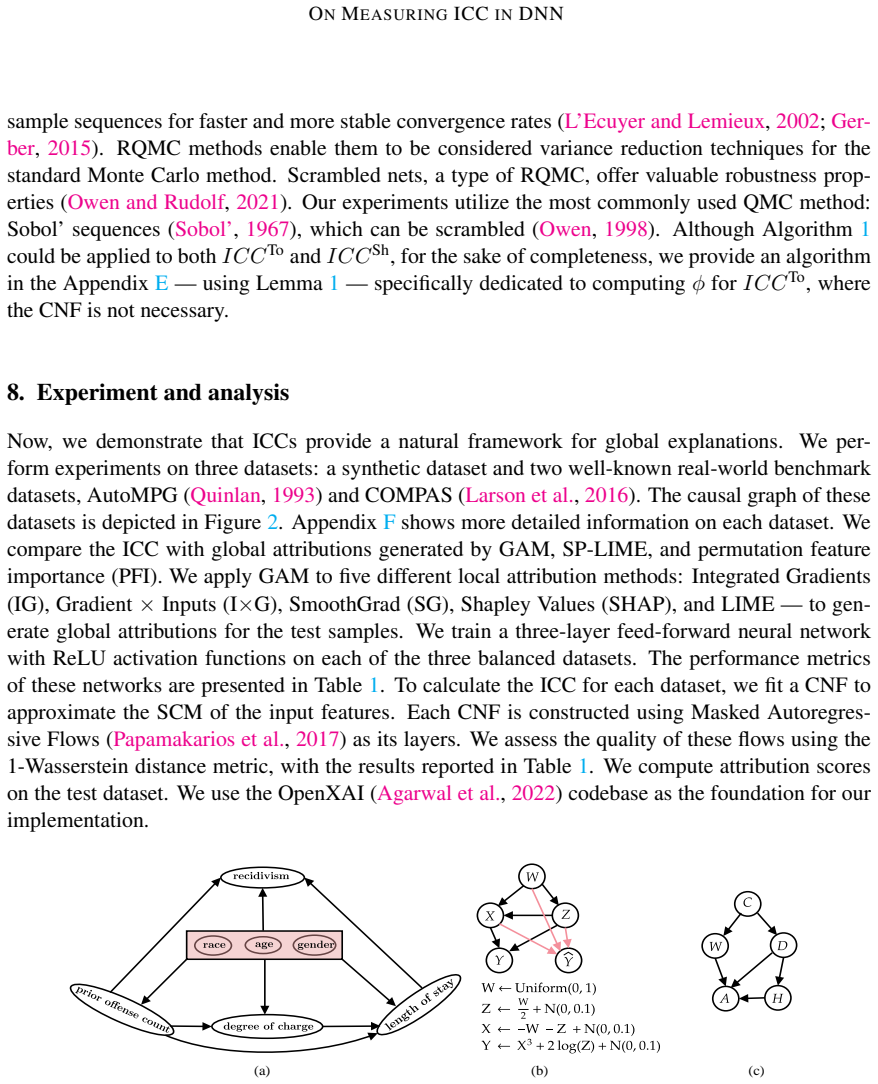
- [Section 7 / Assumption 1 / Appendix F] The central identifiability result is conditional on a correct, confounder-free causal graph, but the real-data experiments do not establish that this assumption holds. Appendix F states that the AutoMPG ground-truth graph is unknown, is adopted from Reddy et al. (2023a), and is 'validated through consultations with GPT-3.5'; the COMPAS graph is only 'inspired by' Plecko and Bareinboim (2024). If the topological order or a parent set is misspecified, the fitted CNF can still match P(X), but the recovered noise variables U will not be the true causal noises, so Lemma 1's equality phi(Yhat|U_T) = phi(Yhat|do(X_T)) fails and the reported ICC values estimate a different quantity. No amount of observational data can detect this misspecification under the stated assumptions. The authors should either use datasets with verified causal graphs, perform a sensitivity analysis over plausible graphs, or explicitly reframe the real-data results as illustrative and conditional on assumed graphs; the abstract and Section 8 currently overstate the empirical support.
- [Section 7, Algorithm 1] Algorithm 1 is not executable as written. Step 3 uses undefined variables epsilon_V and epsilon_W, and the expressions N(F_theta(epsilon_V)) and N(F_theta(epsilon_W)) do not match the quantities u_M, u_N, and u_Q defined in steps 1-2. Since this algorithm is the core estimator for ICC_Sh, the pseudocode must be corrected (likely epsilon_V = u_N and epsilon_W = u_Q) before the experiments can be reproduced.
- [Appendix D, Theorem 2] The proof of the variance monotonicity inequality is garbled and does not establish the claim. The text invokes the law of total variance and concludes 'E(V(X)) >= E_Y(V(X|Y))', which is not a meaningful comparison, and 'interchanging Y and Z' does not yield Var_Y(E(X|Y)) <= Var_{Y,Z}(E(X|Y,Z)). The inequality itself is true and follows directly from applying the law of total variance to E[X|Y,Z], but the proof as written is invalid. This theorem underpins the positivity/monotonicity of the proposed variance-based ICC and the decomposition in Corollary 3, so the proof needs to be rewritten.
minor comments (7)
- [Section 4.1] The definition of the coalition value phi(Yhat|do(X_T)) := sum_{x_T} phi(Yhat|do(X_T=x_T)) ptilde(x_T) is confusing: the left-hand side notation suggests a single interventional quantity, and the averaging over x_T with ptilde(x_T) should be defined precisely and kept consistent with Lemma 1.
- [Section 5, Corollary 3] The transition from unnormalized to normalized phi should be flagged. As written, the decomposition V(Yhat) = sum_j ICC_To is correct only for the unnormalized convention phi(Yhat|U_I) = V_{U_I}(E(Yhat|U_I)); under the normalized convention introduced immediately afterward, the identity becomes 1 = sum_j ICC_To.
- [Appendix D, Property 1 proof] The overbrace in the telescoping sum reads phi(Yhat|U_V), which should be phi(Yhat|U) or phi(Yhat|U_[p]); this is a typo in a proof of a central property.
- [Theorem 4, Eq. (7)] The second display in Theorem 4 writes ICC_phi(X_j -> Yhat) without a superscript; since ICC_To and ICC_Sh coincide under independent inputs, the equality should say so explicitly.
- [Appendix D, Property 3 proof] The binomial coefficients in the Property 3 proof use n where the paper elsewhere uses p; please make the notation uniform.
- [Section 8, COMPAS analysis] The claim that single-feature classifiers resolve the discrepancy between ICC_To and ICC_Sh in COMPAS is not supported: the reported F1 scores are 0.8972, 0.8964, and 0.8912, which are nearly equal, so this check does not show that recidivism is the most critical feature. Please either remove this sanity check or state explicitly what conclusion it supports.
- [Appendix E, Algorithm 2] Algorithm 2's notation x_Q = (x_M-I, x_NI) is ambiguous; please define it elementwise, e.g., x_{Q,i} = x_{M,i} for i not in I and x_{Q,i} = x_{N,i} for i in I.
Circularity Check
No significant circularity: ICC identifiability follows from cited external identifiability results plus explicit graph assumptions, not from the paper's own fitted quantities.
full rationale
The paper's derivation chain is not circular. Intrinsic causal contribution is defined in Eq. (2) in terms of exogenous noises U, and the central identifiability claim (Theorem 7) rests on Lemma 1, which is cited from Janzing et al. (2024), and on the componentwise-invertibility theorem of Javaloy et al. (2023) and Xi and Bloem-Reddy (2023), both external to this author group. Theorem 7 establishes invariance of ICC under componentwise reparameterization of U; that invariance is a nontrivial consequence of measurability of the conditional expectation, not an assumption built into the definition of ICC. The Sobol-index relation in Theorem 4 is proved from the variance decomposition and Owen's Shapley-Sobol theorem, again an external result, so it is a genuine equivalence rather than a renaming. The real-data causal graphs are assumed from prior work and GPT-3.5 consultation, and the COMPAS graph is inspired by an external source; those are external modeling assumptions. If the graph is misspecified or hidden confounders exist, the recovered U variables are not the true causal noises and the estimated ICC targets a different quantity, but that is a validity/identifiability concern under the stated assumptions, not a circular reduction. The only self-citation in the paper, Saha and Garain (2022), appears in a general related-work list and is not load-bearing for any theorem or experiment. No fitted parameter is relabeled as a prediction, and no result is forced by a self-citation chain. Therefore the appropriate finding is no significant circularity.
Assumptions & free parameters
assumptions (3)
- domain assumption The causal graph G among input features is acyclic and contains no latent confounders (Assumption 1).
- domain assumption The input SCM is diffeomorphic and causally sufficient: F invertible with differentiable inverse, and U components independent (Assumption 2).
- domain assumption For real datasets, the true causal graph is replaced by an assumed graph: AutoMPG graph from Reddy et al. validated via GPT-3.5, COMPAS graph from Plecko and Bareinboim.
Cite this review
Pith. "Pith review of On Measuring Intrinsic Causal Attributions in Deep Neural Networks." pith.science (2026). https://pith.science/paper/2VURI2EK
@misc{pith2026250509660,
  author       = {Pith},
  title        = {Pith review of: On Measuring Intrinsic Causal Attributions in Deep Neural Networks},
  year         = {2026},
  howpublished = {\url{https://pith.science/paper/2VURI2EK}},
  note         = {Machine review of arXiv:2505.09660}
}
read the original abstract
Quantifying the causal influence of input features within neural networks has become a topic of increasing interest. Existing approaches typically assess direct, indirect, and total causal effects. This work treats NNs as structural causal models (SCMs) and extends our focus to include intrinsic causal contributions (ICC). We propose an identifiable generative post-hoc framework for quantifying ICC. We also draw a relationship between ICC and Sobol' indices. Our experiments on synthetic and real-world datasets demonstrate that ICC generates more intuitive and reliable explanations compared to existing global explanation techniques.
Figures


Reference graph
Works this paper leans on
-
[1]
Open XAI : Towards a transparent evaluation of model explanations
Chirag Agarwal, Satyapriya Krishna, Eshika Saxena, Martin Pawelczyk, Nari Johnson, Isha Puri, Marinka Zitnik, and Himabindu Lakkaraju. Open XAI : Towards a transparent evaluation of model explanations. In Thirty-sixth Conference on Neural Information Processing Systems Datasets and Benchmarks Track, 2022. URL https://openreview.net/forum?id=MU2495w47rz
2022
-
[2]
A causal framework for explaining the predictions of black-box sequence-to-sequence models
David Alvarez-Melis and Tommi Jaakkola. A causal framework for explaining the predictions of black-box sequence-to-sequence models. In Martha Palmer, Rebecca Hwa, and Sebastian Riedel, editors, Proceedings of the 2017 Conference on Empirical Methods in Natural Language Processing, pages 412--421, Copenhagen, Denmark, September 2017. Association for Comput...
-
[3]
Athreya and Soumen N
Krishna B. Athreya and Soumen N. Lahiri. Measure Theory and Probability Theory (Springer Texts in Statistics). Springer-Verlag, Berlin, Heidelberg, 2006. ISBN 038732903X
2006
-
[4]
Fairness seen as global sensitivity analysis
Cl \'e ment B \'e nesse, Fabrice Gamboa, Jean-Michel Loubes, and Thibaut Boissin. Fairness seen as global sensitivity analysis. Machine Learning, 113 0 (5): 0 3205--3232, May 2024
2024
-
[5]
o baum, Peter G \
Patrick Bl \"o baum, Peter G \"o tz, Kailash Budhathoki, Atalanti A Mastakouri, and Dominik Janzing. Dowhy-gcm: An extension of dowhy for causal inference in graphical causal models. Journal of Machine Learning Research, 25 0 (147): 0 1--7, 2024
2024
-
[6]
Random forests
Leo Breiman. Random forests. Machine Learning, 45 0 (1): 0 5--32, October 2001
2001
-
[7]
Cage: Causality-aware shapley value for global explanations
Nils Ole Breuer, Andreas Sauter, Majid Mohammadi, and Erman Acar. Cage: Causality-aware shapley value for global explanations. In Luca Longo, Sebastian Lapuschkin, and Christin Seifert, editors, Explainable Artificial Intelligence, pages 143--162, Cham, 2024. Springer Nature Switzerland. ISBN 978-3-031-63800-8
2024
-
[8]
Language models are few-shot learners
Tom Brown, Benjamin Mann, Nick Ryder, Melanie Subbiah, Jared D Kaplan, Prafulla Dhariwal, Arvind Neelakantan, Pranav Shyam, Girish Sastry, Amanda Askell, Sandhini Agarwal, Ariel Herbert-Voss, Gretchen Krueger, Tom Henighan, Rewon Child, Aditya Ramesh, Daniel Ziegler, Jeffrey Wu, Clemens Winter, Chris Hesse, Mark Chen, Eric Sigler, Mateusz Litwin, Scott Gr...
1901
Show all 90 references
-
[9]
Neural network attributions: A causal perspective
Aditya Chattopadhyay, Piyushi Manupriya, Anirban Sarkar, and Vineeth N Balasubramanian. Neural network attributions: A causal perspective. In Kamalika Chaudhuri and Ruslan Salakhutdinov, editors, Proceedings of the 36th International Conference on Machine Learning, volume 97 o...
2019
-
[10]
Beyond First-Order Uncertainty Estimation with Evidential Models for Open-World Recognition
Charles Corbi \`e re, Marc Lafon, Nicolas Thome, Matthieu Cord, and Patrick P \'e rez. Beyond First-Order Uncertainty Estimation with Evidential Models for Open-World Recognition . In ICML 2021 Workshop on Uncertainty and Robustness in Deep Learning , Virtual, Austria, Septemb...
2021
-
[11]
Bach, and Himabindu Lakkaraju
Jessica Dai, Sohini Upadhyay, Ulrich Aivodji, Stephen H. Bach, and Himabindu Lakkaraju. Fairness via explanation quality: Evaluating disparities in the quality of post hoc explanations. In Proceedings of the 2022 AAAI/ACM Conference on AI, Ethics, and Society, AIES '22, page 2...
2022
-
[12]
Multi-objective counterfactual explanations
Susanne Dandl, Christoph Molnar, Martin Binder, and Bernd Bischl. Multi-objective counterfactual explanations. In Thomas B \"a ck, Mike Preuss, Andr \'e Deutz, Hao Wang, Carola Doerr, Michael Emmerich, and Heike Trautmann, editors, Parallel Problem Solving from Nature -- PPSN ...
2020
-
[13]
Evaluating and mitigating bias in image classifiers: A causal perspective using counterfactuals
Saloni Dash, Vineeth N Balasubramanian, and Amit Sharma. Evaluating and mitigating bias in image classifiers: A causal perspective using counterfactuals. In Proceedings of the IEEE/CVF Winter Conference on Applications of Computer Vision, pages 915--924, 2022
2022
-
[14]
Look at the variance! efficient black-box explanations with sobol-based sensitivity analysis
Thomas FEL, Remi Cadene, Mathieu Chalvidal, Matthieu Cord, David Vigouroux, and Thomas Serre. Look at the variance! efficient black-box explanations with sobol-based sensitivity analysis. In M. Ranzato, A. Beygelzimer, Y. Dauphin, P.S. Liang, and J. Wortman Vaughan, editors, A...
2021
-
[15]
Nicholas Frosst and Geoffrey E. Hinton. Distilling a neural network into a soft decision tree. ArXiv, abs/1711.09784, 2017. URL https://api.semanticscholar.org/CorpusID:3976789
2017 arXiv
-
[16]
Shapley explainability on the data manifold
Christopher Frye, Damien de Mijolla, Tom Begley, Laurence Cowton, Megan Stanley, and Ilya Feige. Shapley explainability on the data manifold. In International Conference on Learning Representations, 2021. URL https://openreview.net/forum?id=OPyWRrcjVQw
2021
-
[17]
Axioms of causal relevance
David Galles and Judea Pearl. Axioms of causal relevance. Artificial Intelligence, 97 0 (1): 0 9--43, 1997. ISSN 0004-3702. doi:https://doi.org/10.1016/S0004-3702(97)00047-7. URL https://www.sciencedirect.com/science/article/pii/S0004370297000477. Relevance
1997 doi
-
[18]
On integration methods based on scrambled nets of arbitrary size
Mathieu Gerber. On integration methods based on scrambled nets of arbitrary size. Journal of Complexity, 31 0 (6): 0 798--816, 2015. ISSN 0885-064X. doi:https://doi.org/10.1016/j.jco.2015.06.001. URL https://www.sciencedirect.com/science/article/pii/S0885064X1500059X
2015 doi
-
[19]
Explaining classifiers with causal concept effect (cace)
Yash Goyal, Uri Shalit, and Been Kim. Explaining classifiers with causal concept effect (cace). CoRR, abs/1907.07165, 2019 a . URL http://arxiv.org/abs/1907.07165
1907 arXiv
-
[20]
Counterfactual visual explanations
Yash Goyal, Ziyan Wu, Jan Ernst, Dhruv Batra, Devi Parikh, and Stefan Lee. Counterfactual visual explanations. In Kamalika Chaudhuri and Ruslan Salakhutdinov, editors, Proceedings of the 36th International Conference on Machine Learning, volume 97 of Proceedings of Machine Lea...
2019
-
[21]
Causal shapley values: Exploiting causal knowledge to explain individual predictions of complex models
Tom Heskes, Evi Sijben, Ioan Gabriel Bucur, and Tom Claassen. Causal shapley values: Exploiting causal knowledge to explain individual predictions of complex models. In H. Larochelle, M. Ranzato, R. Hadsell, M.F. Balcan, and H. Lin, editors, Advances in Neural Information Proc...
2020
-
[22]
Generalized functional anova diagnostics for high-dimensional functions of dependent variables
Giles Hooker. Generalized functional anova diagnostics for high-dimensional functions of dependent variables. Journal of Computational and Graphical Statistics, 16 0 (3): 0 709--732, 2007. ISSN 10618600. URL http://www.jstor.org/stable/27594267
2007
-
[23]
Global explanations of neural networks: Mapping the landscape of predictions
Mark Ibrahim, Melissa Louie, Ceena Modarres, and John Paisley. Global explanations of neural networks: Mapping the landscape of predictions. In Proceedings of the 2019 AAAI/ACM Conference on AI, Ethics, and Society, AIES '19, page 279–287, New York, NY, USA, 2019. Association ...
2019
-
[24]
Irons, Meyer Scetbon, Soumik Pal, and Zaid Harchaoui
Nicholas J. Irons, Meyer Scetbon, Soumik Pal, and Zaid Harchaoui. Triangular flows for generative modeling: Statistical consistency, smoothness classes, and fast rates, 2021. URL https://arxiv.org/abs/2112.15595
2021 arXiv
-
[25]
Michiel J.W. Jansen. Analysis of variance designs for model output. Computer Physics Communications, 117 0 (1): 0 35--43, 1999. ISSN 0010-4655. doi:https://doi.org/10.1016/S0010-4655(98)00154-4. URL https://www.sciencedirect.com/science/article/pii/S0010465598001544
1999 doi
-
[26]
Feature relevance quantification in explainable ai: A causal problem
Dominik Janzing, Lenon Minorics, and Patrick Bloebaum. Feature relevance quantification in explainable ai: A causal problem. In Silvia Chiappa and Roberto Calandra, editors, Proceedings of the Twenty Third International Conference on Artificial Intelligence and Statistics, vol...
2020
-
[27]
Mastakouri, Philipp M
Dominik Janzing, Patrick Blöbaum, Atalanti A. Mastakouri, Philipp M. Faller, Lenon Minorics, and Kailash Budhathoki. Quantifying intrinsic causal contributions via structure preserving interventions, 2024. URL https://arxiv.org/abs/2007.00714
2024 arXiv
-
[28]
Causal normalizing flows: from theory to practice
Adri \'a n Javaloy, Pablo Sanchez Martin, and Isabel Valera. Causal normalizing flows: from theory to practice. In Thirty-seventh Conference on Neural Information Processing Systems, 2023. URL https://openreview.net/forum?id=QIFoCI7ca1
2023
-
[29]
On measuring causal contributions via do-interventions
Yonghan Jung, Shiva Kasiviswanathan, Jin Tian, Dominik Janzing, Patrick Bloebaum, and Elias Bareinboim. On measuring causal contributions via do-interventions. In Kamalika Chaudhuri, Stefanie Jegelka, Le Song, Csaba Szepesvari, Gang Niu, and Sivan Sabato, editors, Proceedings ...
2022
-
[30]
Balasubramanian, and Amit Sharma
Sai Srinivas Kancheti, Abbavaram Gowtham Reddy, Vineeth N. Balasubramanian, and Amit Sharma. Matching learned causal effects of neural networks with domain priors. In International Conference on Machine Learning, 2021. URL https://api.semanticscholar.org/CorpusID:246473224
2021
-
[31]
Kingma, and Aapo Hyv \"a rinen
Ilyes Khemakhem, Diederik P. Kingma, and Aapo Hyv \"a rinen. Variational autoencoders and nonlinear ica: A unifying framework. In International Conference on Artificial Intelligence and Statistics, 2019. URL https://api.semanticscholar.org/CorpusID:195874364
2019
-
[32]
Knuth and Jayme L
Donald E. Knuth and Jayme L. Szwarcfiter. A structured program to generate all topological sorting arrangements. Information Processing Letters, 2 0 (6): 0 153--157, 1974. ISSN 0020-0190. doi:https://doi.org/10.1016/0020-0190(74)90001-5. URL https://www.sciencedirect.com/scien...
1974
-
[33]
Towards unifying feature attribution and counterfactual explanations: Different means to the same end
Ramaravind Kommiya Mothilal, Divyat Mahajan, Chenhao Tan, and Amit Sharma. Towards unifying feature attribution and counterfactual explanations: Different means to the same end. In Proceedings of the 2021 AAAI/ACM Conference on AI, Ethics, and Society, AIES '21, page 652–663, ...
2021
-
[34]
Kucherenko, S
S. Kucherenko, S. Tarantola, and P. Annoni. Estimation of global sensitivity indices for models with dependent variables. Computer Physics Communications, 183 0 (4): 0 937--946, 2012. ISSN 0010-4655. doi:https://doi.org/10.1016/j.cpc.2011.12.020. URL https://www.sciencedirect....
2012 doi
-
[35]
Backtracking counterfactuals
Julius Von K \"u gelgen, Abdirisak Mohamed, and Sander Beckers. Backtracking counterfactuals. In 2nd Conference on Causal Learning and Reasoning, 2023. URL https://openreview.net/forum?id=stVikewRRvw
2023
-
[36]
Global Sensitivity Analysis for the Interpretation of Machine Learning Algorithms, pages 155--169
Sonja Kuhnt and Arkadius Kalka. Global Sensitivity Analysis for the Interpretation of Machine Learning Algorithms, pages 155--169. Springer International Publishing, Cham, 2022. doi:10.1007/978-3-031-07155-3_6. URL https://doi.org/10.1007/978-3-031-07155-3_6
2022 doi
-
[37]
Bach, and Jure Leskovec
Himabindu Lakkaraju, Stephen H. Bach, and Jure Leskovec. Interpretable decision sets: A joint framework for description and prediction. Proceedings of the 22nd ACM SIGKDD International Conference on Knowledge Discovery and Data Mining, 2016. URL https://api.semanticscholar.org...
2016
-
[38]
How we analyzed the compas recidivism algorithm, 2016
Jeff Larson, Surya Mattu, Lauren Kirchner, and Julia Angwin. How we analyzed the compas recidivism algorithm, 2016. URL https://www.propublica.org/article/how-we-analyzed-the-compas-recidivism-algorithm
2016
-
[39]
Randomized quasi-monte carlo: An introduction for practitioners
Pierre L'Ecuyer. Randomized quasi-monte carlo: An introduction for practitioners. In Art B. Owen and Peter W. Glynn, editors, Monte Carlo and Quasi-Monte Carlo Methods, pages 29--52, Cham, 2018. Springer International Publishing
2018
-
[40]
Recent Advances in Randomized Quasi-Monte Carlo Methods, pages 419--474
Pierre L'Ecuyer and Christiane Lemieux. Recent Advances in Randomized Quasi-Monte Carlo Methods, pages 419--474. Springer US, New York, NY, 2002. ISBN 978-0-306-48102-4. doi:10.1007/0-306-48102-2_20. URL https://doi.org/10.1007/0-306-48102-2_20
2002 doi
-
[41]
Yelvington, Oluwayemisi O
Genyuan Li, Herschel Rabitz, Paul E. Yelvington, Oluwayemisi O. Oluwole, Fred Bacon, Charles E. Kolb, and Jacqueline Schoendorf. Global sensitivity analysis for systems with independent and/or correlated inputs. The Journal of Physical Chemistry A, May 2010
2010
-
[42]
Lundberg and Su-In Lee
Scott M. Lundberg and Su-In Lee. A unified approach to interpreting model predictions. In Proceedings of the 31st International Conference on Neural Information Processing Systems, NIPS'17, page 4768–4777, Red Hook, NY, USA, 2017. Curran Associates Inc. ISBN 9781510860964
2017
-
[43]
Preserving causal constraints in counterfactual explanations for machine learning classifiers
Divyat Mahajan, Chenhao Tan, and Amit Sharma. Preserving causal constraints in counterfactual explanations for machine learning classifiers. ArXiv, abs/1912.03277, 2019. URL https://api.semanticscholar.org/CorpusID:208857863
1912 arXiv
-
[44]
Sampling permutations for shapley value estimation
Rory Mitchell, Joshua Cooper, Eibe Frank, and Geoffrey Holmes. Sampling permutations for shapley value estimation. J. Mach. Learn. Res., 23 0 (1), January 2022. ISSN 1532-4435
2022
-
[45]
Art B. Owen. Scrambling sobol' and niederreiter–xing points. Journal of Complexity, 14 0 (4): 0 466--489, 1998. ISSN 0885-064X. doi:https://doi.org/10.1006/jcom.1998.0487. URL https://www.sciencedirect.com/science/article/pii/S0885064X98904873
1998
-
[46]
Art B. Owen. Sobol' indices and shapley value. SIAM/ASA Journal on Uncertainty Quantification, 2 0 (1): 0 245--251, 2014. doi:10.1137/130936233. URL https://doi.org/10.1137/130936233
2014 doi
-
[47]
Owen and Daniel Rudolf
Art B. Owen and Daniel Rudolf. A strong law of large numbers for scrambled net integration. SIAM Review, 63 0 (2): 0 360--372, 2021. doi:10.1137/20M1320535. URL https://doi.org/10.1137/20M1320535
2021 doi
-
[48]
Masked autoregressive flow for density estimation
George Papamakarios, Theo Pavlakou, and Iain Murray. Masked autoregressive flow for density estimation. In I. Guyon, U. Von Luxburg, S. Bengio, H. Wallach, R. Fergus, S. Vishwanathan, and R. Garnett, editors, Advances in Neural Information Processing Systems, volume 30. Curran...
2017
-
[49]
Normalizing flows for probabilistic modeling and inference
George Papamakarios, Eric Nalisnick, Danilo Jimenez Rezende, Shakir Mohamed, and Balaji Lakshminarayanan. Normalizing flows for probabilistic modeling and inference. J. Mach. Learn. Res., 22 0 (1), January 2021. ISSN 1532-4435
2021
-
[50]
Castro, and Ben Glocker
Nick Pawlowski, Daniel C. Castro, and Ben Glocker. Deep structural causal models for tractable counterfactual inference. In Advances in Neural Information Processing Systems, 2020
2020
-
[51]
Causality
Judea Pearl. Causality. Cambridge University Press, 2 edition, 2009
2009
-
[52]
RISE: randomized input sampling for explanation of black-box models
Vitali Petsiuk, Abir Das, and Kate Saenko. RISE: randomized input sampling for explanation of black-box models. In British Machine Vision Conference 2018, BMVC 2018, Newcastle, UK, September 3-6, 2018 , page 151. BMVA Press, 2018. URL http://bmvc2018.org/contents/papers/1064.pdf
2018
-
[53]
Counterfactual data augmentation using locally factored dynamics
Silviu Pitis, Elliot Creager, and Animesh Garg. Counterfactual data augmentation using locally factored dynamics. In H. Larochelle, M. Ranzato, R. Hadsell, M.F. Balcan, and H. Lin, editors, Advances in Neural Information Processing Systems, volume 33, pages 3976--3990. Curran ...
2020
-
[54]
Causal fairness analysis: A causal toolkit for fair machine learning
Drago Plečko and Elias Bareinboim. Causal fairness analysis: A causal toolkit for fair machine learning. Foundations and Trends® in Machine Learning, 17 0 (3): 0 304--589, 2024. ISSN 1935-8237. doi:10.1561/2200000106. URL http://dx.doi.org/10.1561/2200000106
2024 doi
-
[55]
A comprehensive comparison of total-order estimators for global sensitivity analysis
Arnald Puy, William Becker, Samuele Lo Piano, and Andrea Saltelli. A comprehensive comparison of total-order estimators for global sensitivity analysis. International Journal for Uncertainty Quantification, 12 0 (2): 0 1--18, 2022. ISSN 2152-5080
2022
-
[56]
R. Quinlan. Auto MPG . UCI Machine Learning Repository, 1993. DOI : https://doi.org/10.24432/C5859H
1993 doi
-
[57]
A generalized anova dimensional decomposition for dependent probability measures
Sharif Rahman. A generalized anova dimensional decomposition for dependent probability measures. SIAM/ASA Journal on Uncertainty Quantification, 2 0 (1): 0 670--697, 2014. doi:10.1137/120904378. URL https://doi.org/10.1137/120904378
2014 doi
-
[58]
Balasubramanian, V Varshaneya, and Satya Narayanan Kar
Abbaavaram Gowtham Reddy, Saketh Bachu, Harsh Nilesh Pathak, Ben Godfrey, Vineeth N. Balasubramanian, V Varshaneya, and Satya Narayanan Kar. Towards learning and explaining indirect causal effects in neural networks. In AAAI Conference on Artificial Intelligence, 2023 a . URL ...
2023
-
[59]
On counterfactual data augmentation under confounding, 2023 b
Abbavaram Gowtham Reddy, Saketh Bachu, Saloni Dash, Charchit Sharma, Amit Sharma, and Vineeth N Balasubramanian. On counterfactual data augmentation under confounding, 2023 b . URL https://arxiv.org/abs/2305.18183
2023 arXiv
-
[60]
Retzlaff, Alessa Angerschmid, Anna Saranti, David Schneeberger, Richard Röttger, Heimo Müller, and Andreas Holzinger
Carl O. Retzlaff, Alessa Angerschmid, Anna Saranti, David Schneeberger, Richard Röttger, Heimo Müller, and Andreas Holzinger. Post-hoc vs ante-hoc explanations: xai design guidelines for data scientists. Cognitive Systems Research, 86: 0 101243, 2024. ISSN 1389-0417. doi:https...
2024
-
[62]
why should i trust you?
Marco Tulio Ribeiro, Sameer Singh, and Carlos Guestrin. "why should i trust you?": Explaining the predictions of any classifier. In Proceedings of the 22nd ACM SIGKDD International Conference on Knowledge Discovery and Data Mining, KDD '16, page 1135–1144, New York, NY, USA, 2...
2016
-
[63]
On noise abduction for answering counterfactual queries: A practical outlook
Saptarshi Saha and Utpal Garain. On noise abduction for answering counterfactual queries: A practical outlook. Transactions on Machine Learning Research, 2022. ISSN 2835-8856. URL https://openreview.net/forum?id=4FU8Jz1Oyj
2022
-
[64]
Second-order uncertainty quantification: Variance-based measures
Yusuf Sale, Paul Hofman, Lisa Wimmer, Eyke H \"u llermeier, and Thomas Nagler. Second-order uncertainty quantification: Variance-based measures. arXiv preprint arXiv:2401.00276, 2023
2023 arXiv
-
[65]
Global sensitivity analysis: The primer
Andrea Saltelli, Ratto Marco, A Terry, Campolongo Francesca, Cariboni Jessica, Gatelli Debora, Saisana Michaela, and Tarantola Stefano. Global sensitivity analysis: The primer. 2008. URL https://api.semanticscholar.org/CorpusID:115957810
2008
-
[66]
Scholbeck, Julia Moosbauer, Giuseppe Casalicchio, Hoshin Gupta, Bernd Bischl, and Christian Heumann
Christian A. Scholbeck, Julia Moosbauer, Giuseppe Casalicchio, Hoshin Gupta, Bernd Bischl, and Christian Heumann. Position paper: Bridging the gap between machine learning and sensitivity analysis, 2024. URL https://arxiv.org/abs/2312.13234
2024 arXiv
-
[67]
CXPlain: causal explanations for model interpretation under uncertainty
Patrick Schwab and Walter Karlen. CXPlain: causal explanations for model interpretation under uncertainty. Curran Associates Inc., Red Hook, NY, USA, 2019
2019
-
[68]
Toward causal representation learning
Bernhard Schölkopf, Francesco Locatello, Stefan Bauer, Nan Rosemary Ke, Nal Kalchbrenner, Anirudh Goyal, and Yoshua Bengio. Toward causal representation learning. Proceedings of the IEEE, 109 0 (5): 0 612--634, 2021. doi:10.1109/JPROC.2021.3058954
2021
-
[69]
Selvaraju, Michael Cogswell, Abhishek Das, Ramakrishna Vedantam, Devi Parikh, and Dhruv Batra
Ramprasaath R. Selvaraju, Michael Cogswell, Abhishek Das, Ramakrishna Vedantam, Devi Parikh, and Dhruv Batra. Grad-cam: Visual explanations from deep networks via gradient-based localization. In 2017 IEEE International Conference on Computer Vision (ICCV), pages 618--626, 2017...
2017 doi
-
[70]
L. S. Shapley. 17. A Value for n-Person Games, pages 307--318. Princeton University Press, Princeton, 1953. ISBN 9781400881970. doi:doi:10.1515/9781400881970-018. URL https://doi.org/10.1515/9781400881970-018
1953 doi
-
[71]
Weakly supervised disentangled generative causal representation learning
Xinwei Shen, Furui Liu, Hanze Dong, Qing Lian, Zhitang Chen, and Tong Zhang. Weakly supervised disentangled generative causal representation learning. Journal of Machine Learning Research, 23 0 (241): 0 1--55, 2022. URL http://jmlr.org/papers/v23/21-0080.html
2022
-
[72]
Learning important features through propagating activation differences
Avanti Shrikumar, Peyton Greenside, and Anshul Kundaje. Learning important features through propagating activation differences. In Proceedings of the 34th International Conference on Machine Learning - Volume 70, ICML'17, page 3145–3153. JMLR.org, 2017
2017
-
[73]
Semi-autoregressive energy flows: exploring likelihood-free training of normalizing flows
Phillip Si, Zeyi Chen, Subham Sekhar Sahoo, Yair Schiff, and Volodymyr Kuleshov. Semi-autoregressive energy flows: exploring likelihood-free training of normalizing flows. In Proceedings of the 40th International Conference on Machine Learning, ICML'23. JMLR.org, 2023
2023
-
[74]
Deep inside convolutional networks: Visualising image classification models and saliency maps, 2014
Karen Simonyan, Andrea Vedaldi, and Andrew Zisserman. Deep inside convolutional networks: Visualising image classification models and saliency maps, 2014. URL https://arxiv.org/abs/1312.6034
2014 arXiv
-
[75]
On the distribution of points in a cube and the approximate evaluation of integrals
I.M Sobol'. On the distribution of points in a cube and the approximate evaluation of integrals. USSR Computational Mathematics and Mathematical Physics, 7 0 (4): 0 86--112, 1967. ISSN 0041-5553. doi:https://doi.org/10.1016/0041-5553(67)90144-9. URL https://www.sciencedirect.c...
1967
-
[76]
Global sensitivity indices for nonlinear mathematical models and their monte carlo estimates
I.M Sobol'. Global sensitivity indices for nonlinear mathematical models and their monte carlo estimates. Mathematics and Computers in Simulation, 55 0 (1): 0 271--280, 2001. ISSN 0378-4754. doi:https://doi.org/10.1016/S0378-4754(00)00270-6. URL https://www.sciencedirect.com/s...
2001 doi
-
[77]
Bas Van Stein, Elena Raponi, Zahra Sadeghi, Niek Bouman, Roeland C. H. J. Van Ham, and Thomas Bäck. A comparison of global sensitivity analysis methods for explainable ai with an application in genomic prediction. IEEE Access, 10: 0 103364--103381, 2022. doi:10.1109/ACCESS.202...
2022
-
[78]
Conditional variable importance for random forests
Carolin Strobl, Anne-Laure Boulesteix, Thomas Kneib, Thomas Augustin, and Achim Zeileis. Conditional variable importance for random forests. BMC Bioinformatics, 9 0 (1): 0 307, July 2008
2008
-
[79]
Axiomatic attribution for deep networks
Mukund Sundararajan, Ankur Taly, and Qiqi Yan. Axiomatic attribution for deep networks. In International Conference on Machine Learning, 2017. URL https://api.semanticscholar.org/CorpusID:16747630
2017
-
[80]
Tunkiel, Dan Sui, and Tomasz Wiktorski
Andrzej T. Tunkiel, Dan Sui, and Tomasz Wiktorski. Data-driven sensitivity analysis of complex machine learning models: A case study of directional drilling. Journal of Petroleum Science and Engineering, 195: 0 107630, 2020. ISSN 0920-4105. doi:https://doi.org/10.1016/j.petrol...
2020
-
[81]
Interpretable counterfactual explanations guided by prototypes
Arnaud Van Looveren and Janis Klaise. Interpretable counterfactual explanations guided by prototypes. In Nuria Oliver, Fernando P \'e rez-Cruz, Stefan Kramer, Jesse Read, and Jose A. Lozano, editors, Machine Learning and Knowledge Discovery in Databases. Research Track, pages ...
2021
-
[82]
Hines, John P
Sahil Verma, Varich Boonsanong, Minh Hoang, Keegan E. Hines, John P. Dickerson, and Chirag Shah. Counterfactual explanations and algorithmic recourses for machine learning: A review, 2022. URL https://arxiv.org/abs/2010.10596
2022 arXiv
-
[83]
Counterfactual explanations without opening the black box: Automated decisions and the gdpr, 2018
Sandra Wachter, Brent Mittelstadt, and Chris Russell. Counterfactual explanations without opening the black box: Automated decisions and the gdpr, 2018. URL https://arxiv.org/abs/1711.00399
2018 arXiv
-
[84]
Contrastive-ace: Domain generalization through alignment of causal mechanisms
Yunqi Wang, Furui Liu, Zhitang Chen, Yik-Chung Wu, Jianye Hao, Guangyong Chen, and Pheng-Ann Heng. Contrastive-ace: Domain generalization through alignment of causal mechanisms. IEEE Transactions on Image Processing, 32: 0 235--250, 2023. doi:10.1109/TIP.2022.3227457
2023
-
[85]
Quantifying aleatoric and epistemic uncertainty in machine learning: Are conditional entropy and mutual information appropriate measures? In Robin J
Lisa Wimmer, Yusuf Sale, Paul Hofman, Bernd Bischl, and Eyke H\"ullermeier. Quantifying aleatoric and epistemic uncertainty in machine learning: Are conditional entropy and mutual information appropriate measures? In Robin J. Evans and Ilya Shpitser, editors, Proceedings of th...
2023
-
[86]
Indeterminacy in generative models: Characterization and strong identifiability
Quanhan Xi and Benjamin Bloem - Reddy. Indeterminacy in generative models: Characterization and strong identifiability. In Francisco J. R. Ruiz, Jennifer G. Dy, and Jan - Willem van de Meent, editors, International Conference on Artificial Intelligence and Statistics, 25-27 Ap...
2023
-
[87]
Class specific interpretability in cnn using causal analysis
Ankit Yadu, P K Suhas, and Neelam Sinha. Class specific interpretability in cnn using causal analysis. In 2021 IEEE International Conference on Image Processing (ICIP), pages 3702--3706, 2021. doi:10.1109/ICIP42928.2021.9506118
2021
-
[88]
Global model interpretation via recursive partitioning
Chengliang Yang, Anand Rangarajan, and Sanjay Ranka. Global model interpretation via recursive partitioning. In 2018 IEEE 20th International Conference on High Performance Computing and Communications; IEEE 16th International Conference on Smart City; IEEE 4th International Co...
2018
-
[89]
Causalvae: Disentangled representation learning via neural structural causal models
Mengyue Yang, Furui Liu, Zhitang Chen, Xinwei Shen, Jianye Hao, and Jun Wang. Causalvae: Disentangled representation learning via neural structural causal models. In 2021 IEEE/CVF Conference on Computer Vision and Pattern Recognition (CVPR), pages 9588--9597, 2021. doi:10.1109...
2021
-
[90]
Zeiler and Rob Fergus
Matthew D. Zeiler and Rob Fergus. Visualizing and understanding convolutional networks. In David Fleet, Tomas Pajdla, Bernt Schiele, and Tinne Tuytelaars, editors, Computer Vision -- ECCV 2014, pages 818--833, Cham, 2014. Springer International Publishing. ISBN 978-3-319-10590-1
2014
-
[91]
Causal discovery with reinforcement learning
Shengyu Zhu, Ignavier Ng, and Zhitang Chen. Causal discovery with reinforcement learning. In International Conference on Learning Representations, 2020. URL https://openreview.net/forum?id=S1g2skStPB
2020
Reviewed August 15, 2026 · model on record in the stance chip above.
Discussion (0). Continue with ORCID to comment.