Muon-induced di-tau production as a probe of new physics
Pith reviewed 2026-06-28 05:03 UTC · model grok-4.3
The pith
A compact detector on high-energy muon beams can extend bounds on leptophilic scalars by more than an order of magnitude.
A machine-rendered reading of the paper's core claim, the machinery that carries it, and where it could break.
Core claim
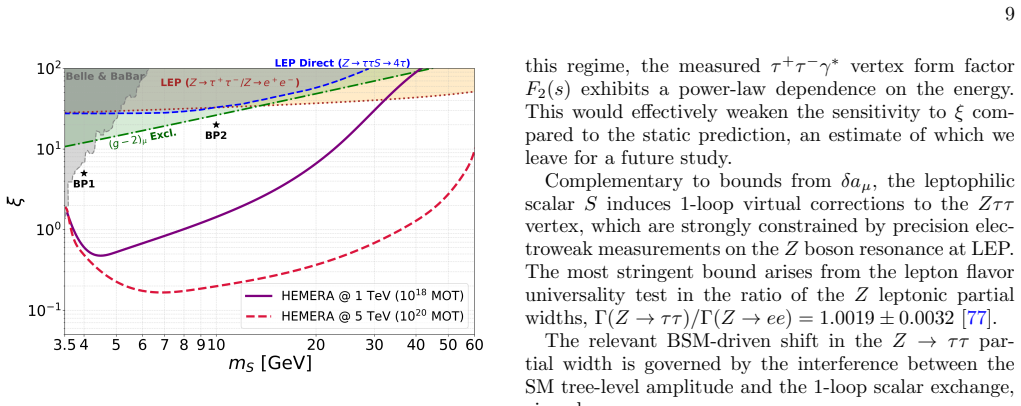
With 10^18 incident TeV-scale muons, even a compact 10 kg silicon-based HEMERA will extend current B-factory and (g-2)μ bounds by over an order of magnitude in coupling strength for a leptophilic scalar with Yukawa-like couplings that can mediate thermal dark matter production.
What carries the argument
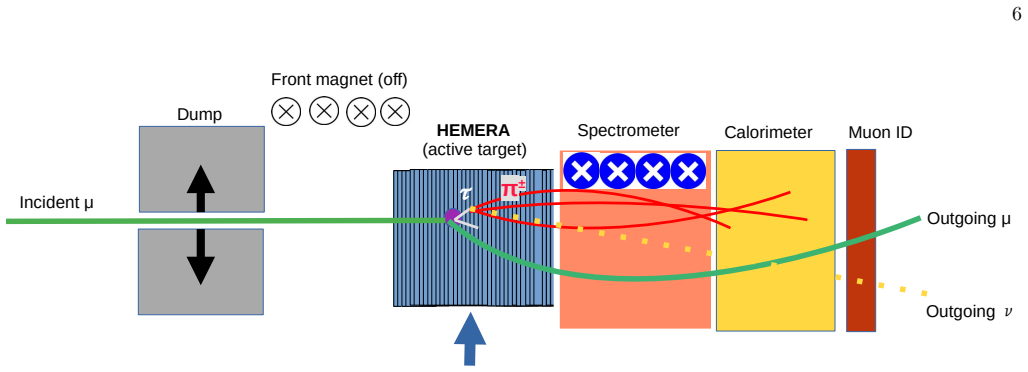
The muon trident process of coherent scattering that produces tau pairs, resolved as prompt signatures inside the HEMERA active-target detector.
If this is right
- The channel provides an independent constraint on leptophilic scalars that can mediate thermal dark matter.
- HEMERA could operate across a range of muon-beam facilities from preparatory beams to a muon collider.
- The approach adds a prompt-signature capability that beam-dump searches lack.
- It supplies additional motivation for developing high-energy muon infrastructure.
Where Pith is reading between the lines
- Similar trident channels could be studied for other light mediators or dark-sector states once muon beams exist.
- The 10 kg scale suggests that even modest detector prototypes could deliver competitive physics before a full collider runs.
- Thermal dark matter models with scalar mediators would face tighter viable parameter space if the projected reach is realized.
Load-bearing premise
Backgrounds can be controlled and prompt signatures resolved sufficiently in the HEMERA detector to reach the projected sensitivity.
What would settle it
A measurement or simulation showing that irreducible backgrounds in a silicon active target prevent the claimed order-of-magnitude improvement in coupling sensitivity with 10^18 TeV muons.
Figures



read the original abstract
The muon trident process, which involves coherent scattering to produce tau pairs, is a powerful tool for constraining dark sectors. We propose to explore this channel using future high-energy muon beams with the dedicated active-target detector, High-Energy Muon Electronic Research Apparatus (HEMERA). The detector would complement muon beam-dump searches by resolving prompt signatures and could operate from preparatory facilities involving an individual muon beam to the full Muon Collider. We illustrate its capabilities for a leptophilic scalar with Yukawa-like couplings that can mediate thermal dark matter production. With $10^{18}$ incident TeV-scale muons, even a compact 10 kg silicon-based HEMERA will extend current $B$-factory and $(g-2)_\mu$ bounds by over an order of magnitude in coupling strength, providing an additional compelling motivation for the development of high-energy muon beam infrastructure.
Editorial analysis
A structured set of objections, weighed in public.
Referee Report
Summary. The manuscript proposes using a dedicated active-target detector (HEMERA) with future high-energy muon beams to study muon-induced di-tau production as a probe of new physics. It focuses on a leptophilic scalar with Yukawa-like couplings that can mediate thermal dark matter, claiming that 10^18 incident TeV-scale muons on a compact 10 kg silicon target would extend current B-factory and (g-2)μ bounds by over an order of magnitude in coupling strength, complementing beam-dump searches via prompt signatures.
Significance. If the sensitivity projections hold after validation of detector performance, the result would provide a new experimental avenue for constraining leptophilic scalars beyond existing limits and motivate development of high-energy muon infrastructure. The conceptual approach of resolving prompt di-tau signatures in an active target is a potentially useful complement to other searches, though its impact hinges on the unverified assumptions about background rejection.
major comments (1)
- [Abstract] Abstract: The headline sensitivity claim (order-of-magnitude extension in Yukawa coupling with 10^18 muons on 10 kg Si) is presented as achievable by design of HEMERA, but no quantitative efficiency, background rejection factors, simulation results, or derivation of the projected reach is provided. This assumption about prompt signature resolution and background control (standard tridents, hadronic activity) is load-bearing for the central claim.
Simulated Author's Rebuttal
We thank the referee for their careful reading and constructive feedback. We address the single major comment below.
read point-by-point responses
-
Referee: [Abstract] Abstract: The headline sensitivity claim (order-of-magnitude extension in Yukawa coupling with 10^18 muons on 10 kg Si) is presented as achievable by design of HEMERA, but no quantitative efficiency, background rejection factors, simulation results, or derivation of the projected reach is provided. This assumption about prompt signature resolution and background control (standard tridents, hadronic activity) is load-bearing for the central claim.
Authors: We agree that the abstract states the projected sensitivity without supplying the supporting quantitative details on efficiencies, background rejection, or the derivation. The current manuscript presents a conceptual proposal and high-level estimates but does not contain the Monte Carlo studies, efficiency numbers, or background rejection factors needed to substantiate the claim. We will revise the manuscript by adding a dedicated subsection that provides these quantitative elements, including the assumed efficiencies, background rejection performance, and the explicit derivation of the reach. The abstract will also be updated to reference this new material. revision: yes
Circularity Check
No circularity detected; proposal paper has no derivation chain
full rationale
The manuscript is a detector proposal outlining the HEMERA concept for muon-induced di-tau production to constrain leptophilic scalars. It contains no equations, parameter fits, or derivations that reduce to their own inputs by construction. Sensitivity estimates are presented as order-of-magnitude projections based on external beam parameters and assumed detector capabilities, without any self-referential fitting or self-citation that bears the central claim. The work is self-contained as a conceptual study and receives the default non-finding for absence of the enumerated circularity patterns.
Axiom & Free-Parameter Ledger
invented entities (1)
-
leptophilic scalar
no independent evidence
Reference graph
Works this paper leans on
-
[1]
J. P. Delahaye, M. Diemoz, K. Long, B. Mansouli´ e, N. Pastrone, L. Rivkin, D. Schulte, A. Skrinsky, and A. Wulzer, (2019), arXiv:1901.06150 [physics.acc-ph]. 11
Pith/arXiv arXiv 2019
-
[2]
Accetturaet al.(International Muon Collider), CERN Yellow Rep
C. Accetturaet al.(International Muon Collider), CERN Yellow Rep. Monogr.2/2024, 176 (2024), arXiv:2407.12450 [physics.acc-ph]
arXiv 2024
-
[3]
Accetturaet al.(International Muon Collider), (2025), arXiv:2504.21417 [physics.acc-ph]
C. Accetturaet al.(International Muon Collider), (2025), arXiv:2504.21417 [physics.acc-ph]
arXiv 2025
-
[4]
C. Cesarotti, S. Homiller, R. K. Mishra, and M. Reece, Phys. Rev. Lett.130, 071803 (2023), arXiv:2202.12302 [hep-ph]
arXiv 2023
-
[5]
C. Cesarotti and R. Gambhir, JHEP05, 283 (2024), arXiv:2310.16110 [hep-ph]
arXiv 2024
-
[6]
H. T. Klest, Phys. Rev. D112, L051504 (2025), arXiv:2506.19301 [nucl-ex]
arXiv 2025
-
[7]
L. Calibbi, T. Li, L. Mukherjee, and Y. Yang, Phys. Rev. D110, 115009 (2024), arXiv:2406.13234 [hep-ph]
arXiv 2024
- [8]
-
[9]
R. Mammen Abraham and M. Fieg, Phys. Rev. D112, 015005 (2025), arXiv:2501.09071 [hep-ph]
arXiv 2025
- [10]
-
[11]
R. Francener, V. P. Goncalves, F. Kling, P. Krack, and J. Rojo, Eur. Phys. J. C85, 1098 (2025), arXiv:2506.13889 [hep-ph]
arXiv 2025
-
[12]
R. Francener, V. P. Goncalves, and G. Rabelo-Soares, (2025), arXiv:2510.18943 [hep-ph]
arXiv 2025
- [13]
-
[14]
Y. M. Andreevet al.(NA64), Phys. Rev. Lett.132, 211803 (2024), arXiv:2401.01708 [hep-ex]
arXiv 2024
-
[15]
Y. M. Andreevet al.(NA64), Phys. Rev. D110, 112015 (2024), arXiv:2409.10128 [hep-ex]
arXiv 2024
-
[16]
C.-Y. Chen, M. Pospelov, and Y.-M. Zhong, Phys. Rev. D95, 115005 (2017), arXiv:1701.07437 [hep-ph]
Pith/arXiv arXiv 2017
-
[17]
Y. Kahn, G. Krnjaic, N. Tran, and A. Whitbeck, JHEP 09, 153 (2018), arXiv:1804.03144 [hep-ph]
Pith/arXiv arXiv 2018
-
[18]
G. Grilli di Cortona and E. Nardi, Phys. Rev. D105, L111701 (2022), arXiv:2204.04227 [hep-ph]
arXiv 2022
-
[19]
S. J. Brodsky and S. C. C. Ting, Phys. Rev.145, 1018 (1966)
1966
-
[20]
J. D. Bjorken and M. C. Chen, Phys. Rev.154, 1335 (1966)
1966
-
[21]
S. R. Kel’ner, Sov. J. Nucl. Phys.5, 778 (1967)
1967
-
[22]
G. R. Henry, Phys. Rev.166, 1553 (1968)
1968
-
[23]
M. J. Tannenbaum, Phys. Rev.167, 1308 (1968)
1968
-
[24]
Ganapathi and J
V. Ganapathi and J. Smith, Phys. Rev. D19, 801 (1979)
1979
-
[25]
V. D. Barger, W.-Y. Keung, and R. J. N. Phillips, Phys. Rev. D20, 630 (1979)
1979
-
[26]
Ganapathi and J
V. Ganapathi and J. Smith, Phys. Rev. D20, 2213 (1979)
1979
-
[27]
A. A. Akhundov, D. Y. Bardin, N. D. Gagunashvili, and N. M. Shumeiko, Sov. J. Nucl. Phys.31, 127 (1980)
1980
-
[28]
A. A. Akhundov, D. Y. Bardin, and N. M. Shumeiko, Sov. J. Nucl. Phys.32, 234 (1980)
1980
-
[29]
Ganapathi and J
V. Ganapathi and J. Smith, Phys. Rev. D23, 75 (1981)
1981
-
[30]
S. R. Kelner, R. P. Kokoulin, and A. A. Petrukhin, Phys. Atom. Nucl.63, 1603 (2000)
2000
-
[31]
A. Bulmahn and M. H. Reno, Phys. Rev. D79, 053008 (2009), arXiv:0812.5008 [hep-ph]
Pith/arXiv arXiv 2009
-
[32]
G. Abbiendi, E. Budassi, C. M. Carloni Calame, A. Gur- gone, and F. Piccinini, Phys. Lett. B854, 138720 (2024), arXiv:2401.06077 [hep-ph]
arXiv 2024
-
[33]
A. J. Buras, P. Gambino, M. Gorbahn, S. Jager, and L. Silvestrini, Phys. Lett. B500, 161 (2001), arXiv:hep- ph/0007085
arXiv 2001
-
[34]
G. D’Ambrosio, G. F. Giudice, G. Isidori, and A. Strumia, Nucl. Phys. B645, 155 (2002), arXiv:hep- ph/0207036
arXiv 2002
-
[35]
V. Cirigliano, B. Grinstein, G. Isidori, and M. B. Wise, Nucl. Phys. B728, 121 (2005), arXiv:hep-ph/0507001
Pith/arXiv arXiv 2005
-
[36]
A. P. Bulmahn,Lepton pair production in high energyµA scattering: cross sections, energy loss, and applications to underground lepton production, Ph.D. thesis, Iowa U. (2010)
2010
-
[37]
B. Ruijl, T. Ueda, and J. Vermaseren, (2017), arXiv:1707.06453 [hep-ph]
Pith/arXiv arXiv 2017
-
[38]
C. F. Perdrisat, V. Punjabi, and M. Vanderhaeghen, Prog. Part. Nucl. Phys.59, 694 (2007), arXiv:hep- ph/0612014
arXiv 2007
-
[39]
G. Lee, J. R. Arrington, and R. J. Hill, Phys. Rev. D 92, 013013 (2015), arXiv:1505.01489 [hep-ph]
Pith/arXiv arXiv 2015
-
[40]
Z. Ye, J. Arrington, R. J. Hill, and G. Lee, Phys. Lett. B777, 8 (2018), arXiv:1707.09063 [nucl-ex]
Pith/arXiv arXiv 2018
-
[41]
Y. M. Andreev and E. V. Bugaev, Phys. Rev. D55, 1233 (1997)
1997
-
[42]
M. Lindner, W. Rodejohann, and X.-J. Xu, JHEP03, 097 (2017), arXiv:1612.04150 [hep-ph]
Pith/arXiv arXiv 2017
-
[43]
X. Chu, J. Pradler, and L. Semmelrock, Phys. Rev. D 99, 015040 (2019), arXiv:1811.04095 [hep-ph]
Pith/arXiv arXiv 2019
-
[44]
Peter Lepage, Journal of Computational Physics27, 192 (1978)
G. Peter Lepage, Journal of Computational Physics27, 192 (1978)
1978
-
[45]
A. Singh, G. D’Ambrosio, and S. K. Vempati, (2026), arXiv:2604.27716 [hep-ph]
Pith/arXiv arXiv 2026
-
[46]
B. Batell, N. Lange, D. McKeen, M. Pospelov, and A. Ritz, Phys. Rev. D95, 075003 (2017), arXiv:1606.04943 [hep-ph]
Pith/arXiv arXiv 2017
-
[47]
B. Batell, A. Freitas, A. Ismail, and D. Mckeen, Phys. Rev. D98, 055026 (2018), arXiv:1712.10022 [hep-ph]
Pith/arXiv arXiv 2018
-
[48]
Kinoshita and W
T. Kinoshita and W. J. Marciano, Adv. Ser. Direct. High Energy Phys.7, 419 (1990)
1990
-
[49]
C.-Y. Chen, H. Davoudiasl, W. J. Marciano, and C. Zhang, Phys. Rev. D93, 035006 (2016), arXiv:1511.04715 [hep-ph]
Pith/arXiv arXiv 2016
-
[50]
C.-Y. Chen, J. Kozaczuk, and Y.-M. Zhong, JHEP10, 154 (2018), arXiv:1807.03790 [hep-ph]
Pith/arXiv arXiv 2018
-
[51]
N. Aghanimet al.(Planck), Astron. Astrophys.641, A6 (2020), [Erratum: Astron.Astrophys. 652, C4 (2021)], arXiv:1807.06209 [astro-ph.CO]
Pith/arXiv arXiv 2020
- [52]
-
[53]
W. Altmannshofer, T. M¨ akel¨ a, S. Sarkar, S. Trojanowski, K. Xie, and B. Zhou, Phys. Rev. D110, 072018 (2024), arXiv:2406.16803 [hep-ph]
arXiv 2024
-
[54]
B. J. King, AIP Conf. Proc.435, 334 (1998), arXiv:hep- ex/9907033
arXiv 1998
-
[55]
D. E. Groom, N. V. Mokhov, and S. I. Striganov, Atom. Data Nucl. Data Tabl.78, 183 (2001)
2001
-
[56]
J. Adhikary, K. J. Kelly, F. Kling, and S. Trojanowski, Phys. Rev. D111, 075019 (2025), arXiv:2412.10315 [hep- ph]
arXiv 2025
-
[57]
F. Kling, Y. Ma, K. M¨ akel¨ a, J. Reuter, and Z. Tabrizi, (2025), arXiv:2508.00761 [hep-ph]
Pith/arXiv arXiv 2025
-
[58]
N. Barchetta, P. Collins, and P. Riedler, Eur. Phys. J. Plus137, 231 (2022), arXiv:2112.13019 [physics.ins-det]. 12
arXiv 2022
-
[59]
Cortina Gilet al.(NA62), JHEP09, 035 (2023), arXiv:2303.08666 [hep-ex]
E. Cortina Gilet al.(NA62), JHEP09, 035 (2023), arXiv:2303.08666 [hep-ex]
arXiv 2023
- [60]
-
[61]
Muon accelerators for particle physics (muon),
M. A. Palmer and K. L. (eds.), “Muon accelerators for particle physics (muon),” JINST special issue (2016– 2021), Article collection; Muon accelerator program (MAP), http://map.fnal.gov (restricted access), archived version 5 May 2021 (free access)
2016
-
[62]
D. Neuffer and V. Shiltsev, JINST13, T10003 (2018), arXiv:1811.10694 [physics.acc-ph]
Pith/arXiv arXiv 2018
-
[63]
Arigaet al.(FASER), (2018), arXiv:1811.10243 [physics.ins-det]
A. Arigaet al.(FASER), (2018), arXiv:1811.10243 [physics.ins-det]
Pith/arXiv arXiv 2018
-
[64]
Arigaet al.(FASER), (2018), arXiv:1812.09139 [physics.ins-det]
A. Arigaet al.(FASER), (2018), arXiv:1812.09139 [physics.ins-det]
Pith/arXiv arXiv 2018
-
[65]
Acamporaet al.(SND@LHC), JINST19, P05067 (2024), arXiv:2210.02784 [hep-ex]
G. Acamporaet al.(SND@LHC), JINST19, P05067 (2024), arXiv:2210.02784 [hep-ex]
arXiv 2024
-
[66]
L. A. Anchordoquiet al., Phys. Rept.968, 1 (2022), arXiv:2109.10905 [hep-ph]
arXiv 2022
-
[67]
J. L. Fenget al., J. Phys. G50, 030501 (2023), arXiv:2203.05090 [hep-ex]
arXiv 2023
-
[68]
J. Adhikaryet al., Eur. Phys. J. C85, 430 (2025), arXiv:2411.04175 [hep-ex]
arXiv 2025
-
[69]
H. Abreuet al.(FASER), Eur. Phys. J. C80, 61 (2020), arXiv:1908.02310 [hep-ex]
arXiv 2020
-
[70]
Abreuet al.(FASER), (2020), arXiv:2001.03073 [physics.ins-det]
H. Abreuet al.(FASER), (2020), arXiv:2001.03073 [physics.ins-det]
arXiv 2020
-
[71]
J. L. Feng, I. Galon, F. Kling, and S. Trojanowski, Phys. Rev. D97, 035001 (2018), arXiv:1708.09389 [hep-ph]
Pith/arXiv arXiv 2018
-
[72]
Navaset al.(Particle Data Group), Phys
S. Navaset al.(Particle Data Group), Phys. Rev. D110, 030001 (2024)
2024
-
[73]
J. P. Leeset al.(BaBar), Phys. Rev. Lett.125, 181801 (2020), arXiv:2005.01885 [hep-ex]
arXiv 2020
-
[74]
D. Biswaset al.(Belle), Phys. Rev. D109, 032002 (2024), arXiv:2207.07476 [hep-ex]
arXiv 2024
-
[75]
I. Adachiet al.(Belle-II), Phys. Rev. Lett.131, 121802 (2023), arXiv:2306.12294 [hep-ex]
arXiv 2023
-
[76]
J. Alda, G. Levati, P. Paradisi, S. Rigolin, and N. Se- limovic, JHEP06, 008 (2025), arXiv:2407.18296 [hep- ph]
arXiv 2025
-
[77]
S. Schaelet al.(ALEPH, DELPHI, L3, OPAL, SLD, LEP Electroweak Working Group, SLD Electroweak Group, SLD Heavy Flavour Group), Phys. Rept.427, 257 (2006), arXiv:hep-ex/0509008
Pith/arXiv arXiv 2006
-
[78]
E. J. Chun and J. Kim, JHEP07, 110 (2016), arXiv:1605.06298 [hep-ph]
Pith/arXiv arXiv 2016
-
[79]
J. Abdallahet al.(DELPHI), Eur. Phys. J. C38, 1 (2004), arXiv:hep-ex/0410017
Pith/arXiv arXiv 2004
-
[80]
G. W. Bennettet al.(Muon g-2), Phys. Rev. D73, 072003 (2006), arXiv:hep-ex/0602035
Pith/arXiv arXiv 2006
discussion (0)
Sign in with ORCID, Apple, or X to comment. Anyone can read and Pith papers without signing in.