REVIEW 4 major objections 4 minor 37 references
Batched robot policy serving should be a closed-loop scheduling problem, and a lookahead scheduler recovers up to 18% throughput on heterogeneous fleets.
Reviewed by Pith at T0; open to challenge. T0 means a machine referee read the full paper against a public rubric. the ladder, T0–T4 →
T0 review · deepseek-v4-flash
2026-08-04 00:40 UTC pith:33C2WE4G
load-bearing objection Solid new formulation, honest system work, but the headline real-world gain is likely a naive-async artifact the authors themselves flag. the 4 major comments →
Action Chunk Scheduling for Batched Robot Policy Serving
The pith
A machine-rendered reading of the paper's core claim, the machinery that carries it, and where it could break.
Core claim
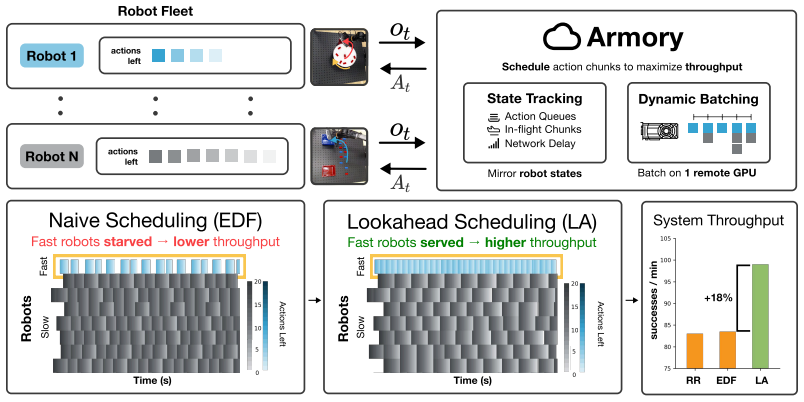
The paper's central discovery is that batching decisions in a shared GPU policy server alter robot behavior in closed loop: a late chunk starves a robot, and the harm depends on the robot's task. The authors build Armory, which maintains a server-side mirror of each robot's action queue, latest executed index, in-flight chunks, and communication delay, and cast scheduling as an MDP whose reward is total executed robot time. Their Lookahead scheduler simulates candidate batches forward and dispatches the first batch of the highest-scoring schedule, normalizing reward by inference time. Evaluations on a simulation benchmark and a ten-robot real fleet show that when all robots consume chunks at
What carries the argument
The central object is the server-side execution mirror: for each robot, the action index of the latest executed step, the latest step received, and the queue of generated chunks with arrival times—where an action chunk is a sequence of future actions produced by one policy query. Scheduling is an MDP over these states; a batch transition advances robots' indices only when a covering chunk has arrived, and the per-epoch reward is total executed robot time, optionally weighted per task. Lookahead is a one-step receding-horizon algorithm (the paper finds deeper lookahead does not improve results) that scores candidate batches by predicted reward divided by inference time and dispatches the best
Load-bearing premise
The real-world 18% throughput gain is assumed to come from Lookahead's better batch selection, but the paper's own appendix shows Lookahead also avoids mid-chunk starts; if that execution smoothness is the true cause, the gain does not validate the scheduling mechanism.
What would settle it
Take the heterogeneous real-world setting and force all schedulers to execute only from chunk start—or use a chunking scheme without the index-0 bias—then compare throughput; if the Lookahead advantage disappears or shrinks to noise, the scheduling policy was not the driver.
If this is right
- Operators can choose a weight per robot class and move along a throughput/starvation tradeoff instead of accepting whatever a fixed heuristic delivers.
- In homogeneous fleets the paper's experiments indicate round-robin or earliest-deadline scheduling is sufficient, so the extra machinery is only needed when reactivity demands differ.
- Choosing small, efficient batches matters more than filling the batch: Lookahead keeps throughput flat as the batch-size cap grows while fixed-batch heuristics starve robots.
- Because Armory is model-agnostic, its scheduling gains compose with any per-model inference speedup.
- Network jitter and median delays up to about 50 ms degrade all schedulers similarly; scheduling policy cannot compensate for raw transport delay, but the system remains practical.
Where Pith is reading between the lines
- The paper's own appendix flags that Lookahead tends to start chunks at executed index 0, avoiding the jerky mid-chunk starts that naive asynchronous execution produces; if that execution-pattern effect rather than batch selection drives the measured gains, the advantage may vanish under real-time chunking strategies that eliminate the bias.
- A natural next step is closed-loop weight adaptation: use task-phase or progress signals to raise a robot's weight during dynamic segments and lower it when quasi-static, which the MDP formulation already supports.
- The same mirror-based formulation could extend to multi-GPU or disaggregated serving by treating prefill/decode or model shards as scheduling resources, though the paper only assumes a single GPU.
- Because starvation cost is task-dependent, scheduler weights could be learned from policy-success statistics instead of being set by hand, making the tradeoff data-driven.
Editorial analysis
A structured set of objections, weighed in public.
Referee Report
Summary. This paper introduces Armory, a serving system for batched inference of robot policies (e.g., VLA models) on a single remote GPU shared by multiple robots. The authors formulate action-chunk scheduling as an MDP over server-side robot state (action indices, queues, latency estimates) and propose Lookahead, a one-step receding-horizon scheduler that scores candidate batches by predicted total executed robot time normalized by inference latency. They evaluate Lookahead against Round Robin and EDF in simulation (LIBERO) and on ten real AgileX PiPER arms with a π0.5 policy. The main empirical claims are that simple schedulers suffice for homogeneous fleets, while Lookahead with tuned per-robot weights improves fast-robot service and, in the one-fast real-world configuration, increases system throughput by up to 18% over baselines.
Significance. If the empirical claims hold, the paper opens a useful new problem area: multi-robot closed-loop policy serving, where inference latency changes robot behavior rather than being a pure SLO. The MDP formulation and the software-mirror abstraction are coherent, and the paper provides detailed pseudocode, extensive ablations (batch-size cap, lookahead depth, network delay/jitter), and a real-robot testbed with two task types. The claimed 18% throughput gain in heterogeneous settings is the paper's headline contribution and would be of interest to the robotics-systems community. However, the real-world evidence currently does not establish the causal mechanism behind that gain, and the simulation results do not reproduce it, so the significance is contingent on additional experiments.
major comments (4)
- [§4.2 / Appendix A.8, Table 5, Figure 10] The headline 18% throughput gain is not attributable to the MDP/lookahead mechanism because the paper itself identifies an uncontrolled confound: Lookahead dispatches a large fraction of chunks starting at index 0, while RR and EDF frequently start mid-chunk; with naive async execution, mid-chunk starts cause jerky/discontinuous motions that reduce task success. Figure 10 shows a strong first-executed-index bias, and the text states that using RTC or VLASH 'may lead to different results.' This means the measured gain could be an execution-pattern side effect rather than the result of smarter starvation-aware batch selection. The authors should either control the first-executed-index distribution across schedulers, repeat with RTC/VLASH, or otherwise provide evidence that the scheduling decision drives the throughput difference.
- [§4.1 / Table 5 / A.8] The real-world throughput result rests on three one-minute rollouts per condition, with no error bars, confidence intervals, or significance tests. The appendix explicitly notes that 'metrics may be noisy due to small sample size' and that real-world evaluations are noisy. For the key one-fast comparison (LA@5 total 98.67 vs RR 83.33), the reader cannot tell whether the 18% difference is signal or seed variation. The paper should report per-seed results, variance, and at least a simple statistical comparison, or temper the throughput claim accordingly.
- [§4.2 vs Appendix A.7, Table 4] The simulation results contradict the claimed real-world transfer. Table 4 and Figure 9 show that Lookahead does not improve aggregate system throughput in simulation; Appendix A.7 explicitly states that 'the core contribution of Lookahead is not in raising aggregate throughput, but in reallocating it across tiers.' Yet Section 4.2 says 'Scheduling gains transfer from simulation to real hardware' and the abstract claims a throughput improvement. This inconsistency undercuts the claim that the lookahead mechanism itself improves total throughput. The authors should either present simulation evidence of aggregate gains or revise the transfer claim to reflect the real evidence.
- [§4.1 / Appendix A.4] The choice of batch-size cap may favor Lookahead independently of its scheduling logic. In the heterogeneous real-world experiments b=5, while Appendix A.4 shows that Lookahead chooses smaller batches on average (mean 3.3) whereas EDF and RR gravitate toward the cap. Since the paper notes that over-batching causes starvation, the advantage could come from Lookahead's dynamic batch-size selection rather than from its forward simulation of execution state. The claim that b=5 'favors RR and EDF' is not backed by the reported real-world sweep. Please show the batch-size tuning for the real-world baselines or run an ablation that restricts Lookahead to the same batch-size choices as the baselines.
minor comments (4)
- [§2 / §A.8] The term 'naive async' is used in the appendix and in the confound discussion but is not formally defined in the main text. Please define it early (e.g., in Section 2 or 3) so the reader understands the execution model that the confounding discussion relies on.
- [§3.2, Eq. (13)] The score in Eq. (13) normalizes by d_infer only, not by the full epoch time including communication delays. This is reasonable for a heuristic, but the choice should be justified, especially since Section 3.1's transition includes d_obs and d_action.
- [Figure 4 caption] The caption says 'legos per minute' while the text uses 'successes per minute' and 'Lego pieces per minute.' Use consistent units and clarify what 'success' means for the real-world tasks.
- [References] Reference [12] is a personal blog post. For a systems claim about execution index continuity, a peer-reviewed or archival source would be more appropriate if one exists.
Circularity Check
No significant circularity: the MDP/Lookahead derivation is self-contained; the Appendix A.8 confound is a validity threat, not a circular reduction.
full rationale
I walked the claimed derivation chain: the serving problem is formulated as an MDP (Eqs. 5-11) with reward R(s_k, B_k) = (1/f_c) sum_j w_j Delta_i_j(s_k, B_k), i.e., executed robot time. Lookahead then selects batches by forward-simulating that same transition model and maximizing Score(S) = sum R(s_l, B_l)/d_infer(|B_l|) (Eq. 13). No parameter of this model is fitted to the headline throughput numbers: d_infer(b) is profiled on startup (Section 3.3), d_obs/d_action are continuously estimated, and w_j is an operator-set knob swept as w=1,3,5 (Section 4.1). Thus the reported 'up to 18%' throughput improvement is an externally measured outcome, not a quantity reconstructed from the model's own fitted values. The only overlapping-author citation, [24] (SAIL), appears in Related Work as one of several orthogonal latency-tolerance techniques and is not load-bearing for Armory's central claims. The paper itself flags a real confound in Appendix A.8: with naive async, Lookahead's bias toward first-executed index 0 may reduce jerky motions, and 'Predicting chunks with more sophisticated asynchronous strategies such as RTC [8] or VLASH [9] may lead to different results.' I weigh this as an external-validity/causal-attribution concern, not a circularity: it does not reduce the throughput claim to the scheduler's inputs by definition. Small sample size (three 1-minute rollouts, Table 5) is an evidence-strength issue, not circularity.
Axiom & Free-Parameter Ledger
free parameters (5)
- batch-size cap b =
b=3 in simulation; b=3 for real all-fast; b=5 for real heterogeneous
- fast-robot reward weight w_j =
w = 1, 3, 5
- Lookahead search depth L =
L=1
- execution horizons and control frequencies =
sim Hmax=6/10, fc=20, Hmin=1; real Hmax=10/20, fc=30, Hmin=5
- score window and candidate-batch pruning =
1-second window; unspecified pruning heuristic
axioms (5)
- domain assumption Robot execution follows action-chunk semantics: action indexes strictly increment, chunks cover [i_start, i_start+H_max), and execution pauses during starvation.
- domain assumption Task performance degrades monotonically with stale horizons and starvation, with dynamic tasks affected more than static tasks.
- domain assumption Inference latency d_infer(b) is known/profiled and stable, and network delays can be estimated accurately enough for the mirror.
- ad hoc to paper The serving objective is to maximize total executed robot time (weighted), and any non-empty batch can be scheduled each epoch.
- ad hoc to paper One-step lookahead (L=1) is sufficient to realize the claimed scheduling benefit.
read the original abstract
Deploying robot foundation models at scale is the next step towards realizing the potential of general-purpose robots. However, Vision-Language-Action (VLA) and other foundation models are computationally demanding, and on-device compute is constrained by power and space. In this paper, we introduce the problem of serving a robot policy to multiple robots from a remote GPU and formulate it as a scheduling problem. We build Armory, a serving system validated on fleets of both simulated and real robots. Our experiments show that naive scheduling heuristics perform well when all robots are the same, but fall short when robots consume action chunks at different rates, uncovering a mismatch between conventional batching methods and the closed-loop requirements of robot policy execution. To address this, we propose a scheduling algorithm that accounts for this heterogeneity and improves overall system throughput by up to $18\%$ in real-world experiments. Additional details are available at https://gatech-rl2.github.io/actionchunkscheduling.
Figures


Reference graph
Works this paper leans on
-
[1]
Zitkovich, T
B. Zitkovich, T. Yu, S. Xu, P. Xu, T. Xiao, F. Xia, J. Wu, P. Wohlhart, S. Welker, A. Wahid, et al. Rt-2: Vision-language-action models transfer web knowledge to robotic control. In Conference on Robot Learning, pages 2165–2183. PMLR, 2023
2023
-
[2]
M. J. Kim, K. Pertsch, S. Karamcheti, T. Xiao, A. Balakrishna, S. Nair, R. Rafailov, E. Foster, G. Lam, P. Sanketi, et al. Openvla: An open-source vision-language-action model.arXiv preprint arXiv:2406.09246, 2024
Pith/arXiv arXiv 2024
-
[3]
K. Black, N. Brown, D. Driess, A. Esmail, M. Equi, C. Finn, N. Fusai, L. Groom, K. Hausman, B. Ichter, et al. pi0: A vision-language-action flow model for general robot control.arXiv preprint arXiv:2410.24164, 2024
Pith/arXiv arXiv 2024
-
[4]
P. Intelligence, K. Black, N. Brown, J. Darpinian, K. Dhabalia, D. Driess, A. Esmail, M. Equi, C. Finn, N. Fusai, et al. pi0.5: A vision-language-action model with open-world generalization.arXiv preprint arXiv:2504.16054, 2025
Pith/arXiv arXiv 2025
-
[5]
J. Bjorck, F. Casta ˜neda, N. Cherniadev, X. Da, R. Ding, L. Fan, Y . Fang, D. Fox, F. Hu, S. Huang, et al. Gr00t n1: An open foundation model for generalist humanoid robots.arXiv preprint arXiv:2503.14734, 2025
Pith/arXiv arXiv 2025
- [6]
-
[7]
T. Z. Zhao, V . Kumar, S. Levine, and C. Finn. Learning fine-grained bimanual manipulation with low-cost hardware.arXiv preprint arXiv:2304.13705, 2023
Pith/arXiv arXiv 2023
-
[8]
K. Black, M. Y . Galliker, and S. Levine. Real-time execution of action chunking flow policies. arXiv preprint arXiv:2506.07339, 2025
Pith/arXiv arXiv 2025
-
[9]
J. Tang, Y . Sun, Y . Zhao, S. Yang, Y . Lin, Z. Zhang, J. Hou, Y . Lu, Z. Liu, and S. Han. Vlash: Real-time vlas via future-state-aware asynchronous inference.arXiv preprint arXiv:2512.01031, 2025
Pith/arXiv arXiv 2025
- [10]
-
[11]
A. Agrawal, A. Panwar, J. Mohan, N. Kwatra, B. S. Gulavani, and R. Ramjee. Sarathi: Efficient llm inference by piggybacking decodes with chunked prefills.arXiv preprint arXiv:2308.16369, 2023
Pith/arXiv arXiv 2023
-
[12]
J. Vial. Distributed real-time chunking, Mar 2026. URLhttps://jackvial.com/posts/ distributed-real-time-chunking.html
2026
-
[13]
C. Chi, Z. Xu, S. Feng, E. Cousineau, Y . Du, B. Burchfiel, R. Tedrake, and S. Song. Diffusion policy: Visuomotor policy learning via action diffusion.The International Journal of Robotics Research, 44(10-11):1684–1704, 2025
2025
-
[14]
T. T. Zhang, D. Pfrommer, C. Pan, N. Matni, and M. Simchowitz. Action chunking and ex- ploratory data collection yield exponential improvements in behavior cloning for continuous control.arXiv preprint arXiv:2507.09061, 2025
arXiv 2025
-
[15]
B. Liu, Y . Zhu, C. Gao, Y . Feng, Q. Liu, Y . Zhu, and P. Stone. Libero: Benchmarking knowl- edge transfer for lifelong robot learning.Advances in Neural Information Processing Systems, 36:44776–44791, 2023. 10
2023
-
[16]
M. J. Kim, Y . Gao, T.-Y . Lin, Y .-C. Lin, Y . Ge, G. Lam, P. Liang, S. Song, M.-Y . Liu, C. Finn, et al. Cosmos policy: Fine-tuning video models for visuomotor control and planning.arXiv preprint arXiv:2601.16163, 2026
Pith/arXiv arXiv 2026
-
[17]
O’Neill, A
A. O’Neill, A. Rehman, A. Maddukuri, A. Gupta, A. Padalkar, A. Lee, A. Pooley, A. Gupta, A. Mandlekar, A. Jain, et al. Open x-embodiment: Robotic learning datasets and rt-x models: Open x-embodiment collaboration 0. In2024 IEEE International Conference on Robotics and Automation (ICRA), pages 6892–6903. IEEE, 2024
2024
-
[18]
A. Khazatsky, K. Pertsch, S. Nair, A. Balakrishna, S. Dasari, S. Karamcheti, S. Nasiriany, M. K. Srirama, L. Y . Chen, K. Ellis, et al. Droid: A large-scale in-the-wild robot manipulation dataset.arXiv preprint arXiv:2403.12945, 2024
Pith/arXiv arXiv 2024
-
[19]
S. Ye, Y . Ge, K. Zheng, S. Gao, S. Yu, G. Kurian, S. Indupuru, Y . L. Tan, C. Zhu, J. Xiang, et al. World action models are zero-shot policies.arXiv preprint arXiv:2602.15922, 2026
Pith/arXiv arXiv 2026
-
[20]
J. Kwok, C. Agia, R. Sinha, M. Foutter, S. Li, I. Stoica, A. Mirhoseini, and M. Pavone. Robomonkey: Scaling test-time sampling and verification for vision-language-action models. arXiv preprint arXiv:2506.17811, 2025
Pith/arXiv arXiv 2025
-
[21]
Y . Ma, Y . Zhou, Y . Yang, T. Wang, and H. Fan. Running vlas at real-time speed.arXiv preprint arXiv:2510.26742, 2025
arXiv 2025
-
[22]
S. H. Høeg, Y . Du, and O. Egeland. Streaming diffusion policy: Fast policy synthesis with variable noise diffusion models.arXiv preprint arXiv:2406.04806, 2024
Pith/arXiv arXiv 2024
-
[23]
L. Guo, Z. Xue, Z. Xu, and H. Xu. Demospeedup: Accelerating visuomotor policies via entropy-guided demonstration acceleration. InProceedings of The 9th Conference on Robot Learning, volume 305 ofProceedings of Machine Learning Research, pages 599–609. PMLR, 2025
2025
-
[24]
N. R. Arachchige, Z. Chen, W. Jung, W. C. Shin, R. Bansal, P. Barroso, Y . H. He, Y . C. Lin, B. Joffe, S. Kousik, et al. Sail: Faster-than-demonstration execution of imitation learning policies.arXiv preprint arXiv:2506.11948, 2025
Pith/arXiv arXiv 2025
-
[25]
Crankshaw, X
D. Crankshaw, X. Wang, G. Zhou, M. J. Franklin, J. E. Gonzalez, and I. Stoica. Clipper: A low-latency online prediction serving system. In14th USENIX Symposium on Networked Systems Design and Implementation (NSDI 17). USENIX Association, 2017
2017
-
[26]
D. Crankshaw, G.-E. Sela, C. Zumar, X. Mo, J. E. Gonzalez, I. Stoica, and A. Tumanov. Inferline: Ml prediction pipeline provisioning and management for tight latency objectives. arXiv preprint arXiv:1812.01776, 2018
Pith/arXiv arXiv 2018
-
[27]
Gujarati, R
A. Gujarati, R. Karimi, S. Alzayat, W. Hao, A. Kaufmann, Y . Vigfusson, and J. Mace. Serving dnns like clockwork: Performance predictability from the bottom up. In14th USENIX Sympo- sium on Operating Systems Design and Implementation (OSDI 20), pages 443–462. USENIX Association, 2020
2020
-
[28]
G.-I. Yu, J. S. Jeong, G.-W. Kim, S. Kim, and B.-G. Chun. Orca: A distributed serving system for{Transformer-Based}generative models. In16th USENIX symposium on operating systems design and implementation (OSDI 22), pages 521–538, 2022
2022
-
[29]
W. Kwon, Z. Li, S. Zhuang, Y . Sheng, L. Zheng, C. H. Yu, J. Gonzalez, H. Zhang, and I. Sto- ica. Efficient memory management for large language model serving with pagedattention. In Proceedings of the 29th symposium on operating systems principles, pages 611–626, 2023
2023
-
[30]
Zheng, L
L. Zheng, L. Yin, Z. Xie, C. L. Sun, J. Huang, C. H. Yu, S. Cao, C. Kozyrakis, I. Stoica, J. E. Gonzalez, et al. Sglang: Efficient execution of structured language model programs.Advances in neural information processing systems, 37:62557–62583, 2024. 11
2024
-
[31]
Zhong, S
Y . Zhong, S. Liu, J. Chen, J. Hu, Y . Zhu, X. Liu, X. Jin, and H. Zhang.{DistServe}: Disag- gregating prefill and decoding for goodput-optimized large language model serving. In18th USENIX Symposium on Operating Systems Design and Implementation (OSDI 24), pages 193– 210, 2024
2024
-
[32]
C. L. Liu and J. W. Layland. Scheduling algorithms for multiprogramming in a hard-real-time environment.Journal of the ACM (JACM), 20(1):46–61, 1973
1973
-
[33]
Tumanov, T
A. Tumanov, T. Zhu, J. W. Park, M. A. Kozuch, M. Harchol-Balter, and G. R. Ganger. TetriSched: Global rescheduling with adaptive plan-ahead in dynamic heterogeneous clus- ters. InProceedings of the 11th European Conference on Computer Systems. Association for Computing Machinery, 2016
2016
-
[34]
Narayanan, R
D. Narayanan, R. Rao, S. Kandula, A. Seshadri, S. Roberts, P. Chaudhary, J. Gu, J. Gonzalez, A. Harlap, A. Krishnamurthy, et al. Heterogeneity-aware cluster scheduling policies for deep learning workloads. In14th USENIX Symposium on Operating Systems Design and Implemen- tation (OSDI 20), pages 481–498. USENIX Association, 2020
2020
-
[35]
Y . Dai, G. Ananthanarayanan, L. Cox, X. Foukas, B. Radunovic, and R. Netravali. Kairos: A scalable serving system for physical ai.arXiv preprint arXiv:2605.11381, 2026
Pith/arXiv arXiv 2026
-
[36]
W. Jiang, J. Clemons, R. O’Flaherty, H. Hadfield, A. Degirmenci, S. Song, Y . Narang, and C. Kozyrakis. Rosa: A robotics foundation model serving system for robot factories.arXiv preprint arXiv:2607.01088, 2026
Pith/arXiv arXiv 2026
-
[37]
Patel, E
P. Patel, E. Choukse, C. Zhang, A. Shah, ´I. Goiri, S. Maleki, and R. Bianchini. Splitwise: Efficient generative llm inference using phase splitting. In2024 ACM/IEEE 51st Annual Inter- national Symposium on Computer Architecture (ISCA), pages 118–132. IEEE, 2024. 12 A Appendix Contents A.1 Scheduler Pseudocode . . . . . . . . . . . . . . . . . . . . . . ....
2024
discussion (0)
Sign in with ORCID, Apple, or X to comment. Anyone can read and Pith papers without signing in.