REVIEW 3 major objections 5 minor 1 cited by
Fluctuations in muon counts from ultra-high-energy cosmic rays set a new lower bound on the first-order Lorentz-violating parameter ηπ > −1.26 × 10⁻⁶ at 5σ confidence.
Reviewed by Pith at T0; open to challenge. T0 means a machine referee read the full paper against a public rubric. the ladder, T0–T4 →
T0 review · deepseek-v4-flash
2026-08-02 23:05 UTC pith:33FH3TC2
load-bearing objection A genuinely new LIV observable from Auger muon fluctuations with a plausible central bound, but the composition-maximization argument has a real proof gap and the reported confidence level is internally inconsistent. the 3 major comments →
Bounds on Lorentz invariance violation from muon fluctuations at the Pierre Auger Observatory
The pith
A machine-rendered reading of the paper's core claim, the machinery that carries it, and where it could break.
Core claim
In the framework of modified dispersion relations, E² − p² = m² + η p^{n+2}/M_Plⁿ, the paper considers first-order (n=1) Lorentz violation with negative η, for which neutral pions live longer and can interact before decaying. Simulating showers with modified particle lifetimes in CONEX for two hadronic interaction models (EPOS-LHC and QGSJetII-04), it finds that LIV increases the average number of muons and reduces event-by-event relative fluctuations σ_{Nμ}/⟨Nμ⟩, especially for proton primaries. Comparing the most conservative predicted curves—obtained by choosing, at each energy, the iron fraction of a proton–iron mixture that maximizes the relative fluctuation—with the measured Auger data
What carries the argument
The key observable is the relative muon-number fluctuation σ_{Nμ}/⟨Nμ⟩, which is dominated by the stochasticity of the first hadronic interaction and is therefore suppressed when LIV makes neutral pions interact rather than decay. The LIV input is the dimensionless coefficient η in the dispersion relation above; only negative values are considered because positive values shorten pion lifetimes and do not alter shower development. The load-bearing construction is the 'conservative model': for each energy and η, the iron fraction f of a proton–iron mixture is varied to maximize the predicted relative fluctuation, and the resulting envelope is compared with data. The paper provides analytic par
Load-bearing premise
The result depends on the assumption that no real mixture of cosmic-ray nuclei can produce larger relative muon fluctuations than the proton–iron mixture chosen to maximize them; the paper checks this for several pairs of species but does not prove it for all possible compositions.
What would settle it
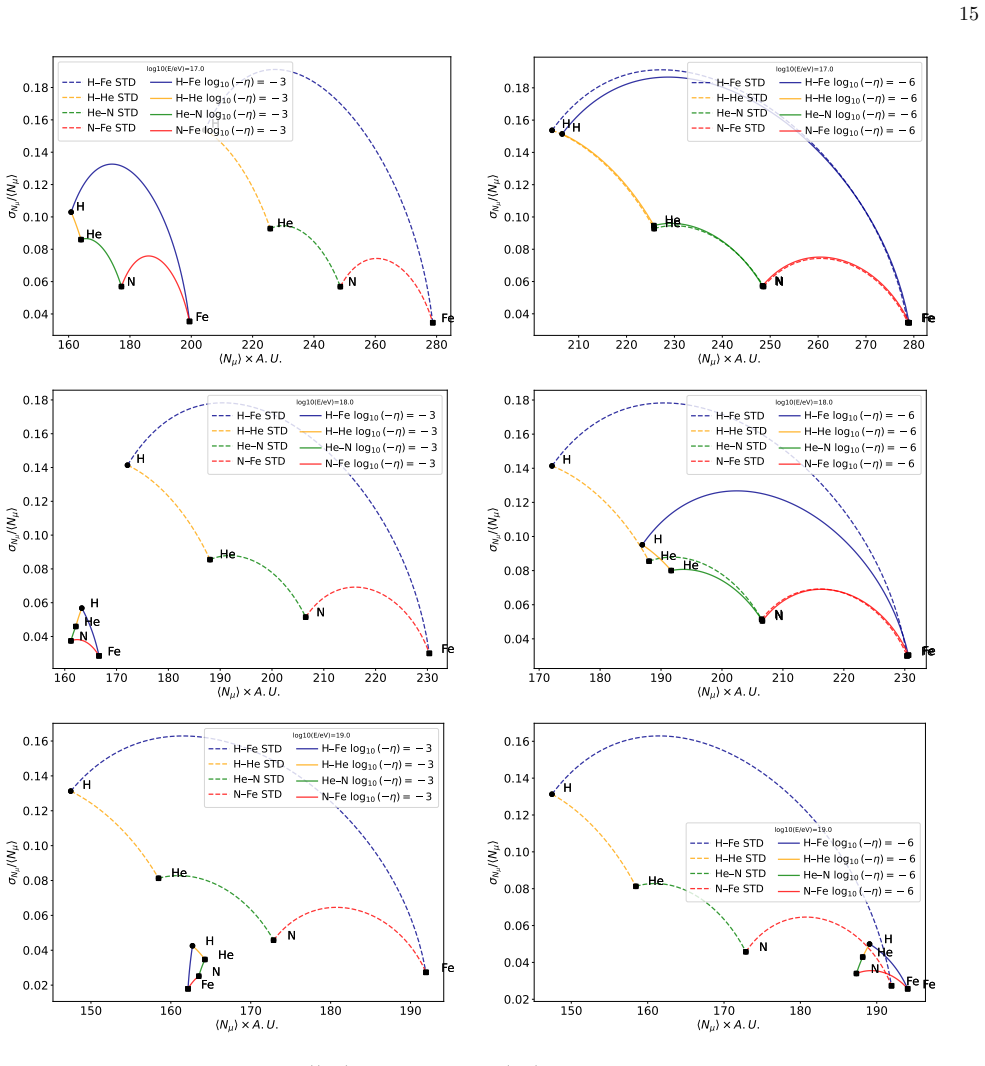
Run the paper's own CONEX-based parametrizations on a three-component mixture (e.g., proton + helium + iron) at log10(E/eV) = 18 and log10(−η) = −6; if the resulting relative muon fluctuation exceeds the p–Fe envelope of Fig. 8, the conservative bound fails. A direct experimental falsifier would be Auger reporting relative muon fluctuations above the predicted model curve at the claimed exclusion energy.
If this is right
- First-order Lorentz violation in the hadronic sector with ηπ below about −1.26 × 10⁻⁶ is excluded at 5σ confidence, the tightest bound currently available for negative η.
- The relative fluctuation of muon number becomes a new, composition-robust observable for LIV searches, probing a region of parameter space inaccessible to propagation-based UHECR constraints.
- The same Auger data can now be used to bound both signs of η: negative values from muon fluctuations, positive values from the observed suppression of the UHECR flux.
- The parametrization framework allows the limit to be recomputed for any η without new simulations, and the analysis can be extended to second-order LIV and to other observables such as radio and underground-muon measurements.
- Accounting for the sub-5% energy-reconstruction bias between LIV and standard scenarios would shift data to higher reconstructed energies and make the constraint more stringent.
Where Pith is reading between the lines
- If the proton–iron maximization is assumed to bound any multi-species composition, the same 'maximize-then-compare' logic could be applied to other shower observables, such as the depth of shower maximum, to set LIV limits that are similarly composition-independent; the paper reports these observables are less sensitive.
- A direct test of the paper's central assumption would be a scan over arbitrary multi-species mixtures (helium, nitrogen, silicon, etc.) in the same CONEX framework; if any mixture yields a relative fluctuation above the p–Fe envelope, the quoted exclusion would need revision.
- Because the energy-reconstruction bias is only estimated and not folded in, re-analyzing the data with LIV-calibrated energies is a concrete step that could push log₁₀(−η) below −5.90 without new data.
- More broadly, the paper suggests that macroscopic stochastic observables of air showers—rather than just average yields—can act as microscopic probes of fundamental symmetries; extending this to second-order η or to the electromagnetic sector would test whether the fluctuation suppression persists at different orders.
Editorial analysis
A structured set of objections, weighed in public.
Referee Report
Summary. This paper proposes a new observable for constraining Lorentz-invariance violation in the hadronic sector: the event-by-event relative fluctuations of the muon number, sigma_{Nmu}/<Nmu>, in inclined hybrid events recorded by the Pierre Auger Observatory. The LIV framework is a modified dispersion relation (Eq. 2); only first-order, negative eta is considered, implemented in CONEX by scaling all unstable-particle lifetimes via Eq. (4). Simulations with EPOS-LHC and QGSJetII-04 for several primary species are parametrized (Appendix II) for the mean and RMS muon number of proton and iron showers; the expected relative fluctuation of a p-Fe mixture is computed with Eqs. (7)-(8), maximizing over the iron fraction f per energy bin to obtain the 'most conservative' LIV prediction. Comparison with Auger data (PRL 126, 152002) gives the limits in Table I (log10(-eta) < -7.03 / -6.82 / -5.90 at 90.5%/95.5%/99.9% CL), i.e., eta_pi > -1.26e-6, quoted in the Conclusions as '5sigma'. The paper claims the strongest negative-eta hadronic LIV bound and independence from mass-composition assumptions.
Significance. If the central argument is completed, this would be a genuinely new and interesting result: muon-number fluctuations couple to the first hadronic interaction and are less normalization-dominated than the mean muon content, making the observable complementary to Xmax- and spectrum-based LIV searches. The analysis has real strengths: the LIV predictions come from independent CONEX simulations, not from fits to the target data, so the bound is not circular; the composition degree of freedom is treated by an explicit maximization rather than by assuming Auger's measured composition; two hadronic interaction models are used and their spread is quoted as a systematic; and the parametrization machinery (Eqs. 10-14, Tables II-IV) is documented in enough detail to be largely reproducible. However, the composition-independence claim rests on an unproven edge-maximality assertion, and the confidence-level derivation is undescribed; until these are supplied, the 'strongest bound' claim is not fully supported.
major comments (3)
- [Results and Discussion, Appendix III] The composition-independence claim rests on the assertion that the maximum of sigma_{Nmu}/<Nmu> over all physical compositions is attained on the p-Fe binary edge. The text itself presents this as an expectation ('can be expected', 'can generally be achieved'), and the evidence (Figs. 8, 9) covers only selected two-species pairs and a 1D scan over f in [0,1] for p-Fe. For a general mixture, sigma^2_mix = sum f_i sigma_i^2 + sum f_i (mu_i - mu)^2; the ratio sigma_mix/mu_mix need not be maximized at an edge of the simplex. An intermediate-mass species with large sigma_i/mu_i can raise the ratio even when its mu_i is intermediate. If such a composition exists, the predicted LIV curves are too low and the exclusion limit on eta is too strong. This is load-bearing for the abstract's claim that the bound does not rely on mass-composition assumptions. Please provide a proof, or scan a multi-spe
- [Results and Discussion, Table I and Conclusions] The statistical procedure is not described. The text only says 'By selecting only the mixed relative fluctuations below the experimental data points, the chi^2 is computed as a function of eta'; the definition of this one-sided chi^2, the number of degrees of freedom, the treatment of statistical and systematic uncertainties, and the mapping from chi^2 to CL are all absent. The CLs 90.5%, 95.5%, 99.9% appear to be imposed by the eta grid rather than computed. In the Conclusions the 99.9% row of Table I is quoted as '5sigma C.L.', which is inconsistent: 99.9% is approximately 3.3sigma (two-sided) or 3.1sigma (one-sided), while 5sigma corresponds to 99.99994%. The headline confidence level is therefore undefined as written and must be documented.
- [Appendix II, Eqs. (11)-(14), Tables III-IV] The limit calculation uses the parametrized curves as fixed functions; the fit-parameter uncertainties in Tables II-IV and the 1sigma bands in Figs. 6-7 are not propagated into Table I, whose quoted systematics cover only the EPOS-LHC vs QGSJetII-04 spread. The ad hoc fixed constants (s=2, t=3.2, A0=0.4, R_inf=0.7 or 1.0) are assigned no uncertainty and varied nowhere. The quadratic dependence on log10(-eta) is extrapolated below the simulated range (eta down to -1e-6 simulated; the 90.5% CL limit is log10(-eta)=-7.03 and fits are displayed to -1e-16). The resulting systematic error on the limits is likely understated; the extrapolated region and the fixed constants should be varied or validated.
minor comments (5)
- [Eq. (8)] The notation 'sigma2_Nmu,mix(Nmu)' contains a stray '(Nmu)'; it should read sigma^2_Nmu,mix.
- [Figures 1-3] Several figure labels appear to have lost the eta symbol (e.g., Fig. 2 'H EPOS-LHC ( = 10^3, 1st order)' and Fig. 1 'LIV ( = 10^3, 1st order)'); please check symbol rendering in the final version.
- [Abstract and Conclusions] The wording 'do not rely on assumptions about the mass composition' is stronger than the analysis currently establishes; see major comment 1.
- [Results and Discussion] The energy-reconstruction bias (<5%) is described but not applied; the statement that correcting it would make the bound 'more stringent' is not quantified. State its size and direction, or apply it.
- [Reproducibility] For reproducibility, list the measured sigma_Nmu/<Nmu> values, their statistical and systematic uncertainties, and the energy binning used as inputs.
Circularity Check
No material circularity: the model curves come from independent CONEX simulations and are not fitted to the target data; the p-Fe maximization is an unproven robustness assumption, not a circular input.
full rationale
Walk-through of the derivation chain: Eqs. 2-4 define the LIV dispersion-relation framework from external phenomenology. The shower predictions are produced by CONEX simulations with modified meson lifetimes (EPOS-LHC and QGSJetII-04), i.e., independent simulation output, not fits to the Auger muon-fluctuation data. The parameterizations in Eqs. 10-14 fit those simulation outputs, so the fitted quantities are simulation observables, not the measured fluctuations. The two-component mixture formula (Eq. 7, cited to [17]) is a standard variance decomposition; the iron fraction f is profiled conservatively to maximize the predicted relative fluctuation, not inferred from the data. The published [17] measurement enters only as the external benchmark against which the chi2 is computed, not as an input used to construct the model curves. Thus no prediction is equivalent by construction to its inputs, and no fitted parameter is renamed as a prediction. Self-citations to [12] and [17] supply context, an experimental dataset, and an elementary formula; they are not load-bearing uniqueness claims and do not smuggle in the paper's conclusion. The main caveat, noted in Appendix III, is that the claim that the p-Fe binary mixture maximizes relative fluctuations over all compositions is argued heuristically from selected umbrella plots rather than proven; that is a conservativeness/robustness question, not circularity. The Table I 99.9% CL value versus the conclusions '5sigma' wording is a reporting inconsistency, also not a circular-input issue.
Axiom & Free-Parameter Ledger
free parameters (6)
- Parametrization coefficients (Tables II–IV) =
Numerous a, b, c values, see Tables II–IV
- s (Gaussian width in Rσ) =
2 (fixed)
- t (transition steepness in Rσ) =
3.2 (fixed)
- R∞ (iron asymptotic ratio) =
1.0 (EPOS-LHC), 0.7 (QGSJetII-04)
- A0 (iron Gaussian amplitude) =
0.4 (fixed)
- f(E) (iron fraction) =
Profiled 0–1 per energy bin
axioms (6)
- domain assumption LIV modifies the dispersion relation as E²−p² = m² + η p^{n+2}/M_Pl^n (Eq. 2).
- ad hoc to paper The only effect of LIV on shower development is the modified particle lifetime τ = γ_LIV τ0 (Eq. 4); cross sections and hadronic production are unchanged.
- ad hoc to paper For positive η the pion lifetime decreases, and 'no effect on the shower development is expected'.
- domain assumption The composition maximizing relative muon fluctuations is always a binary proton–iron mixture.
- domain assumption The measured Auger relative fluctuations [17] can be compared directly to CONEX predictions without detailed detector simulation.
- ad hoc to paper The one-sided χ² statistic (using only points where the model lies below the data) yields well-defined confidence levels.
read the original abstract
Quantum gravity theories often modify spacetime symmetries. In particular, Lorentz invariance may be violated when approaching the Planck scale. Although the scales at which interactions occur in extensive air showers induced by ultra-high-energy cosmic rays in the atmosphere are many orders of magnitude below the Planck scale, these violations might still be observable. In this work, the fluctuations in the number of muons in the extensive air showers measured at the Pierre Auger Observatory are exploited, for the first time, to constrain Lorentz invariance violations. The bounds derived in the hadronic sector are the strongest ever obtained, and do not rely on assumptions about the mass composition of ultra-high-energy cosmic rays. The fluctuations in the number of muons constitute a new and powerful observable to further explore Lorentz invariance in a region of the parameter space not accessible to other observables.
Figures



Forward citations
Cited by 1 Pith paper
-
Wick-connected theories and Lorentz violation
Without Lorentz invariance, double Wick rotations connect inequivalent field theories in flat spacetime, with criteria for when propagating modes, unitarity, and renormalizability fail to translate.
Reference graph
Works this paper leans on
-
[1]
R. Aloisio, P. Blasi, P. L. Ghia, and A. F. Grillo, Phys. Rev. D62, 053010 (2000), arXiv:astro-ph/0001258
Pith/arXiv arXiv 2000
-
[2]
F. W. Stecker and S. T. Scully, New J. Phys.11, 085003 (2009), arXiv:0906.1735 [astro-ph.HE]
Pith/arXiv arXiv 2009
-
[3]
L. Maccione, A. M. Taylor, D. M. Mattingly, and S. Liberati, JCAP04, 022 (2009), arXiv:0902.1756 [astro- ph.HE]
Pith/arXiv arXiv 2009
-
[4]
A. Saveliev, L. Maccione, and G. Sigl, JCAP03, 046 (2011), arXiv:1101.2903 [astro-ph.HE]
Pith/arXiv arXiv 2011
-
[5]
A. Aabet al.(Pierre Auger), Phys. Rev. D102, 062005 (2020), arXiv:2008.06486 [astro-ph.HE]
Pith/arXiv arXiv 2020
-
[6]
Abdul Halimet al.(Pierre Auger), Phys
A. Abdul Halimet al.(Pierre Auger), Phys. Rev. Lett. 135, 241002 (2025), arXiv:2506.11688 [astro-ph.HE]
arXiv 2025
-
[7]
X.-J. Bi, Z. Cao, Y. Li, and Q. Yuan, Phys. Rev. D79, 083015 (2009), arXiv:0812.0121 [astro-ph]
Pith/arXiv arXiv 2009
-
[8]
S. T. Scully and F. W. Stecker, Astropart. Phys.31, 220 (2009), arXiv:0811.2230 [astro-ph]
Pith/arXiv arXiv 2009
-
[9]
D. Boncioli, A. di Matteo, F. Salamida, R. Aloisio, P. Blasi, P. L. Ghia, A. Grillo, S. Petrera, and T. Pierog, PoSICRC2015, 521 (2016), arXiv:1509.01046 [astro- ph.HE]
Pith/arXiv arXiv 2016
-
[10]
Boncioli (Pierre Auger), PoSICRC2017, 561 (2018)
D. Boncioli (Pierre Auger), PoSICRC2017, 561 (2018)
2018
-
[11]
R. G. Lang (Pierre Auger), PoSICRC2019, 327 (2020)
2020
-
[12]
Abreuet al.(Pierre Auger), JCAP01, 023 (2022), arXiv:2112.06773 [astro-ph.HE]
P. Abreuet al.(Pierre Auger), JCAP01, 023 (2022), arXiv:2112.06773 [astro-ph.HE]
Pith/arXiv arXiv 2022
-
[13]
A. Aabet al.(Pierre Auger), JCAP04, 038 (2017), [Er- ratum: JCAP 03, E02 (2018)], arXiv:1612.07155 [astro- ph.HE]
Pith/arXiv arXiv 2017
-
[14]
A. A. Halimet al.(Pierre Auger), JCAP05, 024 (2023), arXiv:2211.02857 [astro-ph.HE]
Pith/arXiv arXiv 2023
-
[15]
A. Aabet al.(Pierre Auger), Nucl. Instrum. Meth. A 798, 172 (2015), arXiv:1502.01323 [astro-ph.IM]
Pith/arXiv arXiv 2015
-
[16]
D. Schmidt (Pierre Auger), in39th International Cosmic Ray Conference(2025) arXiv:2508.08056 [astro-ph.IM]
Pith/arXiv arXiv 2025
-
[17]
A. Aabet al.(Pierre Auger), Phys. Rev. Lett.126, 152002 (2021), arXiv:2102.07797 [hep-ex]
Pith/arXiv arXiv 2021
-
[18]
Abreuet al.(Pierre Auger), PoSICRC2021, 340 (2021)
P. Abreuet al.(Pierre Auger), PoSICRC2021, 340 (2021)
2021
-
[19]
A. Addaziet al., Prog. Part. Nucl. Phys.125, 103948 (2022), arXiv:2111.05659 [hep-ph]
Pith/arXiv arXiv 2022
-
[20]
Matthews, Astropart
J. Matthews, Astropart. Phys.22, 387 (2005)
2005
-
[21]
L. Cazon, R. Concei¸ c˜ ao, and F. Riehn, Phys. Lett. B 784, 68 (2018), arXiv:1803.05699 [hep-ph]
Pith/arXiv arXiv 2018
-
[22]
Linsley and A
J. Linsley and A. A. Watson, Phys. Rev. Lett.46, 459 (1981)
1981
-
[23]
T. Pieroget al., Nucl. Phys. B Proc. Suppl.151, 159 (2006), arXiv:astro-ph/0411260
Pith/arXiv arXiv 2006
-
[24]
T. Bergmann, R. Engel, D. Heck, N. N. Kalmykov, S. Ostapchenko, T. Pierog, T. Thouw, and K. Werner, Astropart. Phys.26, 420 (2007), arXiv:astro- ph/0606564
arXiv 2007
-
[25]
T. Pierog, I. Karpenko, J. M. Katzy, E. Yatsenko, and K. Werner, Phys. Rev. C92, 034906 (2015), arXiv:1306.0121 [hep-ph]
Pith/arXiv arXiv 2015
-
[26]
S. Ostapchenko, Phys. Rev. D83, 014018 (2011), arXiv:1010.1869 [hep-ph]
Pith/arXiv arXiv 2011
-
[27]
A. Aabet al.(Pierre Auger), Phys. Rev. D90, 122005 (2014), arXiv:1409.4809 [astro-ph.HE]
Pith/arXiv arXiv 2014
-
[28]
A. Aabet al.(Pierre Auger), Phys. Rev. D90, 122006 (2014), arXiv:1409.5083 [astro-ph.HE]
Pith/arXiv arXiv 2014
-
[29]
K.-H. Kampert and M. Unger, Astropart. Phys.35, 660 (2012), arXiv:1201.0018 [astro-ph.HE]
Pith/arXiv arXiv 2012
-
[30]
Salamida (Pierre Auger), PoSICRC2023, 016 (2023), arXiv:2312.14673 [astro-ph.HE]
F. Salamida (Pierre Auger), PoSICRC2023, 016 (2023), arXiv:2312.14673 [astro-ph.HE]
Pith/arXiv arXiv 2023
-
[31]
R. Alves Batistaet al., Class. Quant. Grav.42, 032001 (2025), arXiv:2312.00409 [gr-qc]. 10 SUPPLEMENT AL MA TERIAL: BOUNDS ON LORENTZ INV ARIANCE VIOLA TION FROM MUON FLUCTUA TIONS A T THE PIERRE AUGER OBSER V A TOR Y I. LIV EFFECT ON SHOWER MAXIMUM AND ENERGY The depth of the shower maximum and the energy deposit in the atmosphere have been evaluated in ...
Pith/arXiv arXiv 2025
-
[32]
The standard (LI) values of⟨N µ⟩andσ µ for each primary and hadronic interaction model are fitted as a function of energy using an exponential function (see Eq 10)
-
[33]
inverted Fermi–Gaussian
The LIV-modified values are expressed through the ratios: 11 Rµ(ϵ) = ⟨Nµ⟩STD ⟨Nµ⟩η , R σ(ϵ) = σSTD ση ,(9) and parameterised as functions ofϵ= log 10(E/eV) for eachη. Their fit parameters are subsequently modeled as quadratic functions of log 10(−η) (see Eq 14). This choice of treating separately the LI reference and the LIV-to-standard ratios is motivate...
discussion (0)
Sign in with ORCID, Apple, or X to comment. Anyone can read and Pith papers without signing in.