REVIEW 4 major objections 5 minor 65 references
Constraints on extra charges in dyonic Kerr-Newman-Kasuya-Taub-NUT black hole from the observations of quasi-periodic oscillations
T0 review · 4 major / 5 minor · reviewed 2026-08-15 · deepseek-v4-flash
Pith's one-line read The paper finds that QPOs from five X-ray binaries place tight upper limits on electric and magnetic charge in the dyonic Kerr-Newman-Kasuya-Taub-NUT spacetime, with GRS 1915+105 favoring a nonzero Taub-NUT parameter.
desk verdict The Q/M and P/M upper limits are usable, but the GRS 1915+105 NUT detection is internally contradictory and should not be trusted as printed. read the letter →
The pith
A machine-rendered reading of the paper's core claim, the machinery that carries it, and where it could break.
The reading
What carries the argument
The load-bearing object is the dyonic Kerr–Newman–Kasuya–Taub–NUT (KNKTN) metric, a rotating, electrically and magnetically charged extension of the Kerr metric that also carries a Taub–NUT parameter $n$ acting as a gravitational dyon. From this metric the paper derives the three fundamental frequencies of circular equatorial test-particle orbits, the orbital frequency $\nu_\phi$, the radial epicyclic frequency $\nu_r$, and the vertical epicyclic frequency $\nu_\theta$, and forms the periastron precession frequency $\nu_{\rm per}=\nu_\phi-\nu_r$ and the nodal precession frequency $\nu_{\rm nod}=\nu_\phi-\nu_\theta$. The relativistic precession model identifies these with the observed upper high-frequency, lower high-frequency, and low-frequency type-C QPOs, and a Markov-chain Monte Carlo likelihood over the three frequencies converts the timing data into posteriors on $(M,a/M,r/M,Q/M,P/M,n/M)$. The analytic frequency formulas in Appendix A carry every later limit and posterior.
What would settle it
Measure a low-frequency type-C QPO in XTE J1550–564 or GRS 1915+105, the two sources for which Table I lists no nodal frequency, and compare it with the nodal precession frequency $\nu_{\rm nod}$ predicted at the best-fit KNKTN parameters; agreement would support the relativistic precession identification, while a mismatch larger than the quoted uncertainty would falsify the mapping and invalidate the limits and the GRS 1915+105 NUT preference.
Extended reading notes
Core claim
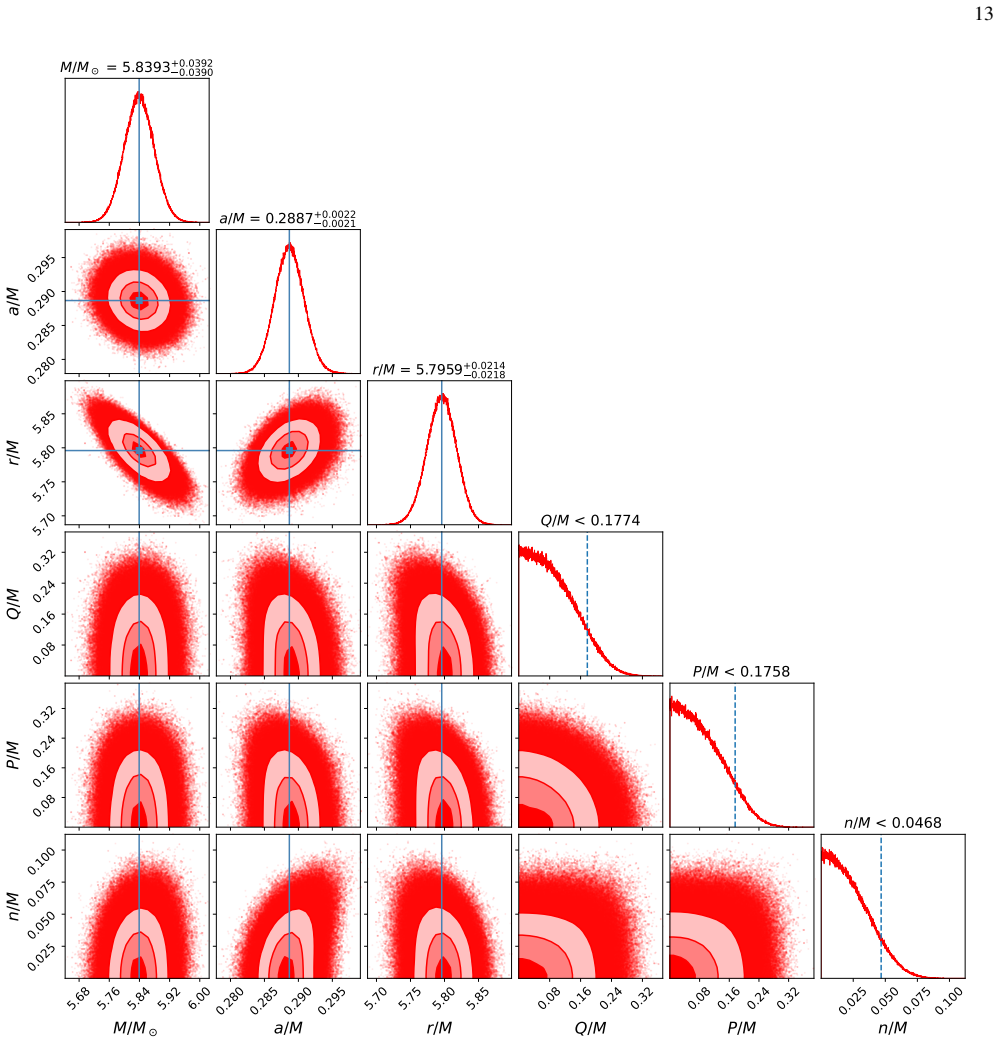
The central claim is that the QPO data from GRO J1655–40, XTE J1859+226, XTE J1550–564, GRS 1915+105, and H1743–322 are compatible with the Kerr metric for all sources except possibly GRS 1915+105. Fitting the dyonic KNKTN spacetime to the observed orbital, periastron, and nodal frequencies yields 90% upper limits $Q/M<0.0649$ for XTE J1859+226, $P/M<0.1837$ for GRO J1655–40, and $n/M<0.0446$ for GRO J1655–40 in the separate three-parameter fits, and no source shows evidence for electric or magnetic charge. The joint six-parameter analysis gives $Q/M<0.1774$, $P/M<0.1758$, and $n/M<0.0468$ for GRO J1655–40, while GRS 1915+105 returns a 90% lower bound $n/M>0.568434$; the separate Kerr–Taub–NUT fit reports $n/M=0.5435^{+0.1031}_{-0.1256}$ at 68% confidence. The authors read this as a possible deviation from Kerr in GRS 1915+105, namely a gravitomagnetic monopole moment, with the other four systems favoring the standard picture.
Load-bearing premise
The results stand or fall on identifying the low-frequency type-C QPO with the nodal precession frequency and the two high-frequency QPOs with the orbital and periastron precession frequencies; for XTE J1550–564 and GRS 1915+105, Table I lists no nodal frequency, yet the likelihood sums over all three frequencies. If that identification is wrong, the upper limits and the GRS 1915+105 Taub–NUT preference do not survive.
Editorial extensions
If this is right
- The tightest electric-charge bound, $Q/M<0.0649$ from XTE J1859+226, means this black hole is observationally neutral at the level of its influence on disk orbital and epicyclic frequencies.
- GRO J1655–40, which has all three QPO frequencies measured with small uncertainties, yields the strongest combined no-charge statement, bounding $Q/M$, $P/M$, and $n/M$ below about $0.18$, $0.18$, and $0.05$ at 90% confidence.
- If the GRS 1915+105 posterior is taken at face value, a nonzero $n/M$ introduces a spacetime twist independent of spin, so the QPO signal would carry information about a gravitomagnetic monopole moment.
- For the other four sources the posteriors peak at zero charge, strengthening the existing case that these particular stellar-mass black holes are consistent with the Kerr spacetime under the relativistic precession model.
Reading between the lines
- A natural next test is to use a simultaneous fit of the same five sources with the missing nodal frequencies treated explicitly or with new measurements, since the paper's GRS 1915+105 lower bound and the unconstrained $n/M$ for XTE J1550–564 depend on how the three-frequency likelihood handles absent entries.
- If the GRS 1915+105 NUT preference is real, the same metric predicts distinctive frequency ratios for high-frequency QPO pairs that could be searched for in other accreting systems as an independent confirmation.
- A nonzero Taub–NUT charge would also shift lensing, shadow, and gravitational-wave ringdown observables relative to Kerr, so the QPO hint could be cross-checked with independent electromagnetic or gravitational-wave measurements.
Signed reviews
Editorial analysis
A structured set of objections, weighed in public.
Referee Report
Summary. The paper derives the orbital, radial-epicyclic, and vertical-epicyclic frequencies for a dyonic Kerr-Newman-Kasuya-Taub-NUT (KNKTN) spacetime, identifies them with the upper, lower, and type-C QPO frequencies through the relativistic precession model, and performs MCMC fits to QPO data from five X-ray binaries. In four separate setups it constrains the mass, spin, orbital radius, and one or more of Q/M, P/M, and n/M. The paper reports null results for electric and magnetic charge across all sources, null NUT results for four sources, and a claimed nonzero NUT parameter for GRS 1915+105 at 68% confidence, which is presented as a possible deviation from the Kerr metric.
Significance. If the GRS 1915+105 NUT detection were robust, it would be a notable hint of a gravitomagnetic monopole moment in a stellar-mass black hole, going beyond the Kerr paradigm. The paper's forward model is standard, and the posterior tables and figures provide a useful template for constraining extra charges with QPO data. The null limits on Q/M and P/M are physically interesting and consistent with expectations from other electromagnetic and gravitational tests. However, the central deviation claim is currently not reproducible as written: the reported 68% and 90% bounds for n/M in GRS 1915+105 are mutually inconsistent, the handling of a missing nodal-frequency datum is unexplained, and the spin parameter definition in the printed formulas is dimensionally incorrect. These issues affect the manuscript's headline conclusion, so the paper needs substantial revision before the NUT claim can be assessed.
major comments (4)
- [III.E, Table VI, Fig. 7, Eq. (3.8)] The GRS 1915+105 NUT result is internally inconsistent. Eq. (3.8) and Table V report a 68% interval n/M = 0.5435 +0.1031/-0.1256, whose lower endpoint is 0.418; Section III.E and Table VI instead give a 90% lower bound n/M > 0.568434; and Figure 7's GRS panel displays the opposite inequality, n/M < 0.56843. For a unimodal posterior, a one-sided 90% lower bound cannot lie above the lower endpoint of the 68% central interval, and the figure's sign conflict makes the claimed detection impossible to reproduce from the reported numbers. Please state which statistic is correct, how it was computed, and why the three quoted numbers disagree.
- [Table I and Eq. (3.3)] Table I lists no ν_nod value for XTE J1550-564 or GRS 1915+105, yet Eq. (3.3) defines the total log-likelihood as the sum of the orbital, periastron-precession, and nodal-precession likelihoods. The manuscript never states how the missing nodal term is treated in the MCMC: is it omitted, set to zero, or assigned some other effective term? This is load-bearing for the GRS 1915+105 NUT claim, because with no nodal datum the claimed nonzero n/M is constrained by only two frequencies and is likely degenerate with r/M and a/M under the adopted priors. The authors should describe the exact likelihood used for each source and, for GRS 1915+105, show the n/M posterior with and without the nodal term.
- [Appendix A, Eq. (A.1)] The definition a_* ≡ a/J in Appendix A is dimensionally inconsistent. Since a = J/M, the quantity a/J has dimensions of inverse mass, not a dimensionless spin; everywhere else in the paper, including Tables II-VI, the spin parameter is a/M. If the numerical implementation actually uses a_* = a/M, the printed definition is a typo that must be corrected. If it uses the printed definition, all spin-dependent frequencies and all MCMC results are miscalculated. Please also state explicitly that the formulas reduce to the standard Kerr (and Schwarzschild) epicyclic frequencies in the appropriate limits, since the current display makes this difficult to verify.
- [Table II and Tables III-VI] The provenance of the Gaussian priors in Table II needs clarification. For GRO J1655-40, Table I lists M = 5.4 ± 0.3 M_sun, but Table II uses a prior mean μ = 5.307 with σ = 0.066, and the posterior in Table III is M = 5.8369, which is more than 8σ from that prior mean. The priors on a/M and r/M have no direct counterpart in Table I at all. If these priors come from previous relativistic-precession-model fits, those sources should be cited and the values reconciled with Table I. Since the reported limits on Q/M, P/M, and n/M are conditional on these priors, the analysis is not reproducible without a clear statement of where the prior means and widths come from.
minor comments (5)
- [III.D] In the opening paragraph, 'the spatial case' should read 'the special case'.
- [Fig. 6 caption] The word 'marginallized' should be 'marginalized'.
- [Eq. (A.1)] The left-hand side is printed as 'v_phi' rather than 'ν_phi'; please fix the notation.
- [Tables III-VI] The captions should state explicitly that M, a/M, and r/M are quoted at 68% confidence while the charge and NUT parameters are quoted at 90% confidence, since mixing confidence levels in one table is confusing.
- [Abstract and Section III.E] The abstract describes the Q/M and P/M limits as 'stringent' for all sources, but Table VI reports Q/M < 0.9539 and P/M < 0.9446 for XTE J1550-564; these are not stringent and the wording should be adjusted.
Circularity Check
No circularity: QPO frequencies are derived from the metric via geodesic and epicyclic equations, and the reported constraints are standard posterior estimates from external QPO data; the GRS 1915+105 n/M hint has internal inconsistencies but no circular reduction.
full rationale
The paper's derivation chain is self-contained and non-circular. The QPO frequencies ν_phi, ν_per, and ν_nod are computed from the dyonic KNKTN metric through the geodesic Lagrangian and epicyclic perturbation equations (Eqs. 2.6–2.28), so the forward model is independent of the QPO data. The MCMC likelihood (Eqs. 3.3–3.4) compares these model frequencies to the external observed QPO values in Table I, and the reported Q/M, P/M, and n/M constraints are ordinary posterior estimates from that same comparison; no fitted quantity is renamed as a prediction. The self-citations to Refs. [38,41] appear only in the context of the Gaussian likelihood and MCMC methodology and are not load-bearing: the central frequency formulas in Appendix A are derived in this paper, and the RPM identification in Eq. (2.29) is an externally established model, not an author-imposed ansatz. The paper therefore contains no circular step. Separate from circularity, the GRS 1915+105 n/M result has internal inconsistencies (Eq. 3.8 gives a 68% interval 0.418–0.647, Table VI quotes a 90% lower bound n/M > 0.568434, and Fig. 7 shows n/M < 0.56843) and Table I lists no ν_nod for this source while Eq. (3.3) sums three likelihood terms without describing how the missing entry is handled; these are reproducibility and data-treatment concerns, not evidence of circular reasoning.
Assumptions & free parameters
free parameters (6)
- Black hole mass M (per source) =
Tables III-VI: e.g., 5.8393+0.0392/-0.0390 M_sun for GRO J1655-40
- Dimensionless spin a/M (per source) =
Tables III-VI: e.g., 0.2887+0.0022/-0.0021 for GRO J1655-40
- Orbital radius r/M (per source) =
Tables III-VI: e.g., 5.7959+0.0214/-0.0218 for GRO J1655-40
- Electric charge Q/M =
90% upper limits: <0.0649 (XTE J1859+226) to <0.3483 (H1743-322)
- Magnetic charge P/M =
90% upper limits: <0.1837 (GRO J1655-40) to <0.3484 (H1743-322)
- Taub-NUT parameter n/M =
GRS 1915+105: 0.5435+0.1031/-0.1256; others upper limits
assumptions (4)
- domain assumption The dyonic KNKTN metric (Eq. 2.1) is the correct spacetime for these sources
- domain assumption Relativistic precession model: the three observed QPO frequencies correspond to the three computed frequencies (Eq. 2.29)
- domain assumption The three QPO measurements have independent Gaussian errors and a product likelihood (Eq. 3.4)
- standard math Epicyclic frequencies follow from small perturbations around circular equatorial orbits (Eqs. 2.23-2.24)
Cite this review
Pith. "Pith review of Constraints on extra charges in dyonic Kerr-Newman-Kasuya-Taub-NUT black hole from the observations of quasi-periodic oscillations." pith.science (2026). https://pith.science/paper/353HYOCT
@misc{pith2026250720165,
  author       = {Pith},
  title        = {Pith review of: Constraints on extra charges in dyonic Kerr-Newman-Kasuya-Taub-NUT black hole from the observations of quasi-periodic oscillations},
  year         = {2026},
  howpublished = {\url{https://pith.science/paper/353HYOCT}},
  note         = {Machine review of arXiv:2507.20165}
}
abstract
This paper investigates the influence of the dimensionless electric charge ($Q/M$), magnetic charge ($P/M$), and Taub-NUT parameter ($n/M$) of a dyonic Kerr-Newman-Kasuya-Taub-NUT black hole on quasi-periodic oscillations (QPOs) observed in X-ray binaries. Using the relativistic precession model, we calculate the three fundamental frequencies arising from particle motion in the accretion disk around the black hole. These theoretical predictions are then confronted with observational QPO data from five X-ray binaries (GRO J1655-40, XTE J1859$+$226, XTE J1550-564, GRS 1915$+$105, and H1743-322), and the Markov Chain Monte Carlo technique is used to constrain the black hole parameters. Our analysis reveals no significant evidence for nonzero values of $Q/M$ and $P/M$ across all sources, thereby allowing us to place several stringent upper limits on electric charge ($Q/M$) and magnetic charge ($P/M$) of the black hole in these systems. Similarly, no compelling indication of a nonzero Taub-NUT parameter is found in QPOs from GRO J1655-40, XTE J1859$+$226, XTE J1550-564, and H1743-322. In contrast, the posterior distribution derived from GRS 1915$+$105 data suggests a nonzero Taub-NUT parameter, i.e., gravitomagnetic monopole moment. This result indicates a potential deviation from the Kerr metric in this astrophysical black hole.
Figures


Figures from the paper (4 more)



Reference graph
Works this paper leans on
-
[1]
Our goal is to con- strain the parameters (𝑀,𝑟/𝑀,𝑎/𝑀,𝑃/𝑀) in this specific scenario
and Taub-NUT parameter (𝑛/𝑀=0). Our goal is to con- strain the parameters (𝑀,𝑟/𝑀,𝑎/𝑀,𝑃/𝑀) in this specific scenario. To achieve this, we perform MCMC analyses using the observed QPOs from five sources, as presented in Table I. Similar to the results discussed in the previous subsection, we do not find any statistically significant evidence for a nonzero v...
-
[2]
First M87 Event Horizon Telescope Results. I. The Shadow of the Supermas- sive BH,
K. Akiyamaet al.[Event Horizon Telescope], “First M87 Event Horizon Telescope Results. I. The Shadow of the Supermas- sive BH,” Astrophys. J. Lett.875, L1 (2019) [arXiv:1906.11238 15 [astro-ph.GA]]
arXiv 2019
-
[3]
First M87 Event Horizon Telescope Results. II. Array and Instrumentation,
K. Akiyamaet al.[Event Horizon Telescope], “First M87 Event Horizon Telescope Results. II. Array and Instrumentation,” As- trophys. J. Lett.875, no.1, L2 (2019) [arXiv:1906.11239 [astro- ph.IM]]
arXiv 2019
-
[4]
Photon ring and ob- servational appearance of a hairy BH,
Q. Gan, P. Wang, H. Wu and H. Yang, “Photon ring and ob- servational appearance of a hairy BH,” Phys. Rev. D104, no.4, 044049 (2021) [arXiv:2105.11770 [gr-qc]]
arXiv 2021
-
[5]
R. S. Lu, T. P. Krichbaum, A. L. Roy, V. L. Fish, S. S. Doeleman, M. D. Johnson, K. Akiyama, D. Psaltis, W. Alef and K. Asada, et al.“Detection of intrinsic source structure at ˜3 Schwarzschild radii with Millimeter-VLBI observations of SAGITTARIUS A*,” Astrophys. J.859, no.1, 60 (2018) [arXiv:1805.09223 [astro-ph.GA]]
arXiv 2018
-
[6]
K. Akiyamaet al.[Event Horizon Telescope], “First Sagittarius A* Event Horizon Telescope Results. III. Imaging of the Galac- tic Center Supermassive BH,” Astrophys. J. Lett.930, no.2, L14 (2022) [arXiv:2311.09479 [astro-ph.HE]]
arXiv 2022
-
[7]
A. A. Grigorian and J. Dexter, “The relationship between simu- lated sub-millimeter and near-infrared images of Sagittarius A* from a magnetically arrested BH accretion flow,” Mon. Not. Roy. Astron. Soc.530, no.2, 1563-1579 (2024) [arXiv:2404.10982 [astro-ph.HE]]
arXiv 2024
-
[8]
J. Samimi, G. H. Share, K. Wood, et. al., “GX339–4: A new BH candidate, ” Nature278, 434 (1979)
work page 1979
Show all 65 references
-
[9]
Khz quasi periodic oscillations in low mass x-ray binaries as probes of general relativity in the strong field regime,
L. Stella and M. Vietri, “Khz quasi periodic oscillations in low mass x-ray binaries as probes of general relativity in the strong field regime,” Phys. Rev. Lett.82, 17-20 (1999) [arXiv:astro- ph/9812124 [astro-ph]]
1999
-
[10]
Lense-Thirring precession and QPOS in low mass x-ray binaries,
L. Stella and M. Vietri, “Lense-Thirring precession and QPOS in low mass x-ray binaries,” Astrophys. J. Lett.492, L59 (1998) [arXiv:astro-ph/9709085 [astro-ph]]. doi:10.1016/j.newar.2020.101524 [arXiv:2001.08758 [astro- ph.HE]]
1998 arXiv
-
[11]
A review of quasi-periodic oscillations from BH X-ray binaries: observation and theory,
A. Ingram and S. Motta, “A review of quasi-periodic oscillations from BH X-ray binaries: observation and theory,” New Astron. Rev.85, 101524 (2019) [arXiv:2001.08758 [astro-ph.HE]]
2019 arXiv
-
[12]
X-ray Properties of Black-Hole Binaries,
R. A. Remillard and J. E. McClintock, “X-ray Properties of Black-Hole Binaries,” Ann. Rev. Astron. Astrophys.44, 49-92 (2006) [arXiv:astro-ph/0606352 [astro-ph]]
2006 arXiv
-
[13]
Correlations in the qpo frequencies of low mass x-ray binaries and the relativistic precession model,
L. Stella, M. Vietri and S. Morsink, “Correlations in the qpo frequencies of low mass x-ray binaries and the relativistic precession model,” Astrophys. J. Lett.524, L63-L66 (1999) [arXiv:astro-ph/9907346 [astro-ph]]
1999 arXiv
-
[14]
Nonlinear resonance in nearly geodesic motion in low mass x-ray binaries,
M. A. Abramowicz, V. Karas, W. Kluzniak, W. H. Lee and P. Rebusco, “Nonlinear resonance in nearly geodesic motion in low mass x-ray binaries,” Publ. Astron. Soc. Jap.55, 466-467 (2003) [arXiv:astro-ph/0302183 [astro-ph]]
2003 arXiv
-
[15]
A Precise determination of angular momentum in the BH candidate GRO J1655-40,
M. A. Abramowicz and W. Kluzniak, “A Precise determination of angular momentum in the BH candidate GRO J1655-40,” Astron. Astrophys.374, L19 (2001) [arXiv:astro-ph/0105077 [astro-ph]]
2001 arXiv
-
[16]
The physics of khz qpos– strong gravity’s coupled anharmonic oscillators,
W. Kluzniak and M. A. Abramowicz, “The physics of khz qpos– strong gravity’s coupled anharmonic oscillators,” [arXiv:astro- ph/0105057 [astro-ph]]
-
[17]
Relativistic diskoseismology. 1. Analytical results for ’grav- ity modes’,
C. A. Perez, A. S. Silbergleit, R. V. Wagoner and D. E. Lehr, “Relativistic diskoseismology. 1. Analytical results for ’grav- ity modes’,” Astrophys. J.476, 589-604 (1997) [arXiv:astro- ph/9601146 [astro-ph]]
1997
-
[18]
Rel- ativistic diskoseismology. 2. Analytical results for C modes,
A. S. Silbergleit, R. V. Wagoner and M. Ortega-Rodriguez, “Rel- ativistic diskoseismology. 2. Analytical results for C modes,” Astrophys. J.548, 335-347 (2001) [arXiv:astro-ph/0004114 [astro-ph]]
2001 arXiv
-
[19]
’Stable’ QPOs and BH properties from diskoseismology,
R. V. Wagoner, A. S. Silbergleit and M. Ortega-Rodriguez, “’Stable’ QPOs and BH properties from diskoseismology,” As- trophys. J. Lett.559, L25-L28 (2001) [arXiv:astro-ph/0107168 [astro-ph]]
2001 arXiv
-
[20]
Precise mass and spin measurements for a stellar- mass BH through X-ray timing: the case of GRO J1655−40,
S. E. Motta, T. M. Belloni, L. Stella, T. Mu ˜noz-Darias and R. Fender, “Precise mass and spin measurements for a stellar- mass BH through X-ray timing: the case of GRO J1655−40,” Mon. Not. Roy. Astron. Soc.437, no.3, 2554-2565 (2014) [arXiv:1309.3652 [astro-ph.HE]]
2014 arXiv
-
[21]
BH mass and spin measurements through the relativistic precession model: XTE J1859+226,
S. E. Motta, T. Belloni, L. Stella, G. Pappas, J. A. Casares, A. T. Mu˜noz-Darias, M. A. P. Torres and I. V. Yanes-Rizo, “BH mass and spin measurements through the relativistic precession model: XTE J1859+226,” Mon. Not. Roy. Astron. Soc.517, no.1, 1469-1475 (2022) [arXiv:2209...
2022 arXiv
-
[22]
Solutions to the relativistic precession model,
A. Ingram and S. Motta, “Solutions to the relativistic precession model,” Mon. Not. Roy. Astron. Soc.444, no.3, 2065-2070 (2014) [arXiv:1408.0884 [astro-ph.HE]]
2014 arXiv
-
[23]
Evidence for harmonic relationships in the high frequency qpos of xte j1550-564 and gro j1655-40,
R. A. Remillard, M. P. Muno, J. E. McClintock and J. A. Orosz, “Evidence for harmonic relationships in the high frequency qpos of xte j1550-564 and gro j1655-40,” Astrophys. J.580, 1030- 1042 (2002) [arXiv:astro-ph/0202305 [astro-ph]]
2002 arXiv
-
[24]
Testing no-hair theorem by quasi- periodic oscillations: the quadrupole of GRO J1655–40,
A. Allahyari and L. Shao, “Testing no-hair theorem by quasi- periodic oscillations: the quadrupole of GRO J1655–40,” JCAP 10, 003 (2021) [arXiv:2102.02232 [gr-qc]]
2021 arXiv
-
[25]
Testing BHs in non-linear electrodynamics from the observed quasi-periodic oscillations,
I. Banerjee, “Testing BHs in non-linear electrodynamics from the observed quasi-periodic oscillations,” JCAP08, no.08, 034 (2022) [arXiv:2203.10890 [gr-qc]]
2022 arXiv
-
[26]
Probing the space-time geometry around BH candi- dates with the resonance models for high-frequency QPOs and comparison with the continuum-fitting method,
C. Bambi, “Probing the space-time geometry around BH candi- dates with the resonance models for high-frequency QPOs and comparison with the continuum-fitting method,” JCAP09, 014 (2012) [arXiv:1205.6348 [gr-qc]]
2012 arXiv
-
[27]
Testing the nature of the BH candidate in GRO J1655-40 with the relativistic precession model,
C. Bambi, “Testing the nature of the BH candidate in GRO J1655-40 with the relativistic precession model,” Eur. Phys. J. C75, no.4, 162 (2015) [arXiv:1312.2228 [gr-qc]]
2015 arXiv
-
[28]
Quasiperiodic oscillations around rotating traversable wormholes,
E. Deligianni, J. Kunz, P. Nedkova, S. Yazadjiev and R. Zhel- eva, “Quasiperiodic oscillations around rotating traversable wormholes,” Phys. Rev. D104, no.2, 024048 (2021) [arXiv:2103.13504 [gr-qc]]
2021 arXiv
-
[29]
Quasiperiodic oscillations in rotating Ellis worm- hole spacetimes,
E. Deligianni, B. Kleihaus, J. Kunz, P. Nedkova and S. Yazad- jiev, “Quasiperiodic oscillations in rotating Ellis worm- hole spacetimes,” Phys. Rev. D104, no.6, 064043 (2021) [arXiv:2107.01421 [gr-qc]]
2021 arXiv
-
[30]
Testing Gravity with Quasi Periodic Oscillations from accreting BHs: the Case of the Einstein-Dilaton-Gauss-Bonnet Theory,
A. Maselli, L. Gualtieri, P. Pani, L. Stella and V. Ferrari, “Testing Gravity with Quasi Periodic Oscillations from accreting BHs: the Case of the Einstein-Dilaton-Gauss-Bonnet Theory,” Astro- phys. J.801, no.2, 115 (2015) [arXiv:1412.3473 [astro-ph.HE]]
2015 arXiv
-
[31]
Testing gravity of a disfor- mal Kerr BH in quadratic degenerate higher-order scalar-tensor theories by quasi-periodic oscillations,
S. Chen, Z. Wang and J. Jing, “Testing gravity of a disfor- mal Kerr BH in quadratic degenerate higher-order scalar-tensor theories by quasi-periodic oscillations,” JCAP06, 043 (2021) [arXiv:2103.11788 [gr-qc]]
2021 arXiv
-
[32]
Constraint on parameters of a ro- tating BH in Einstein-bumblebee theory by quasi-periodic oscil- lations,
Z. Wang, S. Chen and J. Jing, “Constraint on parameters of a ro- tating BH in Einstein-bumblebee theory by quasi-periodic oscil- lations,” Eur. Phys. J. C82, no.6, 528 (2022) [arXiv:2112.02895 16 [gr-qc]]
2022 arXiv
-
[33]
Testing Kerr BH mimickers with quasi-periodic oscillations from GRO J1655- 40,
X. Jiang, P. Wang, H. Yang and H. Wu, “Testing Kerr BH mimickers with quasi-periodic oscillations from GRO J1655- 40,” Eur. Phys. J. C81, no.11, 1043 (2021) [erratum: Eur. Phys. J. C82, no.1, 5 (2022)] [arXiv:2107.10758 [gr-qc]]
2021 arXiv
-
[34]
Testing of QPOs, particle dynamics, emission energy and thermal fluctuation around a regular hairy BH,
A. Ashraf, A. Ditta, T. Naseer, S. K. Maurya, S. Ray, P. Chan- nuie and F. Atamurotov, “Testing of QPOs, particle dynamics, emission energy and thermal fluctuation around a regular hairy BH,” Eur. Phys. J. C85, no.6, 633 (2025)
2025
-
[35]
Circular motion, QPOs testing, emission energy and thermal fluctuations around a non- singular hairy Bardeen BH,
G. Mustafa, A. Ditta, T. Naseer, S. K. Maurya, P. Channuie, A. A. Ibraheem and F. Atamurotov, “Circular motion, QPOs testing, emission energy and thermal fluctuations around a non- singular hairy Bardeen BH,” Eur. Phys. J. C85, no.5, 575 (2025)
2025
-
[36]
Observa- tional constraints on the Kerr and its several single-parameter modified spacetimes using quasi-periodic oscillation data,
S. Yang, J. Lu, W. Li, M. Xu and J. Xu, “Observa- tional constraints on the Kerr and its several single-parameter modified spacetimes using quasi-periodic oscillation data,” [arXiv:2505.08409 [gr-qc]]
-
[37]
Pa- rameter constraints on a BH with Minkowski core through quasiperiodic oscillations,
M. Y. Guo, M. H. Wu, X. M. Kuang and H. Guo, “Pa- rameter constraints on a BH with Minkowski core through quasiperiodic oscillations,” Eur. Phys. J. C85, no.1, 95 (2025) [arXiv:2504.00360 [gr-qc]]
2025 arXiv
-
[38]
Study on high-frequency quasi-periodic oscillations in rotating black bounce spacetime,
S. Yang, J. Lu, X. Yu and J. Xu, “Study on high-frequency quasi-periodic oscillations in rotating black bounce spacetime,” Class. Quant. Grav.42, no.4, 045006 (2025) [arXiv:2403.17454 [gr-qc]]
2025 arXiv
-
[39]
Con- straints on Hairy Kerr BH with quasi-periodic oscillations,
C. Liu, H. Siew, T. Zhu, Q. Wu, Y. Zhao and H. Xu, “Con- straints on Hairy Kerr BH with quasi-periodic oscillations,” [arXiv:2311.12423 [astro-ph.HE]]
-
[40]
Epicyclic frequencies in the equatorial plane around stationary and axially symmetric wormhole geometries,
V. De Falco, “Epicyclic frequencies in the equatorial plane around stationary and axially symmetric wormhole geometries,” Phys. Rev. D108, no.2, 024051 (2023) [arXiv:2307.03151 [gr- qc]]
2023 arXiv
-
[41]
Testing Gravity with BH X-Ray Data,
C. Bambi, “Testing Gravity with BH X-Ray Data,” [arXiv:2210.05322 [gr-qc]]
-
[42]
Constraints on the rotating self-dual BH with quasi-periodic oscillations,
C. Liu, H. Siew, T. Zhu, Q. Wu, Y. Sun, Y. Zhao and H. Xu, “Constraints on the rotating self-dual BH with quasi-periodic oscillations,” JCAP11, 096 (2023) [arXiv:2305.12323 [gr-qc]]
2023 arXiv
-
[43]
Charged Particles’ Tunneling from Hot-NUT-Kerr- Newman-Kasuya Spacetime,
M. H. Ali, “Charged Particles’ Tunneling from Hot-NUT-Kerr- Newman-Kasuya Spacetime,” Int. J. Theor. Phys.47(2008), 2203-2217 [arXiv:0707.1079 [gr-qc]]
2008 arXiv
-
[44]
Quantised singularities in the electromagnetic field,,
P. A. M. Dirac, “Quantised singularities in the electromagnetic field,,” Proc. Roy. Soc. Lond. A133, no.821, 60-72 (1931)
1931
-
[45]
The Theory of magnetic poles,
P. A. M. Dirac, “The Theory of magnetic poles,” Phys. Rev.74, 817-830 (1948)
1948
-
[46]
Magnetic Monopoles in Unified Gauge Theories,
G. ’t Hooft, “Magnetic Monopoles in Unified Gauge Theories,” Nucl. Phys. B79, 276-284 (1974)
1974
-
[47]
Particle Spectrum in Quantum Field Theory,
A. M. Polyakov, “Particle Spectrum in Quantum Field Theory,” JETP Lett.20, 194-195 (1974) PRINT-74-1566 (LANDAU- INST)
1974
-
[48]
Carter, BH Equilibrium States, in: BHs (eds
B. Carter, BH Equilibrium States, in: BHs (eds. C. DeWitt and B. S. DeWitt, Gordon and Breach Science Publishers, New York, 1973) p. 56. rotating charged mass, J. Math. Phys. 6, 918 (1965)
1965
-
[49]
Metric of a Rotating, Charged Mass,
E. T. Newman, E. Couch, K. Chinnapared, A. Exton, A. Prakash and R. Torrence, “Metric of a Rotating, Charged Mass,” J. Math. Phys.6, 918-919 (1965)
1965
-
[50]
Classical monopoles: Newton, NUT space, gravimagnetic lensing and atomic spectra,
D. Lynden-Bell and M. Nouri-Zonoz, “Classical monopoles: Newton, NUT space, gravimagnetic lensing and atomic spectra,” Rev. Mod. Phys.70, 427-446 (1998) [arXiv:gr-qc/9612049 [gr- qc]]
1998 arXiv
-
[51]
Gravomagnetic lensing by NUT space,
M. Nouri-Zonoz and D. Lynden-Bell, “Gravomagnetic lensing by NUT space,” Mon. Not. Roy. Astron. Soc.292, 714-722 (1997) [arXiv:gr-qc/9812094 [gr-qc]]
1997 arXiv
-
[52]
A Space- time dual to the NUT space-time,
M. Nouri-Zonoz, N. Dadhich and D. Lynden-Bell, “A Space- time dual to the NUT space-time,” Class. Quant. Grav.16, 1021- 1026 (1999) [arXiv:gr-qc/9812042 [gr-qc]]
1999 arXiv
-
[53]
Asymptotically anti-de Sitter space-times,
A. Ashtekar and A. Magnon, “Asymptotically anti-de Sitter space-times,” Class. Quant. Grav.1, L39-L44 (1984)
1984
-
[54]
Asymptotically Anti-de Sitter space- times: Conserved quantities,
A. Ashtekar and S. Das, “Asymptotically Anti-de Sitter space- times: Conserved quantities,” Class. Quant. Grav.17, L17-L30 (2000) [arXiv:hep-th/9911230 [hep-th]]
2000 arXiv
-
[55]
Rotating, charged, and uni- formly accelerating mass in general relativity,
J. F. Plebanski and M. Demianski, “Rotating, charged, and uni- formly accelerating mass in general relativity,” Annals Phys.98, 98-127 (1976)
1976
-
[56]
Separability structures and Killing-Yano tensors in vacuum type-𝐷space-times without acceleration,
M. Demianski and M. Francaviglia, “Separability structures and Killing-Yano tensors in vacuum type-𝐷space-times without acceleration,” Int. J. Theor. Phys.19, no.9, 675-680 (1980)
1980
-
[57]
General Kerr-NUT-AdS metrics in all dimensions,
W. Chen, H. Lu and C. N. Pope, “General Kerr-NUT-AdS metrics in all dimensions,” Class. Quant. Grav.23, 5323-5340 (2006) [arXiv:hep-th/0604125 [hep-th]]. 24, F1 (2007)
2006 arXiv
-
[58]
Hidden Symmetry of Higher Dimensional Kerr-NUT-AdS Spacetimes,
D. Kubiznak and V. P. Frolov, “Hidden Symmetry of Higher Dimensional Kerr-NUT-AdS Spacetimes,” Class. Quant. Grav. 24, no.3, F1-F6 (2007) [arXiv:gr-qc/0610144 [gr-qc]]
2007 arXiv
-
[59]
Com- plete integrability of geodesic motion in general Kerr-NUT-AdS spacetimes,
D. N. Page, D. Kubiznak, M. Vasudevan and P. Krtous, “Com- plete integrability of geodesic motion in general Kerr-NUT-AdS spacetimes,” Phys. Rev. Lett.98, 061102 (2007) [arXiv:hep- th/0611083 [hep-th]]
2007
-
[60]
The Most general axially symmetric electrovac space-time admitting separable equations of motion,
N. Dadhich and Z. Y. Turakulov, “The Most general axially symmetric electrovac space-time admitting separable equations of motion,” Class. Quant. Grav.19, 2765 (2002) [arXiv:gr- qc/0112031 [gr-qc]]
2002
-
[61]
Separability of Hamilton-Jacobi and Klein-Gordon Equations in General Kerr- NUT-AdS Spacetimes,
V. P. Frolov, P. Krtous and D. Kubiznak, “Separability of Hamilton-Jacobi and Klein-Gordon Equations in General Kerr- NUT-AdS Spacetimes,” JHEP02, 005 (2007) [arXiv:hep- th/0611245 [hep-th]]
2007
-
[62]
First law for Kerr Taub- NUT AdS BHs,
N. H. Rodr´ıguez and M. J. Rodriguez, “First law for Kerr Taub- NUT AdS BHs,” JHEP10, 044 (2022) [arXiv:2112.00780 [hep- th]]
2022 arXiv
-
[63]
Supersym- metry of topological Kerr-Newman-Taub-NUT-AdS space- times,
N. Alonso-Alberca, P. Meessen and T. Ortin, “Supersym- metry of topological Kerr-Newman-Taub-NUT-AdS space- times,” Class. Quant. Grav.17, 2783-2798 (2000) [arXiv:hep- th/0003071 [hep-th]]
2000
-
[64]
An Improved Dynamical Model for the Microquasar XTE J1550-564,
J. A. Orosz, J. F. Steiner, J. E. McClintock, M. A. P. Torres, R. A. Remillard, C. D. Bailyn and J. M. Miller, “An Improved Dynamical Model for the Microquasar XTE J1550-564,” Astro- phys. J.730, 75 (2011) [arXiv:1101.2499 [astro-ph.SR]]
2011 arXiv
-
[65]
emcee: The MCMC Hammer,
D. Foreman-Mackey, D. W. Hogg, D. Lang and J. Goodman, “emcee: The MCMC Hammer,” Publ. Astron. Soc. Pac.125, 306-312 (2013) [arXiv:1202.3665 [astro-ph.IM]]
2013 arXiv
Reviewed August 15, 2026 · model on record in the stance chip above.
Discussion (0). Continue with ORCID to comment.