REVIEW 3 major objections 4 minor 3 cited by
Defects and their Time Scales in Quantum and Classical Annealing of the Two-Dimensional Ising Model
T0 review · 3 major / 4 minor · reviewed 2026-08-06 · deepseek-v4-flash
Pith's one-line read Quantum annealing of the 2D Ising magnet is governed, at the end of the ramp, by three size-dependent time scales: Kibble-Zurek $L^{2.59}$ fidelity, coarsening $L^2$, and stripe-elimination $L^3$.
desk verdict A careful, honest paper with genuinely new QA results and strong SA numerics; the three-time-scale picture is probably right, but the QA L^3 claim needs a clearer data-selection criterion and the abstract overstates one result. read the letter →
The pith
A machine-rendered reading of the paper's core claim, the machinery that carries it, and where it could break.
The reading
What carries the argument
The central object is the topological winding number $W=(w_x,w_y)$ of domain walls on periodic lattices, which separates confined defects $(0,0)$, axis-spanning stripes $(1,0)/(0,1)$, and diagonal stripes $(1,1)$. The argument is carried by scaling collapse: each observable is plotted against $vL^\alpha$, and the value of $\alpha$ for which data from different $L$ fall on one curve identifies the controlling time scale, such as $\alpha=2.59$, $2$, $3$, $3.17$, or $3.42$. For quantum annealing, the decisive new tool is an excited-state analysis that subtracts the exactly known contributions of the two ferromagnetic ground states, $|a_0|^2$ and $2|a_0|^2$, and further subtracts the lowest-excited-state reference values so that the remaining signal collapses separately under $vL^3$ (stripe elimination) and $vL^2$ (coarsening).
What would settle it
On a periodic superconducting-qubit annealer with $L=10$ through $12$, measure the final $\Gamma=0$ probability of a system-spanning horizontal or vertical stripe as a function of annealing velocity $v$: if it does not collapse under $vL^{2.59}$ but instead collapses under $vL^3$, the paper's claim that KZ controls stripe survival in QA is wrong; in the same data, the excited-state-only excess energy should collapse under $vL^3$ once ground-state shots are removed.
Extended reading notes
Core claim
The paper's central claim is that quantum annealing of the 2D transverse-field Ising model to vanishing field produces a late-time state with two coexisting layers. The ground-state probability is gap-protected after the critical point, so it retains the Kibble-Zurek signature $vL^{z+1/\nu}$ with $z=1$, $1/\nu \approx 1.59$ all the way to $\Gamma=0$; the authors demonstrate near-perfect collapse of $-\log F_{GS}$ versus $vL^{2.59}$. Everything else is carried by excited states, which the paper argues thermalize and evolve under emergent classical dynamics: ordering proceeds by coarsening of confined $(0,0)$ defects on the scale $L^2$, and the last system-spanning $(1,0)/(0,1)$ stripes are eliminated by interface fluctuations on the scale $L^3$. In classical simulated annealing the same analysis shows that diagonal $(1,1)$ stripes decay on $L^{3.42}$, longer than the classical KZ scale $L^{3.17}$, so their final $T=0$ survival probability is KZ-controlled; in quantum annealing the quantum KZ scale $L^{2.59}$ is shorter than $L^3$, so the paper concludes that horizontal and vertical stripe survival is likewise KZ-controlled even though the $L^3$ scale is still present in excited-state observables.
Load-bearing premise
The transfer of the $L^2$ and $L^3$ scales from classical to quantum annealing rests on the assumption that excitations created while crossing the quantum critical point thermalize inside the ordered phase and then move by emergent classical dynamics; if those excitations stay quantum-coherent instead, the identification of the quantum $L^2$ and $L^3$ scales as coarsening and interface fluctuations is not supported.
Editorial extensions
If this is right
- The ground-state success probability of a quantum annealer is decided at the critical point: it obeys $vL^{2.59}$ scaling at $\Gamma=0$, so extending the ramp inside the ferromagnetic phase will not increase the fidelity.
- Annealing times of order $L^2$ remove confined defects but leave system-spanning stripes, so intermediate-time final states of a clean annealer should be dominated by straight horizontal or vertical domain walls.
- In simulated annealing, diagonal stripe survival at $T=0$ carries the KZ exponent $L^{3.17}$ rather than the $L^{3.42}$ fixed-temperature decay scale, because diagonal stripes decay mainly just below $T_c$.
- Post-selecting only non-ground-state shots and subtracting the lowest-excited-state reference exposes the $L^3$ scale in quantum annealing, a measurable signature in experiments where the ground state can be identified.
Reading between the lines
- If the emergent-classical thermalization picture is correct, the same three-clock structure should appear in any non-integrable transverse-field magnet whose ordered phase supports both confined and system-spanning defects, with exponents set by the transition's universality class and interface roughening.
- The argument implies a practical diagnostics protocol: run the annealer at $t_{\rm QA}\sim L^2$; the final ground-state probability should then obey KZ scaling while stripe statistics still show the longer $L^3$ scale, so the two clocks measure device noise in different places.
- By analogy with SA, periodic lattices larger than $L=6$ should show a fourth scale, $L^{3.42}$, for diagonal stripes in QA; with open boundaries that scale should disappear and only $L^3$ remain for all system-spanning walls.
Editorial analysis
A structured set of objections, weighed in public.
Referee Report
Summary. The paper studies defect production and late-time ordering in the two-dimensional transverse-field Ising ferromagnet after quantum annealing to zero transverse field, using exact time evolution for L<=6, and compares with classical simulated annealing of the 2D Ising model for systems up to L=768. The central claim is that the final state of QA exhibits three distinct size-dependent time scales: Kibble-Zurek scaling of the ground-state fidelity with scale L^{2.59}, coarsening of confined defects with scale L^2, and elimination of system-spanning stripe defects with scale L^3. The SA analysis additionally identifies a longer lifetime L^{3.42} for diagonal (W=(1,1)) domain walls, whose survival in SA is argued to be controlled by the KZ scale L^{3.17} rather than by the longer fixed-temperature decay scale. The authors develop an excited-state analysis that they propose as an experimentally applicable method for detecting the L^3 scale in QA.
Significance. If the claims hold, the paper provides a concrete multi-time-scale benchmark for QA devices and a nontrivial example where KZ scaling survives deep into an ordered phase. The exact numerical solutions, with documented tight integration tolerances and parameter-free KZ collapses, are a genuine strength, as are the large-scale SA simulations with multi-spin coding. The paper also makes falsifiable predictions for QA experiments, which is valuable. The main significance, however, depends on the reliability of the L^3 detection in QA, which is the aspect that most needs scrutiny.
major comments (3)
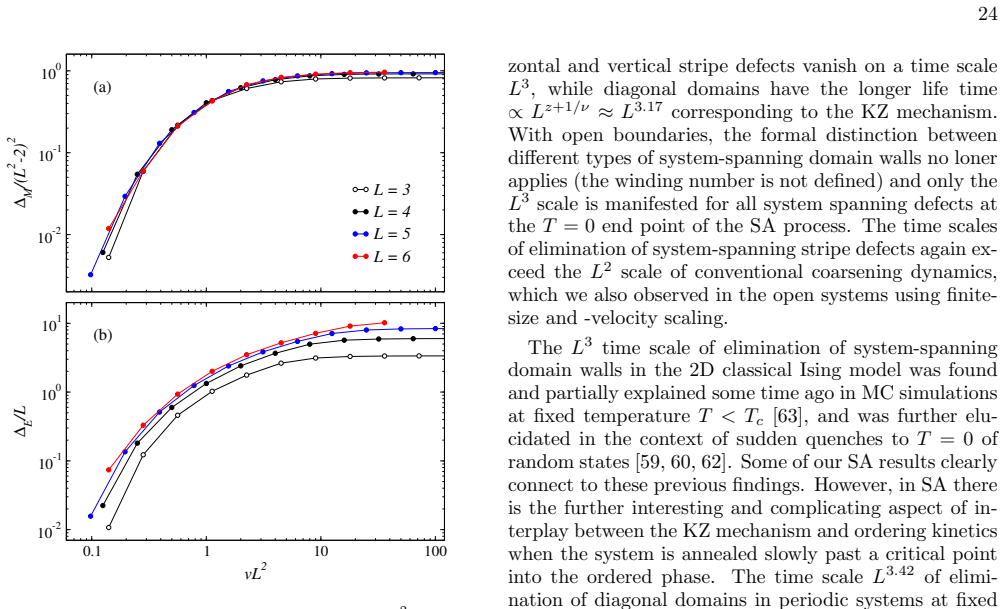
- [Sec. III B, Fig. 26] The L^3 claim for QA rests primarily on the collapse of the excited-state observables in Fig. 26, but the text states that only velocities for which "no numerical anomalies are apparent" are shown, without specifying a deterministic exclusion criterion or listing the excluded runs. Because the anomalies are said to occur at the longest integration times and smallest computed differences, the excluded points are likely concentrated at the small-x=vL^3 end of the scaling plot, exactly where the collapse determines the approach to the lowest-excited-state plateau. As written, the collapse could therefore be an artifact of selective data removal. Please provide a reproducible criterion for excluding points, show the data with and without the excluded points, and demonstrate that the collapse is stable under inclusion of all data that satisfy a well-defined accuracy bound.
- [Abstract and Sec. IV] The statement that in QA the W=(1,0)/(0,1) stripe domains are "controlled by the KZ time scale L^{2.59}" is inferred from the comparison L^3 > L^{2.59} rather than measured directly by scaling the stripe survival probability against vL^{2.59}. The inference is plausible if the L^3 scale is established, but the abstract and conclusions present it as an observed result. Please either soften this to a prediction (as in items (i)-(iii) of the conclusions) or provide a direct test, for example by using the winding-number or stripe-identification method on the exact QA wave functions for the accessible sizes.
- [Sec. III B and Sec. IV] The identification of the QA L^2 and L^3 scales with coarsening and interface fluctuations relies on the assumption that the gap-protected excitations thermalize in the ordered phase and develop effectively classical dynamics. This assumption is acknowledged as "the most plausible" mechanism, but it is not directly tested. The empirical scaling collapses in Figs. 22 and 26 can stand independently of this interpretation; however, the concluding statement that "all our QA results in the ordered phase point to the same ordering mechanisms as in SA" goes beyond the numerical evidence. Please either temper this mechanistic claim or provide a diagnostic of thermalization, such as a comparison of the excited-state energy distribution with a thermal distribution at an effective temperature.
minor comments (4)
- [Sec. IV, first paragraph] The sentence "diagonal domains have the longer life time ∝L^{z+1/ν}≈L^{3.17}" contradicts the fixed-temperature decay exponent L^{3.42} established in Sec. II B. What is controlled by L^{3.17} is the KZ survival probability of diagonal domains in SA, not their fixed-temperature decay time. Please rephrase to avoid this inconsistency.
- [Sec. III A, Eq. (24a)] The scaling variable in Eq. (24a) is written as vL^{1/ν}, but it should be vL^{z+1/ν} to be consistent with Eq. (4) and with the collapse shown in Fig. 21. This appears to be a typo.
- [General presentation] The manuscript text contains several duplicated figure captions and repeated blocks of text, for example around Fig. 24 and in Sec. III B. Please clean these up, as they make the paper difficult to read in the present form.
- [References] References [52] and [53] appear to be identical (C.-W. Liu, A. Polkovnikov, and A. W. Sandvik, Phys. Rev. B 89, 054307 (2014)), and reference [36] contains the misspelling "Sicillia". Please correct these bibliographic issues.
Circularity Check
No significant circularity: QA data are generated by exact evolution and tested against externally fixed KZ exponents and SA-derived scaling variables without fitted exponents; self-citations are non-load-bearing.
full rationale
The paper's derivation chain is largely self-contained. The QA results are obtained by exact numerical integration of the Schrodinger equation for L <= 6, and the KZ exponents used (z=1, 1/nu=1.587375) are imported from the external 3D-Ising/conformal-bootstrap literature, not fitted to QA data. The scaling collapses in Figs. 20 and 21 are parameter-free tests of the KZ ansatz, and the low-velocity v^2 forms are derived from adiabatic perturbation theory rather than assumed from the data. The L^2 coarsening scale in QA is tested by plotting m^2 and excess energy versus vL^2 with the exponent taken from classical SA, where it is independently established on large lattices (L up to 768); this is an external cross-check, not a fit. The L^3 scale in QA is likewise a fixed-exponent hypothesis imported from SA and tested in Figs. 25-27; the excited-state subtraction that defines Delta M and Delta E uses only the exactly known lowest-excited-state values (N-2)^2 and -2N+8, so the observables are not defined in terms of the claimed L^3 scale. The conclusion that W=(1,0)/(0,1) domains in QA obey KZ scaling follows from comparing the SA/QA L^3 elimination scale with the KZ scale L^2.59; this is a logical inference within the stated thermalization/emergent-classical-dynamics assumption, not a restatement of any fitted quantity. Self-citations (Refs. 13, 49-57) provide the critical-point value, APT scaling forms, and KZ analysis methodology, but none is load-bearing: the critical point value is stated to be insensitive to small deviations, and the scaling forms are independently re-derived and confirmed by the data. One passage in Sec. III B discloses that in Fig. 26 'we therefore only show results for those velocities for which no numerical anomalies are apparent,' which is a legitimate validity concern about selective presentation, but it is not an instance of a prediction reducing by construction to its inputs; the L^3 variable is not fitted from the retained points. Overall, the central three-time-scale claim has independent content and is not forced by definition or by a self-citation chain.
Assumptions & free parameters
free parameters (3)
- a_W11_mean =
3.42 ± 0.02 (mean decay time; typical 3.56 ± 0.02)
- a_W10 =
≈3 (2.987 ± 0.013 at T=0.5)
- open_boundary_log_fit =
a=0.72, b=1.7 in ⟨τ_d⟩∝L^2 ln^a(L/b)
assumptions (5)
- domain assumption The Kibble-Zurek scaling ansatz A(v,L)=L^{-kappa/nu} f(vL^{z+1/nu}) applies to the finite-size QA and SA processes.
- domain assumption Excitations created in QA thermalize in the ordered phase and follow emergent classical coarsening dynamics.
- domain assumption For QA systems with L<=6, the infinite-size critical point s_c and the 3D Ising exponents (z=1, nu about 0.63, beta/nu about 0.518) are appropriate for scaling analysis despite finite-size shifts.
- standard math The winding number fully classifies system-spanning topological defects in periodic 2D Ising configurations.
- standard math The lowest excited state of the classical 2D Ising model on a periodic lattice has one flipped spin with energy -2N+8 and magnetization (N-2)^2.
Cite this review
Pith. "Pith review of Defects and their Time Scales in Quantum and Classical Annealing of the Two-Dimensional Ising Model." pith.science (2026). https://pith.science/paper/35BY7SIG
@misc{pith2026250709273,
  author       = {Pith},
  title        = {Pith review of: Defects and their Time Scales in Quantum and Classical Annealing of the Two-Dimensional Ising Model},
  year         = {2026},
  howpublished = {\url{https://pith.science/paper/35BY7SIG}},
  note         = {Machine review of arXiv:2507.09273}
}
abstract
We investigate defects in the two-dimensional transverse-field Ising ferromagnet on periodic $L\times L$ lattices after quantum annealing from high to vanishing field. With exact numerical solutions for $L \le 6$, we observe the expected critical Kibble-Zurek (KZ) time scale $\propto L^{z+1/\nu}$ (with $z=1$ and $1/\nu \approx 1.59$) at the quantum phase transition. We also observe KZ scaling of the ground-state fidelity at the end of the process. The excitations evolve by coarsening dynamics of confined defects, with a time scale $\propto L^2$, and interface fluctuations of system-spanning defects, with life time $\propto L^3$. We build on analogies with classical simulated annealing, where we characterize system-spanning defects in detail and find differences in the dynamic scales of domain walls with winding numbers $W=(1,0)/(0,1)$ (horizontal/vertical) and $W=(1,1)$ (diagonal). They decay on time scales $\propto L^3$ (which applies also to system-spanning domains in systems with open boundaries) and $\propto L^{3.4}$, respectively, when imposed in the ordered phase. As a consequence of $L^{3.4}$ exceeding the classical KZ scale $L^{z+1/\nu}=L^{3.17}$ the probability of $W=(1,1)$ domains in SA scales with the KZ exponent even in the final $T=0$ state. In QA, also the $W=(1,0)/(0,1)$ domains are controlled by the KZ time scale $L^{2.59}$. The $L^3$ scale can nevertheless be detected in the excited states, using a method that we develop that should also be applicable in QA experiments.
Figures


Figures from the paper (18 more)


Forward citations
Cited by 3 Pith papers
-
Finite-time Scaling of the surface special transition in a 3D classical Heisenberg model
When driven from an extraordinary-log boundary critical state into the 3D Heisenberg surface special transition, the surface order parameter obeys M_s^2 ∝ R^{(1+η_s)/r_s} [log(LR^{1/r_s})]^{-q}, a new log-corrected fi...
-
Universal Dynamic Scaling of 2D Quantum Ising Transition on the Fuzzy Sphere
A fuzzy-sphere simulation of the 2D quantum Ising transition shows Kibble-Zurek scaling of the squared order parameter and correlation function, while the excitation energy fails to scale at current sizes.
-
Universal Driven Critical Dynamics near the Boundary
Driven critical dynamics near boundaries of the Ising model obey boundary finite-time scaling in most cases, but cooling through the ordinary boundary universality class produces an anomalous logarithmic dependence on...
Reference graph
Works this paper leans on
-
[1]
Kirkpatrick, C
S. Kirkpatrick, C. D. Gelatt, Jr., and M. P. Vecchi, Op- timization by Simulated Annealing, Science220, 671 (1983)
1983
-
[2]
ˇCern´ y, Thermodynamical approach to the traveling salesman problem: An efficient simulation algorithm, J
V. ˇCern´ y, Thermodynamical approach to the traveling salesman problem: An efficient simulation algorithm, J. Optim. Theor. and Appl.45, 41 (1985)
1985
-
[3]
Granville, M
V. Granville, M. Krivanek, and J.-P. Rasson, Simulated Annealing: A Proof of Convergence, IEEE Trans. Pat- tern Anal. Mach. Intell.,16652 (1994)
1994
-
[4]
A. B. Finnila, M. A. Gomez, C. Sebenik, C. Stenson and D. J. Doll, Quantum annealing: A new method for min- imizing multidimensional functions, Chem. Phys. Lett. 219, 343 (1994)
1994
-
[5]
Kadowaki and H
T. Kadowaki and H. Nishimori, Quantum annealing in the transverse Ising model, Phys. Rev. E58, 5355 (1998)
1998
-
[6]
Bitko, T
D. Bitko, T. F. Rosenbaum, and G. Aeppli, Quantum Critical Behavior for a Model Magnet, Phys. Rev. Lett. 77, 940 (1996)
1996
-
[7]
Brooke, D
J. Brooke, D. Bitko, T. F. Rosenbaum, and G. Aeppli, Quantum Annealing of a Disordered Magnet, Science 284, 779 (1999)
1999
-
[8]
G. E. Santoro, R. Martonak, E. Tosatti, and R. Car, Theory of Quantum Annealing of an Ising Spin Glass, 27 Science295, 2427 (2002)
2002
Show all 101 references
-
[9]
S. F. Edwards and P. W. Anderson, Theory of spin glasses, J. Phys. F: Met. Phys.5, 965 (1975)
1975
-
[10]
Barahona, On the computational complexity of Ising spin glass models, J
F. Barahona, On the computational complexity of Ising spin glass models, J. Phys. A: Math. Gen.15, 3241 (1982)
1982
-
[11]
M. W. Johnson et al., Quantum annealing with manu- factured spins, Nature473, 194 (2011)
2011
-
[12]
Harris et al., Phase transitions in a programmable quantum spin glass simulator, Science361, 162 (2018)
R. Harris et al., Phase transitions in a programmable quantum spin glass simulator, Science361, 162 (2018)
2018
-
[13]
Weinberg, M
P. Weinberg, M. Tylutki, J. R¨ onkk¨ o, J. Westerholm, J. A. ˚Astr¨ om, P. Manninen, P. T¨ orm¨ a and A. W. Sand- vik, Scaling and Diabatic Effects in Quantum Anneal- ing with a D-Wave Device, Phys. Rev. Lett.124090502 (2020)
2020
-
[14]
S. Zhou, D. Green, E. D. Dahl, and C. Chamon, Exper- imental realization of classical Z 2 spin liquids in a pro- grammable quantum device, Phys. Rev. B104, L081107 (2021)
2021
-
[15]
A. D. King et al., Coherent quantum annealing in a programmable 2,000 qubit Ising chain, Nat. Phys.18, 1324 (2022)
2022
-
[16]
A. Ali, H. Xu, W. Bernoudy, A. Nocera, A. D. King, and A. Banerjee, Quantum Quench Dynamics of Geo- metrically Frustrated Ising Models, Nature Comm.15, 10756 (2024)
2024
-
[17]
A. D. King et al., Quantum critical dynamics in a 5000- qubit programmable spin glass, Nature617, 61 (2023)
2023
-
[18]
A. D. King et al., Beyond-classical computation in quan- tum simulation, Science388, 199 (2025)
2025
-
[19]
Sathe, A
P. Sathe, A. D. King, S. M. Mniszewski, C. Coffrin, C. Nisoli, and F. Caravelli, Classical Criticality via Quan- tum Annealing, arXiv:2505.13625
-
[20]
T. I. Andersen et al., Thermalization and Crit- icality on an Analog-Digital Quantum Simulator, arXiv:2405.17385
-
[21]
Keesling, A
A. Keesling, A. Omran, H. Levine, H. Bernien, H. Pich- ler, S. Choi, R. Sama jdar, S. Schwartz, P. Silvi, S. Sachdev, P. Zoller, M. Endres, M. Greiner, V. Vuleti´ c, and M. D. Lukin, Quantum Kibble–Zurek mechanism and critical dynamics on a programmable Rydberg sim- ulator, Na...
2019
-
[22]
Scholl et al., Programmable quantum simulation of 2D antiferromagnets with hundreds of Rydberg atoms, Nature595, 233 (2020)
P. Scholl et al., Programmable quantum simulation of 2D antiferromagnets with hundreds of Rydberg atoms, Nature595, 233 (2020)
2020
-
[23]
Ebadi et al., Quantum optimization of maximum independent set using Rydberg atom arrays, Science, eabo6587 (2022)
S. Ebadi et al., Quantum optimization of maximum independent set using Rydberg atom arrays, Science, eabo6587 (2022)
2022
-
[24]
Manovitz et al., Quantum coarsening and collective dynamics on a programmable simulator, Nature638, 86 (2025)
T. Manovitz et al., Quantum coarsening and collective dynamics on a programmable simulator, Nature638, 86 (2025)
2025
-
[25]
Zhang, Observation of Near-Critical Kibble-Zurek Scaling in Rydberg Atom Arrays, arXiv:2505.07930
T. Zhang, Observation of Near-Critical Kibble-Zurek Scaling in Rydberg Atom Arrays, arXiv:2505.07930
-
[26]
T. W. B. Kibble, J. Phys. A9, 1387 (1976)
1976
-
[27]
W. H. Zurek, Nature (London)317, 505 (1985)
1985
-
[28]
Polkovnikov, Phys
A. Polkovnikov, Phys. Rev. B72, 161201(R) (2005)
2005
-
[29]
W. H. Zurek, U. Dorner, and P. Zoller, Dynamics of a quantum phase transition, Phys. Rev. Lett.95, 105701 (2005)
2005
-
[30]
Dziarmaga, Dynamics of a quantum phase transition: Exact solution of the quantum Ising model, Phys
J. Dziarmaga, Dynamics of a quantum phase transition: Exact solution of the quantum Ising model, Phys. Rev. Lett.95, 245701 (2005)
2005
-
[31]
Dziarmaga, Dynamics of a quantum phase transition and relaxation to a steady state, Adv
J. Dziarmaga, Dynamics of a quantum phase transition and relaxation to a steady state, Adv. Phys.59, 1063 (2010)
2010
-
[32]
Polkovnikov, K
A. Polkovnikov, K. Sengupta, A. Silva, and M. Ven- galattore, Colloquium: Nonequilibrium dynamics of closed interacting quantum systems, Rev. Mod. Phys. 83, 863 (2011)
2011
-
[33]
del Campo and W
A. del Campo and W. H. Zurek, Universality of phase transition dynamics: Topological defects from symme- try breaking, Int. J. Mod. Phys. A29, 1430018 (2014)
2014
-
[34]
A. J. Bray, Theory of phase-ordering kinetics, Adv. Phys.43, 357 (1994)
1994
-
[35]
Blanchard, L
T. Blanchard, L. F. Cugliandolo, M. Picco and A. Tartaglia, Critical percolation in the dynamics of the 2d ferromagnetic Ising model, J. Stat. Mech. (2017) 113201
2017
-
[36]
Biroli, L
G. Biroli, L. F. Cugliandolo, and A. Sicillia, Phys. Rev. E81, 050101R (2010)
2010
-
[37]
Chandran, A
A. Chandran, A. Erez, S. S. Gubser, and S. L. Sondhi, Kibble-Zurek problem: Universality and the scaling limit, Phys. Rev. B86, 064304 (2012)
2012
-
[38]
Chandran, F
A. Chandran, F. J. Burnell, V. Khemani, and S. L. Sondhi, J. Phys.: Conden. Mat.25, 404214 (2013)
2013
-
[39]
Chandran, A
A. Chandran, A. Nanduri, S. S. Gubser, and S. L. Sondhi Phys. Rev. B88, 024306 (2013)
2013
-
[40]
Gagel, P
P. Gagel, P. P. Orth, and J. Schmalian, Universal postquench coarsening and aging at a quantum critical point, Phys. Rev. B92, 115121 (2015)
2015
-
[41]
Samajdar, D
R. Samajdar, D. A. Huse, Quantum and classical coars- ening and their interplay with the Kibble-Zurek mech- anism, arXiv:2401.15144
-
[42]
Pelissetto and E
A. Pelissetto and E. Vicari, Dynamic Off-Equilibrium Transition in Systems Slowly Driven across Thermal First-Order Phase Transitions, Phys. Rev. Lett.118, 030602 (2017)
2017
-
[43]
Suzuki and W
F. Suzuki and W. H. Zurek, Topological Defect Forma- tion in a Phase Transition with Tunable Order, Phys. Rev. Lett.132, 241601 (2024)
2024
-
[44]
J. Gao, Y. Lee, Y. Lim, D. Bae, T. Rabga, and Y. Shin, Universal Early Coarsening of Quenched Bose Gases, Phys. Rev. Lett.128, 135701 (2022)
2022
-
[45]
Schmitt, M
M. Schmitt, M. M. Rams, J. Dziarmaga, M. Heyl, and W. Zurek, Quantum phase transition dynamics in the two-dimensional transverse-field Ising model, Sci. Adv. 8, eabl6850 (2022)
2022
-
[47]
Mauron and G
L. Mauron and G. Carleo, Challenging the Quantum Advantage Frontier with Large-Scale Classical Simula- tions of Annealing Dynamics, arXiv:2503.08247
-
[48]
Zhong and Z
F. Zhong and Z. Xu, Dynamic Monte Carlo renormal- ization group determination of critical exponents with linearly changing temperature, Phys. Rev. B71, 132402 (2005)
2005
-
[49]
De Grandi, V
C. De Grandi, V. Gritsev, and A. Polkovnikov, Phys. Rev. B81, 012303 (2010)
2010
-
[50]
De Grandi, A
C. De Grandi, A. Polkovnikov, and A. W. Sandvik, Phys. Rev. B84, 224303 (2011)
2011
-
[51]
C. D. Grandi, A. Polkovnikov, and A. W. Sandvik, J. Phys.: Cond. Mat.25, 404216 (2013)
2013
-
[52]
C.-W. Liu, A. Polkovnikov, and A. W. Sandvik, Phys. Rev. B89, 054307 (2014)
2014
-
[53]
C.-W. Liu, A. Polkovnikov, and A. W. Sandvik, Phys. Rev. B89, 054307 (2014). 28
2014
-
[54]
C.-W. Liu, A. Polkovnikov, and A. W. Sandvik, Phys. Rev. Lett.114, 147203 (2015)
2015
-
[55]
S. J. Rubin, N. Xu, and A. W. Sandvik, Phys. Rev. E 95, 052133 (2017)
2017
-
[56]
Xu, K.-H
N. Xu, K.-H. Wu, S. J. Rubin, Y.-J. Kao, A. W. Sand- vik, Phys. Rev. E96, 052102 (2017)
2017
-
[57]
N. Xu, C. Castelnovo, R. G. Melko, C. Chamon and A. W. Sandvik, Phys. Rev. B97, 024432 (2018)
2018
-
[58]
M. P. Nightingale abd H. W. J. Bl¨ ote, Monte Carlo com- putation of correlation times of independent relaxation modes at criticality, Phys. Rev. B62, 1089 (2000)
2000
-
[59]
Spirin, P
V. Spirin, P. L. Krapivsky, and S. Redner, Fate of zero-temperature Ising ferromagnets, Phys. Rev. E63, 036118 (2001)
2001
-
[60]
Spirin, P.L
V. Spirin, P.L. Krapivsky, and S. Redner, Freezing in Ising ferromagnets, Phys. Rev. E65, 016119 (2001)
2001
-
[61]
Barros, P
K. Barros, P. L. Krapivsky, and S. Redner, Freezing into stripe states in two-dimensional ferromagnets and crossing probabilities in critical percolation, Phys. Rev. E80, 040101(R) (2009)
2009
-
[62]
Olejarz, P
J. Olejarz, P. L. Krapivsky, and S. Redner, Fate of 2D Kinetic Ferromagnets and Critical Percolation Crossing Probabilities, Phys. Rev. Lett.109, 195702 (2012)
2012
-
[63]
Lipowski, Anomalous phase-ordering kinetics in the Ising model, Physica A268, 6 (1999)
A. Lipowski, Anomalous phase-ordering kinetics in the Ising model, Physica A268, 6 (1999)
1999
-
[64]
Plischke, Z
M. Plischke, Z. R´ acz, and D. Liu, Time-reversal invari- ance and universality of two-dimensional growth mod- els, Phys. Rev. B35, 3485 (1987)
1987
-
[65]
Shimizu, Y
K. Shimizu, Y. Kuno, T. Hirano, and I. Ichinose, Dy- namics of a quantum phase transition in the Bose- Hubbard model: Kibble-Zurek mechanism and beyond, Phys. Rev. A97, 033626 (2018)
2018
-
[66]
Libal, A
A. Libal, A. del Campo, C. Nisoli, C. Reichhardt, and C. Reichhardt, Quenched Dynamics of Artificial Spin Ice: Coarsening versus Kibble-Zurek, Phys. Rev. Res. 2, 033433 (2020)
2020
-
[67]
D. R. Mitchell, C. Adami, W. Lue, and C. P. Williams, Random matrix model of adiabatic quantum comput- ing, Phys. Rev. A71, 052324 (2005)
2005
-
[68]
Caneva, R
T. Caneva, R. Fazio, and G. E. Santoro, Adiabatic quantum dynamics of the Lipkin-Meshkov-Glick model, Phys. Rev. B78, 104426 (2008)
2008
-
[69]
Zanca and G
T. Zanca and G. E. Santoro, Quantum annealing speedup over simulated annealing on random Ising chains, Phys. Rev. B93, 224431 (2016)
2016
-
[70]
M. M. Wauters, R. Fazio, H. Nishimori, and G. E. San- toro Phys. Rev. A96, 022326 (2017)
2017
-
[71]
Zeng, C.-Y
H.-B. Zeng, C.-Y. Xia, and A. del Campo, Universal Breakdown of Kibble-Zurek Scaling in Fast Quenches across a Phase Transition, Phys. Rev. Lett.130, 060402 (2023)
2023
-
[72]
Grabarits, F
A. Grabarits, F. Balducci, and A. del Campo, Driving a quantum phase transition at an arbitrary rate: Exact solution of the transverse-field Ising model, Phys. Rev. A111, 042207 (2025)
2025
-
[73]
R. H. Swendsen and J.-S. Wang, Nonuniversal critical dynamics in Monte Carlo simulations, Phys. Rev. Lett. 58, 86 (1987)
1987
-
[74]
Aasen, R
D. Aasen, R. S. K. Mong, and P. Fendley, Topological Defects on the Lattice I: The Ising model, J. Phys. A: Math. Theor.49354001 (2016)
2016
-
[75]
Hauru, G
M. Hauru, G. Evenbly, W. W. Ho, D. Gaiotto, and G. Vidal, Topological conformal defects with tensor net- works, Phys. Rev. B94, 115125 (2016)
2016
-
[76]
Haegeman, J
J. Haegeman, J. I. Cirac, T. J. Osborne, I. Piˇ zorn, H. Verschelde, and F. Verstraete, Time-dependent varia- tional principle for quantum lattices, Phys. Rev. Lett. 107, 1 (2011)
2011
-
[77]
Haegeman, C
J. Haegeman, C. Lubich, I. Oseledets, B. Vandereycken, and F. Verstraete, Unifying time evolution and opti- mization with matrix product states, Phys. Rev. B94, 165116 (2016)
2016
-
[78]
Czarnik, J
P. Czarnik, J. Dziarmaga, P. Corboz, Time evolution of an infinite projected entangled pair state: An efficient algorithm, Phys. Rev. B99, 035115 (2019)
2019
-
[79]
Yang and S
M. Yang and S. R. White, Time-dependent variational principle with ancillary krylov subspace, Phys. Rev. B 102, 094315 (2020)
2020
-
[80]
Dziarmaga, Time evolution of an infinite projected entangled pair state: Neighborhood tensor update, Phys
J. Dziarmaga, Time evolution of an infinite projected entangled pair state: Neighborhood tensor update, Phys. Rev. B104, 094411 (2021)
2021
-
[81]
Unfried, J
J. Unfried, J. Hauschild, and F. Pollmann, Fast time evolution of matrix product states using the qr decom- position, Phys. Rev. B107, 155133 (2023)
2023
-
[82]
J.-W. Li, A. Gleis, and J. Von Delft, Time-dependent variational principle with controlled bond expansion for matrix product states, Phys. Rev. Lett.133, 026401 (2024)
2024
-
[83]
Schmitt, M
M. Schmitt, M. Heyl, Quantum many-body dynamics in two dimensions with artificial neural networks, Phys. Rev. Lett.125, 100503 (2020)
2020
-
[84]
Carleo, F
G. Carleo, F. Becca, M. Schir´ o, and M. Fabrizio, Local- ization and Glassy Dynamics Of Many-Body Quantum Systems, Sci. Rep.2, 243 (2012)
2012
-
[85]
Carleo, F
G. Carleo, F. Becca, L. Sanchez-Palencia, S. Sorella, and M. Fabrizio, Light-cone effect and supersonic corre- lations in one- and two-dimensional bosonic superfluids, Phys. Rev. A89, 031602(R) (2014)
2014
-
[86]
Blaß and H
B. Blaß and H. Rieger, Test of quantum thermalization in the two-dimensional transverse-field Ising model, Sci. Reps.6, 38185 (2016)
2016
-
[87]
Hairer, S.P
E. Hairer, S.P. Norsett and G. Wanner, ”Solving ordi- nary Differential Equations I. Nonstiff Problems”, 2nd edition. Springer Series in Computational Mathematics, Springer-Verlag (1993)
1993
-
[88]
Hotta, T
C. Hotta, T. Yoshida, and K. Harada, Quantum crit- ical dynamics in the two-dimensional transverse Ising model, Phys. Rev. Res.5, 013186 (2023)
2023
-
[89]
Poland, S
D. Poland, S. Rychkov, and A. Vichi, The conformal bootstrap: Theory, numerical techniques, and applica- tions, Rev. Mod. Phys.91, 015002 (2019)
2019
-
[90]
J. M. Deutsch, Eigenstate thermalization hypothesis, Rep. Prog. Phys.81082001 (2018)
2018
-
[91]
Banks and A
T. Banks and A. Lucas, Emergent entropy production and hydrodynamics in quantum many-body systems, Phys. Rev. E99, 022105 (2019)
2019
-
[92]
Kolodrubetz, D
M. Kolodrubetz, D. Pekker, B. K. Clark, and K. Sen- gupta, Nonequilibrium dynamics of bosonic Mott insu- lators in an electric field, Phys. Rev. B85, 100505(R) (2012)
2012
-
[93]
Maraga, A
A. Maraga, A. Chiocchetta, A. Mitra, and A. Gambassi, Aging and coarsening in isolated quantum systems after a quench: Exact results for the quantumO(N) model withN→ ∞, Phys. Rev. E92, 042151 (2015)
2015
-
[94]
Maraga, P
A. Maraga, P. Smacchia, and A. Silva, Linear ramps of the mass in theO(N) model: Dynamical transition and quantum noise of excitations, Phys. Rev. B94, 245122 (2016). 29
2016
-
[95]
Altshuler, H
B. Altshuler, H. Krovi, and J. Roland, Anderson lo- calization makes adiabatic quantum optimization fail, Proc. Nat. Scad. Sci.10712446 (2010)
2010
-
[96]
Rigol, V
M. Rigol, V. Dunjko, and M. Olshanii, Thermalization and its mechanism for generic isolated quantum sys- tems, Nature452, 854 (2008)
2008
-
[97]
Mondaini, K
R. Mondaini, K. R. Fratus, M. Srednicki, and M Rigol, Eigenstate thermalization in the two-dimensional trans- verse field Ising model, Phys. Rev. E93, 032104 (2016)
2016
-
[98]
Mondaini and M
R. Mondaini and M. Rigol, Eigenstate thermalization in the two-dimensional transverse field Ising model. II. Off-diagonal matrix elements of observables, Phys. Rev. E96, 012157 (2017)
2017
-
[99]
Dutta, A
A. Dutta, A. Rahmani, and A. del Campo, Anti-Kibble- Zurek Behavior in Crossing the Quantum Critical Point of a Thermally Isolated System Driven by a Noisy Con- trol Field, Phys. Rev. Lett.117, 080402 (2016)
2016
-
[100]
Bando and H
Y. Bando and H. Nishimori, Simulated quantum anneal- ing as a simulator of nonequilibrium quantum dynamics, Phys. Rev. A104, 022607 (2021)
2021
-
[101]
Comment on: ”Dynamics of disordered quantum sys- tems with two- and three-dimensional tensor networks” arXiv:2503.05693, A. D. King et al., arXiv:2504.06283
-
[102]
Weinberg and M
P. Weinberg and M. Bukov, SciPost Phys.2, 003 (2017), QuSpin: a Python package for dynamics and exact di- agonalisation of quantum many body systems part I: spin chains, SciPost Phys.7, 020 (2019)
2017
Reviewed August 6, 2026 · model on record in the stance chip above.
Discussion (0). Continue with ORCID to comment.