Electron-Photon Spatial Entanglement in Coherent Cathodoluminescence
Pith reviewed 2026-05-25 04:31 UTC · model grok-4.3
The pith
The electron-photon entangled state in coherent cathodoluminescence is expressed directly from the luminescence spectrum, enabling quantification of spatial entanglement via purity and EPR-type measures.
A machine-rendered reading of the paper's core claim, the machinery that carries it, and where it could break.
Core claim
By expressing the scattered state directly via the luminescence spectrum, the entanglement in the electron-photon system is evaluated using both subsystem purity and an Einstein-Podolsky-Rosen-type criterion. These two measures enable a clear distinction between wave-like, particle-like, and classical regimes in terms of spatial and momentum entanglement, while identifying the roles of the electron's transverse and longitudinal coherence as well as the photon's spectral width and the conditions under which strong spatial entanglement emerges.
What carries the argument
Direct expression of the scattered electron-photon state from the luminescence spectrum, which carries all information needed to compute the two entanglement measures.
If this is right
- Electron transverse coherence controls the degree of spatial entanglement.
- Longitudinal coherence and photon spectral width also govern the entanglement measures.
- Strong spatial entanglement arises only under specific combinations of these coherence properties.
- The framework leads to quantum-enabled functionalities in electron microscopy.
Where Pith is reading between the lines
- The spectral mapping method could be tested on other radiation mechanisms in electron beams.
- It suggests a route to nanoscale quantum sensing that uses the electron as one half of an entangled pair.
- Similar direct-spectrum approaches might characterize entanglement in related light-matter systems.
Load-bearing premise
The quantum state of the electron-photon pair can be expressed directly from the luminescence spectrum without additional microscopic details of the scattering process.
What would settle it
An independent measurement of subsystem purity or EPR correlations in a cathodoluminescence setup that deviates from the values predicted solely by the observed luminescence spectrum.
Figures



read the original abstract
Electron-photon quantum entanglement in an electron microscope paves the way for a new quantum platform, enabling the integration of quantum functionalities into electron microscopy and opening opportunities for quantum imaging and quantum sensing at the nanoscale. To realize such a platform, it is crucial to understand the degree and nature of electron-photon entanglement in cathodoluminescence (CL). However, its dependence on electron-beam properties, particularly transverse coherence, remains unclear. Here, we present a theoretical framework describing the quantum state of an electron-photon pair generated in coherent CL, specifically for transition radiation. By expressing the scattered state directly via the luminescence spectrum, we evaluate the entanglement using both subsystem purity and an Einstein-Podolsky-Rosen-type criterion. These two measures enable a clear distinction between wave-like, particle-like, and classical regimes in terms of spatial and momentum entanglement in the electron-photon system. Our analysis identifies the roles of the electron's transverse and longitudinal coherence, as well as the photon's spectral width, and reveals the conditions under which strong spatial entanglement emerges. This unified perspective clarifies the nature of electron-photon quantum correlations in coherent CL, leading to quantum-enabled functionalities in electron microscopy.
Editorial analysis
A structured set of objections, weighed in public.
Referee Report
Summary. The paper presents a theoretical framework for the quantum state of an electron-photon pair generated in coherent cathodoluminescence (transition radiation). By expressing the scattered state directly via the luminescence spectrum, the authors evaluate entanglement using subsystem purity and an Einstein-Podolsky-Rosen-type criterion. This allows distinction between wave-like, particle-like, and classical regimes in terms of spatial and momentum entanglement, identifying roles of electron transverse and longitudinal coherence and photon spectral width.
Significance. If the central mapping is rigorously justified, the work provides a practical route to quantify electron-photon entanglement from measurable spectra in electron microscopy, clarifying conditions for strong spatial entanglement and potentially supporting quantum imaging or sensing applications. The dual use of purity and EPR-type measures to classify regimes is a clear organizational contribution.
major comments (1)
- [Abstract / framework description] Abstract and framework section: the central construction states that the scattered state is expressed directly via the luminescence spectrum S(ω). The spectrum supplies only modulus-squared amplitudes; the two-particle state also requires relative phases between electron and photon components and the precise form of the transition-radiation coupling operator. No derivation is supplied showing how these phases or transverse coherence factors are fixed by S(ω) alone. Because the subsequent purity and EPR calculations (and therefore the wave-like/particle-like classification) rest on this mapping, the claim does not yet follow from the given data.
Simulated Author's Rebuttal
We are grateful to the referee for their positive assessment of the significance of our work and for the detailed feedback. We address the major comment on the framework construction below and will make the requested revisions to strengthen the manuscript.
read point-by-point responses
-
Referee: [Abstract / framework description] Abstract and framework section: the central construction states that the scattered state is expressed directly via the luminescence spectrum S(ω). The spectrum supplies only modulus-squared amplitudes; the two-particle state also requires relative phases between electron and photon components and the precise form of the transition-radiation coupling operator. No derivation is supplied showing how these phases or transverse coherence factors are fixed by S(ω) alone. Because the subsequent purity and EPR calculations (and therefore the wave-like/particle-like classification) rest on this mapping, the claim does not yet follow from the given data.
Authors: We thank the referee for highlighting this important point regarding the justification of our central construction. We agree that the manuscript would benefit from an explicit derivation showing how the scattered state is obtained from the luminescence spectrum S(ω). In the revised version, we will add this derivation in the framework section, detailing how the amplitudes are taken from the square root of S(ω), how the relative phases are determined by the transition-radiation coupling (which is phase-fixed in the standard treatment), and how transverse coherence factors enter through the electron beam model. This will ensure that the entanglement measures follow rigorously from the given spectrum. revision: yes
Circularity Check
No significant circularity; derivation rests on standard quantum-optics modeling choice
full rationale
The paper constructs the electron-photon state by direct substitution of the measured luminescence spectrum into the two-particle wavefunction ansatz, then applies standard subsystem-purity and EPR-type entanglement witnesses. This mapping is an explicit modeling assumption rather than a self-referential definition or a fitted parameter relabeled as a prediction. No equation reduces to its own input by algebraic identity, no uniqueness theorem is imported from the authors' prior work, and the entanglement measures are computed from the constructed state using textbook definitions. The central claim therefore remains independent of the spectrum data once the state ansatz is granted; any concern lies in the physical justification of that ansatz, not in circularity of the subsequent derivation.
Axiom & Free-Parameter Ledger
Lean theorems connected to this paper
-
IndisputableMonolith/Cost/FunctionalEquation.leanwashburn_uniqueness_aczel unclear?
unclearRelation between the paper passage and the cited Recognition theorem.
By expressing the scattered state directly via the luminescence spectrum, we evaluate the entanglement using both subsystem purity and an Einstein-Podolsky-Rosen-type criterion.
-
IndisputableMonolith/Foundation/RealityFromDistinction.leanreality_from_one_distinction unclear?
unclearRelation between the paper passage and the cited Recognition theorem.
the scattered state|Ψ sc⟩of electron–photon pairs directly from the CL spectrum
What do these tags mean?
- matches
- The paper's claim is directly supported by a theorem in the formal canon.
- supports
- The theorem supports part of the paper's argument, but the paper may add assumptions or extra steps.
- extends
- The paper goes beyond the formal theorem; the theorem is a base layer rather than the whole result.
- uses
- The paper appears to rely on the theorem as machinery.
- contradicts
- The paper's claim conflicts with a theorem or certificate in the canon.
- unclear
- Pith found a possible connection, but the passage is too broad, indirect, or ambiguous to say the theorem truly supports the claim.
Reference graph
Works this paper leans on
-
[1]
Electron-Photon Spatial Entanglement in Coherent Cathodoluminescence
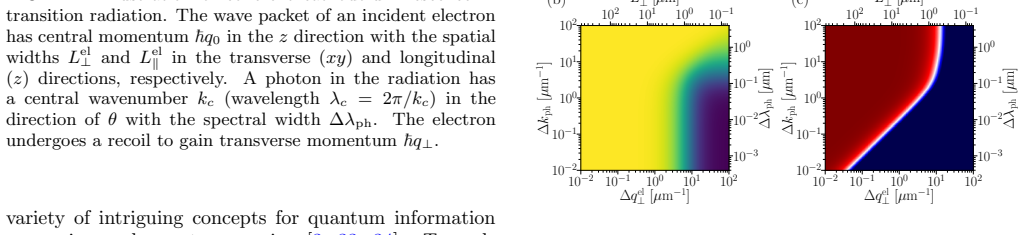
and via interaction with a membrane [27]. Only recently have demonstrations of electron–photon entan- glement generated via cathodoluminescence (CL) been reported [28, 29]. These results mark a milestone in leveraging the unique quantum properties in electron microscopy. The intro- duction of quantum imaging techniques holds great po- tential for overcomi...
work page internal anchor Pith review Pith/arXiv arXiv 2026
-
[2]
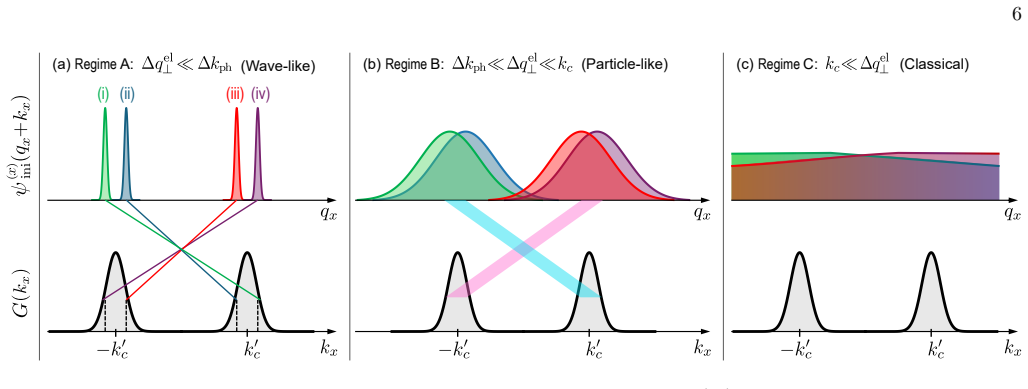
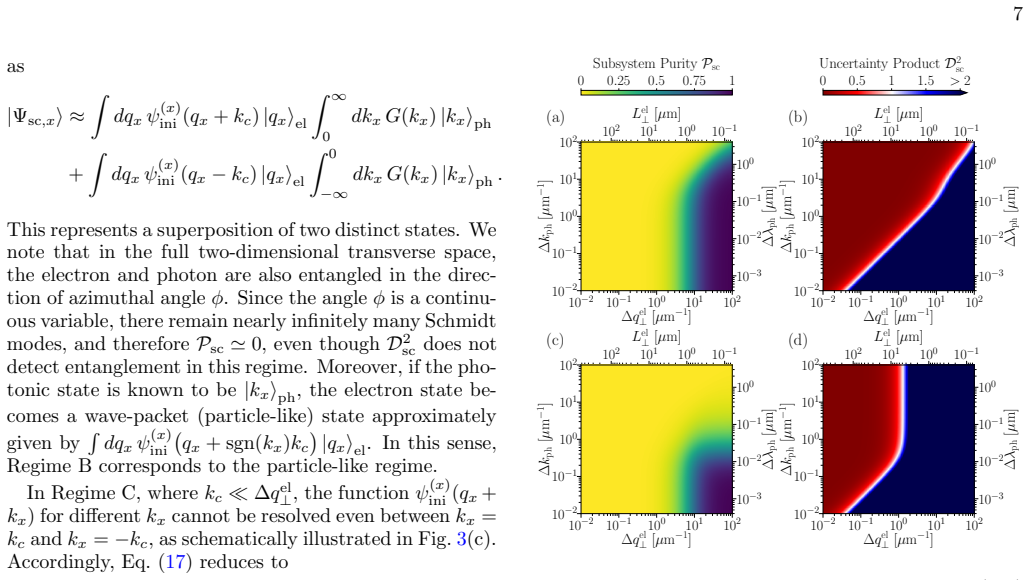
Therefore, this regime corresponds to the classical regime. In summary, in the small-∆k ph regime (∆kph ≪∆q el ∥ and ∆kph ≪k c), the boundary between Regimes A and B lies around ∆q el ⊥ ≈∆k ph, while that between Regimes B and C lies around ∆q el ⊥ ≈k c. D. Influence of electron longitudinal coherence We next examine how the longitudinal coherence of the ...
-
[3]
Perturbation theory In this paper, we consider the case in which each elec- tron in the electron beam induces at most one photon emission, if it occurs. In general, a state of the electron– photon system whose photon number is zero or one is expressed as |Ψ(t)⟩= Z d3q α0(t,q)e −iεqt |q,vac⟩ + Z d3q d3k α1(t,q,k)e −i(εq+ωk)t |q,k⟩,(A1) whereε q =ℏq 2/(2m) ...
-
[4]
Connection between the scattered state and the luminescence spectrum To obtain the expression (3) of the scattered-state am- plitudeψ sc(q,k), we consider the excitation probability (luminescence spectrum) Γ(k) = R d3q| ⟨q,k|Ψ sc⟩ |2 of a photon with a wavevectorkassociated to this scattering event. From Eqs. (A23) and(A24), it is given by Γ(k) = Z d3q ψs...
-
[5]
Joint spatial distributionP(x el, xph) We here derive Eq. (20) for the joint probability distributionP(x el, xph) that the electron is atx el and the photon is atx ph in thexdirection. The joint distributionP(x el, xph) is defined by P(x el, xph) = Z dyeldzel dyphdzph ⟨rel,r ph|Ψsc⟩ 2 ,(C1) 12 wherer el = (xel, yel, zel) andr ph = (xph, yph, zph). Using E...
-
[6]
Joint wavevector distributionP(q el x , kph x ) We here derive Eq. (21) for the joint probability distributionP(q el x , kph x ) that the electron’s wavevector isq el x and the photon’s wavevectorq el x in thexdirection. The joint distributionP(q el x , kph x ) is defined by P(q el x , kph x ) = Z dqel y dqel z dkph y dkph z qel,k ph Ψsc 2 ,(C4) whereq el...
-
[7]
(14) and (16) for the relative position uncertainty [∆(xel −x ph)]2
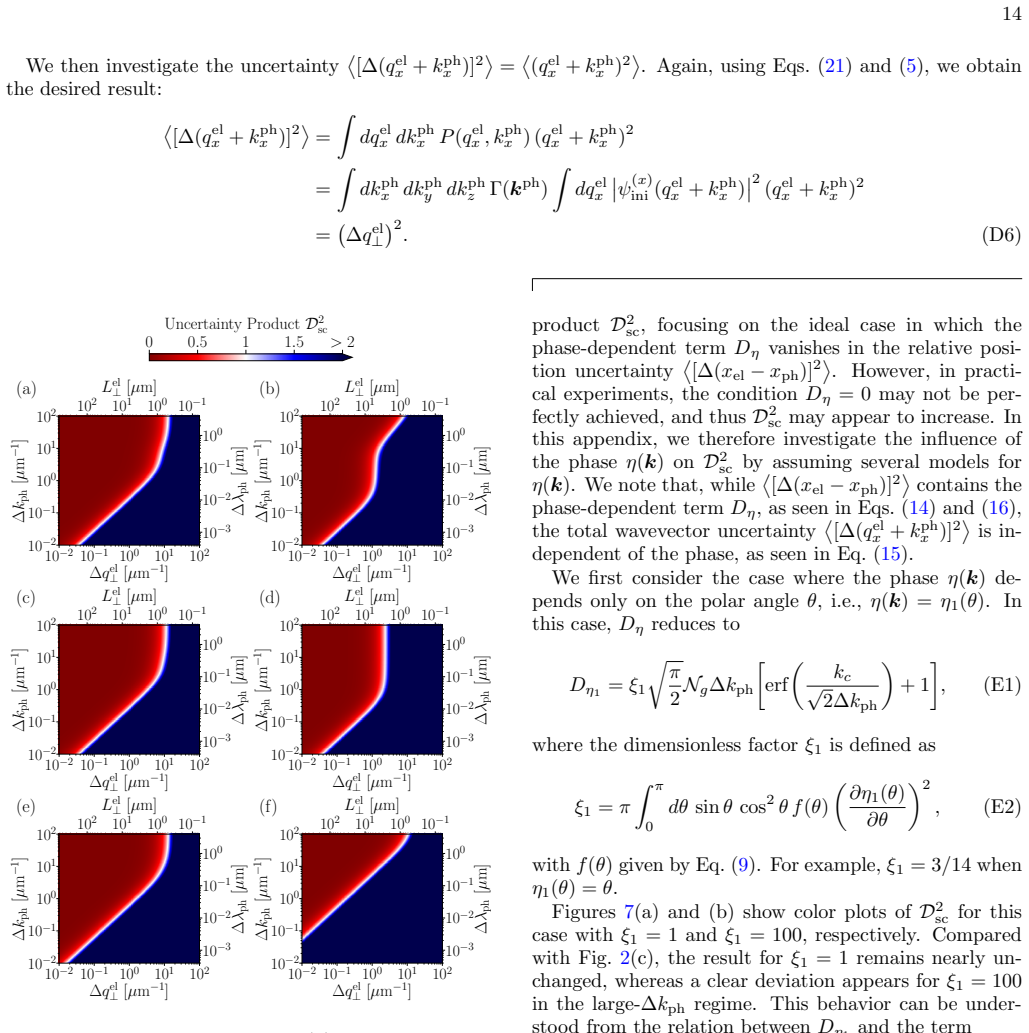
Relative position uncertainty [∆(xel −x ph)]2 We here derive Eqs. (14) and (16) for the relative position uncertainty [∆(xel −x ph)]2 . We first show that the average ofx el −x ph is zero. To this end, we note the relations Γ(−k x, ky, kz) = Γ(kx, ky, kz) andη(−k x, ky, kz) =η(k x, ky, kz), which follow from the in-plane rotational symmetry for Γ(k) andη(...
-
[8]
(15), [∆(qel x +k ph x )]2 = ∆qel ⊥ 2 , without assuming a model for Γ(k)
Total wavevector uncertainty [∆(qel x +k ph x )]2 We here derive Eq. (15), [∆(qel x +k ph x )]2 = ∆qel ⊥ 2 , without assuming a model for Γ(k). We first show that the average ofq el x +k ph x is zero. Using Eqs. (21) and (5) and noting ψ(x) ini (−qx)|2 =|ψ (x) ini (qx)|2, we calculate qel x +k ph x as qel x +k ph x = Z dqel x dkph x P(q el x , kph x ) (qe...
-
[9]
A. Tonomura, N. Osakabe, T. Matsuda, T. Kawasaki, J. Endo, S. Yano, and H. Yamada, Evidence for Aharonov-Bohm effect with magnetic field completely shielded from electron wave, Phys. Rev. Lett.56, 792 (1986)
work page 1986
-
[10]
A. Tonomura, J. Endo, T. Matsuda, T. Kawasaki, and H. Ezawa, Demonstration of single-electron buildup of an interference pattern, American Journal of Physics57, 117 (1989)
work page 1989
- [11]
-
[12]
F. J. Garc´ ıa de Abajo, A. Polman, C. I. Velasco, M. Ko- ciak, L. H. G. Tizei, O. St´ ephan, S. Meuret, T. San- nomiya, K. Akiba, Y. Auad, A. Feist, C. Ropers, P. Baum, J. H. Gaida, M. Sivis, H. Louren¸ co-Martins, L. Serafini, J. Verbeeck, A. Koneˇ cn´ a, N. Talebi, B. M. Ferrari, C. J. R. Duncan, M. G. Bravi, I. Ostroman, G. M. Vanacore, E. Nussinson, ...
work page 2025
-
[13]
V. Giovannetti, S. Lloyd, and L. Maccone, Quantum- enhanced measurements: Beating the standard quantum limit, Science306, 1330 (2004)
work page 2004
-
[14]
V. Giovannetti, S. Lloyd, and L. Maccone, Advances in quantum metrology, Nature Photonics5, 222 (2011)
work page 2011
-
[15]
C. L. Degen, F. Reinhard, and P. Cappellaro, Quantum sensing, Rev. Mod. Phys.89, 035002 (2017)
work page 2017
-
[16]
Barbieri, Optical quantum metrology, PRX Quantum 3, 010202 (2022)
M. Barbieri, Optical quantum metrology, PRX Quantum 3, 010202 (2022)
work page 2022
-
[17]
M. A. Nielsen and I. L. Chuang,Quantum Computation and Quantum Information(Cambridge University Press, Cambridge; New York, 2010)
work page 2010
-
[18]
Y. Yamamoto and K. Semba, eds.,Principles and Meth- ods of Quantum Information Technologies(Springer Tokyo, 2016)
work page 2016
-
[19]
M. M. Wilde,Quantum Information Theory, 2nd ed. (Cambridge University Press, Cambridge; New York, 2017)
work page 2017
- [20]
-
[21]
C. Roques-Carmes, S. E. Kooi, Y. Yang, N. Rivera, P. D. Keathley, J. D. Joannopoulos, S. G. Johnson, I. Kaminer, K. K. Berggren, and M. Soljaˇ ci´ c, Free-electron–light in- teractions in nanophotonics, Applied Physics Reviews 10, 011303 (2023)
work page 2023
-
[22]
B. Barwick, D. J. Flannigan, and A. H. Zewail, Photon- induced near-field electron microscopy, Nature462, 902 (2009)
work page 2009
- [23]
-
[24]
Kfir, Entanglements of electrons and cavity photons in the strong-coupling regime, Phys
O. Kfir, Entanglements of electrons and cavity photons in the strong-coupling regime, Phys. Rev. Lett.123, 103602 (2019)
work page 2019
-
[25]
O. Kfir, V. D. Giulio, F. J. G. de Abajo, and C. Ropers, Optical coherence transfer mediated by free electrons, Science Advances7, eabf6380 (2021)
work page 2021
-
[26]
A. Karnieli, N. Rivera, A. Arie, and I. Kaminer, The coherence of light is fundamentally tied to the quantum coherence of the emitting particle, Science Advances7, eabf8096 (2021)
work page 2021
- [27]
-
[28]
A. Koneˇ cn´ a, F. Iyikanat, and F. J. G. de Abajo, En- tangling free electrons and optical excitations, Science Advances8, eabo7853 (2022)
work page 2022
- [29]
-
[30]
E. Kazakevich, H. Aharon, and O. Kfir, Spatial electron- 16 photon entanglement, Phys. Rev. Res.6, 043033 (2024)
work page 2024
-
[31]
X. Shi, L. W. W. Wong, S. Huang, L. J. Wong, and I. Kaminer, Transverse recoil imprinted on free-electron radiation, Nature Communications15, 7803 (2024)
work page 2024
- [32]
-
[33]
P. Rembold, S. Beltr´ an-Romero, A. Preimesberger, S. Bogdanov, I. C. Bicket, N. Friis, E. Agudelo, D. R¨ atzel, and P. Haslinger, State-agnostic approach to certify- ing electron–photon entanglement in electron microscopy, Quantum Science and Technology10, 045003 (2025)
work page 2025
- [34]
-
[35]
A. Preimesberger, D. Hornof, T. Dorfner, T. Schachinger, M. Hrtoˇ n, A. Koneˇ cn´ a, and P. Haslinger, Exploring single-photon recoil on free electrons, Phys. Rev. Lett. 134, 096901 (2025)
work page 2025
-
[36]
A. Preimesberger, S. Bogdanov, I. C. Bicket, P. Rembold, and P. Haslinger, Experimental verification of electron- photon entanglement (2025), arXiv:2504.13163 [quant- ph]
- [37]
-
[38]
H. Okamoto and Y. Nagatani, Entanglement-assisted electron microscopy based on a flux qubit, Applied Physics Letters104, 062604 (2014)
work page 2014
- [39]
-
[40]
C. I. Velasco and F. J. Garc´ ıa de Abajo, Quantum sensing and metrology with free electrons, Nature Communica- tions17, 868 (2025)
work page 2025
-
[41]
O. Reinhardt, C. Mechel, M. Lynch, and I. Kaminer, Free-electron qubits, Annalen der Physik533, 2000254 (2021)
work page 2021
-
[42]
A. Karnieli, S. Tsesses, R. Yu, N. Rivera, A. Arie, I. Kaminer, and S. Fan, Universal and ultrafast quantum computation based on free-electron-polariton blockade, PRX Quantum5, 010339 (2024)
work page 2024
-
[43]
N. Talebi, Strong interaction of slow electrons with near- field light visited from first principles, Phys. Rev. Lett. 125, 080401 (2020)
work page 2020
-
[44]
Z. Xie, Z. Chen, H. Li, Q. Yan, H. Chen, X. Lin, I. Kaminer, O. D. Miller, and Y. Yang, Maximal quantum interaction between free electrons and photons, Phys. Rev. Lett.134, 043803 (2025)
work page 2025
-
[45]
Zhao, Upper bound for the quantum coupling between free electrons and photons, Phys
Z. Zhao, Upper bound for the quantum coupling between free electrons and photons, Phys. Rev. Lett.134, 043804 (2025)
work page 2025
-
[46]
F. J. Garc´ ıa de Abajo, Optical excitations in electron microscopy, Rev. Mod. Phys.82, 209 (2010)
work page 2010
-
[47]
F. J. Garcia de Abajo and V. Di Giulio, Optical excita- tions with electron beams: Challenges and opportunities, ACS Photonics8, 945 (2021)
work page 2021
-
[48]
S. Mancini, V. Giovannetti, D. Vitali, and P. Tombesi, Entangling macroscopic oscillators exploiting radiation pressure, Phys. Rev. Lett.88, 120401 (2002)
work page 2002
-
[49]
D. B. Williams and C. B. Carter,Transmission Electron Microscopy(Springer New York, NY, 2009)
work page 2009
- [50]
-
[51]
K. W. Chan, C. K. Law, and J. H. Eberly, Localized single-photon wave functions in free space, Phys. Rev. Lett.88, 100402 (2002)
work page 2002
-
[52]
K. W. Chan, C. K. Law, and J. H. Eberly, Quantum entanglement in photon-atom scattering, Phys. Rev. A 68, 022110 (2003)
work page 2003
-
[53]
C. K. Law and J. H. Eberly, Analysis and interpreta- tion of high transverse entanglement in optical paramet- ric down conversion, Phys. Rev. Lett.92, 127903 (2004)
work page 2004
-
[54]
M. V. Fedorov, M. A. Efremov, A. E. Kazakov, K. W. Chan, C. K. Law, and J. H. Eberly, Spontaneous emission of a photon: Wave-packet structures and atom-photon entanglement, Phys. Rev. A72, 032110 (2005)
work page 2005
- [55]
- [56]
-
[57]
H. Di Lorenzo Pires, C. H. Monken, and M. P. van Exter, Direct measurement of transverse-mode entanglement in two-photon states, Phys. Rev. A80, 022307 (2009)
work page 2009
-
[58]
A. D’Errico and E. Karimi, Imaging of biphoton states: Fundamentals and applications, Advanced Functional Materials , e26562 (2026)
work page 2026
-
[59]
J. C. Howell, R. S. Bennink, S. J. Bentley, and R. W. Boyd, Realization of the Einstein-Podolsky-Rosen para- dox using momentum- and position-entangled photons from spontaneous parametric down conversion, Phys. Rev. Lett.92, 210403 (2004)
work page 2004
-
[60]
M. D’Angelo, A. Valencia, M. H. Rubin, and Y. Shih, Resolution of quantum and classical ghost imaging, Phys. Rev. A72, 013810 (2005)
work page 2005
-
[61]
S. Walborn, C. Monken, S. P´ adua, and P. Souto Ribeiro, Spatial correlations in parametric down-conversion, Physics Reports495, 87 (2010)
work page 2010
discussion (0)
Sign in with ORCID, Apple, or X to comment. Anyone can read and Pith papers without signing in.