Instability and self-propulsion of flexible autophoretic filaments
Pith reviewed 2026-05-21 23:06 UTC · model grok-4.3
The pith
A straight elastic filament with uniform chemistry can start swimming by buckling under its own flows.
A machine-rendered reading of the paper's core claim, the machinery that carries it, and where it could break.
Core claim
A straight elastic filament with homogeneous surface chemical properties—which is otherwise immotile—can spontaneously achieve self-propulsion by experiencing a buckling instability that serves as the symmetry-breaking mechanism. Numerical simulations characterize the nonlinear dynamics and identify distinct modes: a steadily translating U shape and a metastable rotating S shape for semiflexible filaments, and an oscillatory state for highly flexible ones.
What carries the argument
Buckling instability driven by autophoretic slip flows on the elastic filament
If this is right
- Semiflexible filaments settle into a steadily translating U shape.
- A metastable rotating S shape can appear under certain conditions.
- Highly flexible filaments enter an oscillatory swimming state.
- The mechanism supplies a design principle for reconfigurable synthetic active colloids.
Where Pith is reading between the lines
- The same buckling route to motion could operate in other flexible active structures such as polymer chains or biological filaments placed in chemical gradients.
- Varying filament stiffness and activity strength in experiments would locate the onset threshold for spontaneous propulsion.
- Multiple filaments interacting through shared solute fields might produce collective patterns beyond the single-filament cases studied here.
Load-bearing premise
Autophoretic slip flows are strong enough relative to bending stiffness to trigger buckling before thermal fluctuations or non-uniformities dominate, and the filament stays in the low-Reynolds-number regime.
What would settle it
A simulation or experiment in which a straight, chemically uniform filament experiences increasing slip-flow strength yet remains straight and produces no net propulsion.
Figures


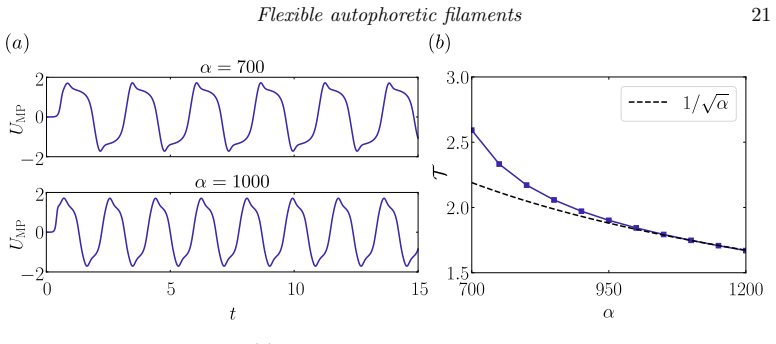
read the original abstract
Over the past decade, autophoretic colloids have emerged as a prototypical system for studying self-propelled motion at microscopic scales, with promising applications in microfluidics, micromachinery, and therapeutics. Their motion in a viscous fluid hinges on their ability to induce surface slip flows that are spatially asymmetric from self-generated solute gradients. Here, we demonstrate theoretically that a straight elastic filament with homogeneous surface chemical properties -- which is otherwise immotile -- can spontaneously achieve self-propulsion by experiencing a buckling instability that serves as the symmetry-breaking mechanism. Using efficient numerical simulations, we characterize the nonlinear dynamics of the elastic filament and show that, over time, it attains distinct swimming modes such as a steadily translating "U" shape and a metastable rotating "S" shape when semiflexible, and an oscillatory state when highly flexible. Our findings provide physical insight into future experiments and the design of reconfigurable synthetic active colloids.
Editorial analysis
A structured set of objections, weighed in public.
Referee Report
Summary. The manuscript claims that a straight elastic filament with uniform autophoretic activity, which is immotile by symmetry, can spontaneously buckle due to self-generated slip flows. This buckling acts as a symmetry-breaking mechanism enabling net self-propulsion. Numerical simulations are used to characterize the resulting nonlinear dynamics, identifying a steadily translating U-shape for semiflexible filaments, a metastable rotating S-shape, and oscillatory states for highly flexible cases.
Significance. If the central claim is substantiated, the work identifies a route to self-propulsion in chemically homogeneous active filaments that relies on elastic instability rather than built-in asymmetry. This mechanism could inform the design of reconfigurable synthetic microswimmers and contribute to understanding elasticity-driven motility in low-Reynolds-number active matter. The numerical exploration of multiple dynamical regimes is a positive aspect of the study.
major comments (2)
- [Simulation Setup] Simulation Setup section: The manuscript does not state whether the straight filament is initialized with machine-precision zero curvature or with added small random displacements. The central claim requires spontaneous onset from the perfectly symmetric homogeneous state; if the numerics rely on explicit perturbations to seed buckling, the symmetry-breaking mechanism is not demonstrated to arise deterministically from the governing equations alone.
- [Results] Results section on instability: No linear stability analysis of the straight, homogeneous base state is reported. Such an analysis would be needed to confirm that the autophoretic slip flows render the straight configuration linearly unstable, as required for the spontaneous buckling and propulsion mechanism to hold without numerical seeding.
minor comments (2)
- [Abstract] The abstract refers to 'efficient numerical simulations' without naming the discretization method (e.g., boundary-element or immersed-boundary approach) or the nondimensionalization of the flexibility parameter.
- [Figures] Figure captions could more explicitly label the direction of the phoretic slip velocity relative to the local curvature in the U- and S-shaped states.
Simulated Author's Rebuttal
We thank the referee for their careful reading of our manuscript and for the constructive comments. We address each of the major comments in turn below.
read point-by-point responses
-
Referee: [Simulation Setup] Simulation Setup section: The manuscript does not state whether the straight filament is initialized with machine-precision zero curvature or with added small random displacements. The central claim requires spontaneous onset from the perfectly symmetric homogeneous state; if the numerics rely on explicit perturbations to seed buckling, the symmetry-breaking mechanism is not demonstrated to arise deterministically from the governing equations alone.
Authors: The straight filament is initialized with machine-precision zero curvature, without any added random displacements or explicit perturbations. The buckling instability emerges due to the inherent numerical noise in the floating-point computations, which provides the necessary infinitesimal symmetry-breaking perturbation. This approach is typical for demonstrating spontaneous instabilities in numerical simulations of nonlinear systems. We will update the Simulation Setup section to clearly specify the initialization procedure and confirm that no artificial seeding is used. revision: yes
-
Referee: [Results] Results section on instability: No linear stability analysis of the straight, homogeneous base state is reported. Such an analysis would be needed to confirm that the autophoretic slip flows render the straight configuration linearly unstable, as required for the spontaneous buckling and propulsion mechanism to hold without numerical seeding.
Authors: We acknowledge that a linear stability analysis of the base state is not presented in the manuscript. While such an analysis would strengthen the theoretical foundation, it would require a substantial additional effort to linearize the coupled integro-differential equations governing the elastic filament, the Stokes flow, and the solute concentration field. Our numerical results demonstrate the instability through the evolution from the symmetric initial condition, with clear exponential growth phases in the early dynamics. In the revised manuscript, we will include a discussion of this point and the supporting numerical evidence. revision: partial
Circularity Check
No circularity: dynamics follow from standard hydrodynamic-elastic equations
full rationale
The paper derives the buckling instability and resulting propulsion modes from the standard low-Reynolds-number Stokes equations coupled to linear elasticity and a uniform autophoretic slip boundary condition. No parameter is fitted to a subset of the target dynamics and then relabeled as a prediction; the homogeneous straight state is shown to be linearly unstable by the governing equations themselves, and the nonlinear evolution is obtained by direct numerical integration. No self-citation is invoked as the sole justification for a uniqueness theorem or ansatz that would force the result, and the symmetry breaking is not smuggled in by redefinition of known patterns. The reported swimming states therefore constitute independent content generated by the model rather than a tautological restatement of its inputs.
Axiom & Free-Parameter Ledger
free parameters (1)
- flexibility parameter
axioms (1)
- domain assumption Fluid flow obeys the Stokes equations at low Reynolds number.
Lean theorems connected to this paper
-
IndisputableMonolith/Foundation/AlexanderDuality.leanalexander_duality_circle_linking unclear?
unclearRelation between the paper passage and the cited Recognition theorem.
the elastophoretic number α = 8πη a l² |AM| / (B D) ... eigenvalue problem σ_n φ_n(s) = ... (b+1)/α ∂⁴_s φ_n
-
IndisputableMonolith/Cost/FunctionalEquation.leanwashburn_uniqueness_aczel unclear?
unclearRelation between the paper passage and the cited Recognition theorem.
growth rate ... governed by the balance between the phoretic and elastic force densities
What do these tags mean?
- matches
- The paper's claim is directly supported by a theorem in the formal canon.
- supports
- The theorem supports part of the paper's argument, but the paper may add assumptions or extra steps.
- extends
- The paper goes beyond the formal theorem; the theorem is a base layer rather than the whole result.
- uses
- The paper appears to rely on the theorem as machinery.
- contradicts
- The paper's claim conflicts with a theorem or certificate in the canon.
- unclear
- Pith found a possible connection, but the passage is too broad, indirect, or ambiguous to say the theorem truly supports the claim.
Reference graph
Works this paper leans on
-
[1]
Alapan, Yunus , Yasa, Oncay , Yigit, Berk , Yasa, I. Ceren , Erkoc, Pelin & Sitti, Metin 2019 Microrobotics and Microorganisms : Biohybrid Autonomous Cellular Robots . Annual Review of Control, Robotics, and Autonomous Systems 2 (1), 205--230
work page 2019
- [2]
-
[3]
Altunkeyik, Berk , Rahmat, Amin & Montenegro-Johnson, Tom 2025 Dynamics of active poroelastic filaments in stokes flow . Phys. Rev. E 111 , 025421
work page 2025
-
[4]
Anderson, J. L. 1989 Colloid Transport by Interfacial Forces . Annual Review of Fluid Mechanics 21 (Volume 21, 1989), 61--99
work page 1989
-
[5]
Nature Physics 14 , 1114--1118
Aubret, Antoine , Youssef, Mena , Sacanna, Stefano & Palacci, Jérémie 2018 Targeted assembly and synchronization of self-spinning microgears . Nature Physics 14 , 1114--1118
work page 2018
-
[6]
Audoly, Basile & Pomeau, Yves 2010 Elasticity and Geometry: From hair curls to the non-linear response of shells \/ . Oxford: OUP Oxford
work page 2010
-
[7]
Baker, Remmi Danae , Montenegro-Johnson , Thomas , Sediako, Anton D. , Thomson, Murray J. , Sen, Ayusman , Lauga, Eric & Aranson, Igor S. 2019 Shape-programmed 3D printed swimming microtori for the transport of passive and active agents . Nature Communications 10 (1), 4932
work page 2019
-
[8]
Baraban, L. , Tasinkevych, M. , Popescu, M. N. , Sanchez, S. , Dietrich, S. & Schmidt, O. G. 2012 Transport of cargo by catalytic janus micro-motors . Soft Matter 8 , 48–52
work page 2012
-
[9]
Batchelor, G. K. 1970 Slender-body theory for particles of arbitrary cross-section in Stokes flow . Journal of Fluid Mechanics 44 (3), 419--440 , publisher: Cambridge University Press
work page 1970
-
[10]
Becker, Leif E. & Shelley, Michael J. 2001 Instability of Elastic Filaments in Shear Flow Yields First-Normal-Stress Differences . Physical Review Letters 87 (19), 198301
work page 2001
-
[11]
Biswas, Bipul , Manna, Raj Kumar , Laskar, Abhrajit , Kumar, P. B. Sunil , Adhikari, Ronojoy & Kumaraswamy, Guruswamy 2017 Linking catalyst-coated isotropic colloids into “active” flexible chains enhances their diffusivity . ACS Nano 11 (10), 10025–10031 , pMID: 28898046, arXiv:arXiv: https://doi.org/10.1021/acsnano.7b04265
- [12]
-
[13]
Bourdieu, L. , Magnasco, M. O. , Winkelmann, D. A. & Libchaber, A. 1995 Actin filaments on myosin beds: The velocity distribution . Phys. Rev. E 52 , 6573--6579
work page 1995
-
[14]
Boyd, John P. 2001 Chebyshev and Fourier Spectral Methods : Second Revised Edition \/ , second edition, revised edn. Mineola, N.Y: Dover Publications
work page 2001
- [15]
-
[16]
New Journal of Physics 2 (1), 324
Camalet, Sébastien & Jülicher, Frank 2000 Generic aspects of axonemal beating . New Journal of Physics 2 (1), 324
work page 2000
-
[17]
Nature Physics 16 (6), 689--694
Chakrabarti, Brato , Liu, Yanan , LaGrone, John , Cortez, Ricardo , Fauci, Lisa , Du Roure, Olivia , Saintillan, David & Lindner, Anke 2020 Flexible filaments buckle into helicoidal shapes in strong compressional flows . Nature Physics 16 (6), 689--694
work page 2020
-
[18]
Chakrabarti, Brato & Saintillan, David 2019 Spontaneous oscillations, beating patterns, and hydrodynamics of active microfilaments . Phys. Rev. Fluids 4 , 043102
work page 2019
-
[19]
Charru, Fran c ois 2007 Instabilit \'e s hydrodynamiques \/ . Les Ulis Paris: EDP SCIENCES
work page 2007
-
[20]
Chelakkot, Raghunath , Gopinath, Arvind , Mahadevan, L. & Hagan, Michael F. 2014 Flagellar dynamics of a connected chain of active, polar, brownian particles . Journal of The Royal Society Interface 11 (92), 20130884 , arXiv:arXiv: https://royalsocietypublishing.org/doi/pdf/10.1098/rsif.2013.0884
-
[21]
Chelakkot, Raghunath , Winkler, Roland G. & Gompper, Gerhard 2012 Flow- Induced Helical Coiling of Semiflexible Polymers in Structured Microchannels . Physical Review Letters 109 (17), 178101
work page 2012
-
[22]
2024 Bifurcations and nonlinear dynamics of the follower force model for active filaments
Clarke, Bethany , Hwang, Yongyun & Keaveny, Eric E. 2024 Bifurcations and nonlinear dynamics of the follower force model for active filaments . Physical Review Fluids 9 (7), 073101
work page 2024
-
[23]
& Schnitzer, Ory 2024 Spontaneous locomotion of a symmetric squirmer
Cobos, Richard , Khair, Aditya S. & Schnitzer, Ory 2024 Spontaneous locomotion of a symmetric squirmer . Journal of Fluid Mechanics 983 , R3
work page 2024
-
[24]
Communications in Applied Mathematics and Computational Science 7 (1), 33--62
Cortez, Ricardo & Nicholas, Michael 2012 Slender body theory for Stokes flows with regularized forces . Communications in Applied Mathematics and Computational Science 7 (1), 33--62
work page 2012
-
[25]
Cox, R. G. 1970 The motion of long slender bodies in a viscous fluid Part 1. General theory . Journal of Fluid Mechanics 44 (04), 791
work page 1970
-
[26]
2017 Spontaneous oscillations of elastic filaments induced by molecular motors
De Canio, Gabriele , Lauga, Eric & Goldstein, Raymond E. 2017 Spontaneous oscillations of elastic filaments induced by molecular motors . Journal of The Royal Society Interface 14 (136), 20170491
work page 2017
-
[27]
Journal of Computational Physics 518 , 113321
Delmotte, Blaise & Usabiaga, Florencio Balboa 2024 A scalable method to model large suspensions of colloidal phoretic particles with arbitrary shapes . Journal of Computational Physics 518 , 113321
work page 2024
-
[28]
Derjaguin, B. V. , Sidorenkov, G. , Zubashchenko, E. & Kiseleva, E. 1993 Kinetic Phenomena in the boundary layers of liquids 1. the capillary osmosis . Progress in Surface Science 43 (1), 138--152
work page 1993
-
[29]
, Fermigier, Marc , Stone, Howard A
Dreyfus, R \'e mi , Baudry, Jean , Roper, Marcus L. , Fermigier, Marc , Stone, Howard A. & Bibette, J \'e r \^o me 2005 Microscopic artificial swimmers . Nature 437 (7060), 862--865
work page 2005
-
[30]
The Royal Society of Chemistry
Duprat, Camille & Stone, Howard 2015 Fluid–Structure Interactions in Low-Reynolds-Number Flows\/ . The Royal Society of Chemistry
work page 2015
-
[31]
Elastocapillary self-folding: buckling, wrinkling and collapse of floating filaments
Evans, Arthur A. , Spagnolie, Saverio E. , Bartolo, Denis & Lauga, Eric 2013 Elastocapillary self-folding: Buckling, wrinkling and collapse of floating filaments . Soft Matter 9 (5), 1711--1720 , arXiv:arXiv: 1209.2149
work page internal anchor Pith review Pith/arXiv arXiv 2013
-
[32]
Science 254 (5036), 1300--1301
Feynman, Richard 1991 There's plenty of room at the bottom . Science 254 (5036), 1300--1301
work page 1991
-
[33]
Physical Review Fluids 8 (1), 014103
Ganguly, Arkava & Gupta, Ankur 2023 Going in circles: Slender body analysis of a self-propelling bent rod . Physical Review Fluids 8 (1), 014103
work page 2023
-
[34]
Glendinning, Paul 1994 Stability, Instability and Chaos : An Introduction to the Theory of Nonlinear Differential Equations \/ , Cambridge Texts in Applied Mathematics , vol. 11 . Cambridge: Cambridge University Press
work page 1994
-
[35]
Golestanian, Ramin , Liverpool, Tanniemola B. & Ajdari, Armand 2005 Propulsion of a Molecular Machine by Asymmetric Distribution of Reaction Products . Physical Review Letters 94 (22), 220801
work page 2005
-
[36]
New Journal of Physics 9 (5), 126--126
Golestanian, R , Liverpool, T B & Ajdari, A 2007 Designing phoretic micro- and nano-swimmers . New Journal of Physics 9 (5), 126--126
work page 2007
-
[37]
G \"o tz, Thomas 2000 Interactions of fibers and flow : Asymptotics , Theory and Numerics . PhD thesis
work page 2000
-
[38]
Guglielmini, Laura , Kushwaha, Amit , Shaqfeh, Eric S. G. & Stone, Howard A. 2012 Buckling transitions of an elastic filament in a viscous stagnation point flow . Physics of Fluids 24 (12), 123601
work page 2012
-
[39]
Guix, Maria , Weiz, Sonja M. , Schmidt, Oliver G. & Medina-S \'a nchez , Mariana 2018 Self- Propelled Micro / Nanoparticle Motors . Particle & Particle Systems Characterization 35 (2), 1700382
work page 2018
-
[40]
Hall-McNair , A. L. , Montenegro-Johnson , T. D. , Gad \^e lha, H. , Smith, D. J. & Gallagher, M. T. 2019 Efficient implementation of elastohydrodynamics via integral operators . Physical Review Fluids 4 (11), 113101
work page 2019
-
[41]
Proceedings of the Royal Society of London
Hancock, G.J 1953 The self-propulsion of microscopic organisms through liquids . Proceedings of the Royal Society of London. Series A. Mathematical and Physical Sciences 217 (1128), 96--121
work page 1953
-
[42]
Howse, Jonathan R. , Jones, Richard A. L. , Ryan, Anthony J. , Gough, Tim , Vafabakhsh, Reza & Golestanian, Ramin 2007 Self- Motile Colloidal Particles : From Directed Propulsion to Random Walk . Physical Review Letters 99 (4), 048102
work page 2007
-
[43]
Physical Review Letters 123 (23), 238004
Hu, Wei-Fan , Lin, Te-Sheng , Rafai, Salima & Misbah, Chaouqi 2019 Chaotic Swimming of Phoretic Particles . Physical Review Letters 123 (23), 238004
work page 2019
- [44]
-
[45]
Illien, Pierre , Golestanian, Ramin & Sen, Ayusman 2017 ‘fuelled’ motion: phoretic motility and collective behaviour of active colloids . Chem. Soc. Rev. 46 , 5508–5518
work page 2017
-
[46]
2020 A numerical method for inextensible elastic filaments in viscous fluids
Jabbarzadeh, Mehdi & Fu, Henry C. 2020 A numerical method for inextensible elastic filaments in viscous fluids . Journal of Computational Physics 418 , 109643
work page 2020
-
[47]
Jayaraman, Gayathri , Ramachandran, Sanoop , Ghose, Somdeb , Laskar, Abhrajit , Bhamla, M. Saad , Kumar, P. B. Sunil & Adhikari, R. 2012 Autonomous Motility of Active Filaments due to Spontaneous Flow-Symmetry Breaking . Physical Review Letters 109 (15), 158302
work page 2012
-
[48]
1980 An improved slender-body theory for Stokes flow
Johnson, Robert E. 1980 An improved slender-body theory for Stokes flow . Journal of Fluid Mechanics 99 (2), 411--431
work page 1980
-
[49]
Kantsler, Vasily & Goldstein, Raymond E. 2012 Fluctuations, dynamics, and the stretch-coil transition of single actin filaments in extensional flows . Phys. Rev. Lett. 108 , 038103
work page 2012
-
[50]
, Koens, Lyndon & Montenegro-Johnson , Thomas D
Katsamba, Panayiota , Butler, Matthew D. , Koens, Lyndon & Montenegro-Johnson , Thomas D. 2023 Active Colloidal Loops and Knots , arXiv:arXiv: 2310.10217
-
[51]
Butler, Matthew , Koens, Lyndon & D
Katsamba, Panayiota , D. Butler, Matthew , Koens, Lyndon & D. Montenegro-Johnson , Thomas 2022 Chemically active filaments: Analysis and extensions of slender phoretic theory . Soft Matter 18 (37), 7051--7063
work page 2022
-
[52]
2020 Slender phoretic theory of chemically active filaments
Katsamba, Panayiota , Michelin, S \'e bastien & Montenegro-Johnson , Thomas D. 2020 Slender phoretic theory of chemically active filaments . Journal of Fluid Mechanics 898 , A24
work page 2020
-
[53]
2024 Introduction to the theories and modelling of active colloids
Katsamba, Panayiota & Montenegro-Johnson, Thomas D. 2024 Introduction to the theories and modelling of active colloids . In Active Colloids: From Fundamentals to Frontiers\/ (ed. Wei Wang, Juliane Simmchen & William Uspal ) , , vol. 20 , chap. 10, pp. 315--375 . Royal Society of Chemistry
work page 2024
- [54]
-
[55]
Keller, Joseph B. & Rubinow, Sol I. 1976 Slender-body theory for slow viscous flow . Journal of Fluid Mechanics 75 (4), 705--714
work page 1976
-
[56]
Journal of Fluid Mechanics 850 , R1
Koens, Lyndon & Lauga, Eric 2018 The boundary integral formulation of Stokes flows includes slender-body theory . Journal of Fluid Mechanics 850 , R1
work page 2018
- [57]
-
[58]
K \"u mmel, Felix , Ten Hagen, Borge , Wittkowski, Raphael , Buttinoni, Ivo , Eichhorn, Ralf , Volpe, Giovanni , L \"o wen, Hartmut & Bechinger, Clemens 2013 Circular Motion of Asymmetric Self-Propelling Particles . Physical Review Letters 110 (19), 198302
work page 2013
-
[59]
Landau, L. D. , Pitaevskii, L. P. , Kosevich, A. M. & Lifshitz, E. M. 1986 Theory of Elasticity : Volume 7\/ , 3rd edn. Amsterdam Heidelberg: Butterworth-Heinemann
work page 1986
-
[60]
2015 Brownian microhydrodynamics of active filaments
Laskar, Abhrajit & Adhikari, R. 2015 Brownian microhydrodynamics of active filaments . Soft Matter 11 (47), 9073--9085
work page 2015
-
[61]
Laskar, Abhrajit , Singh, Rajeev , Ghose, Somdeb , Jayaraman, Gayathri , Kumar, P. B. Sunil & Adhikari, R. 2013 Hydrodynamic instabilities provide a generic route to spontaneous biomimetic oscillations in chemomechanically active filaments . Scientific Reports 3 (1), 1964
work page 2013
-
[62]
Journal of Fluid Mechanics 934
Li, Gaojin 2022 Swimming dynamics of a self-propelled droplet . Journal of Fluid Mechanics 934
work page 2022
-
[63]
2013 The sedimentation of flexible filaments
Li, Lei , Manikantan, Harishankar , Saintillan, David & Spagnolie, Saverio E. 2013 The sedimentation of flexible filaments . Journal of Fluid Mechanics 735 , 705--736
work page 2013
-
[64]
Lighthill, James 1976 Flagellar Hydrodynamics . SIAM Review 18 (2), 161--230
work page 1976
-
[65]
Ling, Feng , Guo, Hanliang & Kanso, Eva 2018 Instability-driven oscillations of elastic microfilaments . Journal of The Royal Society Interface 15 (149), 20180594 , arXiv:arXiv: https://royalsocietypublishing.org/doi/pdf/10.1098/rsif.2018.0594
-
[66]
Lough, Wilson , Weibel, Douglas B. & Spagnolie, Saverio E. 2023 Self-buckling and self-writhing of semi-flexible microorganisms . Soft Matter 19 (38), 7349--7357
work page 2023
-
[67]
, Krüger, Carsten , Herminghaus, Stephan & Bahr, Christian 2016 Swimming droplets
Maass, Corinna C. , Krüger, Carsten , Herminghaus, Stephan & Bahr, Christian 2016 Swimming droplets . Annual Review of Condensed Matter Physics 7 (Volume 7, 2016), 171–193
work page 2016
-
[68]
Maggi, Claudio , Simmchen, Juliane , Saglimbeni, Filippo , Katuri, Jaideep , Dipalo, Michele , De Angelis, Francesco , Sanchez, Samuel & Di Leonardo, Roberto 2016 Self- Assembly of Micromachining Systems Powered by Janus Micromotors . Small 12 (4), 446--451
work page 2016
-
[69]
Soft Matter 15 (25), 5163--5173
Man, Yi & Kanso, Eva 2019 Morphological transitions of axially-driven microfilaments . Soft Matter 15 (25), 5163--5173
work page 2019
-
[70]
Physical Review E 92 (4), 041002
Manikantan, Harishankar & Saintillan, David 2015 Buckling transition of a semiflexible filament in extensional flow . Physical Review E 92 (4), 041002
work page 2015
-
[71]
Manna, Raj Kumar , Kumar, P. B. Sunil & Adhikari, R. 2017 Colloidal transport by active filaments . The Journal of Chemical Physics 146 (2), 024901
work page 2017
-
[72]
Manna, R. K. , Laskar, A. , Shklyaev, O.E. & Balazs, A.C. 2022 Harnessing the power of chemically active sheets in solution. Nature Reviews Physics 4 (Volume 4, 2022), 125–137
work page 2022
-
[73]
Physical Review Fluids 3 (10), 104102
Marchetti, Benjamin , Raspa, Veronica , Lindner, Anke , du Roure , Olivia , Bergougnoux, Laurence , Guazzelli, \'E lisabeth & Duprat, Camille 2018 Deformation of a flexible fiber settling in a quiescent viscous fluid . Physical Review Fluids 3 (10), 104102
work page 2018
-
[74]
2019 Active Brownian filaments with hydrodynamic interactions: Conformations and dynamics
Mart \'i n-G \'o mez , Aitor , Eisenstecken, Thomas , Gompper, Gerhard & Winkler, Roland G. 2019 Active Brownian filaments with hydrodynamic interactions: Conformations and dynamics . Soft Matter 15 (19), 3957--3969
work page 2019
-
[75]
PhD thesis, New York University, United States -- New York
Maxian, Ondrej 2023 Hydrodynamics of Transiently Cross-Linked Actin Networks : Theory , Numerics , and Emergent Behaviors . PhD thesis, New York University, United States -- New York
work page 2023
- [76]
-
[77]
Physical Review Fluids 6 (1), 014102 , arXiv:arXiv: 2007.11728
Maxian, Ondrej , Mogilner, Alex & Donev, Aleksandar 2021 An integral-based spectral method for inextensible slender fibers in Stokes flow . Physical Review Fluids 6 (1), 014102 , arXiv:arXiv: 2007.11728
-
[78]
Annual Review of Fluid Mechanics 55 (Volume 55, 2023), 77–101
Michelin, Sébastien 2023 Self-propulsion of chemically active droplets . Annual Review of Fluid Mechanics 55 (Volume 55, 2023), 77–101
work page 2023
-
[79]
The European Physical Journal E 38 (7)
Michelin, S \'e bastien & Lauga, Eric 2015 Autophoretic locomotion from geometric asymmetry . The European Physical Journal E 38 (7)
work page 2015
-
[80]
Scientific Reports 7 (1), 42264
Michelin, S \'e bastien & Lauga, Eric 2017 Geometric tuning of self-propulsion for Janus catalytic particles . Scientific Reports 7 (1), 42264
work page 2017
discussion (0)
Sign in with ORCID, Apple, or X to comment. Anyone can read and Pith papers without signing in.