REVIEW 3 major objections 5 minor 1 cited by
Kinetic turbulence in shining pair plasma: intermittent beaming and thermalization by radiative cooling
T0 review · 3 major / 5 minor · reviewed 2026-08-14 · deepseek-v4-flash
Pith's one-line read Strong inverse Compton cooling pins a turbulent pair plasma to a quasi-thermal state and concentrates its nonthermal particles into intermittent beams.
desk verdict The thermalization result is solid and directly measured; the beaming result is a suggestive but unresolved extrapolation, and the Fokker-Planck fit is basically a consistency check, not a validation. read the letter →
The pith
A machine-rendered reading of the paper's core claim, the machinery that carries it, and where it could break.
The reading
What carries the argument
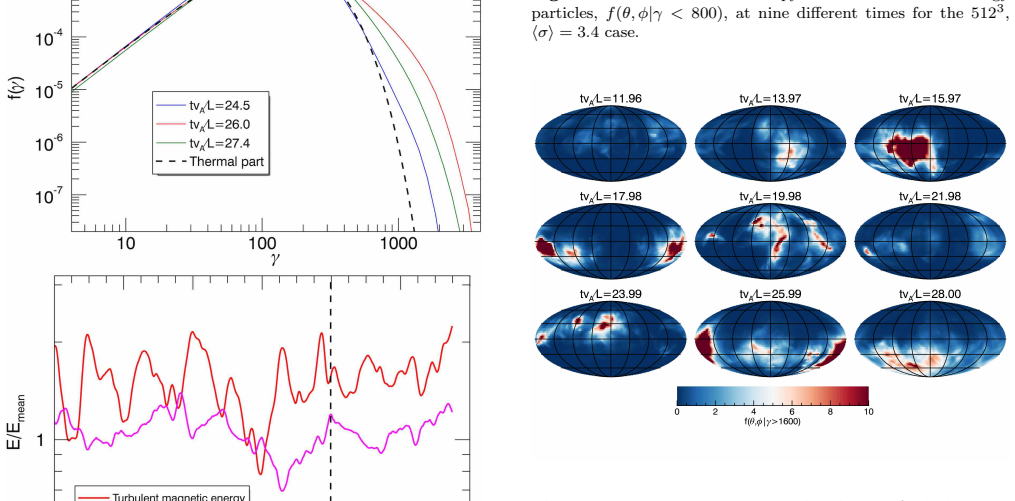
The load-bearing mechanism is the inverse Compton radiation backreaction force, $\mathbf{F}_{\rm IC} = -(4/3)\sigma_T U_{\rm ph}\gamma^2\,\mathbf{v}/c$, added to each particle's Lorentz force; because it scales as $\gamma^2$, it selectively drains the high-energy tail and fixes a statistical steady state whose mean temperature follows from balancing injected power with radiated power. The interpretation then rides on two analytic constructions: a Maxwell-Jüttner reference distribution with a thermal/nonthermal decomposition, and a steady-state Fokker-Planck equation with advection and diffusion coefficients chosen linear and quadratic in momentum, whose closed-form solution is fitted to the simulation spectra. The momentum-anisotropy diagnostic $f(\theta,\phi|\gamma)$ converts the same particle data into maps whose tails quantify intermittent beams and their current-sheet correlation.
What would settle it
Run the $\sigma\approx 3.4$ radiative turbulence at $L/2\pi\rho_e\approx 80$–$100$ and measure the PDF of the global momentum anisotropy for $\gamma>1600$: if the beam tail narrows toward the low-magnetization case instead of preserving the roughly 40–100 times average enhancements seen at $L/2\pi\rho_e\approx 39$, the kinetic-beam explanation of rapid astrophysical flares is contradicted.
Extended reading notes
Core claim
Across the parameter scan of driven relativistic pair-plasma turbulence with external inverse Compton cooling, the time-averaged particle energy distributions are quasi-thermal (Maxwell-Jüttner) in every simulation, with a nonthermal population that extends the tail by a factor of about two in energy rather than forming a power law; the nonthermal energy fraction grows with magnetization, reaching about 50% of the energy and 30% of the particles at $\sigma\approx 11$. The near-thermal shape is reproduced by a steady-state Fokker-Planck solution in which stochastic (second-order Fermi or gyroresonant) diffusion is balanced by radiation reaction. At $\sigma\gtrsim 3$, the nonthermal particles appear as highly variable, narrow beams in the global momentum anisotropy, most often perpendicular to the mean field, with enhancements of roughly 40 to 100 times the average and lifetimes near the eddy turnover time; the beam particles are spatially concentrated at current sheets and gain energy mostly from the perpendicular electric field, consistent with localized magnetic reconnection. The conclusion drawn is that strong radiative cooling quenches nonthermal acceleration in continuously driven turbulence, so broad power laws seen in astrophysical spectra may require weak cooling or a superposition of quasi-thermal regions, while swift flares could still come from beams.
Load-bearing premise
The flare connection assumes that the intermittent beams seen in the 256-cubed and 512-cubed boxes survive at astrophysically large system sizes; the paper's own size scan (Section 4.6, Fig. 26) shows the high-energy anisotropy PDF narrowing by roughly a factor of two when $L/2\pi\rho_e$ is doubled, so extrapolation to real jet scales is untested.
Editorial extensions
If this is right
- A continuously driven, strongly cooled turbulent pair plasma cannot sustain the extended nonthermal power-law tails that non-radiative turbulence produces; observed blazar broadband spectra then require either weaker cooling, transient injection followed by cooling, or a superposition of quasi-thermal zones with a range of temperatures.
- At high magnetization, high-energy particles are beamed into narrow solid angles on timescales of about $0.1\,L/v_A$, so a single beam sweeping across an observer's line of sight can produce a flare orders of magnitude above the average emission without requiring the whole source to vary.
- Because the beam particles sit at current sheets and are energized mainly by the perpendicular electric field, the paper identifies localized magnetic reconnection as the kinetic beaming mechanism in the high-magnetization regime.
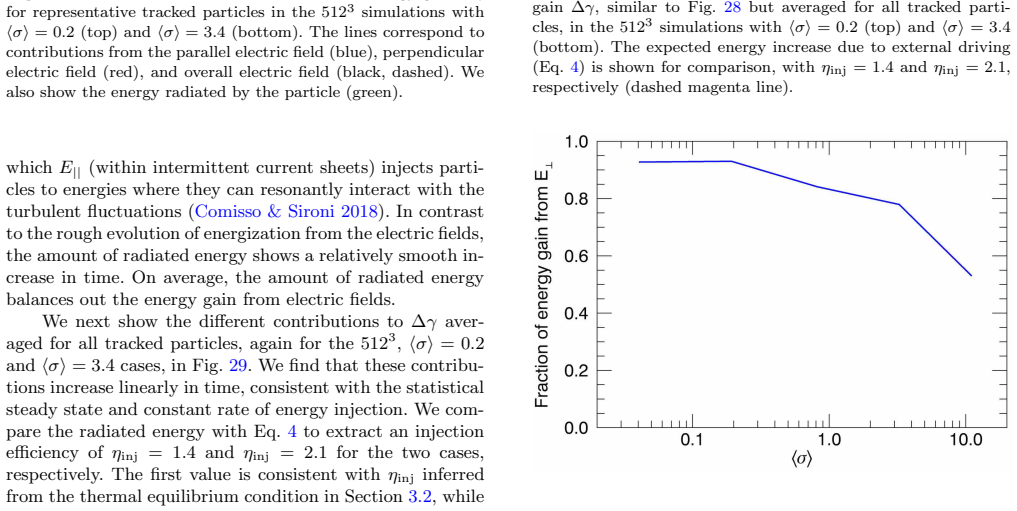
- The nonthermal fraction rises with magnetization, from a few percent at $\sigma\approx 0.04$ toward roughly half the energy at $\sigma\approx 11$, so even a thermalized, radiatively cooled plasma can emit conspicuous nonthermal radiation if its magnetization is high.
- The steady-state temperature is set by the external photon energy density, so observations that constrain the temperature and photon bath can be used to infer the turbulent injection efficiency.
Reading between the lines
- The system-size trend in Section 4.6, where the beams weaken when the box grows, suggests the flare interpretation may depend on whether astrophysical emission is dominated by the global momentum distribution or by localized sub-regions; if only the largest coherent reconnection layers contribute, global anisotropy might fade while localized flares remain, a distinction the present diagnostics can
- Directly measuring the Fokker-Planck advection and diffusion coefficients from tracked particles, rather than hand-chosen fits, would turn the well-fit claim into a quantitative test, since the paper notes the fit parameters carry considerable freedom.
- External inverse Compton cooling is spatially uniform, whereas synchrotron cooling is strongest where the magnetic field is strong, so one can predict that synchrotron radiative turbulence would localize cooling in current sheets even more sharply and perhaps increase the beam-to-average contrast; that is a testable extension for future simulations.
- If each beam is tied to a reconnection site, the relation between beam direction and the local guide-field orientation predicts flare polarization swings that could be searched for in time-resolved blazar polarimetry.
Editorial analysis
A structured set of objections, weighed in public.
Referee Report
Summary. The paper presents particle-in-cell simulations of externally driven relativistic pair-plasma turbulence with external inverse Compton cooling. It reports that, in the statistically steady state, the global particle energy distributions are quasi-thermal (Maxwell-Jüttner-like) across a magnetization scan 0.04 ≲ σ ≲ 11, with only a modest nonthermal tail that broadens the distribution by roughly a factor of two in energy. The authors interpret this as quenching of nonthermal acceleration by radiative cooling and show that the distributions can be fit by analytic Fokker-Planck solutions with radiative reaction. At high magnetization, the high-energy particles appear as intermittent, narrow beams in the global momentum anisotropy that are spatially correlated with current sheets, a phenomenon the authors suggest may explain rapid astrophysical flares. The paper also characterizes turbulence spectra, energetics, pressure anisotropy, and particle energization channels via tracked particles.
Significance. If the results hold, this is a valuable first self-consistent kinetic study of radiatively cooled driven turbulence in pair plasmas. The central thermalization claim is directly measured and robust across the magnetization scan and system-size checks, and it contrasts sharply with the extended power-law tails seen in non-radiative simulations. The paper also provides useful diagnostics of turbulence energetics and tracks particles to identify energization by perpendicular electric fields. The main qualifications are that the intermittent-beaming result is established only at moderate system sizes and weakens with size, and that the Fokker-Planck fits are explicitly provisional, so the headline flare implications and the stochastic-acceleration interpretation are weaker than the thermalization result. These concerns do not undermine the directly measured quasi-thermal distributions, which are the paper's strongest contribution.
major comments (3)
- [§4.6, Fig. 26, §6(v)] The beaming claim, which is central to the abstract and to the flare implications in §5.2, depends on an untested asymptotic limit. The size scan at ⟨σ⟩=3.4 in Fig. 26 shows that the high-energy momentum-anisotropy PDF narrows substantially when L/2πρe increases from 18.0 to 39.1, and §6(v) concedes that "the beaming becomes weaker as the system size is increased... raising questions about beaming statistics in the limit of large system size." Since no high-magnetization run at L/2πρe ≳ 60 is presented (the 768³ run is at ⟨σ⟩≈0.9), the paper does not establish that intermittent beaming persists at scales relevant to astrophysical flares. I ask for either an additional high-σ run at larger system size or a substantial reframing of the flare conclusions as scale-dependent and not yet demonstrated.
- [§4.2, Table 2, Appendix A] The claim that the quasi-thermal distributions are "well fit by analytic models" of stochastic particle acceleration is not an independent test of that model. In Eq. (A8), the solution is fit with Γ0=Γ2 and γ0=300 imposed, Γ2 is set by Eq. (A11), and Γh and Γa are chosen by hand, with the paper itself admitting "considerable amount of freedom" (§4.2). Thus the agreement demonstrates only that the functional form is flexible enough to accommodate the measured distributions, not that the physical transport coefficients take the assumed forms. Since conclusion (iv) and the abstract present this as supporting the stochastic-acceleration interpretation, the authors should either measure the Fokker-Planck coefficients directly from tracked-particle data (extending the analysis in §4.8) or explicitly downgrade this point to a proof of concept in the abstract, §4.2, and §6.
- [§3.2, Fig. 6, Eq. (7)] The comparison between the measured mean particle energy and the equilibrium temperature predicted by Eq. (7) is weakened because the coefficient η_inj=1.4 is chosen to make the prediction agree with the measured values. This does not affect the directly observed quasi-thermal distributions, but it means that Eq. (7) should be described as a calibrated estimate rather than a parameter-free prediction. The text currently states that "Eq. 7 provides an accurate prediction for the steady-state temperature," which overstates the test performed.
minor comments (5)
- [General/typographical] There are several typographical and wording errors, including "resemblence" (§3.1), "consistute" in the caption of Table 1, and the phrase "kinetic turbulence" in the abstract.
- [§4.7 and Fig. 27] The spatial correlation between high-energy particle density and current sheets is asserted on the basis of visual overlays; a quantitative correlation or conditional-average statistic would make the claim more convincing.
- [Figs. 22 and 26] The anisotropy PDF comparisons in Fig. 22 are not controlled for system size, since L/2πρe differs among the σ cases; the authors should note this confounding or show that the qualitative trend persists when size is held fixed.
- [§3.5, Fig. 11] The negative energy transfer at high wavenumbers is acknowledged as likely numerical; the authors should state more explicitly that this implies the kinetic-range dissipation signatures in Fig. 11 are only tentative.
- [§5.1] The blazar spectral model uses η_inj∼0.1 in Eq. (17), while the simulations measure η_inj≈1.4–2.1; since this is an order-of-magnitude discrepancy, the estimate should be presented as illustrative only.
Circularity Check
Core results are direct PIC measurements; only minor fitted-parameter checks are dressed as predictions, and the Fokker-Planck fit is a fit by construction.
-
fitted input called prediction
[Section 3.2 (Equilibrium temperature), around Fig. 6 and Eq. 7]
"We compare ⟨γ⟩ to the equilibrium values predicted from the initial parameters, γss,0, and predicted from the time-averaged parameters, γss, both calculated from Eq. 7 with ηinj = 1.4 chosen to get good agreement between the simulation measurement and the predictions. This value of ηinj is close to the injection efficiency measured in our previous non-radiative simulations (Zhdankin et al. 2018a). Hence, we conclude that Eq. 7 provides an accurate prediction for the steady-state temperature."
The coefficient ηinj is adjusted (ηinj = 1.4) specifically to make Eq. 7 agree with the measured steady-state temperatures, and the same measured data are then used to conclude that Eq. 7 'provides an accurate prediction.' The agreement is therefore partly enforced by the fitted efficiency rather than being an independent prediction. This is a consistency check, not a derivation of the thermalization result, and the quasi-thermal distributions themselves are directly measured, so the circularity is minor and non-load-bearing.
-
fitted input called prediction
[Section 4.2 and Appendix A, Eq. A8, Table 2, Eq. A11]
"After these restrictions, the resulting steady-state solution (Eq. A8) that we fit to has three free parameters (Γ2, Γa, and Γh) which may vary with ⟨σ⟩ and, in principle, L/2π⟨ρe⟩. ... Given the admittedly considerable amount of freedom in fitting to the Fokker-Planck solution and interpreting the parameters, we limit this work to a proof of concept."
The Fokker-Planck solution (Eq. A8) is matched to the measured f(γ) using three free parameters (plus γ0) chosen by hand, so the statement that the distributions are 'well fit' by the model is partly a statement about the flexibility of the fit rather than a validated prediction. The claimed scaling of the diffusion coefficient with second-order Fermi acceleration is also partly imposed, since Γ2 ∝ c/vA is assumed before fitting (Eq. A11). The paper is transparent about the freedom, and the central thermalization claim rests on the measured distributions rather than on the fit, so this is a partial, non-load-bearing circularity.
full rationale
The paper's headline results—quasi-thermal steady-state particle distributions, quenching of the nonthermal power-law tail, and intermittent high-energy beams at high magnetization—are directly measured outputs of PIC simulations, not derived quantities. The comparisons to non-radiative simulations are legitimate baseline comparisons to the authors' own prior work, and the beaming system-size caveat is explicitly acknowledged rather than hidden. The only steps that reduce to their own inputs are (1) the equilibrium-temperature check, where ηinj = 1.4 is chosen to force agreement and then called a prediction, and (2) the Fokker-Planck fits, where three free parameters are adjusted to match the measured distributions and the fit is then presented as support for the stochastic-acceleration interpretation. Both are transparently flagged in the paper and neither is load-bearing for the central measured conclusions. Therefore the overall circularity is low: score 2.
Assumptions & free parameters
free parameters (6)
- η_inj (injection efficiency) =
1.4 (§3.2); 2.1 (§4.8 for σ=3.4)
- Γ2 (= Γ0) Fokker-Planck diffusion rate =
1.8-3.0 (Table 2)
- Γa (first-order acceleration/advection rate) =
-20.0 to -3.5 (Table 2)
- Γh (energy-independent advection/heating rate) =
-5.0 to -1.0 (Table 2)
- γ0 (reference energy for FP fit) =
300 (γ_ss = 225, Θ = 75)
- Θ_ss (target steady-state temperature) =
75 (γ = 225)
assumptions (5)
- domain assumption The IC radiation backreaction on each particle is given by the Landau-Lifshitz drag F_IC = -(4/3)σ_T U_ph γ² v/c (Eq. 2), valid in the Thomson regime for ultra-relativistic particles and an isotropic photon field.
- domain assumption The turbulence can be represented in a periodic cube with an external driving current J_ext that maintains a statistical steady state; the injected energy is assumed to cascade and dissipate on the Alfvén crossing time (Eq. 4).
- domain assumption The particle kinetics are described by an isotropic Fokker-Planck equation with advection linear in momentum and diffusion quadratic in momentum (Eq. A4/A7).
- domain assumption The plasma is optically thin, so radiated IC photons leave the domain and do not reheat the plasma.
- standard math Standard Maxwell-Jüttner statistics and the ultra-relativistic relation Θ = γ/3 for the thermal population.
Cite this review
Pith. "Pith review of Kinetic turbulence in shining pair plasma: intermittent beaming and thermalization by radiative cooling." pith.science (2026). https://pith.science/paper/3A2GRY6F
@misc{pith2026190808032,
  author       = {Pith},
  title        = {Pith review of: Kinetic turbulence in shining pair plasma: intermittent beaming and thermalization by radiative cooling},
  year         = {2026},
  howpublished = {\url{https://pith.science/paper/3A2GRY6F}},
  note         = {Machine review of arXiv:1908.08032}
}
abstract
High-energy astrophysical systems frequently contain collisionless relativistic plasmas that are heated by turbulent cascades and cooled by emission of radiation. Understanding the nature of this radiative turbulence is a frontier of extreme plasma astrophysics. In this paper, we use particle-in-cell simulations to study the effects of external inverse Compton radiation on turbulence driven in an optically thin, relativistic pair plasma. We focus on the statistical steady state (where injected energy is balanced by radiated energy) and perform a parameter scan spanning from low magnetization to high magnetization ($0.04 \lesssim \sigma \lesssim 11$). We demonstrate that the global particle energy distributions are quasi-thermal in all simulations, with only a modest population of nonthermal energetic particles (extending the tail by a factor of $\sim 2$). This indicates that nonthermal particle acceleration (observed in similar non-radiative simulations) is quenched by strong radiative cooling. The quasi-thermal energy distributions are well fit by analytic models in which stochastic particle acceleration (due to, e.g., second-order Fermi mechanism or gyroresonant interactions) is balanced by the radiation reaction force. Despite the efficient thermalization of the plasma, nonthermal energetic particles do make a conspicuous appearance in the anisotropy of the global momentum distribution as highly variable, intermittent beams (for high magnetization cases). The beamed high-energy particles are spatially coincident with intermittent current sheets, suggesting that localized magnetic reconnection may be a mechanism for kinetic beaming. This beaming phenomenon may explain rapid flares observed in various astrophysical systems (such as blazar jets, the Crab nebula, and Sagittarius A*).
Figures


Figures from the paper (22 more)




Forward citations
Cited by 1 Pith paper
-
The interplay of magnetically-dominated turbulence and magnetic reconnection in producing nonthermal particles
In relativistic pair-plasma turbulence, particles are first injected by parallel electric fields at plasmoid-mediated reconnecting current sheets, then accelerated stochastically by perpendicular electric fields, yiel...
Reference graph
Works this paper leans on
-
[1]
Aharonian F., et al., 2007, The Astrophysical Journal Letters, 664, L71
2007
-
[2]
Albert J., et al., 2007, The Astrophysical Journal, 669, 862
2007
-
[3]
P., Zrake J., Fiuza F., 2018, Physical review letters, 121, 245101
Alves E. P., Zrake J., Fiuza F., 2018, Physical review letters, 121, 245101
2018
-
[4]
P., Zrake J., Fiuza F., 2019, Physics of Plasmas, 26, 072105
Alves E. P., Zrake J., Fiuza F., 2019, Physics of Plasmas, 26, 072105
2019
-
[5]
W., Chandran B
Arzamasskiy L., Kunz M. W., Chandran B. D. G., Quataert E., 2019, The Astrophysical Journal, 879, 53
2019
-
[6]
Asano K., Terasawa T., 2009, The Astrophysical Journal, 705, 1714
2009
-
[7]
Bale S., Kasper J., Howes G., Quataert E., Salem C., Sundkvist D., 2009, Physical review letters, 103, 211101
2009
-
[8]
C., 1998, The Astrophysical Journal, 493, 291
Begelman M. C., 1998, The Astrophysical Journal, 493, 291
1998
Show all 117 references
-
[9]
C., Li Z.-Y., 1994, The Astrophysical Journal, 426, 269
Begelman M. C., Li Z.-Y., 1994, The Astrophysical Journal, 426, 269
1994
-
[10]
C., Fabian A
Begelman M. C., Fabian A. C., Rees M. J., 2008, Monthly Notices of the Royal Astronomical Society: Letters, 384, L19
2008
-
[11]
Beresnyak A., 2015, The Astrophysical Journal Letters, 801, L9
2015
-
[12]
Beresnyak A., Lazarian A., Cho J., 2005, The Astrophysical Journal Letters, 624, L93
2005
-
[13]
Blandford R., Eichler D., 1987, Physics Reports, 154, 1
1987
-
[14]
D., Znajek R
Blandford R. D., Znajek R. L., 1977, Monthly Notices of the Royal Astronomical Society, 179, 433
1977
-
[15]
R., Gould R
Blumenthal G. R., Gould R. J., 1970, Reviews of Modern Physics, 42, 237
1970
-
[16]
H., Xia Q., Zhdankin V., 2015, The Astrophysical Journal, 806, 238
Boldyrev S., Chen C. H., Xia Q., Zhdankin V., 2015, The Astrophysical Journal, 806, 238
2015
-
[17]
Boutelier T., Henri G., Petrucci P.-O., 2008, Monthly Notices of the Royal Astronomical Society: Letters, 390, L73
2008
-
[18]
Brunetti G., Lazarian A., 2016, Monthly Notices of the Royal Astronomical Society, 458, 2584
2016
-
[19]
A., 2017, Astronomy & Astrophysics, 607, A134
Cerutti B., Philippov A. A., 2017, Astronomy & Astrophysics, 607, A134
2017
-
[20]
A., Begelman M
Cerutti B., Uzdensky D. A., Begelman M. C., 2012, The Astrophysical Journal, 746, 148
2012
-
[21]
R., Uzdensky D
Cerutti B., Werner G. R., Uzdensky D. A., Begelman M. C., 2013, The Astrophysical Journal, 770, 147
2013
-
[22]
R., Uzdensky D
Cerutti B., Werner G. R., Uzdensky D. A., Begelman M. C., 2014a, Physics of Plasmas, 21, 056501
-
[23]
R., Uzdensky D
Cerutti B., Werner G. R., Uzdensky D. A., Begelman M. C., 2014b, The Astrophysical Journal, 782, 104
-
[24]
A., Spitkovsky A., 2016, Monthly Notices of the Royal Astronomical Society, 457, 2401
Cerutti B., Philippov A. A., Spitkovsky A., 2016, Monthly Notices of the Royal Astronomical Society, 457, 2401
2016
-
[25]
D., 2000, Physical Review Letters, 85, 4656
Chandran B. D., 2000, Physical Review Letters, 85, 4656
2000
-
[26]
Chen C., Leung L., Boldyrev S., Maruca B., Bale S., 2014, Geophysical research letters, 41, 8081
2014
-
[27]
Cho J., 2005, The Astrophysical Journal, 621, 324
2005
-
[28]
Cho J., Lazarian A., 2013, The Astrophysical Journal, 780, 30
2013
-
[29]
T., 2000, The Astrophysical Journal, 539, 273
Cho J., Vishniac E. T., 2000, The Astrophysical Journal, 539, 273
2000
-
[30]
Chou M., Hau L.-N., 2004, The Astrophysical Journal, 611, 1200
2004
-
[31]
Comisso L., Sironi L., 2018, Physical Review Letters, 121, 255101
2018
-
[32]
Comisso L., Sironi L., 2019, The Astrophysical Journal, 886, 122
2019
-
[33]
C., 2019, Monthly Notices of the Royal Astronomical Society, 482, 2107
Das U., Begelman M. C., 2019, Monthly Notices of the Royal Astronomical Society, 482, 2107
2019
-
[34]
Demidem C., Lemoine M., Casse F., 2019, arXiv preprint arXiv:1909.12885
2019 arXiv
-
[35]
Dong C., Wang L., Huang Y.-M., Comisso L., Bhattacharjee A., 2018, Physical review letters, 121, 165101
2018
-
[36]
Fermi E., 1949, Physical Review, 75, 1169
1949
-
[37]
Fermi E., 1954, The Astrophysical Journal, 119, 1
1954
-
[38]
Franci L., Landi S., Matteini L., Verdini A., Hellinger P., 2016, The Astrophysical Journal, 833, 91
2016
-
[39]
Fraschetti F., Pohl M., 2017, Monthly Notices of the Royal Astronomical Society, 471, 4856
2017
-
[40]
A., Begelman M
Giannios D., Uzdensky D. A., Begelman M. C., 2009, Monthly Notices of the Royal Astronomical Society: Letters, 395, L29
2009
-
[41]
A., Begelman M
Giannios D., Uzdensky D. A., Begelman M. C., 2010, Monthly Notices of the Royal Astronomical Society, 402, 1649
2010
-
[42]
Goldreich P., Sridhar S., 1995, The Astrophysical Journal, 438, 763
1995
-
[43]
Guo F., Li H., Daughton W., Liu Y.-H., 2014, Physical Review Letters, 113, 155005
2014
-
[44]
Guo F., Liu Y.-H., Daughton W., Li H., 2015, The Astrophysical Journal, 806, 167
2015
-
[45]
Guo X., Mao J., Wang J., 2017, The Astrophysical Journal, 843, 23
2017
-
[46]
Hakobyan H., Philippov A., Spitkovsky A., 2019, The Astrophysical Journal, 877, 53
2019
-
[47]
Henri G., Saug \'e L., 2006, The Astrophysical Journal, 640, 185
2006
-
[48]
Isliker H., Vlahos L., Constantinescu D., 2017, Physical Review Letters, 119, 045101
2017
-
[49]
H., Hoshino M., 2009, Physical review letters, 103, 075002
Jaroschek C. H., Hoshino M., 2009, Physical review letters, 103, 075002
2009
-
[50]
Kagan D., Nakar E., Piran T., 2016a, The Astrophysical Journal, 826, 221
-
[51]
Kagan D., Nakar E., Piran T., 2016b, The Astrophysical Journal, 833, 155
-
[52]
Kardashev N., 1962, Soviet Astronomy, 6, 317
1962
-
[53]
G., Reville B., 2010, The Astrophysical Journal Letters, 710, L16
Kirk J. G., Reville B., 2010, The Astrophysical Journal Letters, 710, L16
2010
-
[54]
Kowal G., Lazarian A., Beresnyak A., 2007, The Astrophysical Journal, 658, 423
2007
-
[55]
Kowal G., Dal Pino E. M. d. G., Lazarian A., 2012, Physical Review Letters, 108, 241102
2012
-
[56]
Kumar P., Narayan R., 2009, Monthly Notices of the Royal Astronomical Society, 395, 472
2009
-
[57]
W., Schekochihin A
Kunz M. W., Schekochihin A. A., Stone J. M., 2014, Physical Review Letters, 112, 205003
2014
-
[58]
D., Lifshitz E
Landau L. D., Lifshitz E. M., 1975, Course of Theoretical Physics, 2
1975
-
[59]
Lazarian A., Vishniac E., 1999, The Astrophysical Journal, 517, 700
1999
-
[60]
Lazarian A., Vlahos L., Kowal G., Yan H., Beresnyak A., Dal Pino E. d. G., 2012, Space science reviews, 173, 557
2012
-
[61]
S., 2011, High energy astrophysics
Longair M. S., 2011, High energy astrophysics. cambridge university Press
2011
-
[62]
Lyutikov M., 2006, New Journal of Physics, 8, 119
2006
-
[63]
Madejski G., Sikora M., 2016, Annual Review of Astronomy and Astrophysics, 54, 725
2016
-
[64]
Makwana K., Li H., Guo F., Li X., 2017, in Journal of Physics Conference Series. p. 012004
2017
-
[65]
Massaro E., Tramacere A., Perri M., Giommi P., Tosti G., 2006, Astronomy & Astrophysics, 448, 861
2006
-
[66]
Matthaeus W., Wan M., Servidio S., Greco A., Osman K., Oughton S., Dmitruk P., 2015, Philosophical Transactions of the Royal Society of London A: Mathematical, Physical and Engineering Sciences, 373, 20140154
2015
-
[67]
V., Spitkovsky A., 2009, The Astrophysical Journal, 700, 956
Medvedev M. V., Spitkovsky A., 2009, The Astrophysical Journal, 700, 956
2009
-
[68]
Mehlhaff J., Werner G., Uzdensky D., Begelman M., 2019, In preparation
2019
-
[69]
A., Guessoum N., Ramaty R., 1990, The Astrophysical Journal, 361, 701
Miller J. A., Guessoum N., Ramaty R., 1990, The Astrophysical Journal, 361, 701
1990
-
[70]
C., Cerutti B., Uzdensky D
Nalewajko K., Begelman M. C., Cerutti B., Uzdensky D. A., Sikora M., 2012, Monthly Notices of the Royal Astronomical Society, 425, 2519
2012
-
[71]
C., Sikora M., 2014, The Astrophysical Journal, 789, 161
Nalewajko K., Begelman M. C., Sikora M., 2014, The Astrophysical Journal, 789, 161
2014
-
[72]
Nalewajko K., Yuan Y., Chru \'s li \'n ska M., 2018, Journal of Plasma Physics, 84
2018
-
[73]
Narayan R., Kumar P., 2009, Monthly Notices of the Royal Astronomical Society: Letters, 394, L117
2009
- [74]
-
[75]
Nishikawa K.-I., et al., 2011, Advances in Space Research, 47, 1434
2011
-
[76]
A., Spitkovsky A., 2018, The Astrophysical Journal, 855, 94
Philippov A. A., Spitkovsky A., 2018, The Astrophysical Journal, 855, 94
2018
-
[77]
Roytershteyn V., Karimabadi H., Roberts A., 2015, Philosophical Transactions of the Royal Society of London A: Mathematical, Physical and Engineering Sciences, 373, 20140151
2015
-
[78]
B., Lightman A
Rybicki G. B., Lightman A. P., 2008, Radiative processes in astrophysics. John Wiley & Sons
2008
-
[79]
M., Maraschi L., Urry C
Sambruna R. M., Maraschi L., Urry C. M., 1996, The Astrophysical Journal, 463, 444
1996
-
[80]
Sari R., Piran T., Narayan R., 1998, The Astrophysical Journal Letters, 497, L17
1998
-
[81]
Schlickeiser R., 1984, Astronomy and Astrophysics, 136, 227
1984
-
[82]
Schlickeiser R., 1985, Astronomy and Astrophysics, 143, 431
1985
-
[83]
Schlickeiser R., 1989, The Astrophysical Journal, 336, 243
1989
-
[84]
Schoeffler K., Grismayer T., Uzdensky D., Fonseca R., Silva L., 2019, The Astrophysical Journal, 870, 49
2019
-
[85]
Servidio S., Osman K., Valentini F., Perrone D., Califano F., Chapman S., Matthaeus W., Veltri P., 2014, The Astrophysical Journal Letters, 781, L27
2014
-
[86]
Sironi L., Spitkovsky A., 2009, The Astrophysical Journal Letters, 707, L92
2009
-
[87]
Sobacchi E., Lyubarsky Y., 2019, Monthly Notices of the Royal Astronomical Society, 484, 1192
2019
-
[88]
E., 2020, Monthly Notices of the Royal Astronomical Society, 491, 3900
Sobacchi E., Lyubarsky Y. E., 2020, Monthly Notices of the Royal Astronomical Society, 491, 3900
2020
-
[89]
A., Quataert E., Kunz M
Squire J., Schekochihin A. A., Quataert E., Kunz M. W., 2019, Journal of Plasma Physics, 85
2019
-
[90]
Stawarz ., Petrosian V., 2008, The Astrophysical Journal, 681, 1725
2008
-
[91]
Takamoto M., Lazarian A., 2016, The Astrophysical Journal Letters, 831, L11
2016
-
[92]
G., Dorland W., Hammett G
TenBarge J., Howes G. G., Dorland W., Hammett G. W., 2014, Computer Physics Communications, 185, 578
2014
-
[93]
Tenerani A., Velli M., 2018, The Astrophysical Journal Letters, 867, L26
2018
-
[94]
Teraki Y., Takahara F., 2011, The Astrophysical Journal Letters, 735, L44
2011
-
[95]
Thompson C., Blaes O., 1998, Physical Review D, 57, 3219
1998
-
[96]
Towns J., et al., 2014, Computing in Science & Engineering, 16, 62
2014
-
[97]
Tramacere A., Massaro E., Taylor A., 2011, The Astrophysical Journal, 739, 66
2011
-
[98]
A., 2018, Monthly Notices of the Royal Astronomical Society, 477, 2849
Uzdensky D. A., 2018, Monthly Notices of the Royal Astronomical Society, 477, 2849
2018
-
[99]
F., 2018, Physical Review E, 98, 033209
Walker J., Boldyrev S., Loureiro N. F., 2018, Physical Review E, 98, 033209
2018
-
[100]
Weinberg S., 1972, Gravitation and Cosmology: Principles and Applications of the General Theory of Relativity
1972
-
[101]
R., Philippov A
Werner G. R., Philippov A. A., Uzdensky D. A., 2019, Monthly Notices of the Royal Astronomical Society: Letters, 482, L60
2019
-
[102]
A., Werner G
Wong K., Zhdankin V., Uzdensky D. A., Werner G. R., Begelman M. C., 2019, arXiv preprint arXiv:1901.03439
2019 arXiv
-
[103]
Xu S., Zhang B., 2017, The Astrophysical Journal Letters, 846, L28
2017
-
[104]
E., Blandford R
Yuan Y., Nalewajko K., Zrake J., East W. E., Blandford R. D., 2016, The Astrophysical Journal, 828, 92
2016
-
[105]
A., Perez J
Zhdankin V., Uzdensky D. A., Perez J. C., Boldyrev S., 2013, The Astrophysical Journal, 771, 124
2013
-
[106]
A., 2016, Physics of Plasmas, 23, 055705
Zhdankin V., Boldyrev S., Uzdensky D. A., 2016, Physics of Plasmas, 23, 055705
2016
-
[107]
R., Uzdensky D
Zhdankin V., Werner G. R., Uzdensky D. A., Begelman M. C., 2017, Physical Review Letters, 118, 055103
2017
-
[108]
A., Werner G
Zhdankin V., Uzdensky D. A., Werner G. R., Begelman M. C., 2018a, Monthly Notices of the Royal Astronomical Society, 474, 2514
-
[109]
A., Werner G
Zhdankin V., Uzdensky D. A., Werner G. R., Begelman M. C., 2018b, The Astrophysical Journal Letters, 867, L18
-
[110]
A., Werner G
Zhdankin V., Uzdensky D. A., Werner G. R., Begelman M. C., 2019, Physical Review Letters, 122, 055101
2019
-
[111]
Zrake J., 2014, The Astrophysical Journal Letters, 794, L26
2014
-
[112]
E., 2016, The Astrophysical Journal, 817, 89
Zrake J., East W. E., 2016, The Astrophysical Journal, 817, 89
2016
-
[113]
I., 2011, The Astrophysical Journal, 744, 32
Zrake J., MacFadyen A. I., 2011, The Astrophysical Journal, 744, 32
2011
-
[114]
M., Lundman C., 2019, The Astrophysical Journal, 885, 30
Zrake J., Beloborodov A. M., Lundman C., 2019, The Astrophysical Journal, 885, 30
2019
-
[115]
V., de Gouveia Dal Pino E., Kowal G., 2016, Monthly Notices of the Royal Astronomical Society, 463, 4331
del Valle M. V., de Gouveia Dal Pino E., Kowal G., 2016, Monthly Notices of the Royal Astronomical Society, 463, 4331
2016
-
[116]
Sobacchi E., Lyubarsky Y., 2018, Monthly Notices of the Royal Astronomical Society
2018
-
[117]
M., Lundman C., 2018, arXiv preprint arXiv:1810.02228
Zrake J., Beloborodov A. M., Lundman C., 2018, arXiv preprint arXiv:1810.02228
2018 arXiv
Reviewed August 14, 2026 · model on record in the stance chip above.
Discussion (0). Continue with ORCID to comment.