REVIEW 3 major objections 9 minor 77 references
Spiral-sampled GAN halves handwriting synthesis error rate
Reviewed by Pith at T0; open to challenge. T0 means a machine referee read the full paper against a public rubric. the ladder, T0–T4 →
T0 review · glm-5.2
2026-07-09 22:18 UTC pith:3CHJXHKB
load-bearing objection Solid engineering, but the headline FID gains don't survive on the paper's own preferred metric the 3 major comments →
SpiS-GAN: Spiral-Modulated Handwriting Synthesis with Star Operation
The pith
A machine-rendered reading of the paper's core claim, the machinery that carries it, and where it could break.
Core claim
The central claim is that handwriting generation can be improved by replacing grid-based feature sampling with a modulated elliptical spiral pattern that follows the natural trajectory of handwriting strokes, pairing it with an element-wise star multiplication that implicitly expands features into a high-dimensional space at low computational cost, and supervising stroke edges explicitly with a Sobel gradient loss. Together these changes cut the Fréchet Inception Distance on the IAM benchmark from 6.73 to 4.37 at 32-pixel resolution and from 10.17 to 4.58 at 64-pixel resolution, while also reducing downstream recognition error rates.
What carries the argument
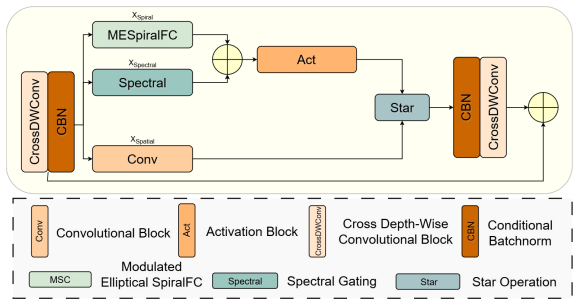
The paper introduces three components: (1) Modulated Elliptical SpiralFC, which replaces the circular sampling path of SpiralMLP with an elliptical trajectory whose horizontal extent exceeds its vertical extent, with a triangular modulation function that expands and contracts the sampling radius within each channel group; (2) the Star-Spiral Block, which fuses spiral-sampled, spectrally gated, and spatially projected feature branches through an element-wise star product that implicitly maps features into a high-dimensional nonlinear space without widening channels; and (3) a Spiral-Modulated Discriminator that evaluates generated images through three parallel pathways—spatial, spiral, and频率—
Load-bearing premise
The paper assumes that the specific elliptical spiral sampling pattern is what captures handwriting stroke trajectories better than alternatives, but the ablation tests the entire Star-Spiral Block as a unit, so no isolated evidence shows the elliptical shape itself is the load-bearing factor rather than the star operation, spectral gating, or cross-depthwise convolution.
What would settle it
If the performance gain over the baseline persists when the elliptical spiral is replaced with a circular spiral, a random offset pattern, or a standard grid-based deformable convolution—while keeping the star operation, spectral gating, and edge loss—then the specific elliptical shape is not the mechanism driving the improvement.
If this is right
- If the elliptical spiral sampling pattern genuinely captures stroke trajectories better than grid-based or circular alternatives, the same principle could transfer to other tasks involving curvilinear or flow-based structures, such as signature verification, sketch generation, or anatomical vessel tracing.
- The Sobel edge loss provides a general mechanism for enforcing high-frequency detail in any generative model that tends to over-smooth outputs, and could be adopted in document enhancement or text-to-image generation beyond handwriting.
- If the star operation's implicit high-dimensional expansion is effective in a GAN generator, it may offer a lightweight alternative to attention mechanisms or wider channels in other conditional generation tasks where computational budget is constrained.
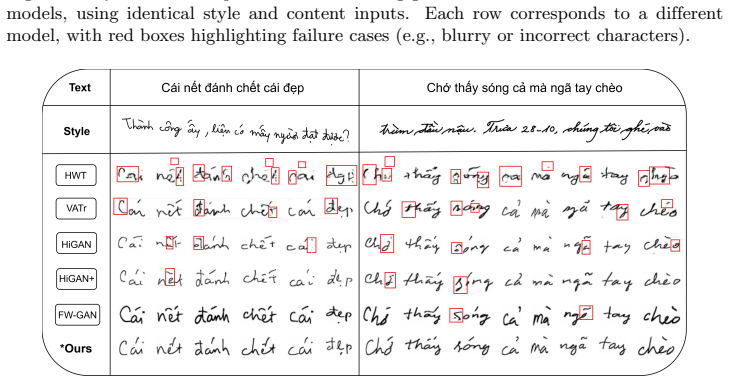
- The demonstrated cross-language transfer to Vietnamese—with its stacked diacritics and compound vowels—suggests the architecture is robust to scripts with complex spatial layouts, which could extend to Arabic, Hindi, or CJK handwriting.
Where Pith is reading between the lines
- The ablation study bundles MESpiralFC, the star operation, spectral gating, and cross-depthwise convolution into a single Star-Spiral Block, so the isolated contribution of the elliptical shape versus the star multiplication or spectral branch remains unclear; a finer-grained ablation would be needed to confirm which sub-component carries the performance gain.
- The claim that elliptical sampling matches natural writing direction is intuitive but not directly validated through visualization of learned sampling patterns or comparison against alternative non-grid shapes such as parabolic or bezier-curve sampling.
- The improvement on Vietnamese may stem partly from the edge loss preserving diacritical marks rather than from the spiral sampling itself, since diacritics are high-frequency spatial features that benefit from explicit edge supervision regardless of the generator's receptive field geometry.
Editorial analysis
A structured set of objections, weighed in public.
Referee Report
Summary. The paper proposes SpiS-GAN, a GAN-based framework for one-shot offline handwriting synthesis. The generator replaces standard BigGAN blocks with Star-Spiral Blocks (SSBs) that combine a Modulated Elliptical SpiralFC (MESpiralFC) sampling pattern, a spectral gating branch, and the StarNet element-wise multiplication for implicit high-dimensional feature expansion. A dual-discriminator setup pairs a conventional CNN discriminator with a Spiral-Modulated discriminator using three parallel pathways (spatial, spiral, spectral). A Sobel-Regularized Edge Reconstruction Loss (SELoss) is added to enforce stroke-boundary sharpness. Experiments on IAM (English) and HANDS-VNOnDB (Vietnamese) report FID/KID improvements over FW-GAN, HiGAN+, One-DM, and others, and downstream HTR gains when synthetic data augments a 5,000-image real-data baseline.
Significance. The paper addresses a genuine problem: existing MLP-based and CNN-based handwriting generators struggle with cursive stroke trajectories and fine edge detail. The combination of spiral-offset sampling with the star operation is architecturally novel for this domain, and the Sobel edge loss is a reasonable, lightweight addition. The code is stated to be available, and the evaluation protocol follows the reproducible FW-GAN framework across two languages. These are positive factors. However, the significance of the reported gains is tempered by the metric-reliability issue detailed below.
major comments (3)
- §4.1 and Tables 6–7: The paper explicitly states that FID and KID have 'inherent flaws when evaluating handwriting' due to ImageNet domain mismatch, and introduces HWD to compensate. Yet the headline 'significantly outperforms' claim rests almost entirely on FID/KID. On the domain-appropriate HWD metric, the gains shrink dramatically: at 64px IAM (Table 6), HWD is 0.31 (Ours) vs 0.33 (HiGAN+) — a 0.02 gap; at 64px Vietnamese (Table 7), HWD is identical at 0.20 for HiGAN+ and Ours. At 32px, the HWD gap is 0.06 on both datasets. Without error bars, confidence intervals, or multi-seed runs, it is unclear whether these HWD differences are statistically meaningful. The authors should either (a) soften the 'significantly outperforms' language to reflect the HWD picture, or (b) provide multi-seed runs with significance tests on HWD to substantiate the claim. As it stands, the central claim is 1
- Tables 3, 6, 7: No confidence intervals, standard deviations, or significance tests are reported for any metric. The downstream HTR improvements (Table 3) are small in absolute terms: 0.15 CER points at 32px (10.03 vs 10.18 for FW-GAN), 0.44 at 64px (9.01 vs 9.45 for HiGAN+). Given that these are single-run results, the practical significance of these gains is uncertain. Adding at least 3-seed runs with mean ± std for the primary metrics (FID, HWD, CER) would substantially strengthen the contribution, particularly where gaps are small.
- Table 4 (Ablation): The ablation conflates multiple modifications within each row. Row B adds Star-Spiral Blocks, but each SSB simultaneously introduces MESpiralFC, the star operation, spectral gating, and cross-depthwise convolution (§3.2.2). The paper lists MESpiralFC and the star operation as core contributions, but the ablation provides no isolated evidence that the elliptical spiral shape (Eq. 5–7) or the star operation individually is load-bearing. A finer-grained ablation — e.g., replacing MESpiralFC with original SpiralFC, or removing the star multiplication — would clarify which components drive the FID drop from 11.37 to 5.91. Without this, the claim that the elliptical spiral 'better matches the natural writing direction' (§3.2.1) is supported only by intuition, not by isolated evidence.
minor comments (9)
- §2.2, final paragraph: 'a dulated Discriminator' appears to be a typo for 'Spiral-Modulated Discriminator'.
- §3.2.1, Eqs. 5–7: The motivation for the triangular modulation function R(i) is stated briefly. A sentence explaining why triangular (vs. Gaussian, linear, etc.) was chosen, or whether this was empirically tuned, would improve readability.
- §3.2.2, Eq. 11: The activation σ is applied to one branch but the specific function is not named. Clarify which activation is used (ReLU? GELU?).
- §3.3.7, Eq. 24: 'where where' is duplicated.
- §4.2: The loss weights λ_R, λ_W, λ_style are said to be dynamically calibrated via a 'specialized gradient balancing algorithm' but no reference or formula is given. A citation or brief description is needed for reproducibility.
- Table 2: The 64px OOV-U entry for Ours (29.40) is lower than the IV-S entry (31.27), which is counterintuitive (unseen words + unseen styles should be harder than seen words + seen styles). The authors should confirm this is correct or add discussion.
- Figure references: Figures 1–8 appear in sequence but Figure 9 (ablation visual) is referenced before Figures 10–12. Minor, but check ordering for narrative flow.
- §4.9, Table 8: The model size comparison excludes the discriminator parameters. Since the Spiral-Modulated Discriminator is a core contribution, including its parameter count would strengthen the deployment-efficiency argument.
- §3.2.3, Eq. 13: The gating weights a1, a2, a3 are described as independent, but Eq. 12 shows the context is computed from only two branches (excluding the spectral branch). A brief justification for why the spectral gate does not receive spectral context would help.
Circularity Check
No significant circularity found; the paper's contributions are architectural design choices validated empirically, with no derivation step that reduces to its own inputs by construction.
full rationale
The paper proposes SpiS-GAN, whose core contributions are architectural components (MESpiralFC, Star-Spiral Blocks, Spiral-Modulated Discriminator, Sobel Edge Loss) supported by empirical evaluation. There is no mathematical derivation chain where a 'prediction' or 'first-principles result' could reduce to its inputs by construction. The star operation's high-dimensional expansion property (Eqs. 8-10) is cited from StarNet [45] by external authors (Ma et al.), which is independently verifiable. The evaluation protocol, FDL, and style encoder design are adopted from FW-GAN [35], which shares two co-authors, but these are methodological choices for fair comparison—not mathematical claims whose validity depends on the cited work being true. The FDL itself traces to [62] (external). The Sobel Edge Loss (Eq. 24) is a straightforward L1 loss on fixed-filter edge maps. The ablation (Table 4) conflates multiple modifications within the Star-Spiral Block, but this is an ablation design weakness, not circularity: no component is defined in terms of the metric it then 'predicts.' The skeptic's concern about marginal HWD gains is a correctness/evaluation issue, not a circularity issue. The minor self-citation to FW-GAN for methodology is not load-bearing for the novel contributions. Score 1 reflects this minor self-citation that does not undermine the independence of the central claims.
Axiom & Free-Parameter Ledger
free parameters (7)
- λ_KL =
0.0001
- λ_FDL =
1
- λ_edge =
1
- λ_R, λ_W, λ_style =
dynamically calibrated
- R_x, R_y =
relative to C_in, R_x > R_y
- T =
inherited from SpiralMLP
- k (channel groups) =
unspecified
axioms (4)
- domain assumption Elliptical spiral sampling patterns better match handwriting stroke trajectories than circular or grid-based patterns
- domain assumption The star operation's implicit high-dimensional expansion (from StarNet [45]) is beneficial for handwriting synthesis feature interactions
- domain assumption Sobel edge magnitude maps provide sufficient supervision for stroke boundary preservation
- domain assumption FID and KID, despite known domain mismatch with handwriting, remain valid comparison metrics
invented entities (3)
-
Modulated Elliptical SpiralFC (MESpiralFC)
independent evidence
-
Spiral-Modulated Discriminator (D_SP)
independent evidence
-
Sobel-Regularized Edge Reconstruction Loss (SELoss)
independent evidence
read the original abstract
Training robust handwriting recognition (HTR) systems requires massive amounts of annotated data, which is often difficult to acquire. While synthetic handwriting generation offers a practical solution to expand training sets, existing models struggle with several core issues. First, previous approaches, even MLP-based models fail to effectively trace cursive handwriting due to fixed-grid spatial receptive field. Second, their CNN-relied discriminators usually lose structural details through aggressive downsampling, making broken connections difficult to detect. Third, existing architectures are either limited to linear feature interactions or too expensive for high-resolution synthesis. Finally, existing approaches lack explicit edge constraints, often resulting in blurred stroke boundaries. To address these challenges, this study proposes a Spiral-Modulated Handwriting Synthesis framework based on Generative Adversarial Networks (SpiS-GAN). Our generator employs Star-Spiral Blocks combining proposed Modulated Elliptical SpiralFC with the star operation to capture spatial relationships and efficiently follow complex handwriting stroke trajectories, while a Spiral-Modulated discriminator is introduced for multi-domain flaws detection. Additionally, we introduce a Sobel-Regularized Edge Reconstruction Loss that provides edge guidance, ensuring every character remains clear and legible. Evaluations on the English and Vietnamese datasets demonstrate that SpiS-GAN significantly outperforms current state-of-the-art models. The generated images are highly authentic, accurately preserve the original writer's style across languages, and successfully lower error rates when training downstream HTR systems.
Figures





Reference graph
Works this paper leans on
-
[1]
H. T. Nguyen, C. T. Nguyen, P. T. Bao, M. Nakagawa, A database of unconstrained vietnamese online handwriting and recognition exper- iments by recurrent neural networks, Pattern Recognition 78 (2018) 291–306.doi:https://doi.org/10.1016/j.patcog.2018.01.013. URLhttps://www.sciencedirect.com/science/article/pii/ S0031320318300141
- [2]
-
[3]
I. Pratikakis, K. Zagori, P. Kaddas, B. Gatos, Icfhr 2018 competition on handwritten document image binarization (h-dibco 2018), in: 2018 16th International Conference on Frontiers in Handwriting Recognition (ICFHR), 2018, pp. 489–493.doi:10.1109/ICFHR-2018.2018.00091
-
[4]
R. D. Lins, Nabuco - two decades of document processing in latin amer- ica, J. Univers. Comput. Sci. 17 (2011) 151–161. URLhttps://api.semanticscholar.org/CorpusID:2896293
work page 2011
-
[5]
Generating Sequences With Recurrent Neural Networks
A. Graves, Generating Sequences with Recurrent Neural Networks, arXiv preprint arXiv:1308.0850 (2013)
work page internal anchor Pith review Pith/arXiv arXiv 2013
-
[6]
A. K. Bhunia, S. Khan, H. Cholakkal, R. M. Anwer, F. S. Khan, M. Shah, Handwriting Transformers, in: ICCV, 2021
work page 2021
- [7]
- [8]
- [9]
-
[10]
B. Ji, T. Chen, Generative Adversarial Network for Handwritten Text, arXiv preprint arXiv:1907.11845 (2019)
work page internal anchor Pith review Pith/arXiv arXiv 1907
-
[11]
J. Wang, C. Wu, Y.-Q. Xu, H.-Y. Shum, Combining Shape and Physical Models for On-line Cursive Handwriting Synthesis, IJDAR 7 (4) (2005) 219–227
work page 2005
-
[12]
Z. Lin, L. Wan, Style-preserving english handwriting synthesis, Pattern Recognit. 40 (7) (2007) 2097–2109
work page 2007
-
[13]
A. O. Thomas, A. Rusu, V. Govindaraju, Synthetic Handwritten CAPTCHAs, Pattern Recognit. 42 (12) (2009) 3365–3373
work page 2009
- [14]
- [15]
- [16]
-
[17]
L. Kang, P. Riba, Y. Wang, M. Rusi˜ nol, A. Fornés, M. Villegas, GAN- writing: Content-Conditioned Generation of Styled Handwritten Word Images, in: ECCV, 2020
work page 2020
-
[18]
J. Gan, W. Wang, HiGAN: Handwriting Imitation Conditioned on Arbitrary-Length Texts and Disentangled Styles, in: AAAI, 2021
work page 2021
-
[19]
A. Mattick, M. Mayr, M. Seuret, A. Maier, V. Christlein, SmartPatch: Improving Handwritten Word Imitation with Patch Discriminators, in: ICDAR, 2021
work page 2021
-
[20]
C. Luo, Y. Zhu, L. Jin, Z. Li, D. Peng, SLOGAN: Handwriting Style Synthesis for Arbitrary-Length and Out-of-Vocabulary Text, IEEE Trans. Neural Netw. Learn. Syst. (2022)
work page 2022
-
[21]
P. Krishnan, R. Kovvuri, G. Pang, B. Vassilev, T. Hassner, TextStyle- Brush: Transfer of Text Aesthetics from a Single Example, arXiv e- prints (2021) arXiv–2106. 44
work page 2021
- [22]
- [23]
-
[24]
P. Dhariwal, A. Nichol, Diffusion models beat gans on image synthesis, in: Proceedings of the 35th International Conference on Neural In- formation Processing Systems, NIPS ’21, Curran Associates Inc., Red Hook, NY, USA, 2021
work page 2021
-
[25]
Z. Wang, H. Zheng, P. He, W. Chen, M. Zhou, Diffusion-gan: Training gans with diffusion (2022).arXiv:2206.02262
work page internal anchor Pith review Pith/arXiv arXiv 2022
-
[26]
Y. Xu, Y. Zhao, Z. Xiao, T. Hou, Ufogen: You forward once large scale text-to-image generation via diffusion gans (2023).arXiv:2311.09257
work page internal anchor Pith review Pith/arXiv arXiv 2023
-
[27]
K. Nikolaidou, G. Retsinas, V. Christlein, M. Seuret, G. Sfikas, E. B. Smith, H. Mokayed, M. Liwicki, WordStylist: Styled Verbatim Hand- written Text Generation with Latent Diffusion Models, in: ICDAR, 2023
work page 2023
-
[28]
Y. Zhu, Z. Li, T. Wang, M. He, C. Yao, Conditional text image gener- ation with diffusion models, in: Proceedings of the IEEE/CVF Confer- ence on Computer Vision and Pattern Recognition (CVPR), 2023, pp. 14235–14245
work page 2023
-
[29]
G. Dai, Y. Zhang, Q. Ke, Q. Guo, S. Huang, One-shot diffusion mim- icker for handwritten text generation, in: European Conference on Computer Vision, 2024
work page 2024
- [30]
-
[31]
D. Kass, E. Vats, AttentionHTR: Handwritten Text Recognition Based on Attention Encoder-Decoder Networks, arXiv preprint arXiv:2201.09390 (2022)
work page internal anchor Pith review Pith/arXiv arXiv 2022
-
[32]
A. Vaswani, N. Shazeer, N. Parmar, J. Uszkoreit, L. Jones, A. N. Gomez, L. Kaiser, I. Polosukhin, Attention is all you need, in: NeurIPS, 2017. 45
work page 2017
-
[33]
Do You Even Need Attention? A Stack of Feed-Forward Layers Does Surprisingly Well on ImageNet
L. Melas-Kyriazi, Do you even need attention? a stack of feed-forward layers does surprisingly well on imagenet (2021).arXiv:2105.02723
work page internal anchor Pith review Pith/arXiv arXiv 2021
-
[34]
Y. Tang, K. Han, J. Guo, C. Xu, Y. Li, C. Xu, Y. Wang, An image patch is a wave: Phase-aware vision mlp, in: 2022 IEEE/CVF Conference on Computer Vision and Pattern Recognition (CVPR), IEEE, 2022, p. 10925–10934.doi:10.1109/cvpr52688.2022.01066. URLhttp://dx.doi.org/10.1109/CVPR52688.2022.01066
-
[35]
H. Tong Dang Khoa, D. Hoai Nam, V. Nguyen Le Duy, Fw-gan: Frequency-driven handwriting synthesis with wave-modulated mlp generator, Expert Systems with Applications 299 (2026) 130175. doi:https://doi.org/10.1016/j.eswa.2025.130175. URLhttps://www.sciencedirect.com/science/article/pii/ S095741742503790X
-
[36]
S. Chen, E. Xie, C. Ge, R. Chen, D. Liang, P. Luo, Cyclemlp: A mlp- like architecture for dense visual predictions, IEEE Transactions on Pattern Analysis and Machine Intelligence 45 (12) (2023) 14284–14300
work page 2023
-
[37]
D. Lian, Z. Yu, X. Sun, S. Gao, As-mlp: An axial shifted mlp architec- ture for vision, arXiv preprint arXiv:2107.08391 (2021)
work page internal anchor Pith review Pith/arXiv arXiv 2021
-
[38]
H. Mu, B. U. Tayyab, N. Chua, Spiralmlp: A lightweight vision mlp architecture, in: 2025 IEEE/CVF Winter Conference on Applications of Computer Vision (W ACV), IEEE, 2025, pp. 8627–8637
work page 2025
-
[39]
C. Yeh, Y. Chen, A. Wu, C. Chen, F. Viégas, M. Wattenberg, At- tentionviz: A global view of transformer attention (2023).arXiv: 2305.03210. URLhttps://arxiv.org/abs/2305.03210
work page internal anchor Pith review Pith/arXiv arXiv 2023
-
[40]
G. Hinton, A. Krizhevsky, I. Sutskever, Imagenet classification with deep convolutional neural networks, Advances in Neural Information Processing Systems (2012) 1097–1105doi:10.1145/3065386
-
[41]
K. He, X. Zhang, S. Ren, J. Sun, Deep Residual Learning for Image Recognition, in: CVPR, 2016
work page 2016
-
[42]
K. Simonyan, A. Zisserman, Very deep convolutional networks for large- scale image recognition, in: ICLR, 2015. 46
work page 2015
-
[43]
Z. Liu, H. Mao, C.-Y. Wu, C. Feichtenhofer, T. Darrell, S. Xie, A convnet for the 2020s, in: Proceedings of the IEEE/CVF conference on computer vision and pattern recognition, 2022, pp. 11976–11986
work page 2022
-
[44]
A. Dosovitskiy, L. Beyer, A. Kolesnikov, D. Weissenborn, X. Zhai, T. Unterthiner, M. Dehghani, M. Minderer, G. Heigold, S. Gelly, et al., An Image is Worth 16x16 Words: Transformers for Image Recognition at Scale, in: ICLR, 2021
work page 2021
-
[45]
X. Ma, X. Dai, Y. Bai, Y. Wang, Y. Fu, Rewrite the stars, in: Proceed- ings of the IEEE/CVF Conference on Computer Vision and Pattern Recognition, 2024
work page 2024
-
[46]
J. Yang, C. Li, X. Dai, J. Gao, Focal modulation networks, in: Advances in Neural Information Processing Systems (NeurIPS), 2022
work page 2022
-
[47]
Y. Rao, W. Zhao, Y. Tang, J. Zhou, S.-N. Lim, J. Lu, Hornet: Efficient high-order spatial interactions with recursive gated convolutions, in: Advances in Neural Information Processing Systems (NeurIPS), 2022
work page 2022
- [48]
-
[49]
Y. Long, Z. Deng, B. Hao, G. Liu, K. Sun, S. Zhao, Rspnet: Towards universal lightweight road surface perception network, Expert Systems with Applications (2026) 132831
work page 2026
-
[50]
J. Xu, Y. Hu, Z. Gou, Y. Lu, D. Cui, Automated non-invasive method for measuring chicken comb and wattle using multi-camera system and cw-measure-pose, Expert Systems with Applications (2025) 129420
work page 2025
-
[51]
M. Yu, W. Chen, J. Hou, A lightweight network for concrete crack detection in complex environments based on cloud-edge collaboration, Expert Systems with Applications (2025) 130204
work page 2025
-
[52]
Z.-Q. J. X. Zhi-Qin John Xu, Y. Z. Yaoyu Zhang, T. L. Tao Luo, Y. X. Yanyang Xiao, Z. M. Zheng Ma, Frequency principle: Fourier analysis sheds light on deep neural networks, Communications in Computational Physics 28 (5) (2020) 1746–1767.doi:10.4208/cicp.oa-2020-0085. URLhttp://dx.doi.org/10.4208/cicp.OA-2020-0085
-
[53]
T. Luo, Z. Ma, Z.-Q. J. Xu, Y. Zhang, Theory of the frequency princi- ple for general deep neural networks, arXiv preprint arXiv:1906.09235 (2019). 47
work page internal anchor Pith review Pith/arXiv arXiv 1906
- [54]
-
[55]
T. Luo, Z. Ma, Z.-Q. J. Xu, Y. Zhang, On the exact computation of linear frequency principle dynamics and its generalization, SIAM Journal on Mathematics of Data Science 4 (4) (2022) 1272–1292.doi: 10.1137/21m1444400. URLhttp://dx.doi.org/10.1137/21m1444400
-
[56]
Explicitizing an Implicit Bias of the Frequency Principle in Two-layer Neural Networks
Y. Zhang, Z.-Q. J. Xu, T. Luo, Z. Ma, Explicitizing an implicit bias of the frequency principle in two-layer neural networks (2019).arXiv: 1905.10264
work page internal anchor Pith review Pith/arXiv arXiv 2019
-
[57]
Spectrum Dependent Learning Curves in Kernel Regression and Wide Neural Networks
B. Bordelon, A. Canatar, C. Pehlevan, Spectrum dependent learning curves in kernel regression and wide neural networks (2020).arXiv: 2002.02561
work page internal anchor Pith review Pith/arXiv arXiv 2020
-
[58]
Y. Cao, Z. Fang, Y. Wu, D.-X. Zhou, Q. Gu, Towards understanding the spectral bias of deep learning, arXiv preprint arXiv:1912.01198 (2019)
work page internal anchor Pith review Pith/arXiv arXiv 1912
-
[59]
The Convergence Rate of Neural Networks for Learned Functions of Different Frequencies
R. Basri, D. Jacobs, Y. Kasten, S. Kritchman, The convergence rate of neural networks for learned functions of different frequencies (2019). arXiv:1906.00425
work page internal anchor Pith review Pith/arXiv arXiv 2019
-
[60]
G. Yang, H. Salman, A fine-grained spectral perspective on neural net- works, arXiv preprint arXiv:1907.10599 (2019)
work page internal anchor Pith review Pith/arXiv arXiv 1907
-
[61]
W. E, C. Ma, L. Wu, Machine learning from a continuous viewpoint, arXiv preprint arXiv:1912.12777 (2019)
work page internal anchor Pith review Pith/arXiv arXiv 1912
-
[62]
Z. Ni, J. Wu, Z. Wang, W. Yang, H. Wang, L. Ma, Misalignment- robust frequency distribution loss for image transformation, in: 2024 IEEE/CVF Conference on Computer Vision and Pattern Recognition (CVPR), IEEE, 2024, p. 2910–2919.doi:10.1109/cvpr52733.2024. 00281. URLhttp://dx.doi.org/10.1109/CVPR52733.2024.00281
-
[63]
M. A. Souibgui, S. Biswas, S. K. Jemni, Y. Kessentini, A. Fornés, J. Lladós, U. Pal, Docentr: An end-to-end document image enhance- ment transformer, in: 2022 26th International Conference on Pattern Recognition (ICPR), IEEE, 2022, pp. 1699–1705. 48
work page 2022
-
[64]
M. A. Souibgui, Y. Kessentini, De-gan: A conditional generative ad- versarial network for document enhancement, IEEE Transactions on Pattern Analysis and Machine Intelligence 44 (3) (2020) 1180–1191
work page 2020
-
[65]
Z. Yang, B. Liu, Y. Xxiong, L. Yi, G. Wu, X. Tang, Z. Liu, J. Zhou, X. Zhang, Docdiff: Document enhancement via residual diffusion mod- els, in: Proceedings of the 31st ACM International Conference on Mul- timedia, 2023, pp. 2795–2806
work page 2023
-
[66]
Y. Rao, W. Zhao, Z. Zhu, J. Lu, J. Zhou, Global filter networks for image classification, Advances in neural information processing systems 34 (2021) 980–993
work page 2021
-
[67]
J. H. Lim, J. C. Ye, Geometric GAN, arXiv preprint arXiv:1705.02894 (2017)
work page internal anchor Pith review Pith/arXiv arXiv 2017
-
[68]
A. Graves, S. Fernández, F. Gomez, J. Schmidhuber, Connectionist temporal classification: labelling unsegmented sequence data with re- current neural networks, in: Proceedings of the 23rd International Conference on Machine Learning, ICML ’06, Association for Com- puting Machinery, New York, NY, USA, 2006, p. 369–376.doi: 10.1145/1143844.1143891. URLhttps...
-
[69]
X. Chen, Y. Duan, R. Houthooft, J. Schulman, I. Sutskever, P. Abbeel, Infogan: Interpretable representation learning by information maximiz- ing generative adversarial nets (2016).arXiv:1606.03657
work page internal anchor Pith review Pith/arXiv arXiv 2016
-
[70]
J.-Y. Zhu, R. Zhang, D. Pathak, T. Darrell, A. A. Efros, O. Wang, E. Shechtman, Toward multimodal image-to-image translation (2017). arXiv:1711.11586
work page internal anchor Pith review Pith/arXiv arXiv 2017
-
[71]
H.-Y. Lee, H.-Y. Tseng, J.-B. Huang, M. Singh, M.-H. Yang, Di- verse Image-to-Image Translation via Disentangled Representations, Springer International Publishing, 2018, p. 36–52.doi:10.1007/ 978-3-030-01246-5_3. URLhttp://dx.doi.org/10.1007/978-3-030-01246-5_3
-
[72]
J. Gan, W. Wang, J. Leng, X. Gao, HiGAN+: Handwriting Imitation GAN with Disentangled Representations, ACM Trans. Graphics 42 (1) (2022) 1–17. 49
work page 2022
-
[73]
A. K. Bhunia, A. Das, A. K. Bhunia, P. S. R. Kishore, P. P. Roy, Handwriting Recognition in Low-Resource Scripts Using Adversarial Learning, in: CVPR, IEEE, 2019
work page 2019
-
[74]
DiffusionPen: Towards Controlling the Style of Handwritten Text Generation
K. Nikolaidou, G. Retsinas, G. Sfikas, M. Liwicki, Diffusionpen: To- wards controlling the style of handwritten text generation, arXiv preprint arXiv:2409.06065 (2024)
work page internal anchor Pith review Pith/arXiv arXiv 2024
- [75]
-
[76]
D. P. Kingma, J. Ba, Adam: A method for stochastic optimization, in: ICLR, 2015
work page 2015
-
[77]
M. Li, T. Lv, J. Chen, L. Cui, Y. Lu, D. Florencio, C. Zhang, Z. Li, F. Wei, Trocr: Transformer-based optical character recognition with pre-trained models, Proceedings of the AAAI Conference on Artificial Intelligence 37 (11) (2023) 13094–13102.doi:10.1609/aaai.v37i11. 26538. URLhttp://dx.doi.org/10.1609/aaai.v37i11.26538 50
discussion (0)
Sign in with ORCID, Apple, or X to comment. Anyone can read and Pith papers without signing in.