REVIEW 3 major objections 4 minor 1 cited by
Set-valued Rothe Tableaux and Grothendieck Polynomials
T0 review · 3 major / 4 minor · reviewed 2026-08-14 · deepseek-v4-flash
Pith's one-line read The double Grothendieck polynomial has a Rothe-tableau formula exactly for 1432-avoiding permutations.
desk verdict A genuinely new tableau model and an iff result for 1432-avoiding permutations, with one load-bearing lemma left as a sketch and a couple of notational slips that need cleaning up. read the letter →
The pith
A machine-rendered reading of the paper's core claim, the machinery that carries it, and where it could break.
The reading
What carries the argument
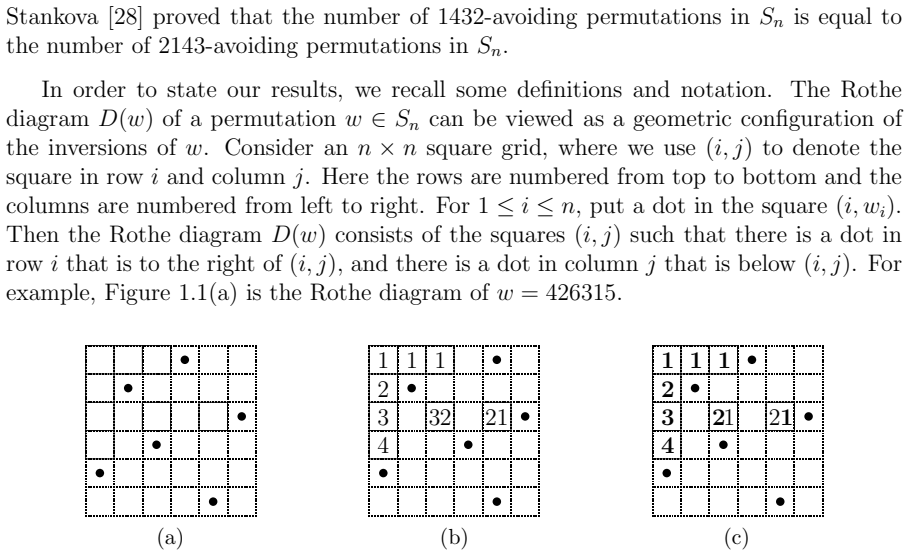
The load-bearing object is the set-valued Rothe tableau: a filling of the Rothe diagram $D(w)$ with finite nonempty subsets of positive integers in which rows are weakly decreasing and columns strictly increasing under the set order $A<B$ when $\max A<\min B$ and $A\leq B$ when $\max A\leq\min B$. The proof mechanism is an induction on length using the isobaric divided difference operator $\pi_r$, where the two tableau sets $\mathrm{SVRT}(ws_r,f_0)$ and $\mathrm{SVRT}(w,f_0)$ are partitioned into equivalence classes supported on the squares containing $r$ or $r+1$; a bijection between class sets and a factorization of the class contributions show $\pi_r G_{ws_r}(C;x,y)=G_w(\Phi(C);x,y)$. The reverse direction uses the balanced-labeling model of Schubert polynomials to produce a labeling of $D(w)$ that is not a single-valued Rothe tableau. A secondary mechanism, the tableau complex of the cited reference [17], converts the main formula into two alternative tableau formulas.
What would settle it
Expanding both sides of (1.2) for the 1432-avoiding, non-321-avoiding permutation $w=35142$ and comparing coefficients would test the forward claim: equality on every monomial is exactly what Theorem 2.1 predicts, while any mismatch disproves it. For the reverse claim, the same coefficient comparison for $w=1432$ should exhibit at least one monomial where the two sides differ, since Theorem 2.2 asserts that this obstruction always exists.
Extended reading notes
Core claim
The central discovery is an exact characterization. A permutation $w$ is 1432-avoiding if and only if $$G_w(x,y)=\sum_{T\in \mathrm{SVRT}(w,f_0)}(-1)^{|T|-\ell(w)}\prod_{(i,j)\in D(w)}\prod_{t\in T(i,j)}\bigl(x_t\oplus y_{m_{ij}(w)+i-t}\bigr),$$ where $D(w)$ is the Rothe diagram of $w$, $\mathrm{SVRT}(w,f_0)$ is the set of set-valued Rothe tableaux of shape $D(w)$ flagged by $f_0=(1,2,\ldots,n)$, $\ell(w)$ is the inversion length, $m_{ij}(w)$ is the number of diagram squares in row $i$ at or to the left of column $j$, and $a\oplus b=a+b-ab$. The forward direction is proved by induction along the first ascent using the isobaric divided difference operator, and the reverse direction is proved by showing that a 1432 pattern forces a failure already in the single-variable Schubert polynomial obtained from the lowest-degree part.
Load-bearing premise
The load-bearing premise is that the equivalence-class case analysis for tableaux of shape $D(w)$ (Theorem 2.10) is complete exactly as sketched, even though the paper gives only a sketch of the proof and relies on the operator identity stated in Lemma 2.12; a missing configuration there would break the induction connecting the two sides.
Editorial extensions
If this is right
- Setting all $y_i$ to zero turns the main formula into a signed tableau sum for the single Grothendieck polynomial of every 1432-avoiding permutation.
- Taking the lowest-degree homogeneous part and replacing $y_i$ by $-y_i$ yields the corresponding formulas for double and single Schubert polynomials of 1432-avoiding permutations.
- Restricted to 321-avoiding permutations, the same formula agrees with the known flagged set-valued Young tableau formula for that family, so the Rothe-tableau model contains the older model as a special case.
- The converse direction is an obstruction: if $w$ contains a 1432 pattern, the double Grothendieck polynomial cannot be represented by this particular Rothe-tableau sum, and the failure is visible already at the level of single Schubert polynomials.
- Via tableau complexes, two equivalent formulas hold for 1432-avoiding permutations, one using limit set-valued Rothe tableaux and one using single-valued Rothe tableaux with correction factors.
Reading between the lines
- An outside reader may test whether the same equivalence-class induction, which uses only the first-ascent condition and local configurations of squares, extends to other single-pattern avoidance classes beyond 1432; the paper does not make this claim.
- Because the paper notes the equal enumeration of 1432-avoiding and 2143-avoiding permutations, one may look for a direct statistic-preserving bijection between set-valued Rothe tableaux of 1432-avoiding permutations and flagged set-valued Young tableaux of 2143-avoiding permutations; the paper does not construct one.
- The tableau-complex formulas suggest a purely topological check: proving that the Rothe tableau complex is shellable would give an independent, noncomputational confirmation of the K-polynomial identities, a question not addressed here.
Signed reviews
Editorial analysis
A structured set of objections, weighed in public.
Referee Report
Summary. The paper introduces set-valued Rothe tableaux, a filling model for the Rothe diagram of a permutation, and proposes that for a 1432-avoiding permutation w the double Grothendieck polynomial G_w(x,y) equals the sign-weighted sum over flagged set-valued Rothe tableaux given in (1.2). The converse is also claimed: if w contains a 1432 pattern, the formula fails. The proof of the forward direction proceeds by induction on length using the isobaric divided difference operator π_r, where r is the first ascent of w; the proof is organized around an equivalence relation on tableaux and a bijection between equivalence classes of SVRT(w s_r, f0) and SVRT(w, f0). The converse is proved by passing to single Schubert polynomials and using the balanced-labeling model of Fomin, Greene, Reiner, and Shimozono. A final section uses Knutson–Miller–Yong tableau complexes to derive two alternative formulas for G_w(x,y).
Significance. If the main theorem is correct, the paper provides the first tableau formula for double Grothendieck polynomials of 1432-avoiding permutations, a class equinumerous with vexillary permutations, and it specializes to Matsumura's formula for 321-avoiding permutations. The strategy of using equivalence classes to make the tableau model compatible with divided differences is natural and, in outline, sound; the paper also gives a useful connection to tableau complexes and to the balanced-labeling model for the converse statement. However, the current version of the manuscript does not contain a complete proof of a central lemma (Theorem 2.10), and several displayed formulas have indexing/domain problems that are load-bearing for the induction step. The result is plausible and significant, but the proof needs substantial repair before the claims are fully supported.
major comments (3)
- [Section 2.2, Theorem 2.10] Theorem 2.10, the formula for G_w(C';x,y) for an equivalence class C' in SVRT(w,f0), is only sketched: the text says 'The proof is nearly the same as the arguments for Theorem 2.7' and that the only difference is that P(T',r) is empty and P(T',r+1) contributes h(C',r+1;x,y). This is load-bearing because Theorem 2.11, specifically equation (2.32), uses this exact factor to identify π_r of the r-row contribution with -h(C',r+1;x,y), and Theorem 2.11 is the induction step establishing Theorem 2.5 and hence Theorem 2.1. The omitted row r+1 case is precisely where D(w) and D(w s_r) differ: the square (r,w_r) is deleted and the r-row squares to its right are shifted down to row r+1. That is exactly the configuration that cannot be assumed to follow from the analysis for i>r+1. A complete proof of Theorem 2.10, including verification of the y-exponents in h(C',r+1;x,y) and of the first factor in (2.24), is required for the induction to go through.
- [Section 2.2, equations (2.9) and (2.29)] Equations (2.9) and (2.29) are not well-defined as written. In (2.9), G_{w s_r}(C;x,y) is defined with a product over (i,j)∈D(w), but the tableaux T∈C have shape D(w s_r), so T(i,j) is undefined for squares of D(w) that are not in D(w s_r). Similarly, the left-hand side of (2.29) multiplies over (i,j)∈D(w) with T∈SVRT(w s_r,f0), and the right-hand side multiplies over D(w) with T'∈SVRT(w,f0); neither product is meaningful without an explicit identification of the square sets. This is not a cosmetic issue: (2.29) is substituted into (2.28), and the comparison between the two sides is the step that transfers the non-r/non-r+1 contribution from w s_r to w after the geometric shift. The intended index sets (presumably D(w s_r) on the left, together with the explicit matching of shifted squares) must be stated, and the equality proved for each type of square, especially the shifted row-r squares.
- [Section 2.2, equation (2.10)] The definition of ℓ_i(T) in (2.10) uses m_{i p_i}(w s_r) for every tableau T, but T may belong to SVRT(w,f0) as well as SVRT(w s_r,f0). For T∈SVRT(w,f0), the leftmost square (r+1,p_{r+1}) of P(T,r+1) is typically not a square of D(w s_r), so m_{i p_i}(w s_r) is undefined. This matters because the polynomial h(C',r+1;x,y) in Theorem 2.10 and the equality ℓ_r(T)=ℓ_{r+1}(T')-1 in (2.32) depend on this quantity. The authors should either define ℓ_i(T) separately for the two Rothe diagrams, with m computed in the corresponding diagram, or prove that the two definitions agree on the relevant squares.
minor comments (4)
- [Abstract and Introduction] There are several typographical slips, including 'Bu ch' in the abstract, 'shew diagram' after Figure 2.1, and 'there exits' in the proof of Theorem 2.13; these should be corrected.
- [Section 2.2, Lemma 2.9] The proof of Lemma 2.9 refers to 'the following two claims' and proves them, but the final sentence of the proof relies on the flag condition T(t,k)={t} for 1≤t≤i; this implication could be made more explicit for the reader.
- [Section 2.2, proof of (2.17)] The proof of (2.17) invokes Figure 2.5 and says 'we see that (2.17) holds'; adding a short explanation of how the definition of m_{i,j}(w s_r) in (1.1) yields the consecutive exponents ℓ_r(T)+1, ..., ℓ_r(T)+b_r(T) would improve readability.
- [Section 3, Theorem 3.1] The substitution in the proof of Theorem 1.4, replacing t_{x/arrownot↦a} by x_a y_{m_{ij}(w)+i-a} and then replacing x_t by 1-x_t and y_t by 1/(1-y_t), is stated very briefly; a few words on how the substitution acts on the K-polynomial and on the expression (x_t ⊕ y_{m}) would help the reader verify the formulas (1.3) and (1.4).
Circularity Check
No circularity: the 1432-avoiding tableau formula is proved by a divided-difference induction from the standard definition of Grothendieck polynomials; no fitted parameter or load-bearing self-citation is present.
full rationale
The proposed tableau formula (1.2) is not used to define the objects: SVRT(w,f0) is a purely combinatorial set of flagged fillings, and the flag f0 and the exponents m_ij(w)+i-t are fixed a priori from w. The proof follows the standard inductive definition of double Grothendieck polynomials: the base case w0 is checked directly against the product formula, and for w != w0 with first ascent r the paper proves Gbar_w = pi_r Gbar_{wsr} (Theorem 2.5) through a bijection of equivalence classes and the class formulas in Theorems 2.7 and 2.10. Since the actual Grothendieck polynomial satisfies G_w = pi_r G_{wsr} by (2.7), induction yields equality. No parameter is fitted to data and then renamed as a prediction, and no load-bearing result is imported from the authors' own prior work. The external ingredients, namely Matsumura's Lemma 2.12, the balanced-labeling formula (2.34) of Fomin-Greene-Reiner-Shimozono, and the tableau-complex theorem 3.1 of Knutson-Miller-Yong, are independent theorems by other authors; they are cited as tools, not as substitutes for the main derivation. The noted weaknesses are correctness and completeness concerns rather than circularity: Theorem 2.10 is presented only as a sketch ('the proof is nearly the same as the arguments for Theorem 2.7'), and equations (2.9) and (2.29) display D(w) where D(wsr) would be expected. These issues would need to be repaired for a fully rigorous proof, but they do not make the target formula equivalent to its input by construction. Therefore the circularity score is 0.
Assumptions & free parameters
assumptions (5)
- standard math The isobaric divided difference operators π_i satisfy the Coxeter relations and the recursion (2.7) uniquely defines double Grothendieck polynomials.
- standard math Matsumura's Lemma 2.12 (π_r applied to a product of (x_r ⊕ y_{a_j}) factors) is correct.
- standard math Knutson-Miller-Yong Theorem 3.1 gives the K-polynomial formulas (3.1)-(3.3) for tableau complexes.
- standard math Fomin-Greene-Reiner-Shimozono balanced labeling formula (2.34) computes S_w(x).
- standard math The lowest-degree homogeneous component of G_w(x,y), after y substitution, is S_w(x,y).
Cite this review
Pith. "Pith review of Set-valued Rothe Tableaux and Grothendieck Polynomials." pith.science (2026). https://pith.science/paper/3EHRZDMI
@misc{pith2026190804164,
  author       = {Pith},
  title        = {Pith review of: Set-valued Rothe Tableaux and Grothendieck Polynomials},
  year         = {2026},
  howpublished = {\url{https://pith.science/paper/3EHRZDMI}},
  note         = {Machine review of arXiv:1908.04164}
}
abstract
The notion of set-valued Young tableaux was introduced by Buch in his study of the Littlewood-Richardson rule for stable Grothendieck polynomials. Knutson, Miller and Yong showed that the double Grothendieck polynomials of 2143-avoiding permutations can be generated by set-valued Young tableaux. In this paper, we introduce the structure of set-valued Rothe tableaux of permutations. Given the Rothe diagram $D(w)$ of a permutation $w$, a set-valued Rothe tableau of shape $D(w)$ is a filling of finite nonempty subsets of positive integers into the squares of $D(w)$ such that the rows are weakly decreasing and the columns are strictly increasing. We show that the double Grothendieck polynomials of 1432-avoiding permutations can be generated by set-valued Rothe tableaux. When restricted to 321-avoiding permutations, our formula specializes to the tableau formula for double Grothendieck polynomials due to Matsumura. Employing the properties of tableau complexes given by Knutson, Miller and Yong, we obtain two alternative tableau formulas for the double Grothendieck polynomials of 1432-avoiding permutations.
Figures


Figures from the paper (7 more)


Forward citations
Cited by 1 Pith paper
-
Integrability approach to Feher-Nemethi-Rimanyi-Guo-Sun type identities for factorial Grothendieck polynomials
Using five-vertex model wavefunctions, the author reproves the Guo-Sun identity and proves a new identity and duality for rectangular factorial Grothendieck polynomials.
Reference graph
Works this paper leans on
-
[1]
K-classes of Brill-Noether loci and a determinantal formula
D. Anderson, L. Chen, N. Tarasca, K-classes of Brill-Noether lo ci and a determi- nantal formula, arXiv:1705.02992v2. 25
-
[2]
Assaf, Combinatorial models for Schubert polynomials, arXiv:1 703.00088v1
S. Assaf, Combinatorial models for Schubert polynomials, arXiv:1 703.00088v1
-
[3]
S. Assaf and D. Searles, Schubert polynomials, slide polynomials, S tanley sym- metric functions and quasi-Yamannouchi pipe dreams, Adv. Math. 306 (2017), 89–122
work page 2017
-
[4]
N. Bergeron and S. Billey, RC-graphs and Schubert polynomials, Exp. Math. 2 (1993), 257–269
work page 1993
-
[5]
N. Bergeron and F. Sottile, Schubert polynomials, the Bruhat or der, and the ge- ometry of flag manifolds, Duke Math. J. 95 (1998), 373–423
work page 1998
- [6]
-
[7]
Buch, A Littlewood-Richardson rule for the K-theory of Grassmannians, Acta Math
A. Buch, A Littlewood-Richardson rule for the K-theory of Grassmannians, Acta Math. 189 (2002), 37–78
work page 2002
-
[8]
A. Buch and R. Rim´ anyi, Specializations of Grothendieck polynomials, C. R. Acad. Sci. Paris, Ser. I 339 (2004), 1–4
work page 2004
Show all 32 references
-
[9]
Chen, G.-G
W.Y.C. Chen, G.-G. Yan and A.L.B. Yang, The skew Schubert polynom ials, Eu- ropean J. Combin. 25 (2004), 1181–1196
2004
-
[10]
Eriksson and S
K. Eriksson and S. Linusson, The size of Fulton’s essential set, Electron. J. Combin. 2 (1995), #R6
1995
-
[11]
Fomin, C
S. Fomin, C. Greene, V. Reiner and M. Shimozono, Balanced labellin gs and Schu- bert polynomials, European J. Combin. 18 (1997), 373–389
1997
-
[12]
Fomin and A.N
S. Fomin and A.N. Kirillov, Grothendieck polynomials and the Yang-B axter equa- tion, Proc. Formal Power Series and Alg. Comb. (1994), 183–190
1994
-
[13]
Fomin and A
S. Fomin and A. N. Kirillov, The Yang-Baxter equation, symmetric functions, and Schubert polynomials, Proceedings of the 5th Conference on Form al Power Series and Algebraic Combinatorics (Florence 1993), Discrete Math. 153 ( 1996), 123–143
1993
-
[14]
Fomin and R.P
S. Fomin and R.P. Stanley, Schubert polynomials and the NilCoxete r algebra, Adv. Math. 103 (1994), 196–207
1994
-
[15]
Knutson and E
A. Knutson and E. Miller, Subword complexes in Coxeter groups, Adv. Math. 184 (2004), 161–176
2004
-
[16]
Knutson and E
A. Knutson and E. Miller, Gr¨ obner geometry of Schubert polyn omials, Ann. Math. 161 (2005), 1245–1318
2005
-
[17]
Knutson, E
A. Knutson, E. Miller and A. Yong, Tableau complexes, Israel J. Math. 163 (2008), 317–343. 26
2008
-
[18]
Knutson, E
A. Knutson, E. Miller and A. Yong, Gr¨ obner geometry of verte x decompositions and of flagged tableaux, J. Reine Angew. Math. 630 (2009), 1–31
2009
-
[19]
T. Lam, S. Lee and M. Shimozono, Back stable Schubert calculus , arXiv:1806.11233v1
-
[20]
Lascoux and M.-P
A. Lascoux and M.-P. Sch¨ uzenberger, Polynˆ omes de Schube rt, C. R. Acad. Sci. Paris 294 (1982), 447–450
1982
-
[21]
Lascoux and M.-P
A. Lascoux and M.-P. Sch¨ utzenberger, Structure de Hopf de l’anneau de cohomolo- gie et de l’anneau de Grothendieck d’une vari´ et´ e de drapeaux, C. R. Acad. Sci. Paris S´ er. I Math. 295 (1982), 629–633
1982
-
[22]
Lenart, S
C. Lenart, S. Robinson and F. Sottile, Grothendieck polynomials via permutation patterns and chains in the Bruhat order, Amer. J. Math. 128 (200 6), 805–848
-
[23]
Macdonald, Notes on Schubert Polynomials, Laboratoire de combinatoire et d’informatique math´ ematique (LACIM), Universit´ e du Qu´ ebec ´ aMontr´ eal, Mon- treal, 1991
I.G. Macdonald, Notes on Schubert Polynomials, Laboratoire de combinatoire et d’informatique math´ ematique (LACIM), Universit´ e du Qu´ ebec ´ aMontr´ eal, Mon- treal, 1991
1991
-
[24]
Matsumura, A tableau formula of double Grothendieck polyno mials for 321- avoiding permutations, Ann
T. Matsumura, A tableau formula of double Grothendieck polyno mials for 321- avoiding permutations, Ann. Comb., to appear
-
[25]
Matsumura, Flagged Grothendieck polynomials, J
T. Matsumura, Flagged Grothendieck polynomials, J. Algebraic C ombin. 49 (2019), 209–228
2019
-
[26]
Matsumura and S
T. Matsumura and S. Sugimoto, Factorial flagged Grothendiec k polynomials, arXiv:1903.02169v1
1903 arXiv
-
[27]
Miller and B
E. Miller and B. Sturmfels, Combinatorial Commutative Algebra, G raduate Texts in Mathematics Vol. 227, Springer-Verlag, New York, 2004
2004
-
[28]
Stankova, Classification of forbidden subsequences of leng th 4, European J
Z. Stankova, Classification of forbidden subsequences of leng th 4, European J. Combin. 17 (1996), 501–517
1996
-
[29]
Stanley, Combinatorics and Commutative Algebra, Second E dition, Progress in Mathematics, 41
R.P. Stanley, Combinatorics and Commutative Algebra, Second E dition, Progress in Mathematics, 41. Birkh¨ auser Boston, Inc., Boston, MA, 1996
1996
-
[30]
Wachs, Flagged Schur functions, Schubert polynomials, and symmetrizing op- erators, J
M. Wachs, Flagged Schur functions, Schubert polynomials, and symmetrizing op- erators, J. Combin. Theory Ser. A. 40 (1985), 276–289
1985
-
[31]
Weigandt and A
A. Weigandt and A. Yong, The prism tableau model for Schubert polynomials, J. Combin. Theory Ser. A 154 (2018), 551–582
2018
-
[32]
Winkel, Diagram rules for the generation of Schubert polynom ials, J
R. Winkel, Diagram rules for the generation of Schubert polynom ials, J. Combin. Theory A. 86 (1999), 14–48. 27
1999
Reviewed August 14, 2026 · model on record in the stance chip above.
Discussion (0). Continue with ORCID to comment.