Superoscillatory initial states during inflation: theory, CMB constraints, and prospects for galaxy clustering
Pith reviewed 2026-06-25 22:42 UTC · model grok-4.3
The pith
A quadratic boundary term realizes superoscillatory initial states that imprint a localized oscillatory feature on the primordial spectrum.
A machine-rendered reading of the paper's core claim, the machinery that carries it, and where it could break.
Core claim
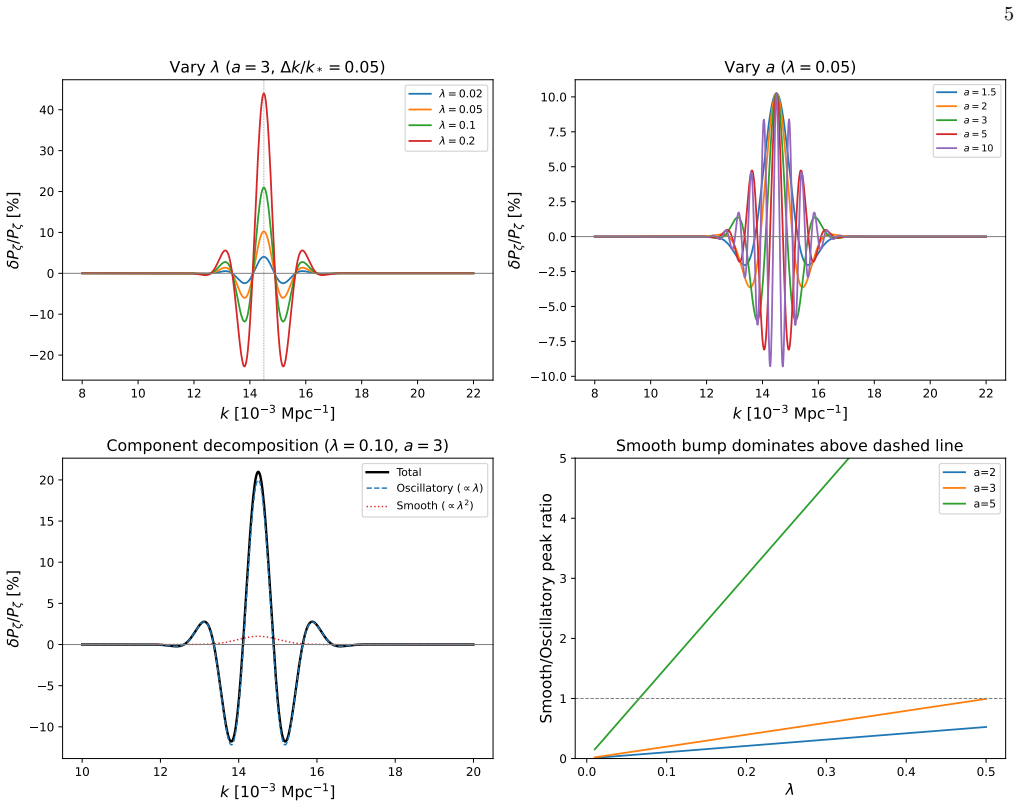
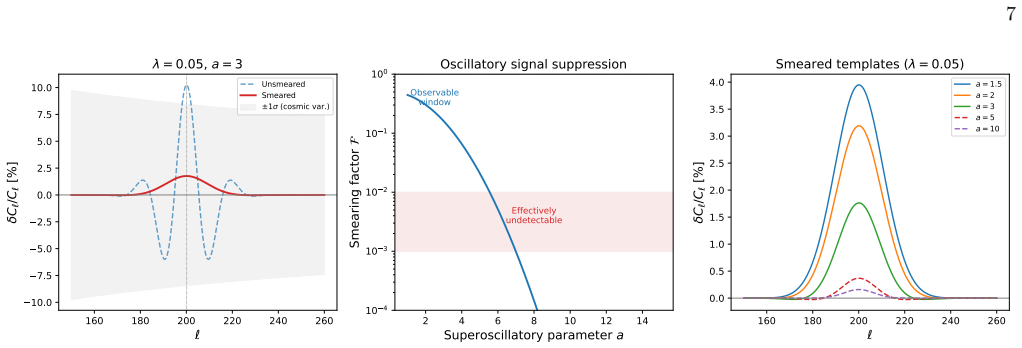
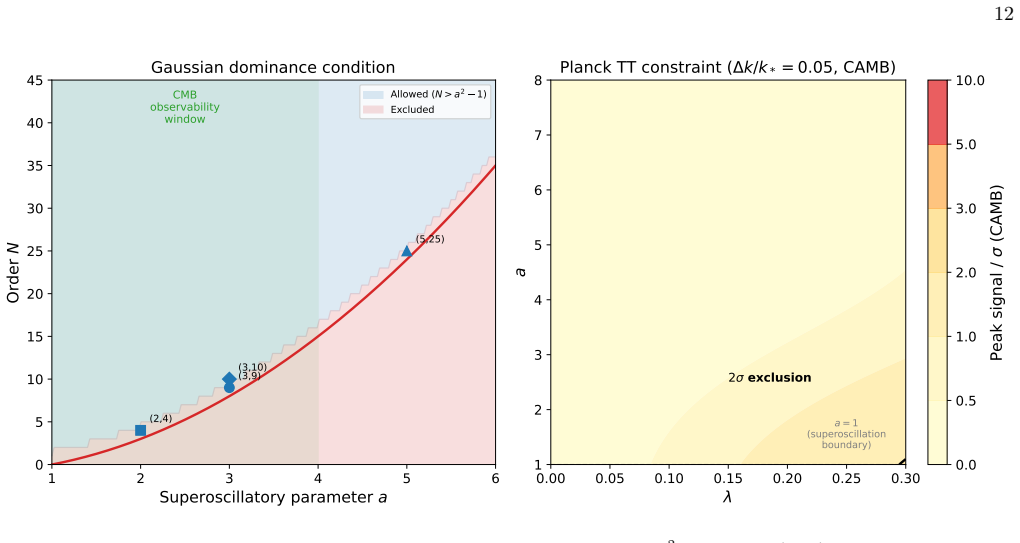
Starting from a quadratic boundary term, the superoscillatory initial state yields Bogoliubov coefficients that produce a localized oscillatory feature in the primordial curvature power spectrum, with the feature fixed by the parameters a and N. Full numerical projection using CAMB shows that transfer functions suppress the oscillation, and a Gaussian approximation overestimates the peak by a factor of three. This leads to a bound from Planck TT data of lambda less than or equal to 0.05 for a representative case, while galaxy clustering is identified as a stronger probe because it retains the unsmeared oscillatory structure.
What carries the argument
The quadratic boundary term on the initial time surface, which encodes the superoscillatory initial state and determines the resulting Bogoliubov coefficients and primordial spectrum.
If this is right
- The oscillatory feature in the primordial spectrum is strongly suppressed when projected onto CMB angular power spectra by transfer functions.
- Planck 2018 temperature data constrain the amplitude parameter lambda to less than or equal to 0.05 for a feature near the first acoustic peak.
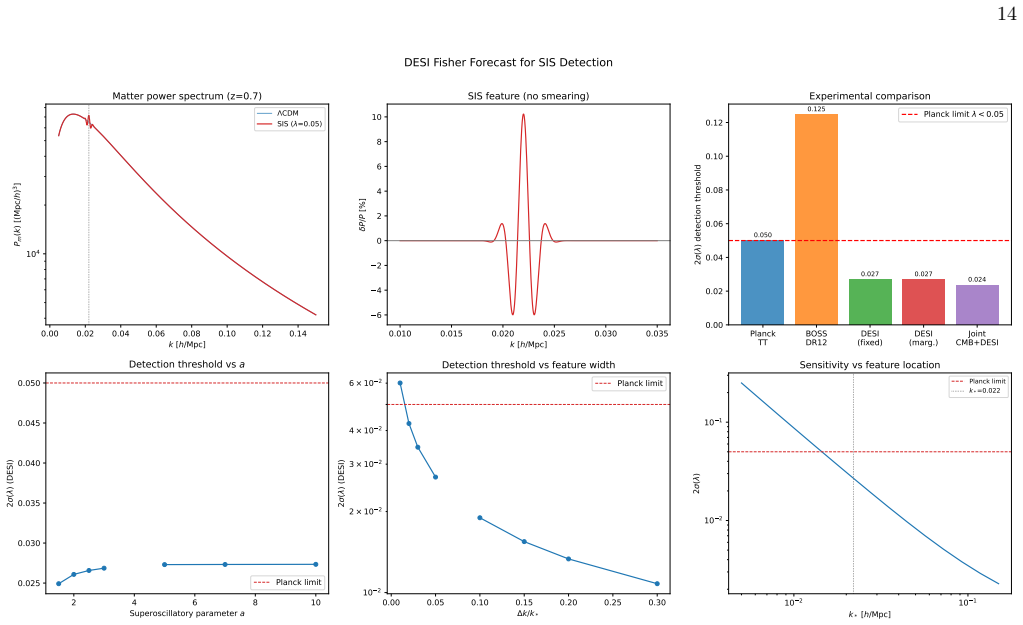
- Galaxy clustering measurements can access the full oscillatory structure without the suppression seen in CMB data.
- Structural differences in the bispectrum and polarization spectra distinguish this model from generic excited-state scenarios.
Where Pith is reading between the lines
- Surveys targeting the matter power spectrum at wavenumbers around 0.01 per megaparsec could test the model at higher sensitivity than current CMB limits allow.
- If the quadratic boundary term is the right realization, similar constructions might apply to other early-universe scenarios with band-limited initial conditions.
- Joint analysis of the power spectrum and bispectrum would be needed to confirm the specific phase-winding signature of superoscillatory states.
Load-bearing premise
The quadratic boundary term on the initial time surface is enough to produce the superoscillatory initial state without changing the later evolution of the universe or the standard transfer functions.
What would settle it
A search in galaxy clustering data for an oscillatory feature with the predicted location, width, and amplitude consistent with the CMB bound; detection at that level or a tighter upper limit would test the claim.
Figures



read the original abstract
We construct an explicit boundary-action realization of superoscillatory initial states (SIS) for inflation, in which quantum interference within a band-limited initial wavefunctional generates a spectrally localized Bogoliubov excitation with a rapidly winding phase. Starting from a quadratic boundary term on the initial time surface, we derive the Bogoliubov coefficients and the resulting primordial curvature spectrum, obtaining a localized oscillatory feature fixed by the superoscillatory parameters $(a,N)$ rather than imposed phenomenologically. We compute the projection of this feature onto CMB angular power spectra and show that transfer-function smearing strongly suppresses the oscillatory component; full CAMB calculations confirm the qualitative effect and show that a simple Gaussian approximation overestimates the peak signal by about a factor of three. Using Planck 2018 TT data, we obtain an indicative matched-filter bound $\lambda \lesssim 0.05$ for a representative feature centered near the first acoustic peak, $\Delta k/k_* = 0.05$ at $k_* = 1.45\times 10^{-2}\,\mathrm{Mpc}^{-1}$. We further derive correlated predictions for polarization and the bispectrum, identify structural constraints that distinguish SIS from generic excited-state models, and show that galaxy clustering provides a qualitatively more powerful probe because it preserves the full oscillatory structure that CMB projection suppresses. This framework provides a concrete and testable realization of how initial-state quantum interference can imprint itself on cosmological observables.
Editorial analysis
A structured set of objections, weighed in public.
Referee Report
Summary. The manuscript constructs an explicit boundary-action realization of superoscillatory initial states for inflation via a quadratic boundary term on the initial time surface. It derives the associated Bogoliubov coefficients, yielding a localized oscillatory feature in the primordial curvature spectrum whose shape is fixed by the parameters (a, N). Projections onto CMB angular power spectra are computed with CAMB, showing strong suppression by transfer functions and that a Gaussian approximation overestimates the peak by a factor of three; an indicative bound λ ≲ 0.05 is reported from Planck 2018 TT data for a representative feature, together with predictions for polarization, the bispectrum, structural distinctions from generic excited-state models, and the claim that galaxy clustering preserves the oscillatory structure better than CMB observables.
Significance. If the derivation is valid, the work supplies a concrete, first-principles route to initial-state quantum interference effects that avoids purely phenomenological insertion of oscillations. The quantitative factor-of-three discrepancy with the Gaussian approximation and the identification of galaxy clustering as a qualitatively stronger probe constitute useful, testable implications for future surveys. The framework also supplies falsifiable structural constraints that differentiate SIS from other excited initial states.
major comments (1)
- [Abstract] Abstract: the central claim states that the oscillatory feature is 'fixed by the superoscillatory parameters (a,N) rather than imposed phenomenologically,' yet an amplitude parameter λ is separately bounded by data fitting. It is not shown whether λ is fixed by the quadratic boundary term or functions as an independent free parameter; this distinction is load-bearing for the assertion that the construction is non-phenomenological.
Simulated Author's Rebuttal
We thank the referee for their careful reading of the manuscript and for highlighting an important point of clarification regarding the non-phenomenological character of the construction. We address the single major comment below.
read point-by-point responses
-
Referee: [Abstract] Abstract: the central claim states that the oscillatory feature is 'fixed by the superoscillatory parameters (a,N) rather than imposed phenomenologically,' yet an amplitude parameter λ is separately bounded by data fitting. It is not shown whether λ is fixed by the quadratic boundary term or functions as an independent free parameter; this distinction is load-bearing for the assertion that the construction is non-phenomenological.
Authors: The quadratic boundary term takes the explicit form λ ∫ d³x φ(τ₀,x) O(a,N) φ(τ₀,x), where the operator O is fixed by the superoscillatory parameters a and N. Consequently, a and N determine the functional shape, frequency, and localization of the resulting oscillatory feature in the primordial spectrum via the induced Bogoliubov coefficients, while λ controls only the overall amplitude. This is distinct from a phenomenological insertion, in which an arbitrary oscillatory template would be added directly to P_R(k). We agree that the manuscript does not explicitly connect λ to the coefficient of the boundary term in the abstract or early sections. In the revised manuscript we will (i) add a clarifying sentence in the abstract, (ii) state the explicit relation between λ and the boundary-action coefficient in Section 2, and (iii) emphasize that the data bound is placed on this derived amplitude rather than on a free functional form. These changes will be made without altering any numerical results. revision: yes
Circularity Check
No significant circularity identified
full rationale
The derivation starts from an explicit quadratic boundary term on the initial surface to obtain Bogoliubov coefficients and a curvature spectrum whose oscillatory feature is fixed by the superoscillatory parameters (a,N). Subsequent CMB and galaxy-clustering projections employ unmodified standard transfer functions via CAMB. The bound on the amplitude parameter lambda is obtained by fitting to Planck 2018 TT data; no equation reduces the claimed spectrum or bound to a fitted input by construction, and no load-bearing self-citation or uniqueness theorem is invoked. The central claim therefore retains independent content from the boundary-action construction and remains self-contained against external benchmarks.
Axiom & Free-Parameter Ledger
free parameters (2)
- a, N
- lambda
axioms (1)
- domain assumption Quadratic boundary term on the initial time surface realizes the superoscillatory state
Reference graph
Works this paper leans on
-
[1]
An explicit boundary-action construction link- ing superoscillatory quantum interference to infla- tionary initial-state modifications—the first such derivation in the inflation literature
-
[2]
A transfer-function smearing calculation, cali- brated against full Boltzmann computation, estab- lishing the CMB observability window 1< a≲3–4 and revealing that the analytic Gaussian approxi- mation overestimates the signal by a factor of∼3
-
[3]
Correlated predictions for TT and EE spectra, in- cluding the identification of the TT/EE modifica- tion ratio as a diagnostic of the feature width
-
[4]
Bispectrum predictions with specific coefficients (c1 = 3 for equilateral,c 2 = 1/2 for folded), obtained from semi-analytic evaluation of the in- in integral and showing that the dominant non- Gaussian signal is a spectrally localized folded bis- pectrum with|f fold NL | ∼λ/(2ϵ)
-
[5]
Five structural constraints distinguishing SIS from generic excited states, arising from band- 15 limitedness and providing an overdetermined con- sistency check for any future detection
-
[6]
Whether DESI can robustly probe below the indicative Planck bound remains an open question requiring a more complete forecast
A preliminary Fisher-matrix forecast indicating that DESI galaxy clustering offers a qualitatively different probe of the SIS signal—free of transfer- function smearing—withσ(λ) = 0.016 before ac- counting for the survey window function and with a limited cosmological parameter set. Whether DESI can robustly probe below the indicative Planck bound remains...
-
[7]
Substituting ¯k−k ∗ = (k ℓ −k ∗)∆k2/(σ2 k + ∆k 2) = (ℓ−ℓ ∗)∆k2/[D∗(σ2 k + ∆k2)] and collecting factors yields eq
cos a(k−k ∗) ∆k = √ 2π σ12 exp − a2σ2 12 2∆k2 cos a(¯k−k ∗) ∆k ,(B5) using the standard Fourier transform of a Gaussian. Substituting ¯k−k ∗ = (k ℓ −k ∗)∆k2/(σ2 k + ∆k 2) = (ℓ−ℓ ∗)∆k2/[D∗(σ2 k + ∆k2)] and collecting factors yields eq. (27) with the smearing parameters (28)–(29)
-
[8]
Inflationary universe: A possible solution to the horizon and flatness problems,
A. H. Guth, “Inflationary universe: A possible solution to the horizon and flatness problems,” Phys. Rev. D23, 347 (1981)
1981
-
[9]
A new inflationary universe scenario: A possible solution of the horizon, flatness, homogeneity, isotropy and primordial monopole problems,
A. D. Linde, “A new inflationary universe scenario: A possible solution of the horizon, flatness, homogeneity, isotropy and primordial monopole problems,” Phys. Lett. B108, 389 (1982)
1982
-
[10]
Chaotic inflation,
A. D. Linde, “Chaotic inflation,” Phys. Lett. B129, 177 (1983)
1983
-
[11]
Cosmology for grand unified theories with radiatively induced symmetry breaking,
A. Albrecht and P. J. Steinhardt, “Cosmology for grand unified theories with radiatively induced symmetry breaking,” Phys. Rev. Lett.48, 1220 (1982)
1982
-
[12]
Superpositions of time evolutions of a quantum system and a quantum time-translation machine,
Y. Aharonov, J. Anandan, S. Popescu, and L. Vaidman, “Superpositions of time evolutions of a quantum system and a quantum time-translation machine,” Phys. Rev. Lett.73, 918 (1994)
1994
-
[13]
Evanescent and real waves in quantum bil- liards and Gaussian beams,
M. V. Berry, “Evanescent and real waves in quantum bil- liards and Gaussian beams,” J. Phys. A27, L391 (1994)
1994
-
[14]
Evolution of quan- tum superoscillations and optical superresolution with- out evanescent waves,
M. V. Berry and S. Popescu, “Evolution of quan- tum superoscillations and optical superresolution with- out evanescent waves,” J. Phys. A39, 6965 (2006)
2006
-
[15]
On the Cauchy problem for the Schr¨ odinger equation with superoscillatory initial data,
Y. Aharonov, F. Colombo, I. Sabadini, D. C. Struppa, and J. Tollaksen, “On the Cauchy problem for the Schr¨ odinger equation with superoscillatory initial data,” J. Math. Pures Appl.111, 403 (2018)
2018
-
[16]
How the result of a measurement of a component of the spin of a spin-1/2 particle can turn out to be 100,
Y. Aharonov, D. Z. Albert, and L. Vaidman, “How the result of a measurement of a component of the spin of a spin-1/2 particle can turn out to be 100,” Phys. Rev. Lett.60, 1351 (1988)
1988
-
[17]
Super-resolution with- out evanescent waves,
F. M. Huang and N. I. Zheludev, “Super-resolution with- out evanescent waves,” Nano Lett.9, 1249 (2009)
2009
-
[18]
Superoscillations and the quantum poten- tial,
M. V. Berry, “Superoscillations and the quantum poten- tial,” Eur. J. Phys.42, 015401 (2021)
2021
-
[19]
Enhanced non-Gaussianity from excited initial states,
R. Holman and A. J. Tolley, “Enhanced non-Gaussianity from excited initial states,” JCAP05, 001 (2008)
2008
-
[20]
Non-Gaussianities and the stim- ulated creation of quanta in the inflationary universe,
I. Agull´ o and L. Parker, “Non-Gaussianities and the stim- ulated creation of quanta in the inflationary universe,” Phys. Rev. D83, 063526 (2011)
2011
-
[21]
Primordial non-Gaussianities from inflation models,
X. Chen, “Primordial non-Gaussianities from inflation models,” Adv. Astron.2010, 638979 (2010)
2010
-
[22]
Inflation, holography and the choice of vacuum in de Sitter space,
U. H. Danielsson, “Inflation, holography and the choice of vacuum in de Sitter space,” JHEP07, 040 (2002)
2002
-
[23]
De- coupling in an expanding universe: Boundary RG-flow affects initial conditions for inflation,
K. Schalm, G. Shiu, and J. P. van der Schaar, “De- coupling in an expanding universe: Boundary RG-flow affects initial conditions for inflation,” JHEP04, 076 (2004)
2004
-
[24]
Boundary effective field theory and trans- Planckian perturbations: Astrophysical implications of short distance physics,
B. R. Greene, K. Schalm, G. Shiu, and J. P. van der Schaar, “Boundary effective field theory and trans- Planckian perturbations: Astrophysical implications of short distance physics,” JCAP02, 001 (2005)
2005
-
[25]
Renormalization of initial conditions and the trans-Planckian problem of inflation,
H. Collins and R. Holman, “Renormalization of initial conditions and the trans-Planckian problem of inflation,” Phys. Rev. D71, 085009 (2005)
2005
-
[26]
The robustness of inflation to changes in super-Planck-scale physics,
R. H. Brandenberger and J. Martin, “The robustness of inflation to changes in super-Planck-scale physics,” Mod. Phys. Lett. A16, 999 (2001)
2001
-
[27]
Trans-Planckian issues for inflationary cosmology,
R. H. Brandenberger and J. Martin, “Trans-Planckian issues for inflationary cosmology,” Class. Quant. Grav. 30, 113001 (2013)
2013
-
[28]
Inflation as a probe of short distance physics,
R. Easther, B. R. Greene, W. H. Kinney, and G. Shiu, “Inflation as a probe of short distance physics,” Phys. Rev. D64, 103502 (2001)
2001
-
[29]
A generic estimate of trans-Planckian modifications to the primordial power spectrum in inflation,
R. Easther, B. R. Greene, W. H. Kinney, and G. Shiu, “A generic estimate of trans-Planckian modifications to the primordial power spectrum in inflation,” Phys. Rev. D66, 023518 (2002)
2002
-
[30]
Non-Gaussian features of primordial fluc- tuations in single field inflationary models,
J. Maldacena, “Non-Gaussian features of primordial fluc- tuations in single field inflationary models,” JHEP05, 013 (2003)
2003
-
[31]
Planck 2018 results. VI. Cosmo- logical parameters,
Planck Collaboration, “Planck 2018 results. VI. Cosmo- logical parameters,” Astron. Astrophys.641, A6 (2020)
2018
-
[32]
Planck 2018 results. V. CMB power spectra and likelihoods,
Planck Collaboration, “Planck 2018 results. V. CMB power spectra and likelihoods,” Astron. Astrophys.641, A5 (2020)
2018
-
[33]
Planck 2018 results. IX. Con- straints on primordial non-Gaussianity,
Planck Collaboration, “Planck 2018 results. IX. Con- straints on primordial non-Gaussianity,” Astron. Astro- phys.641, A9 (2020)
2018
-
[34]
A two-fluid approximation for calculating the cosmic microwave background anisotropies,
U. Seljak, “A two-fluid approximation for calculating the cosmic microwave background anisotropies,” Astrophys. J.435, L87 (1994)
1994
-
[35]
Efficient com- putation of cosmic microwave background anisotropies in closed Friedmann–Robertson–Walker models,
A. Lewis, A. Challinor, and A. Lasenby, “Efficient com- putation of cosmic microwave background anisotropies in closed Friedmann–Robertson–Walker models,” Astro- phys. J.538, 473 (2000)
2000
-
[36]
The Simons Ob- servatory: Science goals and forecasts,
Simons Observatory Collaboration, “The Simons Ob- servatory: Science goals and forecasts,” JCAP02, 056 (2019)
2019
-
[37]
CMB-S4 Science Book, First Edition
CMB-S4 Collaboration, “CMB-S4 Science Book, First Edition,” arXiv:1610.02743 (2016)
work page internal anchor Pith review Pith/arXiv arXiv 2016
-
[38]
Improved constraints on primordial gravitational waves using Planck, WMAP, and BICEP/Keck observations through the 2018 observ- ing season,
BICEP/Keck Collaboration, “Improved constraints on primordial gravitational waves using Planck, WMAP, and BICEP/Keck observations through the 2018 observ- ing season,” Phys. Rev. Lett.127, 151301 (2021)
2018
-
[39]
Probing cosmic inflation with 17 the LiteBIRD cosmic microwave background polarization survey,
LiteBIRD Collaboration, “Probing cosmic inflation with 17 the LiteBIRD cosmic microwave background polarization survey,” PTEP2023, 042F01 (2023)
2023
-
[40]
The clustering of galaxies in the completed SDSS-III Baryon Oscillation Spectroscopic Survey,
S. Alamet al.(BOSS Collaboration), “The clustering of galaxies in the completed SDSS-III Baryon Oscillation Spectroscopic Survey,” Mon. Not. Roy. Astron. Soc.470, 2617 (2017)
2017
-
[41]
DESI 2024 III: Baryon Acoustic Oscillations from Galaxies and Quasars
DESI Collaboration, “DESI 2024 III: Baryon Acoustic Oscillations from galaxies and quasars,” arXiv:2404.03000 (2024)
work page internal anchor Pith review Pith/arXiv arXiv 2024
-
[42]
The DESI Experiment Part I: Science,Targeting, and Survey Design
DESI Collaboration, “The DESI Experiment Part I: Sci- ence, Targeting, and Survey Design,” arXiv:1611.00036 (2016)
work page internal anchor Pith review Pith/arXiv arXiv 2016
-
[43]
Measuring cosmological parameters with galaxy surveys,
M. Tegmark, “Measuring cosmological parameters with galaxy surveys,” Phys. Rev. Lett.79, 3806 (1997)
1997
-
[44]
Power- spectrum analysis of three-dimensional redshift surveys,
H. A. Feldman, N. Kaiser, and J. A. Peacock, “Power- spectrum analysis of three-dimensional redshift surveys,” Astrophys. J.426, 23 (1994)
1994
-
[45]
Bernardeau, S
F. Bernardeau, S. Colombi, E. Gazta˜ naga, and R. Scoc- cimarro, Phys. Rep.367, 1 (2002)
2002
-
[46]
Extracting primordial non-Gaussianity with- out cosmic variance,
U. Seljak, “Extracting primordial non-Gaussianity with- out cosmic variance,” Phys. Rev. Lett.102, 021302 (2009)
2009
-
[47]
Large-scale galaxy bias,
V. Desjacques, D. Jeong, and F. Schmidt, “Large-scale galaxy bias,” Phys. Rep.733, 1 (2018)
2018
discussion (0)
Sign in with ORCID, Apple, or X to comment. Anyone can read and Pith papers without signing in.