Zero-level CCZ Distillation
Pith reviewed 2026-05-22 06:55 UTC · model grok-4.3
The pith
A zero-level protocol generates high-fidelity CCZ magic states from physical qubits on a 2D lattice, achieving logical error rate scaling p_L ≃ 300 p² with only 22 qubits and depth 24.
A machine-rendered reading of the paper's core claim, the machinery that carries it, and where it could break.
Core claim
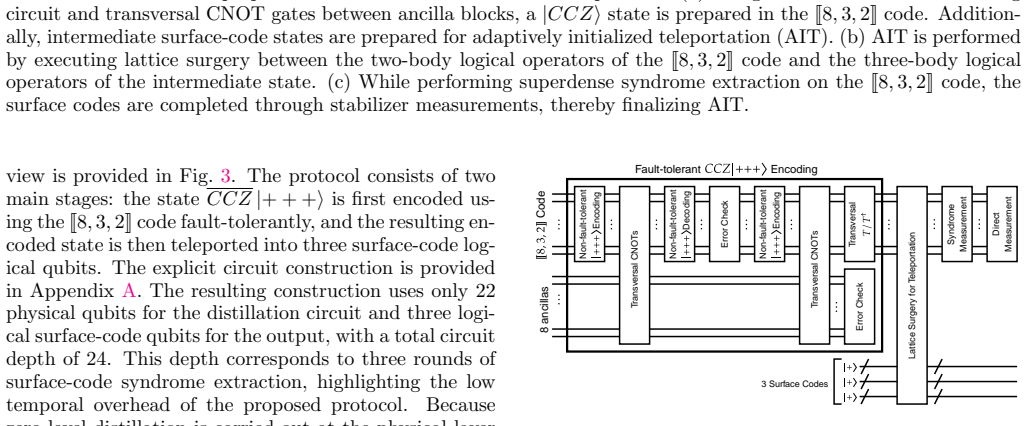
The authors construct a zero-level CCZ distillation circuit that fault-tolerantly prepares the state CCZ|+ + +> by applying the transversal T/T† operation of the [[8,3,2]] code. The prepared state is then teleported onto three surface-code logical qubits using lattice surgery, with adaptively initialized teleportation handling the distance mismatch between codes. Numerical simulations establish that the resulting logical error rate scales as p_L ≃ 300 × p², that the circuit uses only 22 physical qubits and 3 logical qubits at depth 24, and that these resources reduce space-time overhead by a factor of roughly 5-10 relative to standard seven-T-gate methods.
What carries the argument
The zero-level CCZ distillation circuit that applies the transversal T/T† operation of the [[8,3,2]] code to encode CCZ|+ + +> and then teleports the state to surface-code qubits via lattice surgery with adaptively initialized teleportation.
If this is right
- The method reduces space-time overhead by a factor of approximately 5-10 compared with conventional seven-T-gate distillation.
- Logical error rates improve by one to two orders of magnitude at physical error rates of 10^{-3} and 10^{-4}.
- CCZ-state distillation becomes practical for early-stage fault-tolerant quantum computation on 2D lattices.
- Physical-level magic-state distillation offers a new route to resource-efficient non-Clifford gate implementation beyond T-state generation.
Where Pith is reading between the lines
- The protocol could shorten the timeline for running quantum algorithms that benefit from native CCZ gates, such as certain arithmetic or optimization routines, once surface-code hardware reaches the required scale.
- Similar combinations of small-distance codes with lattice surgery might be explored for distilling other multi-qubit magic states that possess transversal non-Clifford operations.
- Integration with existing surface-code compilation tools could reduce the total qubit-time cost of entire quantum circuits that repeatedly invoke CCZ gates.
Load-bearing premise
The numerical error model in the simulations accurately tracks how errors propagate through the transversal T/T† operations, the adaptively initialized teleportation steps, and the lattice-surgery teleportations.
What would settle it
A detailed simulation or physical experiment that includes realistic additional noise sources such as leakage or crosstalk and measures a logical error rate that deviates substantially from the predicted quadratic scaling p_L ≃ 300 p² would falsify the performance claim.
Figures




read the original abstract
Magic state distillation is a key component of fault-tolerant quantum computation, as it enables the implementation of non-Clifford gates such as the $T$ gate and the $CCZ$ gate via gate teleportation. However, conventional distillation protocols require a large number of logical qubits and introduce substantial spatial and temporal overhead, posing a significant bottleneck for scalable fault-tolerant quantum computation. In this work, we propose a zero-level distillation protocol that efficiently generates a high-fidelity logical $CCZ$ magic state using only physical qubits on a two-dimensional square lattice with nearest-neighbor interactions. Our method leverages the transversal $T/T^\dagger$ operation of the $[[ 8,3,2 ]]$ code to fault-tolerantly encode the state $\overline{CCZ}|+++\rangle$, which is subsequently teleported to three surface-code logical qubits via lattice surgery. To enable teleportation between codes with different distances, we introduce adaptively initialized teleportation (AIT), a tailored initialization procedure for the surface code. Numerical simulations demonstrate that the logical error rate scales as $p_L \simeq 300 \times p^2$ with respect to the physical error rate $p$. For example, the proposed method improves the logical error rate by approximately one and two orders of magnitude at $p = 10^{-3}$ and $p = 10^{-4}$, respectively, compared to conventional seven-$T$-gate approaches. The distillation circuit requires only 22 physical qubits, 3 logical qubits, and a circuit depth of 24, reducing the space-time overhead by a factor of approximately 5-10 compared to previous methods. This result highlights the practicality of $CCZ$-state distillation in early fault-tolerant quantum computation and offers a new direction toward resource-efficient physical-level magic state distillation beyond conventional $T$-state generation.
Editorial analysis
A structured set of objections, weighed in public.
Referee Report
Summary. The manuscript proposes a zero-level CCZ magic state distillation protocol that leverages the transversal T/T† operation on the [[8,3,2]] code to fault-tolerantly prepare the encoded state CCZ|++ +⟩ using only physical qubits on a 2D lattice. This state is then transferred to three surface-code logical qubits via a new adaptively initialized teleportation (AIT) procedure combined with lattice surgery. Numerical simulations are reported to demonstrate a logical error rate scaling of p_L ≃ 300 × p², yielding 1–2 orders of magnitude improvement over conventional seven-T-gate methods at physical error rates p = 10^{-3} and 10^{-4}, while using only 22 physical qubits, 3 logical qubits, and circuit depth 24 for a claimed 5–10× reduction in space-time overhead.
Significance. If the reported scaling and overhead reductions hold under realistic noise, the protocol would meaningfully lower the resource cost of CCZ-state distillation in early fault-tolerant quantum computation, enabling more practical non-Clifford gate implementation with minimal qubit and depth overhead. The AIT technique for bridging unequal-distance codes is a technically interesting contribution that could find use in other hybrid-code settings.
major comments (1)
- [Numerical simulations] Numerical simulations section (as summarized in the abstract): The headline claims of p_L ≃ 300 × p² scaling and order-of-magnitude gains rest entirely on Monte Carlo results, yet the error model, treatment of errors in the transversal T/T† step, AIT initialization, and lattice-surgery teleportation, as well as the fitting procedure and any error bars, are not specified. This is load-bearing for the central performance claim; an optimistic independent-depolarizing model that omits correlations or initialization failures would underestimate the logical error rate and could push the quadratic prefactor above 300 or degrade the scaling in the relevant regime.
minor comments (2)
- [Abstract] The abstract introduces 'zero-level' distillation and AIT without a brief inline definition or pointer to prior literature; a short clarifying sentence would improve accessibility.
- [Protocol description] Circuit diagrams and AIT description would benefit from explicit labeling of the adaptive initialization steps and the lattice-surgery operations to make the protocol easier to reproduce from the text alone.
Simulated Author's Rebuttal
We thank the referee for their careful reading of our manuscript and for the constructive feedback. We address the single major comment below and will revise the manuscript accordingly to improve clarity on the numerical results.
read point-by-point responses
-
Referee: [Numerical simulations] Numerical simulations section (as summarized in the abstract): The headline claims of p_L ≃ 300 × p² scaling and order-of-magnitude gains rest entirely on Monte Carlo results, yet the error model, treatment of errors in the transversal T/T† step, AIT initialization, and lattice-surgery teleportation, as well as the fitting procedure and any error bars, are not specified. This is load-bearing for the central performance claim; an optimistic independent-depolarizing model that omits correlations or initialization failures would underestimate the logical error rate and could push the quadratic prefactor above 300 or degrade the scaling in the relevant regime.
Authors: We thank the referee for highlighting the importance of fully specifying the simulation details that support our central claims. In the revised manuscript we will expand the Numerical Simulations section with a complete description of the error model (standard circuit-level independent depolarizing noise applied to every gate, preparation, and measurement), the precise treatment of errors during the transversal T/T† step on the [[8,3,2]] code, the modeling of AIT initialization failures, and the lattice-surgery teleportation circuit. We will also document the fitting procedure (least-squares fit of p_L to a quadratic form over p ∈ [10^{-4}, 10^{-3}]) together with statistical error bars obtained from at least 10^6 Monte Carlo shots per data point. While we acknowledge that an independent depolarizing model omits certain hardware-specific correlations, it is the standard benchmark used for comparing distillation protocols; our simulations nevertheless exhibit clear quadratic scaling with a prefactor near 300 in the regime of interest. We will add a short discussion of this modeling choice and its limitations. revision: yes
Circularity Check
No circularity: numerical scaling is simulation output, not constructed from inputs
full rationale
The paper's central claims—the logical error rate scaling p_L ≃ 300 p², order-of-magnitude improvements, and space-time overhead reduction—are presented as direct outputs of Monte Carlo simulations of the proposed protocol (transversal T/T† on [[8,3,2]], AIT initialization, and lattice-surgery teleportation). No step in the provided derivation chain defines the target scaling or overhead factor in terms of itself, fits a parameter to a subset and renames it a prediction, or relies on a load-bearing self-citation whose content is unverified. The protocol construction and AIT procedure are described independently of the final numerical coefficient; the simulations serve as an external check rather than a tautological re-expression of the inputs. This is the normal case of a self-contained numerical result.
Axiom & Free-Parameter Ledger
free parameters (1)
- scaling prefactor 300
axioms (1)
- domain assumption Standard assumptions of depolarizing noise, nearest-neighbor interactions on a 2D square lattice, and fault tolerance of the [[8,3,2]] code under transversal T/T†
invented entities (1)
-
Adaptively initialized teleportation (AIT)
no independent evidence
Lean theorems connected to this paper
-
IndisputableMonolith/Foundation/AlexanderDuality.leanalexander_duality_circle_linking (D=3 forcing) unclear?
unclearRelation between the paper passage and the cited Recognition theorem.
Numerical simulations demonstrate that the logical error rate scales as p_L ≃ 300 × p² … The distillation circuit requires only 22 physical qubits, 3 logical qubits, and a circuit depth of 24 … superdense syndrome extraction … depth of 8.
-
IndisputableMonolith/Foundation/ArithmeticFromLogic.leanLogicNat ≃ Nat (8-tick periodicity) unclear?
unclearRelation between the paper passage and the cited Recognition theorem.
transversal T/T† operation of the [[8,3,2]] code … fault-tolerantly encode the state CCZ|+++⟩
What do these tags mean?
- matches
- The paper's claim is directly supported by a theorem in the formal canon.
- supports
- The theorem supports part of the paper's argument, but the paper may add assumptions or extra steps.
- extends
- The paper goes beyond the formal theorem; the theorem is a base layer rather than the whole result.
- uses
- The paper appears to rely on the theorem as machinery.
- contradicts
- The paper's claim conflicts with a theorem or certificate in the canon.
- unclear
- Pith found a possible connection, but the passage is too broad, indirect, or ambiguous to say the theorem truly supports the claim.
Reference graph
Works this paper leans on
-
[1]
Peter W Shor. Polynomial-time algorithms for prime fac- torization and discrete logarithms on a quantum com- puter.SIAM review, 41(2):303–332, 1999
work page 1999
-
[2]
A fast quantum mechanical algorithm for database search
Lov K Grover. A fast quantum mechanical algorithm for database search. InProceedings of the twenty-eighth annual ACM symposium on Theory of computing, pages 212–219, 1996
work page 1996
-
[3]
Quantum algorithm for linear systems of equations
Aram W Harrow, Avinatan Hassidim, and Seth Lloyd. Quantum algorithm for linear systems of equations. Physical review letters, 103(15):150502, 2009
work page 2009
-
[4]
Scheme for reducing decoherence in quan- tum computer memory.Physical review A, 52(4):R2493, 1995
Peter W Shor. Scheme for reducing decoherence in quan- tum computer memory.Physical review A, 52(4):R2493, 1995
work page 1995
-
[5]
Keisuke Fujii.Quantum Computation with Topological Codes: from qubit to topological fault-tolerance, volume 8. Springer, 2015
work page 2015
-
[6]
Quantum computations: algorithms and error correction.Russian Mathematical Surveys, 52(6):1191, 1997
A Yu Kitaev. Quantum computations: algorithms and error correction.Russian Mathematical Surveys, 52(6):1191, 1997
work page 1997
-
[7]
Fault-tolerant quantum computation by anyons.Annals of physics, 303(1):2–30, 2003
A Yu Kitaev. Fault-tolerant quantum computation by anyons.Annals of physics, 303(1):2–30, 2003
work page 2003
-
[8]
Austin G Fowler, Matteo Mariantoni, John M Mar- tinis, and Andrew N Cleland. Surface codes: To- wards practical large-scale quantum computation.Phys- ical Review A—Atomic, Molecular, and Optical Physics, 86(3):032324, 2012
work page 2012
-
[9]
A one-way quan- tum computer.Physical review letters, 86(22):5188, 2001
Robert Raussendorf and Hans J Briegel. A one-way quan- tum computer.Physical review letters, 86(22):5188, 2001
work page 2001
-
[10]
Quantum er- ror correction below the surface code threshold.Nature, 638(8052):920–926, 2025
Google Quantum AI and Collaborators. Quantum er- ror correction below the surface code threshold.Nature, 638(8052):920–926, 2025
work page 2025
-
[11]
Restrictions on transversal encoded quantum gate sets.Physical review letters, 102(11):110502, 2009
Bryan Eastin and Emanuel Knill. Restrictions on transversal encoded quantum gate sets.Physical review letters, 102(11):110502, 2009
work page 2009
-
[12]
Sergey Bravyi and Alexei Kitaev. Universal quantum computation with ideal clifford gates and noisy ancil- las.Physical Review A—Atomic, Molecular, and Optical Physics, 71(2):022316, 2005
work page 2005
-
[13]
How to factor 2048 bit rsa integers in 8 hours using 20 million noisy qubits
Craig Gidney and Martin Eker˚ a. How to factor 2048 bit rsa integers in 8 hours using 20 million noisy qubits. Quantum, 5:433, 2021
work page 2048
-
[14]
Minimizing resource overheads for fault- tolerant preparation of encoded states of the steane code
Hayato Goto. Minimizing resource overheads for fault- tolerant preparation of encoded states of the steane code. Scientific reports, 6(1):19578, 2016
work page 2016
-
[15]
Fault- tolerant magic state preparation with flag qubits.Quan- tum, 3:143, 2019
Christopher Chamberland and Andrew W Cross. Fault- tolerant magic state preparation with flag qubits.Quan- tum, 3:143, 2019
work page 2019
-
[16]
Christopher Chamberland and Kyungjoo Noh. Very low overhead fault-tolerant magic state preparation using re- dundant ancilla encoding and flag qubits.npj Quantum Information, 6(1):91, 2020
work page 2020
-
[17]
Efficient magic state distillation by zero- level distillation.PRX Quantum, 6(2):020356, 2025
Tomohiro Itogawa, Yugo Takada, Yutaka Hirano, and Keisuke Fujii. Efficient magic state distillation by zero- level distillation.PRX Quantum, 6(2):020356, 2025
work page 2025
-
[18]
Leveraging zero-level distillation to generate high-fidelity magic states
Yutaka Hirano, Tomohiro Itogawa, and Keisuke Fujii. Leveraging zero-level distillation to generate high-fidelity magic states. In2024 IEEE International Conference on Quantum Computing and Engineering (QCE), volume 1, pages 843–853. IEEE, 2024
work page 2024
-
[19]
Magic state cultivation: growing T states as cheap as CNOT gates
Craig Gidney, Noah Shutty, and Cody Jones. Magic state cultivation: growing t states as cheap as cnot gates.arXiv preprint arXiv:2409.17595, 2024
work page internal anchor Pith review Pith/arXiv arXiv 2024
-
[20]
Efficient magic state cultivation with lat- tice surgery.arXiv preprint arXiv:2510.24615, 2025
Yutaka Hirano, Riki Toshio, Tomohiro Itogawa, and Keisuke Fujii. Efficient magic state cultivation with lat- tice surgery.arXiv preprint arXiv:2510.24615, 2025
-
[21]
Daniel Honciuc Menendez, Annie Ray, and Michael Vas- mer. Implementing fault-tolerant non-clifford gates us- ing the [[8, 3, 2]] color code.Physical Review A, 109(6):062438, 2024
work page 2024
-
[22]
Efficient magic state cultivation on∖p 2
Zi-Han Chen, Ming-Cheng Chen, Chao-Yang Lu, and Jian-Wei Pan. Efficient magic state cultivation on∖p 2. PRX Quantum, 7:010315, Jan 2026
work page 2026
-
[23]
High rate magic state cultivation on the surface code.PRX Quantum, 7:010353, Mar 2026
Yotam Vaknin, Shoham Jacoby, Arne Grimsmo, and Alex Retzker. High rate magic state cultivation on the surface code.PRX Quantum, 7:010353, Mar 2026
work page 2026
-
[24]
Fold-transversal surface code cultivation.arXiv preprint arXiv:2509.05212, 2025
Kaavya Sahay, Pei-Kai Tsai, Kathleen Chang, Qile Su, Thomas B Smith, Shraddha Singh, and Shruti Puri. Fold-transversal surface code cultivation.arXiv preprint arXiv:2509.05212, 2025
-
[25]
Unfolding the color code.New Journal of Physics, 17(8):083026, 2015
Aleksander Kubica, Beni Yoshida, and Fernando Pastawski. Unfolding the color code.New Journal of Physics, 17(8):083026, 2015
work page 2015
-
[26]
https://earltcampbell.com/2016/09/26/ the-smallest-interesting-colour-code/
The smallest interesting colour code. https://earltcampbell.com/2016/09/26/ the-smallest-interesting-colour-code/
work page 2016
-
[27]
Machine learning logical gates for quantum error correction.arXiv preprint arXiv:1912.10063, 2019
Hongxiang Chen, Michael Vasmer, Nikolas P Breuck- mann, and Edward Grant. Machine learning logical gates for quantum error correction.arXiv preprint arXiv:1912.10063, 2019
-
[28]
Hendrik Poulsen Nautrup, Nicolai Friis, and Hans J Briegel. Fault-tolerant interface between quantum mem- ories and quantum processors.Nature communications, 8(1):1321, 2017
work page 2017
-
[29]
Lingling Lao and Carmen G Almudever. Fault-tolerant quantum error correction on near-term quantum proces- sors using flag and bridge qubits.Physical Review A, 101(3):032333, 2020
work page 2020
-
[30]
New circuits and an open source decoder for the color code.arXiv preprint arXiv:2312.08813, 2023
Craig Gidney and Cody Jones. New circuits and an open source decoder for the color code.arXiv preprint arXiv:2312.08813, 2023
-
[31]
Stim: a fast stabilizer circuit simulator
Craig Gidney. Stim: a fast stabilizer circuit simulator. Quantum, 5:497, July 2021
work page 2021
-
[32]
Qulacs: a fast and versatile quantum circuit simu- lator for research purpose.Quantum, 5:559, 2021
Yasunari Suzuki, Yoshiaki Kawase, Yuya Masumura, Yuria Hiraga, Masahiro Nakadai, Jiabao Chen, Ken M Nakanishi, Kosuke Mitarai, Ryosuke Imai, Shiro Tamiya, et al. Qulacs: a fast and versatile quantum circuit simu- lator for research purpose.Quantum, 5:559, 2021
work page 2021
-
[33]
Cambridge university press, 2010
Michael A Nielsen and Isaac L Chuang.Quantum compu- tation and quantum information. Cambridge university press, 2010
work page 2010
-
[34]
Efficient magic state factories with a catalyzed|CCZ⟩to 2|T⟩transformation
Craig Gidney and Austin G Fowler. Efficient magic state factories with a catalyzed|CCZ⟩to 2|T⟩transformation. Quantum, 3:135, 2019
work page 2019
discussion (0)
Sign in with ORCID, Apple, or X to comment. Anyone can read and Pith papers without signing in.