REVIEW 4 major objections 6 minor 57 references
HSA: Hierarchical Slot Attention for Multi-granularity Scene-Decomposition
T0 review · 4 major / 6 minor · reviewed 2026-07-10 · grok-4.5
Pith's one-line read A single slot-attention model, trained with 10% labels and hierarchical alignment, jointly decomposes scenes into foreground, categories, and instances—and beats three separate flat models.
desk verdict Solid multi-level slot method with real efficiency and purity gains; the headline ARI margins overstate hierarchical necessity because supervised flats are trained independently. read the letter →
The pith
A machine-rendered reading of the paper's core claim, the machinery that carries it, and where it could break.
The reading
What carries the argument
Hierarchical Slot Attention (HSA): three independent slot-attention modules on shared DINOv2 patch features, trained with feature reconstruction, delayed Dice supervision on 10% labels, and a hierarchical alignment loss that enforces coverage and cosine consistency between consecutive levels.
What would settle it
Build an unsupervised hierarchical slot model (or a flat model with richer hierarchical objectives) that matches or exceeds HSA’s grouping purity and multi-level ARI on COCO without any category labels; if it succeeds, the claim that semantic hierarchy requires the 10% supervision fails.
Extended reading notes
Core claim
With only 10% categorical segmentation labels and a hierarchical alignment loss, one shared Hierarchical Slot Attention model can jointly produce holistic, semantic, and panoptic scene decompositions that substantially outperform the strongest flat slot-attention baselines trained separately for each granularity.
Load-bearing premise
True semantic category structure cannot emerge from appearance or self-supervised features alone and therefore needs categorical segmentation labels as a grounding signal.
Editorial extensions
If this is right
- Multi-granularity scene understanding can be served by one shared model and one forward pass instead of three separately trained models.
- Even 1% categorical labels already lift every granularity above fully unsupervised flat baselines, showing the grounding signal can be minimal.
- Grouping purity and attention containment become usable diagnostics for whether hierarchy is semantic rather than merely spatial.
- Joint hierarchical training also improves instance-level object discovery and slot-based recognition over specialized single-level models.
- Slot methods can discover object boundaries that go beyond fixed ground-truth annotations while remaining semantically coherent.
Reading between the lines
- Weaker grounding signals such as language captions or free-form tags may be able to replace mask labels while keeping the hierarchical benefit.
- The same three-level architecture is a natural candidate for video, where temporal consistency could lock in hierarchical tracks across frames.
- If stronger foundation features already encode latent category structure, the amount of Dice supervision needed should continue to shrink.
- Evaluation that rewards multiple valid granularities would better credit decompositions that correctly split objects beyond a single fixed ground-truth clustering.
Editorial analysis
A structured set of objections, weighed in public.
Referee Report
Summary. The paper proposes Hierarchical Slot Attention (HSA), a single shared-backbone model with three level-specific slot-attention modules and independent decoders that jointly produce holistic (K=2), semantic (K=6/4), and panoptic (K=11/6) scene decompositions. Training combines DINOv2 feature reconstruction, Dice supervision on 10% of labels at all three granularities, and a hierarchical alignment loss L_align that uses hard nearest-coarse assignment with a straight-through estimator. On COCO and PASCAL VOC the joint model reports large ARI/mBO/mIoU gains over both unsupervised and 10%-supervised flat slot baselines that are trained separately per K, plus efficiency advantages (one forward pass), new hierarchy metrics (grouping purity, attention containment), and supporting ablations and recognition/instance-discovery evaluations.
Significance. If the results hold under fairer controls, the work is a useful practical advance for object-centric learning: multi-granularity decompositions from one model and one pass, with strong label efficiency and clear gains over independently trained single-K slot models. The architecture is simple and reproducible in spirit (code promised), the evaluation suite is broad (discovery, recognition, efficiency, purity/containment), and the qualitative evidence that minimal categorical grounding steers slots toward human-aligned partitions is valuable. The contribution is primarily empirical and systems-level rather than a new theoretical principle of hierarchy; its lasting impact depends on whether joint multi-level supervision (vs. L_align specifically) is cleanly isolated and whether the narrative about semantic hierarchy is tightened to match the ablations.
major comments (4)
- [Abstract; §4.2; Table 1; Table 7] Abstract, §1, and §4.2 attribute the headline +41.5/+14.6/+10.4 ARI gains primarily to hierarchical joint training with L_align. Table 7 shows that Dice alone (row “Dice, no align”) already yields essentially the full lift (Hol. 66.9, Sem. 53.5, Pan. 49.6 vs full 67.0/53.5/49.3), while L_align alone is near-neutral. The main ARI margins therefore measure joint multi-level supervised slot attention with a shared backbone against three independently trained single-K models (Table 1 yellow), not the necessity of hierarchical alignment. The paper should reframe the central claim around joint multi-granularity supervision and treat L_align as a secondary regularizer for structure metrics, or add an explicit multi-head joint control discussion that matches Table 7 in the main narrative.
- [§4.2 Hierarchical Structure Evaluation; Table 4; Table 7] L_align is retained largely for hierarchical structure (Table 4 grouping purity / containment), yet purity/containment are never reported for the “Dice, no align” configuration of Table 7. Without that ablation it is unclear whether the purity gains come from L_align, from multi-level Dice, or from joint training itself. Please report purity and containment for the Table 7 ablations (and ideally for a shared-aggregator joint model) so that the justification for L_align is load-bearing rather than post-hoc.
- [Abstract; §1; §2 Related Work] The strong claim that “semantic hierarchies cannot emerge without supervision, because category names are human constructs” (abstract, §1) is only weakly stress-tested. All unsupervised hierarchical priors discussed in §2 are older spatial/part-whole methods; there is no experiment with modern unsupervised hierarchical objectives, language grounding, or multi-K unsupervised multi-head variants under the same DINOv2 backbone. Given that Table 7 attributes almost all ARI gain to Dice, the manuscript should either soften this necessity claim or provide a concrete negative control showing that appearance-only multi-level training cannot recover category-aligned purity at L2←L3.
- [§4.2 Object Discovery Task; Table 1] Table 1 supervised flat baselines often degrade relative to their unsupervised counterparts (e.g., DINOSAUR/SLATE/SlotDiffusion on VOC; SPOT panoptic on COCO). The paper interprets this as evidence that “supervision alone is insufficient without hierarchical joint training,” but the protocol applies categorical Dice independently at a single K without the shared multi-level feature context HSA enjoys. This makes the degradation partly expected and weakens the rhetorical contrast. Clarify the protocol limitations and avoid over-interpreting independent single-K supervised collapses as proof of hierarchical necessity.
minor comments (6)
- [Table 1 vs Table 7] Table 7 full-model numbers (67.0/53.5/49.3 ARI) do not match Table 1 HSA (69.0/55.2/47.1). State which configuration (aggregators, seeds, schedule) each table uses so readers can reconcile them.
- [§3.4 Hierarchical Alignment; Eq. (7)–(8)] Eq. (8): the hard assignment B via indicator of max cosine similarity is non-differentiable; STE is mentioned in text but not formalized. A one-line definition of the forward/backward STE would help reproducibility.
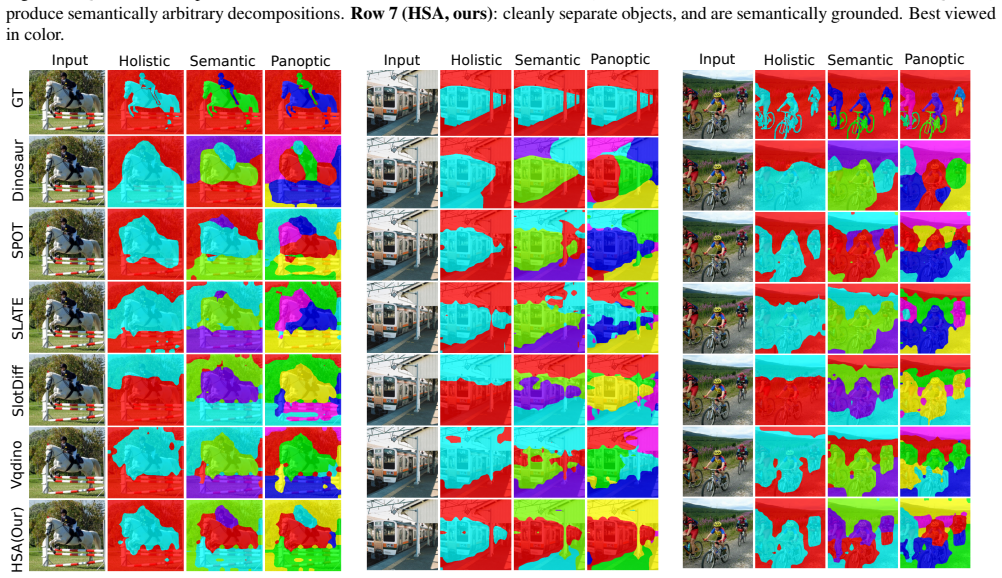
- [Figure 2] Figure 2 caption says “Row 2 (HSA)” then “Rows 3–7: flat baselines,” but the figure layout description in text is easy to misread; label rows explicitly in the figure itself.
- [§4.1 Implementation Details; Table 13] K_hol/K_sem/K_pan are chosen to match average region/category/instance counts; a short sensitivity note in the main text (beyond Table 13 in the appendix) would help readers who need different slot budgets.
- [§1; Tables 11–12] Minor wording: “outperformingfully unsupervised” missing space (contributions bullet); “Seperate” → “Separate” in Table 11/12 captions; consistent use of “panoptic” vs “instance-level.”
- [§2; References] Related work cites Jia et al. ICLR 2023 twice under different conceptual roles ([19] and [20]); deduplicate and keep the intended symbolic-cognition citations distinct.
Circularity Check
No circularity: empirical methods paper whose claims are measured against external COCO/VOC ground truth and published baselines, not derived by equating fitted quantities or self-defined constructs to themselves.
full rationale
HSA is a standard semi-supervised computer-vision methods paper. Its central claims (multi-granularity ARI/mBO/mIoU gains of a single jointly-trained model over flat slot-attention baselines under 10% Dice supervision plus L_align) are evaluated on held-out COCO val2017 and PASCAL VOC 2012 annotations that are external to the training objective. The hierarchical alignment loss (Eq. 8) operates on cosine similarities of slot embeddings with a straight-through estimator; the subsequently reported grouping-purity and attention-containment metrics (Table 4) are defined with respect to ground-truth category labels and attention-mass nesting, respectively, and are therefore not definitionally identical to the training signal. Ablations (Tables 7–10, 13–14) further isolate components without renaming any fitted quantity as a “prediction.” There are no self-definitional equations, no uniqueness theorems imported from the authors’ prior work, no ansatz smuggled via self-citation, and no renaming of a known empirical pattern. Self-citations that appear (e.g., to DINOSAUR, SPOT) are ordinary baseline references, not load-bearing premises. Experimental-design questions about whether the flat baselines received an equivalent multi-head joint-training opportunity are validity concerns, not circularity. The derivation chain therefore contains no step that reduces, by construction, to its own inputs.
Assumptions & free parameters
free parameters (5)
- λ_align (hierarchical alignment weight)
- λ_sup (Dice supervision weight)
- Slot counts K_hol, K_sem, K_pan
- Labeled data fraction (10%)
- Supervision delay (20k steps)
assumptions (5)
- domain assumption Semantic category hierarchy cannot emerge from appearance/DINO reconstruction alone and requires categorical label grounding.
- domain assumption Holistic / semantic / panoptic (K≈2 / categories / instances) is the right three-level human-aligned hierarchy for evaluation and training.
- domain assumption Frozen DINOv2 patch features plus L2 feature reconstruction provide a sufficient shared representation for multi-level slots.
- standard math Hungarian-matched Dice on attention maps is a valid multi-level supervision signal for slots.
- ad hoc to paper Straight-through estimator through hard nearest-coarse assignment yields useful gradients for L_align.
invented entities (3)
-
Hierarchical Slot Attention (three parallel level-specific SA modules + independent decoders)
-
Hierarchical alignment loss L_align (coverage + cosine alignment with STE)
-
Grouping purity and attention containment metrics
Cite this review
Pith. "Pith review of HSA: Hierarchical Slot Attention for Multi-granularity Scene-Decomposition." pith.science (2026). https://pith.science/paper/3LVZZCMV
@misc{pith2026260708249,
  author       = {Pith},
  title        = {Pith review of: HSA: Hierarchical Slot Attention for Multi-granularity Scene-Decomposition},
  year         = {2026},
  howpublished = {\url{https://pith.science/paper/3LVZZCMV}},
  note         = {Machine review of arXiv:2607.08249}
}
abstract
Slot attention is a powerful framework for object-centric learning, decomposing visual scenes into latent slots through iterative competitive attention. However, existing methods share two critical limitations: they decompose scenes into a flat set of slots at a single granularity, and this decomposition is based on appearance rather than semantics. Yet humans understand scenes through semantic hierarchies: separating foreground from background, recognizing object categories, and identifying individual instances. Crucially, such semantic hierarchies cannot emerge without supervision, because category names are human constructs, not visual patterns. We propose Hierarchical Slot Attention (HSA), which learns multi-granularity semantic scene decomposition from a single model. HSA decomposes scenes at three levels: holistic (foreground/background), semantic (object categories), and panoptic (individual instances). Using only 10\% labeled data, combined with hierarchical alignment loss, HSA learns all three levels jointly. We further introduce grouping purity and containment to measure whether the hierarchy is encoded in representation space, not just output masks. Experiments on COCO and PASCAL VOC demonstrate that HSA outperforms the strongest flat baseline by up to \textbf{$+$41.5} ARI at holistic, \textbf{$+$14.6} at semantic, and \textbf{$+$10.4} at panoptic level on COCO, with even larger gains on Pascal VOC, while requiring a single model instead of three. Code will be made available upon acceptance.
Figures


Figures from the paper (2 more)

Reference graph
Works this paper leans on
-
[1]
Pablo Arbelaez, Michael Maire, Charless Fowlkes, and Ji- tendra Malik. Contour detection and hierarchical image seg- mentation.IEEE transactions on pattern analysis and ma- chine intelligence, 33(5):898–916, 2010. 2
work page 2010
-
[2]
Daniel Bear, Chaofei Fan, Damian Mrowca, Yunzhu Li, Seth Alter, Aran Nayebi, Jeremy Schwartz, Li F Fei-Fei, Jiajun Wu, Josh Tenenbaum, et al. Learning physical graph repre- sentations from visual scenes.Advances in Neural Informa- tion Processing Systems, 33:6027–6039, 2020. 2
work page 2020
-
[3]
MONet: Unsupervised Scene Decomposition and Representation
Christopher Burgess, Loic Matthey, Nicholas Watters, Rishabh Kabra, Irina Higgins, Matt Botvinick, and Alexan- der Lerchner. MONet: Unsupervised Scene Decomposition and Representation.arXiv preprint arXiv:1901.11390, 2019. 1, 2
work page Pith review arXiv 1901
-
[4]
Emerg- ing properties in self-supervised vision transformers
Mathilde Caron, Hugo Touvron, Ishan Misra, Herv ´e J´egou, Julien Mairal, Piotr Bojanowski, and Armand Joulin. Emerg- ing properties in self-supervised vision transformers. InPro- ceedings of ICCV, pages 9650–9660, 2021. 1, 2
work page 2021
-
[5]
Neural slot interpreters: Grounding object semantics in emergent slot representations
Bhishma Dedhia and Niraj K Jha. Neural slot interpreters: Grounding object semantics in emergent slot representations. Transactions on Machine Learning Research, 2025, 2025. 2
work page 2025
-
[6]
CTRL-O: Language-Controllable Object-Centric Visual Representation Learning
Aniket Didolkar, Andrii Zadaianchuk, Rabiul Awal, Maxi- milian Seitzer, Efstratios Gavves, and Aishwarya Agrawal. CTRL-O: Language-Controllable Object-Centric Visual Representation Learning. InProceedings of CVPR, pages 29523–29533, 2025. 2
work page 2025
-
[7]
Cathrin Elich, Martin R Oswald, Marc Pollefeys, and Joerg Stueckler. Weakly supervised learning of multi-object 3d scene decompositions using deep shape priors.Computer Vision and Image Understanding, 220:103440, 2022. 2
work page 2022
-
[8]
SA Vi++: Towards end-to-end object-centric learning from real-world videos
Gamaleldin Elsayed, Aravindh Mahendran, Sjoerd Van Steenkiste, Klaus Greff, Michael Mozer, and Thomas Kipf. SA Vi++: Towards end-to-end object-centric learning from real-world videos. InProceedings of NeurIPS, pages 28940–28954, 2022. 2
work page 2022
Show all 57 references
-
[9]
Genesis: generative scene inference and sampling of object- centric latent representations.Proceedings of the ICLR,
M Engelcke, AR Kosiorek, O Parker Jones, and H Posner. Genesis: generative scene inference and sampling of object- centric latent representations.Proceedings of the ICLR,
-
[10]
Attend, infer, repeat: Fast scene understanding with generative models
SM Eslami, Nicolas Heess, Theophane Weber, Yuval Tassa, David Szepesvari, Geoffrey E Hinton, et al. Attend, infer, repeat: Fast scene understanding with generative models
-
[11]
The pascal visual object classes (voc) challenge.International journal of computer vision, 88(2):303–338, 2010
Mark Everingham, Luc Van Gool, Christopher KI Williams, John Winn, and Andrew Zisserman. The pascal visual object classes (voc) challenge.International journal of computer vision, 88(2):303–338, 2010. 4, 14
2010
-
[12]
Adap- tive slot attention: Object discovery with dynamic slot num- ber
Ke Fan, Zechen Bai, Tianjun Xiao, Tong He, Max Horn, Yanwei Fu, Francesco Locatello, and Zheng Zhang. Adap- tive slot attention: Object discovery with dynamic slot num- ber. InProceedings of CVPR, pages 23062–23071, 2024. 2
2024
-
[13]
En- hancing interpretable object abstraction via clustering-based slot initialization
Ning Gao, Bernard Hohmann, and Gerhard Neumann. En- hancing interpretable object abstraction via clustering-based slot initialization. InProceedings of BMVC, 2023. 2
2023
-
[14]
Multi-object representation learning with iterative variational inference
Klaus Greff, Rapha ¨el Lopez Kaufman, Rishabh Kabra, Nick Watters, Christopher Burgess, Daniel Zoran, Loic Matthey, Matthew Botvinick, and Alexander Lerchner. Multi-object representation learning with iterative variational inference. InProceedings of ICML, pages 2424–2433, 2019. 1, 2
2019
-
[15]
On the binding problem in artificial neural networks
Klaus Greff, Sjoerd Van Steenkiste, and J ¨urgen Schmidhu- ber. On the binding problem in artificial neural networks. arXiv preprint arXiv:2012.05208, 2020. 1
2012 arXiv
-
[16]
Slot- match: Distilling object-centric representations for unsuper- vised video segmentation.arXiv preprint arXiv:2508.03411,
Diana-Nicoleta Grigore, Neelu Madan, Andreas Mogel- mose, Thomas B Moeslund, and Radu Tudor Ionescu. Slot- match: Distilling object-centric representations for unsuper- vised video segmentation.arXiv preprint arXiv:2508.03411,
-
[17]
How to represent part-whole hierarchies in a neu- ral network.Neural Computation, 35(3):413–452, 2023
G Hinton. How to represent part-whole hierarchies in a neu- ral network.Neural Computation, 35(3):413–452, 2023. 1, 2
2023
-
[18]
Matrix capsules with EM routing
Geoffrey E Hinton, Sara Sabour, and Nicholas Frosst. Matrix capsules with EM routing. InProceedings of ICLR, 2018. 2
2018
-
[19]
Improving object- centric learning with query optimization
Baoxiong Jia, Yu Liu, and Siyuan Huang. Improving object- centric learning with query optimization. InProceedings of ICLR, 2023. 2
2023
-
[20]
Improving object- centric learning with query optimization
Baoxiong Jia, Yu Liu, and Siyuan Huang. Improving object- centric learning with query optimization. InProceedings of ICLR, 2023. 1
2023
-
[21]
SPOT: Self-Training with Patch-Order Permutation for Object-Centric Learning with Autoregressive Transformers
Ioannis Kakogeorgiou, Spyros Gidaris, Konstantinos Karantzalos, and Nikos Komodakis. SPOT: Self-Training with Patch-Order Permutation for Object-Centric Learning with Autoregressive Transformers. InProceedings of CVPR, pages 22776–22786, 2024. 1, 2, 3, 4, 5, 6, 11, 14
2024
-
[22]
Shepherding slots to objects: Towards stable and ro- bust object-centric learning
Jinwoo Kim, Janghyuk Choi, Ho-Jin Choi, and Seon Joo Kim. Shepherding slots to objects: Towards stable and ro- bust object-centric learning. InProceedings of CVPR, pages 19198–19207, 2023. 2, 5
2023
-
[23]
Kingma and Max Welling
Diederik P. Kingma and Max Welling. Auto-encoding vari- ational bayes. InProceedings of ICLR, 2014. 2
2014
-
[24]
Elsayed, Aravindh Mahen- dran, Austin Stone, Sara Sabour, Georg Heigold, Rico Jon- schkowski, Alexey Dosovitskiy, and Klaus Greff
Thomas Kipf, Gamaleldin F. Elsayed, Aravindh Mahen- dran, Austin Stone, Sara Sabour, Georg Heigold, Rico Jon- schkowski, Alexey Dosovitskiy, and Klaus Greff. Condi- tional Object-Centric Learning from Video. InProceedings of ICLR, 2022. 2
2022
-
[25]
Stacked capsule autoencoders.Advances in neural information processing systems, 32, 2019
Adam Kosiorek, Sara Sabour, Yee Whye Teh, and Geof- frey E Hinton. Stacked capsule autoencoders.Advances in neural information processing systems, 32, 2019. 1, 2
2019
-
[26]
Improving visual recognition with hyperbolical visual hierarchy mapping
Hyeongjun Kwon, Jinhyun Jang, Jin Kim, Kwonyoung Kim, and Kwanghoon Sohn. Improving visual recognition with hyperbolical visual hierarchy mapping. InProceedings of CVPR, pages 17364–17374, 2024. 2
2024
-
[27]
Deep hierarchical semantic segmentation
Liulei Li, Tianfei Zhou, Wenguan Wang, Jianwu Li, and Yi Yang. Deep hierarchical semantic segmentation. InProceed- ings of CVPR, pages 1246–1257, 2022. 1
2022
-
[28]
Microsoft COCO: Common Objects in Context
Tsung-Yi Lin, Michael Maire, Serge Belongie, James Hays, Pietro Perona, Deva Ramanan, Piotr Doll´ar, and C Lawrence Zitnick. Microsoft COCO: Common Objects in Context. In Proceedings of ECCV, pages 740–755, 2014. 4, 14
2014
-
[29]
Break through the fixed number of slots in object- centric learning
Hongjia Liu, Rongzhen Zhao, Haohan Chen, and Joni Pa- jarinen. Break through the fixed number of slots in object- centric learning. InProceedings of NeurIPS, 2025. 2
2025
-
[30]
Slotlifter: Slot-guided feature lifting for learning object- centric radiance fields
Yu Liu, Baoxiong Jia, Yixin Chen, and Siyuan Huang. Slotlifter: Slot-guided feature lifting for learning object- centric radiance fields. InProceedings of ECCV, pages 270–
-
[31]
Object- centric learning with slot attention
Francesco Locatello, Dirk Weissenborn, Thomas Un- terthiner, Aravindh Mahendran, Georg Heigold, Jakob Uszkoreit, Alexey Dosovitskiy, and Thomas Kipf. Object- centric learning with slot attention. InProceedings of NeurIPS, pages 11525–11538, 2020. 1, 2, 14
2020
-
[32]
A hyperbolic perspective on hierarchical struc- ture in object-centric scene representations.Proceedings of CVPR Workshops, 2026
Neelu Madan, `Alex Pujol, Andreas Møgelmose, Sergio Es- calera, Kamal Nasrollahi, Graham W Taylor, and Thomas B Moeslund. A hyperbolic perspective on hierarchical struc- ture in object-centric scene representations.Proceedings of CVPR Workshops, 2026. 1, 2
2026
-
[33]
Temporally consistent object-centric learning by contrasting slots
Anna Manasyan, Maximilian Seitzer, Filip Radovic, Georg Martius, and Andrii Zadaianchuk. Temporally consistent object-centric learning by contrasting slots. InProceedings of CVPR, pages 5401–5411, 2025. 1, 2
2025
-
[34]
DINOv2: Learning robust visual features without supervi- sion.Transactions on Machine Learning Research, 2024
Maxime Oquab, Timoth ´ee Darcet, Th ´eo Moutakanni, Huy V o, Marc Szafraniec, Vasil Khalidov, Pierre Fernandez, Daniel Haziza, Francisco Massa, Alaaeldin El-Nouby, et al. DINOv2: Learning robust visual features without supervi- sion.Transactions on Machine Learning Research, 2...
2024
-
[35]
Multiscale combinatorial grouping for image segmentation and object proposal gener- ation.IEEE TPAMI, 39(1):128–140, 2016
Jordi Pont-Tuset, Pablo Arbelaez, Jonathan T Barron, Fer- ran Marques, and Jitendra Malik. Multiscale combinatorial grouping for image segmentation and object proposal gener- ation.IEEE TPAMI, 39(1):128–140, 2016. 4
2016
-
[36]
Learn- ing transferable visual models from natural language super- vision
Alec Radford, Jong Wook Kim, Chris Hallacy, Aditya Ramesh, Gabriel Goh, Sandhini Agarwal, Girish Sastry, Amanda Askell, Pamela Mishkin, Jack Clark, et al. Learn- ing transferable visual models from natural language super- vision. InProceedings of ICML, pages 8748–8763. PmLR,
-
[37]
Dy- namic routing between capsules.Advances in neural infor- mation processing systems, 30, 2017
Sara Sabour, Nicholas Frosst, and Geoffrey E Hinton. Dy- namic routing between capsules.Advances in neural infor- mation processing systems, 30, 2017. 2
2017
-
[38]
Object scene representation transformer.Advances in neural infor- mation processing systems, 35:9512–9524, 2022
Mehdi SM Sajjadi, Daniel Duckworth, Aravindh Mahen- dran, Sjoerd Van Steenkiste, Filip Pavetic, Mario Lucic, Leonidas J Guibas, Klaus Greff, and Thomas Kipf. Object scene representation transformer.Advances in neural infor- mation processing systems, 35:9512–9524, 2022. 2
2022
-
[39]
Bridging the gap to real-world object-centric learning
Maximilian Seitzer, Max Horn, Andrii Zadaianchuk, Do- minik Zietlow, Tianjun Xiao, Carl-Johann Simon-Gabriel, Tong He, Zheng Zhang, Bernhard Sch¨olkopf, Thomas Brox, et al. Bridging the gap to real-world object-centric learning. InProceedings of ICLR, 2023. 1, 2, 3, 4, 5, 6, 1...
2023
-
[40]
Hierarchy and adaptivity in segmenting visual scenes.Nature, 442(7104):810–813, 2006
Eitan Sharon, Meirav Galun, Dahlia Sharon, Ronen Basri, and Achi Brandt. Hierarchy and adaptivity in segmenting visual scenes.Nature, 442(7104):810–813, 2006. 2
2006
-
[41]
Illiterate dall-e learns to compose
Gautam Singh, Sungjin Ahn, and Fei Deng. Illiterate dall-e learns to compose. InProceedings of ICLR, 2022. 2, 4, 5, 6, 11, 14
2022
-
[42]
Unsupervised discovery and composition of object light fields.TMLR, 2023
Cameron Smith, Hong-Xing Yu, Sergey Zakharov, Fr ´edo Durand, Joshua B Tenenbaum, Jiajun Wu, and Vincent Sitz- mann. Unsupervised discovery and composition of object light fields.TMLR, 2023. 2
2023
-
[43]
Principles of object perception.Cogni- tive science, 14(1):29–56, 1990
Elizabeth S Spelke. Principles of object perception.Cogni- tive science, 14(1):29–56, 1990. 1, 3, 8
1990
-
[44]
Language-mediated, object-centric representation learning
Ruocheng Wang, Jiayuan Mao, Samuel Gershman, and Ji- ajun Wu. Language-mediated, object-centric representation learning. InFindings of the Association for Computational Linguistics: ACL-IJCNLP 2021, pages 2033–2046, 2021. 2
2021
-
[45]
Learning visual hierarchies in hyperbolic space for image re- trieval
Ziwei Wang, Sameera Ramasinghe, Chenchen Xu, Julien Monteil, Loris Bazzani, and Thalaiyasingam Ajanthan. Learning visual hierarchies in hyperbolic space for image re- trieval. InProceedings of ICCV, pages 9924–9934, 2025. 2
2025
-
[46]
The Macmillan company, New York, 1927
Alfred North Whitehead.Symbolism: Its Meaning and Ef- fect. The Macmillan company, New York, 1927. 1
1927
-
[47]
Slotdiffusion: Object-centric generative model- ing with diffusion models.Advances in Neural Information Processing Systems, 36:50932–50958, 2023
Ziyi Wu, Jingyu Hu, Wuyue Lu, Igor Gilitschenski, and Ani- mesh Garg. Slotdiffusion: Object-centric generative model- ing with diffusion models.Advances in Neural Information Processing Systems, 36:50932–50958, 2023. 2, 4, 5, 6, 11, 14
2023
-
[48]
Groupvit: Semantic segmentation emerges from text supervision
Jiarui Xu, Shalini De Mello, Sifei Liu, Wonmin Byeon, Thomas Breuel, Jan Kautz, and Xiaolong Wang. Groupvit: Semantic segmentation emerges from text supervision. In Proceedings of CVPR, pages 18134–18144, 2022. 2
2022
-
[49]
Unsuper- vised discovery of object radiance fields
Hong-Xing Yu, Leonidas Guibas, and Jiajun Wu. Unsuper- vised discovery of object radiance fields. InProceedings of ICLR, 2022. 2
2022
-
[50]
Object-centric learning for real-world videos by predict- ing temporal feature similarities
Andrii Zadaianchuk, Maximilian Seitzer, and Georg Mar- tius. Object-centric learning for real-world videos by predict- ing temporal feature similarities. InProceedings of NeurIPS, pages 61514–61545, 2023. 2
2023
-
[51]
S4l: Self-supervised semi-supervised learning
Xiaohua Zhai, Avital Oliver, Alexander Kolesnikov, and Lu- cas Beyer. S4l: Self-supervised semi-supervised learning. In Proceedings of ICCV, pages 1476–1485, 2019. 5
2019
-
[52]
Vector-quantized vision foundation models for object-centric learning
Rongzhen Zhao, Vivienne Huiling Wang, Juho Kannala, and Joni Pajarinen. Vector-quantized vision foundation models for object-centric learning. InProceedings of ACM-MM, pages 5422–5430, 2025. 4, 5, 6, 11, 14
2025
-
[53]
Slot attention with re-initialization and self-distillation
Rongzhen Zhao, Yi Zhao, Juho Kannala, and Joni Pajarinen. Slot attention with re-initialization and self-distillation. In Proceedings of ACM-MM, pages 4185–4192, 2025. 2, 5
2025
-
[54]
Predicting video slot attention queries from random slot-feature pairs
Rongzhen Zhao, Jian Li, Juho Kannala, and Joni Pajari- nen. Predicting video slot attention queries from random slot-feature pairs. InProceedings of the AAAI, pages 13208– 13216, 2026. 2
2026
-
[55]
Smoothing slot attention iterations and recurrences
Rongzhen Zhao, Wenyan Yang, Juho Kannala, and Joni Pa- jarinen. Smoothing slot attention iterations and recurrences. InProceedings of ICML, 2026. 2
2026
-
[56]
Additional Experiments Alignment Loss Weight Analysis.Table 9 evaluates the impact of the final alignment loss weightλ align on COCO val2017. We observe that settingλ align = 1.0provides the optimal balance for coarser granularities, yielding peak per- formance in both Holisti...
-
[57]
Results on COCO val 2017.Figure 4 shows additional qualitative results on COCO val2017 [28]
Additional Qualitative results This section shows and discusses additional qualitative re- sults on COCO val2017 [28], and Pascal VOC [11] datasets. Results on COCO val 2017.Figure 4 shows additional qualitative results on COCO val2017 [28]. Rows 1– 6 show results from GT, DIN...
2017
Reviewed July 10, 2026 · model on record in the stance chip above.
Discussion (0). Continue with ORCID to comment.