REVIEW 5 major objections 6 minor 4 cited by
LLaVA-MR: Large Language-and-Vision Assistant for Video Moment Retrieval
T0 review · 5 major / 6 minor · reviewed 2026-08-12 · deepseek-v4-flash
Pith's one-line read By sampling densely, flagging the most dynamic frames, and compressing the rest, LLaVA-MR outperforms prior state-of-the-art methods on QVHighlights, Charades-STA, and ActivityNet Captions.
desk verdict Plausible engineering recipe let down by an un-isolated key module and some sloppy evaluation; worth review, but fix the ablations first. read the letter →
The pith
A machine-rendered reading of the paper's core claim, the machinery that carries it, and where it could break.
The reading
What carries the argument
The load-bearing machinery is the interleaved multimodal token sequence fed to the LLM, built by three modules. DFTE increases the number of sampled frames (60 for Charades-STA, 80 for QVHighlights) and places a time token before every frame embedding, using relative frame indices when sampled frames per second is at least one and timestamps otherwise. IFS computes the L2 distance between adjacent frame feature maps, smooths the resulting signal with a Gaussian filter, and treats the top-k frames as key frames that retain their full Q-Former tokens. DTC compresses the remaining non-key frames, either by average pooling or by keeping only the half of Q-Former queries with the highest variance across frames, which the paper argues preserves dynamic content. The sequence, marked with begin and end tokens for time and frame segments, is fed to the LLM, which outputs a nested list of predicted start and end times.
What would settle it
Run a controlled ablation that keeps the total token budget identical but replaces Informative Frame Selection's top-distance key frames with the same number of uniformly random key frames, repeated over several seeds on Charades-STA and QVHighlights; if the R1@0.5 and mAP differences stay within noise, the adjacent-feature-distance criterion is not doing the claimed work.
Extended reading notes
Core claim
The central claim is that moment retrieval can be reframed as an open-ended text-generation problem solved by a pretrained MLLM, provided the video is represented as a dense but compressed interleaved sequence of time tokens and frame embeddings. Dense Frame and Time Encoding supplies fine-grained spatial-temporal features by sampling many frames and prefixing each with a time token chosen by the frame sampling rate. Informative Frame Selection marks the frames with the largest Gaussian-smoothed adjacent-feature L2 distances as key frames, capturing event boundaries, and Dynamic Token Compression reduces the token count of non-key frames by keeping only Q-Former queries with the highest variance across frames. The paper reports that this combination reaches state-of-the-art results on QVHighlights, Charades-STA, and ActivityNet Captions, with the largest gains on the longer-video dataset.
Load-bearing premise
The whole gain rests on the assumption that the frames whose adjacent visual features change most sharply are the frames that matter for locating the queried moment, and that the remaining frames can be compressed without losing information the model needs.
Editorial extensions
If this is right
- MLLM-based moment retrieval can use far more frames than the LLM context would naively allow, because most frames are reduced to a few high-variance query tokens.
- The choice of time representation matters: relative frame indices beat rounded timestamps when frames are denser than one per second, and timestamps beat indices when frames are sparser.
- Variance-based token compression outperforms both no compression and average pooling, indicating that high-variance Q-Former queries carry the dynamic information the task needs.
- The full pipeline runs faster than the sparse-sampling baseline Mr. BLIP at the same frame count, because compression more than offsets the cost of frame selection.
- The method transfers to longer and more complex videos, with larger absolute gains on QVHighlights than on Charades-STA.
Reading between the lines
- If the adjacent-feature-distance criterion is truly what selects key frames, the same selection module should transfer to other long-video MLLM tasks with event boundaries, such as temporal action localization or highlight detection, without retraining the selector.
- A possible extension the paper does not develop is query-aware key-frame selection: IFS is query-agnostic, so reranking candidate key frames by relevance to the text could improve recall on moments that are visually static but semantically relevant.
- The sampling-rate rule for time encoding suggests a continuous time embedding instead of integer indices or rounded timestamps, which should remove the token-collision problem and may improve both dense and sparse sampling regimes.
Signed reviews
Editorial analysis
A structured set of objections, weighed in public.
Referee Report
Summary. The paper proposes LLaVA-MR, an MLLM-based video moment retrieval method built on BLIP-2. It introduces three modules: Dense Frame and Time Encoding (DFTE), which samples more frames and chooses either relative frame indices or timestamps as time tokens depending on the sampling rate; Informative Frame Selection (IFS), which selects top-k frames by smoothed adjacent-feature L2 distance; and Dynamic Token Compression (DTC), which compresses non-key frame tokens either by average pooling or by retaining high-variance Q-Former queries. The authors report state-of-the-art results on QVHighlights test (76.59 R1@0.5, 69.41 mAP@0.5), Charades-STA (70.65 R1@0.5), and ActivityNet Captions (55.16 R1@0.5), with ablations on Charades-STA showing monotone gains. The implementation is promised to be open-sourced upon acceptance.
Significance. If the reported results are reproducible, LLaVA-MR is a simple and potentially useful recipe for adapting frozen-image MLLMs to moment retrieval: dense sampling plus a hand-crafted frame-selection and token-compression scheme. A genuine strength is that the headline QVHighlights test numbers come from the evaluation server, so those labels were not directly visible to the authors. The paper also reports a modest inference-time advantage over Mr. BLIP. However, the specific mechanism claimed to be most novel, IFS, is not isolated in the ablations, and the experimental protocol contains enough selection-on-test-set and post-processing ambiguity that the central claim is not yet established to the standard expected for this venue. The work is nonetheless a reasonable engineering contribution that could become acceptable after substantial revision.
major comments (5)
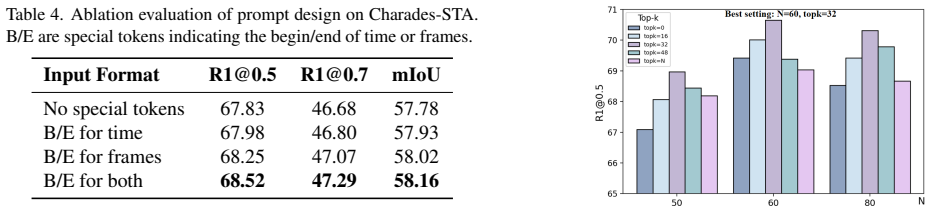
- [§4.3, Tables 2 and 5] The contribution of IFS is never isolated. Row (c) to (d) of Table 2 enables IFS and DTC together, so the +2.13 R1@0.5 gain belongs to the combination, not to IFS alone. Table 5 then varies only the compression method (none, average pooling, variance-based DTC) with IFS fixed, so the selection criterion itself is not tested. Without an ablation that compares IFS against random key-frame selection, and against uniform/dense sampling at the same token budget, the paper's central claim that adjacent-feature L2 distance identifies informative frames is not supported. The interpretation is further complicated because the sparse baseline in Table 2 (a) scores 65.48 R1@0.5, well below Mr. BLIP's 69.31 on the same Charades-STA test set, so the module gains are measured from a weaker starting point than the leading baseline.
- [§4.3, Fig. 6 and Table 8] For Charades-STA, the hyperparameters N=60 and k=32 are selected by optimizing performance on the Charades-STA test set, not on a held-out validation split. This is test-set selection and can inflate the reported gains. The QVHighlights hyperparameters are selected on the validation set (Table 8), but Charades-STA, where the full ablation and final SOTA comparison are run, is not handled this way. Please report a validation-based selection procedure for both datasets, or clearly state how many configurations were tried and account for the selection in the reported numbers.
- [§4.1 and Supplementary §7] The final reported numbers depend on post-processing heuristics described only qualitatively. The algorithm swaps start and end times, extracts number pairs from malformed outputs, and substitutes [-1,-1] for invalid predictions; such heuristics can change recall and mAP. The paper does not quantify the effect of post-processing on the final scores, nor does it state whether the Mr. BLIP baseline numbers were obtained with equivalent post-processing. This is necessary for a fair SOTA comparison, especially because the paper states that the heuristics are applied 'to improve prediction accuracy.'
- [§4.3, Tables 1 and 3] The ablation tables are internally inconsistent. Table 1 reports LLaVA-MR at 78.13 R1@0.5 on QVHighlights validation, while Table 3 reports at most 76.06 for either time representation; Table 2 row (c) gives 68.52 R1@0.5 on Charades-STA, while Table 3 gives 67.83 or 66.37. The text also states that 'using frame indices as time tokens led to better performance' on QVHighlights, but Table 3 shows timestamps are better by 1.29 points. The configuration underlying each table (which modules, special tokens, and post-processing are active) must be stated, and the contradiction resolved, before the time-encoding design claim can be evaluated.
- [§4.1 and §4.2] All experiments appear to be single runs with no error bars. Given that the headline improvements over Mr. BLIP are on the order of 0.5 to 2 points, and the ablations involve choices of N, k, and T, reporting mean and standard deviation over at least three seeds, or providing per-seed numbers, is necessary to establish that the differences are not optimization noise. This is particularly important because the Charades-STA configuration was selected on the test set.
minor comments (6)
- [Abstract and Conclusion] The abstract says the method outperforms 11 state-of-the-art methods, while the conclusion says ten leading methods; please reconcile the count.
- [§4.3, Fig. 6] The text says 'As illustrated in Figure 4' when discussing the effect of k on performance, but the relevant figure appears to be Figure 6 (hyperparameter optimization results).
- [§3.3, Eq. (2)] Equation (2) sets \hat d_0 = max(d), which forces the first frame to be a key frame even though there is no preceding frame; this choice is not motivated and deserves a one-sentence justification.
- [§4.1] The LoRA rank and alpha are not reported; including them would improve reproducibility.
- [Table 1] For Charades-STA, mAP@0.5 and mAP@0.75 are reported only for LLaVA-MR and not for Mr. BLIP; adding these numbers for the closest baseline would help the reader assess the comparison.
- [§3.4 and Table 7] Variance-Based DTC is described as retaining the top half of queries by variance, but Table 7 later tunes T (the compressed token count) as a hyperparameter; please clarify whether the 'top half' rule is a fixed design choice or a tuned hyperparameter.
Circularity Check
No significant circularity: the headline results are grounded in external benchmark comparisons, and the module designs are heuristic preprocessing steps whose value is tested downstream rather than derived from the target metric by construction.
full rationale
I walked the claimed derivation chain. DFTE, IFS, and DTC are defined by their own equations (Eq. 2 and Eq. 3 for IFS, the variance criterion in Sec. 3.4 for DTC, and the sampling-rate rule in Sec. 3.2 for DFTE). None of these definitions involves the moment-retrieval metric or the annotated moments the model is asked to predict; their contribution is assessed by downstream R1/mAP numbers on public benchmarks, which are independent of the paper's own construction. In particular, the QVHighlights test results are obtained through the evaluation server with hidden labels, so the claimed improvements over Mr. BLIP cannot reduce to the authors' definitions or fitted values. The only self-citations appear in related-work surveys and method background, and they are not load-bearing for the central claim. The legitimate concerns in this paper are about experimental attribution and overfitting, not circularity: IFS is never isolated in Table 2 (row (c) to (d) enables IFS and DTC simultaneously), hyperparameters N, k, T and the time-encoding choice are tuned on the Charades-STA test set and QVHighlights validation set, and Table 5's no-compression row has the same score as Table 2(c), suggesting IFS alone may add little. However, these are confounded-ablation and test-set-selection issues, not cases where an output is equivalent to its input by construction or where a fitted parameter is renamed as a prediction. No equation is defined in terms of the result it is claimed to predict, so the derivation chain is not circular.
Assumptions & free parameters
free parameters (4)
- N (number of sampled frames) =
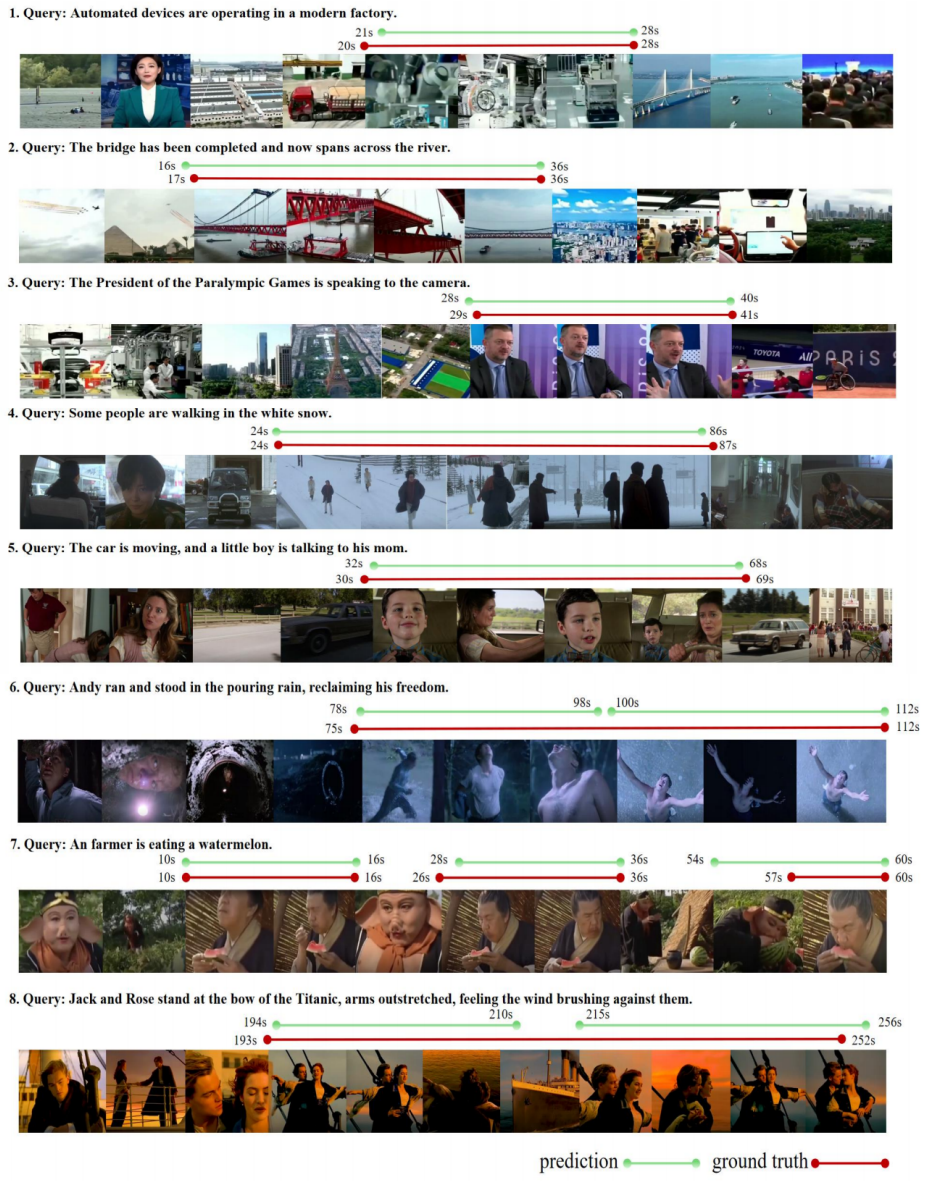
60 for Charades-STA, 80 for QVHighlights
- k (number of key frames in IFS) =
32 for both datasets
- T (post-compression token count per frame after DTC) =
16
- Time encoding choice (relative frame indices vs timestamps) =
relative indices for Charades-STA; timestamps for QVHighlights
assumptions (3)
- domain assumption Pretrained BLIP-2 provides transferable visual and language representations for video moment retrieval.
- domain assumption Frames with high adjacent feature distance tend to mark event boundaries and are more informative for retrieval.
- domain assumption Variance of Q-Former queries across frames correlates with informativeness for moment retrieval.
Cite this review
Pith. "Pith review of LLaVA-MR: Large Language-and-Vision Assistant for Video Moment Retrieval." pith.science (2026). https://pith.science/paper/3PT6EIIR
@misc{pith2026241114505,
  author       = {Pith},
  title        = {Pith review of: LLaVA-MR: Large Language-and-Vision Assistant for Video Moment Retrieval},
  year         = {2026},
  howpublished = {\url{https://pith.science/paper/3PT6EIIR}},
  note         = {Machine review of arXiv:2411.14505}
}
read the original abstract
Multimodal Large Language Models (MLLMs) are widely used for visual perception, understanding, and reasoning. However, long video processing and precise moment retrieval remain challenging due to LLMs' limited context size and coarse frame extraction. We propose the Large Language-and-Vision Assistant for Moment Retrieval (LLaVA-MR), which enables accurate moment retrieval and contextual grounding in videos using MLLMs. LLaVA-MR combines Dense Frame and Time Encoding (DFTE) for spatial-temporal feature extraction, Informative Frame Selection (IFS) for capturing brief visual and motion patterns, and Dynamic Token Compression (DTC) to manage LLM context limitations. Evaluations on benchmarks like Charades-STA and QVHighlights demonstrate that LLaVA-MR outperforms 11 state-of-the-art methods, achieving an improvement of 1.82% in R1@0.5 and 1.29% in mAP@0.5 on the QVHighlights dataset. Our implementation will be open-sourced upon acceptance.
Figures


Figures from the paper (4 more)


Forward citations
Cited by 4 Pith papers
-
DisTime: Distribution-based Time Representation for Video Large Language Models
A single learnable time token, decoded into a probability distribution over time bins, improves temporal grounding in Video-LLMs and is trained partly on a new 1.25M-event pseudo-labeled dataset.
-
Sparse-Dense Side-Tuner for efficient Video Temporal Grounding
SDST is a parameter-efficient, anchor-free side-tuning architecture for video temporal grounding that matches or beats state-of-the-art methods with about 73% fewer trainable parameters.
-
SMART: Shot-Aware Multimodal Video Moment Retrieval with Audio-Enhanced MLLM
SMART, an audio-enhanced MLLM with shot-aware token compression, reports new state-of-the-art moment retrieval accuracy on Charades-STA and QVHighlights.
-
A Survey on Video Temporal Grounding with Multimodal Large Language Model
A taxonomized review of video temporal grounding with multimodal large language models, covering model roles, training paradigms, feature processing, benchmarks, and open problems.
Reference graph
Works this paper leans on
-
[1]
Flamingo: a visual language model for few-shot learning
Jean-Baptiste Alayrac, Jeff Donahue, Pauline Luc, Antoine Miech, Iain Barr, Yana Hasson, Karel Lenc, Arthur Mensch, Katherine Millican, Malcolm Reynolds, et al. Flamingo: a visual language model for few-shot learning. In NeurIPS, pages 23716–23736, 2022. 2
2022
-
[2]
Localizing mo- ments in video with natural language
Lisa Anne Hendricks, Oliver Wang, Eli Shechtman, Josef Sivic, Trevor Darrell, and Bryan Russell. Localizing mo- ments in video with natural language. In ICCV, pages 5803– 5812, 2017. 2
work page 2017
-
[3]
Anas Awadalla, Irena Gao, Josh Gardner, Jack Hessel, Yusuf Hanafy, Wanrong Zhu, Kalyani Marathe, Yonatan Bitton, Samir Gadre, Shiori Sagawa, Jenia Jitsev, Simon Kornblith, Pang Wei Koh, Gabriel Ilharco, Mitchell Wortsman, and Ludwig Schmidt. Openflamingo: An open-source frame- work for training large autoregressive vision-language mod- els, 2023. 2
work page 2023
-
[4]
CTRN: Class-Temporal Relational Network for Action Detection
Rui Dai, Srijan Das, and Francois Bremond. Ctrn: Class- temporal relational network for action detection. arXiv preprint arXiv:2110.13473, 2021. 2
work page Pith review arXiv 2021
-
[5]
Ms-tct: Multi-scale temporal con- vtransformer for action detection
Rui Dai, Srijan Das, Kumara Kahatapitiya, Michael S Ryoo, and Franc ¸ois Br´emond. Ms-tct: Multi-scale temporal con- vtransformer for action detection. In CVPR, pages 20041– 20051, 2022. 2
work page 2022
-
[6]
Instructblip: Towards general- purpose vision-language models with instruction tuning,
Wenliang Dai, Junnan Li, Dongxu Li, Anthony Meng Huat Tiong, Junqi Zhao, Weisheng Wang, Boyang Li, Pascale Fung, and Steven Hoi. Instructblip: Towards general- purpose vision-language models with instruction tuning,
-
[7]
Tall: Temporal activity localization via language query
Jiyang Gao, Chen Sun, Zhenheng Yang, and Ram Nevatia. Tall: Temporal activity localization via language query. In ICCV, pages 5267–5275, 2017. 2, 5, 1
work page 2017
-
[8]
Video action transformer network
Rohit Girdhar, Joao Carreira, Carl Doersch, and Andrew Zis- serman. Video action transformer network. In CVPR, pages 244–253, 2019. 2
work page 2019
Show all 55 references
-
[9]
Lora: Low-rank adaptation of large language models
Edward J Hu, Yelong Shen, Phillip Wallis, Zeyuan Allen- Zhu, Yuanzhi Li, Shean Wang, Lu Wang, and Weizhu Chen. Lora: Low-rank adaptation of large language models. arXiv preprint arXiv:2106.09685, 2021. 5
2021 arXiv
-
[10]
Knowing where to focus: Event-aware transformer for video grounding, 2023
Jinhyun Jang, Jungin Park, Jin Kim, Hyeongjun Kwon, and Kwanghoon Sohn. Knowing where to focus: Event-aware transformer for video grounding, 2023. 6
2023
-
[11]
Efficient multimodal large language models: A survey
Yizhang Jin, Jian Li, Yexin Liu, Tianjun Gu, Kai Wu, Zhengkai Jiang, Muyang He, Bo Zhao, Xin Tan, Zhenye Gan, et al. Efficient multimodal large language models: A survey. arXiv preprint arXiv:2405.10739, 2024. 1
2024
-
[12]
Dense-captioning events in videos,
Ranjay Krishna, Kenji Hata, Frederic Ren, Li Fei-Fei, and Juan Carlos Niebles. Dense-captioning events in videos,
-
[13]
Temporal convolutional networks for ac- tion segmentation and detection
Colin Lea, Michael D Flynn, Rene Vidal, Austin Reiter, and Gregory D Hager. Temporal convolutional networks for ac- tion segmentation and detection. In CVPR, pages 156–165,
-
[14]
Berg, and Mohit Bansal
Jie Lei, Tamara L. Berg, and Mohit Bansal. Qvhighlights: Detecting moments and highlights in videos via natural lan- guage queries, 2021. 1, 6
2021
-
[15]
Detecting mo- ments and highlights in videos via natural language queries
Jie Lei, Tamara L Berg, and Mohit Bansal. Detecting mo- ments and highlights in videos via natural language queries. NeurIPS, 34:11846–11858, 2021. 2, 5
2021
-
[16]
Mimic-it: Multi-modal in-context instruction tuning, 2023
Bo Li, Yuanhan Zhang, Liangyu Chen, Jinghao Wang, Fanyi Pu, Jingkang Yang, Chunyuan Li, and Ziwei Liu. Mimic-it: Multi-modal in-context instruction tuning, 2023. 2
2023
-
[17]
Blip-2: Bootstrapping language-image pre-training with frozen image encoders and large language models, 2023
Junnan Li, Dongxu Li, Silvio Savarese, and Steven Hoi. Blip-2: Bootstrapping language-image pre-training with frozen image encoders and large language models, 2023. 3
2023
-
[18]
A survey on benchmarks of multimodal large language models,
Jian Li, Weiheng Lu, Hao Fei, Meng Luo, Ming Dai, Min Xia, Yizhang Jin, Zhenye Gan, Ding Qi, Chaoyou Fu, Ying Tai, Wankou Yang, Yabiao Wang, and Chengjie Wang. A survey on benchmarks of multimodal large language models,
-
[19]
Videochat: Chat-centric video understanding, 2024
KunChang Li, Yinan He, Yi Wang, Yizhuo Li, Wenhai Wang, Ping Luo, Yali Wang, Limin Wang, and Yu Qiao. Videochat: Chat-centric video understanding, 2024. 2
2024
-
[20]
Fast learning of temporal action proposal via dense boundary generator
Chuming Lin, Jian Li, Yabiao Wang, Ying Tai, Donghao Luo, Zhipeng Cui, Chengjie Wang, Jilin Li, Feiyue Huang, and Rongrong Ji. Fast learning of temporal action proposal via dense boundary generator. In Proceedings of the AAAI conference on artificial intelligence , pages 11499–11506,
-
[21]
Univtg: Towards unified video- language temporal grounding, 2023
Kevin Qinghong Lin, Pengchuan Zhang, Joya Chen, Shra- man Pramanick, Difei Gao, Alex Jinpeng Wang, Rui Yan, and Mike Zheng Shou. Univtg: Towards unified video- language temporal grounding, 2023. 6
2023
-
[22]
Bsn: Boundary sensitive network for temporal action proposal generation
Tianwei Lin, Xu Zhao, Haisheng Su, Chongjing Wang, and Ming Yang. Bsn: Boundary sensitive network for temporal action proposal generation. In ECCV, pages 3–19, 2018. 2
2018
-
[23]
Visual instruction tuning, 2023
Haotian Liu, Chunyuan Li, Qingyang Wu, and Yong Jae Lee. Visual instruction tuning, 2023. 2
2023
-
[24]
Umt: Unified multi-modal transformers for joint video moment retrieval and highlight detection
Ye Liu, Siyuan Li, Yang Wu, Chang-Wen Chen, Ying Shan, and Xiaohu Qie. Umt: Unified multi-modal transformers for joint video moment retrieval and highlight detection. In CVPR, pages 3042–3051, 2022. 2
2022
-
[25]
Decoupled weight decay regularization, 2019
Ilya Loshchilov and Frank Hutter. Decoupled weight decay regularization, 2019. 5
2019
-
[26]
Valley: Video assistant with large language model enhanced ability, 2023
Ruipu Luo, Ziwang Zhao, Min Yang, Junwei Dong, Da Li, Pengcheng Lu, Tao Wang, Linmei Hu, Minghui Qiu, and Zhongyu Wei. Valley: Video assistant with large language model enhanced ability, 2023. 2
2023
-
[27]
Video-chatgpt: Towards detailed video understanding via large vision and language models, 2024
Muhammad Maaz, Hanoona Rasheed, Salman Khan, and Fa- had Shahbaz Khan. Video-chatgpt: Towards detailed video understanding via large vision and language models, 2024. 2
2024
-
[28]
The surprising effectiveness of multimodal large language models for video moment retrieval, 2024
Boris Meinardus, Anil Batra, Anna Rohrbach, and Marcus Rohrbach. The surprising effectiveness of multimodal large language models for video moment retrieval, 2024. 1, 2, 3, 5, 6, 7
2024
-
[29]
Query-dependent video representa- tion for moment retrieval and highlight detection, 2023
WonJun Moon, Sangeek Hyun, SangUk Park, Dongchan Park, and Jae-Pil Heo. Query-dependent video representa- tion for moment retrieval and highlight detection, 2023. 6
2023
-
[30]
Correlation-guided query-dependency calibration for video temporal grounding, 2024
WonJun Moon, Sangeek Hyun, SuBeen Lee, and Jae-Pil Heo. Correlation-guided query-dependency calibration for video temporal grounding, 2024. 1, 6
2024
-
[31]
Local- global video-text interactions for temporal grounding
Jonghwan Mun, Minsu Cho, and Bohyung Han. Local- global video-text interactions for temporal grounding. In CVPR, pages 10810–10819, 2020. 2
2020
-
[32]
Pat: Position-aware transformer for dense multi-label action detection
Faegheh Sardari, Armin Mustafa, Philip JB Jackson, and Adrian Hilton. Pat: Position-aware transformer for dense multi-label action detection. In CVPR, pages 2988–2997,
-
[33]
Temporal action localization in untrimmed videos via multi-stage cnns
Zheng Shou, Dongang Wang, and Shih-Fu Chang. Temporal action localization in untrimmed videos via multi-stage cnns. In CVPR, pages 1049–1058, 2016. 2
2016
-
[34]
Vlg-net: Video-language graph matching network for video grounding, 2021
Mattia Soldan, Mengmeng Xu, Sisi Qu, Jesper Tegner, and Bernard Ghanem. Vlg-net: Video-language graph matching network for video grounding, 2021. 1
2021
-
[35]
Learning grounded vision-language representation for versatile understanding in untrimmed videos, 2023
Teng Wang, Jinrui Zhang, Feng Zheng, Wenhao Jiang, Ran Cheng, and Ping Luo. Learning grounded vision-language representation for versatile understanding in untrimmed videos, 2023. 1
2023
-
[36]
Internvideo2: Scaling foundation models for multimodal video understanding, 2024
Yi Wang, Kunchang Li, Xinhao Li, Jiashuo Yu, Yinan He, Chenting Wang, Guo Chen, Baoqi Pei, Ziang Yan, Rongkun Zheng, Jilan Xu, Zun Wang, Yansong Shi, Tianxiang Jiang, Songze Li, Hongjie Zhang, Yifei Huang, Yu Qiao, Yali Wang, and Limin Wang. Internvideo2: Scaling foundation mo...
2024
-
[37]
Unloc: A unified framework for video localization tasks, 2023
Shen Yan, Xuehan Xiong, Arsha Nagrani, Anurag Arnab, Zhonghao Wang, Weina Ge, David Ross, and Cordelia Schmid. Unloc: A unified framework for video localization tasks, 2023. 6, 1
2023
-
[38]
Unloc: A unified framework for video localization tasks, 2023
Shen Yan, Xuehan Xiong, Arsha Nagrani, Anurag Arnab, Zhonghao Wang, Weina Ge, David Ross, and Cordelia Schmid. Unloc: A unified framework for video localization tasks, 2023. 1, 6
2023
-
[39]
Self-chained image-language model for video localization and question answering, 2023
Shoubin Yu, Jaemin Cho, Prateek Yadav, and Mohit Bansal. Self-chained image-language model for video localization and question answering, 2023. 6
2023
-
[40]
Semantic conditioned dynamic modulation for tempo- ral sentence grounding in videos
Yitian Yuan, Lin Ma, Jingwen Wang, Wei Liu, and Wenwu Zhu. Semantic conditioned dynamic modulation for tempo- ral sentence grounding in videos. NeurIPS, 32, 2019. 2
2019
-
[41]
Graph con- volutional networks for temporal action localization
Runhao Zeng, Wenbing Huang, Mingkui Tan, Yu Rong, Peilin Zhao, Junzhou Huang, and Chuang Gan. Graph con- volutional networks for temporal action localization. In ICCV, pages 7094–7103, 2019. 2
2019
-
[42]
Dense regression network for video grounding, 2020
Runhao Zeng, Haoming Xu, Wenbing Huang, Peihao Chen, Mingkui Tan, and Chuang Gan. Dense regression network for video grounding, 2020. 1
2020
-
[43]
Unimd: Towards unifying moment retrieval and temporal ac- tion detection, 2024
Yingsen Zeng, Yujie Zhong, Chengjian Feng, and Lin Ma. Unimd: Towards unifying moment retrieval and temporal ac- tion detection, 2024. 1, 6
2024
-
[44]
Actionformer: Localizing moments of actions with transformers
Chen-Lin Zhang, Jianxin Wu, and Yin Li. Actionformer: Localizing moments of actions with transformers. In ECCV, pages 492–510. Springer, 2022. 2
2022
-
[45]
Man: Moment alignment network for natural language moment retrieval via iterative graph adjustment
Da Zhang, Xiyang Dai, Xin Wang, Yuan-Fang Wang, and Larry S Davis. Man: Moment alignment network for natural language moment retrieval via iterative graph adjustment. In CVPR, pages 1247–1257, 2019. 2
2019
-
[46]
Video-llama: An instruction-tuned audio-visual language model for video un- derstanding, 2023
Hang Zhang, Xin Li, and Lidong Bing. Video-llama: An instruction-tuned audio-visual language model for video un- derstanding, 2023. 2
2023
-
[47]
Llama-adapter: Efficient fine-tuning of language models with zero-init attention, 2024
Renrui Zhang, Jiaming Han, Chris Liu, Peng Gao, Aojun Zhou, Xiangfei Hu, Shilin Yan, Pan Lu, Hongsheng Li, and Yu Qiao. Llama-adapter: Efficient fine-tuning of language models with zero-init attention, 2024. 2
2024
-
[48]
Learning 2d temporal adjacent networks for moment local- ization with natural language
Songyang Zhang, Houwen Peng, Jianlong Fu, and Jiebo Luo. Learning 2d temporal adjacent networks for moment local- ization with natural language. In AAAI, pages 12870–12877,
-
[49]
Temporal action detection with structured segment networks
Yue Zhao, Yuanjun Xiong, Limin Wang, Zhirong Wu, Xi- aoou Tang, and Dahua Lin. Temporal action detection with structured segment networks. In ICCV, pages 2914–2923,
-
[50]
Minigpt-4: Enhancing vision-language understanding with advanced large language models, 2023
Deyao Zhu, Jun Chen, Xiaoqian Shen, Xiang Li, and Mo- hamed Elhoseiny. Minigpt-4: Enhancing vision-language understanding with advanced large language models, 2023. 2
2023
-
[51]
Enriching local and global contexts for temporal action localization
Zixin Zhu, Wei Tang, Le Wang, Nanning Zheng, and Gang Hua. Enriching local and global contexts for temporal action localization. In ICCV, pages 13516–13525, 2021. 2 LLaV A-MR: Large Language-and-Vision Assistant for Video Moment Retrieval Supplementary Material
2021
-
[52]
Additional Experiments We present additional experimental results, including a comparison with state-of-the-art methods on the Activi- tyNet Captions dataset and more findings from hyperparam- eter optimization. 6.1. Comparison on ActivityNet Captions Dataset ActivityNet Capti...
-
[53]
[[-1, -1]]
Post-Processing of LLM Outputs Despite training LLMs specifically for the moment re- trieval task and instructing them to output results in the for- mat of a nested list of moments: y = [[tstart 1 , tend 1 ], [tstart 2 , tend 2 ], . . .] LLMs can still produce outputs that dev...
-
[54]
automated devices operating in a modern factory
More Qualitative Results One of the key advantages of using MLLMs for moment retrieval tasks is their strong generalization and adaptabil- ity. Unlike transformer models with task-specific prediction heads, which are prone to annotation bias, MLLMs utilize cross-modal represen...
-
[55]
This section explores po- tential future directions for enhancing the performance of MLLMs in moment retrieval tasks
Future research potential The moment retrieval task has a wide range of applica- tions, including video summarization, content-based re- trieval, multimedia search, video recommendation systems, and educational video indexing. This section explores po- tential future direction...
Reviewed August 12, 2026 · model on record in the stance chip above.
Discussion (0). Continue with ORCID to comment.