A Finite-Volume Scheme for the Continuum Extrapolation of Lattice Step-Scaling in (2+1)D Hamiltonian U(1) Gauge Theory
Pith reviewed 2026-06-26 15:12 UTC · model grok-4.3
The pith
A finite-volume scheme enables controlled continuum extrapolations of the step-scaling function in Hamiltonian U(1) gauge theory.
A machine-rendered reading of the paper's core claim, the machinery that carries it, and where it could break.
Core claim
The authors claim that their finite-volume scheme, applied to the dual Hamiltonian formulation of (2+1)D pure U(1) gauge theory with matrix-product-state computations of the confining string, produces a stable continuum limit of the step-scaling function on presently accessible lattice sizes, thereby providing a controlled route to the running coupling via a force-based definition.
What carries the argument
The finite-volume scheme for continuum extrapolation of the step-scaling function, which organizes volume and coupling data to isolate the continuum limit while the confining string supplies the force used to define the renormalized coupling.
If this is right
- The running coupling can be determined in Hamiltonian lattice gauge theories using step-scaling on accessible volumes.
- The scheme remains stable for the lattice sizes currently reachable by Hamiltonian simulations with matrix product states.
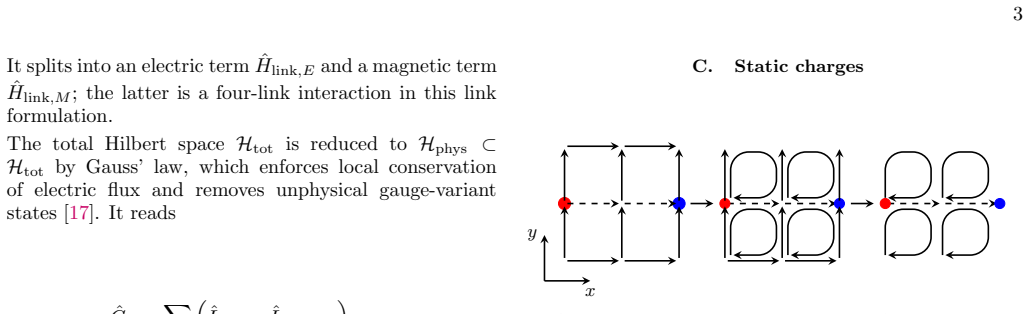
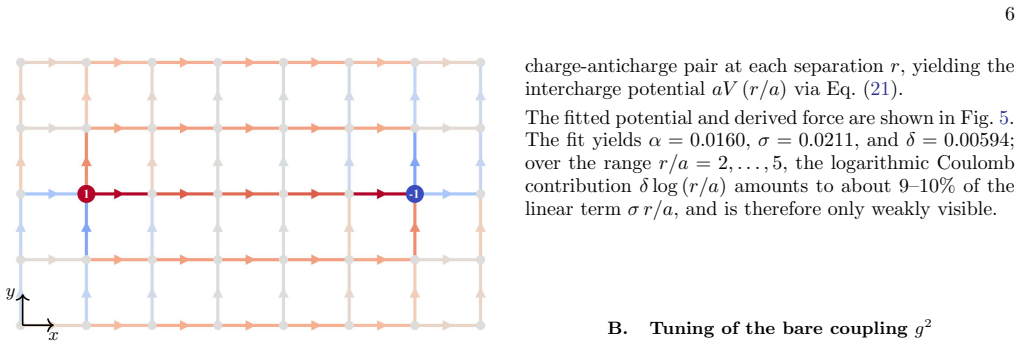
- Static external charges can be implemented and the confining string studied directly in the dual formulation.
- The approach extends to other gauge groups and spacetime dimensions without fundamental changes.
Where Pith is reading between the lines
- Similar finite-volume control could be tested in non-Abelian theories once efficient Hamiltonian formulations become available.
- The method may reduce the volume range needed to reach the continuum compared with traditional Euclidean step-scaling analyses.
- Force-based definitions extracted from the string tension offer an alternative route to renormalization that avoids direct use of Wilson loops at large separations.
Load-bearing premise
The dual Hamiltonian formulation together with the chosen operator basis remains efficient and accurate toward weak coupling so that the static potential can be extracted reliably from the confining string.
What would settle it
A computation on significantly larger lattices or with an independent formulation that yields a step-scaling function whose extrapolated continuum value differs from the one obtained with the proposed scheme would falsify the claim of stability.
Figures




read the original abstract
We propose a finite-volume scheme to perform controlled continuum extrapolations of the lattice step-scaling function, a key ingredient for determining the running coupling in a Hamiltonian lattice gauge theory in small volumes. As a testbed, we employ a dual Hamiltonian formulation of pure U(1) gauge theory in (2+1) dimensions and an operator basis that remains efficient toward weak coupling. We describe the implementation of static external charges on the spatial lattice and study, using matrix product states, the resulting confining string, from which we extract the static potential and a force-based renormalized coupling. Using the proposed finite-volume scheme, we demonstrate a stable continuum limit of the step-scaling function on the lattice sizes accessible to present Hamiltonian simulations. The method is readily extendable to other gauge groups and dimensions, providing a pathway toward Hamiltonian step-scaling studies in other theories.
Editorial analysis
A structured set of objections, weighed in public.
Referee Report
Summary. The paper proposes a finite-volume scheme for controlled continuum extrapolations of the lattice step-scaling function in Hamiltonian lattice gauge theories. Using a dual Hamiltonian formulation of pure U(1) gauge theory in (2+1) dimensions together with an operator basis efficient toward weak coupling, the authors implement static external charges, employ matrix product states to study the confining string, extract the static potential, and define a force-based renormalized coupling. They report that the proposed scheme yields a stable continuum limit for the step-scaling function on lattice sizes accessible to present Hamiltonian simulations and note that the method extends to other gauge groups and dimensions.
Significance. If the central demonstration holds, the work supplies a practical route to step-scaling analyses in Hamiltonian formulations, where Euclidean Monte Carlo methods are unavailable or inefficient. The dual formulation and MPS approach are presented as enabling access to weak coupling on modest volumes; successful validation would therefore constitute a concrete technical advance for non-perturbative running-coupling studies in Hamiltonian lattice gauge theory.
major comments (1)
- [Results section (demonstration of continuum limit)] The central claim that a stable continuum limit is demonstrated rests on the accuracy of the static potential extracted from the confining string via MPS in the dual formulation. No quantitative bounds on bond-dimension convergence, truncation error, or cross-validation against known analytic or Euclidean results for the U(1) static potential at weak coupling are supplied; without such controls the observed stability could arise from uncontrolled systematics rather than true continuum behavior.
minor comments (2)
- [Methods] Notation for the force-based renormalized coupling and the precise definition of the finite-volume step-scaling function should be stated explicitly with an equation number in the methods section.
- [Figures] Figure captions should include the specific lattice sizes, bond dimensions, and coupling values used for each data set shown in the continuum-extrapolation plots.
Simulated Author's Rebuttal
We thank the referee for their careful reading and constructive comments on the manuscript. We address the single major comment below.
read point-by-point responses
-
Referee: [Results section (demonstration of continuum limit)] The central claim that a stable continuum limit is demonstrated rests on the accuracy of the static potential extracted from the confining string via MPS in the dual formulation. No quantitative bounds on bond-dimension convergence, truncation error, or cross-validation against known analytic or Euclidean results for the U(1) static potential at weak coupling are supplied; without such controls the observed stability could arise from uncontrolled systematics rather than true continuum behavior.
Authors: We agree that the current manuscript does not supply explicit quantitative bounds on bond-dimension convergence or truncation errors, nor direct cross-validation against Euclidean or analytic results. In the revised manuscript we will add a dedicated subsection (and associated figures) that reports the dependence of the extracted static potential and force on bond dimension for representative values of the coupling and lattice size, together with estimates of the truncation error obtained from the discarded singular-value weight and from direct comparisons at different bond dimensions. We will also include a comparison of the force-based renormalized coupling to one-loop perturbation theory in the weakest-coupling regime accessible to the simulations. These additions will make the control over systematics explicit and will confirm that the reported stability of the continuum extrapolation is not an artifact of insufficient MPS accuracy. revision: yes
Circularity Check
No circularity in proposed scheme or continuum extrapolation demonstration
full rationale
The paper proposes a finite-volume scheme for continuum extrapolation of the step-scaling function, implements it via a dual Hamiltonian U(1) formulation and MPS extraction of the static potential from the confining string, then reports a stable limit on accessible volumes. No quoted step reduces a claimed prediction to a fitted input by construction, invokes self-citations for load-bearing uniqueness, or renames a known result as new organization. The confining-string observable is treated as independent input for testing the scheme rather than derived from it. The central demonstration therefore remains non-circular and self-contained.
Axiom & Free-Parameter Ledger
axioms (2)
- domain assumption The dual Hamiltonian formulation accurately represents pure U(1) gauge theory in (2+1) dimensions.
- domain assumption Matrix product states provide a faithful representation of the confining string states for extraction of the static potential.
Reference graph
Works this paper leans on
-
[1]
Confinement of Quarks,
Kenneth G. Wilson, “Confinement of Quarks,” Phys. Rev. D10, 2445–2459 (1974)
1974
-
[2]
Review of particle physics,
C. Patrignaniet al.(Particle Data Group), “Review of particle physics,” Chinese Physics C40, 100001 (2016)
2016
-
[3]
A nu- merical method to compute the running coupling in asymptotically free theories,
Martin L¨ uscher, Peter Weisz, and Ulli Wolff, “A nu- merical method to compute the running coupling in asymptotically free theories,” Nucl. Phys. B359, 221– 243 (1991)
1991
-
[4]
Volume dependence of the energy spectrum in massive quantum field theories,
Martin L¨ uscher, “Volume dependence of the energy spectrum in massive quantum field theories,” Commun. Math. Phys.104, 177 (1986)
1986
-
[5]
R. Sommer, “A New way to set the energy scale in lattice gauge theories and its applications to the static force and αs in SU(2) Yang-Mills theory,” Nucl. Phys. B411, 839– 854 (1994), arXiv:hep-lat/9310022
Pith/arXiv arXiv 1994
-
[6]
Non-perturbative determination of the running coupling in the su(3) yang-mills theory,
R. Sommeret al., “Non-perturbative determination of the running coupling in the su(3) yang-mills theory,” Nucl. Phys. B519, 315–338 (1998)
1998
-
[7]
Computational Complexity and Fundamental Limitations to Fermionic Quantum Monte Carlo Simulations,
Matthias Troyer and Uwe-Jens Wiese, “Computational Complexity and Fundamental Limitations to Fermionic Quantum Monte Carlo Simulations,” Phys. Rev. Lett. 94, 170201 (2005), arXiv:cond-mat/0408370 [cond-mat]
Pith/arXiv arXiv 2005
-
[8]
Critical slowing down and error analysis in lattice QCD simulations,
Stefan Schaefer, Rainer Sommer, and Francesco Virotta (ALPHA), “Critical slowing down and error analysis in lattice QCD simulations,” Nucl. Phys. B845, 93–119 (2011), arXiv:1009.5228 [hep-lat]
Pith/arXiv arXiv 2011
-
[9]
Algorithms for lattice QCD: progress and challenges,
Stefan Schaefer, “Algorithms for lattice QCD: progress and challenges,” AIP Conf. Proc.1343, 93–98 (2011), arXiv:1011.5641 [hep-ph]
Pith/arXiv arXiv 2011
-
[10]
Hamiltonian For- mulation of Wilson’s Lattice Gauge Theories,
John B. Kogut and Leonard Susskind, “Hamiltonian For- mulation of Wilson’s Lattice Gauge Theories,” Phys. Rev. D11, 395–408 (1975)
1975
-
[11]
The density-matrix renormalization group in the age of matrix product states,
Ulrich Schollwoeck, “The density-matrix renormalization group in the age of matrix product states,” Annals Phys. 326, 96–192 (2011), arXiv:1008.3477 [cond-mat.str-el]
Pith/arXiv arXiv 2011
-
[12]
Matrix product state representations,
D. Perez-Garcia, F. Verstraete, M. M. Wolf, and J. I. Cirac, “Matrix product state representations,” Quant. Inf. Comput.7, 401–430 (2007), arXiv:quant- ph/0608197
arXiv 2007
-
[13]
Digitizing SU(2) gauge fields and what to look out for when doing so,
Timo Jakobs, Tobias Hartung, Karl Jansen, Johann Ost- meyer, and Carsten Urbach, “Digitizing SU(2) gauge fields and what to look out for when doing so,” PoSLAT- TICE2022, 015 (2023), arXiv:2212.09496 [hep-lat]
arXiv 2023
-
[14]
Timo Jakobs, Marco Garofalo, Tobias Hartung, Karl Jansen, Paul Ludwig, Johann Ostmeyer, Simone Romiti, and Carsten Urbach, “A Comprehensive Stress Test of Truncated Hilbert Space Bases against Green’s function Monte Carlo in U(1) Lattice Gauge Theory,” (2025), arXiv:2510.27611 [hep-lat]
arXiv 2025
-
[15]
Giuseppe Clemente, Arianna Crippa, and Karl Jansen, “Strategies for the determination of the running coupling of (2+1)-dimensional QED with quantum computing,” Phys. Rev. D106, 114511 (2022), arXiv:2206.12454 [hep- lat]
arXiv 2022
-
[16]
Arianna Crippa, Simone Romiti, Lena Funcke, Karl Jansen, Stefan K¨ uhn, Paolo Stornati, and Carsten Urbach, “Towards determining the (2+1)-dimensional Quantum Electrodynamics running coupling with Monte Carlo and quantum computing methods,” Commun. Phys.8, 367 (2025), arXiv:2404.17545 [hep-lat]
arXiv 2025
-
[17]
New basis for Hamil- tonian SU(2) simulations,
Irian D’Andrea, Christian W. Bauer, Dorota M. Grabowska, and Marat Freytsis, “New basis for Hamil- tonian SU(2) simulations,” Phys. Rev. D109, 074501 (2024), arXiv:2307.11829 [hep-ph]
arXiv 2024
-
[18]
Gauge-invariant rotor Hamil- tonian from dual variables of 3DU(1) gauge theory,
Judah F. Unmuth-Yockey, “Gauge-invariant rotor Hamil- tonian from dual variables of 3DU(1) gauge theory,” Phys. Rev. D99, 074502 (2019), arXiv:1811.05884 [hep- lat]
Pith/arXiv arXiv 2019
-
[19]
U(1) gauge theory on a spatial lattice: Du- ality, photons, and shadow states,
Axel Weber, “U(1) gauge theory on a spatial lattice: Du- ality, photons, and shadow states,” JHEP05, 157 (2013)
2013
-
[20]
Phase transitions in abelian lattice gauge theories,
Tom Banks, Roger Myerson, and John Kogut, “Phase transitions in abelian lattice gauge theories,” Nucl. Phys. B129, 493–510 (1977)
1977
-
[21]
Path integral Monte Carlo approach to the U(1) lattice gauge theory in (2+1)-dimensions,
Mushtaq Loan, Michael Brunner, Clare Sloggett, and Chris Hamer, “Path integral Monte Carlo approach to the U(1) lattice gauge theory in (2+1)-dimensions,” Phys. Rev. D68, 034504 (2003), arXiv:hep-lat/0209159
Pith/arXiv arXiv 2003
-
[22]
Matching Lagrangian and Hamiltonian simulations in (2+1)-dimensional U(1) gauge theory,
C. F. Groß, S. Romiti, L. Funcke, K. Jansen, A. Kan, S. K¨ uhn, and C. Urbach, “Matching Lagrangian and Hamiltonian simulations in (2+1)-dimensional U(1) gauge theory,” Eur. Phys. J. C85, 1253 (2025), arXiv:2503.11480 [hep-lat]
arXiv 2025
-
[23]
The itensor software library for ten- sor network calculations,
Matthew Fishman, Steven R. White, and E. Miles Stoudenmire, “The itensor software library for ten- sor network calculations,” SciPost Phys. Codebases , 4 (2022), arXiv:2007.14822 [cs.MS]
arXiv 2022
-
[24]
Codebase release 0.3 for itensor,
Matthew Fishman, Steven R. White, and E. Miles Stoudenmire, “Codebase release 0.3 for itensor,” SciPost Phys. Codebases , 4–r0.3 (2022)
2022
-
[25]
Studying two dimensional systems with the density matrix renor- malization group,
E. Miles Stoudenmire and Steven R. White, “Studying two dimensional systems with the density matrix renor- malization group,” Annual Review of Condensed Mat- ter Physics3, 111–128 (2012), arXiv:1105.1374 [cond- mat.str-el]
Pith/arXiv arXiv 2012
-
[26]
Compact U(1) in 2+1 dimensions: The finite-lattice Hamiltonian approach,
A. C. Irving, J. F. Owens, and C. J. Hamer, “Compact U(1) in 2+1 dimensions: The finite-lattice Hamiltonian approach,” Phys. Rev. D28, 2059 (1983)
2059
-
[27]
Review on Novel Methods for Lattice Gauge Theories,
Mari Carmen Ba˜ nuls and Krzysztof Cichy, “Review on Novel Methods for Lattice Gauge Theories,” Rept. Prog. Phys.83, 024401 (2020), arXiv:1910.00257 [hep-lat]. 12
arXiv 2020
-
[28]
Simulating Lattice Gauge Theories within Quantum Technologies,
M. C. Ba˜ nulset al., “Simulating Lattice Gauge Theories within Quantum Technologies,” Eur. Phys. J. D74, 165 (2020), arXiv:1911.00003 [quant-ph]
arXiv 2020
-
[29]
Renormalization algo- rithms for quantum-many body systems in two and higher dimensions,
F. Verstraete and J. I. Cirac, “Renormalization algo- rithms for quantum-many body systems in two and higher dimensions,” (2004), arXiv:cond-mat/0407066
Pith/arXiv arXiv 2004
-
[30]
Roman Orus, “A Practical Introduction to Tensor Net- works: Matrix Product States and Projected Entan- gled Pair States,” Annals Phys.349, 117–158 (2014), arXiv:1306.2164 [cond-mat.str-el]
Pith/arXiv arXiv 2014
-
[31]
Isometric Ten- sor Network States in Two Dimensions,
Michael P. Zaletel and Frank Pollmann, “Isometric Ten- sor Network States in Two Dimensions,” Phys. Rev. Lett. 124, 037201 (2020), arXiv:1902.05100 [cond-mat.str-el]
arXiv 2020
-
[32]
Efficient Tensor Network Ansatz for High- Dimensional Quantum Many-Body Problems,
Timo Felser, Simone Notarnicola, and Simone Mon- tangero, “Efficient Tensor Network Ansatz for High- Dimensional Quantum Many-Body Problems,” Phys. Rev. Lett.126, 170603 (2021), arXiv:2011.08200 [quant- ph]
arXiv 2021
-
[33]
Quantum Computing in the NISQ era and beyond,
John Preskill, “Quantum Computing in the NISQ era and beyond,” Quantum2, 79 (2018), arXiv:1801.00862 [quant-ph]
Pith/arXiv arXiv 2018
-
[34]
Quantum Computing for High- Energy Physics: State of the Art and Challenges,
Alberto Di Meglioet al., “Quantum Computing for High- Energy Physics: State of the Art and Challenges,” PRX Quantum5, 037001 (2024), arXiv:2307.03236 [quant-ph]
arXiv 2024
-
[35]
The mass spectrum of the Schwinger model with Matrix Product States,
M. C. Ba˜ nuls, K. Cichy, K. Jansen, and J. I. Cirac, “The mass spectrum of the Schwinger model with Matrix Product States,” JHEP11, 158 (2013), arXiv:1305.3765 [hep-lat]
Pith/arXiv arXiv 2013
-
[36]
Matrix prod- uct states for gauge field theories,
Boye Buyens, Jutho Haegeman, Karel Van Acoleyen, Henri Verschelde, and Frank Verstraete, “Matrix prod- uct states for gauge field theories,” Phys. Rev. Lett.113, 091601 (2014), arXiv:1312.6654 [hep-lat]
Pith/arXiv arXiv 2014
-
[37]
Lattice Gauge Tensor Networks,
Pietro Silvi, Enrique Rico, Tommaso Calarco, and Si- mone Montangero, “Lattice Gauge Tensor Networks,” New J. Phys.16, 103015 (2014), arXiv:1404.7439 [quant- ph]
Pith/arXiv arXiv 2014
-
[38]
Tensor networks for Lattice Gauge Theories and Atomic Quantum Simulation,
E. Rico, T. Pichler, M. Dalmonte, P. Zoller, and S. Mon- tangero, “Tensor networks for Lattice Gauge Theories and Atomic Quantum Simulation,” Phys. Rev. Lett.112, 201601 (2014), arXiv:1312.3127 [cond-mat.quant-gas]
Pith/arXiv arXiv 2014
-
[39]
Two-dimensional quantum-link lat- tice Quantum Electrodynamics at finite density,
Timo Felser, Pietro Silvi, Mario Collura, and Si- mone Montangero, “Two-dimensional quantum-link lat- tice Quantum Electrodynamics at finite density,” Phys. Rev. X10, 041040 (2020), arXiv:1911.09693 [quant-ph]
arXiv 2020
-
[40]
Lattice quantum electrodynamics in (3+1)-dimensions at finite density with tensor networks,
Giuseppe Magnifico, Timo Felser, Pietro Silvi, and Si- mone Montangero, “Lattice quantum electrodynamics in (3+1)-dimensions at finite density with tensor networks,” Nature Commun.12, 3600 (2021), arXiv:2011.10658 [hep-lat]. Appendix A: Deriving the Hamiltonian with static charges The Hamiltonian in Eq. (16) can be derived using the transfer matrix formal...
arXiv 2021
-
[41]
β X x,µ<ν cosF x,µν +i X x,µ Jµ(x)A x,µ # = Z D[Ax,µ] Y x,µ<ν X nx,µν ∈Z Inx,µν(β) exp(i n x,µν Fx,µν) ×exp i X x,µ Jµ(x)A x,µ ! = Z D[Ax,µ] X {nx,µν ∈Z} Y x,µ<ν Inx,µν(β) ×exp
The partition function with static charges We begin with the Euclidean partition function for com- pact U(1) gauge theory in the Wilson formulation Z= Z D[Ax,µ]e −S[A] , S[A] =−β X x,µ<ν cosF x,µν , (A1) where the plaquette field strength is Fx,µν = ∆µAx,ν −∆ νAx,µ ,(A2) and Z DA≡ Y x,µ Z π −π dAx,µ 2π .(A3) The forward derivative is defined as ∆µf(x) =f(...
-
[42]
In (2+1) dimensions, an antisymmetric plaquette field on the direct lattice is thus mapped to an integer-valued link field on the dual lattice
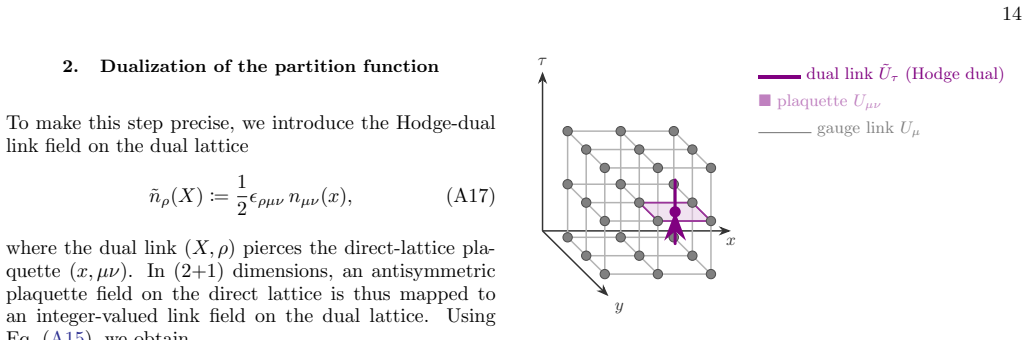
Dualization of the partition function To make this step precise, we introduce the Hodge-dual link field on the dual lattice ˜nρ(X) := 1 2 ϵρµν nµν(x),(A17) where the dual link (X, ρ) pierces the direct-lattice pla- quette (x, µν). In (2+1) dimensions, an antisymmetric plaquette field on the direct lattice is thus mapped to an integer-valued link field on ...
-
[43]
17: Schematic of the Hodge dual of a single plaquette
Obtaining the Hamiltonian From this, the transfer matrix can be identified as ⟨m(t+ 1)| ˆT|m(t)⟩=K m(t), m(t+ 1) V m(t) .(A23) x y τ dual link ˜Uτ (Hodge dual) ■plaquetteU µν gauge linkUµ FIG. 17: Schematic of the Hodge dual of a single plaquette. The plaquette becomes a direct link on the dual lattice, thus now coupling two positions in the time directio...
discussion (0)
Sign in with ORCID, Apple, or X to comment. Anyone can read and Pith papers without signing in.