REVIEW 3 major objections 4 minor 26 references
Over-the-Air Computation Systems: Optimization, Analysis and Scaling Laws
T0 review · 3 major / 4 minor · reviewed 2026-08-14 · deepseek-v4-flash
Pith's one-line read Closed-form switching policy minimizes over-the-air computation error
desk verdict Clean closed-form AirComp policy and a survivable O(1/sqrt(K)) upper bound, but the appendix's Lemma 3a is false and takes down most of the scaling-law proofs. read the letter →
The pith
A machine-rendered reading of the paper's core claim, the machinery that carries it, and where it could break.
The reading
What carries the argument
The carrying object is the sequence $g_i$ and the partition of the positive real line into intervals $\mathcal{S}_i = (1/(h_{i+1}\sqrt{P}), 1/(h_i\sqrt{P})]$. On each interval, the optimal transmit gains have a switching form: the $i$ weakest sensors use full power and the rest use channel inversion, which turns the joint transmit-receive MSE into a quadratic function of the receiver gain $a$. The sequence $g_i$ is unimodal, so $i^*$ equal to the maximizer of $g_i$ selects the globally optimal interval. This reduces a non-convex joint optimization to a one-dimensional comparison of K known quantities.
What would settle it
Compute $\mathbb{E}[X_{(K-1)}/X_{(K)}]$ for $K=100$ i.i.d. standard exponentials using Rényi's representation: the bound in Lemma 3a gives about $2/K = 0.02$, while numerical evaluation gives a constant near 0.8. If this discrepancy is confirmed, the proof of Theorems 3 and 4 does not support the stated scaling laws.
Extended reading notes
Core claim
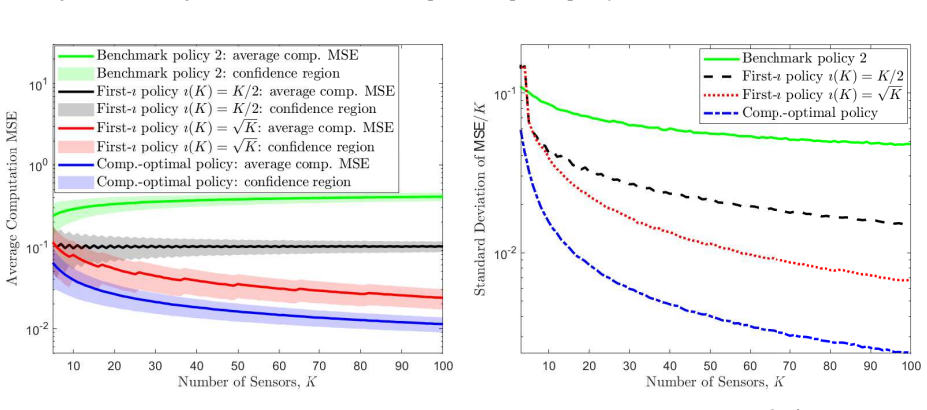
Ordering channel coefficients as $h_1 \le \cdots \le h_K$, define $g_i = \sqrt{P} \sum_{k=1}^i h_k / (\sigma^2 + P \sum_{k=1}^i h_k^2)$. The global optimum of the non-convex MSE-minimization problem is described by $i^* = \arg\max_{1 \le i \le K} g_i$: sensors with the $i^*$ smallest channels transmit at peak power $\sqrt{P}$, the remaining sensors transmit with channel-inversion gains $1/(a^* h_k)$, and the receiver scaling $a^*$ is chosen by minimizing the resulting quadratic MSE in that interval. Under Rayleigh fading, this policy is computation-effective, with average per-sensor MSE at most $O(1/\sqrt{K})$, and simulations indicate it is also energy-efficient in that its average per-sensor power tends to zero. The related sum-of-MSE estimation policy for a traditional MAC is full-power transmission by every sensor, and it equals the AirComp optimal policy precisely when $g_K = \max_i g_i$.
Load-bearing premise
The scaling-law proofs rely on an order-statistics inequality (Lemma 3a) bounding ratios of ordered exponential channel gains; if that inequality fails, the exact decay-rate claims are not established.
Editorial extensions
If this is right
- The optimal transmit-receive policy is given by a one-line rule depending only on the sorted channel gains; no iterative or alternating optimization is needed.
- With Rayleigh fading, the optimal policy achieves average per-sensor MSE at most $O(1/\sqrt{K})$, so larger sensor populations improve per-sensor computation accuracy.
- Numerical results indicate the optimal policy is simultaneously computation-effective and energy-efficient, a combination neither benchmark achieves.
- The optimal MAC sum-of-MSE policy is full-power transmission by all sensors, and it coincides with the AirComp policy exactly when $g_K = \max_i g_i$.
- The channel-inversion benchmark has infinite average per-sensor MSE under Rayleigh fading, while full-power transmission has non-vanishing average per-sensor MSE.
Reading between the lines
- If the order-statistics inequality in Lemma 3a is false, the exact decay-rate claims for first-$\imath$ policies would need repair, but the optimal policy's $O(1/\sqrt{K})$ upper bound could survive because it is obtained via a feasible first-$\sqrt{K}$ policy.
- The switching structure depends only on the channel ordering and the quadratic MSE, so a similar closed-form rule should generalize to other fading distributions and correlated channels, with only the scaling constants changing.
- Deriving the distribution of the optimal cutoff $i^*$ would turn the numerically observed energy efficiency of the optimal policy into an analytic theorem.
Signed reviews
Editorial analysis
A structured set of objections, weighed in public.
Referee Report
Summary. The paper studies a single-antenna over-the-air computation (AirComp) system with K sensors and one fusion center, where each sensor has a peak power constraint. The central optimization problem is to minimize the computation mean-squared error by jointly choosing the transmit and receive scaling factors. The authors derive a closed-form "computation-optimal policy": a switching policy with critical index i* = arg max_i g_i, where g_i is defined in Eq. (11); sensors with the smallest channel gains transmit at full power, while the remaining sensors use channel inversion. They also compare this MSE-of-sum AirComp problem with a sum-of-MSE remote-estimation MAC problem, characterizing the optimal sum-of-MSE policy and the achievable MSE region. The second half of the paper analyzes ergodic performance under Rayleigh fading, defining computation-effective and energy-efficient policies and deriving scaling laws for average MSE and average power consumption as K grows. The main scaling claims are an O(1/sqrt(K)) decay of average MSE for the computation-optimal policy, and the existence of a first-i policy with i(K) ~ sqrt(K) that is both computation-effective and energy-efficient.
Significance. If the main claims are established, the paper makes a useful contribution: the closed-form optimal Tx-Rx policy for the single-antenna AirComp problem is a clean result that improves on earlier suboptimal or numerical designs, and the comparison with the classical sum-of-MSE MAC problem is conceptually valuable. The O(1/sqrt(K)) upper bound on the optimal policy's average MSE is obtained by constructing an explicit feasible policy, so that part of the scaling analysis is credible and falsifiable. However, the more detailed scaling laws for first-i policies and the claimed existence of a simultaneously computation-effective and energy-efficient policy rest on an order-statistics lemma in Appendix B that is false as stated. These scaling-law claims are a large part of the paper's novelty, so the manuscript requires substantive correction rather than minor polishing.
major comments (3)
- [Appendix B, Lemma 3a and Theorem 3, Appendix C and Theorem 4] Lemma 3a is false as stated. For i = K-1 and j = K, the claimed bound gives E[X_(i)/X_(j)] <= 2/(K-2), which is O(1/K). Rényi's representation gives X_(K) = X_(K-1) + Z_K with Z_K ~ Exp(1), while X_(K-1) = Theta(log K); therefore X_(K-1)/X_K tends to 1 in probability, and since this ratio lies in [0,1], its expectation also tends to 1, not 0. This lemma is used in equations (A.9)-(A.12) to derive the lower bounds in Theorem 3 and in equations (A.15)-(A.16) to derive the upper bound in Theorem 4. Consequently Theorem 3 cases 2 and 3, Proposition 3, and Proposition 5 are not established as written. The O(1/sqrt(K)) upper bound for the computation-optimal policy in Proposition 4 survives, because it follows from the valid bound in (A.4) applied to a feasible first-sqrt(K) policy. The scaling-law statements should be re-proved with a correct order-statistics argument, or explicitly weakened.
- [Section III-A, Lemmas 2a-2c] The proofs of Lemmas 2a, 2b, and 2c are omitted with the statement that they 'can be verified using the similar steps.' These lemmas are load-bearing: Theorem 1's optimality proof relies on the unimodality of the sequence {g_i} and the consequent unimodality of {MSE_i}. Please provide complete proofs of these lemmas, or cite a source that contains them, so that the main closed-form optimality claim is fully supported.
- [Section V-C, Proposition 5] Proposition 5 claims that the first-sqrt(K) policy is energy-efficient with a decay rate between O(1/sqrt(K)) and O(log(K)/sqrt(K)). This specific quantitative claim depends on Theorem 4(3), whose upper bound uses Lemma 3a in (A.15). Since Lemma 3a is false, the stated decay rate for the power consumption is unproved. At present the paper only rigorously proves that this policy is computation-effective; the energy-efficiency claim should either be re-proved with a valid argument or presented as a numerical observation.
minor comments (4)
- [Section VI, Fig. 8] The figure caption says 'The average critical number of the computation-optimal policy versus the number of sensors,' but the text describes Fig. 8 as showing the average power consumption. The caption and the text should be made consistent.
- [Section VI, Fig. 9] The caption reads 'the average power consumption versus K,' while the surrounding text discusses the average computation MSE achieved by the multi-antenna policies. One of the two is mislabeled.
- [Appendix B, Eq. (A.10)] The line 'K-k+1 > K-k-17' appears to contain a typographical error; the subsequent replacement of (k+1) by k and the change from K-k+1 to K-k need a clearer derivation, not an unexplained numeric constant.
- [Throughout] There are several small language and typographical errors, e.g., 'standard derivations' where 'standard deviations' is meant, and 'the the average' in the discussion of Fig. 9. A careful proofreading pass is needed.
Circularity Check
No significant circularity: the central optimization and scaling-law results are self-contained analytical derivations from the stated system model.
full rationale
The paper's central claims are derived from the stated system model in Eqs. (3)-(5), and the computation-optimal policy in Theorem 1 follows from the interval decomposition in Lemma 1a, the quadratic minimization in Lemma 1b, the improvement argument in Lemma 1c, and the unimodality lemmas 2a-2c. The expression i* = arg max_i g_i is proven from these lemmas, not assumed as the definition of optimality. Proposition 4 obtains the O(1/sqrt(K)) decay by upper-bounding the optimal MSE with an explicitly constructed feasible first-sqrt(K) policy through Eq. (A.4); this is a domination argument, not a fitted input or a conclusion assumed into the premise. The energy-efficiency claim for the computation-optimal policy is explicitly supported by numerical simulation ('our numerical results show that the policy is also energy-efficient'), so no fitted parameter is renamed as a prediction. The few self-citations, e.g., [20], are contextual background references and are not load-bearing for the main derivation. The questionable order-statistics bound in Appendix B, Lemma 3a, would be a correctness defect if false, but it is not a circularity: the lemma is an independent analytical inequality, and the O(1/sqrt(K)) upper bound for the optimal policy survives via the feasible-policy argument. Therefore no derivation step reduces by construction to its own input, and no load-bearing step depends on a self-citation chain.
Assumptions & free parameters
assumptions (5)
- domain assumption Symbol-level synchronization and perfect channel state information at sensors and receiver
- domain assumption Pre-processed signals x_k are independent, zero-mean, normalized variance, bounded in [-v,v]
- domain assumption Rayleigh fading with i.i.d. unit-variance channel power gains (standard exponential order statistics)
- standard math Renyi representation and inverse-gamma mean E[1/sum(Z_j)] = 1/(j-1) for exponential order statistics
- domain assumption Nomographic function decomposition exists for the computation task (cited [3])
Cite this review
Pith. "Pith review of Over-the-Air Computation Systems: Optimization, Analysis and Scaling Laws." pith.science (2026). https://pith.science/paper/3SEMXPDX
@misc{pith2026190900329,
  author       = {Pith},
  title        = {Pith review of: Over-the-Air Computation Systems: Optimization, Analysis and Scaling Laws},
  year         = {2026},
  howpublished = {\url{https://pith.science/paper/3SEMXPDX}},
  note         = {Machine review of arXiv:1909.00329}
}
abstract
For future Internet of Things (IoT)-based Big Data applications (e.g., smart cities/transportation), wireless data collection from ubiquitous massive smart sensors with limited spectrum bandwidth is very challenging. On the other hand, to interpret the meaning behind the collected data, it is also challenging for edge fusion centers running computing tasks over large data sets with limited computation capacity. To tackle these challenges, by exploiting the superposition property of a multiple-access channel and the functional decomposition properties, the recently proposed technique, over-the-air computation (AirComp), enables an effective joint data collection and computation from concurrent sensor transmissions. In this paper, we focus on a single-antenna AirComp system consisting of $K$ sensors and one receiver (i.e., the fusion center). We consider an optimization problem to minimize the computation mean-squared error (MSE) of the $K$ sensors' signals at the receiver by optimizing the transmitting-receiving (Tx-Rx) policy, under the peak power constraint of each sensor. Although the problem is not convex, we derive the computation-optimal policy in closed form. Also, we comprehensively investigate the ergodic performance of AirComp systems in terms of the average computation MSE and the average power consumption under Rayleigh fading channels with different Tx-Rx policies. For the computation-optimal policy, we prove that its average computation MSE has a decay rate of $O(1/\sqrt{K})$, and our numerical results illustrate that the policy also has a vanishing average power consumption with the increasing $K$, which jointly show the computation effectiveness and the energy efficiency of the policy with a large number of sensors.
Figures


Figures from the paper (3 more)


Reference graph
Works this paper leans on
-
[22]
Optimized Power Control for Over-the-Air Computation in Fading Channels
X. Cao, G. Zhu, J. Xu, and K. Huang, “Optimal power control for over-the-air computation in fading channels,” arXiv preprint, 2019. [Online]. Available: https://arxiv .org/pdf/1906.06858.pdf
work page Pith review arXiv 2019
-
[1]
X. Wu, X. Zhu, G.-Q. Wu, and W. Ding, “Data mining with big data,” IEEE Trans. Knowl. Data Eng. , vol. 26, no. 1, pp. 97–107, 2013
work page 2013
-
[2]
Inc, Data Never Sleeps 6.0 , 2018
D. Inc, Data Never Sleeps 6.0 , 2018. [Online]. Available: https://www .domo.com/learn/data-never-sleeps-6
work page 2018
-
[3]
Approximate complexity and functional representation,
R. C. Buck, “Approximate complexity and functional representation,” J. Math. Anal. Appl. , vol. 70, pp. 280–298, 1979
work page 1979
-
[4]
Robust analog function computation via wireless multiple-access channels,
M. Goldenbaum and S. Stanczak, “Robust analog function computation via wireless multiple-access channels,” IEEE Trans. Commun., vol. 61, no. 9, pp. 3863–3877, Sep. 2013
work page 2013
-
[5]
Harnessing interference for analog function computation in wireless sensor networks,
M. Goldenbaum, H. Boche, and S. Staczak, “Harnessing interference for analog function computation in wireless sensor networks,” IEEE Trans. Signal Process. , vol. 61, no. 20, pp. 4893–4906, Oct 2013. May 8, 2020 DRAFT 32
work page 2013
-
[6]
F. Molinari, S. Stanczak, and J. Raisch, “Exploiting the superposition property of wireless communication for average consensus problems in multi-agent systems,” in Proc. European Control Conference (ECC) , 2018, pp. 1766–1772
work page 2018
-
[7]
Towards an intelligent edge: Wireless communication meets machine learning,
G. Zhu, D. Liu, Y . Du, C. You, J. Zhang, and K. Huang, “Towards an intelligent edge: Wireless communication meets machine learning,” arXiv preprint arXiv:1809.00343 , 2018
arXiv 2018
Show all 26 references
-
[8]
Machine learning at the wireless edge: Distributed stochastic gradient descent over-the-air,
M. M. Amiri and D. Gunduz, “Machine learning at the wireless edge: Distributed stochastic gradient descent over-the-air,” arXiv preprint arXiv:1901.00844 , 2019
1901 arXiv
-
[9]
Wireless federated distillation for distributed edge learning with heterogeneous data,
J.-H. Ahn, O. Simeone, and J. Kang, “Wireless federated distillation for distributed edge learning with heterogeneous data,” arXiv preprint arXiv:1907.02745 , 2019
1907 arXiv
-
[10]
Nomographic gossiping for f-consensus,
M. Goldenbaum, H. Boche, and S. Staczak, “Nomographic gossiping for f-consensus,” in Proc. IEEE WiOpt, May 2012, pp. 130–137
2012
-
[11]
Over-the-air function computation in sensor networks,
O. Abari, H. Rahul, and D. Katabi, “Over-the-air function computation in sensor networks,” arXiv preprint , 2016. [Online]. Available: https://arxiv.org/pdf/1612.02307.pdf
2016 arXiv
-
[12]
MIMO over-the-air computation for high-mobility multimodal sensing,
G. Zhu and K. Huang, “MIMO over-the-air computation for high-mobility multimodal sensing,” IEEE Internet Things J. , vol. 6, no. 4, pp. 6089–6103, Aug 2019
2019
-
[13]
Wirelessly powered data aggregation for IoT via over-the-air function computation: Beamforming and power control,
X. Li, G. Zhu, Y . Gong, and K. Huang, “Wirelessly powered data aggregation for IoT via over-the-air function computation: Beamforming and power control,” IEEE Trans. Wireless Commun. , vol. 18, no. 7, pp. 3437–3452, Jul. 2019
2019
-
[14]
On the channel estimation effort for analog computation over wireless multiple-access channels,
M. Goldenbaum and S. Stanczak, “On the channel estimation effort for analog computation over wireless multiple-access channels,” IEEE Wireless Commun. Lett. , vol. 3, no. 3, pp. 261–264, June 2014
2014
-
[15]
The CEO problem,
T. Berger, Zhen Zhang, and H. Viswanathan, “The CEO problem,” IEEE Trans. Inf. Theory , vol. 42, no. 3, pp. 887–902, May 1996
1996
-
[16]
Distortion outage minimization and diversity order analysis for coherent multiaccess,
C. Wang, A. S. Leong, and S. Dey, “Distortion outage minimization and diversity order analysis for coherent multiaccess,” IEEE Trans. Signal Process. , vol. 59, no. 12, pp. 6144–6159, Dec 2011
2011
-
[17]
Linear coherent decentralized estimation,
J. Xiao, S. Cui, Z. Luo, and A. J. Goldsmith, “Linear coherent decentralized estimation,” IEEE Trans. Signal Process. , vol. 56, no. 2, pp. 757–770, Feb 2008
2008
-
[18]
Optimal power allocation for parameter tracking in a distributed amplify-and- forward sensor network,
F. Jiang, J. Chen, and A. L. Swindlehurst, “Optimal power allocation for parameter tracking in a distributed amplify-and- forward sensor network,” IEEE Trans. Signal Process. , vol. 62, no. 9, pp. 2200–2211, May 2014
2014
-
[19]
Power allocation for outage minimization in state estimation over fading channels,
A. S. Leong, S. Dey, G. N. Nair, and P. Sharma, “Power allocation for outage minimization in state estimation over fading channels,” IEEE Trans. Signal Process. , vol. 59, no. 7, pp. 3382–3397, Jul. 2011
2011
-
[20]
Wireless networked control systems with coding-free data transmission for industrial IoT,
W. Liu, P. Popovski, Y . Li, and B. Vucetic, “Wireless networked control systems with coding-free data transmission for industrial IoT,” IEEE Internet Things J. , vol. 7, no. 3, pp. 1788–1801, 2020
2020
-
[21]
Uncoded transmission is exactly optimal for a simple Gaussian “Sensor
M. Gastpar, “Uncoded transmission is exactly optimal for a simple Gaussian “Sensor” network,” IEEE Trans. Info. Theory, vol. 54, no. 11, pp. 5247–5251, Nov. 2008
2008
-
[23]
Sum capacity of the vector gaussian broadcast channel and uplink-downlink duality,
P. Viswanath, D. N. C. Tse et al., “Sum capacity of the vector gaussian broadcast channel and uplink-downlink duality,” IEEE Trans. Inf. Theory , vol. 49, no. 8, pp. 1912–1921, 2003
1912
-
[24]
Guaranteed performance region in fading orthogonal space-time coded broadcast channels,
E. A. Jorswieck, B. Ottersten, A. Sezgin, and A. Paulraj, “Guaranteed performance region in fading orthogonal space-time coded broadcast channels,” in Proc. IEEE ISIT , 2007, pp. 96–100
2007
-
[25]
Inference from randomized transmissions by many backscatter sensors,
G. Zhu, S. Ko, and K. Huang, “Inference from randomized transmissions by many backscatter sensors,” IEEE Trans. Wireless Commun., vol. 17, no. 5, pp. 3111–3127, May 2018
2018
-
[26]
B. C. Arnold, N. Balakrishnan, and H. N. Nagaraja, A first course in order statistics . Siam, 1992, vol. 54. May 8, 2020 DRAFT
1992
Reviewed August 14, 2026 · model on record in the stance chip above.
Discussion (0). Continue with ORCID to comment.