Stable Qubit Readout and the Identifiability of Population Change
Pith reviewed 2026-06-30 06:11 UTC · model grok-4.3
The pith
Calibrated measurement directions determine whether stable qubit readout data can identify the sign or range of population changes.
A machine-rendered reading of the paper's core claim, the machinery that carries it, and where it could break.
Core claim
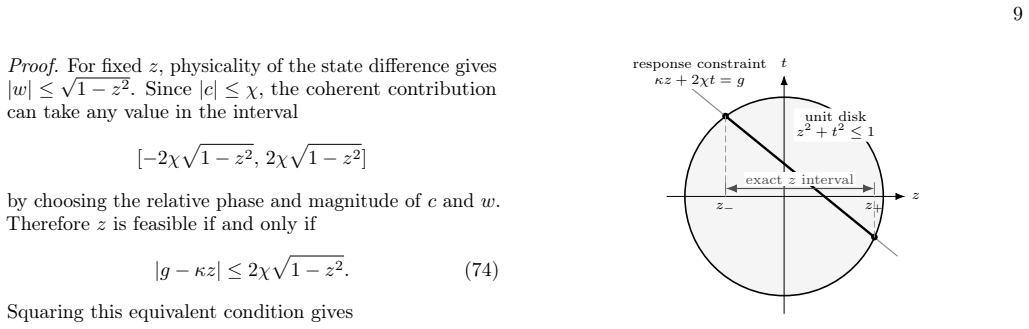
For a fully calibrated finite readout family the set of compatible population changes is given by an exact closed-form interval; when only a diagonal gain and coherence-sensitivity bound are trusted, the sharp minimax interval is obtained and the sign of the population change is identified if and only if g exceeds 2 chi.
What carries the argument
The exact closed-form interval of compatible population changes derived from the calibrated measurement directions, together with the minimax interval and sign condition g>2χ under partial calibration.
If this is right
- Reproducible readout probabilities alone do not certify population change without calibration of measurement directions.
- Identical probability records can be consistent with positive, zero, and negative population changes.
- The condition g>2χ is necessary and sufficient for sign identification under the diagonal-gain plus coherence-bound model.
- The derived intervals supply analytic benchmarks against which qubit readout calibration procedures can be tested.
Where Pith is reading between the lines
- Calibration protocols should therefore emphasize extraction of measurement directions rather than repeated stability checks.
- In settings with incomplete calibration, population changes may remain ambiguous even when all standard consistency tests pass.
- The same identifiability question arises for continuous or multi-outcome readouts and for multi-qubit systems.
Load-bearing premise
The physical device is accurately modeled by binary readouts acting on a finite set of qubit states whose measurement directions are either fully calibrated or limited to a diagonal gain plus a coherence-sensitivity bound.
What would settle it
An experiment in which the observed population change lies outside the derived interval for a fully calibrated family, or in which the sign is incorrectly identified when g is less than or equal to 2 chi under the partial-trust model.
Figures

read the original abstract
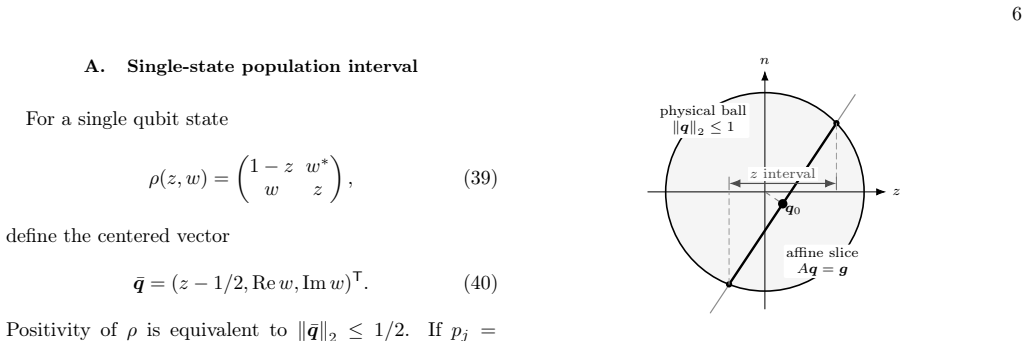
Stable readout statistics are often taken as evidence for a well-defined physical response, but stability alone need not identify which state quantity has changed. We analyze this issue for finite collections of qubit states measured by binary readouts, focusing on changes in computational-basis population. The central question is when reproducible response data certify the sign or range of an underlying population change. We show that the answer is controlled by the calibrated measurement directions, not by loop consistency alone. For a fully calibrated finite readout family, we derive an exact closed-form interval of all compatible population changes. We also construct a same-record, jointly measurable example in which identical probabilities and accepted loop checks admit positive, zero, and negative population interpretations. When only a diagonal readout gain and a bound on coherence sensitivity are trusted, we obtain the sharp minimax interval and the necessary-and-sufficient sign condition $g>2\chi$. These results separate implementation stability from population identifiability and provide analytic benchmarks for qubit readout calibration.
Editorial analysis
A structured set of objections, weighed in public.
Referee Report
Summary. The paper analyzes when stable readout statistics for finite collections of qubit states under binary readouts certify the sign or range of changes in computational-basis population. It derives an exact closed-form interval of compatible population changes for a fully calibrated finite readout family, constructs a same-record jointly measurable counter-example admitting positive, zero, and negative interpretations despite identical probabilities and loop checks, and for the case trusting only a diagonal readout gain g plus coherence-sensitivity bound χ obtains the sharp minimax interval together with the necessary-and-sufficient sign condition g>2χ.
Significance. If the derivations are correct, the results usefully separate readout stability from population identifiability and supply analytic benchmarks for qubit readout calibration. The closed-form interval, the explicit counter-example, and the minimax sign condition constitute concrete, falsifiable contributions.
major comments (1)
- [Abstract] Abstract: the central claims of an exact closed-form interval under full calibration and of the necessary-and-sufficient condition g>2χ under partial calibration are asserted, but the provided manuscript text contains no sections, equations, or explicit constructions, so the derivations, error handling, and scope of the finite readout family cannot be verified.
Simulated Author's Rebuttal
We thank the referee for the summary recognizing the separation of readout stability from population identifiability and the concrete contributions of the closed-form interval, counter-example, and minimax condition. We address the single major comment below.
read point-by-point responses
-
Referee: [Abstract] Abstract: the central claims of an exact closed-form interval under full calibration and of the necessary-and-sufficient condition g>2χ under partial calibration are asserted, but the provided manuscript text contains no sections, equations, or explicit constructions, so the derivations, error handling, and scope of the finite readout family cannot be verified.
Authors: The full manuscript (arXiv:2606.30462) contains dedicated sections beyond the abstract that supply the explicit derivations of the closed-form interval for any fully calibrated finite readout family, the same-record jointly measurable counter-example admitting multiple population interpretations, and the sharp minimax interval together with the necessary-and-sufficient sign condition g>2χ when only diagonal gain g and coherence-sensitivity bound χ are trusted. These sections include all equations, the precise scope over finite collections of qubit states under binary readouts, and error-handling considerations for the calibrated measurement directions. The referee's own summary accurately captures these elements, indicating the body text was available. If the reviewed version appeared incomplete, this may reflect a viewing or formatting issue; the complete paper provides the required constructions and proofs. revision: no
Circularity Check
No circularity: derivations start from standard calibrated models and produce intervals directly
full rationale
The abstract and reader's summary indicate that the central results—an exact closed-form interval for fully calibrated readouts and the minimax interval plus sign condition g>2χ under diagonal gain plus coherence bound—are derived from the calibrated measurement directions and trusted parameters. No equations or steps are shown that reduce a claimed prediction back to a fitted quantity defined in terms of the target result, nor any load-bearing self-citation chain. The construction of the jointly measurable counter-example is presented as an explicit example, not a renaming or self-definition. This matches the default case of a self-contained derivation from modeling assumptions.
Axiom & Free-Parameter Ledger
free parameters (2)
- g
- χ
axioms (2)
- domain assumption Readouts are binary and act on finite collections of qubit states.
- domain assumption Measurement directions are either fully calibrated or limited to diagonal gain plus coherence bound.
Reference graph
Works this paper leans on
-
[1]
an implementation certificate, such as Eqs.(14) and (15), for the registered source–readout family
-
[2]
a population interval or lower bound derived from one declared measurement-information regime in Table III. On a simultaneous confidence event, a positive popula- tion response with marginζ is supported only when the implementation certificate passes and min i zi,L ≥ζ,(100) where zi,L iscomputedfromthefullycalibratedfamily, the bounded-coherence formula, ...
-
[3]
Since ∥X∥1 = 2r for the above trace-zero qubit operator, this impliesr≤1
State-difference ball Every trace-zero Hermitian qubit operator can be writ- ten as X= −z w ∗ w z ! ,q= (z,Rew,Imw) T.(A1) Its eigenvalues are±r, where r= p z2 +|w| 2 =∥q∥ 2 .(A2) If X = ρ−σ for density operators, then∥X∥1 ≤ 2. Since ∥X∥1 = 2r for the above trace-zero qubit operator, this impliesr≤1. Conversely, ifr≤1, then ρ= I+X 2 , σ= I−X 2 (A3) are po...
-
[4]
9 68 − 3 √ 191 340 , 9 68 + 3 √ 191 340 # ,(B12) z(0+) ∈
Connection with the established span criterion Let Herm0(d)be the real Hilbert space of trace-zero Hermitian operators on a d-dimensional Hilbert space, equipped with the Hilbert–Schmidt inner product ⟨X, Y⟩= Tr(XY). The response map associated with effectsF1, . . . , Fm is M(X) = (Tr(F1X), . . . ,Tr(FmX)).(A6) For a trace-zero target observableT, the val...
-
[5]
Support-function derivation For fixedz, Eq.(20)implies |w| ≤ √ 1−z 2. Optimizing over the phase and magnitude ofcgives max |c|≤χ,|w|≤ √ 1−z2 2 Re(cw) = 2χ p 1−z 2.(D1) Thus the lower endpoint is the smallestz for which the observed response can be generated at all, namely the smallest solution of g≤κz+ 2χ p 1−z 2.(D2) At the lower endpoint, equality holds...
-
[6]
Monotonicity on the positive branch Assume g > 2χ and g < R . Write b = 2χ and define angles cosα= g R ,cosϕ= κ R ,(D6) sinϕ= b R , R 2 =κ 2 +b 2.(D7) Then the lower endpoint can be written as z− = cos(α+ϕ)>0.(D8) For fixed g, increasing b increases both α and ϕ, and therefore decreases z−. Increasing κ increases α and decreases ϕ, but on the positive bra...
-
[7]
X. Rong, M. Wang, J. Geng, X. Qin, M. Guo, M. Jiao, Y. Xie, P. Wang, P. Huang, F. Shi, Y.-F. Cai, C. Zou, and J. Du, Searching for an exotic spin-dependent interaction with a single electron-spin quantum sensor, Nat. Commun. 9, 739 (2018), arXiv:1706.03482 [quant-ph]
work page internal anchor Pith review Pith/arXiv arXiv 2018
-
[8]
Busch, P
P. Busch, P. J. Lahti, and P. Mittelstaedt,The Quantum Theory of Measurement, 2nd ed. (Springer, Berlin, 1996)
1996
-
[9]
A. S. Holevo,Probabilistic and Statistical Aspects of Quan- tum Theory, 2nd ed., Publications of the Scuola Normale Superiore (Edizioni della Normale, Pisa, 2011)
2011
-
[10]
M. A. Nielsen and I. L. Chuang,Quantum Computation and Quantum Information, 10th ed. (Cambridge Univer- sity Press, Cambridge, 2010)
2010
-
[11]
M. G. A. Paris and J. Řeháček, eds.,Quantum State Estimation, Lecture Notes in Physics, Vol. 649 (Springer, Berlin, 2004)
2004
-
[12]
Hradil, Quantum-state estimation, Phys
Z. Hradil, Quantum-state estimation, Phys. Rev. A55, R1561 (1997)
1997
-
[13]
D. F. V. James, P. G. Kwiat, W. J. Munro, and A. G. White, Measurement of qubits, Phys. Rev. A64, 052312 (2001)
2001
-
[14]
Fiurášek, Maximum-likelihood estimation of quantum measurement, Phys
J. Fiurášek, Maximum-likelihood estimation of quantum measurement, Phys. Rev. A64, 024102 (2001)
2001
- [15]
-
[16]
Y. S. Teo, J. Řeháček, and Z. Hradil, Informationally incomplete quantum tomography, Quantum Meas. Quan- tum Metrol.1, 57 (2013)
2013
-
[17]
J. M. Renes, R. Blume-Kohout, A. J. Scott, and C. M. Caves, Symmetric informationally complete quantum mea- surements, J. Math. Phys.45, 2171 (2004)
2004
-
[18]
A. J. Scott, Tight informationally complete quantum measurements, J. Phys. A39, 13507 (2006)
2006
-
[19]
G. M. D’Ariano, P. Perinotti, and M. F. Sacchi, Quan- tum indirect estimation theory and joint estimate of all moments of two incompatible observables, Phys. Rev. A 77, 052108 (2008), arXiv:0708.3960
work page internal anchor Pith review Pith/arXiv arXiv 2008
-
[20]
Probing quantum state space: does one have to learn everything to learn something?
C. Carmeli, T. Heinosaari, J. Schultz, and A. Toigo, Prob- ing quantum state space: Does one have to learn every- thing to learn something?, Proc. R. Soc. A473, 20160866 (2017), arXiv:1611.04388
work page internal anchor Pith review Pith/arXiv arXiv 2017
-
[21]
A. C. Keith, C. H. Baldwin, S. Glancy, and E. Knill, Joint quantum-state and measurement tomography with incom- plete measurements, Phys. Rev. A98, 042318 (2018), arXiv:1803.08245
work page internal anchor Pith review Pith/arXiv arXiv 2018
-
[22]
Christandl and R
M. Christandl and R. Renner, Reliable quantum state tomography, Phys. Rev. Lett.109, 120403 (2012)
2012
-
[23]
L. Zambrano, D. Farina, E. Pagliaro, M. M. Taddei, and A. Acin, Certification of quantum state functions under partial information, Quantum8, 1442 (2024), arXiv:2311.06094
-
[24]
S. T. Merkel, J. M. Gambetta, J. A. Smolin, S. Poletto, A. D. Córcoles, B. R. Johnson, C. A. Ryan, and M. Steffen, Self-consistent quantum process tomography, Phys. Rev. A87, 062119 (2013)
2013
-
[25]
S. J. van Enk and R. Blume-Kohout, When quantum tomography goes wrong: Drift of quantum sources and other errors, New J. Phys.15, 025024 (2013)
2013
-
[26]
Stark, Self-consistent tomography of the state- measurement gram matrix, Phys
C. Stark, Self-consistent tomography of the state- measurement gram matrix, Phys. Rev. A89, 052109 (2014)
2014
-
[27]
Detecting correlated errors in SPAM tomography
C. Jackson and S. J. van Enk, Detecting correlated errors in state-preparation-and-measurement tomography, Phys. Rev. A92, 042312 (2015), arXiv:1508.05633
work page internal anchor Pith review Pith/arXiv arXiv 2015
-
[28]
Introduction to Quantum Gate Set Tomography
D. Greenbaum, Introduction to quantum gate set tomog- raphy (2015), arXiv:1509.02921
work page internal anchor Pith review Pith/arXiv arXiv 2015
-
[29]
A. F. McCormick, S. J. van Enk, and M. Beck, Ex- perimental demonstration of loop state-preparation-and- measurement tomography, Phys. Rev. A95, 042329 (2017), arXiv:1701.06498
work page internal anchor Pith review Pith/arXiv arXiv 2017
-
[30]
Probing context-dependent errors in quantum processors
K. Rudinger, T. Proctor, D. Langharst, M. Sarovar, K. Young, and R. Blume-Kohout, Probing context- dependent errors in quantum processors, Phys. Rev. X9, 021045 (2019), arXiv:1810.05651
work page internal anchor Pith review Pith/arXiv arXiv 2019
-
[31]
O. D. Matteo, J. Gamble, C. Granade, K. Rudinger, and N. Wiebe, Operational, gauge-free quantum tomography, Quantum4, 364 (2020)
2020
-
[32]
R. Blume-Kohout, K. Rudinger, E. Nielsen, T. Proctor, and K. Young, Wildcard error: Quantifying unmodeled errors in quantum processors (2020), arXiv:2012.12231
-
[33]
Nielsen, J
E. Nielsen, J. K. Gamble, K. Rudinger, T. Scholten, K. Young, and R. Blume-Kohout, Gate set tomography, Quantum5, 557 (2021)
2021
-
[34]
Rudinger, G
K. Rudinger, G. J. Ribeill, L. C. G. Govia, M. Ware, E. Nielsen, K. Young, T. A. Ohki, R. Blume-Kohout, and T. Proctor, Characterizing midcircuit measurements on a superconducting qubit using gate set tomography, Phys. Rev. Applied17, 014014 (2022)
2022
-
[35]
M. Cattaneo, M. A. C. Rossi, K. Korhonen, E.-M. Borrelli, G. Garcia-Perez, Z. Zimboras, and D. Cavalcanti, Self- consistent quantum measurement tomography based on semidefinite programming, Phys. Rev. Research5, 033154 (2023), arXiv:2212.10262
-
[36]
A. Jayakumar, S. Chessa, C. Coffrin, A. Y. Lokhov, M. Vuffray, and S. Misra, Universal framework for si- multaneous tomography of quantum states and SPAM noise, Quantum8, 1426 (2024), arXiv:2308.15648
-
[37]
R. Blume-Kohout, T. Proctor, and K. Young, Quan- tum characterization, verification, and validation (2025), arXiv:2503.16383
-
[38]
A. Hashim, L. B. Nguyen, N. Goss, B. Marinelli, R. K. Naik, T. Chistolini, J. Hines, J. P. Marceaux, Y. Kim, 18 P. Gokhale, T. Tomesh, S. Chen, L. Jiang, S. Ferracin, K. Rudinger, T. Proctor, K. C. Young, I. Siddiqi, and R. Blume-Kohout, A practical introduction to benchmark- ing and characterization of quantum computers, PRX Quantum6, 030202 (2025), arXi...
- [39]
-
[40]
M. Q. Khan, L. M. Norris, and L. Viola, Separate and efficient characterization of state-preparation and mea- surement errors using single-qubit operations, Quantum Sci. Technol.11, 025051 (2026), arXiv:2509.19448
work page internal anchor Pith review Pith/arXiv arXiv 2026
-
[41]
J. S. Lundeen, A. Feito, H. Coldenstrodt-Ronge, K. L. Pregnell, C. Silberhorn, T. C. Ralph, J. Eisert, M. B. Plenio, and I. A. Walmsley, Tomography of quantum detectors, Nat. Phys.5, 27 (2009)
2009
-
[42]
Feito, J
A. Feito, J. S. Lundeen, H. Coldenstrodt-Ronge, J. Eisert, M.B.Plenio,andI.A.Walmsley,Measuringmeasurement: Theory and practice, New J. Phys.11, 093038 (2009)
2009
-
[43]
Mapping coherence in measurement via full quantum tomography of a hybrid optical detector
L. Zhang, H. B. Coldenstrodt-Ronge, A. Datta, G. Puentes, J. S. Lundeen, X.-M. Jin, B. J. Smith, M. B. Plenio, and I. A. Walmsley, Mapping coherence in mea- surement via full quantum tomography of a hybrid optical detector, Nat. Photonics6, 364 (2012), arXiv:1204.1893
work page internal anchor Pith review Pith/arXiv arXiv 2012
-
[44]
Y. Chen, M. Farahzad, S. Yoo, and T.-C. Wei, Detector tomography on IBM quantum computers and mitigation of an imperfect measurement, Phys. Rev. A100, 052315 (2019)
2019
- [45]
- [46]
- [47]
-
[48]
L. Xu, H. Xu, T. Jiang, F. Xu, K. Zheng, B. Wang, A. Zhang, and L. Zhang, Direct characterization of quan- tum measurements using weak values, Phys. Rev. Lett. 127, 180401 (2021)
2021
- [49]
-
[50]
Experimental measurement-device-independent quantum random number generation
Y.-Q. Nie, J.-Y. Guan, H. Zhou, Q. Zhang, X. Ma, J. Zhang, and J.-W. Pan, Experimental measurement- device-independent quantum random-number generation, Phys. Rev. A94, 060301(R) (2016), arXiv:1612.02114 [quant-ph]
work page internal anchor Pith review Pith/arXiv arXiv 2016
- [51]
-
[52]
Coherence Response in Noisy Quantum Measurements
Z. Malik, Q. Langfitt, and Z. Saleem, Coherence response in noisy quantum measurements (2025), arXiv:2512.13949 [quant-ph]
work page internal anchor Pith review Pith/arXiv arXiv 2025
- [53]
-
[54]
F. B. Maciejewski, Z. Zimborás, and M. Oszmaniec, Miti- gation of readout noise in near-term quantum devices by classical post-processing based on detector tomography, Quantum4, 257 (2020)
2020
-
[55]
P. D. Nation, H. Kang, N. Sundaresan, and J. M. Gam- betta, Scalable mitigation of measurement errors on quan- tum computers, PRX Quantum2, 040326 (2021)
2021
- [56]
-
[57]
J. Barbera-Rodriguez, L. Zambrano, A. Acin, and D. Fa- rina, Boosting projective methods for quantum process and detector tomography, Phys. Rev. Research7, 013208 (2025), arXiv:2406.11646
-
[58]
L. Zambrano, S. Ramos-Calderer, and R. Kueng, Fast quantum measurement tomography with dimension- optimal error bounds (2025), arXiv:2507.04500
-
[59]
A. Das, S. K. Yung, L. O. Conlon, O. Erkilic, A. Walsh, Y.-S. Kim, P. K. Lam, S. M. Assad, and J. Zhao, Precision bounds for characterising quantum measurements, Nat. Commun.17, 1821 (2026)
2026
-
[60]
Rosset, R
D. Rosset, R. Ferretti-Schöbitz, J.-D. Bancal, N. Gisin, and Y.-C. Liang, Imperfect measurement settings: Impli- cations for quantum state tomography and entanglement witnesses, Phys. Rev. A86, 062325 (2012)
2012
-
[61]
Morelli, H
S. Morelli, H. Yamasaki, M. Huber, and A. Tavakoli, Entanglement detection with imprecise measurements, Phys. Rev. Lett.128, 250501 (2022)
2022
-
[62]
Tavakoli, Quantum steering with imprecise mea- surements, Phys
A. Tavakoli, Quantum steering with imprecise mea- surements, Phys. Rev. Lett.132, 070204 (2024), arXiv:2308.15356
-
[63]
Svegborn, N
E. Svegborn, N. d’Alessandro, O. Gühne, and A. Tavakoli, Imprecision plateaus in quantum steering, Phys. Rev. A 111, L020404 (2025)
2025
-
[64]
L. Zambrano, T. Parella-Dilme, A. Acin, and D. Farina, Certification of quantum properties with imperfect mea- surements (2026), arXiv:2601.16570
-
[65]
Faking entanglement with imperceptible measurement deviations
J. Moreno, E. Svegborn, S. Morelli, M. Hiekkamäki, L. Kopf, R. Fickler, and A. Tavakoli, Faking entangle- ment with imperceptible measurement deviations (2026), arXiv:2606.20396 [quant-ph]
work page internal anchor Pith review Pith/arXiv arXiv 2026
-
[66]
C.-T. Chu, S. u. Lee, H. Zheng, S. Chen, B. Pokharel, A. Seif, and L. Jiang, Learning mid-circuit measurement backaction from three repeated measurements (2026), arXiv:2606.00433 [quant-ph]
work page internal anchor Pith review Pith/arXiv arXiv 2026
-
[67]
Notes on Joint Measurability of Quantum Observables
T. Heinosaari, D. Reitzner, and P. Stano, Notes on Joint Measurability of Quantum Observables, Found. Phys.38, 1133 (2008), arXiv:0811.0783 [quant-ph]
work page internal anchor Pith review Pith/arXiv arXiv 2008
-
[68]
Yu, N.-L
S. Yu, N.-L. Liu, L. Li, and C. H. Oh, Joint measurement of two unsharp observables of a qubit, Phys. Rev. A81, 062116 (2010)
2010
- [69]
-
[70]
Boyd and L
S. Boyd and L. Vandenberghe,Convex Optimization (Cambridge University Press, Cambridge, 2004)
2004
-
[71]
Hoeffding, Probability inequalities for sums of bounded random variables, J
W. Hoeffding, Probability inequalities for sums of bounded random variables, J. Am. Stat. Assoc.58, 13 (1963)
1963
- [72]
discussion (0)
Sign in with ORCID, Apple, or X to comment. Anyone can read and Pith papers without signing in.