REVIEW 3 major objections 6 minor 22 references
GNNAS-Dock: Budget Aware Algorithm Selection with Graph Neural Networks for Molecular Docking
T0 review · 3 major / 6 minor · reviewed 2026-08-12 · deepseek-v4-flash
Pith's one-line read No single docking tool wins every case; a GNN that picks per pair cuts mean RMSD to 1.74 Å.
desk verdict The core idea is sound—GNN-based algorithm selection for blind docking—but the headline 1.74 Å result is an in-sample number from test-set architecture selection, not a clean estimate. read the letter →
The pith
A machine-rendered reading of the paper's core claim, the machinery that carries it, and where it could break.
The reading
What carries the argument
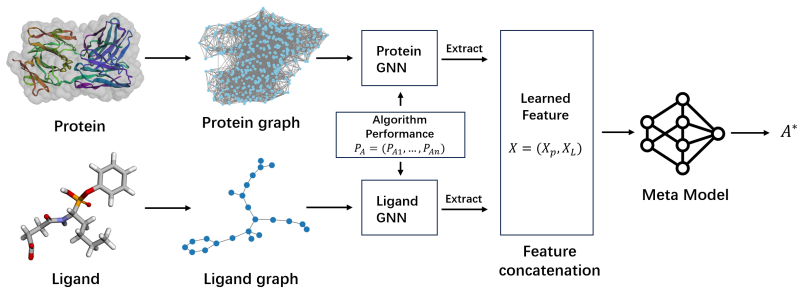
The machinery is a stacked graph-neural-network selector. Ligands are represented as atom-bond graphs and proteins as amino-acid-residue graphs with peptide-bond edges; the selected architecture pair is GAT for the ligand graph and a GCN+GAT+GINE combination for the protein graph, the latter adapted from graphLambda. The two GNNs' learned feature vectors are concatenated and fed into a small dense meta-model that outputs either predicted RMSD per algorithm (accuracy model) or predicted binary success at the 2 Å threshold plus predicted runtime per algorithm (efficiency model). The selection rule is to choose the algorithm with the lowest predicted RMSD, or, in the efficiency variant, the fastest algorithm among those predicted to succeed, falling back to the fastest overall when none is predicted to succeed.
What would settle it
Re-run the comparison on a hold-out set built by clustering PDBBind proteins at 30% sequence identity, with architecture selection done on a validation split; if the selected model's mean RMSD is not materially below DiffDock's, the claimed advantage is an artifact of test-set reuse and near-duplicate proteins.
Extended reading notes
Core claim
The paper's central claim is that algorithm selection by learned performance prediction can beat every tested single docking program on average RMSD. The accuracy model, GNNAS-Dock (Accuracy), predicts the RMSD each of nine docking algorithms would produce for a given protein-ligand pair and selects the predicted best; on the test set this yields a mean RMSD of 1.74 Å, compared with 2.95 Å for DiffDock, the strongest individual tool. The efficiency model predicts both whether each algorithm will succeed (RMSD below 2 Å) and how long it will take, then chooses the fastest predicted-successful algorithm; it reaches a mean RMSD of 2.75 Å, keeps 79.73% of results below 2 Å, and averages 29.05 seconds per docking. The paper also reports an oracle that always picks the true best tool, reaching 0.67 Å mean RMSD, indicating that the remaining gap is due to imperfect performance prediction rather than to the portfolio itself.
Load-bearing premise
The reported improvement assumes that the GNN architecture selected in Table 1 and the final results in Table 2 come from the same random test split, with no filtering of similar proteins across train and test; if the architecture had been chosen on a separate validation set and the split clustered by sequence identity, the 1.74 Å mean RMSD could shrink toward DiffDock's level.
Editorial extensions
If this is right
- If the accuracy model's estimates are unbiased, algorithm selection over existing docking tools can lower mean RMSD below every tested single tool on the same distribution of protein-ligand pairs.
- The efficiency model shows that per-instance selection can reduce average runtime relative to DiffDock while keeping roughly four out of five poses under 2 Å, making it relevant for high-throughput screening.
- Because the selector uses only the structures of the protein and ligand, it can in principle recommend a docking tool for any new blind docking pair without retraining.
- The accuracy model's 92.00% success rate below 5 Å suggests that selection mostly removes poor docking outcomes rather than only sharpening already-good poses.
- The oracle result of 0.67 Å mean RMSD defines an upper bound: further improvements in the performance predictor could roughly halve the mean RMSD of the current accuracy model.
Reading between the lines
- A direct test of generalization would be to split PDBBind by protein sequence identity and choose the GNN architecture on a validation set, then measure mean RMSD on a held-out cluster; this would show whether the reported advantage survives contact with unseen protein families.
- The same stacked-GNN selection idea could be transferred to docking settings where no single tool dominates, such as flexible-side-chain docking, covalent docking, or docking into cryo-EM density maps.
- Because labeling each protein-ligand pair requires running all nine docking tools, active learning over the label budget could make the approach scale to larger datasets at lower computational cost.
- The accuracy model averages 66.85 seconds per task, slower than DiffDock, because it sometimes selects slow traditional tools paired with p2rank; a budget-constrained variant that excludes tools over a time limit would directly probe the accuracy-efficiency frontier.
Editorial analysis
A structured set of objections, weighed in public.
Referee Report
Summary. The paper proposes GNNAS-Dock, a graph-neural-network-based algorithm selection system for blind molecular docking. It builds separate GNN encoders for ligand and protein graphs, concatenates their learned features, and trains two meta-models: an accuracy model that predicts the RMSD of each candidate docking algorithm and selects the predicted best, and an efficiency model that predicts binary success (RMSD < 2 Å) and runtime, then selects the fastest predicted-successful algorithm. The system is evaluated on the PDBBind 2020 refined set against a portfolio of nine docking configurations (DiffDock, DSDP, TankBind, GNINA, SMINA, Qvina-W, and three p2rank-augmented variants). The central quantitative claims are a mean RMSD of about 1.74 Å for the accuracy model versus 2.95 Å for DiffDock, and a mean RMSD of 2.75 Å with an average runtime of 29.05 seconds for the efficiency model.
Significance. The paper addresses a practically important and relatively underexplored problem: automated selection among docking algorithms for individual protein-ligand pairs. The idea of end-to-end learned algorithm selection with graph representations of both partners is sensible, and the two-model formulation (accuracy versus efficiency) is a useful framing. If the reported improvements held under a properly unbiased evaluation, the work would be a meaningful step toward robust and cost-aware docking pipelines. The paper also provides a relatively broad algorithmic portfolio and reports symmetry-corrected RMSD, which is good practice. However, the current evaluation protocol does not support the headline numbers, so the significance is currently prospective rather than established.
major comments (3)
- [§4.1, Table 1 and §4.2, Table 2] The GNN architecture pair is selected using the test set, and the same test set is then used to report the final results. Table 1 evaluates 21 protein/ligand architecture combinations on the test set and selects the pair with the lowest test-set RMSD (GCN_GAT_GINE for protein, GAT for ligand). Table 2 then reports the accuracy model's mean RMSD of 1.74 Å on that same test set. Because the test set was used for model selection among 21 configurations, the reported 1.74 Å is the minimum of a small family of test-set estimates, not an unbiased estimate of performance on new data. The expected performance on a fresh test set would regress toward the typical values in Table 1 (approximately 1.83–2.0 Å), which may still be competitive but is not established by the current protocol. The authors need a separate validation set for architecture selection, or nested cross-validation, so that the final test-set numbers are not used in any model-selection decision.
- [§4.1, dataset split] The train/test split is described only as a ratio of 0.3, with no statement about sequence-identity filtering. PDBBind contains homologous protein families, and a random split can place near-identical proteins in both training and test partitions, inflating the reported accuracy. The authors should cluster proteins by sequence or structure similarity (for example, using BLAST or MMseqs2 clustering) before splitting, and report the resulting split statistics. Without this control, the generalization claim for the 1.74 Å mean RMSD is not supported.
- [§4.2, Tables 1–2] No error bars, standard deviations, or significance tests are reported for any of the RMSD or success-rate values. GNN training is stochastic, and the differences between some entries are small (for example, 81.80% versus 84.36% below 2 Å, and 79.73% versus 84.36% in the efficiency comparison). The authors should run multiple independent training runs with different seeds and report means with standard deviations, and use a paired statistical test (e.g., paired bootstrap or Wilcoxon signed-rank test) for the comparisons that support the abstract's claim of significant improvement. As it stands, the reader cannot assess whether the differences are reproducible or within noise.
minor comments (6)
- [§1, Introduction] The sentence "no single algorithm consistently outperforms the others" would be clearer as "no single algorithm consistently outperforms all others."
- [§3.2, Protein Graph] The text says the protein GNN architecture is derived from graphLambda and that "different combination of GNNs should be experimented to determine an effective GNN architecture," but the actual search is only described in §4.1. A brief forward reference would improve readability.
- [§4.1, Table 1] The sentence "it should be noted that any of these pairs outperform the overall, single best docking algorithm of DiffDock" is misleading: the values in Table 1 are model-selection metrics on the test set, not independent performance estimates, and the statement should be qualified accordingly.
- [§4.2, Table 2] In the Oracle row, the value under the 5 Å column is written as "99.65" without a percent sign; it should be "99.65%."
- [Throughout] There are several typographical errors that should be corrected: "structual" (§1), "diagnoal" (§3.1), "Efficieny" (§4.2), and "it due it its success" (§1).
- [§2.1, Background] The text says PDBBind contains "more than 19,000 pairs" while the abstract and §4 state the refined set has about 5,300 pairs; the distinction between the general and refined sets should be stated explicitly to avoid confusion.
Circularity Check
No significant circularity: the reported accuracy is evaluated against RMSD labels produced by external docking tools, and no fitted parameter or self-citation is repackaged as a prediction.
full rationale
The paper's derivation chain is self-contained. GNNAS-Dock trains GNNs on protein and ligand graphs to predict the RMSD that each of nine external docking algorithms would achieve on a given complex, and then recommends the algorithm with the best predicted value. The labels come from running DiffDock, DSDP, TankBind, GNINA, SMINA, Qvina-W, and the p2rank-augmented variants on the PDBBind refined set, so the model's output is not used to construct its own evaluation target. The headline 1.74 Å mean RMSD is the measured RMSD of the algorithm selected by the accuracy model, not a fitted quantity renamed as a result. The only self-citation is background context about the authors' earlier traditional algorithm-selection work and the ALORS recommender; that citation is not load-bearing for the current GNN-based system. The test-set-based architecture selection described in Section 4.1 and Table 1 is an evaluation-protocol concern that could bias the reported numbers, but it is not circular reasoning: choosing the best of 21 configurations by test-set RMSD does not make the final comparison equivalent to an input by construction. No step in the paper reduces an equation to itself or presents a fitted parameter as an independent prediction, so the circularity score is 0.
Assumptions & free parameters
free parameters (4)
- GNN architecture combination (ligand GAT; protein GCN+GAT+GINE) =
Ligand GAT; protein GCN_GAT_GINE
- Learning rate and epoch count for architecture search =
0.0001, 50 epochs
- Meta-model hidden layer width =
4×k
- RMSD success threshold =
2 Å
assumptions (6)
- standard math Standard GNN update rules for GCN, GAT, and GINE are correct and applicable to molecular graphs.
- domain assumption Amino-acid-level protein graphs with peptide-bond edges preserve enough information to predict docking algorithm RMSD.
- domain assumption RDKit-generated 3D ligand conformations from SMILES are suitable inputs for predicting docking performance.
- domain assumption Symmetry-corrected RMSD (spyrmsd) is the correct ground truth for comparing docking poses.
- domain assumption The PDBBind 2020 refined set is representative of blind docking tasks and a random split avoids protein-level leakage.
- ad hoc to paper The test set can be used for architecture selection and still yield unbiased performance estimates.
Cite this review
Pith. "Pith review of GNNAS-Dock: Budget Aware Algorithm Selection with Graph Neural Networks for Molecular Docking." pith.science (2026). https://pith.science/paper/3VNQVV24
@misc{pith2026241112597,
  author       = {Pith},
  title        = {Pith review of: GNNAS-Dock: Budget Aware Algorithm Selection with Graph Neural Networks for Molecular Docking},
  year         = {2026},
  howpublished = {\url{https://pith.science/paper/3VNQVV24}},
  note         = {Machine review of arXiv:2411.12597}
}
read the original abstract
Molecular docking is a major element in drug discovery and design. It enables the prediction of ligand-protein interactions by simulating the binding of small molecules to proteins. Despite the availability of numerous docking algorithms, there is no single algorithm consistently outperforms the others across a diverse set of docking scenarios. This paper introduces GNNAS-Dock, a novel Graph Neural Network (GNN)-based automated algorithm selection system for molecular docking in blind docking situations. GNNs are accommodated to process the complex structural data of both ligands and proteins. They benefit from the inherent graph-like properties to predict the performance of various docking algorithms under different conditions. The present study pursues two main objectives: 1) predict the performance of each candidate docking algorithm, in terms of Root Mean Square Deviation (RMSD), thereby identifying the most accurate method for specific scenarios; and 2) choose the best computationally efficient docking algorithm for each docking case, aiming to reduce the time required for docking while maintaining high accuracy. We validate our approach on PDBBind 2020 refined set, which contains about 5,300 pairs of protein-ligand complexes.
Figures
Reference graph
Works this paper leans on
-
[4]
URL https://doi.org/10.1038/ s41598-017-15571-7
doi: 10.1038/s41598-017-15571-7. URL https://doi.org/10.1038/ s41598-017-15571-7 . Weihua Hu, Bowen Liu, Joseph Gomes, Marinka Zitnik, Percy Liang, Vijay Pande, and Jure Leskovec. Strategies for pre-training graph neural networks. In International Conference on Learning Representations (ICLR),
-
[5]
URL https://doi.org/ 10.1021/acs.jcim.3c00519
doi: 10.1021/acs.jcim.3c00519. URL https://doi.org/ 10.1021/acs.jcim.3c00519. PMID: 37386792. Arian Rokkum Jamasb, Ramon Viñas Torné, Eric J Ma, Yuanqi Du, Charles Harris, Kexin Huang, Dominic Hall, Pietro Lio, and Tom Leon Blundell. Graphein - a python library for geometric deep learning and network analysis on biomolecular structures and interaction net...
-
[6]
URL https://openreview.net/forum?id=SJU4ayYgl. David Ryan Koes, Matthew P. Baumgartner, and Carlos J. Camacho. Lessons learned in empirical scoring with smina from the csar 2011 benchmarking exercise. Journal of Chemical Information and Modeling, 53(8):1893–1904,
work page 2011
-
[9]
URL https://doi.org/10.1021/acs
doi: 10.1021/acs.accounts.6b00491. URL https://doi.org/10.1021/acs. accounts.6b00491. PMID: 28182403. Andrea Loreggia, Yuri Malitsky, Horst Samulowitz, and Vijay Saraswat. Deep learning for algorithm portfolios. In Proceedings of the AAAI Conference on Artificial Intelligence, volume 30,
-
[14]
doi: https://doi.org/10.1016/j.jksuci.2023.01.014
ISSN 1319-1578. doi: https://doi.org/10.1016/j.jksuci.2023.01.014. URL https://www.sciencedirect.com/science/article/pii/S1319157823000228. Ghaith Mqawass and P. Popov. Graphlambda: Fusion graph neural networks for binding affinity prediction. Journal of Chemical Information and Modeling, 64(7):2323–2330,
-
[16]
doi: https://doi.org/10.1016/j.artint.2016.12.001
ISSN 0004-3702. doi: https://doi.org/10.1016/j.artint.2016.12.001. URL https://www.sciencedirect.com/science/article/pii/S0004370216301436. Ivan Olier, Noureddin Sadawi, G Richard Bickerton, Joaquin Vanschoren, Crina Grosan, Larisa Soldatova, and Ross D King. Meta-qsar: a large-scale application of meta-learning to drug design and discovery. Machine Learn...
-
[18]
doi: 10.1016/bs. pmch.2021.01.004. URL https://doi.org/10.1016/bs.pmch.2021.01.004. 11 Hannes Stärk, Octavian-Eugen Ganea, Lagnajit Pattanaik, Regina Barzilay, and Tommi Jaakkola. Equibind: Geometric deep learning for drug binding structure prediction,
doi:10.1016/bs 2021
-
[19]
URL https: //arxiv.org/abs/2202.05146. Oleg Trott and Arthur J. Olson. Autodock vina: Improving the speed and accuracy of docking with a new scoring function, efficient optimization, and multithreading. Journal of Computational Chemistry, 31(2):455–461,
Show all 22 references
-
[20]
URL https://doi.org/10.1002/ jcc.21334
doi: 10.1002/jcc.21334. URL https://doi.org/10.1002/ jcc.21334. Petar Veliˇckovi´c, Guillem Cucurull, Arantxa Casanova, Adriana Romero, Pietro Liò, and Yoshua Bengio. Graph attention networks. In International Conference on Learning Representations,
-
[22]
URL https://doi.org/10.1016/j.aiopen
doi: 10.1016/j.aiopen.2021.01.001. URL https://doi.org/10.1016/j.aiopen. 2021.01.001. 12
2021 doi
-
[1997]
URL https: //doi.org/10.1109/4235.585893
doi: 10.1109/4235.585893. URL https: //doi.org/10.1109/4235.585893. Jie Zhou, Ganqu Cui, Shutao Hu, Zhengyan Zhang, Cheng Yang, Zhiyuan Liu, Li Wang, Chang Li, and Maosong Sun. Graph neural networks: A review of methods and applications. AI Open, 1: 57–81,
-
[2001]
URL https://doi.org/ 10.1007/s008940100038
doi: 10.1007/s008940100038. URL https://doi.org/ 10.1007/s008940100038. Rocco Meli and Philip C. Biggin. spyrmsd: symmetry-corrected rmsd calculations in python. Journal of Cheminformatics, pp. 49,
-
[2002]
URL https://onlinelibrary.wiley.com/doi/abs/10.1002/prot.10115
doi: https://doi.org/10.1002/prot.10115. URL https://onlinelibrary.wiley.com/doi/abs/10.1002/prot.10115. Nafisa M. Hassan, Amr A. Alhossary, Yuguang Mu, and Chee-Keong Kwoh. Protein-ligand blind docking using quickvina-w with inter-process spatio-temporal integration. Scientif...
-
[2010]
URL https://iubmb.onlinelibrary.wiley.com/doi/abs/10.1002/ bmb.20392
doi: https://doi.org/ 10.1002/bmb.20392. URL https://iubmb.onlinelibrary.wiley.com/doi/abs/10.1002/ bmb.20392. Thalea Schlender, Markus Viljanen, Jan N van Rijn, Felix Mohr, Willie JGM Peijnenburg, Holger H Hoos, Emiel Rorije, and Albert Wong. The bigger fish: a comparison of ...
-
[2013]
URL https://doi.org/10
doi: 10.1021/ci300604z. URL https://doi.org/10. 1021/ci300604z. Ana Kostovska, Anja Jankovic, Diederick Vermetten, Sašo Džeroski, Tome Eftimov, and Carola Doerr. Comparing algorithm selection approaches on black-box optimization problems. In Proceedings of the Companion Confer...
-
[2017]
doi: 10.3390/molecules22010136
ISSN 1420-3049. doi: 10.3390/molecules22010136. URL https://www.mdpi.com/1420-3049/22/ 1/136. Tianlai Chen, Xiwen Shu, Huiyuan Zhou, Floyd A Beckford, and Mustafa Misir. Algorithm selection for protein–ligand docking: strategies and analysis on ace. Scientific Reports, 13(1):8219,
-
[2018]
URL httpe://doi.org/10.1186/s13321-018-0285-8
doi: 10.1186/s13321-018-0285-8. URL httpe://doi.org/10.1186/s13321-018-0285-8 . Zhihai Liu, Minyi Su, Li Han, Jie Liu, Qifan Yang, Yan Li, and Renxiao Wang. Forging the basis for developing protein–ligand interaction scoring functions. Accounts of Chemical Research, 50(2): 302–309,
-
[2020]
URL https: //doi.org/10.1186/s13321-020-00455-2
doi: 10.1186/s13321-020-00455-2. URL https: //doi.org/10.1186/s13321-020-00455-2 . Ammar Mohammed and Rania Kora. A comprehensive review on ensemble deep learning: Oppor- tunities and challenges. Journal of King Saud University - Computer and Information Sciences, 35(2):757–774,
-
[2021]
URL https://doi.org/10.1186/s13321-021-00522-2
doi: 10.1186/s13321-021-00522-2. URL https://doi.org/10.1186/s13321-021-00522-2 . Jens Meiler, Michael Müller, Anita Zeidler, and Felix Schmäschke. Generation and evaluation of dimension-reduced amino acid parameter representations by artificial neural networks. Molecular mode...
-
[2022]
URL https://www.biorxiv.org/content/early/2022/ 10/25/2022.06.06.495043
doi: 10.1101/2022.06.06.495043. URL https://www.biorxiv.org/content/early/2022/ 10/25/2022.06.06.495043. Andrew T. McNutt, Paul Francoeur, Rishal Aggarwal, Tomohide Masuda, Rocco Meli, Matthew Ragoza, Jocelyn Sunseri, and David Ryan Koes. Gnina 1.0: Molecular docking with deep...
2022 doi
-
[2023]
URL https://doi.org/10.1038/s41598-023-35132-5
doi: 10.1038/s41598-023-35132-5. URL https://doi.org/10.1038/s41598-023-35132-5 . Gabriele Corso, Hannes Stärk, Bowen Jing, Regina Barzilay, and Tommi S. Jaakkola. Diffdock: Diffusion steps, twists, and turns for molecular docking. In the 11th International Conference on Learn...
-
[2024]
URL https://doi.org/10.1021/acs.jcim.3c00771
doi: 10.1021/ acs.jcim.3c00771. URL https://doi.org/10.1021/acs.jcim.3c00771. Mustafa Mısır and Michèle Sebag. ALORS: An algorithm recommender system. Artificial Intelli- gence, 244:291–314,
Reviewed August 12, 2026 · model on record in the stance chip above.
Discussion (0). Continue with ORCID to comment.